

United Kingdom Wireless and Mobile Backhaul Equipment Market Size & Forecast:
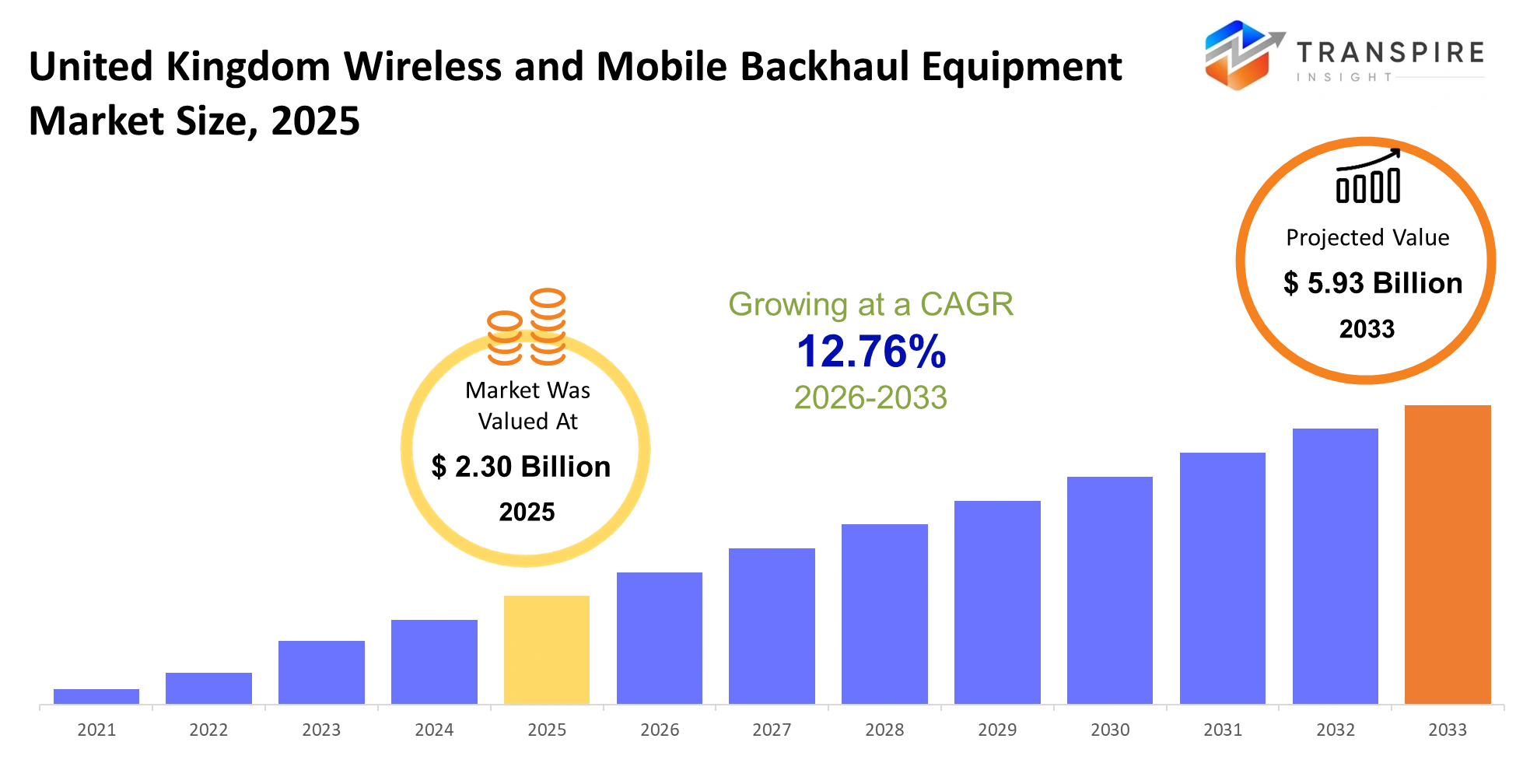
- United Kingdom Wireless and Mobile Backhaul Equipment Market Size 2025: USD 2.30 Billion
- United Kingdom Wireless and Mobile Backhaul Equipment Market Size 2033: USD 5.93 Billion
- United Kingdom Wireless and Mobile Backhaul Equipment Market CAGR: 12.76%
- United Kingdom Wireless and Mobile Backhaul Equipment Market Segments: By Equipment Type (Microwave Backhaul Equipment, Millimeter Wave Equipment, Small Cell Backhaul, Satellite Backhaul Systems, IP/MPLS Backhaul Systems, Others); By Technology (4G LTE Backhaul, 5G Backhaul, Cloud-native Backhaul, AI-enabled Backhaul, Software-defined Backhaul, Others); By Application (Telecom Networks, Enterprise Connectivity, Rural Connectivity, Smart Cities, Defense Communication, Others); By End User (Telecom Operators, ISPs, Enterprises, Government Agencies, Defense Organizations, Others); By Deployment (Indoor Deployment, Outdoor Deployment, Edge Deployment, Hybrid Deployment, Others).
To learn more about this report,  Download Free Sample Report
United Kingdom Wireless and Mobile Backhaul Equipment Market Summary
The United Kingdom Wireless and Mobile Backhaul Equipment Market was valued at USD 2.30 Billion in 2025. It is forecast to reach USD 5.93 Billion by 2033. That is a CAGR of 12.76% over the period.
In the United Kingdom, wireless and mobile backhaul gear keeps the mobile data moving around between base stations, fiber handoff points, and core systems, particularly in places where fiber rollout is slow, expensive, or straight-up impractical such as dense cities, major ports, offshore energy zones, and rural industrial corridors. In practice, it’s like an unseen transport layer that helps 4G and 5G services stay steady, including for logistics, factory automation, and maritime operations.
Over the last few years, the market has sort of drifted away from older microwave connections toward much higher capacity millimeter wave links and software-controlled backhaul, mostly as 5G standalone rollouts expand and networks get more densely built out. One big trigger was the supply chain disruption after geopolitical tensions connected to the Russia-Ukraine conflict, which then pushed carriers to diversify vendors, and speed up local sourcing across the UK and wider Europe. So now operators are putting money into adaptable, multi-band backhaul systems to cut reliance on one single transport path, boost resilience, and allow heavier edge traffic loads without as many hiccups.
Key Market Insights
- England, pretty much takes over the United Kingdom Wireless and Mobile Backhaul Equipment Market, with something like over 55% share because the urban telecom layers are dense plus there are enterprise hubs spread around.
- London is still the main revenue place for the United Kingdom Wireless and Mobile Backhaul Equipment Market, kept strong by hyperscale data traffic hunger.
- Microwave backhaul kind of leads the United Kingdom Wireless and Mobile Backhaul Equipment Market, it holds the biggest installed base across telecom tower networks , not a small thing.
- Millimeter-wave solutions are moving the quickest too, mainly from 5G ultra-low latency needs and the push for very high capacity data movement.
- Packet optical transport systems end up with the second-largest share, helping operators run hybrid fiber-wireless setups.
- Mobile operator networks are the ones actually using it most, they account for more than 60% share in the United Kingdom Wireless and Mobile Backhaul Equipment Market, in practice.
- Enterprise private 5G networks show the fastest growth, because manufacturing automation and smart logistics are being adopted more and more, slowly but surely.
- Maritime and offshore connectivity is also expanding rapidly, backing energy platforms and port digitalization programs.
- Telecom operators keep leading end-user demand with notable share, tied to ongoing 5G rollout plus network densification projects .
- Finally, industrial enterprises represent the fastest-growing end-user group, as Industry 4.0 keeps increasing reliance on wireless backhaul.
What are the Key Drivers, Restraints, and Opportunities in the United Kingdom Wireless and Mobile Backhaul Equipment Market?
The United Kingdom Wireless and Mobile Backhaul Equipment Market is mostly driven by faster 5G standalone deployment and those growing dense urban network expansions, like it’s kinda relentless. Operators are swapping out older microwave links with high-capacity millimeter-wave options plus fiber-integrated backhaul systems, so they can handle the rising data demand coming from cloud applications, IoT based industrial automation and low latency enterprise services. The whole shift really kicked in after spectrum availability reforms and the aggressive 5G rollout objectives that UK regulators set, it pushed telecom operators to upgrade their transport layers quicker than what they originally planned. As a result it has directly lengthened procurement cycles for advanced backhaul equipment, and also boosted recurring revenue from software defined networking upgrades and capacity scaling, over and over.
One notable restraint in this market is the expensive and kind of complicated move away from legacy microwave infrastructure, toward hybrid fiber-wireless architectures. A lot of rural and semi-urban zones still rely on older systems because fiber reach is limited, and geography can be a real headache. That kind of structural reality can slow down full scale modernization, which then causes uneven network performance and pushes back monetization of high speed 5G services, especially for industrial buyers located beyond the main metropolitan centers.
An important opportunity is starting to show up, via private 5G networks in industrial hubs and port areas like Felixstowe and Teesside. In these kinds of spaces, companies need dedicated, very reliable backhaul connections , which is pushing spending toward more adjustable millimeter wave and edge-tuned transport approaches. As organizations keep funding their own connectivity assets, the United Kingdom Wireless and Mobile Backhaul Equipment Market should gradually open up fresh, enterprise driven revenue streams , not just the usual earnings from traditional telecom operators.
What Has the Impact of Artificial Intelligence Been on the United Kingdom Wireless and Mobile Backhaul Equipment Market?
Artificial intelligence is increasingly embedded in the United Kingdom Wireless and Mobile Backhaul Equipment Market, where it gets used to automate network monitoring and tweak transport performance across microwave , millimeter-wave, and fiber-linked backhaul nodes. Telecom operators roll out AI-enabled self-organizing network systems (SON) to keep re-adjusting routing, capacity distribution, and link balancing, so the need for manual touch points drops in crowded 5G setups. This kind of automation tends to help operational steadiness in high-traffic corridors like London, and Birmingham, where backhaul congestion basically hits service quality, right away.
At the same time machine learning approaches are widely used for predictive maintenance of backhaul radios and antenna units. These models examine signal weakening trends, weather-related disruptions, and traffic oddities to anticipate equipment breakdowns before they happen. Many operators say network uptime climbs, and unplanned maintenance visits go down, which lowers operating costs. It also helps service-level commitments for enterprise customers who count on low-latency connectivity.
AI-based traffic forecasting, moreover, supports capacity planning by mapping bandwidth allocation to moment-to-moment demand bursts from cloud services and industrial IoT workloads. Still, adoption has one main sticking point: patchy data quality from older microwave infrastructure and remote rural sites limits how accurate the models can be. On top of that, integration issues with older hardware setups slow down a full rollout of AI , especially in hybrid backhaul settings where real-time telemetry is kind of incomplete.
Key Market Trends
- From 2020 to 2026, almost a third of UK operators sort of moved off legacy microwave and into millimeter-wave backhaul for more raw capacity, handling 5G traffic more effectively, and yeah it reshapes transport networks in practice.
- Since 2022, Ericsson and Nokia have been scaling up AI-led self-organizing network rollouts, which tends to cut down the manual backhaul tuning, and helps link utilization stay better across crowded urban 5G corridors.
- After 2022 geopolitical frictions, UK operators had to diversify backhaul vendors so they were less tied to a single provider, and this also sped up partnerships for European sourcing, for resilience reasons.
- From 2023, private 5G deployments grew across UK manufacturing and logistics, and that increased the appetite for dedicated wireless backhaul, supporting low latency industrial automation systems, rather tightly.
- Rural rollout delays still linger, because fiber deployment remains uneven, so operators keep leaning on microwave backhaul for remote coverage and tighter cost management.
- In 2024, operators more often combine edge computing with the backhaul infrastructure, which improves latency performance for cloud gaming, IoT, and enterprise services.
- Following UK limits on Huawei equipment starting in 2020, vendors like Cisco and NEC gained share within secure backhaul modernization efforts.
- Meanwhile, North Sea offshore energy projects are increasingly using wireless backhaul upgrades, to back remote monitoring and real time operational connectivity needs that do not really wait around.
United Kingdom Wireless and Mobile Backhaul Equipment Market Segmentation
By Equipment Type :
Microwave backhaul equipment still carries a lot of those legacy networks across rural and semi-urban zones, it sort of stays there because it does not require huge overhaul spending, and the performance stays pretty stable, overall.Millimeter wave equipment is also growing, mainly as 5G traffic keeps getting bigger in cities. In many cases operators lean into higher capacity links, this cuts congestion and helps with more real time data flow, generally.
Small cell backhaul meanwhile supports dense urban deployments where network points are nearer to each other, so the demand climbs as operators add more small cells to handle the incoming loads.IP/MPLS backhaul systems back up a more unified traffic routing approach over mixed networks. As adoption keeps increasing it gets easier to manage traffic and that strengthens service reliability for enterprise users too.
By Technology :
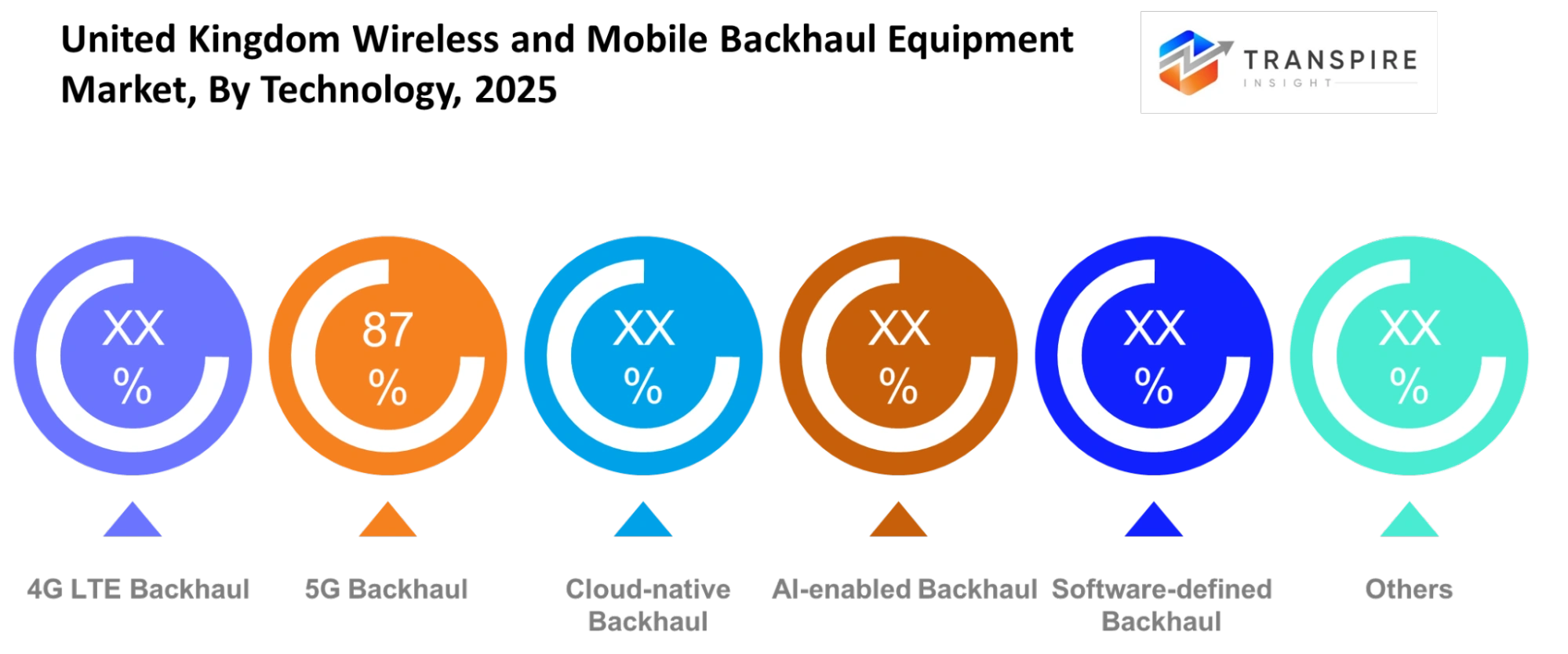
4G LTE backhaul still keeps working in lots of older networks ,and especially in those rural coverage zones. It delivers a kind of steady connectivity, even when 5G rollout is still limited or taking its time.5G backhaul adoption is climbing fast, as operators build out high speed networks. With more data flowing every day, they have to upgrade toward higher capacity and also reduce latency systems.
Cloud native backhaul helps teams scale things more flexibly, plus it allows faster service updates. Many operators move toward software based control ,so they can handle the rising traffic demand more efficiently, with less friction.AI enabled and software defined backhaul also improves routing choices and network control. These approaches cut down on manual work and make the system respond quicker when traffic spikes show up.
To learn more about this report, Download Free Sample Report
By Application :
Telecom networks stay the biggest application area as operators keep expanding mobile coverage, well basically always. Continuous upgrades help push faster data speeds, and of course better service quality, even when demand feels endless.Enterprise connectivity demand is also rising since companies rely more on steady digital communication systems for daily operations, cloud services, and these remote work setups that everyone is using more and more.
In rural regions connectivity still leans on hybrid systems because fiber rollout is limited. For that reason wireless backhaul gets used, to tie remote areas together without making the heavy infrastructure investment, and the timelines stay less painful. Then there are smart city projects, they raise the need for stable and fast communication links. These systems support traffic monitoring, public services and the growth of connected infrastructure, all at once kind of.
By End User :
Telecom operators lead adoption as they invest heavily in 5G rollout and network upgrades. Continuous infrastructure expansion drives steady equipment demand.
Internet service providers use backhaul systems to extend broadband coverage and improve service quality in both urban and semi-urban locations.
Enterprises increase usage for private networks supporting automation and cloud operations. Demand grows as industries rely more on real-time data exchange.
Government agencies and defense organizations adopt secure communication systems for critical operations, requiring stable and high-reliability backhaul networks.
By Deployment :
Indoor deployment works in controlled spaces like data centers and enterprise buildings. It provides steady connectivity for internal communication, and the services that run there, as well. Outdoor deployment is basically the one that dominates big scale mobile networks. The gear goes up on towers and rooftops, supporting broad area coverage and that user mobility thing too.
Edge deployment is growing because computing is pushed nearer to people. This cuts delay down, and boosts performance for real time applications, and services as well.Hybrid deployment mixes several setups together, to raise flexibility, reliability. Operators pick it to juggle cost, reach, and performance demands all at once.
What are the Key Use Cases Driving the United Kingdom Wireless and Mobile Backhaul Equipment Market?
Telecom operator network expansion is still kind of the main use case in the United Kingdom Wireless and Mobile Backhaul Equipment Market, and it keeps looking that way because the ongoing 5G rollout needs high-capacity connections between cell sites, the core layers and edge nodes too. The pressure feels the highest in city areas, where data traffic is really dense, and where people expect the service to stay reliable, even when things get busy or complicated.
Then, on the other hand, private enterprise networks and ISP-led broadband extensions are getting more attention as use cases. This is especially visible in manufacturing hubs and logistics corridors. Those customers really care about steady, low-latency links, so they can run automation systems, run cloud workloads, and keep real time data movement flowing across operations that are spread out, not just in one place.
More recently, the emerging demand is also building around smart infrastructure and offshore energy monitoring, because wireless backhaul helps with remote sensing, predictive maintenance, and general operational visibility. Meanwhile defense communication networks are also trialing secure backhaul setups that aim to boost mobility and resilience in mission-critical environments, where network stability matters more than usual.
|
Report Metrics |
Details |
|
Market size value in 2025 |
USD 2.30 Billion |
|
Market size value in 2026 |
USD 2.58 Billion |
|
Revenue forecast in 2033 |
USD 5.93 Billion |
|
Growth rate |
CAGR of 12.76% from 2026 to 2033 |
|
Base year |
2025 |
|
Historical data |
2021 - 2024 |
|
Forecast period |
2026 - 2033 |
|
Report coverage |
Revenue forecast, competitive landscape, growth factors, and trends |
|
Regional scope |
Middle East and Africa (Saudi Arabia, United Arab Emirates, South Africa, Rest of Middle East and Africa) |
|
Key company profiled |
Ericsson, Nokia, Huawei, Samsung Networks, ZTE Corporation, NEC Corporation, Ceragon Networks, Aviat Networks, Cisco Systems, Juniper Networks, Fujitsu, CommScope, Mavenir, Siklu Communication, Airspan Networks. |
|
Customization scope |
Free report customization (country, regional & segment scope). Avail customized purchase options to meet your exact research needs. |
|
Report Segmentation |
By Equipment Type (Microwave Backhaul Equipment, Millimeter Wave Equipment, Small Cell Backhaul, Satellite Backhaul Systems, IP/MPLS Backhaul Systems, Others); By Technology (4G LTE Backhaul, 5G Backhaul, Cloud-native Backhaul, AI-enabled Backhaul, Software-defined Backhaul, Others); By Application (Telecom Networks, Enterprise Connectivity, Rural Connectivity, Smart Cities, Defense Communication, Others); By End User (Telecom Operators, ISPs, Enterprises, Government Agencies, Defense Organizations, Others); By Deployment (Indoor Deployment, Outdoor Deployment, Edge Deployment, Hybrid Deployment, Others). |
Which Regions are Driving the United Kingdom Wireless and Mobile Backhaul Equipment Market Growth?
England sits at the top of the United Kingdom Wireless and Mobile Backhaul Equipment Market, mostly because of its dense telecom fabric and the way data traffic hubs cluster in places like London, Manchester and Birmingham. You can sort of see the advantage early on, since the region follows pretty aggressive 5G rollout approaches, with help from national spectrum planning and quick network densification efforts. Big data centers, financial services networks, and transport routes keep generating nonstop requirements for high capacity backhaul systems. On top of that, a fairly mature mix of telecom operators , tower infrastructure providers, and equipment vendors adds extra weight to its leading position.
Scotland also moves along in a steady way, supported by regular funding for nationwide broadband expansion and enterprise connectivity initiatives. Compared with England, Scotland’s trajectory is less about city congestion and more about preserving dependable coverage for scattered populations and difficult terrain. Connectivity in the energy slice, especially around oil gas and renewable undertakings, keeps demand steady for resilient backhaul systems. There are also public sector backed infrastructure drives, which makes upgrades feel more predictable and keeps long-term network stability in place.
Scotland, though, is showing the fastest growth momentum lately. This is tied to expansions in offshore wind farms and rural 5G connectivity programs that ramp up recently. Government-led digital inclusion policies, plus private capital directed toward remote industrial sites, has helped accelerate deployment of wireless backhaul links. As coastal areas and the highland regions get upgraded, some old connectivity gaps are shrinking, and new industrial applications are starting to appear. For market entrants and investors, this shift points toward wider openings in hybrid backhaul options and ruggedized network equipment during the 2026–2033 period.
Who are the Key Players in the United Kingdom Wireless and Mobile Backhaul Equipment Market and How Do They Compete?
Competition in the United Kingdom wireless and mobile backhaul equipment market is only kind of consolidated, like there is a short list of global telecom infrastructure vendors that pretty much set the pace. The bigger incumbents try to hold on to their share with advanced 5G transport capabilities and tightly integrated software-defined networking, and honestly it feels like they lean on those more than pure pricing. The battle is mostly about network performance, lower latency, better spectrum efficiency, and end-to-end service reliability , not “who’s cheaper”. Also there are big capital needs and very strict security certifications, so it’s hard for new entrants to really show up , meaning the barriers stay structurally high.
Ericsson runs a more technology-led approach , centered on AI-driven self-organizing networks and very high-capacity millimeter-wave backhaul systems. They differentiate by doing deep integration between software-defined transport and radio access networks, which helps with real-time traffic steering in dense urban setups. Growth keeps moving via long-term partnerships with UK operators and upgrades to 5G standalone infrastructure, especially as edge computing demand keeps increasing.
Nokia tends to emphasize scalable IP/MPLS and optical backhaul systems that can support resilient hybrid fiber wireless networks, in a practical kind of way. Cisco Systems highlights secure software-defined networking , combining backhaul visibility with cloud-managed routing platforms. NEC Corporation leans into private 5G plus mission-critical backhaul systems for enterprise and defense segments, more tailored than general. And Huawei is still somewhat constrained in the United Kingdom because regulatory restrictions curb new deployment opportunities, so the demand shifts toward alternative vendors in those cases.
Company List
- Ericsson
- Nokia
- Huawei
- Samsung Networks
- ZTE Corporation
- NEC Corporation
- Ceragon Networks
- Aviat Networks
- Cisco Systems
- Juniper Networks
- Fujitsu
- CommScope
- Mavenir
- Siklu Communication
- Airspan Networks
Recent Development News
In October 2025, Virgin Media O2 entered a partnership with SpaceX Starlink. The collaboration integrates Starlink’s Direct-to-Cell satellite system with Virgin Media O2’s UK mobile network to improve backhaul connectivity and eliminate rural coverage gaps, enhancing resilience and extending mobile network reach in hard-to-serve UK areas.
Source: https://www.techradar.com/
In April 2026, Tracxn reported increased startup activity and investment momentum in wireless backhaul equipment companies operating across Europe, including the UK market. The report highlights growing funding and strategic interest in next-generation backhaul technologies supporting 5G densification and low-latency mobile infrastructure expansion.
Source: https://tracxn.com/
What Strategic Insights Define the Future of the United Kingdom Wireless and Mobile Backhaul Equipment Market?
The United Kingdom Wireless and Mobile Backhaul Equipment Market is sort of steadily moving toward fully software-defined, higher-capacity transport networks where backhaul tasks are now more and more blended with edge computing , and 5G standalone cores. This change is being pushed by ongoing data traffic growth from industrial automation, cloud workloads, plus latency-sensitive business applications , so operators tend to favor flexible, adaptive transport layers over the older, fixed legacy designs.
There’s also a less obvious risk, a growing reliance on a limited group of advanced semiconductor and RF component suppliers. If anything goes wrong in those upstream supply chains it can end up slowing deployment schedules for millimeter-wave and AI-enabled backhaul systems, even if the demand stays strong. In other words, this limitation is frequently underplayed in the more optimistic, headline style growth assumptions.
Meanwhile there’s a real opening showing up in private 5G backhaul for logistics hubs, offshore energy operations, and smart port ecosystems like the Felixstowe expansion zones. In these places , funding is starting to shift toward building dedicated connectivity infrastructure , rather than depending purely on public telecom networks.
For market players, the smart direction is to focus on modular, vendor-agnostic backhaul platforms that can slot in quickly within hybrid and private network setups, so the solution keeps relevance across the UK as deployment patterns keep evolving.
United Kingdom Wireless and Mobile Backhaul Equipment Market Report Segmentation
By Equipment Type
- Microwave Backhaul Equipment
- Millimeter Wave Equipment
- Small Cell Backhaul
- Satellite Backhaul Systems
- IP/MPLS Backhaul Systems
By Technology
- 4G LTE Backhaul
- 5G Backhaul
- Cloud-native Backhaul
- AI-enabled Backhaul
- Software-defined Backhaul
By Application
- Telecom Networks
- Enterprise Connectivity
- Rural Connectivity
- Smart Cities
- Defense Communication
By End User
- Telecom Operators
- ISPs
- Enterprises
- Government Agencies
- Defense Organizations
By Deployment
- Indoor Deployment
- Outdoor Deployment
- Edge Deployment
- Hybrid Deployment
Frequently Asked Questions
Find quick answers to common questions.
The United Kingdom Wireless and Mobile Backhaul Equipment Market size is USD 5.93 Billion in 2033.
Key segments for the United Kingdom Wireless and Mobile Backhaul Equipment Market are By Equipment Type (Microwave Backhaul Equipment, Millimeter Wave Equipment, Small Cell Backhaul, Satellite Backhaul Systems, IP/MPLS Backhaul Systems, Others); By Technology (4G LTE Backhaul, 5G Backhaul, Cloud-native Backhaul, AI-enabled Backhaul, Software-defined Backhaul, Others); By Application (Telecom Networks, Enterprise Connectivity, Rural Connectivity, Smart Cities, Defense Communication, Others); By End User (Telecom Operators, ISPs, Enterprises, Government Agencies, Defense Organizations, Others); By Deployment (Indoor Deployment, Outdoor Deployment, Edge Deployment, Hybrid Deployment, Others).
Major United Kingdom Wireless and Mobile Backhaul Equipment Market players are Ericsson, Nokia, Huawei, Samsung Networks, ZTE Corporation, NEC Corporation, Ceragon Networks, Aviat Networks, Cisco Systems, Juniper Networks, Fujitsu, CommScope, Mavenir, Siklu Communication, Airspan Networks.
The United Kingdom Wireless and Mobile Backhaul Equipment Market size is USD 2.30 Billion in 2025.
The United Kingdom Wireless and Mobile Backhaul Equipment Market CAGR is 12.76% from 2026 to 2033.
- Ericsson
- Nokia
- Huawei
- Samsung Networks
- ZTE Corporation
- NEC Corporation
- Ceragon Networks
- Aviat Networks
- Cisco Systems
- Juniper Networks
- Fujitsu
- CommScope
- Mavenir
- Siklu Communication
- Airspan Networks
About the Authors

Mayur Shinde
I am Mayur Shinde, a Senior Research Analyst at Transpire Insight, specializing in the Automotive & Transportation and Information & Communication Technology (ICT) Industry. My work focuses on analyzing emerging market trends, technological advancements, competitive landscapes, and industry developments to deliver accurate, data-driven insights. I am passionate about transforming complex market information into clear, actionable content that helps businesses, professionals, and decision-makers stay informed and make confident strategic decisions.

Chakradhar Khansole
Chakradhar serves as the Research Director at Transpire Insight, bringing over 8 years of experience in technology, innovation, and strategic market intelligence. He specializes in transforming complex market data into actionable business insights that enable organizations to make informed, growth-oriented decisions. Recognized for his strategic vision and analytical expertise, Chakradhar leads high-impact research initiatives, delivering comprehensive market assessments, competitive intelligence, and forward-looking industry analysis.
Recently Published Reports
-
Apr 2026
3D Optical Profiler Market
3D Optical Profiler Market Size, Share & Analysis Report By Type (Desktop 3D Optical Profiler, and Portable 3D Optical Profiler), By Technology (Confocal Technology, and White Light Interference), By End-Use Industry (Manufacturing, Research Institutions, Automotive, Aerospace and Defense, Medical Devices, and Other), and Geography (North America, Europe, Asia-Pacific, Middle East and Africa, South and Central America), 2021 - 2031
-
Apr 2026
Depth Sensor Market
Depth Sensor Market Size, Share & Analysis Report By Type (Infrared Depth Sensors, Time-of-Flight (ToF) Sensors, Stereo Vision Sensors, Structured Light Sensors, Ultrasonic Depth Sensors), By Application (Automotive, Robotics, Gaming, Consumer Electronics, Industrial Automation, Healthcare, Security & Surveillance, Others), By End Users (Automotive Manufacturers, Consumer Electronics Companies, Healthcare Providers, Industrial Companies, Security Agencies, Gaming Companies, Robotics Companies, Others), and Geography (North America, Europe, Asia-Pacific, Middle East and Africa, South and Central America), 2021 – 2031
-
Apr 2026
Digital Manufacturing Market
Digital Manufacturing Market Size, Share & Analysis Report By Component (Hardware, Software, and Services), By Technology (Robotics, 3D Printing, Internet of Things (IoT), and Others), By Application (Automotive and Transportation, Aerospace and Defense, Consumer Electronics, Industrial Machinery, and Others), By Process Type (Computer-Based Designing, Computer-Based Simulation, Computer 3D Visualization, Analytics, and Others), and Geography (North America, Europe, Asia-Pacific, Middle East and Africa, South and Central America), 2021 – 2031
-
Apr 2026
Digital Visa Services Market
Digital Visa Services Market Size, Share & Analysis Report By Type (Individual Travelers, Group Travelers), By Application (Tourism, Business Travel, Others), and Geography (North America, Europe, Asia-Pacific, Middle East and Africa, South and Central America), 2021 – 2031