
France Telecom Services Market Size & Forecast:
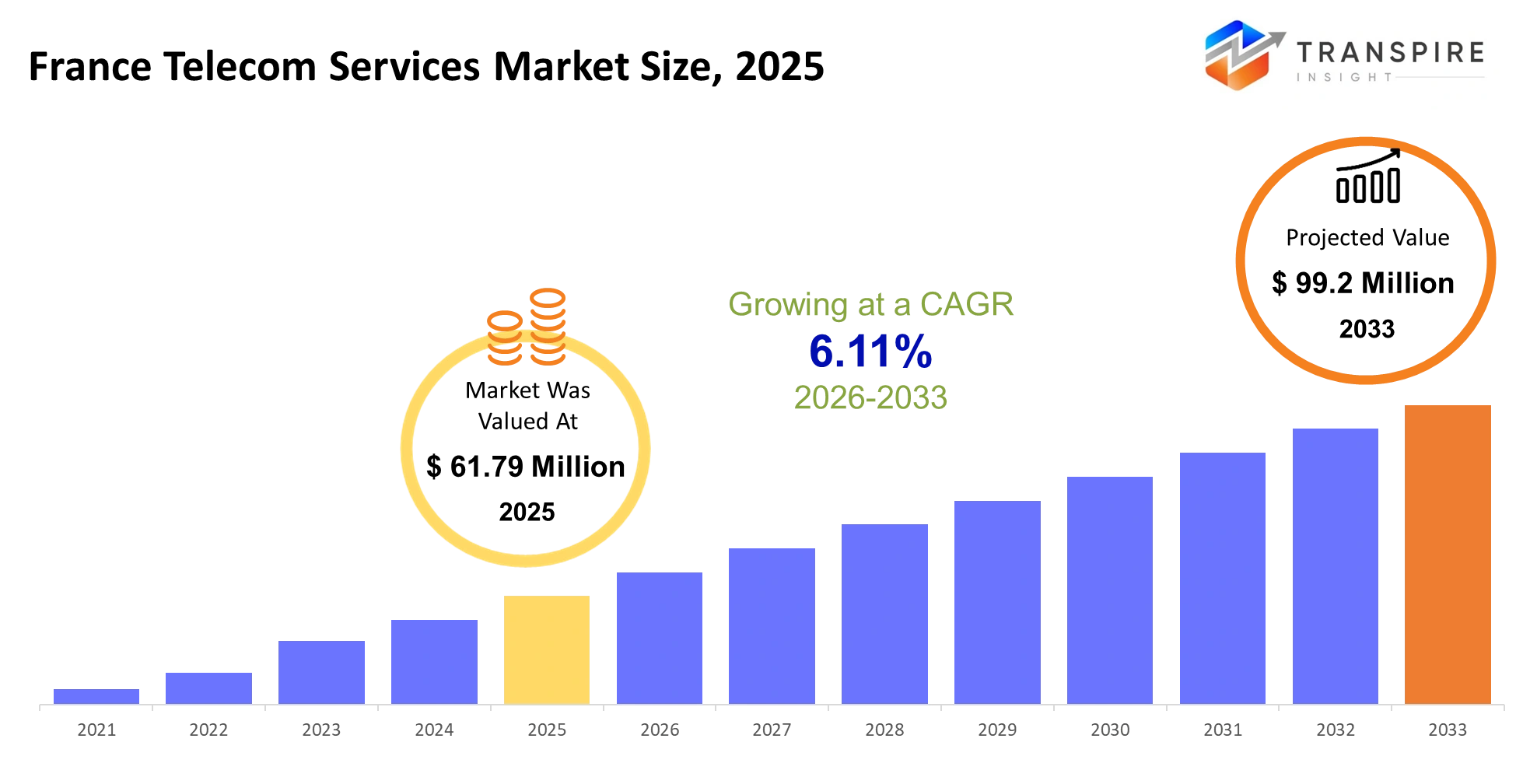
- France Telecom Services Market Size 2025: USD 61.79 Million
- France Telecom Services Market Size 2033: USD 99.2 Million
- France Telecom Services Market CAGR: 6.11%
- France Telecom Services Market Segments: By Type (Wireless Services, Wireline Services, Internet Services, Satellite Services, Others); By Application (Consumer Communication, Enterprise Solutions, Data Services, IoT Connectivity, Cloud Communication, Network Security, Others); By End-User (Individuals, Enterprises, SMEs, Government, IT & Telecom Companies, Media Companies, Others); By Service (Voice, Data, Video, Messaging, Value-added Services, Others).
To learn more about this report,  Download Free Sample Report
France Telecom Services Market Summary
The France Telecom Services Market was valued at USD 61.79 Million in 2025. It is forecast to reach USD 99.2 Million by 2033. That is a CAGR of 6.11% over the period.
The France telecom services market kind of acts like the backbone of the country’s digital economy , because it keeps mobile connectivity running, makes broadband access possible, supports enterprise communication, backs up cloud networking, and carries data transmission across basically all industries. Telecom operators sustain a lot of critical work for manufacturing plants, financial institutions, healthcare systems, transport networks and also for public administration by maintaining secure, fast communication infrastructure. In the last five years, things moved away from traditional voice-first revenue frameworks , toward more data heavy digital ecosystems , mainly due to 5G rollouts, fiber-optic reach widening, and enterprise cloud integration .
This change really sped up after the COVID-19 pandemic, which sort of locked in higher remote work habits, boosted video streaming traffic, and increased how much enterprises depend on digital collaboration tools. As companies updated their day to day operations, telecom providers kept putting more money into low latency networks, cybersecurity services, and edge computing capabilities. So, the outcome is stronger enterprise spending on managed connectivity solutions , plus ongoing recurring revenues connected to high bandwidth applications, industrial automation, and smart infrastructure projects across France.
Key Market Insights
- The France Telecom Services market, sort of reached USD 61.79 million in 2025, and it is projected to get close to USD 99.2 million by 2033, like in a steady ramp-up.
- In 2025, Northern and urban areas held the biggest slice at nearly 48% market share, mainly because dense enterprise connectivity infrastructure showed up, and fiber penetration was simply higher.
- Meanwhile Western France is now coming up as the fastest growing regional telecom hub, driven by faster rural broadband rollout and government-supported digital inclusion programs, which kind of keeps momentum.
- On the services side, mobile telecom services stayed in the lead during 2025 as 5G subscriptions kept expanding across enterprise and consumer communication networks.
- Broadband plus fiber-optic offerings took the second-largest segment, since nationwide FTTH infrastructure modernization kept rolling forward since 2021.
- Managed enterprise communication solutions are expected to be the fastest mover through 2033, because many industries are adopting cloud-native operational platforms and related tools.
- For applications, enterprise applications made up more than 55% share in 2025, with financial services, manufacturing, and logistics ramping up digital transformation budgets.
- Smart industrial connectivity, and IoT-enabled automation, became the fastest-growing application group right after large scale Industry 4.0 implementation programs started scaling.
- Looking at end users, large enterprises remained the dominant segment, but SMEs were the ones increasing telecom spending quickly, especially for cybersecurity and hybrid workplace connectivity solutions.
- Key companies like Orange S.A., SFR, Bouygues Telecom, Free Mobile, Ericsson, and Nokia strengthened their competitive position via 5G infrastructure partnerships and AI based network optimization.
- Also, telecom operators moved more often toward Open RAN architecture and edge computing collaborations between 2023 and 2025 , aiming to lower operational costs and improve network flexibility, overall.
What are the Key Drivers, Restraints, and Opportunities in the France Telecom Services Market?
The main growth driver in the France telecom services industry is this nationwide move toward high-capacity digital infrastructure, backed by fairly aggressive fiber optical and 5G rollout programs, you know. Government-supported digital modernization policies along with enterprise cloud migration strategies basically pushed telecom operators to extend low-latency connectivity networks across both commercial sites and industrial zones. Manufacturing companies, logistics providers, and financial institutions now rely more often on real time data exchange, which in turn boosts enterprise spending for managed network services, extra cybersecurity layers, and also dedicated cloud connectivity contracts. Because of that, service providers see stronger recurring service revenues while adoption of newer communication platforms gets accelerated.
The biggest restraint still sounds simple but it is expensive, meaning the high capital expenditure needed for nationwide 5G and fiber deployment. Telecom operators keep getting squeezed by infrastructure upkeep costs, spectrum licensing expenses, and the constant push for network densification. Expanding in rural areas also stays commercially tricky because the subscriber density is lower, so return on investment periods get stretched out. All those things delay infrastructure expansion in less served regions, and they mute short-term profitability even when the long-term demand looks strong.
A major future opportunity is industrial private 5G networks plus edge computing services. French manufacturers are spending more into smart factory ecosystems where ultra-low latency communication supports robotics, predictive maintenance, and automated production systems. Telecom providers that can tie in private wireless infrastructure with cloud-based industrial analytics platforms could open up a meaningful new
What Has the Impact of Artificial Intelligence Been on the France Telecom Services Market?
Artificial intelligence has sort of reshaped the France telecom services space, mainly by boosting network automation , predictive maintenance abilities, and making enterprise service management feel more efficient, in practice. Telecom operators now more often rely on AI-driven analytics platforms to keep an eye on traffic loads and decide on bandwidth allocation, plus they automate fault detection across fiber and 5G infrastructure. With those kinds of tools, network congestion tends to go down, and service continuity holds up better when data consumption jumps. Machine learning methods also help with predictive maintenance by spotting early equipment degradation signals in base stations, routers, and transmission setups, before failures show up. As a result , unexpected downtime is reduced, and infrastructure repair costs also fall.
On top of that, advanced digital technologies improved customer service operations, using AI-powered virtual assistants, automated billing management, and ongoing real-time monitoring of cybersecurity threats. Telecom providers that roll out intelligent traffic-routing systems have reported measurable gains in latency handling, and energy efficiency across communication networks that are heavy on data. In enterprise settings, AI-enabled network orchestration platforms can help with cloud connectivity improvements, and also support IoT device supervision for industrial customers.
Still, AI adoption has some practical limits. Bringing AI into older telecom infrastructure often asks for major investment and also complex interoperability tuning, not just a simple upgrade. A lot of operators also deal with operational data that is too fragmented, so predictive accuracy can drop, and real-time network automation models become less effective.
Key Market Trends
- France kinda accelerated the countrywide FTTH roll out after 2021, and it did help a lot with broadband access across suburban plus semi rural business groupings.
- Telecom operators then shifted where they put money, from voice style services toward high margin enterprise cloud networking, and also cybersecurity oriented managed communication type offerings, which kind of changed the whole focus.
- Meanwhile 5G enterprise adoption really took off between 2023 and 2025 , since manufacturers went for low latency industrial automation plus smart factory use cases.
- Orange S.A. also pushed more AI based network traffic tuning investments, aiming to boost service steadiness and lower the day to day infrastructure operating spend.
- After 2023 , Open RAN started gaining momentum as telecom providers looked for more flexible, and frankly cost efficient network design approaches.
- At the same time, French businesses more and more paired telecom connectivity with edge computing services, to enable real time analytics plus IoT enabled industrial operations without too much delay.
- Between 2022 and 2025, telecom firms strengthened their strategic ties with cloud providers, so they could broaden hybrid workplace communication solutions.
- And on the security side, telecom services that are more cybersecurity focused saw stronger take up after several European ransomware incidents, which exposed weaknesses in enterprise communication infrastructure.
- On the consumer side, people started leaning more toward unlimited mobile data packages. Streaming platforms kept growing, plus remote collaboration apps, together they drove bandwidth demand quite a bit.
- Lastly, infrastructure sharing agreements among telecom operators expanded over the last years, as partners tried to ease capex pressure connected to nationwide 5G buildouts.
France Telecom Services Market Segmentation
By Type
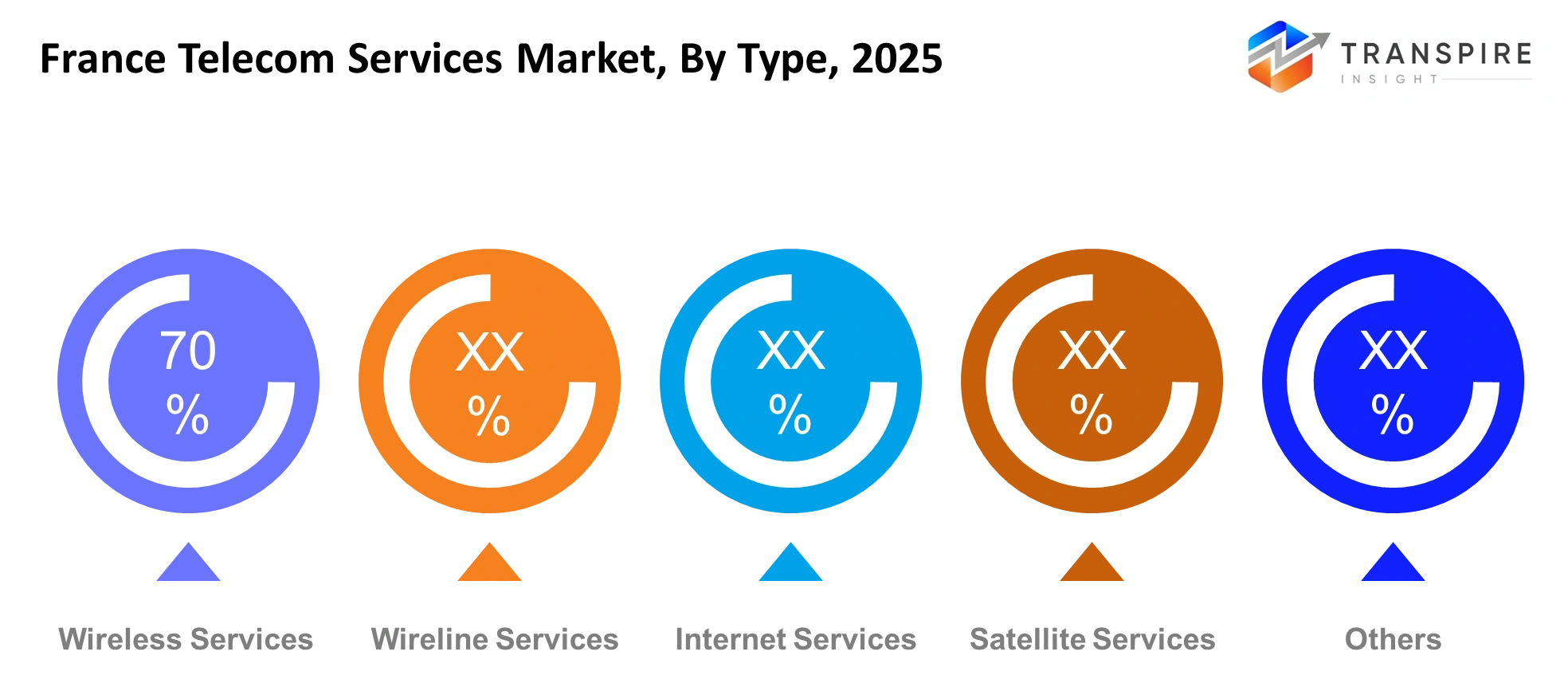
Wireless services still hold the dominant market position, mostly because mobile connectivity keeps being at the center of enterprise communication, streaming consumption, and the day to day digital business operations across France. Smartphone adoption is strong, nationwide 5G rollout programs keep moving, and more enterprise teams rely on low latency communication networks, so segment expansion stays on track. Transportation, manufacturing, and financial institutions are deploying wireless infrastructure more and more, to coordinate a mobile workforce, while also enabling industrial automation systems. Telecom operators keep putting money into wireless investments, because subscription based mobile data plans produce a fairly steady kind of recurring revenue stream, and that matters.
Wireline services continue to keep a substantial market share, mainly due to how enterprises lean on fiber optic infrastructure for secure and high capacity data transmission. Big enterprises, government institutions, and cloud service operators depend on fixed broadband networks in order to run mission critical digital operations, and also to maintain cybersecurity sensitive environments. Internet services keep their rapid growth momentum, since households and enterprises increasingly consume cloud applications, video streaming platforms, and hybrid workplace collaboration tools. Satellite services remain smaller, but they are still strategically important, because remote connectivity requirements are expanding, plus there are maritime communication projects, and emergency network resilience initiatives. Others , including integrated communication and managed connectivity solutions , keep drawing investment too, as telecom providers diversify their enterprise service portfolio, and it’s all slowly becoming a more blended mix.
To learn more about this report, Download Free Sample Report
By Application
Consumer communication stays the leading application segment, and it kind of makes sense because mobile voice, messaging, streaming, and broadband connectivity services keep bringing in the largest subscriber numbers. People rely on mobile apps each day, video conferencing platforms too, and the digital entertainment ecosystem, so network traffic still climbs more or less steadily across telecom networks. Telecom providers also bundle entertainment subscriptions, cloud storage, and cybersecurity features into consumer communication packages, in order to keep customers longer, maybe longer than the usual. Meanwhile the continuous rollout of 5G infrastructure improves service quality, and, somehow, it also reshapes mobile data consumption patterns.
For enterprise solutions it maintains strong market positioning, largely because businesses keep asking for secure cloud networking, remote collaboration systems, and managed communication platforms. Data services keep expanding, especially as financial institutions, healthcare systems, and logistics providers handle big operational datasets using high capacity digital infrastructure. IoT connectivity is picking up speed through smart manufacturing, fleet monitoring, and connected infrastructure deployments across industrial sectors. Cloud communication services still draw investment, since hybrid work models and enterprise digital transformation programs depend a lot on scalable communication ecosystems. Network security applications see faster growth as ransomware attacks keep showing up, and data protection regulations push higher enterprise cybersecurity spending. Other areas, like smart city communication systems and AI driven customer engagement platforms, keep emerging in specialized commercial environments.
By End-User
Individuals still end up being the biggest end-user slice, mostly because households keep on consuming quite a lot of mobile data, broadband streaming, and digital communication services. Basically, with smartphones now being everywhere, people rely on streaming platforms , online gaming, and remote communication applications, which keeps subscriber activity pretty high within consumer networks. Telecom providers are also leaning harder into more individualized mobile plans, bundled entertainment options, and faster fiber subscriptions , just to keep customers from hopping away. At the same time, steady consumer pull helps justify long-term spending for nationwide 5G rollouts and broader broadband infrastructure build-outs.
Enterprises hold a solid market standing, driven by the rising need for cloud connectivity, cybersecurity frameworks, and managed communication systems. Small and medium-sized businesses tend to adopt digital teamwork tools, plus managed broadband services , since cloud solutions are becoming more reachable and a bit less expensive across regional areas. Government bodies continue to invest in secure communication infrastructure too, in order to keep digital public services stable , improve emergency response coordination, and push administrative modernization. IT and telecom firms also generate a lot of network traffic via cloud computing, data center operations and software delivery platforms. Media companies keep increasing their telecom budgets because streaming services and digital advertising platforms need high-bandwidth content distribution, kind of non-stop. And then there are others, like healthcare and education, which are gradually expanding their telecom usage through remote learning efforts and telemedicine platforms.
By Service
Data services sort of dominate the market, because enterprises plus consumers depend more and more on cloud applications, streaming ecosystems, and those high-capacity digital communication platforms, yeah. Video streaming, industrial IoT systems, and enterprise cloud computing environments keep pushing sustained growth in network traffic, across fixed as well as mobile infrastructure, basically. Telecom operators lean into data-centric pricing approaches and spend on modernization, because bandwidth usage, directly shapes recurring service revenues. Also the expansion of fiber-optic infrastructure along with nationwide 5G rollouts ends up reinforcing the long-term appetite for fast data transmission services.
Voice services still keep a pretty steady relevance even while migration continues toward internet-based communication tools and mobile messaging ecosystems. Video services keep showing strong momentum, since hybrid work setups, virtual collaboration platforms, and digital entertainment consumption keep changing the way people communicate. Messaging services also stay broadly used across enterprise authentication systems, customer engagement platforms, and mobile communication networks. Value-added services continue to expand through cybersecurity packages, cloud storage subscriptions, AI-driven customer support, and enterprise mobility solutions. Other offerings, like integrated digital communication ecosystems and managed connectivity services, are also increasingly helping with complicated enterprise operational settings. In the forecast period, video and value-added services are expected to pull in stronger investment activity, as telecom operators move toward service diversification and higher-margin digital business models.
What are the Key Use Cases Driving the France Telecom Services Market?
Enterprise connectivity still ends up being the main, kind of driving force behind the France telecom services market, especially for financial institutions, manufacturing facilities, retail chains, and public sector organizations. In practice, these customers lean on fast fiber networks , secure cloud communication, and low latency mobile infrastructure, so they can handle real time operations, digital payments, remote teamwork, and those cybersecurity sensitive workloads. This particular use case also brings in the biggest share of revenue, because telecom contracts are more and more often bundling connectivity with managed IT and data protection, then locking it into longer enterprise agreements.
In nearby areas, the applications are getting wider traction too, like logistics, transportation, and healthcare systems. Logistics operators use IoT enabled telecom networks for fleet monitoring and warehouse automation , and hospitals increasingly depend on secure mobile data delivery plus telemedicine platforms. Even small and medium-sized enterprises are taking up managed communication services, to back hybrid work setups and cloud based operations.
Looking forward, newer directions are showing up, including private 5G industrial networks and satellite assisted mobile connectivity. French manufacturers are testing ultra low latency communication setups for robotics , as well as predictive maintenance. At the same time, telecom providers are exploring direct to device satellite connectivity, for remote coverage resilience and also emergency connectivity scenarios.
|
Report Metrics |
Details |
|
Market size value in 2025 |
USD 61.79 Million |
|
Market size value in 2026 |
USD 65.5 Million |
|
Revenue forecast in 2033 |
USD 99.2 Million |
|
Growth rate |
CAGR of 6.11% from 2026 to 2033 |
|
Base year |
2025 |
|
Historical data |
2021 - 2024 |
|
Forecast period |
2026 - 2033 |
|
Report coverage |
Revenue forecast, competitive landscape, growth factors, and trends |
|
Regional scope |
United States; Canada; Mexico; United Kingdom; Germany; France; Italy; Spain; Denmark; Sweden; Norway; China; Japan; India; Australia; South Korea; Thailand; Brazil; Argentina; South Africa; Saudi Arabia; United Arab Emirates |
|
Key company profiled |
Orange, SFR, Bouygues Telecom, Free, Vodafone, Telefonica, BT Group, AT&T, Verizon, Deutsche Telekom, Telenor, Telstra, Airtel, Reliance Jio, NTT. |
|
Customization scope |
Free report customization (country, regional & segment scope). Avail customized purchase options to meet your exact research needs. |
|
Report Segmentation |
By Type (Wireless Services, Wireline Services, Internet Services, Satellite Services, Others); By Application (Consumer Communication, Enterprise Solutions, Data Services, IoT Connectivity, Cloud Communication, Network Security, Others); By End-User (Individuals, Enterprises, SMEs, Government, IT & Telecom Companies, Media Companies, Others); By Service (Voice, Data, Video, Messaging, Value-added Services, Others). |
Which Regions are Driving the France Telecom Services Market Growth?
The Île-de-France region keeps on being the main contributor to France telecom services revenue, mainly because it gathers the country’s biggest enterprise customer base, hyperscale data centers and financial institutions. Paris does sort of act as a central hub, for cloud infrastructure rollouts , enterprise cybersecurity services, and those advanced 5G testing programs. Also, regulatory backing for digital modernization plus smart city infrastructure helps boost regional investment tempo. And in practice the ecosystem is helped by dense fiber coverage, solid purchasing power, and a steady need for high-capacity communication networks aimed at enterprises.
Auvergne-Rhône-Alpes remains a stable and strategically relevant telecom services region, because its industrial and manufacturing economy is quite strong. Different from Paris, the growth rhythm here relies less on corporate headquarters, and more on industrial digitalization, logistics infrastructure, and the way regional businesses stay connected. In places like Lyon, manufacturing firms increasingly put in IoT-activated operational systems, which means they need reliable fiber as well as low-latency wireless networks. With ongoing regional spending on industrial automation and transport infrastructure, telecom budgets tend to become long-term and predictable, somehow.
Western France is now showing up as the fastest-growing telecom services region, since broadband buildouts keep speeding up access in less served suburban and rural zones. Public funding schemes together with private fiber programs improved digital availability between 2023 and 2026, especially for SMEs and regional public organizations. Telecom operators also pushed 5G deployment along logistics routes and across coastal commercial areas, to support smart transportation plus connected infrastructure services.
Who are the Key Players in the France Telecom Services Market and How Do They Compete?
The France telecom services market stays, moderately consolidated… like, the established operators hold most of the nationwide network infrastructure, yet they still compete quite intensely on service quality, fiber footprint, enterprise solutions, and pricing flexibility, even when it feels slightly redundant at times. Lately the real competition is moving toward technology capabilities, not just traditional voice tariffs, especially around enterprise cloud networking, cybersecurity integration, and AI-driven network stewardship. Incumbents keep trying to defend their market share through infrastructure investments and strategic partnerships. Meanwhile, digital-native challengers push on pricing structures and they also speed up the innovation cycles, again and again.
Orange S.A. sets itself apart with broad fiber infrastructure, strong enterprise cybersecurity capacities, and large-scale AI-enabled network optimization programs. It also extended its positioning via collaborations with firms such as Tech Mahindra and AST SpaceMobile, aiming to reinforce enterprise automation and satellite based connectivity offerings. Bouygues Telecom, on the other hand, leans on infrastructure-sharing mechanisms and focused 5G deployment in dense urban zones as well as industrial regions. This helps the company improve network efficiency while also keeping capital expenditure more controlled.
Free continues, in a sense, competing through aggressive pricing and simplified digital service models, which pull in cost-sensitive mobile and broadband customers. SFR previously leaned heavily on converged broadband and media propositions, before it even entered acquisition discussions with competitors in 2026.
Company List
- Orange
- SFR
- Bouygues Telecom
- Free
- Vodafone
- Telefonica
- BT Group
- AT&T
- Verizon
- Deutsche Telekom
- Telenor
- Telstra
- Airtel
- Reliance Jio
- NTT
Recent Development News
In April 2026, Orange S.A. and ZEBOX announced a strategic partnership to accelerate deployment of scalable telecom and digital innovation solutions. The collaboration strengthens startup-driven enterprise transformation and expands Orange’s open innovation ecosystem across industrial sectors.
Source: http://newsroom.orange.com
In March 2026, Orange S.A. partnered with AST SpaceMobile and Satellite Connect Europe to expand direct-to-device satellite connectivity services. The agreement supports voice, SMS, and mobile data coverage in remote regions while improving network resilience across European markets.
Source: http://newsroom.orange.com
What Strategic Insights Define the Future of the France Telecom Services Market?
The France telecom services market is sort of structurally moving, toward AI-native , software-defined connectivity ecosystems where telecom operators function less as pure bandwidth providers and more like integrated digital infrastructure partners. The underlying push behind this shift is enterprise dependence on real-time cloud computing, cybersecurity protection, industrial automation, and edge-based analytics. Over the next five to seven years, value creation will increasingly come from managed digital services layered on top of fiber and 5G infrastructure rather than from traditional connectivity alone.
One hidden risk is the growing concentration of network ownership and infrastructure control among a smaller group of operators, especially if consolidation activity speeds up. Less competition could end up slowing pricing innovation and it might also create regulatory pressure around market fairness and investment allocation. At the same time, private 5G industrial ecosystems are a major up-and-coming opportunity, most notably within French manufacturing and logistics corridors adopting Industry 4.0 technologies.
Market participants should put an emphasis on partnerships with AI, cloud, and industrial automation providers rather than trying to compete only on network scale, because future profitability will rely on ecosystem integration and enterprise service depth.
France Telecom Services Market Report Segmentation
By Type
- Wireless Services
- Wireline Services
- Internet Services
- Satellite Services
- Others
By Application
- Consumer Communication
- Enterprise Solutions
- Data Services
- IoT Connectivity
- Cloud Communication
- Network Security
- Others
By End-User
- Individuals
- Enterprises
- SMEs
- Government
- IT & Telecom Companies
- Media Companies
- Others
By Service
- Voice
- Data
- Video
- Messaging
- Value-added Services
- Others
Frequently Asked Questions
Find quick answers to common questions.
The approximate France Telecom Services Market size for the market will be USD 99.2 Million in 2033.
Key segments for the France Telecom Services Market are By Type (Wireless Services, Wireline Services, Internet Services, Satellite Services, Others); By Application (Consumer Communication, Enterprise Solutions, Data Services, IoT Connectivity, Cloud Communication, Network Security, Others); By End-User (Individuals, Enterprises, SMEs, Government, IT & Telecom Companies, Media Companies, Others); By Service (Voice, Data, Video, Messaging, Value-added Services, Others).
Major France Telecom Services Market players are Orange, SFR, Bouygues Telecom, Free, Vodafone, Telefonica, BT Group, AT&T, Verizon, Deutsche Telekom, Telenor, Telstra, Airtel, Reliance Jio, NTT.
The France Telecom Services Market size is USD 61.79 Million in 2025.
The France Telecom Services Market CAGR is 6.11% from 2026 to 2033.
- Orange
- SFR
- Bouygues Telecom
- Free
- Vodafone
- Telefonica
- BT Group
- AT&T
- Verizon
- Deutsche Telekom
- Telenor
- Telstra
- Airtel
- Reliance Jio
- NTT
Recently Published Reports
-
Apr 2026
3D Optical Profiler Market
3D Optical Profiler Market Size, Share & Analysis Report By Type (Desktop 3D Optical Profiler, and Portable 3D Optical Profiler), By Technology (Confocal Technology, and White Light Interference), By End-Use Industry (Manufacturing, Research Institutions, Automotive, Aerospace and Defense, Medical Devices, and Other), and Geography (North America, Europe, Asia-Pacific, Middle East and Africa, South and Central America), 2021 - 2031
-
Apr 2026
Depth Sensor Market
Depth Sensor Market Size, Share & Analysis Report By Type (Infrared Depth Sensors, Time-of-Flight (ToF) Sensors, Stereo Vision Sensors, Structured Light Sensors, Ultrasonic Depth Sensors), By Application (Automotive, Robotics, Gaming, Consumer Electronics, Industrial Automation, Healthcare, Security & Surveillance, Others), By End Users (Automotive Manufacturers, Consumer Electronics Companies, Healthcare Providers, Industrial Companies, Security Agencies, Gaming Companies, Robotics Companies, Others), and Geography (North America, Europe, Asia-Pacific, Middle East and Africa, South and Central America), 2021 – 2031
-
Apr 2026
Digital Manufacturing Market
Digital Manufacturing Market Size, Share & Analysis Report By Component (Hardware, Software, and Services), By Technology (Robotics, 3D Printing, Internet of Things (IoT), and Others), By Application (Automotive and Transportation, Aerospace and Defense, Consumer Electronics, Industrial Machinery, and Others), By Process Type (Computer-Based Designing, Computer-Based Simulation, Computer 3D Visualization, Analytics, and Others), and Geography (North America, Europe, Asia-Pacific, Middle East and Africa, South and Central America), 2021 – 2031
-
Apr 2026
Digital Visa Services Market
Digital Visa Services Market Size, Share & Analysis Report By Type (Individual Travelers, Group Travelers), By Application (Tourism, Business Travel, Others), and Geography (North America, Europe, Asia-Pacific, Middle East and Africa, South and Central America), 2021 – 2031