

Asia Pacific Rich Communication Services (RCS) Market Size & Forecast:
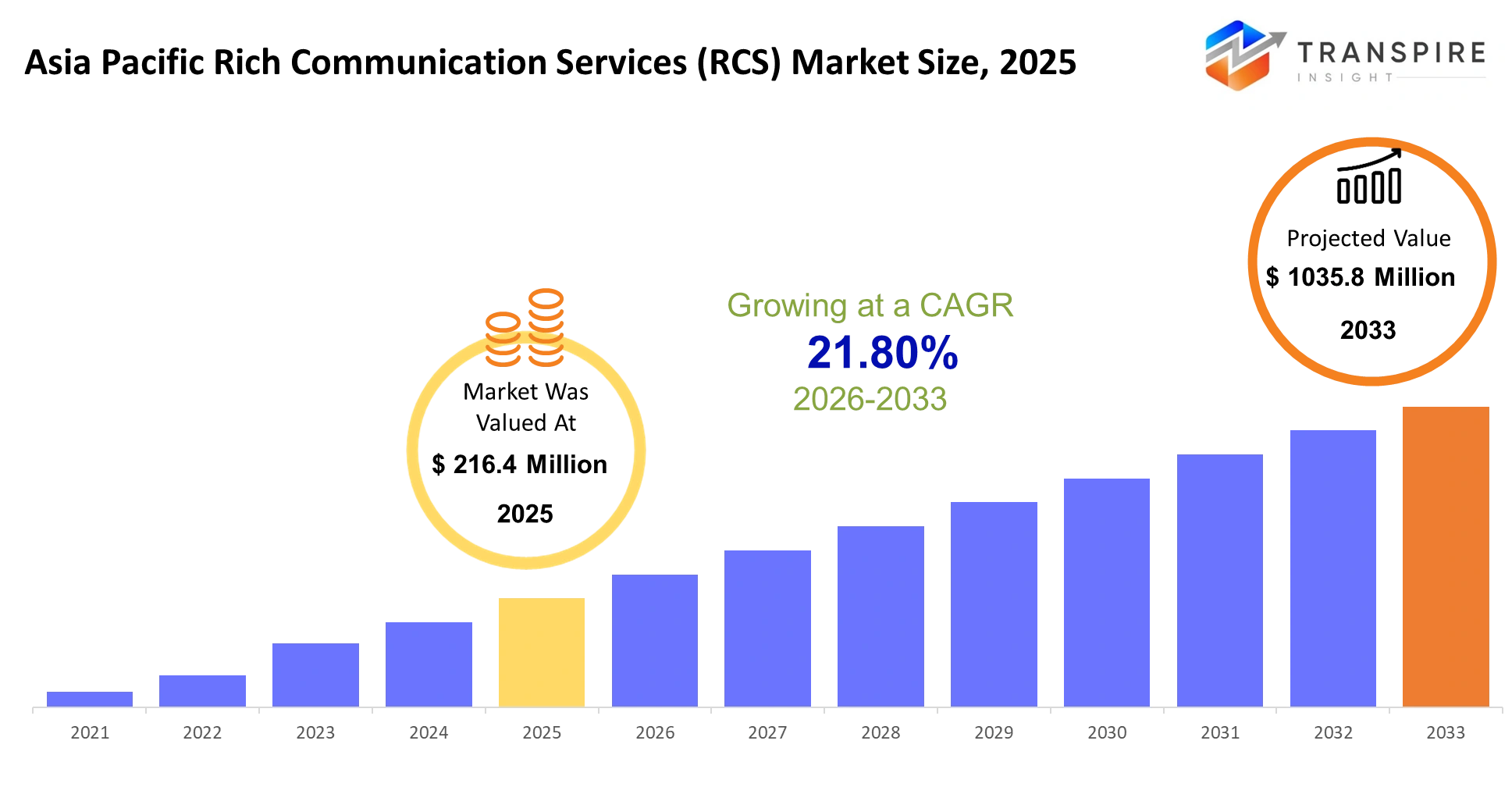
- Asia Pacific Rich Communication Services (RCS) Market Size 2025: USD 216.4 Million
- Asia Pacific Rich Communication Services (RCS) Market Size 2033: USD 1035.8 Million
- Asia Pacific Rich Communication Services (RCS) Market CAGR: 21.80%
- Asia Pacific Rich Communication Services (RCS) Market Segments: By Type (A2P Messaging, P2P Messaging, Business Messaging, Rich Media Messaging, Chatbots, Others); By Application (Marketing, Customer Engagement, Payments, Notifications, Authentication, Others); By Deployment (Cloud, On-premises, Hybrid, SaaS, Platform-based, Others); By End-User (Telecom Operators, Enterprises, SMEs, OTT Players, BFSI, Others)
To learn more about this report,  Download Free Sample Report
Asia Pacific Rich Communication Services (RCS) Market Summary:
The Asia Pacific Rich Communication Services (RCS) Market size is estimated at USD 216.4 Million in 2025 and is anticipated to reach USD 1035.8 Million by 2033, growing at a CAGR of 21.80% from 2026 to 2033. The Asia Pacific region's rich communication services (RCS) market in the telecom and messaging industry will mark a transition from simple SMS communications to advanced and interactive forms of communication that are part of the native messaging platform.
The collaboration between telecom and technology firms will result in branded communications, sender verification, and media-rich messaging that are in line with consumer demands formed through OTT services. Increased interest in smooth engagement with consumers will lead companies to embrace RCS as an important way of marketing their products and communicating with customers. Improved 5G network technologies and greater device compatibility will ensure that communications are delivered successfully.
What Has the Impact of Artificial Intelligence Been on the Asia Pacific Rich Communication Services (RCS) Market?
The artificial intelligence system creates new methods for handling rich communication services (RCS) markets in Asia Pacific because it delivers more precise data analysis and quicker decision processes. The operational capacity of the Asia Pacific RCS market will benefit from artificial intelligence which enables telecom operators and business customers to analyze extensive messaging data while discovering user patterns and enhancing their marketing approaches.
The Asia Pacific RCS market ecosystem will benefit from artificial intelligence which improves demand forecasting and predictive analytics to help businesses predict customer interactions before those interactions happen. The advanced automation system will handle three main tasks which include campaign implementation, chatbot operation, and customer support processes, which will enhance service delivery by reducing time wasting and boosting service quality. The system will enhance production efficiency through its ability to optimize messaging content and delivery timing and personalization processes during actual operations.
Artificial intelligence will create competitive advantages for the Asia Pacific RCS market because it enables businesses to create highly customized communications which they can deliver to many customers at once. The predictive engines will determine supply chain operations which include making decisions about messaging infrastructure and cloud resource allocation, which will reduce expenses while ensuring system dependability.
Key Market Trends & Insights:
- China leads in the asia pacific rich communication services (RCS) market with around 35% share in 2024 owing to telecom ecosystem integration.
- India remains the highest growing region anticipated to grow with a CAGR of more than 18% during 2025-2030 owing to growing smartphone penetration.
- Demand in Southeast Asia remains nascent with increasing digital commerce trends and enterprise conversational messaging platform deployment.
- A2P (Application-to-person) messaging services are leading with nearly 60% market share in 2024, driven by enterprise communication requirements.
- P2A (Person-to-application) is the second largest player with increasing customer engagement with various use cases related to messaging.
- Conversational messaging services remain the fastest-growing application category anticipated to show high growth until 2030 with AI integration.
- Applications for marketing and advertisement remain dominant with almost 40% market share owing to brand engagement and personalization requirements.
- Customer support services remain the fastest growing application owing to increasing real-time and automated communication trends.
- The Telecom and IT industry remains a leading vertical with nearly 45% share owing to infrastructure and early adoption of technology.
Asia Pacific Rich Communication Services (RCS) Market Segmentation
By Type
The A2P messaging will ensure enterprise-level interactions between business entities and their clients with the help of alert notifications and one-time passwords and messages. The popularity of the P2P messaging system will persist among those users who wish to message each other, but the system will experience slower growth compared to enterprise-level communication solutions. Growth in business messaging will become an evident trend, and businesses will start developing their own communication platforms to earn customer loyalty and boost brand reputation. Introduction of rich media messaging will allow users to engage in communication using visual elements such as images and video content along with interactive features.
Chatbots are expected to transform the way people communicate as they will be able to get instant replies and answers from them eliminating any need to have people answering messages. Messaging capabilities will become more advanced with improvements in device compatibility and network access.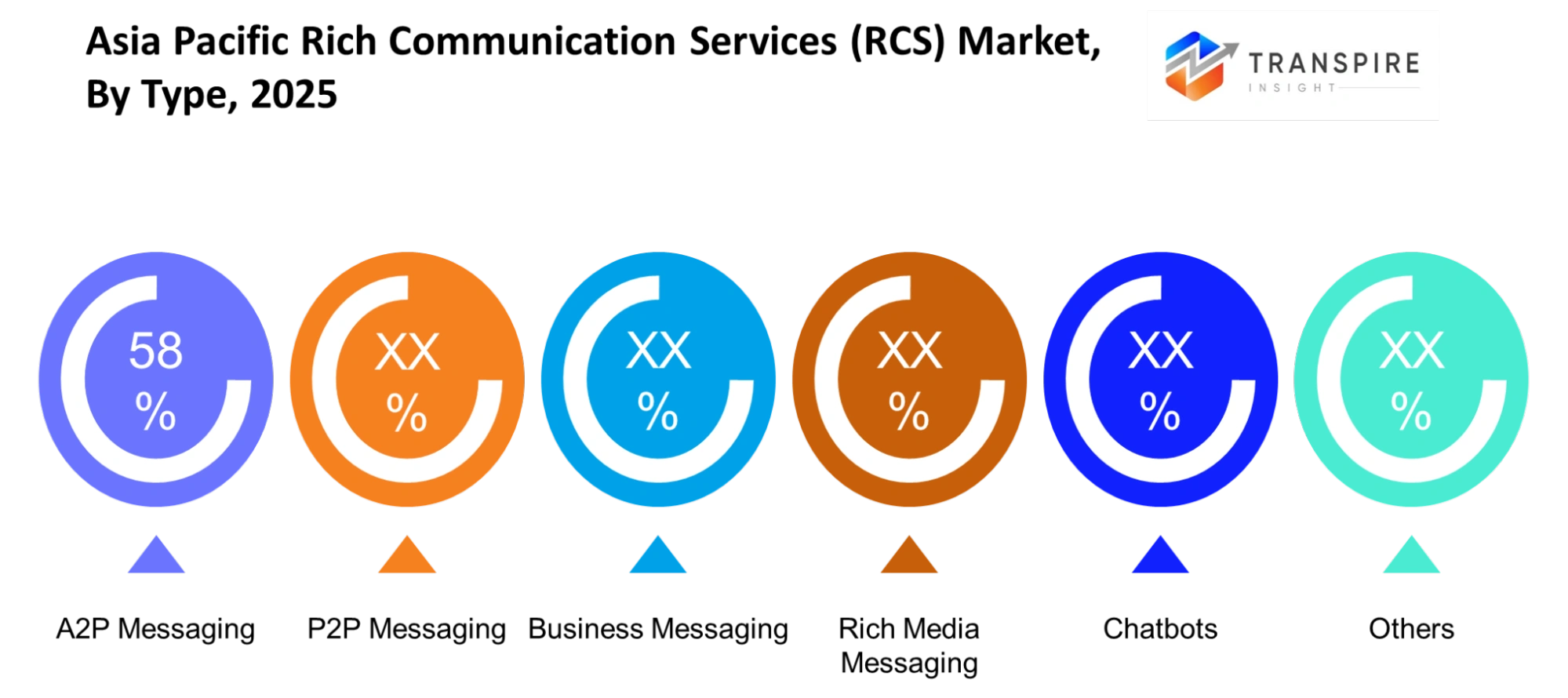
To learn more about this report, Download Free Sample Report
By Application
The strong demand for personalized marketing campaigns together with targeted promotional efforts will make marketing applications the leading choice for businesses. Businesses will establish interactive channels to develop customer relationships that will enhance their engagement with customers. Payment-based messaging enables users to receive transaction updates which build trust through transparent payment confirmation processes. Notification services will remain essential for delivering timely updates across sectors such as logistics and e-commerce.
The digital security system will depend on authentication methods which use one-time passwords and verification messages to secure online financial transactions. The digital transformation of various industries will drive the development of new use cases through their emerging use cases. The business sector will continue searching for effective methods to use messaging as a core component of their daily operations. The user experience will improve because this change will make communication more effective.
By Deployment
The selection of the cloud-based implementation approach should be made according to its benefits of flexible operation and scalable system capabilities and reduced initial investment requirements. The selection of the cloud-based implementation approach should be based on its benefits of flexible operation and scalable system capabilities and reduced initial investment requirements. The internal deployment option would be ideal for organizations that require greater control and regulatory compliance concerning data management. The hybrid mode of deployment would provide the best of both worlds. The software-as-a-service (SaaS) approach would make implementation easier without the cost of infrastructure investment.
Deployment through platform would facilitate the development of communication systems that allow multiple applications to run in one application interface. Other modes of deployment would include customized options. Cloud infrastructure improvements would continue to enhance performance and reliability. The type of deployment to adopt will be based on cost considerations.
By End-User
Telecom operators will maintain a powerful market presence because they control both their network infrastructure and their messaging delivery systems. Enterprises will expand usage as digital communication will become central to operations and customer interaction. SMEs will adopt messaging solutions at a faster rate due to affordability and ease of use. Through messaging features, OTT players will enhance user engagement and expand their service range.
The BFSI sector depends on secure messaging to carry out its transaction process and alert system and authentication methods. Other end-users will include industries such as healthcare, education, and logistics, where communication will support daily operations. Organizations will move toward advanced messaging solutions because digital adoption continues to grow across all sectors. The Asia Pacific rich communication services market will experience improved communication efficiency as this trend develops across various sectors.
What are the Main Challenges for the Asia Pacific Rich Communication Services (RCS) Market Growth?
The asia pacific rich communication services (RCS) market faces operational and technical difficulties which slow its development because different countries show different levels of network reliability and device support. The existence of separate telecom systems creates performance deficiencies which result in unreliable customer service and product delivery issues.
The Asia-Pacific economies impose different regulatory standards which create manufacturing and commercialization obstacles that impact the Asia Pacific RCS market. Telecom operators must align with different compliance standards which delays service rollout and increases operational costs. The need for high capital investment to upgrade infrastructure for 5G and platform modernization projects creates financial strain on organizations. Market restrictions create obstacles which prevent smaller businesses from entering or growing their presence in the market.
The Asia Pacific RCS market faces major adoption obstacles because numerous areas lack proper infrastructure and trained technical personnel. Businesses in developing economies face RCS adoption challenges because they have not received enough information about RCS capabilities. Existing OTT messaging services present a challenge for growth because users prefer to use their existing applications. The market will face pricing challenges and data privacy developments which will determine its sustainable growth rate.
Country Insights
The regions of Asia-Pacific will exhibit different patterns of technology adoption because of their telecom development level and their digital readiness and their business requirements. The market in China will dominate due to the robust backing that it gets from the telecom operators in addition to the early adoption of modern messaging systems. In India, the market is anticipated to grow rapidly because there will be increased use of smartphones and greater demand from businesses for messaging services..
Southeast Asia will see consistent development because digital commerce will grow and mobile-first users will begin to depend on interactive communication. Indonesia and Vietnam will facilitate their market growth through better network infrastructure and higher business usage of their systems. Japan and South Korea will keep their current market status because of their developed technology systems and their early use of advanced messaging functions.
Australia will drive its market growth through its high corporate usage of products and its commitment to developing customer retention solutions while developing markets will start to use products when their basic systems become more advanced. The pace of technology adoption will continue to be affected by local regulatory frameworks and different levels of financial support from different regions. The overall development of the market will derive from both established telecom systems and developing telecom systems which will determine the market's future development.
Recent Development News
In March 2026, Bharti Airtel announced collaboration with Google. The partnership introduced AI-powered spam protection to enhance secure RCS messaging for users across India.https://www.airtel.in/
In April 2026, Google launched new Business Communications API features. The update enabled partners to upload and manage verification documents, improving agent authentication processes in RCS business messaging.https://developers.google.com/
|
Report Metrics |
Details |
|
Market size value in 2025 |
USD 216.4 Million |
|
Market size value in 2026 |
USD 263.5 Million |
|
Revenue forecast in 2033 |
USD 1035.8 Million |
|
Growth rate |
CAGR of 21.80% from 2026 to 2033 |
|
Base year |
2025 |
|
Historical data |
2021 - 2024 |
|
Forecast period |
2026 - 2033 |
|
Report coverage |
Revenue forecast, competitive landscape, growth factors, and trends |
|
Regional scope |
Asia Pacific (China, India, Japan, South Korea, Australia, Rest of Asia Pacific) |
|
Key company profiled |
Google, Samsung, Huawei, Ericsson, Nokia, Vodafone, Orange, AT&T, Verizon, Infobip, Twilio, Sinch, SAP, Oracle, ZTE |
|
Customization scope |
Free report customization (country, regional & segment scope). Avail customized purchase options to meet your exact research needs. |
|
Report Segmentation |
By Type (A2P Messaging, P2P Messaging, Business Messaging, Rich Media Messaging, Chatbots, Others); By Application (Marketing, Customer Engagement, Payments, Notifications, Authentication, Others); By Deployment (Cloud, On-premises, Hybrid, SaaS, Platform-based, Others); By End-User (Telecom Operators, Enterprises, SMEs, OTT Players, BFSI, Others) |
How Can New Companies Establish a Strong Foothold in the Asia Pacific Rich Communication Services (RCS) Market?
New market entry points for companies in the asia pacific region can be established through rich communication services (RCS) deployment to unserved messaging segments of their business. The healthcare and logistics and smart cities sectors will benefit from companies which provide secure interactive messaging solutions to address their communication delays. The early adoption process will gain strength from appointment reminders and delivery tracking and citizen alerts which deliver clear value to users. The current market growth pattern together with the specialized solution advantages will lead to market success through this approach.
The asia pacific rich communication services (RCS) market will depend on technology differentiation which will enable AI-driven personalization together with automation and analytics capabilities to develop. The platform development of companies will become distinct through their implementation of predictive messaging and multilingual support together with real-time engagement tools. The enterprise innovation strategies must include API integration which enables quick system connections while decreasing user onboarding duration and operational hindrances. The new players will acquire capabilities which enable them to adapt to industry changes and meet enterprise requirements.
Startups will enter the asia pacific rich communication services (RCS) market faster through strategic partnerships which establish connections between them and telecom operators together with cloud service providers. The system will achieve improved distribution and enhanced reliability together with better scalability while reducing the need for costly infrastructure development. Route Mobile together with Gupshup have shown how localized solutions which focus on enterprise messaging can create strong business advantages for new market entrants. The combination of continuous innovation efforts and new market entry will help emerging businesses establish brand reputation and develop long-lasting market advantages.
Key Asia Pacific Rich Communication Services (RCS) Market Company Insights
Competition will stay intense because telecom companies, cloud services and messaging platforms keep growing their service offerings. The biggest companies will spend their resources on better delivery services and verified messaging and enterprise solutions to create a stronger market position. The ongoing development of infrastructure together with its integration support will determine how businesses compete in different economic areas.
Telecom companies need to establish partnerships with technology providers to achieve their objectives through secure strategic alliances. The collaboration will enable organizations to expand their service capabilities while establishing stronger platform functions and bridging their existing operational shortcomings. The established companies together with the new market entrants will find business opportunities because they choose to expand their operations into high-demand markets which include India and Southeast Asia.
Companies will establish their unique market positions through innovation which requires them to spend funds on AI-based messaging systems and automation technologies and customized user communication tools. Companies that deliver better user experiences which allow users to interact with their products in real time will achieve market leadership. The pricing methods together with the personalized service options will determine how businesses win new enterprise customers and keep their existing clients.
New companies will compete against established businesses by providing affordable and adaptable services designed specifically for small and medium business operations. The new market players will gain competitive advantages through their ability to deploy solutions at a faster rate while their operations will run more smoothly than before. The competitive environment will experience ongoing changes because more customers adopt advanced technologies which lead them to expect interactive communication methods.
Company List
- Samsung
- Huawei
- Ericsson
- Nokia
- Vodafone
- Orange
- AT&T
- Verizon
- Infobip
- Twilio
- Sinch
- SAP
- Oracle
- ZTE
What are the Key Use-Cases Driving the Growth of the Asia Pacific Rich Communication Services (RCS) Market?
Rich Communication Services (RCS) for marketing and customer engagement use-cases in the Asia Pacific region have gained popularity due to rich media messages containing images, carousels, and quick reply buttons that generate high conversion rates. Retail and e-commerce businesses in particular are utilizing them for promoting personalized offers and discounts, as well as sending reminders about abandoned carts to enhance their sales performance.
Customer service and service automation use-cases constitute another driving factor behind the growth of the Asia Pacific rich communication services (RCS) market. Chatbot messaging is being deployed by organizations to handle customer inquiries, schedule appointments, and resolve disputes in real time. For example, the healthcare sector is adopting this solution for appointment booking, reminders, and patient communication.
Lastly, transactional and security-based use-cases represent a promising application area of the Asia Pacific rich communication services (RCS) market. Banks and other financial entities are using this technology for sending one-time-password (OTP) verifications, fraud alerts, and transaction confirmations. The automotive industry is implementing transactional RCS for sending reminders about scheduled maintenance and new vehicles. Such applications present scalable opportunities for businesses, whereas innovations in AI messaging are expected to generate new use cases in the future.
Asia Pacific Rich Communication Services (RCS) Market Report Segmentation
By Type
- A2P Messaging
- P2P Messaging
- Business Messaging
- Rich Media Messaging
- Chatbots
- Others
By Application
- Marketing
- Customer Engagement
- Payments
- Notifications
- Authentication
- Others
By Deployment
- Cloud
- On-premises
- Hybrid
- SaaS
- Platform-based
- Others
By End-User
- Telecom Operators
- Enterprises
- SMEs
- OTT Players
- BFSI
- Others
Frequently Asked Questions
Find quick answers to common questions.
The Approximate Asia Pacific Rich Communication Services (RCS) Market size for the Market will be USD 1035.8 Million in 2033.
Key segments for the Asia Pacific Rich Communication Services (RCS) Market are By Type (A2P Messaging, P2P Messaging, Business Messaging, Rich Media Messaging, Chatbots, Others); By Application (Marketing, Customer Engagement, Payments, Notifications, Authentication, Others); By Deployment (Cloud, On-premises, Hybrid, SaaS, Platform-based, Others); By End-User (Telecom Operators, Enterprises, SMEs, OTT Players, BFSI, Others).
Major Asia Pacific Rich Communication Services (RCS) Market Players are Google, Samsung, Huawei, Ericsson, Nokia, Vodafone, Orange, AT&T, Verizon, Infobip, Twilio, Sinch, SAP, Oracle, ZTE.
The Current Asia Pacific Rich Communication Services (RCS) Market size is USD 216.4 Million in 2025.
The Asia Pacific Rich Communication Services (RCS) Market CAGR is 21.80%.
- Samsung
- Huawei
- Ericsson
- Nokia
- Vodafone
- Orange
- AT&T
- Verizon
- Infobip
- Twilio
- Sinch
- SAP
- Oracle
- ZTE
Recently Published Reports
-
Dec 2024
3D Optical Profiler Market
3D Optical Profiler Market Size, Share & Analysis Report By Type (Desktop 3D Optical Profiler, and Portable 3D Optical Profiler), By Technology (Confocal Technology, and White Light Interference), By End-Use Industry (Manufacturing, Research Institutions, Automotive, Aerospace and Defense, Medical Devices, and Other), and Geography (North America, Europe, Asia-Pacific, Middle East and Africa, South and Central America), 2021 - 2031
-
Feb 2025
Depth Sensor Market
Depth Sensor Market Size, Share & Analysis Report By Type (Infrared Depth Sensors, Time-of-Flight (ToF) Sensors, Stereo Vision Sensors, Structured Light Sensors, Ultrasonic Depth Sensors), By Application (Automotive, Robotics, Gaming, Consumer Electronics, Industrial Automation, Healthcare, Security & Surveillance, Others), By End Users (Automotive Manufacturers, Consumer Electronics Companies, Healthcare Providers, Industrial Companies, Security Agencies, Gaming Companies, Robotics Companies, Others), and Geography (North America, Europe, Asia-Pacific, Middle East and Africa, South and Central America), 2021 – 2031
-
Feb 2025
Digital Manufacturing Market
Digital Manufacturing Market Size, Share & Analysis Report By Component (Hardware, Software, and Services), By Technology (Robotics, 3D Printing, Internet of Things (IoT), and Others), By Application (Automotive and Transportation, Aerospace and Defense, Consumer Electronics, Industrial Machinery, and Others), By Process Type (Computer-Based Designing, Computer-Based Simulation, Computer 3D Visualization, Analytics, and Others), and Geography (North America, Europe, Asia-Pacific, Middle East and Africa, South and Central America), 2021 – 2031
-
Feb 2025
Digital Visa Services Market
Digital Visa Services Market Size, Share & Analysis Report By Type (Individual Travelers, Group Travelers), By Application (Tourism, Business Travel, Others), and Geography (North America, Europe, Asia-Pacific, Middle East and Africa, South and Central America), 2021 – 2031