Israel Intelligent Traffic Management System Market Size & Forecast:
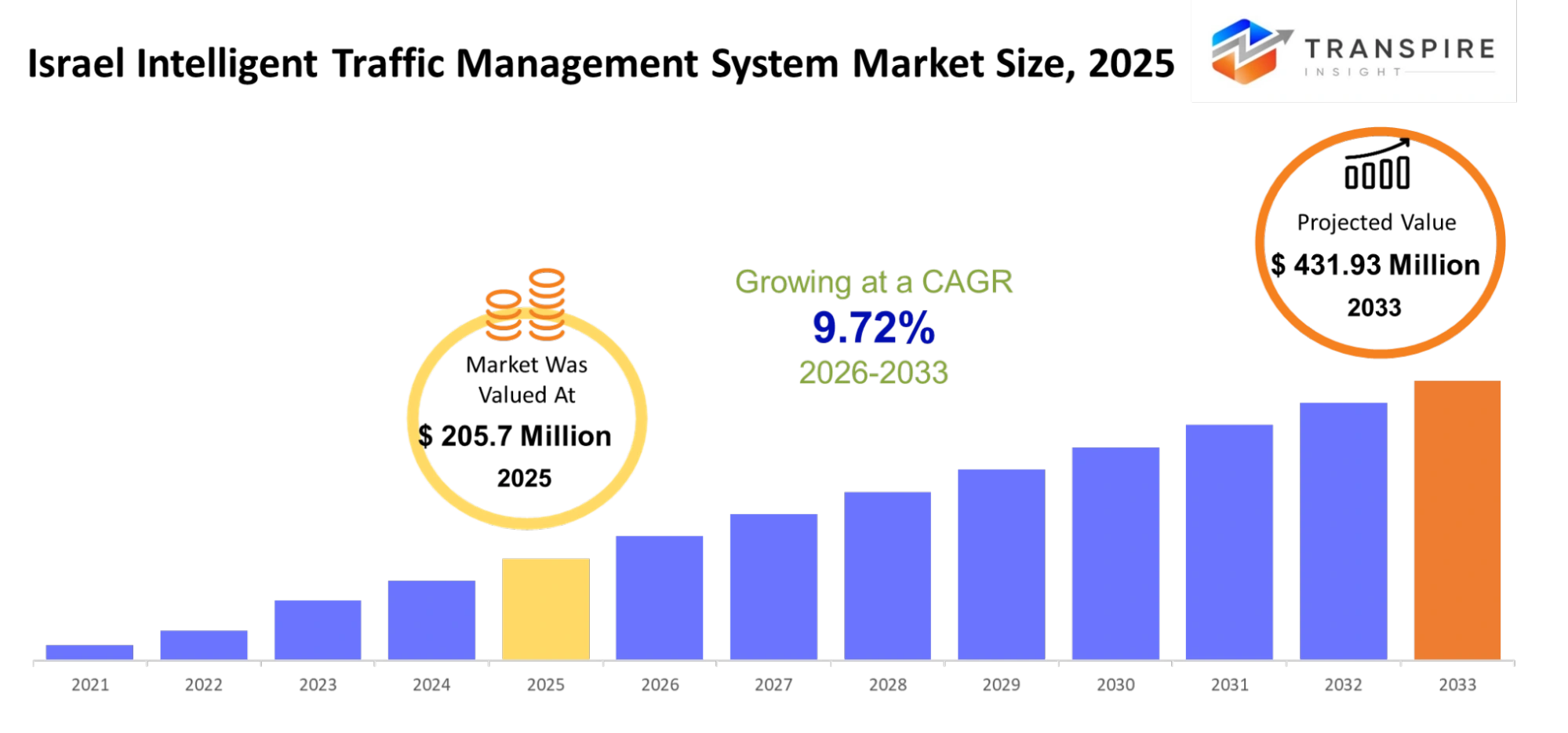
- Israel Intelligent Traffic Management System Market Size 2025: USD 205.7 Million
- Israel Intelligent Traffic Management System Market Size 2033: USD 431.93 Million
- Israel Intelligent Traffic Management System Market CAGR: 9.72%
- Israel Intelligent Traffic Management System Market Segments: By Component (Hardware, Software, Services), By Application (Traffic Monitoring, Traffic Signal Control, Incident Detection), By End-User (Government Authorities, Smart Cities).
To learn more about this report,  Download Free Sample Report
Israel Intelligent Traffic Management System Market Summary:
The Israel Intelligent Traffic Management System Market size is estimated at USD 205.7 Million in 2025 and is anticipated to reach USD 431.93 Million by 2033, growing at a CAGR of 9.72% from 2026 to 2033.
The smart transportation sector in Israel will see its intelligent traffic management system market growth because the nation actively seeks to digitize urban transportation. The authorities will concentrate their efforts on establishing real-time traffic monitoring systems to address the increasing traffic problems which occur during peak times in urban areas. Commuters will start demanding uninterrupted travel services which will result in greater need for systems that combine traffic signals with sensors and public transportation information. The development of AI-powered analytics together with edge computing technology will enhance the accuracy of traffic predictions through improved predictive traffic control methods. The regulatory framework will provide growing support for investments in smart infrastructure projects which also advance environmental sustainability objectives. Adaptive systems will prove vital for urban areas because they help reduce delays and improve safety while facilitating better public transit movement throughout city regions.
Key Market Trends & Insights:
People in Israel now expect urban transportation to provide them with fast travel options that use improved street planning methods. The public demands two types of information which transportation systems must supply: correct updates which reflect the current situation and updates which come with short waiting times. The demand for synchronized public transit operations will lead to closer ties between navigation systems and transit data and main traffic management networks which help cities operate their transit systems better.
Artificial intelligence will play a stronger role in shaping traffic flow decisions across major cities. The system will use predictive modeling methods to predict future congestion patterns which will enable it to adjust traffic signals in real time. The intelligent system will achieve two benefits through its automatic adjustments, which will decrease travel times while increasing fuel efficiency to meet sustainability targets established by both lawmakers and public opinion.
Roadways will see a rise in connected infrastructure because more sensors and cameras and IoT devices will be installed through the network. The new technology will improve data collection precision while it enables emergency teams to identify incidents more quickly. The emergency response team will reach accident or disruption sites faster which will boost road safety while maintaining continuous traffic flow through busy times.
The government will support smart city developments which create collaboration opportunities between public organizations and technology companies. The government will direct its regulatory efforts to advance transportation digital transformation through financing smart transportation systems. The new system will establish common traffic data standards which will enhance system compatibility while preserving the capacity of future mobility systems to deliver operational excellence and environmental friendliness.
Israel Intelligent Traffic Management System Market Segmentation
By Component
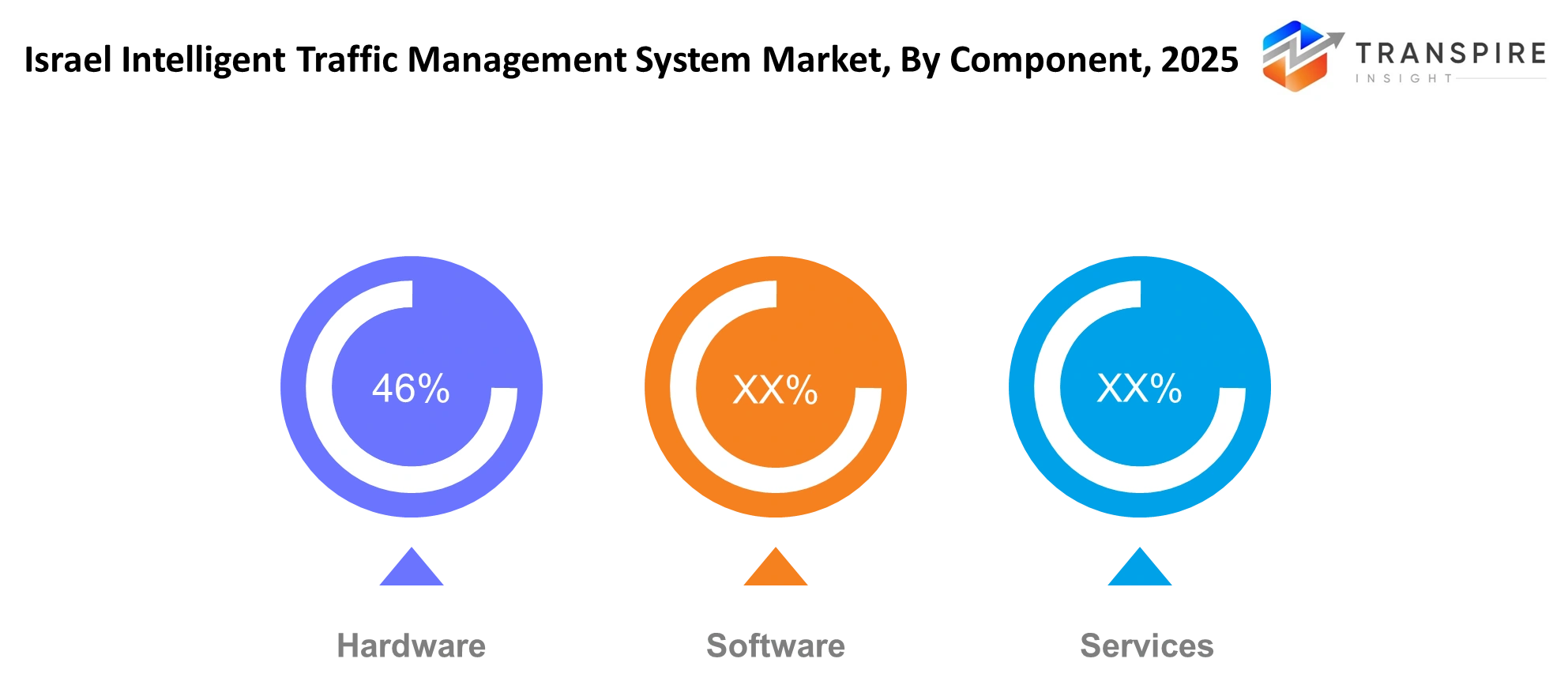
Hardware- The physical infrastructure of intelligent traffic systems throughout Israel will rely solely on existing hardware elements. Authorities will progressively install advanced cameras and radar sensors and variable message signs and connected signal controllers throughout highway systems and urban street intersections. The devices will operate continuously to collect data which enables authorities to monitor traffic congestion and handle road accidents and unexpected incidents throughout busy street networks.
Software- The software will use unprocessed data to create useful information which controls traffic systems. Artificial intelligence and machine learning systems will analyze traffic density data to forecast upcoming traffic jams while they control traffic signal operations. The cloud-based system enables control rooms to monitor various locations at once which enhances operational efficiency across multiple transportation routes.
Services- The services will assist traffic systems from their initial development stage through their entire operational period until their final decommissioning stage. The combination of consulting services and system integration work and technical support will enable authorities to implement customized solutions which meet their local infrastructure requirements. The system will preserve its operational capacity through continuous system assessments which provide updates about security measures and performance enhancements needed to meet future urban mobility demands.
To learn more about this report, Download Free Sample Report
By Application
Traffic Monitoring- The process of traffic monitoring will use cameras and sensors and connected devices to collect and analyze actual road conditions through real-time data collection. The systems will deliver comprehensive information about vehicle movement patterns and traffic jam conditions and travel duration. The data will serve as a foundation for authorities who will use it to develop better route planning strategies that will improve traffic flow in crowded urban environments.
Traffic Signal Control- The system for traffic signal control will evolve into a system that uses current road conditions to modify signal timings through real-time updates from live data. Intelligent systems will operate based on traffic volumes to create dynamic responses that replace fixed schedules and decrease waiting times. The approach will enhance intersection operations while decreasing traffic congestion to create better vehicle flow throughout city street systems.
Incident Detection- The systems used for incident detection will recognize accidents and stalled vehicles and unusual traffic patterns as they occur. The systems will use video analytics and sensor data to deliver immediate alerts to control centers. The faster emergency response system will reduce disruptions while maintaining continuous traffic movement during unexpected situations.
By End-User
Government Authorities- The primary users of intelligent traffic solutions will be government authorities who will handle all aspects of system planning and deployment and regulatory activities. The organization will create new advanced systems which will solve urban traffic congestion issues while improving road safety and meeting environmental sustainability goals. Public agencies will use traffic management systems to create their transportation policies and develop their infrastructure development plans.
Smart Cities- Smart cities initiatives will drive connected traffic system implementation through their integration into existing digital ecosystems. The system will use integrated traffic control systems to operate together with energy management systems and public transportation networks and urban development platforms. The team aims to design a complete urban system that enables people to travel smoothly while using data-based technologies and sustainable design methods.
Country Insights
The traffic technologies which will be implemented through Israel's urban areas will create a framework for their national implementation. The Tel Aviv metropolitan area which has high population density will need systems that can react quickly to handle the growing number of vehicles. The limited options for expanding roads will force authorities to develop advanced data analysis methods which will enable them to use current infrastructure efficiently without constructing new facilities.
Public expectations about mobility will increase because people will begin using navigation applications together with real-time services. Commuters will search for travel routes which provide precise time estimates together with trustworthy information, which will create a demand for improved operational links between public transportation systems and street networks. This shift will guide investments toward integrated systems that deliver consistent and transparent traffic information.
The strong technology ecosystem of Israel will enable fast development of traffic management solutions through its existing capabilities. Local startups and established firms will collaborate with government bodies to test and deploy advanced systems. The development environment will support testing of artificial intelligence, edge computing, and connected devices which will enhance the country's capacity to develop intelligent transportation solutions.
Sustainability and efficiency objectives will become the primary focus of policy direction, which will result in decreased emissions and enhanced road safety. The authorities will support intelligent systems which reduce waiting time while they manage traffic movement. The combination of regulatory support and funding initiatives will enable organizations to implement solutions which are both scalable and secure while meeting the future needs of transportation systems.
Recent Development News
Smart Enforcement Expansion with Advanced Camera Systems (2025–2026)- Smart Enforcement Expansion with Advanced Camera Systems (2025–2026) Israel will move toward deploying next-generation speed enforcement technologies that go beyond fixed cameras The authorities will install hundreds of intelligent surveillance systems which will operate together with their night patrols and their improved punishment system. The automated traffic control system will become more effective through this change because drivers will stop doing their common driving patterns which they use at normal camera positions.
Government Investment in Smart Transportation Testbeds (2026)- The government will invest millions of shekels in dedicated smart transportation testing centers in cities such as Ashdod and Be'er Sheva. The centers will conduct testing of advanced traffic management systems which will progress from initial testing stages to complete operation while meeting safety requirements and legal standards.
Adoption of AI and LiDAR-Based Traffic Intelligence Solutions (2026)- Adoption of AI and LiDAR-Based Traffic Intelligence Solutions (2026) New solutions which combine LiDAR sensing and edge AI computing will enhance traffic monitoring and incident detection capabilities. Companies are introducing ready-to-deploy platforms that integrate with existing infrastructure enabling accurate real-time analysis of road conditions. The new technologies will enable faster decision processes while making urban traffic systems more efficient.
|
Report Metrics |
Details |
|
Market size value in 2025 |
USD 205.7 Million |
|
Market size value in 2026 |
USD 225.7 Million |
|
Revenue forecast in 2033 |
USD 431.93 Million |
|
Growth rate |
CAGR of 9.72% from 2026 to 2033 |
|
Base year |
2025 |
|
Historical data |
2021 – 2024 |
|
Forecast period |
2026 – 2033 |
|
Report coverage |
Revenue forecast, competitive landscape, growth factors, and trends |
|
Country scope |
Israel |
|
Key company profiled |
Siemens AG, Kapsch TrafficCom AG, Cubic Corporation, Thales Group, Q-Free ASA, Iteris Inc., Swarco AG, Siemens Mobility GmbH, FLIR Systems Inc., Bosch Mobility Solutions, IBM Corporation, Cisco Systems Inc., Huawei Technologies Co. Ltd., Indra Sistemas S.A., Hitachi Ltd. |
|
Customization scope |
Free report customization (country, regional & segment scope). Avail customized purchase options to meet your exact research needs. |
|
Report Segmentation |
By Component (Hardware, Software, Services), By Application (Traffic Monitoring, Traffic Signal Control, Incident Detection), By End-User (Government Authorities, Smart Cities). |
Key Israel Intelligent Traffic Management System Market Company Insights
Key players operating in this space will blend local innovation with global expertise. The companies NoTraffic Valerann and Exelerate will advance AI-based traffic optimization technology while Cygnus and Mobi will specialize in real-time analytics and predictive control solutions. Public entities including Netivei Israel will collaborate with technology providers to scale integrated data-centric traffic solutions throughout the entire nation.
Company List
- Siemens AG
- Kapsch TrafficCom AG
- Cubic Corporation
- Thales Group
- Q-Free ASA
- Iteris Inc.
- Swarco AG
- Siemens Mobility GmbH
- FLIR Systems Inc.
- Bosch Mobility Solutions
- IBM Corporation
- Cisco Systems Inc.
- Huawei Technologies Co. Ltd.
- Indra Sistemas S.A.
- Hitachi Ltd
Israel Intelligent Traffic Management System Market Report Segmentation
By Component
- Hardware
- Software
- Services
By Application
- Traffic Monitoring
- Traffic Signal Control
- Incident Detection
By End-User
- Government Authorities
- Smart Cities
Frequently Asked Questions
Find quick answers to common questions.
The approximate Israel Intelligent Traffic Management System Market size for the market will be USD 431.93 Million in 2033.
Key segments for the Israel Intelligent Traffic Management System Market By Component (Hardware, Software, Services), By Application (Traffic Monitoring, Traffic Signal Control, Incident Detection), By End-User (Government Authorities, Smart Cities).
Major players in the Israel Intelligent Traffic Management System Market are Siemens AG, Kapsch TrafficCom AG, Cubic Corporation, Thales Group, Q-Free ASA, Iteris Inc., Swarco AG, Siemens Mobility GmbH, FLIR Systems Inc., Bosch Mobility Solutions, IBM Corporation, Cisco Systems Inc., Huawei Technologies Co. Ltd., Indra Sistemas S.A., Hitachi Ltd.
The Israel Intelligent Traffic Management System Market size is USD 205.7 Million in 2025.
The Israel Intelligent Traffic Management System Market CAGR is 9.72%.
- Siemens AG
- Kapsch TrafficCom AG
- Cubic Corporation
- Thales Group
- Q-Free ASA
- Iteris Inc.
- Swarco AG
- Siemens Mobility GmbH
- FLIR Systems Inc.
- Bosch Mobility Solutions
- IBM Corporation
- Cisco Systems Inc.
- Huawei Technologies Co. Ltd.
- Indra Sistemas S.A.
- Hitachi Ltd
Recently Published Reports
-
Apr 2026
ATV & UTV Market
ATV & UTV Market Size, Share & Analysis Report By Type (ATV, and UTV), By Variants (Less Than 400 CC, 400 CC To 800 CC, and More Than 800 CC), and Geography (North America, Europe, Asia-Pacific, Middle East and Africa, South and Central America), 2021 - 2031
-
Apr 2026
Automotive Central Gateway Module Market
Automotive Central Gateway Module Market Size, Share & Analysis Report By Type (Ethernet Central Gateway Module, CAN Central Gateway Module, LIN Central Gateway Module, and FlexRay), By Application (Powertrain Control, Body Control, Infotainment System, Advanced Driver Assistance Systems (ADAS), and Others), By End User (Passenger Vehicles, and Commercial Vehicles), and Geography (North America, Europe, Asia-Pacific, Middle East and Africa, South and Central America), 2021 - 2031
-
Apr 2026
Automotive Engine Oil Filter Market
Automotive Engine Oil Filter Market Size, Share & Analysis Report By Filter Type (Fuel Filter, Engine Oil Filter, Hydraulic Oil Filter, and Others), By Filter Media (Cellulose, Synthetic, and Micro), By Sales Channel (OEMs, and Aftermarket), By Vehicle Type (Passenger Cars, Light Commercial Vehicles, Heavy Duty Trucks, Buses and Coaches, and Off-road Vehicles), and Geography (North America, Europe, Asia-Pacific, Middle East and Africa, South and Central America), 2021 - 2031
-
Apr 2026
Automotive Parts Aluminium Die Casting Market
Automotive Parts Aluminium Die Casting Market Size, Share & Analysis Report By Production Process (Pressure Die Casting, Vacuum Die Casting, Squeeze Die Casting, Gravity Die Casting), By Application (Body Parts, Engine Parts, Transmission Parts, Battery And Related Components, Other Application Types), and Geography (North America, Europe, Asia-Pacific, Middle East and Africa, South and Central America), 2021 - 2031
Our Clients