

United Kingdom Walk-in Cooler and Freezer Market Summary
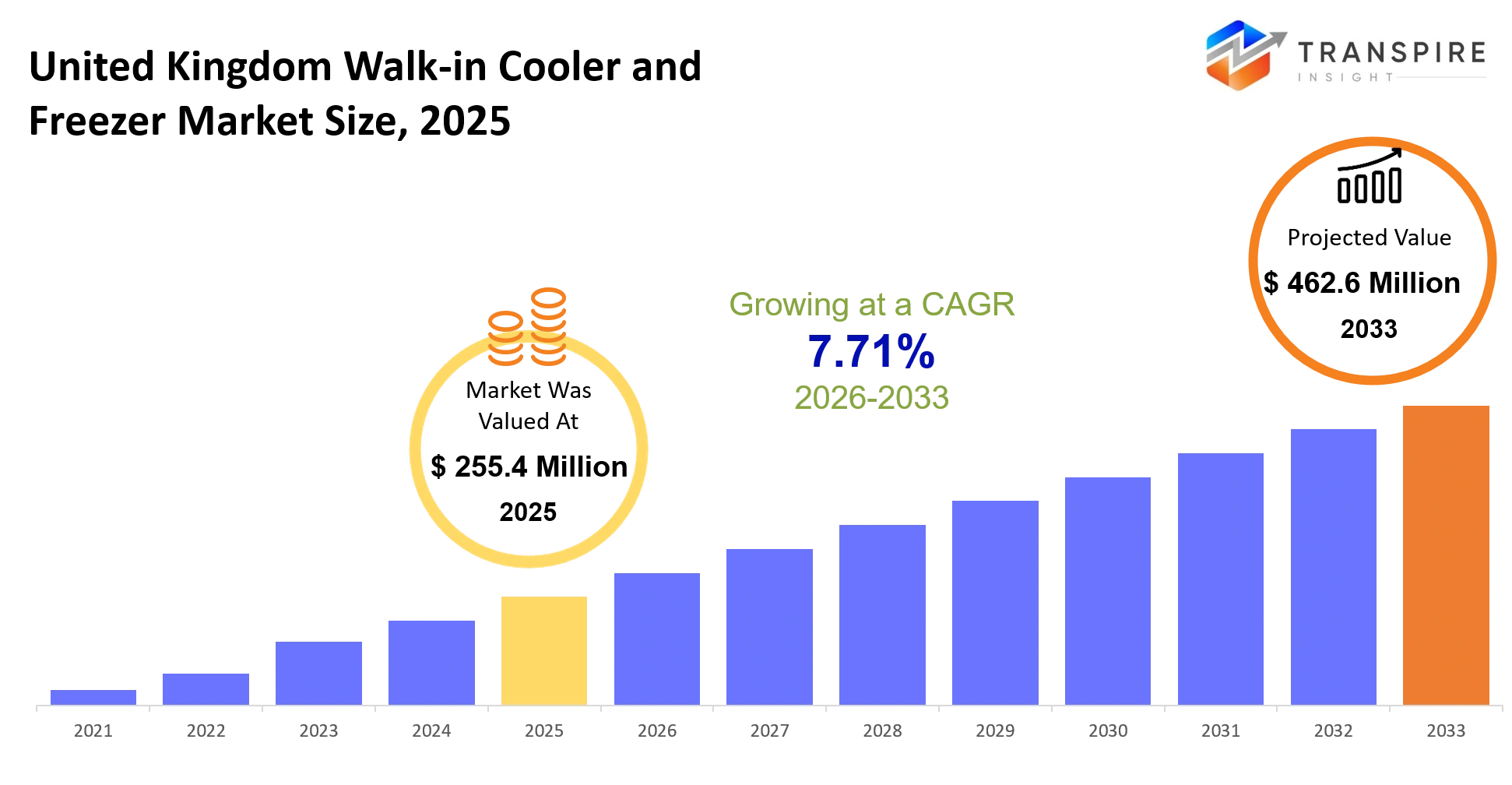
As per Transpire Insight Analysis the United Kingdom Walk-in Cooler and Freezer Market size is estimated at USD 255.4 Million in 2025 and is anticipated to reach USD 462.6 Million by 2033, growing at a CAGR of 7.71% from 2026 to 2033.
Walk-in coolers and freezers kinda form the real backbone of temperature controlled storage throughout the United Kingdom, across food processing plants, supermarkets, pharma facilities , hospitality businesses, and logistics hubs too. In practice these units help hold product quality steady, stretch shelf life, and also keep regulatory compliance in check. At the same time they help cold chain operations run without interruption, even when demand swings.
Over the last five years, though, the market has been leaning more and more toward energy efficient refrigeration systems that use low global warming potential refrigerants. That shift is happening because environmental rules are getting stricter, and because companies have started setting more aggressive sustainability goals. Then came COVID-19, and after the fallout the supply chain had disruptions, which basically highlighted where cold storage capacity could fall short. So, a lot of operators started modernizing their sites , and they began investing in more resilient refrigeration infrastructure.
Also, as grocery distribution, pharmaceutical storage, and food delivery networks keep getting more sophisticated, many operators now want bigger cold storage assets that are digitally monitored , and that also keep operating costs down. This is encouraging the replacement of older equipment, which supports higher value installations, and it opens up stronger long term revenue opportunities for manufacturers, system integrators, and maintenance service providers.
United Kingdom Walk-in Cooler and Freezer Market Size & Forecast:
- United Kingdom Walk-in Cooler and Freezer Market Size 2025: USD 255.4 Million
- Expected Market Value 2033: USD 462.6 Million
- Forecast CAGR: 7.71%
- Leading region in 2025: England
- Fastest Growing region: Scotland
- Key Profile: Carrier Commercial Refrigeration, Daikin, Thermo Fisher Scientific, Nor-Lake, Master-Bilt, Hussmann, Viessmann, Polar Refrigeration, Foster Refrigerator, Williams Refrigeration, American Panel, Kolpak, Danfoss, MISA, Interlevin
Key Market Insights
- England kind of dominated the market, with an estimated 68% share in 2025, mostly helped by the dense retail, food manufacturing, pharmaceutical, and also cold logistics infrastructure.
- Scotland is projected to be the fastest-growing regional market during 2025–2033, and it is pushed along by food processing expansion investments, plus temperature controlled distribution facilities.
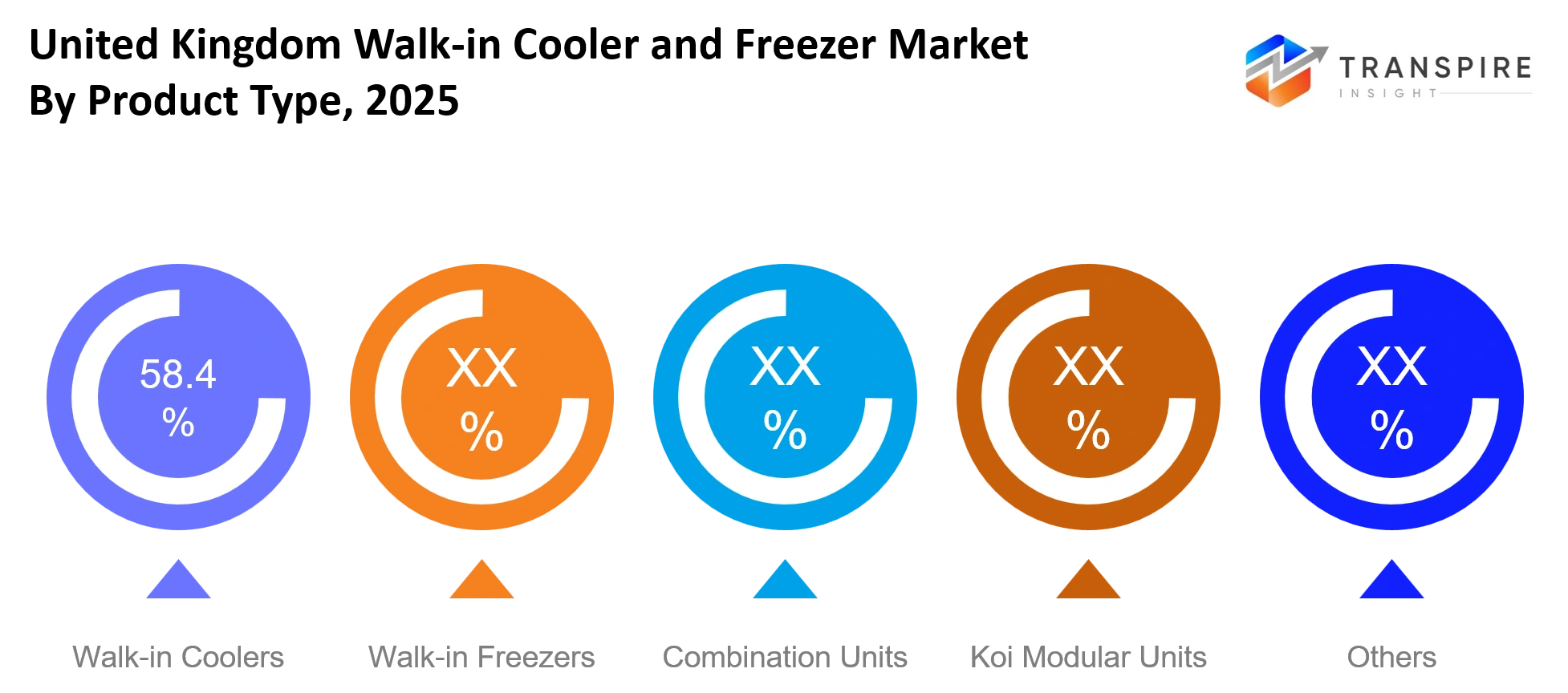
- Walk-in coolers stayed as the leading product segment, making up around 58% market share in 2025, and that was tied to supermarket refurbishment and hospitality modernization projects.
- Walk-in freezers came in as the second-largest segment, mainly because frozen food distribution and pharmaceutical storage capacity kept growing across regional logistics networks.
- Smart connected refrigeration systems are expected to see the fastest segment growth through 2033, since remote diagnostics and energy optimization are becoming procurement priorities, kind of more and more.
- For applications, food and beverage storage was in front with nearly 52% market share in 2025, supported by stricter cold chain compliance requirements.
- Pharmaceutical and life sciences storage should become the fastest-growing application across the forecast period, as biologics and vaccine logistics continue to expand.
- When it comes to end users, supermarkets and hypermarkets represented the top category with roughly 39% share in 2025, backed by ongoing store refurbishment programs, even if it’s gradual.
- Finally, third-party cold storage and logistics providers will remain the fastest-growing end-user category, as nationwide fulfillment networks keep expanding refrigerated warehouse capacity and reach further.
What are the Key Drivers, Restraints, and Opportunities in the United Kingdom Walk-in Cooler and Freezer Market?
Energy efficiency rules are still kinda the most forceful driver behind the United Kingdom walk in cooler and freezer market, even if most folks dont really clock it day to day. The shift toward refrigerants with lower global warming potential, and also higher electricity bills, has really changed what buyers end up caring about across food retail, pharmaceutical cold storage, and logistics sites.Firms are now swapping out old refrigeration assets sooner, because lower running costs boost long-term returns, even when the initial spend looks heavier. On top of that, digital monitoring tools help teams stay within compliance requirements more easily, and they also reduce product losses. So all these elements together, kind of support higher installation values, and better aftermarket service income too.
That said, the capital intensity part is still the big structural limit. A full refrigeration replacement is rarely simple; it needs serious funding, building adjustments, and specialist setup work. Refrigeration engineers who can actually do the job are still not evenly available in several regions, so schedules stretch out and timelines can drift. From the Transpire Insight look at regional procurement notices and launch timing, the biggest execution risk is supply chain concentration. Delivery hiccups, component shortages, and longer commissioning windows all push revenue recognition further out, while also slowing down facility growth and stretching replacement cycles.
The most powerful opportunity is in smart cold storage infrastructure. With AI enabled monitoring, cloud based energy control, and predictive upkeep platforms, the daily expense can drop quite a lot while equipment lifespan gets longer. Distribution hubs for pharmaceutical goods, online grocery order fulfillment, and premium food exports seem like the best spots to place capital. Sites that blend automation with natural refrigerants and more advanced controls will probably win the best long term deals because buyers are moving toward whole lifecycle efficiency, not just the upfront purchase price.
What Has the Impact of Artificial Intelligence Been on the United Kingdom Walk-in Cooler and Freezer Market?
Artificial intelligence is kinda reshaping refrigerated storage operations, turning the old-school cooling hardware into connected, more data-driven stuff. With AI powered controllers they keep scanning compressor performance, temperature stability, humidity levels and energy consumption, then automatically adjust the operating settings so everything stays aligned with strict food safety, and pharmaceutical storage requirements. Basically it’s like the system is constantly thinking, not just cooling, and it does this in real time.And the cloud-linked monitoring dashboards, they also cut down on all those manual checks, because they push constant alerts and keep digital audit trails.
More and more machine learning models are supporting predictive maintenance too, by spotting unusual compressor vibration, weird refrigerant leakage patterns, and signs of component wear before the failures actually show up. Distribution centers, and supermarket operators, they’re applying predictive analytics as well, mainly to forecast how full storage will be and to balance refrigeration loads when seasonal demand changes. In the end this helps with better uptime, less money spent on urgent fixes, lower electricity consumption and fewer inventory losses linked to temperature deviations. Digital twins are starting to get used for optimizing equipment during facility planning and refurbishment projects, improving overall efficiency over the long run.
Still, even with all these wins, broad deployment is held back by big integration costs and by inconsistent data quality from older refrigeration systems. A lot of older facilities sort of end up needing sensor upgrades, new network infrastructure, and sometimes even full control system replacement, before advanced AI platforms start delivering any clear measurable value. Those implementation hurdles keep dragging the pace for smaller operators, even if the operational benefits can be real, and kind of noticeable.
Key Market Trends
- Since 2022, adoption of natural refrigerants has been accelerating, with environmental rules basically nudging procurement choices in commercial refrigeration projects. It’s like they just had to rethink everything a bit.
- Smart remote monitoring platforms started replacing those manual inspection routines across big supermarket chains, and honestly it helped compliance reporting, and it also cut maintenance response times faster than before.
- Food distribution centers are more and more requesting variable speed compressors, mainly to reduce electricity use during partial load, but still keep temperature consistency steady, no drama.
- Pharmaceutical cold storage investments picked up again after 2021 , and this supports biologics, specialty medicines, plus other temperature sensitive healthcare logistics across the United Kingdom.
- Carrier Commercial Refrigeration and Danfoss have increased their spend on connected refrigeration technologies, which in turn support predictive maintenance, and also give stronger operational visibility.
- Cold storage developers are also kind of leaning into IoT sensors paired with cloud analytics, so they can run continuous diagnostics , and even automated performance tuning, without having to rely on someone checking each thing manually.
- Warehouse developers after 2023 started drifting toward modular walk-in refrigeration systems, this helps cut installation timelines and makes later scale expansion more straightforward too.
- Refrigeration contractors these days often bundle preventive maintenance, remote monitoring and lifecycle service agreements along with new equipment installs, instead of selling everything as separate line items, one by one.
- Retail refurbishment projects now tend to prioritize energy efficient refrigeration systems, lowering operating expenditure, while also helping with long-term environmental compliance.
- Competition is increasingly about lifecycle operating costs, digital features, and service capabilities, instead of focusing purely on equipment purchase price.
United Kingdom Walk-in Cooler and Freezer Market Segmentation
By Product Type :
Walk-in coolers hold the biggest slice, because supermarkets , restaurants , hotels, and food processing facilities still rely on dependable chilled storage for fresh items. Getting the temperature stable really helps to cut down food waste, maintains product quality in a more steady way, and yes also aligns with food safety requirements. Walk-in freezers, they take up a pretty large portion too, since frozen food distribution keeps spreading through retail and logistics systems. Some combination units get picked by companies that need both chilled and frozen storage in one place, like a single installation, not two separate setups.
Modular units are getting more attention, it feels like, because the flexible design makes installation easier, and future expansion less of a headache. Food manufacturers and warehouse operators choose modular systems to adapt as their storage needs shift, without tearing up everything again. Beyond that, other product types support more specialized storage situations across healthcare, research, and industrial spaces. Product development keeps leaning into energy efficiency, smarter controls, and lower operating costs, which is basically the direction most buyers want to see.
By Insulation Type :
Polyurethane panels kind of lead the insulation segment because of high thermal efficiency, it cuts energy consumption and helps temperature stability stay more consistent, you know, over time. Many commercial facilities pick these panels in order to trim operating expenses while still keeping steady refrigeration performance. Their strong insulation traits also support compliance with tough cold storage rules and cold-chain requirements. Plus a long service life just really boosts the overall preference for polyurethane solutions.
Polystyrene panels are still a solid choice when projects have tighter installation budgets, and when insulation demands are more moderate than extreme. Fiberglass panels tend to fit uses that need durability, and also moisture resistance under particular operating conditions, not everywhere though. Other insulation materials keep getting used too, especially in specialized commercial and industrial projects where there’s a specific need. Manufacturers keep rolling out upgraded insulation technologies, aiming to strike a balance between thermal performance and environmental targets.
By Application :
Food service is probably the leading kind of use, since restaurants, hotels, catering businesses, and commercial kitchens all need dependable refrigerated storage for day to day running. Keeping fresh ingredients intact, handling inventory more neatly and meeting food safety rules, those things basically push steady investment in modern cooling setups. Retail operations add a lot too, especially with supermarket growth and convenience store refurbishment, you know.
Pharmaceutical storage keeps getting bigger as well, because temperature sensitive medicines demand trustworthy cold chain infrastructure. Cold storage spaces end up driving more spending, to back grocery distribution, food processing, and logistics work across the country. Warehouse modernization is also a big factor, it often means larger refrigeration units and digital monitoring features.
Besides that, there are a few other areas, like research labs and industrial processing sites that need pretty specific temperature handling. And generally, ongoing technology upgrades keep improving operational efficiency across each application category, even when the use case changes.
By Installation Type :
Indoor installations take up the biggest chunk of the market because retail outlets, restaurants, healthcare centers, and food processing plants need safe , temperature-protected refrigeration environments. Indoor setups make upkeep simpler, but they also help keep operating conditions under control all year round, more steady, you know. When the system is built into the structure, it can also make day to day workflow smoother, and it helps inventory tracking, generally better. For most buyers energy performance is still a key purchasing concern, even if everything else looks good.
Outdoor installations keep growing too, especially around distribution hubs and warehouse facilities, where you really need a larger storage capacity. Thanks to better weather resistant construction, the equipment keeps running without drama despite changing outdoor conditions. There are also other installation formats that are used for tailored industrial projects, mainly when space requirements are not typical. In the end, design flexibility keeps shaping what people decide to buy across different commercial areas.
By End User :
Honestly supermarkets are still the main end-user, because those long chilled and frozen product ranges kind of force dependable refrigeration for daily routines. Also store modernization programs keep going— they replace the older units with energy-efficient systems, so overall operating costs go down. Restaurants are another big customer group, not just because they sell food, but because the steady food quality really hinges on reliable cold storage. Healthcare facilities keep investing too, for specialized refrigeration around medicines, vaccines and laboratory materials, you know, the temperature has to stay right.
Warehouse operators are showing strong expansion as temperature-controlled logistics networks keep growing and add more storage space across regional distribution centers. The cold chain investment also helps online grocery fulfillment along with pharmaceutical distribution. Other end users, include schools and universities, research facilities, and industrial processing companies, all of them typically need specialized storage solutions. And the digital monitoring systems keep getting better, improving operational reliability across every single end-user category too.
By Distribution Channel :
Direct sales are still kind of the leading distribution channel, because big corporate buyers usually want customized refrigeration solutions, technical consultation, and also installation support. Manufacturers, in practice, keep building long-term customer relationships by using maintenance agreements and after sales services. Dealers keep expanding market reach by pushing standardized products to regional businesses and to independent commercial facilities, and that’s where their whole network kind of lives. Technical expertise stays a big advantage inside dealer networks, even if it sounds a bit technical.
Online sales are still developing too, mainly as comparison tools and digital procurement platforms become more accepted, for standard refrigeration equipment. The digital path makes it easier to choose products for smaller commercial projects, while also improving purchasing efficiency. Meanwhile, other distribution channels help with specialized procurement requirements across industrial and institutional customers. In the end, distribution strategies keep shifting toward integrated sales, installation, and long-term service support.
What are the Key Use Cases Driving the United Kingdom Walk-in Cooler and Freezer Market?
The biggest use case kind of comes from supermarkets and big food retailers that rely on steady refrigerated holding to help protect fresh meat, dairy items, fruit, veg, and ready-to-eat meals. With constant stock rotation , and tight food safety expectations, they end up investing in high-capacity cooling setups that keep temperatures basically stable during day to day operations, even when demand shifts a bit.
Also, pharmaceutical companies and healthcare sites are increasingly adopting these solutions for temperature-sensitive meds, vaccines, and lab materials that demand controlled storage conditions. On top of that third party cold warehousing providers are bringing in added refrigerated capacity to back grocery distribution, food processing businesses, and wide reach delivery networks, since logistics tasks are getting more complex over time.
New opportunities are also forming around micro-fulfillment centers, supporting fast grocery drops in dense urban zones and in niche life science spaces that handle modern biological products. These scenarios will likely lean on connected monitoring systems, automated temperature reporting, and tougher compliance requirements which push organizations to upgrade refrigerated infrastructure throughout the forecast period.
|
Report Metrics |
Details |
|
Market size value in 2025 |
USD 255.4 Million |
|
Market size value in 2026 |
USD 275.1 Million |
|
Revenue forecast in 2033 |
USD 462.6 Million |
|
Growth rate |
CAGR of 7.71% from 2026 to 2033 |
|
Base year |
2025 |
|
Historical data |
2021 - 2024 |
|
Forecast period |
2026 - 2033 |
|
Report coverage |
Revenue forecast, competitive landscape, growth factors, and trends |
|
Regional scope |
United Kingdom (England, Scotland, Wales, Northern Ireland) |
|
Key company profiled |
Carrier Commercial Refrigeration, Daikin, Thermo Fisher Scientific, Nor-Lake, Master-Bilt, Hussmann, Viessmann, Polar Refrigeration, Foster Refrigerator, Williams Refrigeration, American Panel, Kolpak, Danfoss, MISA, Interlevin . |
|
Customization scope |
Free report customization (country, regional & segment scope). Avail customized purchase options to meet your exact research needs. |
|
Report Segmentation |
By Product Type (Walk-in Coolers, Walk-in Freezers, Combination Units, Modular Units, Others); By Insulation Type (Polyurethane Panels, Polystyrene Panels, Fiberglass Panels, Others); By Application (Food Service, Retail, Pharmaceuticals, Cold Storage, Others); By Installation Type (Indoor, Outdoor, Others); By End User (Restaurants, Supermarkets, Healthcare, Warehouses, Others); By Distribution Channel (Direct Sales, Dealers, Online, Others) |
Which Regions are Driving the United Kingdom Walk-in Cooler and Freezer Market Growth?
England makes up roughly 68% of the United Kingdom Walk in Cooler and Freezer Market, mainly because the highest concentration of supermarkets, food processors, pharmaceutical plants and logistics hubs basically runs across the area. There are solid food safety rules, environmental expectations, and ongoing spending on the cold chain setup, so companies can plan for both equipment refresh cycles and brand new installations. Also, major refrigeration companies, engineering contractors, distribution specialists, and service providers work together in one sort of continuous supply net, which tends to speed up project timelines and keep after sales help better, more promptly. With retail modernization continuing, plus warehouse automation and pharmaceutical growth, England should keep its top position during the forecast window.
Meanwhile, the Midlands and Wales are the second largest regional market, because manufacturing work and distribution infrastructure drive steady refrigeration needs, not that kind of fast capacity surge you might see elsewhere. Industrial output stays fairly stable, transport links are reliable, and commercial investment is more predictable so equipment replacement happens in a regular rhythm across food production and warehouse locations. Local companies are still upgrading their refrigeration systems, aiming for better operating efficiency while also satisfying environmental compliance requirements. Overall this steady kind of funding pattern helps the region remain a dependable long term revenue contributor.
Scotland is expected to see the swifter growth between 2026 and 2033 , as food processing expansion keeps moving, cold storage development gains ground, and logistics investment speeds up across several major industrial spots. In the last few years, recent warehouse modernization work, along with more temperature controlled distribution capacity, has opened up new chances for advanced refrigeration systems. At the same time, exports of premium food products are still rising, and that push is also nudging investors toward dependable cold storage infrastructure, which helps keep product quality intact throughout transit . Put together, this momentum should give manufacturers, installers, and tech providers some solid opportunities, especially for those aiming at expansion in the 2026–2033 period.
Who are the Key Players in the United Kingdom Walk-in Cooler and Freezer Market and How Do They Compete?
Competition across the United Kingdom Walk-in Cooler and Freezer Market is still fairly moderately fragmented, because global refrigeration manufacturers keep showing up together with regional cold room specialists as well as installation companies, so it isn’t really one tidy lane. In practice, buyer choices tend to hinge more on tech performance, energy efficiency, lifecycle service and customization, than on equipment price by itself, which is kinda surprising. Meanwhile, long established suppliers keep pushing their service networks and improving digital monitoring options, yet specialist firms often win by using flexible design approaches and slightly faster installation schedules. Customers are also looking harder at long-term operating costs, rather than only staring at the upfront capital spend.
Carrier Commercial Refrigeration leans into connected refrigeration systems that support remote monitoring, energy management and also predictive-style maintenance planning for commercial sites. Daikin sets itself apart with low-emission refrigeration technologies, plus continuous investment in cooling solutions that are environmentally compliant, helping customers to curb ongoing operating cost. Danfoss, for its part, improves its position through intelligent controls, electronic components and digital optimization platforms, so overall refrigeration performance and energy efficiency get a boost.
Viessmann Refrigeration Solutions concentrates on integrated cold room systems backed by monitoring capabilities, and it also delivers tailored commercial refrigeration projects that match specific site requirements. ISD Solutions builds its competitive edge by mixing customized cold storage design with installation know-how, then pairing that with nationwide project delivery for food, healthcare and logistics users. Going forward, more investment into smart controls, stronger service offerings, and sustainable refrigeration technologies will continue to be the main approach for growing market presence over the next few years.
Company List
- Carrier Commercial Refrigeration
- Daikin
- Thermo Fisher Scientific
- Nor-Lake
- Master-Bilt
- Hussmann
- Viessmann
- Polar Refrigeration
- Foster Refrigerator
- Williams Refrigeration
- American Panel
- Kolpak
- Danfoss
- MISA
- Interlevin
Recent Development News
In September 2025, Danfoss Climate Solutions signed a strategic partnership extension with Beijer Ref through the end of 2027. The agreement strengthens collaboration on energy-efficient refrigeration solutions and expands distribution capabilities across Europe, including the United Kingdom commercial refrigeration sector. Sourcehttps://www.danfoss.com/
In March 2026, Danfoss Climate Solutions announced the release of new SVL-HT 65B valve housings for high-temperature heat pump and refrigeration applications as part of its commercial refrigeration portfolio. The launch strengthens equipment performance and supports more efficient refrigeration installations serving commercial cold storage and food processing facilities. Sourcehttps://www.danfoss.com/
What Strategic Insights Define the Future of the United Kingdom Walk-in Cooler and Freezer Market?
The United Kingdom Walk-in Cooler and Freezer Market is expected to swing toward intelligent, low emission, and digitally handled cold storage setup over the next five to seven years. This is mostly because tougher environmental rules and also higher day to day operating costs are pushing buyers to change how they shop. Instead of focusing so much on sheer equipment volume, value creation will lean more on lifecycle efficiency, like the whole life cost, energy use, and upkeep. In a way suppliers will need to blend refrigeration systems with software, continuous monitoring, and longer service commitments, even if it’s not always obvious at first.
There’s also a quieter kind of risk, the supply side has become concentrated for compressors, electronic controls, and those specialized refrigeration parts. So, installations can get delayed even if project demand is still pretty strong, because one component stalls everything else. Still, there’s an emerging chance too. It looks like AI enabled energy optimization platforms could become a real focus, especially ones that help automate compliance reporting for pharmaceutical and food distribution locations.
So firms entering or just expanding in this space should put money into integrated refrigeration solutions, combining natural refrigerants with predictive maintenance and a nationwide service coverage model. That combination should help build stronger customer retention, and yes, it can lift recurring revenue across the forecast period.
United Kingdom Walk-in Cooler and Freezer Market Report Segmentation
By Product Type
- Walk-in Coolers
- Walk-in Freezers
- Combination Units
- Modular Units
By Insulation Type
- Polyurethane Panels
- Polystyrene Panels
- Fiberglass Panels
By Application
- Food Service
- Retail
- Pharmaceuticals
- Cold Storage
By Installation Type
- Indoor
- Outdoor
By End User
- Restaurants
- Supermarkets
- Healthcare
- Warehouses
By Distribution Channel
- Direct Sales
- Dealers
- Online
Frequently Asked Questions
Find quick answers to common questions.
The expected United Kingdom Walk-in Cooler and Freezer Market size for the market will be USD 462.6 Million in 2033.
Key segments for the United Kingdom Walk-in Cooler and Freezer Market are By Product Type (Walk-in Coolers, Walk-in Freezers, Combination Units, Modular Units, Others); By Insulation Type (Polyurethane Panels, Polystyrene Panels, Fiberglass Panels, Others); By Application (Food Service, Retail, Pharmaceuticals, Cold Storage, Others); By Installation Type (Indoor, Outdoor, Others); By End User (Restaurants, Supermarkets, Healthcare, Warehouses, Others); By Distribution Channel (Direct Sales, Dealers, Online, Others).
Major United Kingdom Walk-in Cooler and Freezer Market players are Carrier Commercial Refrigeration, Daikin, Thermo Fisher Scientific, Nor-Lake, Master-Bilt, Hussmann, Viessmann, Polar Refrigeration, Foster Refrigerator, Williams Refrigeration, American Panel, Kolpak, Danfoss, MISA, Interlevin.
The United Kingdom Walk-in Cooler and Freezer Market size is USD 255.4 Million in 2025.
The United Kingdom Walk-in Cooler and Freezer Market CAGR is 7.71% from 2026 to 2033.
- Carrier Commercial Refrigeration
- Daikin
- Thermo Fisher Scientific
- Nor-Lake
- Master-Bilt
- Hussmann
- Viessmann
- Polar Refrigeration
- Foster Refrigerator
- Williams Refrigeration
- American Panel
- Kolpak
- Danfoss
- MISA
- Interlevin
About the Authors

Chetan Dhatrak
I’m Chetan Dhatrak, a Senior Research Analyst at Transpire Insight, specializing in the Consumer Goods, Foods and Beverages industry. I focus on analyzing market trends, consumer behavior, competitive landscapes, and industry developments to deliver accurate, data-driven insights. My research at Transpire Insight is built on credible sources and in-depth analysis, helping businesses and readers better understand market dynamics, emerging opportunities, and evolving consumer preferences. I’m committed to creating reliable, well-researched content that supports informed decision-making and reflects the latest developments in the consumer goods and food & beverage sectors.

Chakradhar Khansole
Chakradhar serves as the Research Director at Transpire Insight, bringing over 8 years of experience in technology, innovation, and strategic market intelligence. He specializes in transforming complex market data into actionable business insights that enable organizations to make informed, growth-oriented decisions. Recognized for his strategic vision and analytical expertise, Chakradhar leads high-impact research initiatives, delivering comprehensive market assessments, competitive intelligence, and forward-looking industry analysis.
Recently Published Reports
-
Apr 2026
Bottled Water Market
Bottled Water Market Size, Share & Analysis Report By Product Type (Still Bottled Water, Carbonated Bottled Water, Functional Bottled Water, and Others), By Packaging (PET, Cans, and Others), By Sales Channel (Supermarkets/Hypermarkets, Convenience Stores/Drug Stores, Grocery Stores/Club Stores, Foodservice, and Others) and Geography (North America, Europe, Asia-Pacific, Middle East and Africa, South and Central America), 2021 - 2032
-
Apr 2026
Color Cosmetic Packaging Market
Color Cosmetic Packaging Market Size, Share & Analysis Report By Application (Mascara Packaging, Liquid Packaging, and Liquid Face), By Type (Tubes & Bottles, Pens & Markers, Compacts & Containers, and Droppers & Pumps), and Geography (North America, Europe, Asia-Pacific, Middle East and Africa, South and Central America), 2021 - 2031
-
Apr 2026
External Microphone For Camera Market
External Microphone For Camera Market Size, Share & Analysis Report By Type (Shotgun Microphone, Lavalier Microphone, and Others), By Application (Digital Camera, Professional Video Camera, and Others), and Geography (North America, Europe, Asia-Pacific, Middle East and Africa, South and Central America), 2021 - 2031
-
Apr 2026
Foot Orthotic Insoles Market
Foot Orthotic Insoles Market Size, Share & Analysis Report By Type (Pre-fabricated, and Custom-made), By Material (Thermoplastic, Composite Carbon Fiber, and Others), By Distribution Channel (Drug Stores, Hospitals & Clinics, and Others), and Geography (North America, Europe, Asia-Pacific, Middle East and Africa, South and Central America), 2021 - 2031