

Global Cooler Box Market Size & Forecast:
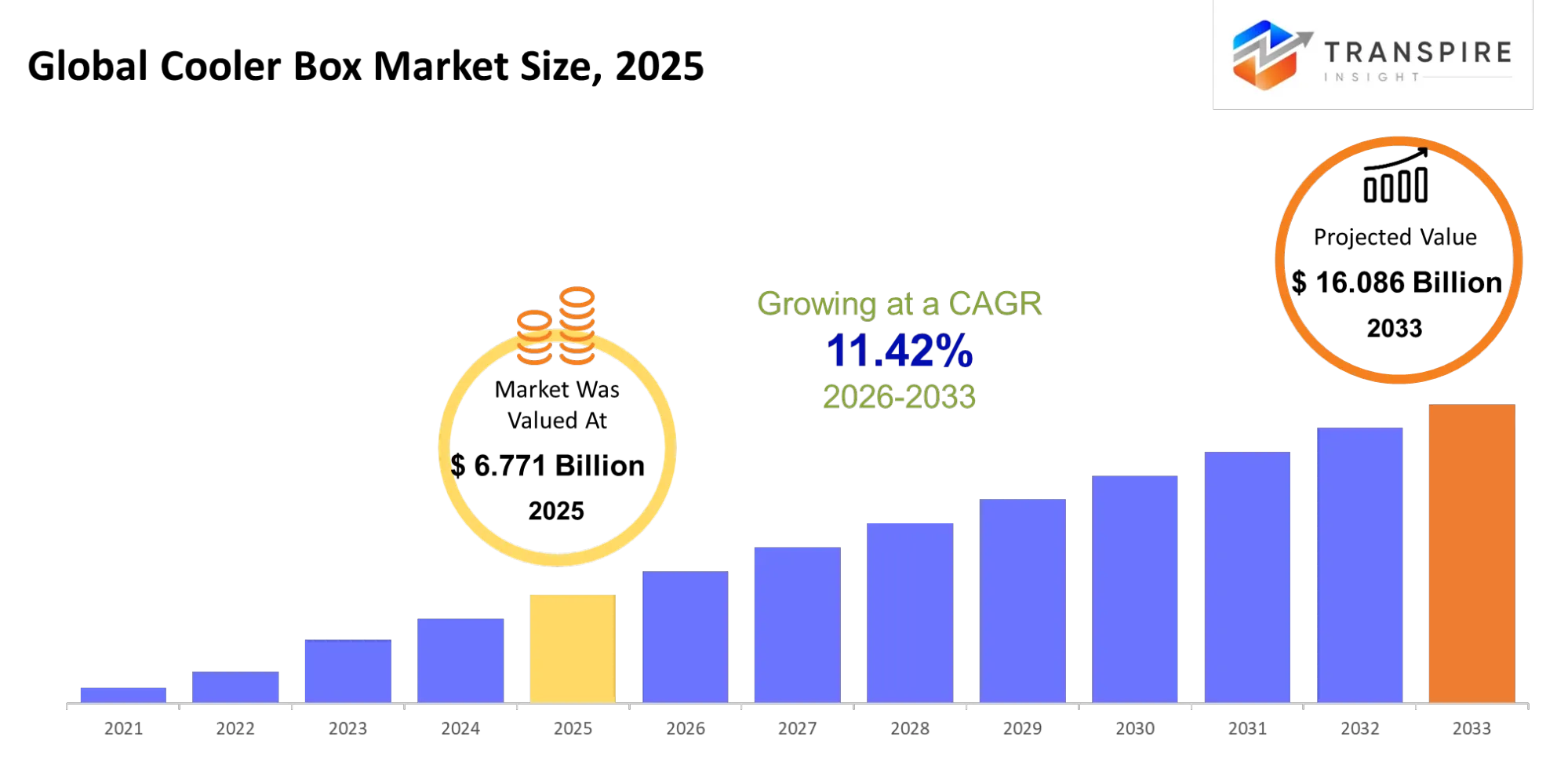
- Global Cooler Box Market Size 2025: USD 6.771 Billion
- Global Cooler Box Market Size 2033: USD 16.086 Billion
- Global Cooler Box Market CAGR: 11.42%
- Global Cooler Box Market Segments: By Type (Hard Cooler Boxes, Soft Cooler Bags, Electric Cooler Boxes, Wheeled Cooler Boxes, Marine Cooler Boxes, Insulated Cooler Containers, Others); By Application (Outdoor Recreation, Food & Beverage Storage, Medical Transportation, Camping & Hiking, Marine Applications, Others); By End-User (Consumers, Healthcare Providers, Food Service Companies, Logistics Providers, Others); By Material (Plastic Coolers, Metal Coolers, Fabric Coolers, Composite Material Coolers, Others).
To learn more about this report,  Download Free Sample Report
Global Cooler Box Market Summary:
The Global Cooler Box Market size is estimated at USD 6.771 billion in 2025 and is anticipated to reach USD 16.086 billion by 2033, growing at a CAGR of 11.42% from 2026 to 2033.
The cooler boxes are used to ensure that products like food, drinks, vaccines, and medicine stay cold in outdoor environments and during transportation. They can be considered temporary forms of refrigeration since regular methods of refrigeration are not applicable when outdoors or travelling. Within the past 3-5 years, there have been notable changes within the market, including moving from simple camp coolers to more advanced and reliable coolers that can retain a certain degree of temperature. One structural change has been the shift in temperature compliance demands in the pharmaceutical sector to ensure that their products remain intact. This change has pushed cooler companies to create more advanced coolers that will maintain the temperature for up to 7-10 days with an IoT system that measures temperature. Home delivery services have increased due to the pandemic; hence, it has acted as a catalyst for the demand for cooler boxes. This market has grown because of increased cold chain infrastructure and greater involvement in outdoor recreation (cause-and-effect).
Key Global Cooler Box Market Insights:
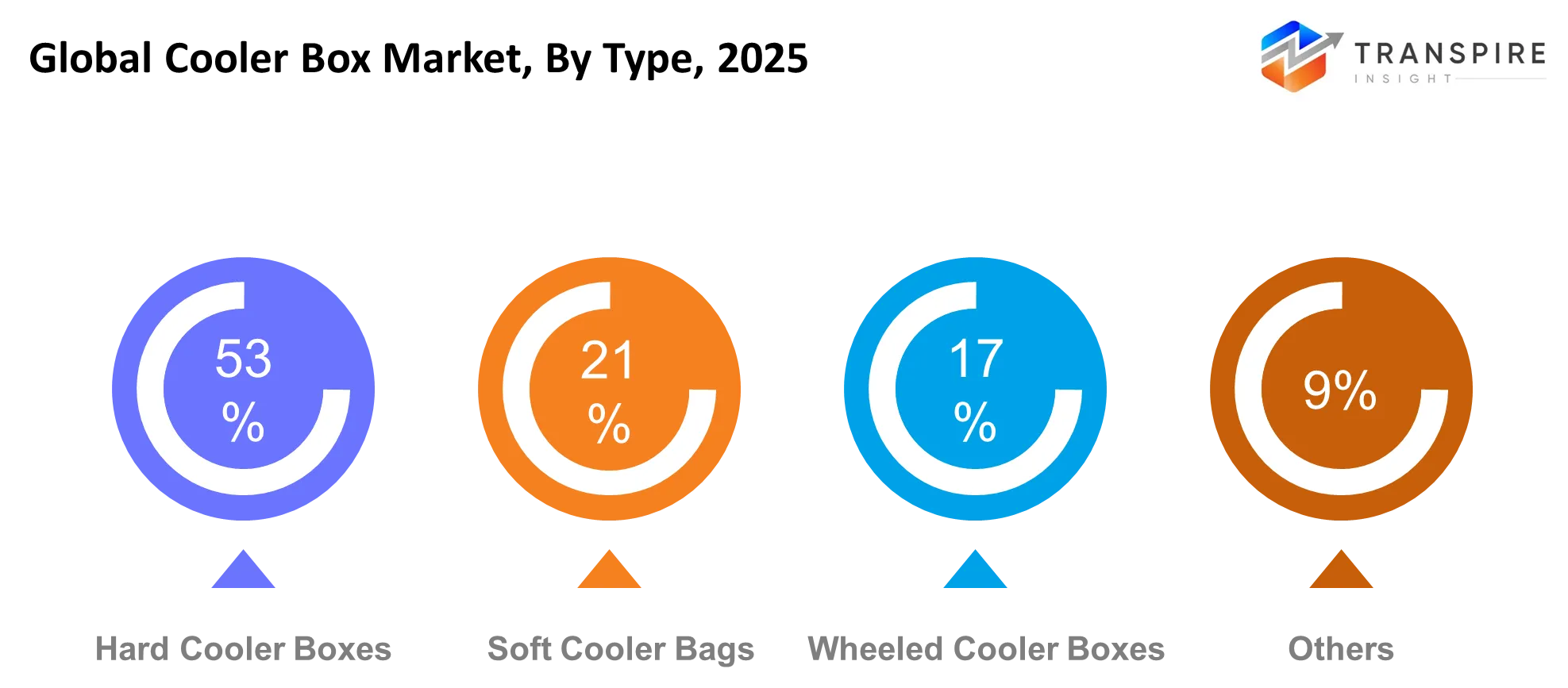
- The hard Cooler Boxes account for 53% of the market, with the YETI and Pelican brands boosting the popularity of the rotomolded construction technology that promises 7–10 days of ice retention over single-use options.
- Electric Cooler Boxes register a CAGR of 12.1% while Dometic and Engel Coolers add 12V/24V compatibility, leading RV/marine customers to continuously powered solutions instead of disposable ice coolers.
- North America currently holds 37% of the market, home to YETI, Igloo and Coleman, and boasting high disposable incomes, which means premium cooler purchases outdoors.
- Asia Pacific is growing at 11.2% CAGR, with the e-commerce food delivery market expanding, and the use of smart coolers with the help of IoT is a familiar sight for middle-class people.
- Soft Cooler Bags account for 21% of the market, with Stanley and Stanley taking the lead with portable models for urban picnics and grocery shopping.
- Reusable cooler boxes outnumber disposable options, with the green-minded consumer and European directives on environmental protection giving preference to reusable, repairable items for the circular economy.
- Medical/transport applications are the fastest-growing, as pharmaceutical companies require certified temperature-controlled transport for vaccines, with companies like Igloo obtaining compliance certifications.
- The 0-20L and 20-50L coolers account for approximately 35% of the market each, with consumers opting for personal/portable coolers vs group/ family coolers for camping and outdoor events.
What are the Key Drivers, Restraints, and Opportunities in the Global Cooler Box Market?
Drivers:
The most significant growth factor for the Global Cooler Box Market is the increasing number of people spending time outdoors, with camping, fishing, boating and road trips seeing more time in the outdoors, and also requiring reliable, days-long food and drink cold storage. This change is related to consumers' preference for leisure experiences and outdoor adventures rather than staying home. To satisfy this need, manufacturers began producing high-performance coolers that rotomolded containers can hold ice for 7-10 days. Consequently, sales of coolers are increasing as a result, and coolers are becoming more widely used for recreational and commercial applications such as food delivery, which helps to increase total market revenue.
In February 2026, Igloo Coolers launched its Tag Along Too Spinner Cooler, featuring advanced insulation, smooth multi-wheel mobility, and secure locking for extended outdoor and travel use.
Restraint:
The one obstacle is the price of replacing an advanced cooler box as opposed to a normal cooler or ice chest. The expensive models have high insulation values, tough plastics, and need complex production components, making them too costly. The problem persists as it is difficult to switch out good materials with cheaper ones without compromising on the long ice retention that customers are looking for. This makes budget-sensitive consumers less willing to purchase or opt for less expensive alternatives, thereby restricting the market expansion in places with price-sensitive consumers.
Opportunities:
The market for coolers with smart technology is huge and represents a great opportunity to increase sales in new markets such as the Asia-Pacific. Coolers are getting more and more useful for tech-savvy consumers with new features such as temperature sensors, Bluetooth applications, solar-powered cooling, etc. Asia-Pacific companies investing in smart portable coolers can leverage the increasing popularity of outdoor recreation and a booming e-commerce food delivery system, generating new revenue-generating opportunities and accelerating the growth of the market. These smart coolers are also applicable to pharmaceutical firms requiring a strict temperature compliance for transporting vaccines and medicines, and opening high-value healthcare contracts. Moreover, the solar models are attractive for those looking for eco-friendly cooling options, as they do not require electricity to power the refrigeration process or the disposal of ice.
- Instance: In January 2026, Anker SOLIX launched its solar-powered refrigeration system designed for portable cooling applications, featuring solar panel integration with battery storage that powers AC/DC output for fridges and freezers without grid electricity.
Source: https://www.ankersolix.com/blogs/fridge-power/solar-powered-refrigeration
What Has the Impact of Artificial Intelligence Been on the Global Cooler Box Market?
The AI innovations have revolutionized the cooler box industry, where smart systems using artificial intelligence have been incorporated into cooler boxes' production process. This has enabled temperature insulation tests, material optimisation, and fast prototyping, among other advantages.
The use of AI innovation is manifested in the predictive capabilities of these coolers by examining usage and climatic data and designing the cooler in the best way possible. The smart cooling system uses AI with big data analysis, which allows for automation of operation and setting up of the right parameters depending on the historical and current operating conditions, thus improving its performance while minimising energy consumption. Remote monitoring of the cooler is made easier by the Internet of Things, where real-time diagnostics and equipment status can be checked at any moment. Other operational efficiencies associated with AI innovation include automation of logistics processes such as real-time inventory management, predicting restocking, and fast delivery, among others. However, the most critical challenge with AI innovations in coolers is their high cost, which limits smaller and mid-size companies from embracing them due to the existing competition between premium and budget coolers.
- Instance: In November 2025, Frigoglass (a major manufacturer of commercial refrigeration) partnered with NU!, a French technology company. A new generation of AI-driven, IoT-connected commercial smart coolers. The partnership was formed to integrate NU!’s smart shelf systems—which utilise weighing sensors, cameras, and AI processing—into Frigoglass’s vending coolers.
Key Global Cooler Box Market Trends:
The Global Cooler Box Market has moved away from conventional ice retention and toward smartness, sustainability, and application-specific solutions due to changing needs within the pharmaceutical cold chain and green consumerism trends.
- Reusable Cooler boxes are no longer competing with the disposable variety as sustainability and practicality outweigh convenience in cooler buying decisions.
- The technology used in rotomolded coolers has advanced beyond its initial premium status as seen in YETI coolers to become an industry standard for 7-10 days of ice retention for Coleman, Pelican, and ORCA coolers.
- The pharmaceutical cold chain market segment, which initially was of secondary importance, became the key growth factor due to the demand for coolers specified to meet pharmaceutical standards.
- Electrical coolers with 12v/24v capabilities have advanced from the marine market segment, where the technology originated, to gain wider popularity for non-traditional applications like food delivery and catering services.
- IoT temperature monitoring and tracking have shifted from a luxury feature to a necessary characteristic for pharmaceutical compliance purposes to ensure cold chain integrity.
- The cooler box uses recyclable and bio-based insulating materials instead of petroleum-based polyurethane foam and expanded polystyrene as the push towards sustainable materials becomes stronger.
- Direct-to-consumer sales methods have progressed from additional sources of income to becoming the primary way of selling high-end brands due to higher profits and customer insights.
- Market growth in regions other than the mature markets of North America and Europe has become an increasing trend as the Asian Pacific region grows.
Global Cooler Box Market Segmentation
By Type:
Hard Cooler Boxes dominate the market with 53% of total market share, with their rotomolded construction and best ice-retaining performance in 7–10 days, making them the preferred choice for outdoor recreational, camping and pharmaceutical transport applications. Soft Cooler Bags make up 21% of the market, providing portability and affordability for urban picnics and grocery runs, and Wheeled Cooler Boxes make up 17%, serving as solutions for mobility for elderly consumers and for large groups. The fastest-growing coolers, Electric Cooler Boxes, will see a CAGR of 12.1%, as they are growing in popularity with RV/marine usage and food delivery logistics necessitating constant cooling. The remaining 9% are made up of Marine Cooler Boxes, Insulated Cooler Containers, and Others.
To learn more about this report, Download Free Sample Report
By Application:
Outdoor Recreation and Camping & Hiking collectively dominate due to North America's strong outdoor culture, followed by Food & Beverage Storage, driven by meal kit delivery services and organised retail. Medical Transportation is the fastest growing application, because the requirements of the vaccine cold chain demand certified temperature-controlled transport, and Marine Applications are niche boating and fishing markets.
By End-User:
Consumers are the biggest market segment, with retail sales for end-user use on the rise, and Healthcare Providers are quickly growing as pharmaceutical companies are investing in solutions certified to meet compliance standards. Food Service Companies and Logistics Providers continue to expand by investing in food delivery and last-mile cold chain infrastructure.
By Material:
Plastic Coolers are the leader in polyurethane foam and EPS insulation, Metal Coolers are gaining ground in premium durability segments, Fabric Coolers take the lead in soft-sided applications, and Composite Material Coolers are working their way into the lightweight and eco-conscious consumer segments looking for sustainable options.
What are the Key Use Cases Driving the Global Cooler Box Market?
Outdoor recreation is the leading demand in the Global Cooler Box Market, with activities like camping, fishing, and picnicking fueling growth in the 0-20L and 20-50L cooler box size categories, accounting for 65.90% of the market size in 2025.
The cold chain logistics of pharmaceuticals and retail distribution are emerging applications, as cooler boxes carry vaccines, medicines, and temperature-sensitive foods during transit. Delivery services and logistics have become more dependent on portable coolers for ease and refrigeration purposes.
Electric coolers for RV and boat use, solar energy-powered coolers for field workers, and emergency supplies coolers are some upcoming application areas. Lifestyle uses such as personal coolers for city picnics, school events, and grocery shopping are being developed.
|
Report Metrics |
Details |
|
Market size value in 2025 |
USD 6.771 Billion |
|
Market size value in 2026 |
USD 7.544 Billion |
|
Revenue forecast in 2033 |
USD 16.086 Billion |
|
Growth rate |
CAGR of 11.42% from 2026 to 2033 |
|
Base year |
2025 |
|
Historical data |
2021 - 2024 |
|
Forecast period |
2026 - 2033 |
|
Report coverage |
Revenue forecast, competitive landscape, growth factors, and trends |
|
Regional scope |
United States; Canada; Mexico; United Kingdom; Germany; France; Italy; Spain; Denmark; Sweden; Norway; China; Japan; India; Australia; South Korea; Thailand; Brazil; Argentina; South Africa; Saudi Arabia; United Arab Emirates |
|
Key company profiled |
YETI Holdings, Coleman, Igloo Products, Pelican Products, Engel Coolers, ORCA Coolers, Stanley, Arctic Zone, Thermos, Dometic, Koolatron, Rubbermaid, RTIC Outdoors, Grizzly Coolers, Cabela’s. |
|
Customization scope |
Free report customisation (country, regional & segment scope). Avail customised purchase options to meet your exact research needs. |
|
Report Segmentation |
By Type (Hard Cooler Boxes, Soft Cooler Bags, Electric Cooler Boxes, Wheeled Cooler Boxes, Marine Cooler Boxes, Insulated Cooler Containers, Others); By Application (Outdoor Recreation, Food & Beverage Storage, Medical Transportation, Camping & Hiking, Marine Applications, Others); By End-User (Consumers, Healthcare Providers, Food Service Companies, Logistics Providers, Others); By Material (Plastic Coolers, Metal Coolers, Fabric Coolers, Composite Material Coolers, Others). |
Which Regions are Driving the Global Cooler Box Market Growth?
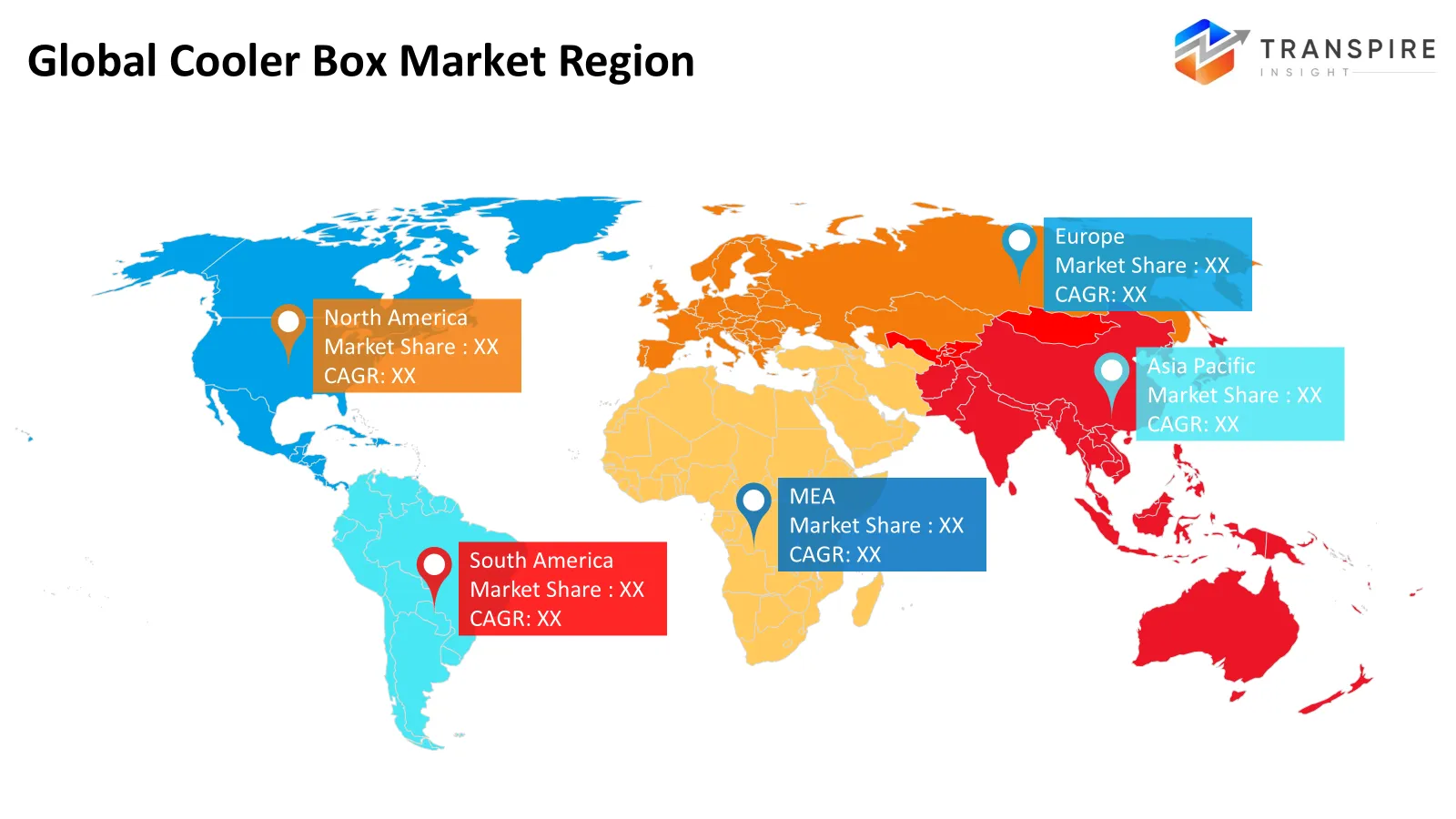
The Global Cooler Box Market in North America dominates the global market, with around 37% of the global revenues. Well-developed outdoor recreation culture in the region creates a steady demand for high-performance cooling products, including outdoor camping, fishing, hunting, boating and tailgating. The retail environment is robust, with speciality outdoor retailers, sport shops and e-commerce retailers, resulting in a wide choice and high penetration of premium brands. Additionally, advanced logistics infrastructure, increasing recreational vehicle ownership and rigorous food and beverage transportation safety regulations are expected to fuel continued growth and increased investment in durable cooler box solutions.
- Instance: In January 2026, YETI partnered with League One Volleyball (LOVB). YETI became the official cooler and drinkware partner of LOVB Pro and LOVB Clubs, integrating its premium cooling products on the sidelines and during athlete training sessions.
Europe delivers the second largest share, 28%, and is powered by other growth drivers than North America. Leveraging sustainable consumer products, an organised tourism network and widespread adoption of transportable cooling solutions, Europe's economy is mainly supported by non-outdoor adventure spending. The well-established regulatory framework in the region promotes the creation of energy-efficient and eco-friendly products, contributing to the stability of the market in the long term. The rest of Europe is further bolstered by high disposable incomes, developed distribution channels and regular sales of coolers to consumers as well as commercial users.
- Instance: In March 2026, LG Electronics partnered with MCE (Biennial HVAC Tradeshow) in Milan to launch an expanded lineup of R290-based air-to-water heat pump solutions. The reason for this launch was to meet Europe's surging demand for energy-efficient, eco-friendly heating and cooling systems while complying with strict regional environmental regulations.
Asia Pacific is the largest market, at present accounting for 26% of the total and is expected to grow at a CAGR of 11.2%. The growth has been fueled by the rapid urbanisation, growth of the middle class and increase in inbound tourism in countries like China, India, Indonesia and Thailand. The growth of cold chain infrastructure, awareness of outdoor recreation, and the rise of online retail platforms have contributed to increased access to products. Cold chain infrastructure, outdoor recreation awareness, and an increase in online retail platforms have made it easier to access products. Future opportunities for market players include investments in smart cooler technologies, regional manufacturing facilities, and investments in temperature-sensitive pharmaceutical distribution.
- Instance: In August 2025, Celcius Logistics announced a strategic launch of Celcius+, investing ₹50 crore to build a dedicated pharmaceutical fleet and partner with top pharmaceutical firms. To directly address the surging demand for temperature-sensitive drug distribution and to meet stricter regulatory and compliance controls for vaccines across India's expanding supply chain.
To learn more about this report, Download Free Sample Report
Who are the Key Players in the Global Cooler Box Market and how do they Compete?
The cooler box industry is moderately concentrated, with major companies (YETI, Igloo, Coleman, Pelican, ORCA) sharing a combined ~40% of global market revenue. There are premium hardened coolers, portable electric coolers, and soft coolers in the industry, where competition is based on ice retention capacity, durability, and brands and not merely pricing. YETI pursues an innovation strategy with premium differentiation through roto-molding technology and 7 to 10 days of ice retention capacity, growing through direct consumer sales channels and product line extension within the hunting and fishing segment. Coleman and Igloo utilise a cost leadership strategy, with differentiation through value-oriented pricing and broad distribution networks, expanding through online retailing channels in the Asia-Pacific region. RTIC Outdoors follows a niche disruption strategy by providing 90% of YETI’s product quality for 50% pricing, with aggressive internet marketing and exclusive private label distribution. Pelican Products follows a niche strategy in the industrial market with military-grade durability certification, lifetime warranties, and expansion into the pharmaceutical cold-chain logistics industry. Dometic and Engel Coolers focus on the electric cooler segment with an innovation strategy, differentiating through 12V/24V compatibility and expansion into the RV/marine market.
Key Players are:
- YETI Holdings
- Coleman
- Igloo Products
- Pelican Products
- Engel Coolers
- ORCA Coolers
- Stanley
- Arctic Zone
- Thermos
- Dometic
- Koolatron
- Rubbermaid
- RTIC Outdoors
- Grizzly Coolers
- Cabela’s
Recent Development News
- In April 2026, Ninja launched the FrostVault Hard Cooler series. This product line introduces drawer-based access and advanced thermal retention, allowing users to access items without exposing the main compartment to warm outside air.
Source: https://www.which.co.uk/reviews/food-and-drink-storage/article/best-cool-boxes-a1StQ2z2mxWO
- In January 2026, Market Research Future published a comprehensive strategic report on the global cool box and temperature-controlled appliance market. This report identifies a significant trend of consumers and logistics firms shifting towards lightweight, high-efficiency rigid cooling solutions.
Source: https://www.precisioncncsolutions.com/blog/2026-top-plug-in-cool-box-features-for-buyers/
What Strategic Insights Define the Future of the Global Cooler Box Market?
The market for cool boxes will be rapidly moving towards a value of USD 16.086 with a CAGR of 11.42%, influenced by growth in the expansion of cold chains in the pharmaceutical industry, organised retail, and the rising need for outdoor recreation. Fluctuations in the price of petroleum directly affect the cost of production of polyurethane foam and EPS, which results in reduced margin space for manufacturers, along with the growing pressure to move to costly, environmentally sustainable materials without guaranteed premium prices. Reusability becomes the primary factor that drives market growth as environmentally conscious customers, along with pharmaceutical clients, seek cool boxes that can offer them sustainable, long-lasting products with improved cold retaining properties and certifications. Recommended strategy is that manufacturers should focus on utilising bio-based insulating materials along with IoT-enabled cooling systems with real-time temperature control capabilities.
Key Segmentations are:
By Type
- Hard Cooler Boxes
- Soft Cooler Bags
- Electric Cooler Boxes
- Wheeled Cooler Boxes
- Marine Cooler Boxes
- Insulated Cooler Containers
- Others
By Application
- Outdoor Recreation
- Food & Beverage Storage
- Medical Transportation
- Camping & Hiking
- Marine Applications
- Others
By End-User
- Consumers
- Healthcare Providers
- Food Service Companies
- Logistics Providers
- Others
By Material
- Plastic Coolers
- Metal Coolers
- Fabric Coolers
- Composite Material Coolers
- Others
Regional Outlook
North America
- United States
- Canada
- Mexico
Europe
- Germany
- United Kingdom
- France
- Spain
- Italy
- Rest of Europe
Asia Pacific
- Japan
- China
- Australia & New Zealand
- South Korea
- India
- Rest of Asia Pacific
South America
- Brazil
- Argentina
- Rest of South America
Middle East & Africa
- Saudi Arabia
- United Arab Emirates
- South Africa
- Rest of the Middle East & Africa
Frequently Asked Questions
Find quick answers to common questions.
The global cooler box market size was valued at USD 6.771 Billion in 2025 and is poised to reach USD 16.086 Billion by 2033, expanding at a 11.42% CAGR.
Key segments for the global cooler box market are By Type (Hard Cooler Boxes, Soft Cooler Bags, Electric Cooler Boxes, Wheeled Cooler Boxes, Marine Cooler Boxes, Insulated Cooler Containers, Others); By Application (Outdoor Recreation, Food & Beverage Storage, Medical Transportation, Camping & Hiking, Marine Applications, Others); By End-User (Consumers, Healthcare Providers, Food Service Companies, Logistics Providers, Others); By Material (Plastic Coolers, Metal Coolers, Fabric Coolers, Composite Material Coolers, Others).
Growth is primarily driven by the expansion of outdoor recreation, pharmaceutical cold chain logistics, and mobile food delivery services that require reliable temperature-controlled storage. The post-pandemic surge in e-commerce, food delivery, and organised retail has created sustained demand for portable cooling during last-mile delivery and for cold chain infrastructure development.
The global cooler box market is led by major manufacturers, including YETI Holdings, Coleman, Igloo Products, Pelican Products, Engel Coolers, ORCA Coolers, Stanley, Arctic Zone, Thermos, Dometic, Koolatron, Rubbermaid, RTIC Outdoors, Grizzly Coolers, and Cabela’s.
North America makes up 37% of the global market share for cooler boxes due to factors such as having a rich outdoor activity-based culture, well-developed cold chain logistics, major manufacturers such as YETI, Igloo, and Coleman, strict temperature controls, and high disposable income.
Key commercial opportunities include smart coolers with IoT sensors for pharmaceutical cold chain compliance and solar-powered models for eco-conscious consumers in Asia-Pacific's booming e-commerce market. Direct-to-consumer channels and off-grid rural expansion with solar cooling solutions offer significant revenue potential for emerging middle-class markets.
- YETI Holdings
- Coleman
- Igloo Products
- Pelican Products
- Engel Coolers
- ORCA Coolers
- Stanley
- Arctic Zone
- Thermos
- Dometic
- Koolatron
- Rubbermaid
- RTIC Outdoors
- Grizzly Coolers
- Cabela’s
About the Authors

Chetan Dhatrak
I’m Chetan Dhatrak, a Senior Research Analyst at Transpire Insight, specializing in the Consumer Goods, Foods and Beverages industry. I focus on analyzing market trends, consumer behavior, competitive landscapes, and industry developments to deliver accurate, data-driven insights. My research at Transpire Insight is built on credible sources and in-depth analysis, helping businesses and readers better understand market dynamics, emerging opportunities, and evolving consumer preferences. I’m committed to creating reliable, well-researched content that supports informed decision-making and reflects the latest developments in the consumer goods and food & beverage sectors.

Chakradhar Khansole
Chakradhar serves as the Research Director at Transpire Insight, bringing over 8 years of experience in technology, innovation, and strategic market intelligence. He specializes in transforming complex market data into actionable business insights that enable organizations to make informed, growth-oriented decisions. Recognized for his strategic vision and analytical expertise, Chakradhar leads high-impact research initiatives, delivering comprehensive market assessments, competitive intelligence, and forward-looking industry analysis.
Recently Published Reports
-
Apr 2026
Bottled Water Market
Bottled Water Market Size, Share & Analysis Report By Product Type (Still Bottled Water, Carbonated Bottled Water, Functional Bottled Water, and Others), By Packaging (PET, Cans, and Others), By Sales Channel (Supermarkets/Hypermarkets, Convenience Stores/Drug Stores, Grocery Stores/Club Stores, Foodservice, and Others) and Geography (North America, Europe, Asia-Pacific, Middle East and Africa, South and Central America), 2021 - 2032
-
Apr 2026
Color Cosmetic Packaging Market
Color Cosmetic Packaging Market Size, Share & Analysis Report By Application (Mascara Packaging, Liquid Packaging, and Liquid Face), By Type (Tubes & Bottles, Pens & Markers, Compacts & Containers, and Droppers & Pumps), and Geography (North America, Europe, Asia-Pacific, Middle East and Africa, South and Central America), 2021 - 2031
-
Apr 2026
External Microphone For Camera Market
External Microphone For Camera Market Size, Share & Analysis Report By Type (Shotgun Microphone, Lavalier Microphone, and Others), By Application (Digital Camera, Professional Video Camera, and Others), and Geography (North America, Europe, Asia-Pacific, Middle East and Africa, South and Central America), 2021 - 2031
-
Apr 2026
Foot Orthotic Insoles Market
Foot Orthotic Insoles Market Size, Share & Analysis Report By Type (Pre-fabricated, and Custom-made), By Material (Thermoplastic, Composite Carbon Fiber, and Others), By Distribution Channel (Drug Stores, Hospitals & Clinics, and Others), and Geography (North America, Europe, Asia-Pacific, Middle East and Africa, South and Central America), 2021 - 2031