

Global Pharmaceutical Warehousing Market Size & Forecast:
- Global Pharmaceutical Warehousing Market Size 2025: USD 58.29 Billion
- Global Pharmaceutical Warehousing Market Size 2033: USD 94.37 Billion
- Global Pharmaceutical Warehousing Market CAGR: 6.21%
- Global Pharmaceutical Warehousing Market Segments: By Type (Cold Storage Warehousing, Ambient Warehousing, Controlled Substance Warehousing, Automated Pharmaceutical Warehousing, Hazardous Drug Warehousing, Smart Warehousing Systems, Others); By Application (Drug Storage, Vaccine Storage, Clinical Trial Supply, Biologics Warehousing, Medical Device Storage, Others); By End-User (Pharmaceutical Companies, Hospitals, Contract Manufacturers, Distributors, Others); By Technology (IoT-enabled Warehousing, AI-driven Inventory Systems, Robotics-integrated Warehousing, Others)

To learn more about this report,  Download Free Sample Report
Global Pharmaceutical Warehousing Market Summary:
The Global Pharmaceutical Warehousing Market size is estimated at USD 58.29 billion in 2025 and is anticipated to reach USD 94.37 billion by 2033, growing at a CAGR 6.21% from 2026 to 2033.
Pharmaceutical warehousing provides a secure environment for maintaining the temperature-sensitive nature of pharmaceuticals, vaccines, and other advanced treatments before they reach the hospital's pharmacies. In recent times, spanning the past three to five years, this market segment transformed from conventional storage units into a complex distribution system. This transition was necessitated by the huge upsurge in the manufacture of sensitive biological treatments that cannot tolerate slight environmental changes and degrade immediately. This change was marked by strict temperature tracking and safety measures implemented in the industry, rendering conventional storage methods irrelevant.
With these drugs necessitating precise temperature conditions at all levels of delivery and due to increasing urban population centres in the Asia Pacific and expanding distribution channels in North America, there is great investment in the establishment of cold storage plants.
Key Market Insights:
The pharmaceutical warehousing industry will develop with the growing need for a cold chain and secured delivery system for medicines. Temperature-controlled warehouses and automated warehousing system expansion will help this market to develop.
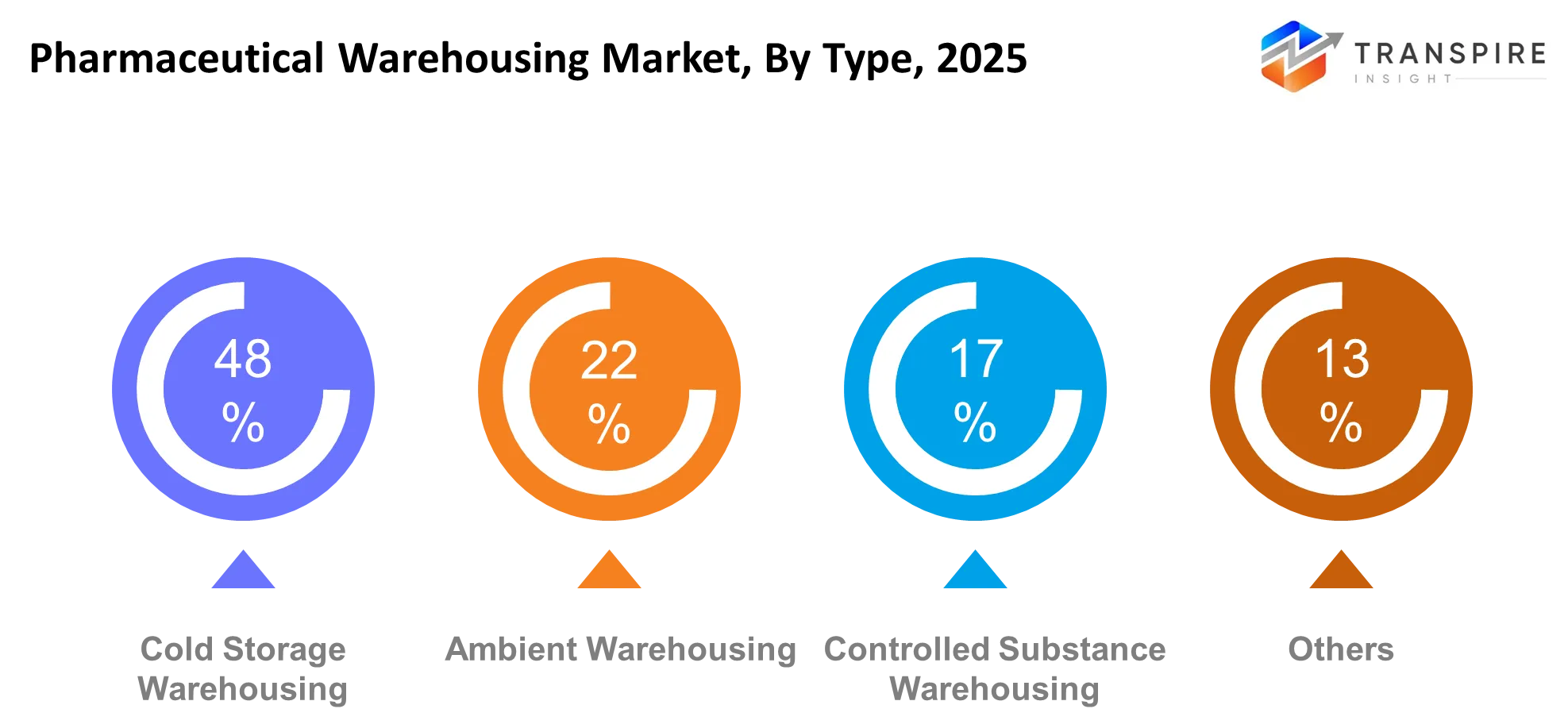
- Cold Storage Warehousing formed 48% segment share, emerging as the dominant type of warehousing.
- Ambient Warehousing constituted 22% market share because of the growing demand for storage of pharmaceutical products.
- Controlled Substance Warehousing formed 17% segment share owing to the increased requirement for medicine storage.
- Others formed 13% market share with their specialized warehousing solutions.
- Automated Pharmaceutical Warehousing is forecasted to witness a CAGR of 11.5% owing to increased adoption of automated storage solutions.
- There has been an increase in cold chain logistics for efficient storage and handling of medicines by pharmaceutical companies.
- Warehouses are now equipped with improved monitoring systems owing to the increased need for inventory management.
- There are increased pharmaceutical distribution activities driving warehousing solutions investments.
What are the Key Drivers, Restraints, and Opportunities in the Global Pharmaceutical Warehousing Market?
Driver:
The need for safe transport of delicate biopharmaceuticals, prevention of operational mistakes, and facilitation of the sale of digital medicines is behind a huge rise in the logistics industry. This development has been catalyzed by an increase in the prevalence of chronic illnesses that necessitate treatment through temperature-sensitive medication, technological developments in terms of IoT devices and automation, and consumers' transition to online pharmacies. All of these factors have a significant influence on industry revenues as well as the implementation of new infrastructure, causing the market size to increase considerably during the following ten years in constant terms of compound annual growth rate. In order to tap into the growing market, warehouse operators are now rapidly moving away from outdated facilities to build highly advanced distribution centres and cold chain infrastructure. This use of climate-controlled and automated logistics leads to incredibly profitable revenue flows for today's logistics providers.
Restraint:
Operational costs associated with pharmaceutical warehousing remain relatively high and pose a restraint on market growth. High capital expenditure and operational costs are required to ensure temperature control and regulation, continuous power supply, proper handling, and other regulations at pharmaceutical warehouses.
Opportunity:
Market players see many business opportunities resulting from increased automation in pharmaceutical warehousing. Advanced technologies enable businesses to optimise their warehousing process and decrease the risks that arise due to product handling operations. Rising manufacturing and healthcare sector investments in Asia-Pacific are also expected to boost the establishment of new pharmaceutical warehousing facilities and logistics.
What Has the Impact of Artificial Intelligence Been on the Global Pharmaceutical Warehousing Market?
There have been significant changes in pharmaceutical warehousing through the use of automated storage, digital inventory control, and intelligent monitoring in warehouses. Warehouse managers are using automated storage systems and monitoring tools to effectively manage medicine storage by ensuring there is appropriate storage of pharmaceutical products in warehouses.
Predictive monitoring systems are now being used by various organizations to predict possible problems such as temperature change, lack of inventory, and other storage issues that might cause problems in storing pharmaceutical products in warehouses. The operations within warehouses have improved through automated inventory control, stock monitoring in the digital sense, and faster order processing in pharmaceuticals. Several pharmaceuticals are adopting automation technology to eliminate manual activities in their warehouses in order to increase storage accuracy and distribution efficiencies.
The cost implications and technical integration issues with the automated warehousing system have continued to be major challenges for several pharmaceutical storage firms. Many small and mid-sized pharmaceutical storage firms have had difficulty implementing automated storage solutions in their warehouses. In November 2025, Cencora disclosed a USD 1 billion capital outlay for the expansion of its pharmaceutical supply chain facilities within the U.S., with the inclusion of automatic distribution centres having robotic pickers and advanced cold storage facilities for specialty drugs.
Key Market Trends:
Warehouses that deal in pharmaceuticals are paying attention to the fast delivery of drugs, improved cold chain infrastructures, and better storage management. Growth in the number of temperature-controlled warehouses and the modernisation of warehouse infrastructures remain important in shaping the pharmaceutical industry's storage facilities.
- Growth in cold storage warehouses has emerged as a result of growing movements of vaccines, biological, and speciality drugs.
- Pharmaceutical firms are improving their warehouse infrastructures to enhance drug delivery processes.
- Pharmaceutical storage warehouses are implementing temperature monitoring tools to ensure the integrity of products.
- Manual storage techniques within warehouses are now giving way to automatic handling systems.
- Refrigerated storage services have gained prominence due to the rising need for temperature-sensitive drugs.
- Pharmaceutical companies are modernising their storage infrastructures to improve capacity and inventory movement.
- Real-time inventory tracking systems have become commonplace among pharmaceutical distribution centres.
- Securing pharmaceutical products within storage facilities has become essential because of growing regulations.
- Warehouse modernisation trends are on the rise within the pharmaceutical industry to expedite order handling operations.
- Growing manufacturing operations within the pharmaceutical industry continue to increase the demand for large storage facilities.
Global Pharmaceutical Warehousing Market Segmentation
By Type
The share of Cold Storage Warehousing was 57%, driven by growing demand for vaccine storage, biologics and temperature-sensitive drugs. Cold Storage Warehousing constituted 48% share, sustaining its status as the leading type of warehousing used in pharmaceuticals. The need for chilled warehouse facilities by pharmaceutical firms to sustain the stability throughout storage and transport processes. Ambient Warehousing had 22% market share, attributed to the increased storage capacity of conventional medicines and healthcare products. Warehouse handling and management are gaining traction in expanding pharmaceutical distribution channels. Controlled Substance Warehousing gained 17% market share due to stringent medicine storage regulations and rising concern for secure pharmaceutical handling practices. Pharmaceutical companies are developing advanced monitoring and regulated storage operations in their warehouses. Others had 13% market share from specialised pharmaceutical warehouses and customised warehouse facilities for healthcare products.
To learn more about this report, Download Free Sample Report
By Applications
Drugs Warehousing and Vaccines Warehousing have continued to be key applications owing to increasing pharmaceutical logistics operations within the healthcare industry. There is increased focus on building cold chain logistics systems for facilitating the safe handling of temperature-sensitive drugs and vaccines. Specialty Drugs Warehousing has become a significant factor owing to the increased manufacturing of specialty drugs needing stable warehouse facilities and controlled logistics operations. Another important warehousing factor is that of Clinical Trials Supply Warehousing, owing to increased medical testing.
By End-Users
The Pharmaceutical companies still remain dominant end-users as they have large production and distribution operations. The companies are making efforts to invest in safe warehouse storage space, cold warehousing systems, and inventory management to enhance supply chain management in the pharma industry. Hospitals and Distributors are also looking to increase their warehousing capabilities for better provision of medicines. There has been increased demand for Contract Manufacturing from manufacturers of pharmaceuticals requiring flexibility in storing and distributing medicines.
By Technology
Automated Pharmaceutical warehousing is anticipated to witness a growth by 11.5% CAGR. This will be fueled by the adoption of automated inventory solutions, digitised monitoring platforms, and material handling technologies that can streamline warehouse operations.
IoT-enabled warehouses and robotics-enabled warehouses are gaining importance in the pharma warehousing sector because of real-time tracking, automated handling, and other improvements in warehousing operations.
What are the Key Use Cases Driving the Global Pharmaceutical Warehousing Market?
Storage of vaccines, biologics, and temperature-sensitive drugs continues to be a critical application area in the Global Pharmaceutical Warehousing Market. Increasing the use of storage and handling technologies for medicines through the cold chain is becoming an important focus for pharmaceutical companies.
Distribution of medicines along with their storage operations from hospital to hospital and from distributor to distributors are other factors aiding the growth of the market. Improvement in systems and processes related to medicine storage and movement is becoming necessary. Biologics storage, handling of clinical trial supplies, and management of speciality pharmaceuticals form some of the emerging applications in the market. Better monitoring systems and storage techniques are being sought to handle such medicines.
|
Report Metrics |
Details |
|
Market size value in 2025 |
USD 58.29 Billion |
|
Market size value in 2026 |
USD 61.91 Billion |
|
Revenue forecast in 2033 |
USD 94.37 Billion |
|
Growth rate |
CAGR of 6.21% from 2026 to 2033 |
|
Base year |
2025 |
|
Historical data |
2021 - 2024 |
|
Forecast period |
2026 - 2033 |
|
Report coverage |
Revenue forecast, competitive landscape, growth factors, and trends |
|
Regional scope |
United States; Canada; Mexico; United Kingdom; Germany; France; Italy; Spain; Denmark; Sweden; Norway; China; Japan; India; Australia; South Korea; Thailand; Brazil; Argentina; South Africa; Saudi Arabia; United Arab Emirates |
|
Key company profiled |
DHL Supply Chain, UPS Healthcare, FedEx Healthcare, Kuehne + Nagel, DB Schenker, AmerisourceBergen, Cardinal Health, McKesson, CEVA Logistics, XPO Logistics, DSV, Nippon Express, Agility Logistics, GXO Logistics, Lineage Logistics |
|
Customization scope |
Free report customization (country, regional & segment scope). Avail customized purchase options to meet your exact research needs. |
|
Report Segmentation |
By Type (Cold Storage Warehousing, Ambient Warehousing, Controlled Substance Warehousing, Automated Pharmaceutical Warehousing, Hazardous Drug Warehousing, Smart Warehousing Systems, Others); By Application (Drug Storage, Vaccine Storage, Clinical Trial Supply, Biologics Warehousing, Medical Device Storage, Others); By End-User (Pharmaceutical Companies, Hospitals, Contract Manufacturers, Distributors, Others); By Technology (IoT-enabled Warehousing, AI-driven Inventory Systems, Robotics-integrated Warehousing, Others) |
Which Regions are Driving the Global Pharmaceutical Warehousing Market Growth?
North America
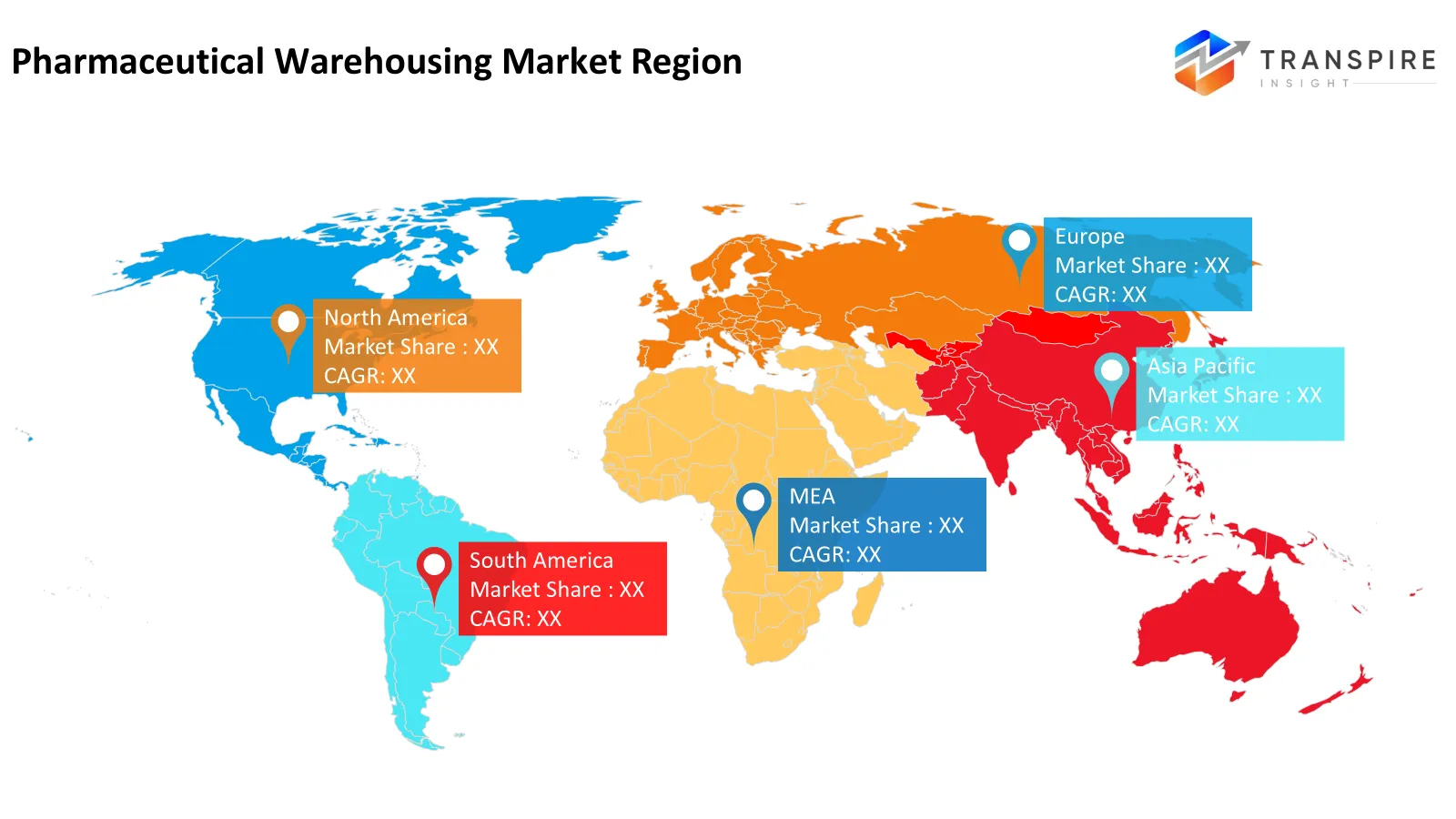
The North American continent plays a crucial role as a leader in the pharmaceutical warehousing industry, accounting for an enormous 39% of the world’s market share. This dominance is attributed to the huge boom in retail online transactions, along with the necessity for efficient logistics systems. The structure of this region is based on extremely high standards since all activities should be performed according to the guidelines of the FDA. Since local logistics providers continue to invest heavily in the creation of broad distribution channels, North America keeps its prominent place in the world of medicine.In September 2025, a pharmaceutical distribution firm operating in the U.S. increased its refrigerated storage capabilities to enhance its storage capabilities of specialised drugs and vaccines within its regional health care systems.
Europe
Europe acts as the second-largest region in the context of this logistics area, holding an impressive share of 29% in the entire global logistics business. Whereas North America largely benefits from changes in technology as well as increases in retail figures to grow, Europe’s logistics market growth largely depends on demographic changes, involving an aging population base and continuous investments in healthcare services by the state. The European Medicines Agency serves as an excellent structural support for the region in terms of implementing common safety standards in major countries such as Germany, France, and the United Kingdom.In July 2025, Germany's warehouse operators for pharmaceuticals enhanced their temperature-controlled storage systems and medicine monitoring systems to assist with regulated pharmaceutical activities.
Asia-Pacific
The Asia-Pacific region can be considered to be the fastest-growing market around the globe, occupying a whopping 24% market share in addition to experiencing a phenomenal CAGR of 12.8%. This is owing to the introduction of huge numbers of investments within the health sector, together with the growth of pharmaceutical plant facilities in China, India, and Japan. There is increasing pressure on regional authorities to adopt stringent control policies, which leads to a quick migration away from old warehouse facilities towards advanced storage facilities. With this modernization trend, tremendous business opportunities arise for international logistics companies such as Kuehne Nagel and UPS Supply Chain Solutions in securing their presence in the coming years, leaving the ROW with just 8% of the market share. In March 2026, the Indian pharmaceutical industries increased its investment in cold chain warehouses to provide adequate storage for biologics and exports of medicines
To learn more about this report, Download Free Sample Report
Who are the Key Players in the Global Pharmaceutical Warehousing Market and how do they Compete?
Pharmaceutical warehousing involves stiff competition owing to specific cold chain needs and strict regulations. To gain a competitive advantage and market share, global logistics integrators and healthcare distributors are abandoning price competition and moving towards technological distinction and geographical infrastructure. Such a fragmented market requires operators to have unique capabilities in order to handle intricate temperature-controlled supply chains.
The dominant players in the North American market include AmerisourceBergen, McKesson Corporation, and Cardinal Health, which have adopted innovative approaches to business. These firms differentiate themselves by offering predictive data analysis and automated warehouse management technologies, which are embedded within client processes. The growth strategies adopted by these firms revolve around digitalisation and commercial partnership initiatives. players like DHL Supply Chain, UPS Healthcare, and Kuehne + Nagel adopt niche differentiation and specialisation. Their growth strategies involve large investments in state-of-the-art robotic and artificial intelligence technologies for managing inventories and ultra-cold warehouses. Their growth strategies revolve around geographic acquisitions of local health providers and business collaborations with biotech companies.
Global Pharmaceutical Warehousing Market companies
- DHL Supply Chain
- UPS Healthcare
- FedEx Healthcare
- Kuehne
- NagelD
- Schenker
- AmerisourceBergen
- Cardinal Health
- McKesson
- CEVA Logistics
- XPO Logistics
- DSV
- Nippon Express
- Agility Logistics
- GXO Logistics
- Lineage Logistics
Recent Development News
In January 2026, UPS Healthcare launched its state-of-the-art "UPS HealthTech" facility to cater to the needs of the North American market. This is a new concept that offers integrated inventory storage, transportation facilities, and installation facilities for clinical and medical equipment.
In December 2025. Healthcare logistics company UPS Healthcare completed its corporate purchase of the Andlauer Healthcare Group (AHG). The merger will help the company expand its temperature-controlled storage and cold chain shipping capabilities in the North American clinical market sector.
What Strategic Insights Define the Future of the Global Pharmaceutical Warehousing Market?
Global Pharmaceutical Warehousing Market trends indicate the future towards greater emphasis on building up more cold chain capacity, regional warehousing facilities, and an efficient distribution network for drugs and healthcare products. There have been increased investments by drug manufacturers in building up storage capabilities, temperature-controlled warehousing facilities, and efficient warehouse management processes for speciality drugs, biologicals, and healthcare products. Increased pharmaceutical manufacturing processes in the Asia-Pacific region are also likely to result in more robust demands for improved warehousing solutions.
An important challenge for warehousing companies includes the increased cost of operating a refrigeration system, maintenance costs in warehousing, and regulatory requirements for warehouses. Advancements in the automation of warehouse management processes are providing new opportunities for warehouse companies. Companies focused on improving cold chain logistics, regional distribution networks, and inventory management are likely to see sustained business growth in the long run.
Global Pharmaceutical Warehousing Market Report Segmentation
By Type
- Cold Storage Warehousing
- Ambient Warehousing
- Controlled Substance Warehousing
- Automated Pharmaceutical Warehousing
- Hazardous Drug Warehousing
- Smart Warehousing Systems
By Application
- Drug Storage
- Vaccine Storage
- Clinical Trial Supply
- Biologics Warehousing
- Medical Device Storage
By End-User
- Pharmaceutical Companies
- Hospitals
- Contract Manufacturers
- Distributors
By Technology
- IoT-enabled Warehousing
- AI-driven Inventory Systems
- Robotics-integrated Warehousing
Regional Outlook
North America
- United States
- Canada
- Mexico
Europe
- Germany
- United Kingdom
- France
- Spain
- Italy
- Rest of Europe
Asia Pacific
- Japan
- China
- Australia & New Zealand
- South Korea
- India
- Rest of Asia Pacific
South America
- Brazil
- Argentina
- Rest of South America
Middle East & Africa
- Saudi Arabia
- United Arab Emirates
- South Africa
- Rest of the Middle East & Africa
Frequently Asked Questions
Find quick answers to common questions.
The global Global Pharmaceutical Warehousing Market size was valued at USD 58.29 billion in 2025 and is poised to reach USD 94.37 billion by 2033, expanding at a 6.21% CAGR.
Key segments for the Global Pharmaceutical Warehousing Market are by type (Cold Storage Warehousing, Ambient Warehousing, Controlled Substance Warehousing, Automated Pharmaceutical Warehousing, Hazardous Drug Warehousing, Smart Warehousing Systems, Others); By Application (Drug Storage, Vaccine Storage, Clinical Trial Supply, Biologics Warehousing, Medical Device Storage, Others); By End-User (Pharmaceutical Companies, Hospitals, Contract Manufacturers, Distributors, Others); By Technology (IoT-enabled Warehousing, AI-driven Inventory Systems, Robotics-integrated Warehousing, Others)
Growth is primarily driven by the growing need for cold chain storage, increasing distribution of biological products and vaccines, increased production of pharmaceuticals, and investments in refrigerated warehouses.
The global market is led by major manufacturers, including DHL Supply Chain, UPS Healthcare, FedEx Healthcare, Kuehne + Nagel, DB Schenker, AmerisourceBergen, Cardinal Health, McKesson, CEVA Logistics, XPO Logistics, DSV, Nippon Express, Agility Logistics, GXO Logistics, Lineage Logistics.
The Asia-Pacific region is a major driver of the market for warehousing medicines, with a high growth rate of 6.21%. The growth rate is attributed to increased production of pharmaceuticals, health investments, and cold chain storage practices.
The commercial opportunities are being created via growth in automated warehouses, cold chain storage, and digitalized inventory management systems, which help optimize the processes of storing and distributing medications.
- DHL Supply Chain
- UPS Healthcare
- FedEx Healthcare
- Kuehne
- NagelD
- Schenker
- AmerisourceBergen
- Cardinal Health
- McKesson
- CEVA Logistics
- XPO Logistics
- DSV
- Nippon Express
- Agility Logistics
- GXO Logistics
- Lineage Logistics
About the Authors

Pankaj Ghogare Patil
I am Pankaj Ghogare Patil, a Senior Research Analyst at Transpire Insight, specializing in the Pharmaceutical, Chemicals & Materials, Healthcare IT, and Biotechnology industry. My expertise lies in conducting comprehensive market research, analyzing industry trends, evaluating competitive landscapes, and translating complex data into actionable insights. At Transpire Insight, I closely follow emerging technologies, regulatory developments, and market innovations to create accurate, well-researched, and informative content that helps businesses and professionals make informed decisions. I am committed to producing credible, evidence-based articles that reflect industry best practices while making technical topics accessible and valuable for a broad audience.

Chakradhar Khansole
Chakradhar serves as the Research Director at Transpire Insight, bringing over 8 years of experience in technology, innovation, and strategic market intelligence. He specializes in transforming complex market data into actionable business insights that enable organizations to make informed, growth-oriented decisions. Recognized for his strategic vision and analytical expertise, Chakradhar leads high-impact research initiatives, delivering comprehensive market assessments, competitive intelligence, and forward-looking industry analysis.
Recently Published Reports
-
Apr 2026
AI in Diabetic Retinopathy Market
AI in Diabetic Retinopathy Market Size, Share & Analysis Report By Type (Screening AI Systems, Diagnostic AI Systems, and Predictive AI Models), By Application Segment (Hospitals, Ophthalmology Clinics, Diagnostic Centers, and Research and Development), and Geography (North America, Europe, Asia-Pacific, Middle East and Africa, South and Central America), 2021 - 2031
-
Apr 2026
Psychometric Tests Market
Psychometric Tests Market Size, Share & Analysis Report By Type (Personality Tests, Ability/Aptitude Tests, Skill/Knowledge Tests, and Others), By Application (Talent Acquisition and Talent Management), and Geography (North America, Europe, Asia-Pacific, Middle East and Africa, South and Central America), 2021 – 2031
-
Apr 2026
Rare Biological Sample Collection Market
Rare Biological Sample Collection Market Size, Share & Analysis Report By Type (Isolation Kits & Reagent, Blood Collection Tubes, and Others), By Application (Oncology, Transcriptomics, Pharmacogenomics, and Others), and Geography (North America, Europe, Asia-Pacific, Middle East and Africa, South and Central America), 2021 – 2031
-
Jul 2026
Diabetic Retinopathy Market
Diabetic Retinopathy Market Size, Share & Analysis Report By Type (Proliferative Diabetic Retinopathy, and Diabetic Macular Edema (DME)), By Treatment Type (Anti VEGF Drug, Steroid Implants, Laser Surgeries, and Vitrectomy), and Geography (North America, Europe, Asia-Pacific, Middle East and Africa, South and Central America), 2021 – 2031
Our Clients







