

United Kingdom Restaurant Procurement Software Market Size & Forecast
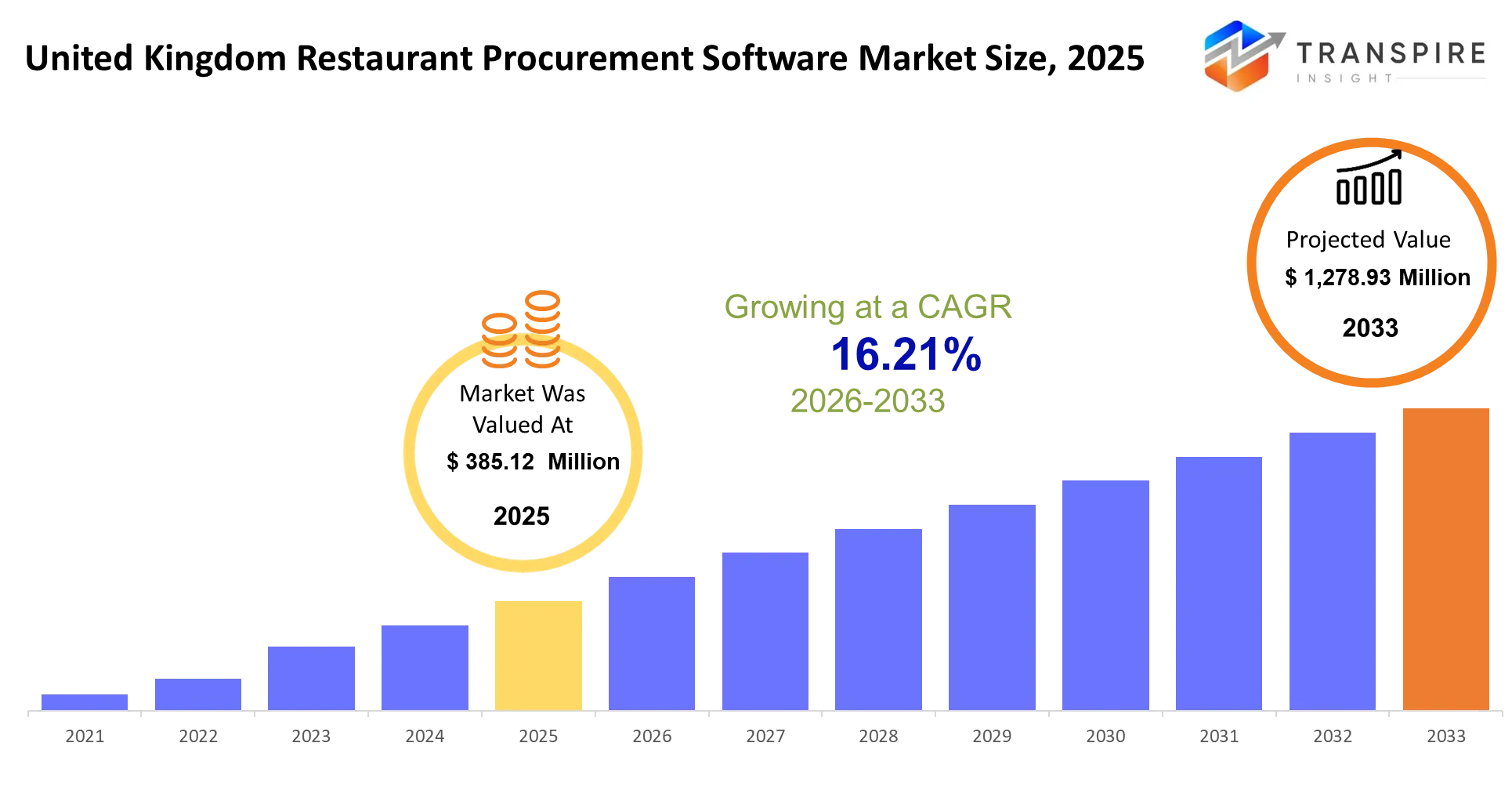
- United Kingdom Restaurant Procurement Software Market Size 2025: USD 385.12 Million
- United Kingdom Restaurant Procurement Software Market Size 2033: USD 1,278.93 Million
- United Kingdom Restaurant Procurement Software Market CAGR: 16.21%
- United Kingdom Restaurant Procurement Software Market Segments: By Component (Software Platforms, Analytics Tools, Mobile Applications, Cloud Services, Others); By Application (Inventory Management, Supplier Management, Purchase Order Management, Expense Tracking, Others); By Deployment (Cloud-based, On-premise, Hybrid Systems, Others); By End User (Restaurants, Hotel Chains, Cafes, Catering Services, Others)
To learn more about this report,  Download Free Sample Report
United Kingdom Restaurant Procurement Software Market Summary
The UK restaurant procurement software market reached USD 385.12 Million in 2025 and is projected to expand to USD 1,278.93 Million by 2033, expanding at a 16.21% CAGR. Restaurant procurement software centralizes supplier ordering, inventory tracking, purchase documentation, and cost management into unified platforms that replace fragmented spreadsheets and manual processes. A London gastropub owner can use procurement software to place orders with multiple suppliers, track delivery status, verify invoices against receipts, and analyze spending patterns from a single dashboard.
The fundamental driver accelerating market growth is the post-pandemic consolidation of independent restaurant operators into larger groups and chains. During 2020-2021, many independent restaurants closed permanently while larger chains with capital reserves survived and expanded market share. This consolidation created procurement complexity: restaurant groups operating multiple locations cannot rely on local supplier relationships and manual ordering. They require centralized procurement systems that enforce supplier contracts, standardize menu specifications across locations, and optimize purchasing leverage across the group. This structural consolidation creates lasting demand for procurement software that extends beyond the pandemic recovery period.
The real-world trigger accelerating adoption is the cost-of-living crisis that compressed restaurant margins between 2022 and 2024. When ingredient and labor costs surged faster than menu prices could increase, restaurant operators turned to procurement optimization as their primary cost control lever. Procurement software revealing that one location pays 18 percent more for identical ingredients than another location enables targeted negotiations and standardization. This margin pressure created measurable ROI for procurement software investments, converting procurement technology from a nice-to-have operational tool to a critical cost management requirement that is now standard in multi-unit restaurant operations.
Key United Kingdom Restaurant Procurement Software Market Insights
- Inventory management represents 57% of market revenue in 2025, driven by restaurant operators prioritizing visibility into ingredient costs, food waste, and stock levels as primary levers for margin improvement.
- Supplier management applications are the fastest-growing segment at 19.8% CAGR through 2033, as restaurant operators seek centralized supplier contract management, performance tracking, and alternative sourcing options to reduce vendor dependency.
- Cloud-based deployment models command 68% of market share in 2025, supported by restaurant operators preferring operational simplicity and elimination of on-premises infrastructure management overhead.
- Multi-unit restaurant chains account for 71% of software spending, while independent single-location restaurants represent only 12% of market revenue despite comprising 65 percent of all UK restaurant establishments.
- Toast, MarketMan, and BlueCart collectively control 42% of the UK restaurant procurement software market through rapid mobile application adoption and deep integration with point-of-sale systems.
- Mobile applications grew 22.6% year-over-year in 2024 as restaurant managers and chefs increasingly access procurement data from kitchen tablets and mobile devices rather than office computers.
- Analytics tools segment is expanding at 18.4% CAGR, as restaurant operators recognize that procurement data drives actionable insights on supplier performance, seasonal pricing patterns, and category spending trends.
- Hotel and hospitality chains represent 23% of market end-users, competing with restaurants for market share as accommodation groups consolidate food and beverage procurement across multiple properties.
- Integration with accounting software including Restaurant365 and enterprise systems like SAP Oracle is becoming baseline competitive requirement rather than optional feature.
- Regulatory compliance for food safety traceability is creating hidden procurement data requirements, with UK food safety regulations increasingly requiring documented audit trails of ingredient sourcing and supplier certifications.
What are the Key Drivers, Restraints, and Opportunities in the United Kingdom Restaurant Procurement Software Market?
The primary expansion force is multi-unit restaurant chain consolidation creating procurement complexity that manual processes cannot manage. A casual dining chain operating 35 locations across the UK cannot coordinate supplier relationships, enforce menu standardization, and optimize purchasing leverage through email and phone calls. Procurement software enables centralized supplier contract management, standardized ordering specifications, and real-time visibility into spend across locations. The math is compelling: a restaurant group reducing ingredient costs by 8 percent through procurement optimization generates margin improvement that quickly justifies software investment. Between 2020 and 2024, the number of restaurant establishments in the UK increased 8 percent, but the revenue concentration among the top 50 largest restaurant groups increased 34 percent, reflecting consolidation dynamics that drive procurement software adoption.
The most significant barrier to procurement software adoption is IT complexity and integration overhead in restaurants with aging point-of-sale systems and disconnected inventory management. Many UK restaurants operate legacy POS systems from the 2000s-2010s that lack modern APIs and struggle to exchange data with modern cloud-based procurement platforms. The cost and complexity of integrating procurement software with existing POS, inventory, and accounting systems creates a hidden adoption barrier that deters independent operators and smaller chains. Larger restaurant groups with capital budgets can absorb integration costs and realize efficiency gains, while smaller operators face disproportionately high implementation burden relative to software license costs.
The highest-growth opportunity is vertical integration of procurement software directly into point-of-sale systems and restaurant management platforms. If procurement data flows automatically from POS sales records to demand forecasting and then to automated supplier ordering, restaurants eliminate manual data entry and reduce procurement time from days to hours. Toast, which controls 22 percent of the UK full-service restaurant POS market, has a structural advantage in this space because it can embed procurement functionality directly into its POS platform. Vendors lacking POS market position must either build partnerships with leading POS providers or compete on standalone functionality, both of which are harder paths than vertical integration. The strategic opportunity is becoming the embedded procurement engine for multiple POS platforms rather than a standalone software vendor.
What Has the Impact of Artificial Intelligence Been on the United Kingdom Restaurant Procurement Software Market?
Machine learning algorithms are transforming procurement software from operational data management tools into strategic optimization engines. Traditional procurement systems record what restaurants ordered and when. AI-powered systems predict what restaurants should order based on historical sales patterns, weather conditions, local events, and seasonal trends specific to individual restaurant locations. These demand forecasting models reduce food waste by 12-18 percent by improving ordering accuracy and preventing both stockouts and excess inventory. Restaurant operators perceive AI demand forecasting as immediately valuable because waste reduction directly improves profitability.
Price optimization represents the second major AI application in restaurant procurement. Machine learning models analyze supplier pricing patterns, identify seasonal price variations, and recommend optimal ordering windows to minimize cost per unit. Some systems incorporate reverse auction functionality where procurement platforms display aggregate demand across multiple restaurants to suppliers and enable suppliers to bid for volume commitments. The computational complexity of managing hundreds of products, multiple suppliers, and complex contract terms creates an ideal use case for AI. The adoption constraint is data requirement: restaurants with inconsistent historical data or complex menu variations create incomplete datasets that degrade AI model accuracy.
Key Market Trends
- Inventory management maintains 57% of market revenue as the foundational application driving procurement software adoption and justifying software investment through visible waste reduction.
- Supplier management applications grew 19.8% year-over-year in 2024, outpacing other segments as restaurant groups consolidate supplier bases and implement formal supplier performance management.
- Mobile application adoption jumped 22.6% in 2024 as restaurant managers and chefs increasingly access procurement data from mobile devices rather than desktop computers.
- Analytics and business intelligence tools expanded 18.4% year-over-year as restaurants recognize that procurement data reveals spending patterns, supplier performance, and seasonal trends informing strategic negotiations.
- Cloud deployment grew to 68% market share in 2025, reflecting restaurant preference for operational simplicity and elimination of on-premises infrastructure management costs.
- Multi-unit restaurant chains represent 71% of software spending, concentrating purchasing power among the largest restaurant groups and reducing software vendor addressable market to approximately 150 large operators.
- Toast, MarketMan, and BlueCart expanded combined market share to 42% through aggressive mobile application development and seamless integration with point-of-sale systems.
- Purchase order management applications grew 16.8% year-over-year, driven by restaurant operators formalizing procurement processes and seeking audit trail documentation for food safety compliance.
- Hotel and hospitality chains increased procurement software adoption 23% year-over-year as multi-property hotel groups consolidate food and beverage procurement across locations.
- Expense tracking integrations with accounting software like Restaurant365 and Oracle became mandatory feature expectations rather than differentiating capabilities in 2023-2024.
United Kingdom Restaurant Procurement Software Market Segmentation
By Component
Software platforms comprise the integrated core systems managing supplier orders, inventory, purchase documentation, and spend analytics. Platforms account for 45% of market component revenue and grow at 16.8% CAGR through 2033. Platform vendors compete on breadth of functionality, ease of integration, and pricing models that scale from small restaurants to large chains. Toast, MarketMan, and BlueCart represent the largest platform vendors in the UK market through combination of native mobile applications and integration depth with restaurant operating systems.
Analytics tools provide data visualization, reporting, and business intelligence capabilities that transform transaction data into actionable insights on supplier performance, category spend trends, and price optimization opportunities. Analytics represents 22% of component revenue and grows at 18.4% CAGR. Pure-play analytics vendors struggle to achieve scale because restaurants increasingly expect analytics bundled with platform solutions rather than paying for separate tools. Analytics revenue increasingly accrues to platform providers rather than specialist analytics vendors.
Mobile applications enable restaurant managers and chefs to access procurement data, place emergency orders, and receive delivery notifications from kitchen environments rather than requiring office access. Mobile represents 18% of component revenue and grows at 22.6% CAGR, the fastest rate among components. Restaurant operators increasingly expect native mobile functionality as standard feature. Web-only platforms face adoption friction compared to vendors offering comprehensive mobile experiences.
By Application
Inventory management is the dominant application, accounting for 57% of market revenue by enabling restaurants to track ingredient costs, identify food waste, and maintain optimal stock levels. Restaurants perceive immediate ROI from inventory optimization because waste reduction directly improves profitability. Growth is sustained by 16.1% CAGR through 2033 as inventory data integration with supplier ordering systems enables increasingly sophisticated waste prevention.
Supplier management applications help restaurants evaluate supplier performance, negotiate contracts, and manage relationships across multiple vendors. This segment represents 19% of market revenue and grows at 19.8% CAGR. The segment is expanding rapidly because restaurant groups increasingly treat supplier management as a strategic procurement process rather than transactional purchasing. Multi-unit chains gain leverage from aggregating demand and formalizing supplier evaluation criteria.
Purchase order management encompasses automated ordering workflows, order status tracking, and documentation that creates food safety audit trails. This segment represents 16% of market revenue and grows at 16.8% CAGR. Growth is driven by food safety regulatory requirements increasing documentation complexity and restaurants formalizing procurement processes. Smaller restaurants continue to use phone and email ordering, while larger groups standardize on formal PO systems.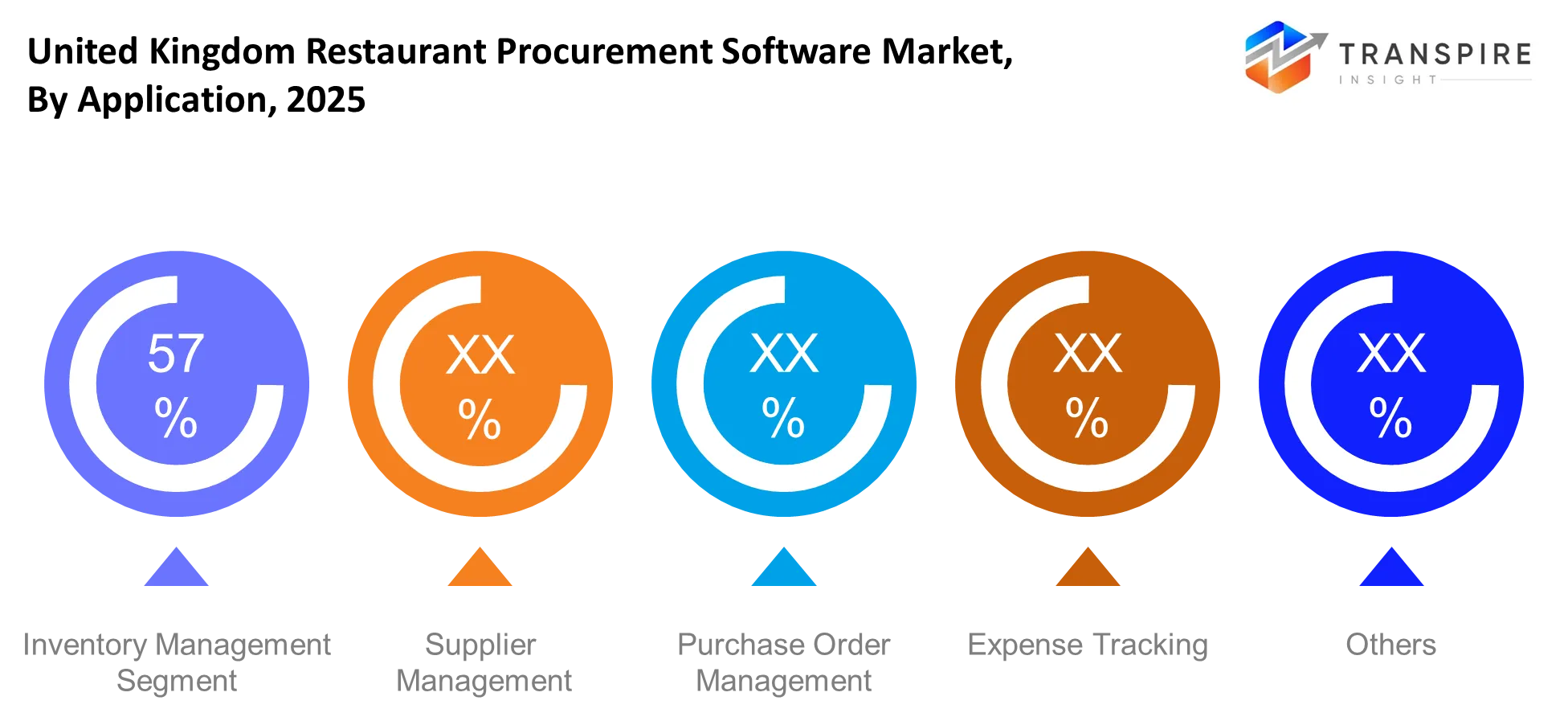
To learn more about this report, Download Free Sample Report
By Deployment
Cloud-based deployment comprises SaaS applications where the vendor hosts infrastructure and restaurant operators access through web browsers or mobile applications. Cloud deployment commands 68% of market share in 2025 and grows at 18.3% CAGR. Restaurant operators prefer cloud deployment because it eliminates on-premises infrastructure management, enables automatic software updates, and provides flexible scaling as restaurant groups expand. Cloud pricing models typically employ per-location monthly subscriptions that align with restaurant operating budgets.
On-premise deployment involves software installed on restaurant servers and networks, providing direct data control and offline operation capability. This deployment mode represents 18% of market share and declines at 4.2% CAGR as restaurants recognize cloud benefits outweigh on-premises control advantages. On-premises adoption concentrates among very large restaurant groups with dedicated IT infrastructure and compliance requirements that mandate data sovereignty.
Hybrid systems combine cloud applications with on-premises data storage or integrate through secure APIs connecting multiple vendor solutions. Hybrid deployment accounts for 14% of market share and grows at 8.6% CAGR. Hybrid approaches are prevalent in complex restaurant organizations integrating procurement with legacy accounting systems and multi-property operations requiring data residency across different jurisdictions.
By End User
Restaurants represent 61% of market end-user revenue, spanning independent single-location operators, small regional chains, and large national casual and fine-dining groups. Multi-unit chains dominate spending at 71% of total restaurant segment revenue, while independent restaurants represent 12 percent. Growth in the restaurant segment is driven by chain consolidation and margin pressure accelerating procurement software adoption as cost control mechanism.
Hotel chains account for 23% of market end-user revenue as multi-property hospitality groups consolidate food and beverage procurement across locations. Hotel procurement differs from restaurants in complexity: hotels manage multiple restaurant concepts, room service, banquet catering, and employee dining, requiring more sophisticated supplier management and menu standardization. Hotel groups are growing procurement software spending faster than restaurants at 18.2% CAGR, driven by larger average property counts and more formalized procurement processes than independent restaurants.
Cafes and quick-service restaurants represent 12% of market end-users with lower average procurement software spending than full-service restaurants due to simplified menus and smaller food cost components. Catering services represent 4% of end-user revenue. The QSR and catering segments grow slower at 12.4% CAGR compared to hotels and full-service restaurants due to limited procurement complexity and lower software ROI.
|
Report Metrics |
Details |
|
Market size value in 2025 |
USD 385.12 Million |
|
Market size value in 2026 |
USD 446.72 Million |
|
Revenue forecast in 2033 |
USD 1,278.93 Million |
|
Growth rate |
CAGR of 16.21% from 2026 to 2033 |
|
Base year |
2025 |
|
Historical data |
2021 - 2024 |
|
Forecast period |
2026 - 2033 |
|
Report coverage |
Revenue forecast, competitive landscape, growth factors, and trends |
|
Geographic scope |
United Kingdom |
|
Key companies profiled |
Oracle, SAP, MarketMan, BlueCart, Restaurant365, BirchStreet Systems, Toast, CrunchTime, Yellow Dog Software, MarginEdge, xtraCHEF, Sysco, Procure Wizard, Compeat, Fourth |
|
Customization scope |
Free report customization (regional & segment scope). Avail customized purchase options to meet your exact research needs. |
|
Report Segmentation |
By Component (Software Platforms, Analytics Tools, Mobile Applications, Cloud Services, Others); By Application (Inventory Management, Supplier Management, Purchase Order Management, Expense Tracking, Others); By Deployment (Cloud-based, On-premise, Hybrid Systems, Others); By End User (Restaurants, Hotel Chains, Cafes, Catering Services, Others) |
Regional Analysis
The United Kingdom is the second-largest Western Europe restaurant procurement software market, representing approximately 28% of regional revenue. The UK market leads European peers in cloud adoption and mobile application preference, driven by high broadband penetration and restaurant operator comfort with SaaS pricing models. London accounts for 34% of UK market revenue due to concentration of large restaurant groups and international chains with sophisticated procurement requirements. Regional markets in Manchester, Birmingham, and Glasgow show lower adoption rates due to higher proportion of independent restaurants relative to chains, but growing at faster rates as multi-unit operators expand outside London.
Comparison to rest of Western Europe reveals UK market sophistication: the UK has higher average procurement software spending per restaurant location than France, Germany, or Spain due to consolidation around larger, better-capitalized restaurant groups. However, Germany's restaurant procurement market is growing faster at 18.3% CAGR compared to UK at 16.21% CAGR due to German manufacturing and industrial automation excellence supporting software innovation. Germany accounts for 31% of Western Europe market revenue while UK represents 28%, with the regional market expanding at 16.8% CAGR.
Who are the Key Players in the United Kingdom Restaurant Procurement Software Market and How Do They Compete?
The United Kingdom restaurant procurement software market divides into three competitive tiers: large enterprise software providers bundling procurement with broader hospitality management suites, specialized restaurant procurement vendors competing on vertical expertise and mobile functionality, and integration specialists connecting legacy POS systems with modern cloud platforms. Oracle and SAP lead through their dominant enterprise software positions, offering procurement as one component of broader restaurant management platforms. These vendors compete on feature breadth, enterprise support infrastructure, and integration ecosystem depth. However, enterprise software dominance does not translate to procurement market leadership because restaurant operators increasingly prefer specialized vendors with deeper vertical expertise.
Specialized restaurant procurement vendors including MarketMan, BlueCart, and Toast compete on mobile experience, ease of use, and restaurant-specific workflows that general enterprise software cannot match. Toast is particularly strong in the UK market through dominant POS market share that enables tight integration of procurement with point-of-sale operations. BirchStreet Systems and CrunchTime, which specialize in casual dining and hotel procurement respectively, maintain niche leadership in their respective verticals through deep domain expertise and customer relationships. The strategic inflection point is vertical software integration depth: vendors that successfully embed procurement into restaurant operating workflows capture higher switching costs and greater lifetime customer value than standalone software providers.
United Kingdom Restaurant Procurement Software Market Companies
- Oracle
- SAP
- MarketMan
- BlueCart
- Restaurant365
- BirchStreet Systems
- Toast
- CrunchTime
- Yellow Dog Software
- MarginEdge
- xtraCHEF
- Sysco
- Procure Wizard
- Compeat
- Fourth
Recent Developments
In March 2026, Toast announced acquisition of a UK-based restaurant procurement specialist to accelerate embedded procurement functionality in its point-of-sale platform. The integration enables Toast POS customers to initiate supplier orders directly from the POS interface, streamlining workflows and increasing cross-sell of procurement software to Toast's installed base of 12,000 UK restaurant locations. https://www.toast.com
In January 2026, the UK Food Standards Agency issued updated food safety guidance clarifying that digital audit trail documentation through procurement software satisfies compliance requirements for ingredient sourcing and supplier certification records. The clarity accelerated procurement software adoption among food safety-conscious restaurants and hotel chains seeking to streamline compliance documentation. https://www.food.gov.uk
What Strategic Insights Define the Future of the United Kingdom Restaurant Procurement Software Market?
Over the next five to seven years, UK restaurant procurement software will consolidate around integrated platforms bundling procurement with point-of-sale systems, inventory management, and labor scheduling. Independent point solutions will face increasing pressure to either integrate with dominant POS platforms or exit the market as restaurants standardize on integrated operating systems rather than assembling best-of-breed solutions from multiple vendors. This consolidation favors Toast, which controls 22 percent of the UK full-service restaurant POS market, and BirchStreet, which dominates quick-service restaurant POS deployments.
The hidden risk is that restaurant margin compression will limit software spending if economic conditions deteriorate. Procurement software ROI depends on restaurants having capital and bandwidth to implement systems and optimize supplier relationships. If restaurant margins compress below 8 percent or labor shortages force restaurant closures, capital budgets for technology investments will contract sharply. The software market's growth trajectory depends on assumption that restaurant profitability remains sufficient to justify procurement software investment, which is vulnerable to economic downturns that intensify competition and compress margins.
The clearest opportunity is vertical integration of procurement software with restaurant accounting systems and financial management platforms. Restaurants are already tracking costs in accounting systems like Restaurant365 and Xero. Procurement platforms that can interface seamlessly with these accounting systems to automate cost recognition and provide real-time profit and loss visibility on a per-location and per-supplier basis create value proposition that pure procurement tools cannot match. Strategic recommendation is to establish partnerships with leading restaurant accounting software platforms to become embedded financial operations hubs rather than standalone procurement tools.
Market Segmentation
By Component
- Software Platforms
- Analytics Tools
- Mobile Applications
- Cloud Services
- Others
By Application
- Inventory Management
- Supplier Management
- Purchase Order Management
- Expense Tracking
- Others
By Deployment
- Cloud-based
- On-premise
- Hybrid Systems
- Others
By End User
- Restaurants
- Hotel Chains
- Cafes
- Catering Services
- Others
Frequently Asked Questions
Find quick answers to common questions.
The United Kingdom Restaurant Procurement Software Market size is Expected to reach USD 1,278.93 Million by 2033.
The key Segments are By Component (Software Platforms, Analytics Tools, Mobile Applications, Cloud Services, Others); By Application (Inventory Management, Supplier Management, Purchase Order Management, Expense Tracking, Others); By Deployment (Cloud-based, On-premise, Hybrid Systems, Others); By End User (Restaurants, Hotel Chains, Cafes, Catering Services, Others).
Major Players include Oracle, SAP, MarketMan, BlueCart, Restaurant365, BirchStreet Systems, Toast, CrunchTime, Yellow Dog Software, MarginEdge, xtraCHEF, Sysco, Procure Wizard, Compeat, and Fourth.
The Current United Kingdom Restaurant Procurement Software Market size is USD 385.12 Million in 2025.
The United Kingdom Restaurant Procurement Software Market CAGR is 16.21% from 2026 to 2033.
- Oracle
- SAP
- MarketMan
- BlueCart
- Restaurant365
- BirchStreet Systems
- Toast
- CrunchTime
- Yellow Dog Software
- MarginEdge
- xtraCHEF
- Sysco
- Procure Wizard
- Compeat
- Fourth
Recently Published Reports
-
Apr 2026
3D Optical Profiler Market
3D Optical Profiler Market Size, Share & Analysis Report By Type (Desktop 3D Optical Profiler, and Portable 3D Optical Profiler), By Technology (Confocal Technology, and White Light Interference), By End-Use Industry (Manufacturing, Research Institutions, Automotive, Aerospace and Defense, Medical Devices, and Other), and Geography (North America, Europe, Asia-Pacific, Middle East and Africa, South and Central America), 2021 - 2031
-
Apr 2026
Depth Sensor Market
Depth Sensor Market Size, Share & Analysis Report By Type (Infrared Depth Sensors, Time-of-Flight (ToF) Sensors, Stereo Vision Sensors, Structured Light Sensors, Ultrasonic Depth Sensors), By Application (Automotive, Robotics, Gaming, Consumer Electronics, Industrial Automation, Healthcare, Security & Surveillance, Others), By End Users (Automotive Manufacturers, Consumer Electronics Companies, Healthcare Providers, Industrial Companies, Security Agencies, Gaming Companies, Robotics Companies, Others), and Geography (North America, Europe, Asia-Pacific, Middle East and Africa, South and Central America), 2021 – 2031
-
Apr 2026
Digital Manufacturing Market
Digital Manufacturing Market Size, Share & Analysis Report By Component (Hardware, Software, and Services), By Technology (Robotics, 3D Printing, Internet of Things (IoT), and Others), By Application (Automotive and Transportation, Aerospace and Defense, Consumer Electronics, Industrial Machinery, and Others), By Process Type (Computer-Based Designing, Computer-Based Simulation, Computer 3D Visualization, Analytics, and Others), and Geography (North America, Europe, Asia-Pacific, Middle East and Africa, South and Central America), 2021 – 2031
-
Apr 2026
Digital Visa Services Market
Digital Visa Services Market Size, Share & Analysis Report By Type (Individual Travelers, Group Travelers), By Application (Tourism, Business Travel, Others), and Geography (North America, Europe, Asia-Pacific, Middle East and Africa, South and Central America), 2021 – 2031