
North America Hospital Asset Tracking and Inventory Management Systems Market Size & Forecast:
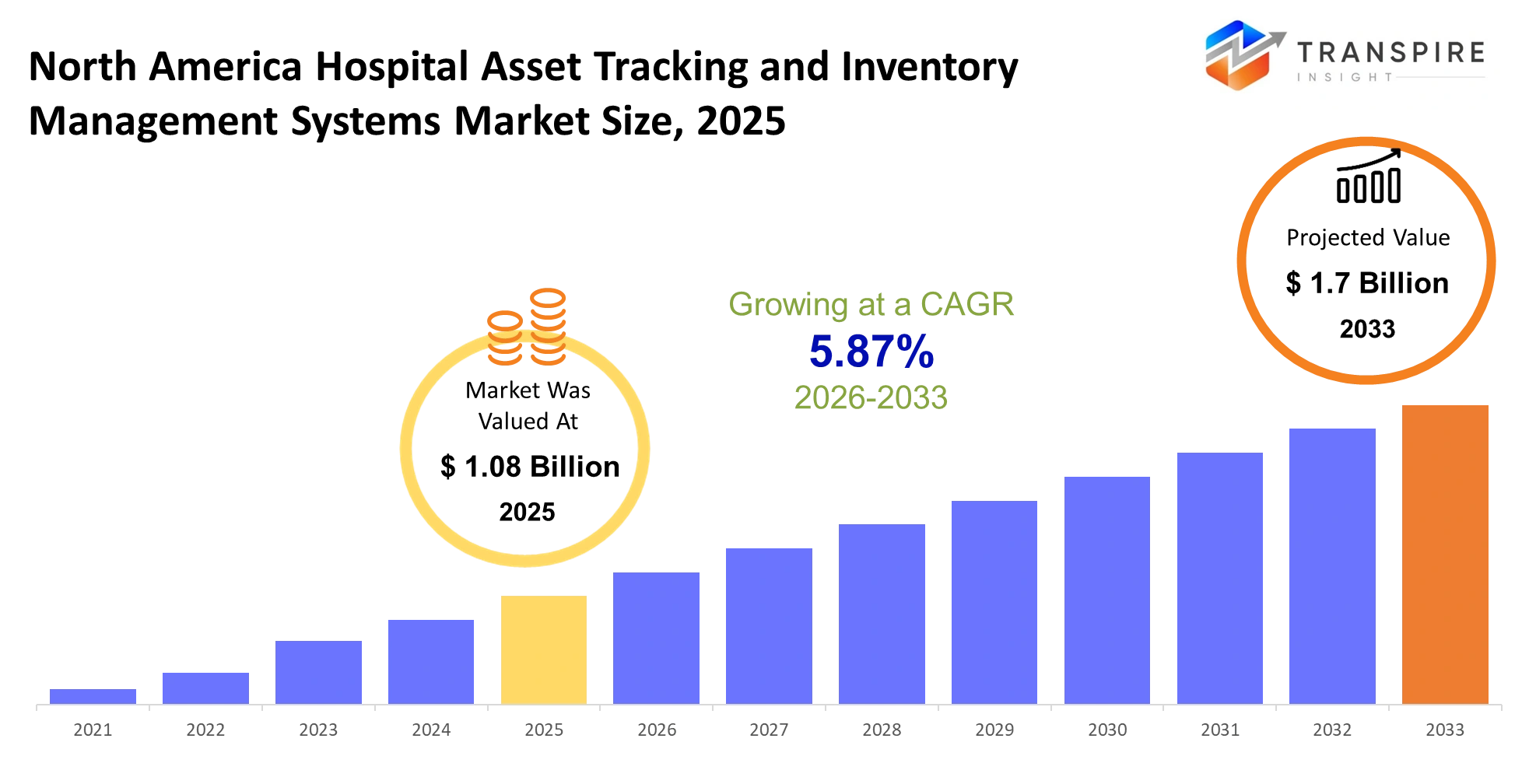
- North America Hospital Asset Tracking and Inventory Management Systems Market Size 2025: USD 1.08 Billion
- North America Hospital Asset Tracking and Inventory Management Systems Market Size 2033: USD 1.7 Billion
- North America Hospital Asset Tracking and Inventory Management Systems Market CAGR: 5.87%
- North America Hospital Asset Tracking and Inventory Management Systems Market Segments: By Component (Software, Hardware, Services), By Technology (RFID, Barcode, RTLS), By End-User (Hospitals, Clinics).
To learn more about this report,  Download Free Sample Report
North America Hospital Asset Tracking and Inventory Management Systems Market Summary:
The North America Hospital Asset Tracking and Inventory Management Systems Market size is estimated at USD 1.08 Billion in 2025 and is anticipated to reach USD 1.7 Billion by 2033, growing at a CAGR of 5.87% from 2026 to 2033. The hospital asset tracking and inventory management systems market in North America, which includes Canada and the United States and Mexico, will continue to change how medical facilities in the healthcare technology industry manage their equipment and track their supplies. The region's hospitals will implement intelligent tracking systems that use real-time location technology and predictive analytics and cloud-based dashboards to meet their accuracy and cost management requirements. The need for patient safety and audit transparency will drive institutions to implement automated logging systems whereas staff members will request user-friendly interfaces that minimize their manual tasks. The current situation will evolve into a period of data-driven hospital management that replaces traditional methods of inventory management.
Key Market Trends & Insights:
The implementation of real-time location systems will change the way hospitals track vital equipment throughout their various departments. Hospitals will use RFID and Bluetooth Low Energy and Wi-Fi-enabled tags to achieve continuous monitoring of their medical devices which include infusion pumps and ventilators. The new system will decrease equipment search times while it enables medical personnel to make quicker decisions about patient treatment. The need for uninterrupted tracking will increase because people expect better visibility of operations and responsibility management through sophisticated medical testing facilities.
Hospitals throughout Canada and the United States and Mexico will adopt cloud-based systems as their primary solution for handling inventory management tasks. The system enables users to control operations from one location while accessing the system remotely and receiving automatic software enhancements without needing to install extensive system infrastructure. Healthcare executives will select systems that can expand their capabilities while working with both electronic health record systems and procurement software. The current trend demonstrates how digital systems which allow institutions to quickly adapt to new requirements are becoming more common in modern business practice.
Artificial intelligence and predictive analytics will increasingly control the management of inventory levels. Hospitals will use data patterns to forecast shortages while optimizing stock distribution and preventing excess purchasing. This method will enable cost-effective operations while securing critical resources during periods of high demand. Organizations will use data-driven predictions to replace manual estimation processes which will help them achieve precise resource needs and operational requirements.
The system adoption process and its operational capabilities will remain under the influence of regulatory standards throughout North America. Hospitals will need to adopt automated tracking systems because they must comply with safety regulations and audit procedures and maintain precise reporting standards. Healthcare professionals require simplified user interfaces which help them perform their daily tasks more efficiently. Organizations will create solutions according to this requirement which ensures that their technology meets both compliance standards and operational needs.
North America Hospital Asset Tracking and Inventory Management Systems Market Segmentation
By Component
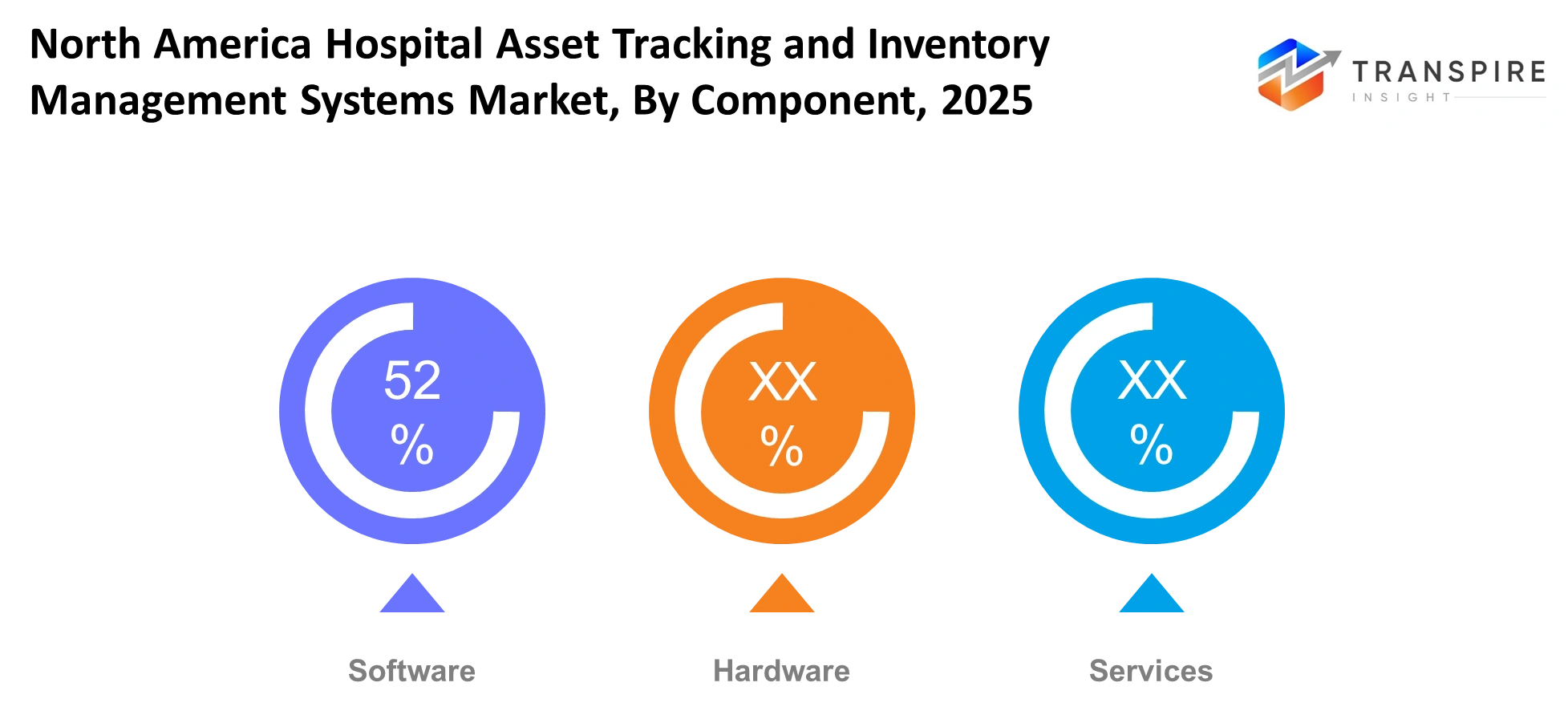
Software- The software platforms function as the intelligence layer which enables hospital asset tracking systems to provide real-time tracking and reporting and analytics capabilities. The solutions will connect with hospital information systems to provide unified data access which will work across different hospital departments. Users will expect their systems to provide intuitive dashboard design and mobile device access and automatic notifications about stock quantity changes and equipment tracking. Software development for hospitals will progress to predictive insights and workflow automation which will decrease the need for manual tasks.
Hardware- The physical structure of tracking systems will consist of hardware components which include tags and scanners and sensors and readers equipment. Hospitals will use RFID tags and barcode scanners as tracking devices to gather live information throughout their facilities. The development of products will maintain three vital aspects which include durability and battery life and accuracy, because these factors play a crucial role in areas with heavy foot traffic that includes clinical environments. Hospitals will require small-sized hardware solutions which provide dependable operation throughout their entire time of use while being able to endure sterilization methods.
Services- The services will assist healthcare facilities through their implementation and ongoing asset tracking system maintenance and system performance optimization. The providers will deliver system integration services together with staff training and continuous technical support to enable efficient system operation. The need for consulting services which provide customized solutions to hospitals will grow as medical facilities implement advanced technologies. The healthcare industry requires constant system monitoring and system upgrades to preserve performance standards and security measures while meeting changing compliance requirements.
To learn more about this report, Download Free Sample Report
By Technology
RFID- The RFID system provides automatic asset identification and tracking capabilities through asset detection which does not require direct line-of-sight scanning. Hospitals will use RFID tags to track their valuable assets and essential items throughout all their operational areas. The system improves operational efficiency through its ability to decrease the need for manual asset scanning activities while providing better asset location precision. The increasing requirement for immediate information will drive more organizations to implement RFID technology especially in medical facilities which need to perform accurate and fast procedures for their patients.
Barcode- The healthcare industry will continue to implement barcode systems because they provide affordable and effective asset tracking solutions. Hospitals will use barcode labels to manage their inventory and track medications and identify equipment. The system needs manual scanning for operation but it provides users with reliable and simple-to-use function. The system serves as an ideal tracking solution for all small organizations or departments which need to control their costs for advanced tracking systems.
RTLS- Real-time location systems provide hospitals with the ability to track their assets throughout their entire facility while monitoring their staff and patient movements. The RTLS system uses multiple wireless technologies to deliver accurate location information which helps optimize operational processes and handle emergency situations. The technology helps hospitals decrease their equipment theft incidents while it increases their equipment operational efficiency. The operational transparency requirement drives RTLS systems to become essential tools which improve operational collaboration and business productivity.
By End-User
Hospitals- The primary users of asset tracking and inventory management systems will be hospitals because their operations require complex systems to track their extensive inventory. The institutions need advanced solutions to track their equipment and decrease operational delays while they need to keep precise inventory data. The systems have to be integrated as they are considered essential components for performing patient care workflows. Hospitals are likely to increasingly invest in technologies that offer visibility, accountability, and optimization of resources.
Clinics- Clinics will adopt asset tracking systems at a more focused scale, emphasizing simplicity and cost efficiency. The facilities will use tracking solutions to handle their essential equipment while they create organized inventory systems that require no additional infrastructure. The two main elements that need to be evaluated during adoption are operational simplicity and implementation speed. The clinics need solutions that will help them run their daily tasks while eliminating operational mistakes and delivering consistent service in their restricted work areas.
Regional Insights
The healthcare systems in North America will adjust their asset tracking methods to meet growing demands for operational efficiency and financial responsibility. The United States healthcare sector will focus on implementing advanced digital technologies while Canadian healthcare facilities will work to establish standardized systems that interconnect their operations throughout various provinces. Private healthcare organizations in Mexico plan to expand their tracking system use as they invest in new technologies. The region will show different levels of development, but all countries will advance toward implementing organized systems that use technology for their inventory management processes.
The United States will continue its status as a major healthcare technology investor because of its extensive hospital networks. Organizations will develop tracking systems that provide immediate asset visibility throughout their operational and financial processes. Public healthcare organizations in Canada will need to adopt identical solutions which provide transparency according to the country's more regulated system. The urban hospitals in Mexico will serve as the first to implement modern tracking systems which will help develop the country's infrastructure.
System design across the region will depend on workforce requirements because healthcare professionals will need tools which make their daily tasks easier. Staff members in Canada and the United States will require mobile systems which help them complete their work without extra administrative responsibilities. Mexican healthcare providers will select solutions which provide both usability and affordability. System deployment decisions in all three countries will depend on two factors which include training simplicity and daily operations maintenance.
North America will use policy frameworks and compliance requirements to implement its implementation strategies. The United States will mandate that organizations maintain complete documentation and audit readiness while using automated tracking systems. Canada will establish standardized practices to protect patient safety and ensure consistent data handling. Mexico will develop its regulatory framework until it meets international standards. The evolving requirements will force hospitals to implement systems which ensure accuracy and accountability and sustain operational efficiency throughout time.
Recent Development News
Expansion of Real-Time Tracking Integration: Healthcare providers across the United States are increasingly integrating real-time location systems into hospital environments to strengthen equipment monitoring and workflow coordination. Recent updates indicate that RTLS adoption will accelerate as hospitals seek continuous visibility of assets and personnel. Market observations show that this technology will remain central to digital transformation initiatives, with North America maintaining a dominant position in RTLS deployment within healthcare infrastructur; e.
Strengthening Standardized Digital Healthcare SystemsCanada has recently focused on aligning hospital asset tracking solutions with broader digital healthcare frameworks. Public healthcare systems are moving toward unified platforms that support consistent inventory visibility across provinces. This direction will enhance interoperability and data accuracy while reducing duplication of resources. The emphasis on coordinated implementation reflects a national effort to modernize hospital operations through structured and technology-supported inventory systems that improve transparency and operational discipline.
|
Report Metrics |
Details |
|
Market size value in 2025 |
USD 1.08 Billion |
|
Market size value in 2026 |
USD 1.14 Billion |
|
Revenue forecast in 2033 |
USD 1.7 Billion |
|
Growth rate |
CAGR of 5.87% from 2026 to 2033 |
|
Base year |
2025 |
|
Historical data |
2021 – 2024 |
|
Forecast period |
2026 – 2033 |
|
Report coverage |
Revenue forecast, competitive landscape, growth factors, and trends |
|
Regional scope |
North America (Canada, The United States, and Mexico) |
|
Key company profiled |
Zebra Technologies Corporation, Stanley Healthcare (AeroScout), GE HealthCare Technologies Inc., Siemens Healthineers AG, IBM Corporation, Oracle Corporation, CenTrak Inc., Midmark Corporation, Impinj Inc., Savi Technology Inc., ThingMagic (JADAK), Infor Inc., Accenture plc, Honeywell International Inc., BlueBin Inc. |
|
Customization scope |
Free report customization (country, regional & segment scope). Avail customized purchase options to meet your exact research needs. |
|
Report Segmentation |
By Component (Software, Hardware, Services), By Technology (RFID, Barcode, RTLS), By End-User (Hospitals, Clinics). |
Key North America Hospital Asset Tracking and Inventory Management Systems Market Company Insights
The North America hospital asset tracking and inventory management systems market which includes Canada, United States and Mexico will experience competition through ongoing innovations and strategic partnerships among its main market participants. The companies in the market will develop unified systems that integrate tracking solutions with sophisticated data analysis tools and intuitive user interfaces. The vendors will start developing customized solutions which hospitals can use to operate their current digital systems. The ability to establish partnerships with healthcare providers will enhance product importance while organizations need to invest in cloud capabilities and cybersecurity systems to maintain their operations. Organizations will achieve competitive advantages when they provide dependable system operation which can handle different healthcare settings through their complete technical assistance.
Company List
- Zebra Technologies Corporation
- Stanley Healthcare (AeroScout)
- GE HealthCare Technologies Inc.
- Siemens Healthineers AG
- IBM Corporation
- Oracle Corporation
- CenTrak Inc.
- Midmark Corporation
- Impinj Inc.
- Savi Technology Inc.
- ThingMagic (JADAK)
- Infor Inc.
- Accenture plc
- Honeywell International Inc.
- BlueBin Inc
North America Hospital Asset Tracking and Inventory Management Systems Market Report Segmentation
By Component
- Software
- Hardware
- Services
By Technology
- RFID
- Barcode
- RTLS
By End-User
- Hospitals
- Clinics
Frequently Asked Questions
Find quick answers to common questions.
The approximate North America Hospital Asset Tracking and Inventory Management Systems Market size for the market will be USD 1.7 Billion in 2033.
Key segments for the North America Hospital Asset Tracking and Inventory Management Systems Market: By Component (Software, Hardware, Services), By Technology (RFID, Barcode, RTLS), By End-User (Hospitals, Clinics).
Major players in the North America Hospital Asset Tracking and Inventory Management Systems Market are Zebra Technologies Corporation, Stanley Healthcare (AeroScout), GE HealthCare Technologies Inc., Siemens Healthineers AG, IBM Corporation, Oracle Corporation, CenTrak Inc., Midmark Corporation, Impinj Inc., Savi Technology Inc., ThingMagic (JADAK), Infor Inc., Accenture plc, Honeywell International Inc., BlueBin Inc.
The North America Hospital Asset Tracking and Inventory Management Systems Market size is USD 1.08 Billion in 2025.
The North America Hospital Asset Tracking and Inventory Management Systems Market CAGR is 5.87%.
- Zebra Technologies Corporation
- Stanley Healthcare (AeroScout)
- GE HealthCare Technologies Inc.
- Siemens Healthineers AG
- IBM Corporation
- Oracle Corporation
- CenTrak Inc.
- Midmark Corporation
- Impinj Inc.
- Savi Technology Inc.
- ThingMagic (JADAK)
- Infor Inc.
- Accenture plc
- Honeywell International Inc.
- BlueBin Inc
Recently Published Reports
-
Apr 2026
AI in Diabetic Retinopathy Market
AI in Diabetic Retinopathy Market Size, Share & Analysis Report By Type (Screening AI Systems, Diagnostic AI Systems, and Predictive AI Models), By Application Segment (Hospitals, Ophthalmology Clinics, Diagnostic Centers, and Research and Development), and Geography (North America, Europe, Asia-Pacific, Middle East and Africa, South and Central America), 2021 - 2031
-
Apr 2026
Psychometric Tests Market
Psychometric Tests Market Size, Share & Analysis Report By Type (Personality Tests, Ability/Aptitude Tests, Skill/Knowledge Tests, and Others), By Application (Talent Acquisition and Talent Management), and Geography (North America, Europe, Asia-Pacific, Middle East and Africa, South and Central America), 2021 – 2031
-
Apr 2026
Rare Biological Sample Collection Market
Rare Biological Sample Collection Market Size, Share & Analysis Report By Type (Isolation Kits & Reagent, Blood Collection Tubes, and Others), By Application (Oncology, Transcriptomics, Pharmacogenomics, and Others), and Geography (North America, Europe, Asia-Pacific, Middle East and Africa, South and Central America), 2021 – 2031
-
May 2026
Patient Lift Pendant Market
Patient Lift Pendant Market By Product Type (Wired Pendants, Wireless, Programmable), By Operation Type(Manual, Electric), By End-Users (Healthcare Professionals, Patients), By Application (Hospitals, Homecare, Rehabilitation Centers, Others), By Industry Analysis, Size, Share, Growth, Trends, and Forecasts 2021-2033
Our Clients
.jpg)