

North America Pharmaceutical CRM Software Market Size & Forecast:
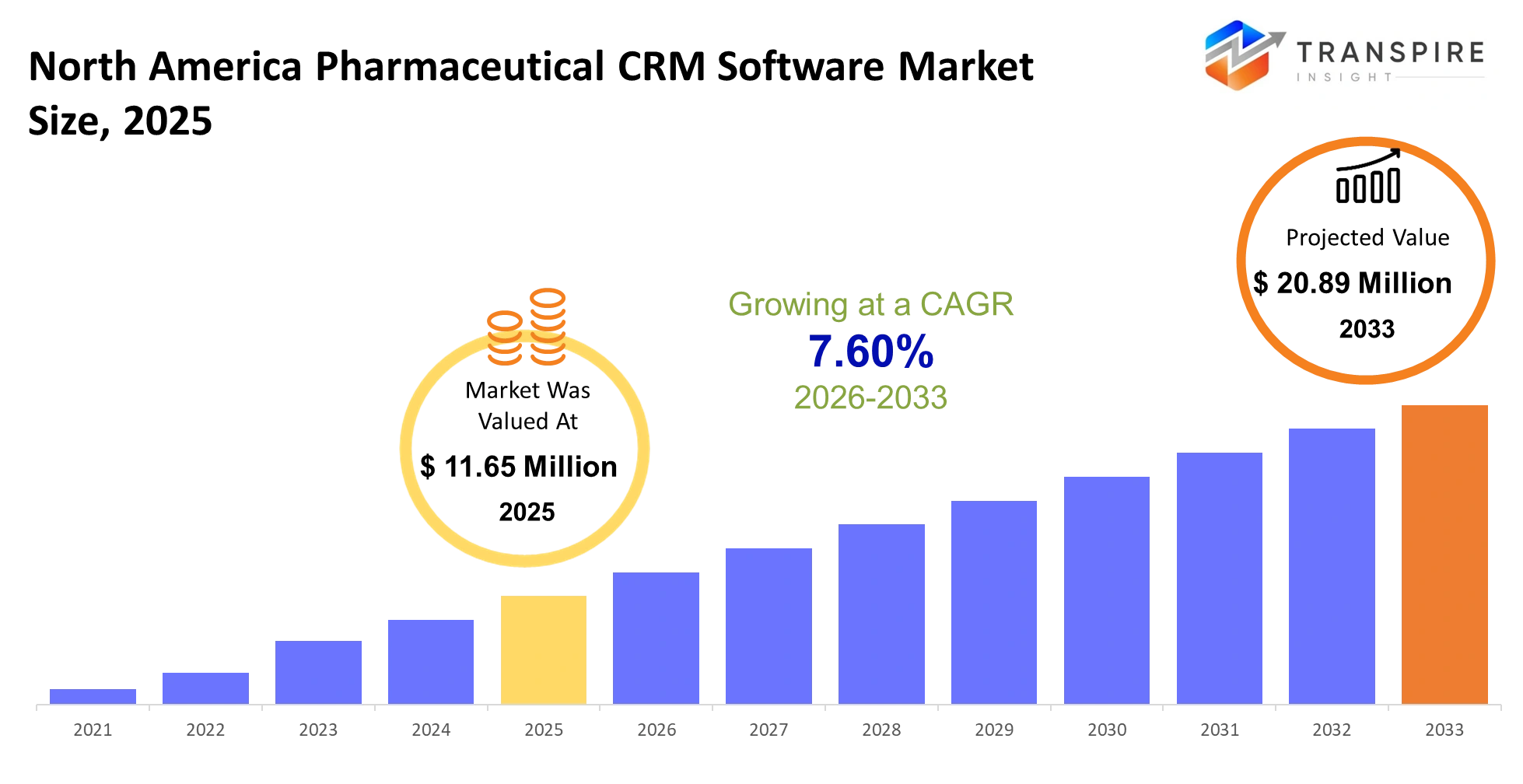
- North America Pharmaceutical CRM Software Market Size 2025: USD 11.65 Million
- North America Pharmaceutical CRM Software Market Size 2033: USD 20.89 Million
- North America Pharmaceutical CRM Software Market CAGR: 7.60%
- North America Pharmaceutical CRM Software Market Segments: By Deployment (Cloud, On-Premise), By Application (Sales Management, Marketing Automation, Customer Support), By End-User (Pharmaceutical Companies, Biotech Firms).
To learn more about this report,  Download Free Sample Report
North America Pharmaceutical CRM Software Market Summary:
The North America Pharmaceutical CRM Software Market size is estimated at USD 11.65 Million in 2025 and is anticipated to reach USD 20.89 Million by 2033, growing at a CAGR of 7.60% from 2026 to 2033. The pharmaceutical customer Relationship management system (CRM) software market of North America which includes Canada and the United States and Mexico will operate as a dedicated digital component within the healthcare technology sector. The system will evolve from its traditional sales tracking function to establish a relationship management system that uses data analysis for relationship management according to new compliance requirements and privacy regulations. Companies will need to implement advanced systems which combine prescription monitoring with real-time data analysis and multiple communication channels because customers increasingly want customized interactions. The combination of cloud deployment and AI-driven insights will create new operational processes while government regulations will determine system architecture data protection requirements and vendor development activities throughout the area.
Key Market Trends & Insights:
Predictive analytics will help pharmaceutical companies to better understand physician requirements and patient behavior which will result in more precise prescription engagement methods. Sales representatives will use real-time information that mobile systems provide instead of relying on fixed data. Healthcare networks will benefit from this development because it will enable quicker choice-making and better tailored connections.
Companies will establish digital-first communication methods to build relationships with healthcare professionals. The adoption of email and virtual detailing methods together with remote consultations will continue to grow which will decrease the need for face-to-face meetings. Physicians will drive this change through their need for convenient healthcare solutions while businesses will build all-inclusive systems to coordinate their digital customer interactions.
Regulatory authorities will establish stricter standards which will govern how healthcare organizations handle patient information and disclose their marketing activities particularly throughout the United States and Canada. Software vendors will develop customer relationship management systems that include sophisticated compliance tracking and auditing tools. Pharmaceutical companies will build trust with their stakeholders by following legal requirements which differ across multiple countries.
Firms will require integration capabilities because they want to connect their customer relationship management systems with clinical data systems and supply chain management systems and external data sources. Organizations will achieve operational efficiency through interoperability which will provide them with deeper insights to synchronize their sales and research and distribution operations with the changing healthcare requirements throughout North America.
North America Pharmaceutical CRM Software Market Segmentation
By Deployment
Cloud- Pharmaceutical organizations are showing increased interest in cloud-based systems because these solutions provide them with adaptable and expandable technology options that require minimal infrastructure expenditures. The system will provide real-time data access to teams that work in different locations which will enhance their ability to work together between sales and medical teams. Vendors will create secure hosting environments that include frequent updates and integration capabilities to ensure compliance with regulatory requirements while enabling faster deployment and simpler operational management.
On-Premise- Organizations that need to protect their sensitive healthcare data and control their internal operations will continue to use on-premise solutions. The systems will provide users with bespoke system design that meets their particular operational needs and regulatory obligations. Organizations that already have IT systems will use this model because their data governance requirements and their existing legacy systems make cloud migration impractical.

To learn more about this report, Download Free Sample Report
By Application
Sales Management- Sales management applications will transform into intelligence-driven platforms which provide representatives with actionable insights instead of basic reporting functions. The systems will enable organizations to monitor doctor interaction and prescription patterns and regional performance metrics throughout the day. The combination of automation and predictive recommendations will enable teams to plan their work with greater accuracy while they distribute their resources to achieve better performance results in the field.
Marketing Automation- Marketing automation software is utilized by pharmaceutical companies to design advertisements and implement marketing strategies.The system will use personalized content delivery and triggered communication together with behavior-based targeting to create central features. The platforms will provide marketers with the ability to interact with healthcare professionals through personalized digital experiences which maintain brand consistency across all touchpoints.
Customer Support- Healthcare organizations will use customer support applications to interact with their healthcare providers and business partners through structured communication channels. The system will enable accurate and fast communication through its integrated ticketing system and knowledge base and response tracking features. Organizations can use historical interaction data to achieve accurate service delivery which will help them maintain enduring relationships with all healthcare stakeholders.
By End-User
Pharmaceutical Companies- Pharmaceutical companies will continue to be the main users who use crm platforms to handle their complicated connections with doctors and medical facilities and distribution partners. The organizations will depend on integrated data insights to synchronize their sales operations with actual prescription patterns and current treatment practices. The systems will support compliance tracking, ensuring that all interactions adhere to evolving regulatory expectations across North America.
Biotech Firms- Biotech firms will adopt crm solutions to support niche product portfolios and specialized engagement strategies. The company plans to use targeted marketing to reach specific healthcare markets instead of conducting general outreach efforts. The CRM system will enable the companies to handle their clinical partnerships and stakeholder communications and product training sessions which will help them establish robust relationships despite their limited team capacity.
Regional Insights
The United States will lead regional adoption due to its advanced healthcare infrastructure and strong presence of pharmaceutical giants. Companies will invest heavily in complex crm systems which fulfill their requirements for multiple compliance standards that include data privacy and promotional regulations. The need for immediate analytical data and tools to engage physicians will determine system enhancements whereas competition between vendors will drive them to develop flexible security solutions which meet operational demands of large organizations.
Canada will show steady progress because its healthcare system operates through structured infrastructure which requires organizations to comply with data protection standards. Pharmaceutical companies will develop solutions which meet national privacy regulations and enable bilingual communication. The market will exhibit equal development because businesses will choose to adopt new technology only after they confirm that their digital changes will not jeopardize their need to follow rules and protect patient information in both public and private healthcare settings.
Mexico will display a growing environment because healthcare system development will drive technology adoption through improved medical facilities. Pharmaceutical companies will focus on cost-effective crm systems that support expanding distribution networks and physician outreach. The rising digital awareness will drive companies to update their customer interaction methods, but financial limitations and inconsistent enforcement of regulations will determine how quickly organizations adopt new technologies.
North America will experience different ways of selecting and implementing crm systems because each region has its own distinct characteristics. The United States will focus on large scale operations and advanced analytical capabilities while Canada will prioritize compliance through structured systems and Mexico will seek low cost solutions that are easy to use. Vendors will need to adap
Recent Development News
United States: Strategic Platform Expansion and Competitive Shifts
Recent developments in the United States highlight a strong push toward specialized crm ecosystems designed for life sciences. A notable shift occurred when Salesforce introduced its Life Sciences Cloud in 2025, attracting major pharmaceutical clients seeking integrated engagement solutions. At the same time, Veeva moved away from Salesforce to strengthen its independent Vault CRM platform, signaling intensifying competition and platform differentiation in the region.
Canada: Rising Focus on Compliance-Driven Digital Systems
In Canada, recent updates show increasing alignment between crm platforms and regulatory expectations. Organizations are prioritizing solutions that embed compliance tracking and secure data management as standard features. This shift is being reinforced by broader healthcare digitalization efforts, where crm systems are expected to support transparency and audit readiness, reflecting a growing emphasis on trust and controlled data usage across pharmaceutical operations.
Mexico: Gradual Digital Expansion with Cost-Conscious Innovation
Mexico is witnessing steady progress as pharmaceutical companies adopt more affordable and scalable crm tools. Recent developments indicate that vendors are introducing flexible deployment models to suit varying budgets and infrastructure levels. This trend is encouraging wider adoption among mid-sized firms, while ongoing digital transformation efforts are pushing companies to modernize physician engagement and streamline distribution communication without significantly increasing operational costs.
|
Report Metrics |
Details |
|
Market size value in 2025 |
USD 11.65 Million |
|
Market size value in 2026 |
USD 12.51 Million |
|
Revenue forecast in 2033 |
USD 20.89 Million |
|
Growth rate |
CAGR of 7.60% from 2026 to 2033 |
|
Base year |
2025 |
|
Historical data |
2021 – 2024 |
|
Forecast period |
2026 – 2033 |
|
Report coverage |
Revenue forecast, competitive landscape, growth factors, and trends |
|
Country scope |
North America (Canada, The United States, and Mexico) |
|
Key company profiled |
Salesforce Inc., Oracle Corporation, SAP SE, Veeva Systems Inc., Microsoft Corporation, Zoho Corporation, HubSpot Inc., Freshworks Inc., Creatio, SugarCRM Inc., Zendesk Inc., Pega Systems Inc., Insightly Inc., Nimble Inc., Copper CRM Inc. |
|
Customization scope |
Free report customization (country, regional & segment scope). Avail customized purchase options to meet your exact research needs. |
|
Report Segmentation |
By Deployment (Cloud, On-Premise), By Application (Sales Management, Marketing Automation, Customer Support), By End-User (Pharmaceutical Companies, Biotech Firms). |
Key North America Pharmaceutical CRM Software Market Company Insights
The pharmaceutical customer relationship management software market in North America which includes Canada, United States and Mexico will see its key competitors divided between specialized life sciences vendors and large-scale cloud platforms.
will continue strengthening its position through Vault CRM which leading biopharma firms use and which AI-driven capabilities support.
will develop its Life Sciences Cloud through new data integration features and intelligent automation capabilities which will attract major pharmaceutical clients. The vendors will need to develop customized solutions which meet regional compliance requirements in response to this competitive shift that emerged after their organizational separation.
Company List
- Salesforce Inc.
- Oracle Corporation
- SAP SE
- Veeva Systems Inc.
- Microsoft Corporation
- Zoho Corporation
- HubSpot Inc.
- Freshworks Inc.
- Creatio
- SugarCRM Inc.
- Zendesk Inc.
- Pega Systems Inc.
- Insightly Inc.
- Nimble Inc.
- Copper CRM Inc.
North America Pharmaceutical CRM Software Market Report Segmentation
By Deployment
- Cloud
- On-Premise
By Application
- Sales Management
- Marketing Automation
- Customer Support
By End-User
- Pharmaceutical Companies
- Biotech Firms
Frequently Asked Questions
Find quick answers to common questions.
The approximate North America Pharmaceutical CRM Software Market size for the market will be USD 20.89 Million in 2033.
Key segments for the North America Pharmaceutical CRM Software Market By Deployment (Cloud, On-Premise), By Application (Sales Management, Marketing Automation, Customer Support), By End-User (Pharmaceutical Companies, Biotech Firms).
Major players in the North America Pharmaceutical CRM Software Market are Salesforce Inc., Oracle Corporation, SAP SE, Veeva Systems Inc., Microsoft Corporation, Zoho Corporation, HubSpot Inc., Freshworks Inc., Creatio, SugarCRM Inc., Zendesk Inc., Pega Systems Inc., Insightly Inc., Nimble Inc., Copper CRM Inc.
The North America Pharmaceutical CRM Software Market size is USD 11.65 Million in 2025.
The North America Pharmaceutical CRM Software Market CAGR is 7.60%.
- Salesforce Inc.
- Oracle Corporation
- SAP SE
- Veeva Systems Inc.
- Microsoft Corporation
- Zoho Corporation
- HubSpot Inc.
- Freshworks Inc.
- Creatio
- SugarCRM Inc.
- Zendesk Inc.
- Pega Systems Inc.
- Insightly Inc.
- Nimble Inc.
- Copper CRM Inc.
Recently Published Reports
-
May 2026
Biosimilars Market
Biosimilars Market By Product Type (Monoclonal Antibodies, Recombinant Hormones, Erythropoietin, G-CSF, Others), By Indication (Oncology, Autoimmune Diseases, Blood Disorders, Diabetes, Others), By Manufacturing Type (In-House Manufacturing, Contract Manufacturing), By Distribution Channel (Hospital Pharmacies, Retail Pharmacies, Online Pharmacies), By Industry Analysis, Size, Share, Growth, Trends, and Forecasts 2021-2033
-
Apr 2026
Gastrointestinal Endoscopy Market
Gastrointestinal Endoscopy Market By Type (Rigid Gastrointestinal Endoscope, Flexible Gastrointestinal Endoscopes, Disposable Gastrointestinal Endoscope), By Procedure Type (Colonoscopy, Gastroscopy, Duodenoscopy, Enteroscopy, Flexible Sigmoidoscopy, Others), By Application (Diagnosis, Treatment), By End-Users (Hospitals, Ambulatory Surgical Centers, Specialty Clinics, Laboratories, Others), By Industry Analysis, Size, Share, Growth, Trends, and Forecasts 2021-2033
-
Apr 2026
Rare Inherited Metabolic Disorder Drug Market
Rare Inherited Metabolic Disorder Drug Market By Drug Class (Enzyme Replacement Drugs, Gene Therapy Drugs, Substrate Reduction Drugs, Small Module Drugs, Protein Drugs), By Route of Administration(Parenteral, Oral, Intrathecal), By Clinical Development (Marketed Drugs, Late Stage Clinical Phase III, Early Stage Clinical Phase I-II, Preclinical Candidates), By Indication (Lysosomal Storage Disorders, Urea Cycle Disorders, Amino Acid Metabolic Disorders, organic Acidemias, Peroximal Disorders), By Industry Analysis, Size, Share, Growth, Trends, and Forecasts 2021-2033
-
Jan 2026
Pharmaceutical Cleanroom Technology Market
Pharmaceutical Cleanroom Technology Market By Product (Equipment, Consumables, Services); By Cleanroom Type (Standard Cleanrooms, Modular Cleanrooms); By End Use (Pharmaceutical Companies, Biotechnology Companies), By Industry Analysis, Size, Share, Growth, Trends, and Forecasts 2021-2033