
South Korea Polyurethane Coatings Market Size & Forecast:
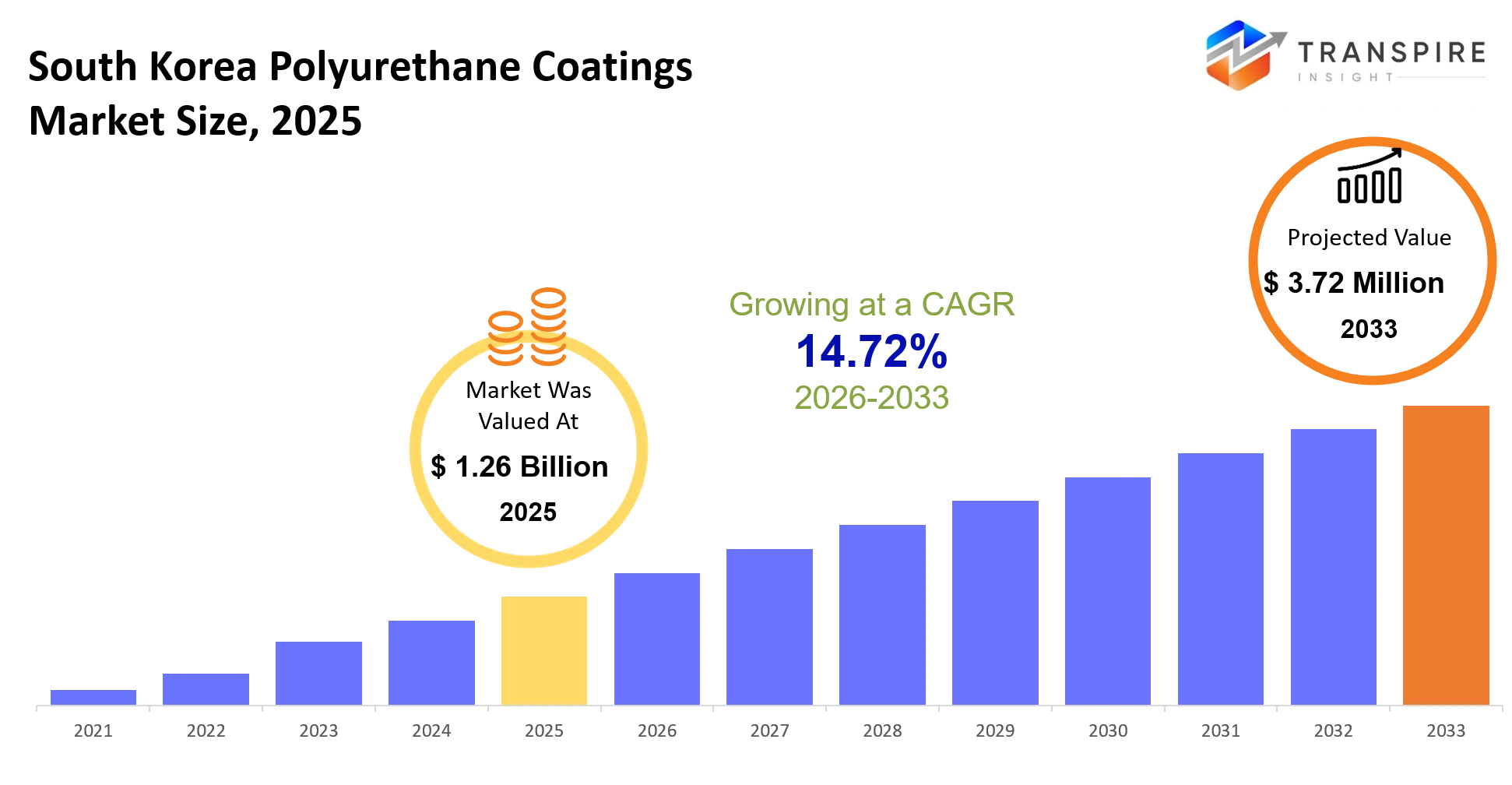
- South Korea Polyurethane Coatings Market Size 2025: USD 1.26 Billion
- South Korea Polyurethane Coatings Market Size 2033: USD 3.72 Million
- South Korea Polyurethane Coatings Market CAGR: 14.72%
- South Korea Polyurethane Coatings Market Segments: By Type (Solvent-borne, Water-borne, Powder Coatings, UV-cured, Others); By Application (Automotive, Construction, Industrial Equipment, Wood Finishing, Others); By End User (Automotive, Construction, Manufacturing, Others); By Technology (Single Component, Two Component, Others)
To learn more about this report,  Download Free Sample Report
South Korea Polyurethane Coatings Market Summary
The South Korea Polyurethane Coatings Market was valued at USD 1.26 Billion in 2025. It is forecast to reach USD 3.72 Million by 2033. That is a CAGR of 14.72% over the period.
South Korea’s polyurethane coatings market, pretty much shelters shipbuilding, offshore structures, and heavy industrial gear by creating tough films that fight corrosion, abrasion and that constant saltwater ordeal. In shipyards and coastal plants these coatings get put onto hulls, tanks ,and other steel structures, so the whole asset lasts longer and the maintenance downtime drops down a bit too.
Lately, the whole scene has been leaning away from solvent-based coatings toward high-solids and waterborne polyurethane systems. Korea tightened VOC controls and shipyards started matching procurement with ESG needs, so the switch made sense. Then, during the pandemic there were the usual disruptions in isocyanate and resin supply , and it kind of added more pressure. Manufacturers had to tweak their formulations and also broaden their sourcing , sometimes in a rush, because it was all a bit tight. At the same time global shipping picked up again. Plus, offshore maintenance activity bounced back, so recoating happens more often, and that naturally lifts demand too.All of this is pushing customers toward higher-durability coatings that actually follow regulations, which helps lower lifecycle maintenance costs, while also improving how efficiently teams apply them across both marine and industrial use cases.
Key Market Insights
- Ngs Market, with a projected 42-45% share in 2025 owing to industry focus and infrastructure needs.
- The southeastern industrial belt is expected to be the fastest expanding region by shipbuilding growth and increasing capacity for manufacturing automobiles, up to 2030.
- Increasing demand for polyurethane coatings in coastal areas due to maritime application (protection, anti-corrosion) and upgrades in industrial facilities oriented towards exportation.
- Solvent-based coatings hold a significant share (approximately 38-40%) in the South Korea Polyurethane Coatings Market owing to their durability and applications in industries.
- Waterborne polyurethane coatings account for the second largest share of South Korea Polyurethane Coatings Market by supporting environment-friendly directives and growing use of low-VOC based coating materials.
- The Powder-based polyurethane coatings are estimated to be the fastest growing segment until 2030 owing to environmental friendly demand and rise in cost efficiencies.
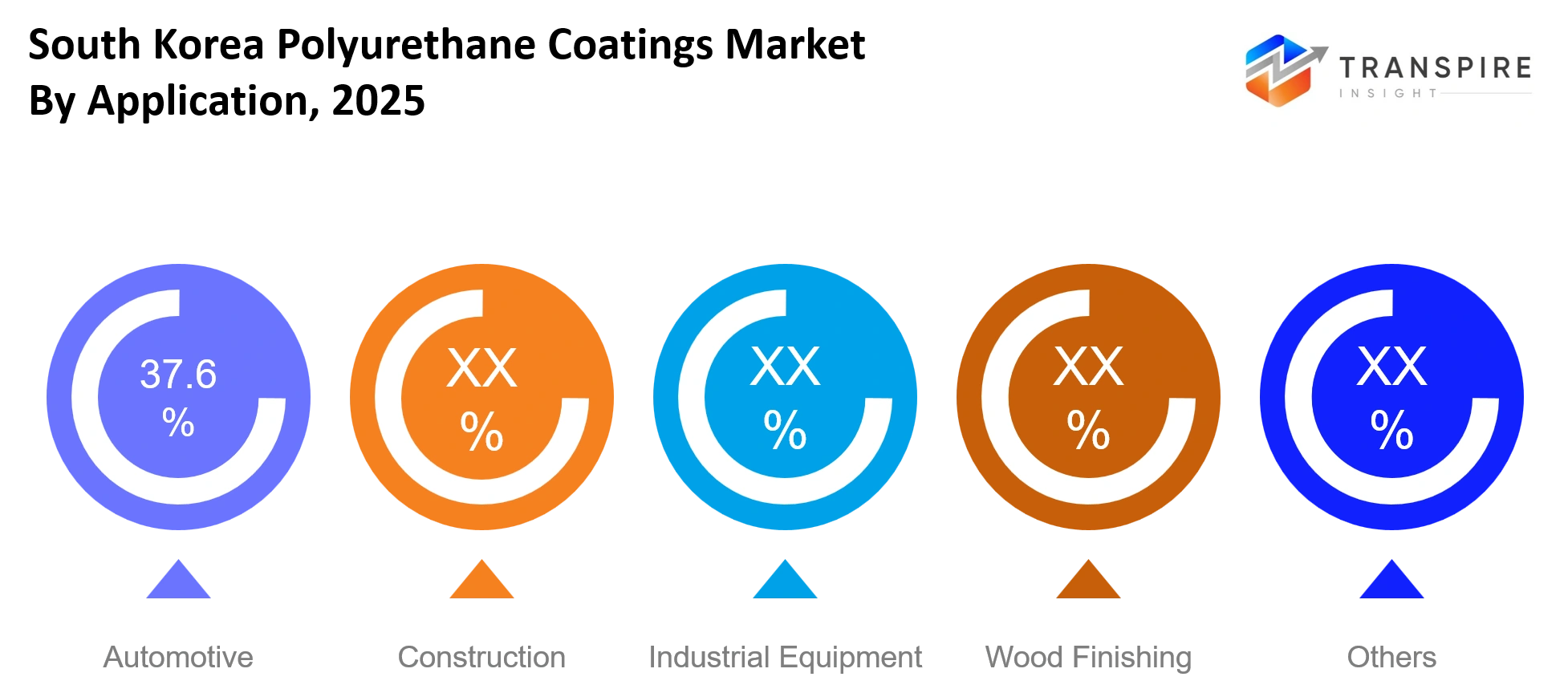
- Automotive applications constitute around 35% share owing to rise inOEMs demand, vehicle refinishing and innovations in the field of lightweight coating solutions.
- The marine and shipbuilding application is estimated to witness the highest growth rate owing to stringent demand for anti-corrosion features and rise in South Korean global position in shipbuilding industry.
- The construction segment is basically seeing a strong demand , mostly because of modern infrastructure buildouts and the rising need for durable but also protective surface coating solutions.
- Meanwhile industrial manufacturing is expected to sit at the higher end, as the prime end user application, holding something like nearly 40% share in the South Korea Polyurethane Coatings Market.
What are the Key Drivers, Restraints, and Opportunities in the South Korea Polyurethane Coatings Market?
Strict environmental legislation under South Korea's Green New Deal regulations is the key driver, particularly for a rapid switch away from conventional high solvent content systems used in automotive and construction sectors. Major players like Hyundai and Kia have significantly ramped up their adoption of advanced PU coating systems for EV applications beyond 2023 as scratch resistance and lightweight properties translate directly to increased vehicle efficiency and a longer product life cycle. The combination of regulation and rapid increases in EV output leads to high value coating contracts and better margin realization for OEM suppliers of these advanced systems.
South Korea's high reliance on the imports of upstream petrochemical feedstocks, mainly isocyanates and polyols, represents a major structural constraint on the South Korea Polyurethane Coatings Market as its supply and price become susceptible to external price volatility and disruptions. The volatility of the feedstock, deeply intertwined with the crude oil price cycle, leaves a lack of leverage on price negotiations for the coating manufacturers, and also delayed purchasing decisions especially during external oil crises. Such constraints reduce the margin for mid-term investment in capacity expansion, and create margin compression pressure particularly for mid-tier domestic producers that lack upstream vertical integration.
The prominent long-term growth opportunity is identified with growth in advanced marine and shipbuilding PU coating applications linked to the construction of LNG carriers and the push toward green vessel standards being implemented in shipbuilding sectors of Busan and Ulsan. There is a significant upswing in investment in nano-structured PU coating systems that can offer high corrosion resistance and up to 30% shorter maintenance intervals. Coupled with increasing orders for green vessels, such advanced PU coatings can serve as another source of high value growth for the South Korea Polyurethane Coatings Market.
What Has the Impact of Artificial Intelligence Been on the South Korea Polyurethane Coatings Market?
In relation to the improvement in efficiency and compliance of operations, the Korea Polyurethane Coatings Market has seen a gradual shift towards stronger alignment of AI and advanced digital technologies with industrial coating performance systems applied in automotive, marine and infrastructure sectors.
The utilization of AI controlled systems in coating production processes to precisely maintain parameters such as viscosity, curing temperature, and uniform spraying in real-time is increasing within the aspect of operational automation and optimization. AI controlled monitoring systems analyzing data received from vessel fleets passing through Busan and Ulsan ports have been adopted within maritime applications linking with scrubber performance systems and exhaust gas cleaning technology, aimed at determining the optimal coating lifespan under fluctuating salinity and humidity and enabling better schedule for repair activities.
Predictive analyses are being enhanced through ML models to predict coating degradation trends based on environmental exposures, salt concentration and load requirements, enhancing reliability of predictive maintenance activities leading to between 10-15% reduction in unplanned downtime for ship operators and industrial sites and improved efficiency of coating lifespan, aligned with stringent emissions regulations impacting coating durability. Within the scope of operational optimization and cost saving, a 8-12% improvement has been identified for large scale coating operations by utilizing digital process controls. Limitation is placed in developing fully accurate ML models for extreme weather situations due to sparse datasets generated from real sea conditions leading to a gradual process in deployment in the Korea Polyurethane Coatings Market.
Key Market Trends
- New VOC regulations from 2023 drove near-30% of manufactures' product portfolios toward low-solvent polyurethane formulation.
- Hyundai and Kia raised EV coating usage from 2024 onward. Production demand then pivoted toward lightweight and highly durable polyurethane surface systems.
- Ulsan shipbuilders expanded the use of corrosion-resistant polyurethane from 2025 with the increased export order of LNG carrier constructions.
- The solvent-based coating productions of domestic manufacturers plummeted from 2023 after heightened environmental audits and penalties.
- AkzoNobel and PPG Industries kind of boosted their R&D outlay for waterborne polyurethane starting in 2024 and running into 2026, basically aiming at premium procurement deals with higher purchase value.
- Meanwhile the adoption of powder coating kept rising from 2024 onward because manufacturers tended to like lower lifecycle emissions, plus those more energy-efficient curing routines.
- On the OEM side the procurement contract shifted toward performance based agreements by 2025, and manufacturers were more interested in coating materials that offer stronger wear resistance, and also faster curing rates, which matters a lot.
- Increased monitoring systems enabled higher uniformity and reduced industrial waste levels.
- Export-driven marine demand gained momentum after 2025 following the surge in contracts for eco-friendly ships with European ship owners.
- Kansai Paint and Jotun entered an expanded partnership with ship builders to establish long-term coating supply agreements at coastal Korean facilities.
South Korea Polyurethane Coatings Market Segmentation
By Type :
Solvent-based coatings are still being utilized as there is a good adhesion, and have long been standard in the industries, but the application level has gradually decreased due to the tougher standard regulations applied during recent times. Water-based coatings have higher adoption rates as most of the industries are progressing toward lower emissions at their manufacturing lines, and safer work environments.
The growing demands for powder coatings due to their wastage reduction, higher efficiency on drying, and reduced power consumption during curing time is notable. The utilization of UV coatings is growing very slowly as these systems are generally used in few of the highly precise applications as speed and surface finish is extremely critical. The other types of coatings are not as commonly used as the above coatings and they are limited to specific industrial use where they find applicability.
By Application :
The automotive sector is a key driver in the demand for polyurethane coatings due to increasing demand for scratch resistance and surface protection applications as well as vehicle Lightweight design. Demand from the construction sector is steady due to upkeep of infrastructure and use of durable protective coatings for construction.
Demand from industrial equipment applications is increasing due to increased use of high durability coatings for extending machinery life time and reducing machinery downtime. Demand for the finishing wood is stable in indoor applications. Other applications of PU coating are for industrial niche sectors in applications like chemically resistant and durable services coating.
To learn more about this report, Download Free Sample Report
By End User :
Strong share among automotive end-users is expected to grow as vehicle production continues and awareness of surface needs regarding electric mobility is amplified. A growing use is anticipated from construction end-users due to sustained infrastructure upgrades and renovation processes.
Adoption by manufacturing end-users is driven by its use in protecting manufacturing equipment from wear and the subsequent minimization of maintenance requirements during production processes. The other end-users are expected from specialty sectors where protective coatings are essential in extreme environments where their wear resistance and resistance performances are critical.
By Technology :
Single component systems are generally favored due to their simplicity in application, and overall simpler operational requirements for normal industrial usage. Two component systems are more suitable where a more robust performance is required with excellent bonding strength and chemical resistance.
Usage of two component systems have become more prevalent as industry requests longer coating lifespan and greater substrate protection. All other technologies are used in specialized applications.
What are the Key Use Cases Driving the South Korea Polyurethane Coatings Market?
In the South Korea Polyurethane Coatings Market, automotive surface protection still dominates. The number of automotive production increased and the demands for better scratch resistance, gloss retention, and long coating life are the drivers of the automotive industry. Electric vehicle production is the growth driver, and it further increases the demand for polyurethane systems with lightweight performance to facilitate weight reduction and energy saving in automotive manufacturing plants.
Other emerging applications are industrial machinery protection and construction surface finish. These are growing fast as secondary application types. Plants apply PU coatings on their equipment to cut down on wear and increase product life, while new urbanization projects on both concrete and steel structures are coated with polyurethane coatings due to their high endurance against harsh environmental factors. Both types of application rely heavily on their industrial and construction end users due to the advantage of reduced maintenance costs.
Advanced electronics housing protection, and durable coatings for renewable energy structures, such as coatings applied on solar panel frames, are new and niche applications but catching the interest from Korean end-users. Long-life span of assets and rigorous environmental performance standards in the forecast period are pushing these applications forward.
|
Report Metrics |
Details |
|
Market size value in 2025 |
USD 1.26 Billion |
|
Market size value in 2026 |
USD 1.44 Billion |
|
Revenue forecast in 2033 |
USD 3.72 Million |
|
Growth rate |
CAGR of 14.72% from 2026 to 2033 |
|
Base year |
2025 |
|
Historical data |
2021 - 2024 |
|
Forecast period |
2026 - 2033 |
|
Report coverage |
Revenue forecast, competitive landscape, growth factors, and trends |
|
Country scope |
South Korea |
|
Key company profiled |
PPG, Akzo Nobel, Sherwin-Williams, BASF, Axalta, Jotun, Nippon Paint, Kansai Paint, KCC Corporation, RPM International, Hempel, Berger Paints, Asian Paints, Sika, Covestro |
|
Customization scope |
Free report customization (country, regional & segment scope). Avail customized purchase options to meet your exact research needs. |
|
Report Segmentation |
By Type (Solvent-borne, Water-borne, Powder Coatings, UV-cured, Others); By Application (Automotive, Construction, Industrial Equipment, Wood Finishing, Others); By End User (Automotive, Construction, Manufacturing, Others); By Technology (Single Component, Two Component, Others) |
Which Regions are Driving the South Korea Polyurethane Coatings Market Growth?
The South Korea Polyurethane Coatings Market is driven by the Seoul Capital Region, which boasts the highest concentration of automobile OEMs, chemical suppliers, and smart manufacturing facilities. Stringent regulation over VOC emissions forced plants in the Seoul Capital Region to implement advanced polyurethane systems earlier compared to other regions. Its major research & development facilities and state-of-the-art plants, along with an effective logistics network that guarantees timely delivery of both the raw materials and finished products to domestic markets and abroad, are significant factors.
The stable second region in the market is the southeastern industrial zone of the Ulsan and Busan areas, where the marine and heavy industries are predominantly present. It differs from the Seoul region since it relies on shipbuilding and petrochemical demands rather than an array of diverse industries. Its long-term contracts with shipyards and coat suppliers guarantee consistent cash flow even in recessionary phases. Constant investments made by major ship owners and operators also bring consistent cash flow and demand.
The southwestern coastal area is the fastest-growing region since the port infrastructure development and renewable-energy related projects commenced construction there. With increased pressure to manage vessel emissions and upgraded export facilities, new, advanced polyurethane systems were more aggressively implemented since 2024. Investments by public and private entities in smart port infrastructure have resulted in greater needs for corrosion protection and maintenance coating. This suggests considerable opportunities for coat suppliers during the 2026–2033 forecast period.
Who are the Key Players in the South Korea Polyurethane Coatings Market and How Do They Compete?
The South Korea Polyurethane Coatings Market features a moderately consolidated competitive landscape, with global chemical and coating suppliers dominating the overall market share and local players catering to particular industrial sectors. Market competitiveness is determined not only by prices but also by technological advancement capabilities and compliance levels. Key success factors are innovation in the low-VOC coating systems, improvement of durability characteristics of polyurethane coatings, and rapid curing of systems to satisfy the stringent environmental and industrial requirements. For automotive and marine sectors, entry to the market requires dependence on raw materials and the acquisition of respective certifications which are critical.
PPG Industries specializes in innovation and enhancement of performance coatings with special focus on automotive OEMs that necessitate better scratch resistance and lightweight material adaptability inEV platforms. The firm stands out because of its advanced formula development and integration with global automobile supply networks. The expansion is realized through establishing strong partnerships with Korean manufacturers requiring custom coating systems for future generation cars.
AkzoNobel enhances competitiveness by leveraging its environmentally- friendly low- emission coating systems that will meet various regulatory standards in industrial and construction sectors. Key differentiators lie within their waterborne technology platforms which cut down on environmental footprint and provide excellent endurance at the same time. Local product customization for Korean industrial customers is facilitated through regional partnerships with domestic industrial component suppliers.
Sherwin-Williams achieves competitiveness by providing consistent and standardizable products together with effective service infrastructure for automobile re-finishing purposes. Key advantages include its application efficiencies and high-consistency finish. The company promotes its expansion through contracts with industrial and automotive firms for their supply networks.
Nippon Paint places emphasis on R&D in sustainable polyurethane coatings which meet Asian environmental standards. The key differentiators are in its fast adaptation of products with regards to shifting environmental policies and also collaborative joint development efforts with various manufacturers aimed at sustainable coating solutions.
Jotun aims at strengthening its competitiveness in marine and offshore protective coating segments where long service life is a prerequisite for its anti-corrosion attributes. It has established itself as a specialist through its high-resistance finish and the longevity aspect of its products. Expansion efforts are driven through cooperative projects with shipbuilding companies building and developing LNG carrier and high specification ships in various parts of Korea.
Company List
- PPG
- Akzo Nobel
- Sherwin-Williams
- BASF
- Axalta
- Jotun
- Nippon Paint
- Kansai Paint
- KCC Corporation
- RPM International
- Hempel
- Berger Paints
- Asian Paints
- Sika
- Covestro
Recent Development News
In August 2025, Chokwang Paint signed a Memorandum of Understanding with KOMSCO. The partnership focuses on joint R&D for advanced industrial coating technologies, including next-generation structural coloration and functional coating compositions, aimed at enhancing performance and differentiation in high-value coating applications.
Source https://www.newswire.co.kr/
In August 2025, KCC Corporation entered a strategic partnership with Graco. The collaboration integrates KCC’s polyurethane-based paints and waterproofing coatings with Graco’s industrial spray equipment to deliver a unified coating application system for construction and industrial use, strengthening KCC’s position in end-to-end coating solutions.
Source https://www.koreaittimes.com/
What Strategic Insights Define the Future of the South Korea Polyurethane Coatings Market?
The market will be structurally reforming in favour of high performance, low emission products, as industrial buyers begin to consider coating compliance, performance longevity as a means to operational optimisation, not volume growth, over 5-7 years. Key growth areas will be influenced by trends in electric vehicle production, advanced marine facilities, and digitised production where coating lifetime directly contributes to asset operating cost and uptime.
An unarticulated risk is the increasing reliance on imports of isocyanates and polyol intermediates from which the market would remain exposed to volatile upstream commodity petrochemical prices, as well as potential concentration in the hands of just a few international chemical producers, thus pressuring margins at times of strong product demand, and restricting domestic expansion capability.
A less widely recognised, yet considerable future market opening is associated with coating application technologies in smart factories in industrial hubs of Ulsan and Incheon driven by Artificial Intelligence in process control to minimise coating defects and wastage. The domestic industry must invest in vertical integration back to its raw materials and adopt sophisticated digital application methods in order to gain contract security, and long term market position, for the more valuable segments.
South Korea Polyurethane Coatings Market Report Segmentation
By Type
- Solvent-borne
- Water-borne
- Powder Coatings
- UV-cured
By Application
- Automotive
- Construction
- Industrial Equipment
- Wood Finishing
By End User
- Automotive
- Construction
- Manufacturing
By Technology
- Single Component
- Two Component
Frequently Asked Questions
Find quick answers to common questions.
The expected South Korea Polyurethane Coatings Market size is USD 3.72 Million in 2033.
Key segments for the South Korea Polyurethane Coatings Market are By Type (Solvent-borne, Water-borne, Powder Coatings, UV-cured, Others); By Application (Automotive, Construction, Industrial Equipment, Wood Finishing, Others); By End User (Automotive, Construction, Manufacturing, Others); By Technology (Single Component, Two Component, Others).
Major South Korea Polyurethane Coatings Market players are PPG, Akzo Nobel, Sherwin-Williams, BASF, Axalta, Jotun, Nippon Paint, Kansai Paint, KCC Corporation, RPM International, Hempel, Berger Paints, Asian Paints, Sika, Covestro.
The South Korea Polyurethane Coatings Market size is USD 1.26 Billion in 2025.
The South Korea Polyurethane Coatings Market CAGR is 14.72% from 2026 to 2033.
- PPG
- Akzo Nobel
- Sherwin-Williams
- BASF
- Axalta
- Jotun
- Nippon Paint
- Kansai Paint
- KCC Corporation
- RPM International
- Hempel
- Berger Paints
- Asian Paints
- Sika
- Covestro
About the Authors

Pankaj Ghogare Patil
I am Pankaj Ghogare Patil, a Senior Research Analyst at Transpire Insight, specializing in the Pharmaceutical, Chemicals & Materials, Healthcare IT, and Biotechnology industry. My expertise lies in conducting comprehensive market research, analyzing industry trends, evaluating competitive landscapes, and translating complex data into actionable insights. At Transpire Insight, I closely follow emerging technologies, regulatory developments, and market innovations to create accurate, well-researched, and informative content that helps businesses and professionals make informed decisions. I am committed to producing credible, evidence-based articles that reflect industry best practices while making technical topics accessible and valuable for a broad audience.

Chakradhar Khansole
Chakradhar serves as the Research Director at Transpire Insight, bringing over 8 years of experience in technology, innovation, and strategic market intelligence. He specializes in transforming complex market data into actionable business insights that enable organizations to make informed, growth-oriented decisions. Recognized for his strategic vision and analytical expertise, Chakradhar leads high-impact research initiatives, delivering comprehensive market assessments, competitive intelligence, and forward-looking industry analysis.
Recently Published Reports
-
May 2026
Healthcare Polymer Packaging Market
Healthcare Polymer Packaging Market Size, Share & Analysis Report By Packaging Type (Syringes, IV Bottles and Pouches, Clamshells, Blisters, Bottles & Jars, Containers, Tubes, IV Parental Packaging, Others), By Type (Regulated, Non-regulated), By Polymer Type (LDPE (Low-Density Polyethylene), HDPE (High-Density Polyethylene), Homo-polymer (Homo), Random Copolymer (Random), Block Copolymer (Block), PET, Polystyrene, Polyvinyl Chloride, Polyamide/EVOH, Others), and Geography (North America, Europe, Asia-Pacific, Middle East and Africa, South and Central America), 2021 - 2031
-
Apr 2026
Hydrophilic Tape (Waterstop) Market
Hydrophilic Tape (Waterstop) Market Size, Share & Analysis Report By Type (Bentonite-Based Hydrophilic Tape, Rubber-Based Hydrophilic Tape), By Application (Residential Buildings, Commercial Buildings, Infrastructure Projects), and Geography (North America, Europe, Asia-Pacific, Middle East and Africa, South and Central America), 2021 - 2031
-
Apr 2026
Metalens Market
Metalens Market Size, Share & Analysis Report By Type (Visible Light Metalens, and Infrared Metalens), By Application (Consumer Electronics, Automotive Electronics, Industrial, Medical, and Others), and Geography (North America, Europe, Asia-Pacific, Middle East and Africa, South and Central America), 2021 - 2031
-
Apr 2026
PBT Resin Market
PBT Resin Market Size, Share & Analysis Report By Type (Reinforced PBT Resin, Unreinforced PBT Resin), By Processing Method (Injection Molding, Extrusion, Blow Molding, Others), By End-User (Automotive, Electrical & Electronics, Consumer Appliances, Industrial Machinery, Medical Devices, Packaging, Others), and Geography (North America, Europe, Asia-Pacific, Middle East and Africa, South and Central America), 2021 - 2031