
France Circular Construction Market Size & Forecast:
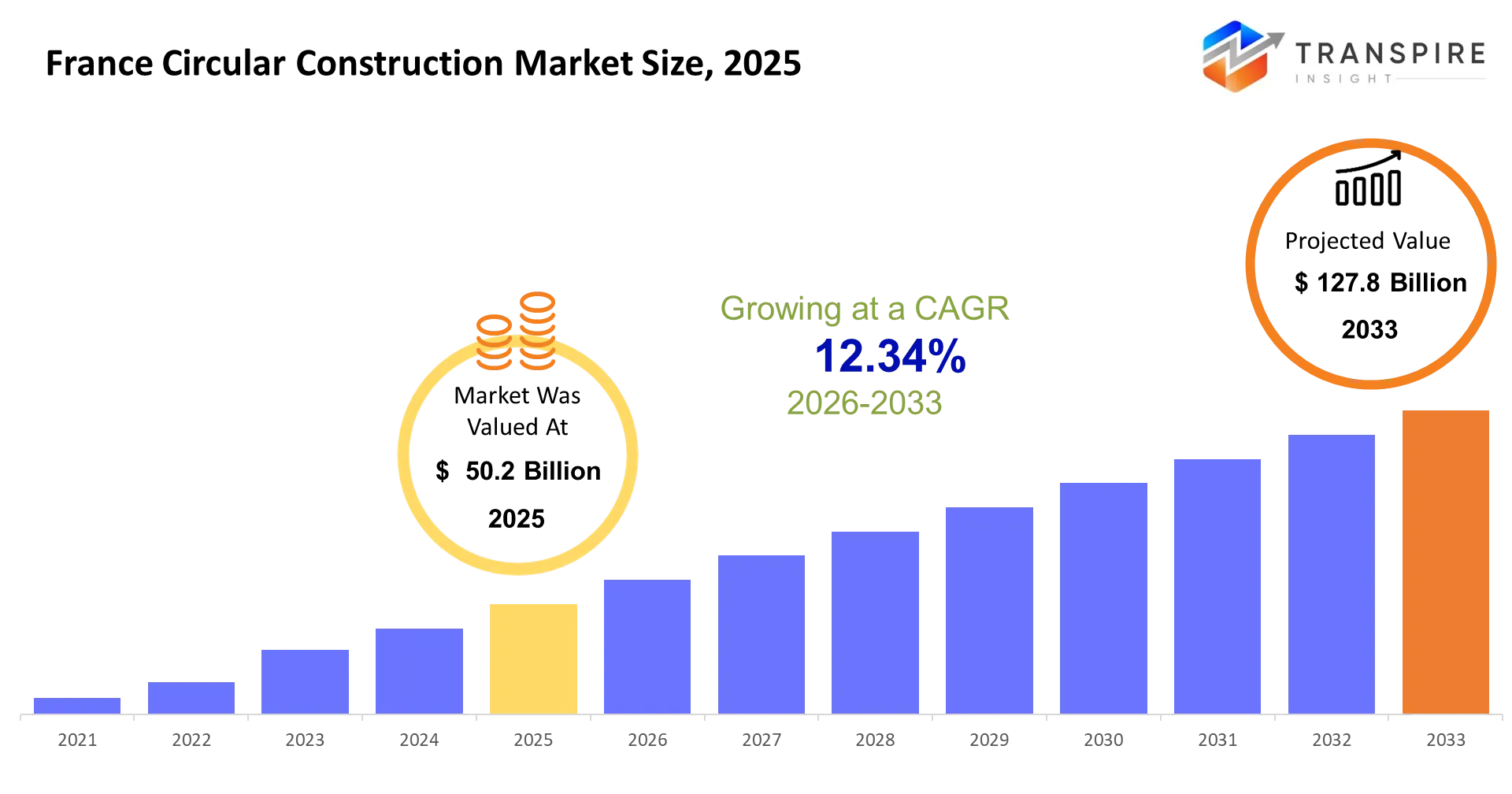
- France Circular Construction Market Size 2025: USD 50.2 Billion
- France Circular Construction Market Size 2033: USD 127.8 Billion
- France Circular Construction Market CAGR: 12.34%
- France Circular Construction Market Segments: By Type (Recycled Materials, Modular Construction, Reusable Components, Others); By Application (Residential, Commercial, Infrastructure, Others); By End-User (Construction Firms, Developers, Government, Others); By Material (Concrete, Steel, Wood, Others)
To learn more about this report,  Download Free Sample Report
France Circular Construction Market Summary
The France Circular Construction Market was valued at USD 50.2 Billion in 2025. It is forecast to reach USD 127.8 Billion by 2033. That is a CAGR of 12.34% over the period.
The France Circular Construction Market, um, plays a critical role in reducing material waste, bringing carbon emissions down, and extending the lifecycle of buildings and infrastructure assets . In practice, this sector tends to focus on reusing demolition materials, and weaving recycled inputs into new projects, while also designing buildings that can be pulled apart and repurposed rather than just discarded . This whole approach supports construction firms in handling rising raw material costs, and at the same time it helps them meet tighter environmental performance requirements across both public and private initiatives.
Over the last five years, France has moved from the usual linear construction models toward resource-efficient building systems , backed by circular economy laws and green procurement mandates. The Anti-Waste for a Circular Economy Law helped speed up investment in recycled concrete, modular building systems and material recovery platforms. On top of that, supply chain disruptions plus sharp increases in cement, steel , and energy prices after the pandemic basically forced contractors to seek secondary materials more locally. So, in the end, developers, municipalities, and infrastructure operators are adopting circular construction practices not only to satisfy sustainability compliance, but also to stabilize procurement expenses, enhance project resilience, and open up long-term operational savings.
Key Market Insights
- Northern, and Île-de-France regions kind of accounted for nearly 38% market share in 2025 due to dense urban redevelopment, and demolition activity was just active.
- Western France is showing up as the fastest-growing regional market through 2033, it’s been pushed by sustainable housing investments, plus municipal circular procurement programs.
- Recycled construction materials were the big driver, taking over 42% share in 2025, mainly because there’s strong concrete and steel recovery demand.
- Modular, and prefabricated construction systems sat as the second-largest segment. Developers have been trying to reduce material waste, also shorten delivery timelines, so yeah it makes sense.
- Building material traceability platforms are forecast to gain the fastest adoption through 2033 as digital compliance reporting is becoming mandatory for contractors.
- When it comes to applications, commercial real estate redevelopment stayed dominant, with about 35% market share in 2025, thanks to adaptive reuse projects.
- Public infrastructure renovation emerged as the quickest-growing application segment too, after France started expanding low-carbon public procurement requirements in 2023.
- Looking at end users, large construction enterprises led adoption with roughly 48% share, mostly because they have more compliance capacity and established recycling partnerships.
- Meanwhile mid-sized regional contractors are becoming the fastest-growing end-user category as recycled aggregates become commercially competitive with virgin materials, and it’s getting easier to source them.
- Strategic partnerships between demolition firms and material recovery operators have also improved secondary material availability and strengthened competitive positioning across the French construction ecosystem.
What are the Key Drivers, Restraints, and Opportunities in the France Circular Construction Market?
The most powerful thing pushing the France Circular Construction Market forward is basically the national and EU-level carbon reduction rules getting tighter, especially for the built environment. France’s RE2020 environmental regulation sort of changed the way developers look at construction materials, by putting embodied carbon next to operational efficiency. In practice this regulatory nudge made contractors and real estate developers rethink procurement, so they started weaving in recycled concrete, reclaimed steel and modular building systems. The financial effect looks pretty strong, since circular approaches cut landfill charges, reduce transportation exposure, and can also strengthen eligibility for public infrastructure deals that are tied to sustainability targets
Still, the market’s biggest “stuck” factor remains the patchy supply and certification of secondary materials. Recycled aggregates and reclaimed components often don’t have uniform quality checks across regions. That gap makes insurers, engineers and project managers hesitate. And unfortunately this issue can’t be fixed overnight, because it needs nationwide processing capability, harmonized testing routines, and a long-term alignment of the rules themselves. So adoption moves slower in bigger residential projects and in infrastructure builds, where compliance risk is never really low
At the same time, a real growth chance is showing up via digital material passport systems, plus AI-assisted building deconstruction platforms. France is seeing more money go into tools that map material origin, lifecycle performance, and reuse potential across building assets. Firms using BIM-integrated recovery systems can spot salvageable materials before demolition even starts, which usually improves recovery rates and supports better resale value
What Has the Impact of Artificial Intelligence Been on the France Circular Construction Market?
Artificial intelligence and advanced digital technologies are, sort of reshaping the France Circular Construction Market, by pushing material recovery efficiency further, supporting predictive asset management, and enabling lifecycle tracking across construction projects. AI- powered image recognition systems are now being used during demolition planning, to spot reusable steel, concrete, timber and façade parts, before structural dismantling even starts. This kind of automation cuts down on sorting mistakes and boosts material recovery rates for contractors that operate under strict waste reduction targets.
At the same time, machine learning models are improving predictive maintenance and lifecycle analysis for buildings that are designed using circular construction principles. Contractors rely on AI driven Building Information Modeling platforms to estimate material degradation, guess refurbishment schedules, and tune reuse opportunities for future renovation cycles. The result is that developers can avoid a lot of needless material replacement, while still improving long-term asset utilization. Digital twins that are integrated with circular construction workflows have also made project scheduling a bit more accurate, and they even lower material procurement costs, in practical terms.
From an operations angle, AI assisted waste management platforms are helping companies reduce what ends up in landfill, strengthen traceability compliance, and also shorten deconstruction timelines. A few contractors say they see real reductions in material handling costs and fewer project delays after they bring in automated recovery analytics into their workflow.
Still, AI adoption has a major constraint. Many older buildings in France don’t have digitized structural records, so it becomes hard to train reliable machine learning models for material identification, and reuse forecasting as well.
Key Market Trends
- Since 2022, French contractors have been pushing more recycled concrete into projects, partly because cement pricing volatility made the usual procurement math feel a bit, well, less predictable.
- Public infrastructure tenders increasingly ask for embodied carbon disclosures, which sort of changes supplier qualification, across several big urban redevelopment efforts.
- Modular construction picked up speed after developers looked for faster build cycles and a reduction in on site material waste, not just a small tweak.
- Material passport technologies started getting real attention in 2024 , as developers braced for tighter EU circularity reporting obligations.
- Demolition contractors have leaned more toward selective deconstruction rather than the old bulk demolition approach, mainly to protect and lift the resale value of reclaimed materials.
- Saint-Gobain has expanded its low-carbon insulation and recycled glass manufacturing capacity, trying to reinforce circular material supply chains that don’t break so easily.
- Meanwhile, large real estate developers are partnering more often with local recycling operators, to lock in steadier secondary aggregate supplies even while raw material inflation keeps showing up.
- BIM-integrated circular design tools are showing up more frequently, after French municipalities introduced tougher lifecycle assessment requirements for public works.
- Reclaimed steel usage has also risen in industrial redevelopment projects, as contractors try to limit their exposure to price swings for imported materials.
- From 2023 to 2025, mid-sized construction firms started investing in on-site material sorting systems too , aiming to cut landfill volume and transport costs at the same time.
France Circular Construction Market Segmentation
By Type
Recycled Materials hold the dominant position in the market, sure, because recycled concrete, reclaimed steel and secondary aggregates are still right in the middle of low-carbon building compliance across France. They get strongly integrated into urban redevelopment plans and public infrastructure upgrades, and this keeps pushing high commercial adoption among contractors as well as municipalities. Landfill disposal costs keep rising, plus the embodied carbon rules are getting stricter too, so long-term demand for recycled construction inputs stays basically locked in. Material recovery operators are also investing, maybe a bit more than before, in advanced sorting systems and localized processing facilities, so supply is steadier and certification is more reliable.
Modular Construction keeps a significant market share because prefabricated systems, in practice, reduce material waste, shorten project time, and boost labor efficiency across residential as well as commercial developments. The demand keeps climbing especially in dense city regions where developers are asking for faster delivery, with less on site disruption and all that. Reusable components are gaining momentum too, mainly because selective demolition is improving the recovery of structural steel, façade systems, and interior fittings that can be reused for redevelopment projects. Other circular construction approaches, like adaptive reuse systems and digital material passport technologies, are expected to open specialized growth pathways for technology providers and for sustainability focused investors over the forecast period.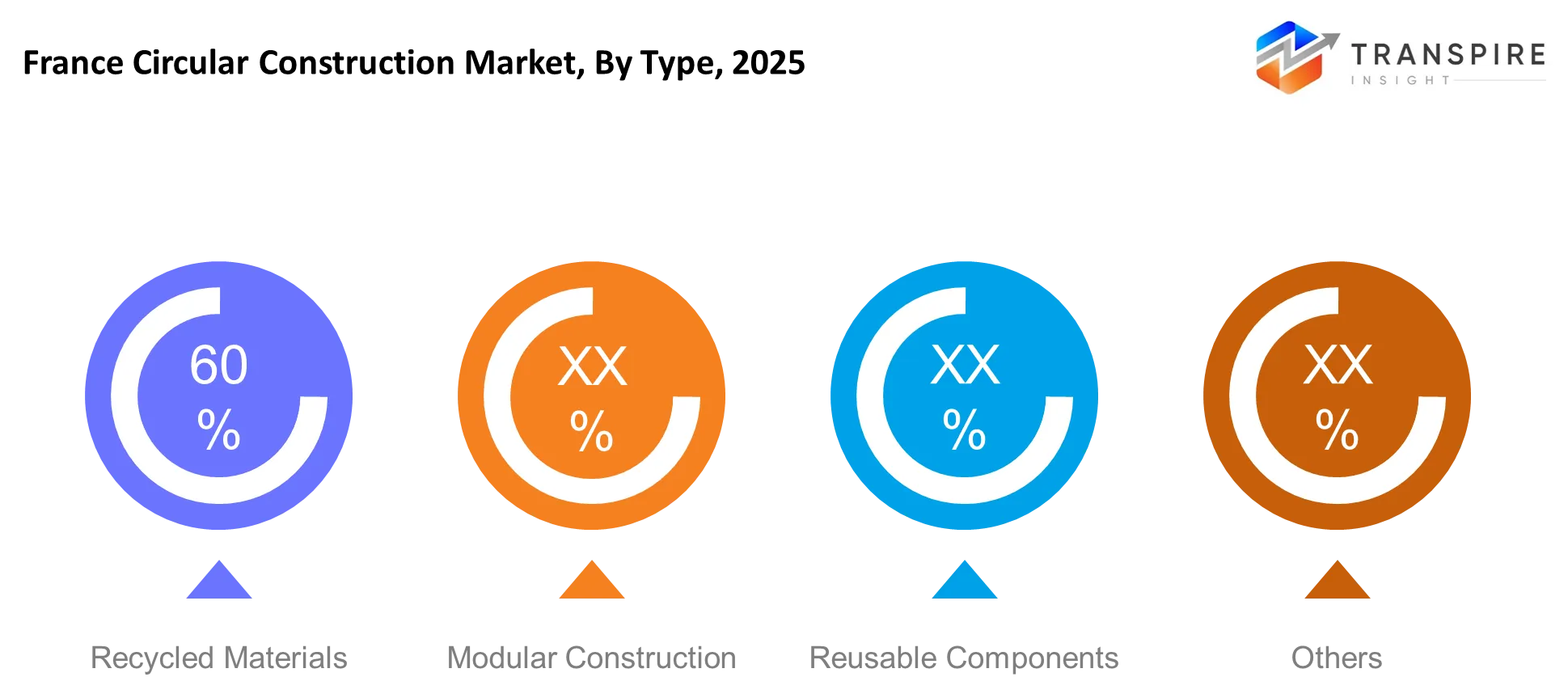
To learn more about this report, Download Free Sample Report
By Application
Residential construction is basically the leading application segment, mainly because big scale housing renewal and city redevelopment programs are, in general, asking for low-carbon , and also resource-efficient building methods. There’s still strong take up of recycled insulation, modular housing systems, and reclaimed structural materials that keeps feeding recurring demand across metro construction jobs. The energy efficiency rules, plus public housing modernization initiatives, also keep nudging investors toward circular building practices inside the residential development pipeline. And honestly, the long term housing shortages in a lot of urban areas are giving modular and prefabricated providers, like, steady activity for a while too.
Commercial construction keeps a meaningful market footprint too, since office refurbishments , retail redevelopment, and mixed-use projects are now often focused on embodied carbon reduction and reuse oriented material goals. On top of that, infrastructure applications are climbing gradually as local governments fold in recycled asphalt, reclaimed aggregates, and circular procurement guidelines into roads and public works. Public transit upgrades and climate resilient infrastructure spending are also helping, so more recycled construction materials get adopted by regional authorities. Other uses, like industrial facility retrofits and educational campus redevelopment are likely to bring extra demand for digital lifecycle tracking services, plus advanced deconstruction planning—those are, sort of, becoming a common need.
By End-User
Construction firms kinda dominate the end-user segment because contractors are the ones who directly handle demolition recovery, material procurement, and compliance execution across these circular building projects. Bigger companies tend to get a bit more advantage, they already have well formed recycling partnerships, plus better certification capabilities, and also supply chain networks that make it easier to obtain reclaimed construction materials. And then, the whole trend of expanding environmental reporting duties, it is nudging major contractors toward investment in digital material tracking, waste reduction systems, and similar efforts. Meanwhile, competitive bidding for public infrastructure contracts keeps pushing adoption of low-carbon construction methods across the contractor ecosystem, even when budgets feel tight.
Developers keep a solid market stance, largely because real estate operators now more often fold circular construction strategies into how they plan residential and commercial assets. Government entities are moving faster too, through green procurement mandates, public housing modernization, and infrastructure decarbonization programs that connect back to national climate targets. Municipal redevelopment agencies are still backing longer term commitments to recycled construction materials, and adaptive reuse initiatives across urban renewal activities. Beyond that, other end users, like industrial operators and institutional property owners, are expected to take part more often as lifecycle cost optimization becomes increasingly important through the forecast period.
By Material
Concrete still seems to be leading the market in a kind of obvious way because recycled aggregates along with low-carbon concrete formulations stay very important for infrastructure, housing , and offices, you know, the whole set of construction projects that keep moving. In a lot of urban redevelopment areas, demolition volumes are high so that gives a fairly steady supply of concrete that can be reused. That reuse fits roadworks, structural uses, and even public infrastructure upgrades. On top of that the regulatory push to cut cement-related emissions keeps speeding up new investments in recycled concrete processing technologies. Meanwhile product developers are steadily tweaking durability performance and certification requirements , just to make sure it gets accepted across big engineering programs.
Steel keeps a major share too, largely since reclaimed structural steel is highly recyclable, comes with a lower embodied carbon footprint, and can still sell for a good price later on. This matters a lot for renovation work and industrial redevelopment. Wood is also showing up as a fast-growing category, mostly because there’s more interest in bio-based building systems and sustainable modular housing. Cross-laminated timber is growing, but more gradually in low-rise residential and mixed-use projects that are chasing carbon reduction targets. Other options, like recycled glass, insulation composite materials, and reclaimed plastics, are expected to open up smaller, more niche opportunities for specialized manufacturers and circular material innovators over the forecast period.
What are the Key Use Cases Driving the France Circular Construction Market?
In the France Circular Construction Market the dominant use case kind of sits with urban redevelopment plus commercial building renovation. In practice, contractors re use concrete aggregates, structural steel, insulation materials, and façade elements, mostly to cut down disposal expenses and also to meet low carbon construction regulations. The big metropolitan areas see the highest demand, because demolition volumes are typically larger, and the chances for material recovery are simply way more significant.
Also, there are adjacent applications that keep stretching out into public infrastructure modernization and residential housing developments. Municipal authorities are adding recycled asphalt, reclaimed concrete, and modular construction systems into roads, schools, and transit works. At the same time, housing developers are starting to use prefabricated circular building components too, not only to speed up the build, but to keep procurement costs more stable.
Newer use cases are showing up as well, like AI-enabled deconstruction planning and digital material passport platforms that record reusable components across many building lifecycles. Industrial facility retrofits, and adaptive reuse projects too, are getting more attention, especially since France is prioritizing resource efficiency within manufacturing and logistics infrastructure redevelopment.
|
Report Metrics |
Details |
|
Market size value in 2025 |
USD 50.2 Billion |
|
Market size value in 2026 |
USD 56.6 Billion |
|
Revenue forecast in 2033 |
USD 127.8 Billion |
|
Growth rate |
CAGR of 12.34% from 2026 to 2033 |
|
Base year |
2025 |
|
Historical data |
2021 - 2024 |
|
Forecast period |
2026 - 2033 |
|
Report coverage |
Revenue forecast, competitive landscape, growth factors, and trends |
|
Regional scope |
France |
|
Key company profiled |
LafargeHolcim, Vinci, Bouygues, Skanska, Saint-Gobain, CRH, HeidelbergCement, Kingspan, Sika, BASF, Cemex, Veolia, Eiffage, FCC Construction, Ferrovial |
|
Customization scope |
Free report customization (country, regional & segment scope). Avail customized purchase options to meet your exact research needs. |
|
Report Segmentation |
By Type (Recycled Materials, Modular Construction, Reusable Components, Others); By Application (Residential, Commercial, Infrastructure, Others); By End-User (Construction Firms, Developers, Government, Others); By Material (Concrete, Steel, Wood, Others) |
Which Regions are Driving the France Circular Construction Market Growth?
Île-de-France keeps looking like the dominant region in the France Circular Construction Market , mostly because it has a high density of city redevelopments happening all the time, and also because regulators are fairly strict about low-carbon building. Basically, Paris and the nearby metropolitan belt keep producing big volumes of demolition waste , which then turns into a steady supply of reusable concrete, steel, and aggregates for circular building initiatives. On top of that, regional administrations have put embodied carbon reduction targets right into their public purchasing rules , so recycled construction materials are being picked up faster than before.
Auvergne-Rhône-Alpes still lands as the second-largest contributor, but the whole growth mechanism feels a bit different than in the Paris area . There, momentum is more tied to industrial modernization, and to infrastructure projects that connect back to manufacturing. The region does well thanks to a mixed economic fabric, consistent cycles of municipal spend, and a strong tilt toward energy-efficient renovation programs across commercial and industrial sites. Lyon and Grenoble , especially, have become key testing grounds for low-carbon construction approaches, notably for modular building systems and for the reuse of reclaimed material.
Western France is starting to move ahead as the fastest-growing regional market through 2033, mostly due to the new investments in sustainable housing, municipal waste recovery schemes, and regional recycling infrastructure. Nantes and Bordeaux are mentioned a lot because local authorities pushed circular procurement standards fairly quickly , after expanding climate-centered urban planning actions between 2024 and 2026. There has also been a noticeable rise in prefabricated building systems adoption, as developers try to manage labor constraints and keep material transport expenses under control.
Who are the Key Players in the France Circular Construction Market and How Do They Compete?
Competition in the France Circular Construction Market is kinda moderately consolidated, with big construction groups and global building material manufacturers holding much of the recycling, processing, and delivery muscle for infrastructure. In practice the market also seems to reward the companies that can blend material recovery networks with low-carbon product ideas, plus digital lifecycle tracking that is actually usable. Incumbents are defending their share through acquisitions, and also by running recycling operations in a more vertical way. Meanwhile smaller tech-minded firms keep slipping in through narrow offerings, like material traceability services and AI-assisted deconstruction planning, which sounds fancy but it is a real angle.
Holcim is pushing harder to hold its ground by expanding in recycled construction material processing and circular concrete technologies. Its ECOCycle platform kinda differentiates them, because it lets concrete products include high percentages of recycled demolition materials, without big performance trade-offs. They also grew in France by picking up recycling activities and precast construction assets, which improved access to secondary material streams and to infrastructure customers too. Saint-Gobain, on the other hand, competes using advanced insulation systems and low-carbon building materials, plus partnerships for workforce development that focus on sustainable construction skills, training basically.
Eiffage differentiates itself with infrastructure-centered circular construction capabilities, especially in transport and public works, where projects need recycled aggregates and low-carbon paving systems that fit the specs. Veolia leverages its waste management know-how and industrial recycling expertise to lock in longer-term partnerships for construction material recovery and urban waste valorization.
Company List
- LafargeHolcim
- Vinci
- Bouygues
- Skanska
- Saint-Gobain
- CRH
- HeidelbergCement
- Kingspan
- Sika
- BASF
- Cemex
- Veolia
- Eiffage
- FCC Construction
- Ferrovial
Recent Development News
In April 2026, Saint-Gobain entered a partnership with In’li to accelerate low-carbon residential construction and sustainable urban redevelopment in France. The collaboration focuses on circular building methods, decarbonized materials, and resilient urban infrastructure, strengthening France’s sustainable housing ecosystem.http://www.saint-gobain.com
In December 2025, Holcim announced acquisitions of recycling businesses in France, Germany, and the UK to expand circular construction operations. The deals added approximately 1.3 million tons of annual demolition material processing capacity and strengthened Holcim’s recycled building materials network in Europe.http://www.reuters.com
What Strategic Insights Define the Future of the France Circular Construction Market?
The France Circular Construction Market is sort of structurally moving toward fully integrated urban resource recovery systems , where demolition waste turns into a standardized input for new infrastructure and building development. This change is being pushed by tighter embodied carbon rules , raw material price swings, and more political pressure on municipalities to cut landfill reliance. Over the next five to seven years, digital material passports, AI-assisted deconstruction planning, and local recycling hubs are probably going to turn into core competitive differentiators, not just optional sustainability toys or nice-to-have features.\
One not so obvious risk is a possible shortage of high-quality reusable demolition material. As demand for certified recycled inputs picks up faster than the processing infrastructure can expand, the supply side may get messy. That mismatch could trigger pricing pressure and regional supply bottlenecks, even in places that currently look well-served. Meanwhile , adaptive reuse initiatives tied to public housing renovation and transport infrastructure modernization are a big but still underused opportunity, especially beyond Paris. Firms that start early with regional recycling logistics, traceability systems, and longer term municipal alliances may end up in a stronger position to lock in dependable material access and stable, long-duration contract pipelines.
France Circular Construction Market Report Segmentation
By Type
- Recycled Materials
- Modular Construction
- Reusable Components
- Others
By Application
- Residential
- Commercial
- Infrastructure
- Others
By End-User
- Construction Firms
- Developers
- Government
- Others
By Material
- Concrete
- Steel
- Wood
- Others
Frequently Asked Questions
Find quick answers to common questions.
The Approximate France Circular Construction Market size for the Market will be USD 127.8 Billion in 2033.
Key Segments for the France Circular Construction Market are By Type (Recycled Materials, Modular Construction, Reusable Components, Others); By Application (Residential, Commercial, Infrastructure, Others); By End-User (Construction Firms, Developers, Government, Others); By Material (Concrete, Steel, Wood, Others).
Major France Circular Construction Market players are LafargeHolcim, Vinci, Bouygues, Skanska, Saint-Gobain, CRH, HeidelbergCement, Kingspan, Sika, BASF, Cemex, Veolia, Eiffage, FCC Construction, Ferrovial.
The Current France Circular Construction Market size is USD 50.2 Billion in 2025.
The France Circular Construction Market CAGR is 12.34% from 2026 to 2033.
- LafargeHolcim
- Vinci
- Bouygues
- Skanska
- Saint-Gobain
- CRH
- HeidelbergCement
- Kingspan
- Sika
- BASF
- Cemex
- Veolia
- Eiffage
- FCC Construction
- Ferrovial
Recently Published Reports
-
Apr 2026
Handling and Lifting Equipment Market
Handling and Lifting Equipment Market Size, Share & Analysis Report By Product (Cranes and Hoists, Forklifts, Conveyor Systems, Aerial Work Platforms, Others), By Application (E-Commerce, Automotive and Railway, Food and Beverages, Aviation, Others), and Geography (North America, Europe, Asia-Pacific, Middle East and Africa, South and Central America), 2021 - 2031
-
Apr 2026
HVAC Equipment Market
HVAC Equipment Market Size, Share & Analysis Report By Heating Equipment Type (Boilers and Furnaces, Heat Pumps, and Unitary Heaters), By Ventilation Equipment (Air Handling Units, Humidifiers and Dehumidifiers, Air Filters, and Fan Coiling Units), By Air Conditioning Equipment (Unitary Air Conditioners, Room Air Conditioners, Packaged Terminal Air Conditioners, and Chillers), By End User (Commercial, Residential, Industrial, and others), and Geography (North America, Europe, Asia-Pacific, Middle East and Africa, South and Central America), 2021 – 2031
-
Apr 2026
Refrigeration Valves Market
Refrigeration Valves Market Size, Share & Analysis Report By Type (Solenoid Valves, Expansion Valves, Check Valves, Service Valves, Others), By Application (Commercial Refrigeration, Industrial Refrigeration, Transport Refrigeration, Residential Refrigeration, Air Conditioning Systems), By End User (Food and Beverage Industry, Pharmaceutical Industry, HVAC Industry, Chemical Industry, Others), and Geography (North America, Europe, Asia-Pacific, Middle East and Africa, South and Central America), 2021 – 2031
-
Apr 2026
E-Commerce Packaging Materials Market
E-Commerce Packaging Materials Market By Material Type (Corrugated Boxes, Paper & Paperboard, Foam & Cushioning Materials, Plastic Packaging, Flexible Packaging, Protective Packaging, Others), By Product(Primary Packaging, Secondary Packaging, Tertiary Packaging), By Packaging Function (Protective Packaging, Branding & Presentation Packaging, Transit & Logistic Packaging, Sustainable Packaging, Tamper Evidence Packaging), By End-User (Retail & Consumer Goods, Electronic Appliances, Food & Beverages, Healthcare & Pharmaceutical, Fashion & Apparel, Home & Furnishing, Others); By Industry Analysis, Size, Share, Growth, Trends, and Forecasts 2021-2033