

France Construction Robots Market Size & Forecast:
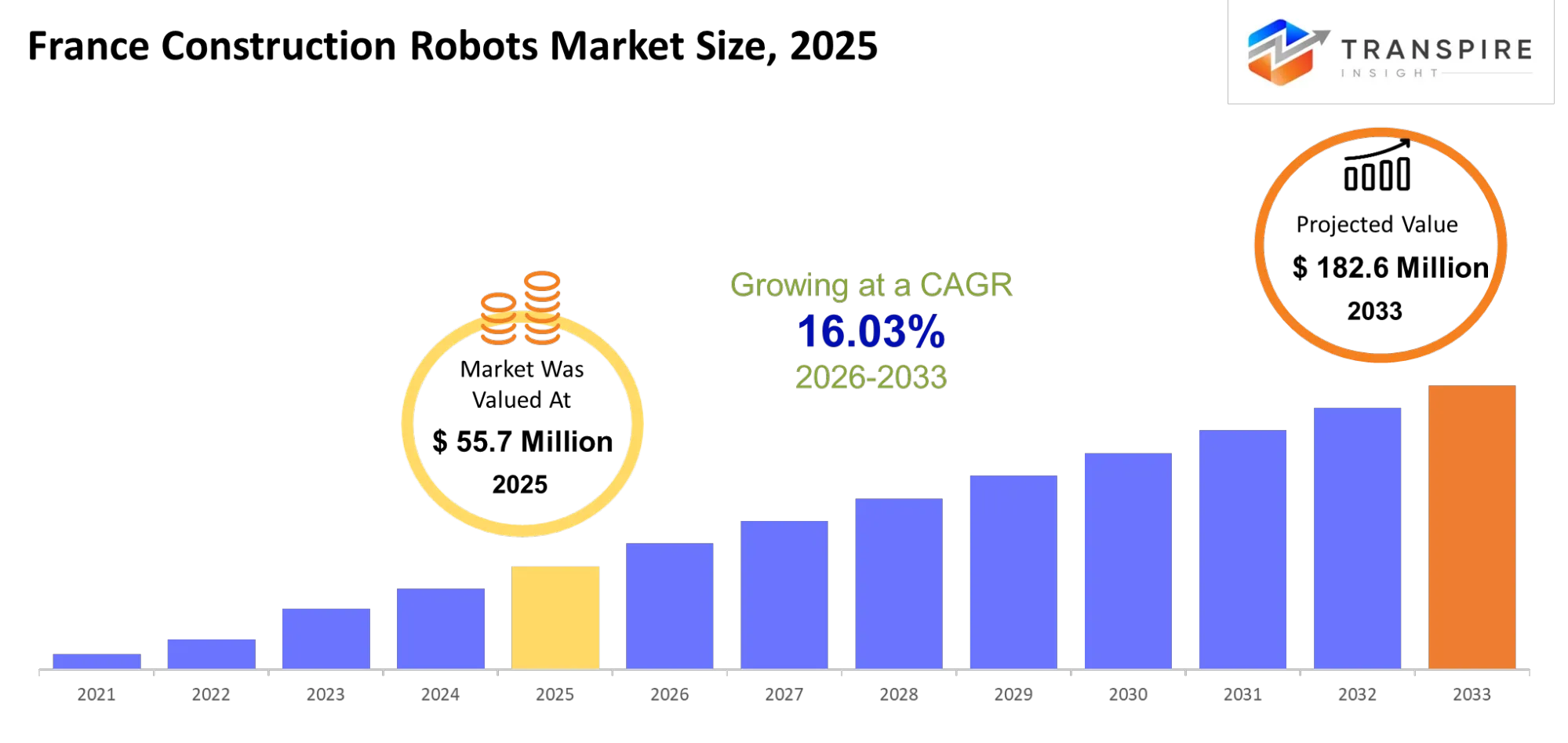
- France Construction Robots Market Size 2025: USD 55.7 Million
- France Construction Robots Market Size 2033: USD 182.6 Million
- France Construction Robots Market CAGR: 16.03%
- France Construction Robots Market Segments: By Type (Robotic Arms, Autonomous Mobile Robots, Exoskeleton Robots, 3D Printing Robots, Others); By Application (Material Handling, Bricklaying, Demolition, Concrete Processing, Site Inspection, Finishing Work, Others); By End-User (Construction Companies, Infrastructure Developers, Real Estate Developers, Government Projects, Industrial Sector, Others); By Automation (Fully Autonomous, Semi-autonomous, Remote-controlled, Others)
To learn more about this report,  Download Free Sample Report
France Construction Robots Market Summary
The France Construction Robots Market was valued at USD 55.7 Million in 2025. It is forecast to reach USD 182.6 Millionby 2033. That is a CAGR of 16.03% over the period.
The France Construction Robots Market is changing how contractors execute their work in commercial buildings and infrastructure projects and industrial facilities because of its ability to manage repetitive and dangerous and physically demanding tasks. Construction robots are currently being used for five different applications which include bricklaying and demolition and concrete finishing and autonomous surveying and site inspection, which enables businesses to decrease project delays and create safer work environments and achieve accurate results during their compressed project timelines. The market has moved from testing new automation methods during the past five years to using complete robotic systems which work together with BIM platforms and AI project management tools and digital twin technology.
The French construction industry discovered its operational hazards through labor shortages and material cost fluctuations which began after the pandemic ended. The construction industry adopted robotic systems because contractors needed to increase their productivity while maintaining their profit margins during a period of tighter operational requirements. The trend is driving infrastructure developers to buy more equipment while it creates ongoing revenue streams for robotics manufacturers and software integration companies and maintenance providers.
Key Market Insights
- The France Construction Robots Market in 2025 was dominated by Île-de-France which held almost 34% market share because of its extensive infrastructure development and commercial area redevelopment work.
- The southern part of France will experience the fastest market growth until 2033 because of transport corridor development and renewable energy project construction activities.
- The demolition robots market segment achieved the highest market share in 2025 because urban renovation projects which required safety measures brought in almost 29% of total industry revenue.
- The bricklaying and masonry robot market segment became the most rapidly expanding after 2023 because contractors needed to solve their skilled labor shortfall problem while meeting project delivery time requirements.
- Infrastructure contractors implemented robotic site inspection systems which included drone technology and LiDAR mapping and AI-based progress monitoring systems.
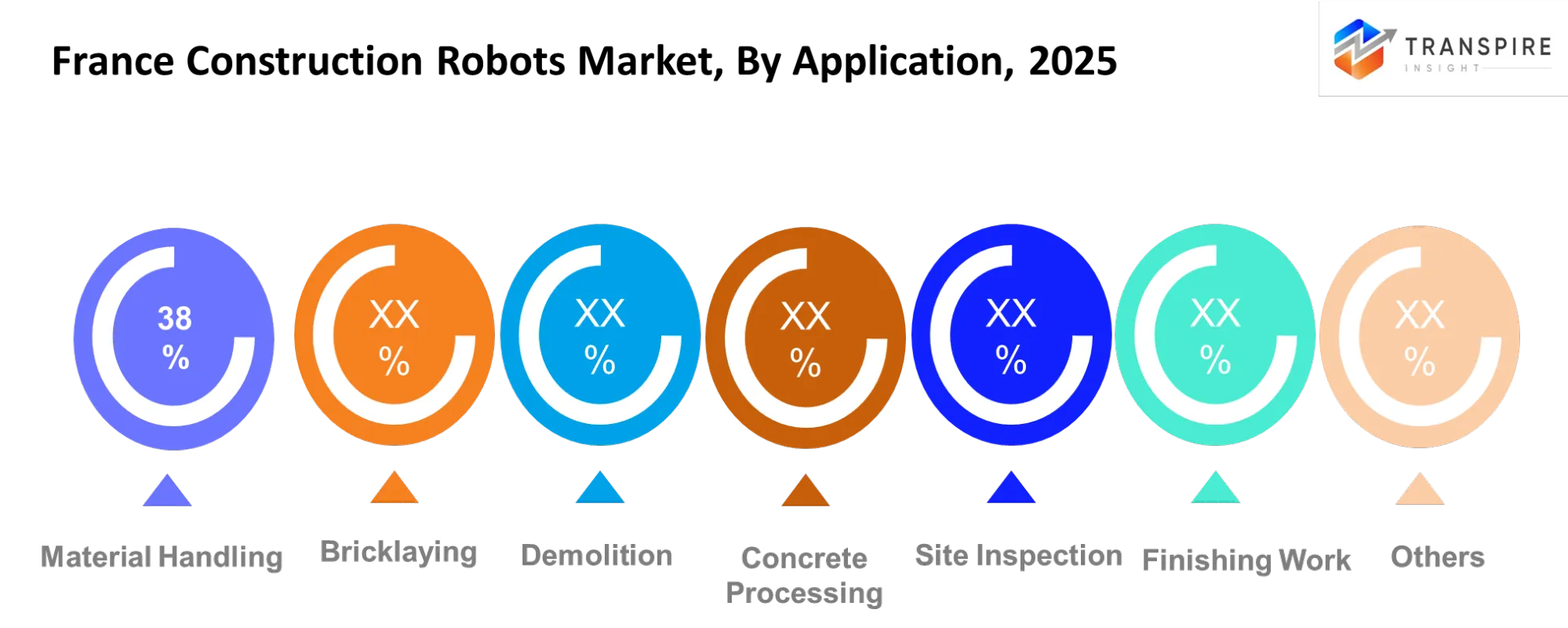
- The commercial construction sector emerged as the top application segment with more than 38% market share because it involves office retrofitting and logistics hub development and mixed-use property construction.
- The industrial facility construction sector has emerged as the fastest-growing market segment because manufacturers in France are using automation to develop their warehouse and semiconductor manufacturing facilities.
- The construction industry uses robotic systems mainly through its large construction firms which use their multiple projects to buy more than 60% of total market demand.
- Robotics-as-a-service models which enabled mid-sized contractors to lower their initial costs and system setup expenses after 2024 led to increased technology adoption in their business operations.
- The market leaders obtain competitive benefits through their use of AI-based autonomous navigation systems and their partnerships with construction companies and their growth into smart construction ecosystems.
What are the Key Drivers, Restraints, and Opportunities in the France Construction Robots Market?
The France Construction Robots Market experiences its highest growth because construction companies face two challenges which include their need for workers who meet industry standards and their obligation to finish projects within established deadlines. France's infrastructure modernization initiatives together with its urban redevelopment projects and its energy transition efforts compelled contractors to accomplish their work without using skilled personnel. The technological gap between existing construction processes and robotic bricklaying demolition and autonomous surveying systems which operate continuously at improved precision brought about an increase in funding. The shift toward robotics usage began as a method to increase operational capacity because organizations needed to handle their growing labor costs and project delivery deadlines which became more common after 2021. The transition brought direct benefits which raised revenue for robotics vendors and software integration companies and predictive maintenance solution vendors.
The market faces its most fundamental obstacle because of excessive expenses required for system integration. Construction robots need to work with building information modeling systems and digital site mapping technologies and operators must receive training on their specialized functions. The majority of medium-sized French construction companies still depend on outdated machinery and disjointed operational processes which create problems for executing robotic technology because it demands both technical expertise and financial backing. Construction sites lack standard procedures because their conditions change continuously which results in decreased efficiency for implementing new technologies. The existing constraint prevents industries from adopting new technologies while it creates obstacles which stop software products and maintenance services from generating expected revenue within the complete automation system.
The processing of various construction projects through robotics-as-a-service and AI-powered autonomous construction systems presents a significant market opportunity for developers. The French construction industry increasingly adopts subscription-based robotic systems which enable contractors to decrease their equipment expenses while receiving software updates and remote diagnostic capabilities.
What Has the Impact of Artificial Intelligence Been on the France Construction Robots Market?
The France Construction Robots Market is undergoing transformation because robotic systems now function as adaptive construction platforms that can make operational decisions in real time. AI-powered robots are increasingly used for autonomous navigation, site mapping, material handling, and precision layout tasks across commercial and infrastructure projects. Construction firms now use machine vision systems together with robotics to create automated systems that perform brick placement and detect structural deviations while monitoring worker safety conditions in active work environments.
Machine learning models are also enhancing robotic fleet operations through their ability to predict maintenance needs for robotic systems. Robot arms and demolition equipment and autonomous vehicles use their embedded sensors to monitor vibration patterns and thermal signatures and component stress levels to forecast equipment failures before equipment starts to break down. These systems help contractors improve equipment uptime, reduce repair costs, and optimize resource allocation across multiple projects. AI-driven project analytics also support scheduling accuracy and fuel efficiency by minimizing idle equipment operation and unnecessary material movement.
Robotic systems and project managers can now achieve better coordination through advanced digital construction technologies that connect with BIM platforms and digital twins. The current adoption process faces obstacles because integration expenses remain high and site conditions show inconsistency. AI models in construction environments generate less accurate results than their factory counterparts because contractors need to gather substantial amounts of top-notch field data which they currently do not possess.
Key Market Trends
- The French contractors through 2022 started their pilot robotics programs but they changed their focus to permanent automation solutions which they used in infrastructure work and commercial building projects.
- AI-powered site inspection robots received wider acceptance because labor shortages created a need for continuous project observation and accurate quality assessment.
- The deployment of demolition robotics systems accelerated in cities with high population density because safety regulations and space constraints needed to be solved through methods that required less human work.
- Construction companies between 2023 and 2025 started using robotics-as-a-service which helped them to avoid spending money on complete automation systems.
- The construction industry implemented BIM-integrated robotic systems because contractors wanted to achieve synchronized digital construction processes and real-time project management.
- Autonomous surveying drones and robotic mapping systems became standard on transport infrastructure projects which needed continuous geospatial progress tracking.
- After 2024, Komatsu and ABB extended their AI-based construction automation partnerships with European infrastructure companies.
- The mid-sized contractors used more robotic systems because leasing models combined with cloud-based analytics platforms reduced their operational costs and system integration expenses.
- The use of material handling robots increased because supply chain interruptions showed how manual inventory handling and site logistics management were ineffective.
- Digital twin technology brought a new competitive advantage to construction firms because it allowed them to create virtual robotic work processes which they could test before actual implementation on difficult projects.
France Construction Robots Market Segmentation
By Type
Contractors use precision-controlled systems to perform their repetitive and dangerous tasks which include bricklaying and welding and concrete placement and material handling. The strong compatibility of digital construction workflows with BIM platforms enables infrastructure and commercial building projects to adopt these systems. Equipment manufacturers continue their work to advance construction site operations through better payload capacity and improved motion accuracy and AI-based control systems.
Construction companies are starting to use autonomous mobile robots because they need to manage complex logistics in their vast building sites. Construction businesses use mobile robotic systems to transport materials and conduct autonomous surveying and operate warehouse facilities because these systems help decrease their need for human workers and enhance their operational efficiency. Exoskeleton robots hold essential value for projects that need workers to lift heavy items repeatedly and perform tasks above their heads while 3D printing robots receive funding for their development of modular housing and efficient concrete building solutions. The Others category includes specialized robotic systems for tunneling, hazardous inspection, and industrial engineering activities that require customized automation capabilities.
By Application
Robotic systems find their primary application in material handling because construction sites need to transport concrete, steel, tools, and prefabricated parts throughout their intricate work zones. Robotic transport systems enhance operational reliability while they decrease project delays and help construction teams reach their work efficiency goals in large-scale infrastructure and industrial building projects. The market for bricklaying robots is expanding because construction companies face ongoing shortages of skilled masonry workers together with increasing demands to finish projects more quickly.
The market for demolition robotics maintains strong demand because urban redevelopment projects require remote-controlled systems that can function safely in narrow spaces and unstable structural conditions. The construction industry expands its concrete processing, site inspection, and finishing work applications through the use of artificial intelligence monitoring platforms together with drone technology and digital mapping systems that enhance construction precision while minimizing human error. The Others category includes robotic welding, excavation support, and hazardous environment operations that continue attracting investment from specialized engineering contractors.
To learn more about this report, Download Free Sample Report
By End-User
The main customer group for construction companies includes all businesses that need to execute projects because they must achieve higher productivity gains and use their workforce most efficiently while protecting their operational activities. Construction companies with large operations now use robotic systems for their residential and industrial projects to better manage their work schedule and solve their shortage of skilled workers. The use of robots in construction operations enables businesses to control their expenses because it helps them reduce material waste and decrease the need for construction work to be redone when they use precise methods.
The construction industry is experiencing growth through infrastructure development because transport systems are being modernized and renewable energy projects are being built and public infrastructure projects are receiving increased funding throughout France. Real estate developers are also increasing robotic deployment to accelerate commercial property delivery and improve construction consistency in dense urban environments. Smart city projects and warehouse development and logistics infrastructure modernization initiatives create continuous procurement requirements for government projects and industrial sector projects. The Others category includes engineering service providers and maintenance contractors deploying robotics for specialized inspection and repair activities.
By Automation
Construction companies currently favor semi-autonomous systems because these systems enable workers to maintain supervision while they handle unexpected tasks at construction sites. Semi-autonomous robots provide productivity gains while reducing deployment risks in demolition operations and material transport activities and concrete processing tasks. The construction industry continues to choose systems which use AI to assist operators while allowing them to control their work in complex building sites.
The development of fully autonomous robotics has accelerated because machine vision technology and AI navigation systems and digital twin platforms enhance construction site decision-making processes. Large infrastructure developers increasingly test autonomous excavation systems, robotic surveying platforms and self-directed material handling fleets to reduce dependency on human operators. The construction industry maintains high demand for remote-controlled robotic systems which operate in dangerous environments such as tunnel engineering and confined demolition projects where worker safety remains critical. The Others category includes hybrid automation platforms and customized robotic solutions which developers designed to handle specific construction tasks and adaptable operational needs.
What are the Key Use Cases Driving the France Construction Robots Market?
The France Construction Robots Market demonstrates its strongest use case through demolition operations and hazardous material handling tasks in urban redevelopment projects. Demolition robots operate through remote control which enables contractors to use them for work in confined spaces and tunnels and aging concrete structures that present manual operation dangers to workers.
The application generates maximum demand because it enables businesses to decrease their need for workers while minimizing their insurance costs and preventing project delays. The commercial sector and infrastructure contractors are beginning to adopt robotic layout systems and autonomous surveying platforms and concrete finishing machines. The construction industry now employs robotic site inspection technologies which include precision mapping tools that work with BIM workflows to serve large logistics parks and railway upgrades and industrial facilities.
The field has developed new applications which include humanoid robots that perform repetitive assembly work and AI-based systems that autonomously excavate large-scale infrastructure projects. French smart city developments and energy transition projects are testing robotic welding and digital twin-connected inspection platforms, which will become commercially viable during the forecast period.
|
Report Metrics |
Details |
|
Market size value in 2025 |
USD 55.7 Million |
|
Market size value in 2026 |
USD 64.5 Million |
|
Revenue forecast in 2033 |
USD 182.6 Million |
|
Growth rate |
CAGR of 16.03% from 2026 to 2033 |
|
Base year |
2025 |
|
Historical data |
2021 - 2024 |
|
Forecast period |
2026 - 2033 |
|
Report coverage |
Revenue forecast, competitive landscape, growth factors, and trends |
|
Regional scope |
France |
|
Key company profiled |
ABB, KUKA, FANUC, Yaskawa, Komatsu, Built Robotics, Husqvarna, Brokk, Caterpillar, Boston Dynamics, Trimble, Leica, Hitachi, Doosan, Volvo CE |
|
Customization scope |
Free report customization (country, regional & segment scope). Avail customized purchase options to meet your exact research needs. |
|
Report Segmentation |
By Type (Robotic Arms, Autonomous Mobile Robots, Exoskeleton Robots, 3D Printing Robots, Others); By Application (Material Handling, Bricklaying, Demolition, Concrete Processing, Site Inspection, Finishing Work, Others); By End-User (Construction Companies, Infrastructure Developers, Real Estate Developers, Government Projects, Industrial Sector, Others); By Automation (Fully Autonomous, Semi-autonomous, Remote-controlled, Others) |
Which Regions are Driving the France Construction Robots Market Growth?
The Île-de-France region maintains its position as the leading regional market because it combines extensive commercial redevelopment work with its most advanced digital construction capabilities. The Paris metropolitan area and its surrounding regions continue to spend considerable resources on upgrading their transportation systems and developing areas and enhancing their public facilities which necessitate advanced automated systems. The construction industry adopted demolition robots and autonomous inspection systems and robotic concrete technologies because of enforced safety regulations and restricted building areas. The presence of major contractors and engineering firms and robotics integrators and BIM-focused project management providers establishes a strong foundation for the region to maintain its dominance.
The secondary market of Auvergne-Rhône-Alpes operates as a stable market which depends on industrial strength and advanced manufacturing capabilities instead of urban development projects. The construction sector in Lyon increasingly adopts robotic technology to support its logistics operations at facilities and industrial sites and energy projects which require consistent operations throughout multiple project phases. The region shows a slower pace of technology adoption which follows industrial investment patterns that extend over many years when compared to Île-de-France. The construction industry between commercial and industrial sectors benefits from active partnerships which exist between regional engineering companies and automation providers and technical research facilities.
The Southern France market experiences rapid growth because of three main factors which include renewable energy development and infrastructure improvements linked to ports and building projects driven by tourism. The modernization initiatives conducted in the Marseille area together with the Mediterranean logistics corridors have created a more efficient system for conducting robotic surveying work.
Who are the Key Players in the France Construction Robots Market and How Do They Compete?
The France Construction Robots Market has a moderate level of competition which includes global industrial robotics firms and specialized construction automation companies and autonomous technology startups. The market has entered a new phase where companies now compete with complete software solutions that include AI navigation and robotics-as-a-service offerings, instead of competing only via hardware products. Established companies maintain their market positions by using their engineering capabilities and distribution systems while start-ups create unique market positions through their autonomous systems and instant data processing and simpler system implementation. The main elements that companies use to distinguish themselves from their rivals include technology integration and their ability to maintain precise control systems and provide customer support after the sale.
ABB operates its business with AI-based robotic automation systems and cutting-edge simulation solutions that enhance project execution precision for industrial applications. The RobotStudio platform of the company uses NVIDIA Omniverse technology to enhance digital twin functionality which decreases the time needed to build robotic systems. Brokk operates in specific construction markets by developing remote-controlled demolition systems which work in tight spaces and dangerous building sites. The company strengthened its position in 2025 through SmartPower+ technologies and intelligent demolition attachments that improve precision and operational safety.
Built Robotics operates as a business that provides autonomous excavation technology alongside heavy equipment automation systems which reduce the need for skilled machine operators. The company Komatsu develops infrastructure machine control systems while manufacturing large equipment. The company Boston Dynamics uses its advanced robot inspection systems, which can operate in challenging construction environments, as its main competitive advantage.
Company List
• KUKA
• FANUC
• Yaskawa
• Komatsu
• Built Robotics
• Husqvarna
• Brokk
• Caterpillar
• Boston Dynamics
• Trimble
• Leica
• Hitachi
• Doosan
• Volvo CE
Recent Development News
In April 2025, Brokk launched the Brokk 130+ demolition robot. The new system introduced enhanced SmartPower+ technology and higher impact efficiency, strengthening automated demolition capabilities for confined construction environments.http://www.brokk.com
In March 2026, ABB partnered with NVIDIA to integrate Omniverse capabilities into RobotStudio. The collaboration improved robotic simulation accuracy and reduced deployment costs for AI-enabled autonomous robotic systems.http://blogs.nvidia.com
What Strategic Insights Define the Future of the France Construction Robots Market?
The France Construction Robots Market is moving toward AI-connected autonomous construction ecosystems which utilize robotics digital twins and BIM platforms to operate as a complete system instead of separate automation components. Persistent labor shortages and stricter project delivery requirements together with urban infrastructure projects needing precise construction work have created this transformation. The next five to seven years will witness a transition in robotics usage from large businesses to mid-sized contractors who will use subscription services and service-based access models for their operations.
Software interoperability and vendor concentration represent a hidden danger. The need for integrated robotic systems will make contractors more dependent on proprietary platforms which will drive up costs and limit their ability to operate. The combination of autonomous inspection technologies with AI-powered earthmoving systems for renewable energy and transport infrastructure projects creates substantial new business possibilities.
Market participants should establish partnerships with software analytics providers and BIM platform developers instead of competing only through their robotic hardware capabilities.
France Construction Robots Market Report Segmentation
By Type
Robotic Arms
Autonomous Mobile Robots
Exoskeleton Robots
3D Printing Robots
Others
By Application
Material Handling
Bricklaying
Demolition
Concrete Processing
Site Inspection
Finishing Work
Others
By End-User
Construction Companies
Infrastructure Developers
Real Estate Developers
Government Projects
Industrial Sector
Others
By Automation
Fully Autonomous
Semi-autonomous
Remote-controlled
Others
Frequently Asked Questions
Find quick answers to common questions.
The confirmed 2033 market size figure is USD 182.6 Million.
Key segments for the France Construction Robots Market are By Type (Robotic Arms, Autonomous Mobile Robots, Exoskeleton Robots, 3D Printing Robots, Others); By Application (Material Handling, Bricklaying, Demolition, Concrete Processing, Site Inspection, Finishing Work, Others); By End-User (Construction Companies, Infrastructure Developers, Real Estate Developers, Government Projects, Industrial Sector, Others); By Automation (Fully Autonomous, Semi-autonomous, Remote-controlled, Others).
Major France Construction Robots Market players are ABB, KUKA, FANUC, Yaskawa, Komatsu, Built Robotics, Husqvarna, Brokk, Caterpillar, Boston Dynamics, Trimble, Leica, Hitachi, Doosan, Volvo CE.
The France Construction Robots Market size is USD 55.7 Million in 2025.
The France Construction Robots Market CAGR is 16.03% from 2026 to 2033.
- ABB
• KUKA
• FANUC
• Yaskawa
• Komatsu
• Built Robotics
• Husqvarna
• Brokk
• Caterpillar
• Boston Dynamics
• Trimble
• Leica
• Hitachi
• Doosan
• Volvo CE
Recently Published Reports
-
Apr 2026
Handling and Lifting Equipment Market
Handling and Lifting Equipment Market Size, Share & Analysis Report By Product (Cranes and Hoists, Forklifts, Conveyor Systems, Aerial Work Platforms, Others), By Application (E-Commerce, Automotive and Railway, Food and Beverages, Aviation, Others), and Geography (North America, Europe, Asia-Pacific, Middle East and Africa, South and Central America), 2021 - 2031
-
Apr 2026
HVAC Equipment Market
HVAC Equipment Market Size, Share & Analysis Report By Heating Equipment Type (Boilers and Furnaces, Heat Pumps, and Unitary Heaters), By Ventilation Equipment (Air Handling Units, Humidifiers and Dehumidifiers, Air Filters, and Fan Coiling Units), By Air Conditioning Equipment (Unitary Air Conditioners, Room Air Conditioners, Packaged Terminal Air Conditioners, and Chillers), By End User (Commercial, Residential, Industrial, and others), and Geography (North America, Europe, Asia-Pacific, Middle East and Africa, South and Central America), 2021 – 2031
-
Apr 2026
Refrigeration Valves Market
Refrigeration Valves Market Size, Share & Analysis Report By Type (Solenoid Valves, Expansion Valves, Check Valves, Service Valves, Others), By Application (Commercial Refrigeration, Industrial Refrigeration, Transport Refrigeration, Residential Refrigeration, Air Conditioning Systems), By End User (Food and Beverage Industry, Pharmaceutical Industry, HVAC Industry, Chemical Industry, Others), and Geography (North America, Europe, Asia-Pacific, Middle East and Africa, South and Central America), 2021 – 2031
-
Apr 2026
E-Commerce Packaging Materials Market
E-Commerce Packaging Materials Market By Material Type (Corrugated Boxes, Paper & Paperboard, Foam & Cushioning Materials, Plastic Packaging, Flexible Packaging, Protective Packaging, Others), By Product(Primary Packaging, Secondary Packaging, Tertiary Packaging), By Packaging Function (Protective Packaging, Branding & Presentation Packaging, Transit & Logistic Packaging, Sustainable Packaging, Tamper Evidence Packaging), By End-User (Retail & Consumer Goods, Electronic Appliances, Food & Beverages, Healthcare & Pharmaceutical, Fashion & Apparel, Home & Furnishing, Others); By Industry Analysis, Size, Share, Growth, Trends, and Forecasts 2021-2033