

United Kingdom Refrigeration Component Market Size & Forecast:
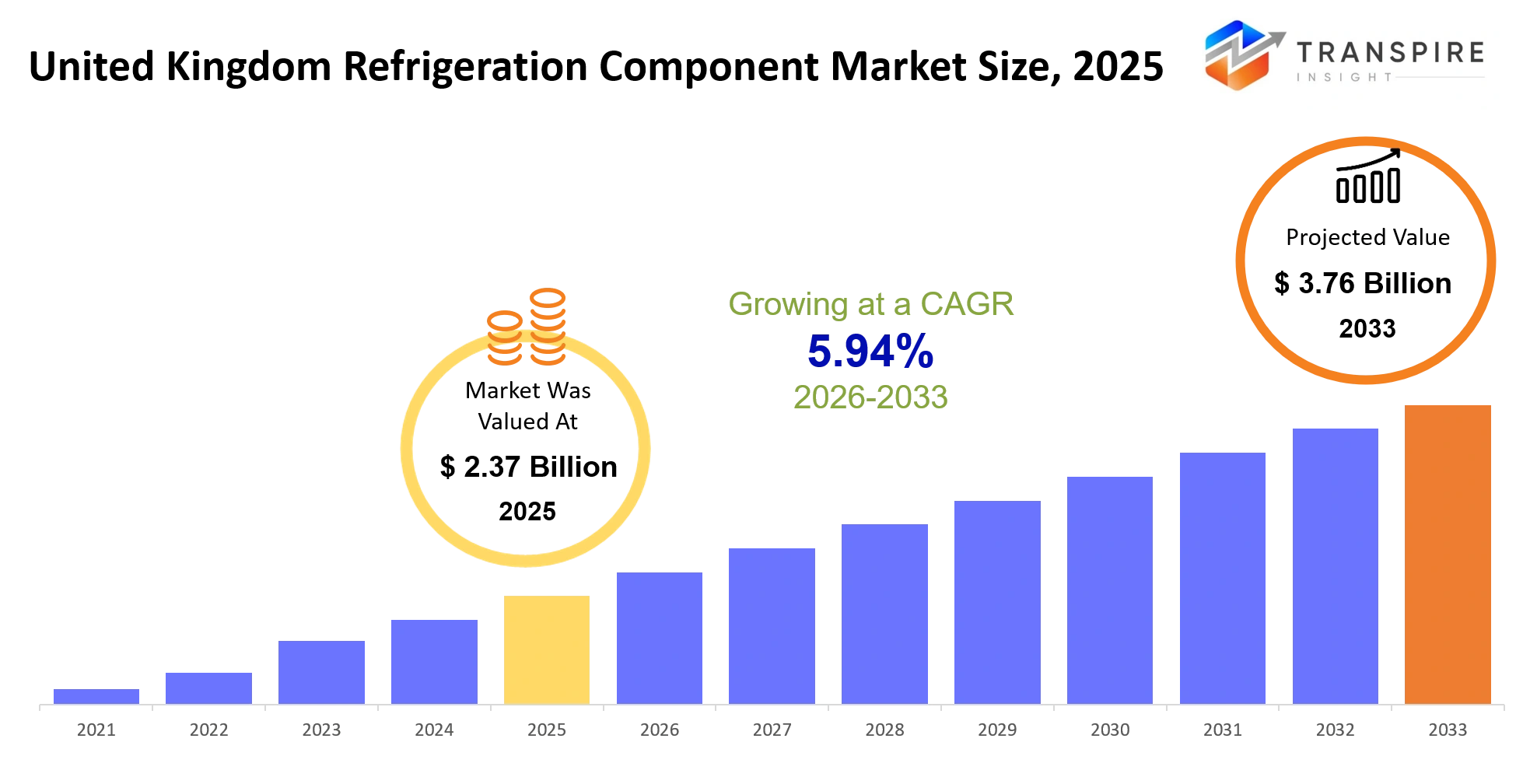
- United Kingdom Refrigeration Component Market Size 2025: USD 2.37 Billion
- United Kingdom Refrigeration Component Market Size 2033: USD 3.76 Billion
- United Kingdom Refrigeration Component Market CAGR: 5.94%
- United Kingdom Refrigeration Component Market Segments: By Component Type (Compressors, Condensers, Evaporators, Expansion Valves, Refrigerant Controls, Heat Exchangers, Others); By Refrigerant Type (HFC Refrigerants, Natural Refrigerants, Hydrocarbon Refrigerants, CO2 Refrigerants, Others); By Application (Commercial Refrigeration, Industrial Refrigeration, Transport Refrigeration, Residential Refrigeration, Cold Storage, Others); By End User (Food & Beverage Industry, Pharmaceutical Industry, Retail Sector, Logistics Industry, Others).
To learn more about this report,  Download Free Sample Report
United Kingdom Refrigeration Component Market Summary
The United Kingdom Refrigeration Component Market was valued at USD 2.37 Billion in 2025. It is forecast to reach USD 3.76 Billion by 2033. That is a CAGR of 5.94%over the period.
In the United Kingdom Refrigeration Component Market, everything kinda hinges on keeping food, pharmaceuticals, chemicals, and other temperature-sensitive industrial items inside fairly strict temperature boundaries during production, storage, and also distribution. Refrigeration components like compressors, condensers, evaporators, valves, and control systems really become the core of the cold chain setup. That whole setup kind of stops product spoilage , keeps the quality benchmarks steady, and it also supports regulatory requirements across different sectors, kind of no drama.
Over the past five years there’s been this noticeable drift toward low-global-warming-potential refrigerants and refrigeration designs that are more energy efficient. The shift sped up once stricter environmental rules started showing up, and yeah it includes the ongoing refrigerant phase-down measures, alongside wider carbon reduction targets too. Then there were the supply chain disruptions that came around the pandemic timeframe , which made a lot of companies reexamine older refrigeration assets, and build more operational resilience rather than just patching things. When energy prices started climbing, operators put more attention into advanced components that lower power draw and also reduce upkeep. Because of that, the market is starting to see revenue coming from replacements, while adoption keeps widening in logistics, retail, food processing, and healthcare sites. Altogether this supports long-term value growth for the market, even if it’s sort of uneven month to month.
Key Market Insights
- The United Kingdom Refrigeration Component Market kind of rides on nationwide cold chain modernization , and food logistics is responsible for more than 35% of the component replacement pull.
- England is basically the main player, with about 70% market share in 2025, mostly because it has a heavy concentration of food processing plants, pharmaceutical sites and logistics facilities.
- Scotland is showing the quickest pace of expansion through 2033 , supported by seafood processing investments, plus temperature-controlled export infrastructure that’s slowly getting more attention.
- Across the product side, compressors stay on top , taking nearly 30% of industry revenue in 2025 since they directly affect system performance and energy consumption.
- Condensers sit second, with broad uptake across commercial refrigeration and industrial cold storage uses.
- Smart control systems are the fastest-growing category, projected to rise above 7% per year over the forecast timeline, mainly because automation integration is becoming more common.
- When you look at applications, food and beverage processing leads , with over 40% market share, driven by strict temperature control expectations and product safety rules.
- Pharmaceutical cold chain use cases are also among the quicker movers, supported by biologics, vaccine distribution, and specialty medicine logistics needs.
- For end users, retail supermarkets still lead the mix, representing roughly one third of refrigeration component demand across the United Kingdom.
- Some major players like Danfoss, Emerson Electric, Carrier Global, BITZER, Johnson Controls, and Copeland are strengthening their position through digital monitoring solutions, low-GWP refrigerant compatibility , and ongoing strategic expansion pushes.
What are the Key Drivers, Restraints, and Opportunities in the United Kingdom Refrigeration Component Market?
The strongest growth driver is, kind of the modernization of aging refrigeration infrastructure, which is meant to keep up with shifting environmental and energy efficiency standards, sort of. In particular, regulatory pressure tied to refrigerant phase down programs has nudged facility operators into swapping out outdated compressors and heat exchangers , plus valves and the control systems. At the same time higher electricity costs have, boosted the monetary value of energy efficient equipment.So businesses that reduce refrigeration energy consumption can lower operating expenses a lot, which makes component upgrades feel more worthwhile economically. This whole dynamic really feeds into replacement cycles and it also opens up recurring revenue chances for manufacturers and service providers.
The biggest restraint is the high capital cost that comes with upgrading entire refrigeration systems. A lot of facilities run integrated refrigeration networks, and in those cases changing one component often means modifications to piping, controls, refrigerants, and even the supporting infrastructure. That becomes a structural obstacle, because investments are locked into long asset lifecycles and complicated engineering needs. Small and medium-sized operators often delay modernization efforts, so equipment replacement gets pushed back and that in turn restricts near-term market expansion.
A big chance turns up with the rollout of intelligent refrigeration systems,these systems sort of combine advanced sensors, with IoT connectivity and predictive analytics. Food distribution centers, and pharmaceutical warehouses, plus major retail chains are starting to want real-time sight into how the refrigeration performs. At the same time, spending on smart cold storage facilities at logistics hubs is pushing demand for digitally enabled compressors, electronic expansion valves, and automation-first control platforms.
What Has the Impact of Artificial Intelligence Been on the United Kingdom Refrigeration Component Market?
Artificial intelligence and advanced digital technologies are, in a way, reshaping refrigeration operations . They boost efficiency, reliability and asset utilization across the cold-chain world, almost like everything runs a bit smoother , even if people don’t notice it right away. In many modern refrigeration setups, AI-enabled monitoring platforms are becoming normal, they keep watch on temperature, pressure, compressor loading, refrigerant movement and energy draw, basically all the key signals. Then the system can nudge and shift operating parameters on its own to keep “just right” performance, while also cutting electricity usage.
At the same time, machine learning is backing predictive maintenance strategies. Instead of sticking to rigid calendar based service intervals, operators are looking at historical equipment records , plus live sensor feedback, to spot subtle early warning signs. Things like compressor wear starting up, refrigerant leakage behaving oddly, fan motor decline, or a heat exchanger that’s getting grimy from fouling. With this style of proactive detection, unexpected failures tend to drop, and facility uptime usually goes up too.
There’s also AI-powered analytics that helps day to day performance: forecasting cooling demand trends and then tuning energy consumption during both peak and quieter periods. Some large cold-storage operators say they saw measurable declines in maintenance expenses and energy spending after installing intelligent control systems. Digital twins, plus cloud-based performance management platforms, are also spreading among more advanced refrigeration teams.
That said, adoption is not seamless. It’s often held back by integration complexity and cost. A lot of refrigeration installations still run on older equipment that does not have standardized digital interfaces. And when historical datasets are sparse, or when sensor retrofits are expensive, the accuracy of AI deployments can suffer, along with the overall economic sense of the project, especially for smaller operators, or those working with older infrastructure that’s hard to upgrade.
Key Market Trends
- Since 2021, the take up of low-GWP refrigerant compatible parts has been speeding up , as companies kind of get ready for tougher refrigerant phase-down rules coming soon.
- Energy efficient compressor setups went up across the bigger cold-storage sites, mostly because power costs stayed fairly high from 2022 through 2025.
- Smart refrigeration controls also grew pretty fast , with connected monitoring systems cutting unplanned shutdowns by something like 15–25% in more advanced facilities , yeah.
- Food logistics providers put more money into automated cold-chain infrastructure, which really backs up the rising need for electronically regulated refrigeration components.
- Pharmaceutical cold storage programs expanded after they followed through on vaccine distribution investments , and that’s opened new pathways for precision temperature management tech.
- Manufacturers are now more often weaving IoT sensor capability into refrigeration units, so they can run continuous diagnostics , and also tune performance remotely.
- Meanwhile , component suppliers have been leaning into lifecycle service agreements, moving from a one time hardware sale mindset into more recurring revenue frameworks.
- Industrial customers started using predictive maintenance platforms more often after they noticed maintenance expenses dropping around 10–20% overall.
- Some firms like Danfoss, Emerson, Carrier, and BITZER ramped up spending on digital refrigeration ecosystems , plus connected equipment portfolios.
- The supply chain shocks that hit after 2020 basically nudged operators to treat equipment dependability as a priority, along with spare-part readiness, and more local service networks.
United Kingdom Refrigeration Component Market Segmentation
By Component Type
Compressors kinda hold the dominant spot because they sit right at the middle of refrigeration cycle performance, and also because they really drive how energy consumption gets managed. For basically every commercial, industrial, and cold-storage setup, compressor efficiency becomes the make or break factor , so this segment ends up being the biggest revenue contributor. Condensers stay in the second-largest position since how well they reject heat has a direct impact on system reliability, and it also shows up in operating costs. Evaporators and heat exchangers keep steady demand rolling in via replacement cycles , while refrigerant controls and expansion valves start gaining more traction as people move toward automation and more precise temperature governance technologies.
Looking ahead, compressors should keep the leadership because companies are pushing harder for energy savings and also for compliance under tougher environmental standards. Refrigerant controls are expected to grow the fastest , mainly due to the rising take up of connected refrigeration setups, remote monitoring dashboards, and predictive upkeep solutions. Expansion valves should benefit from the need for fine refrigerant flow regulation in modern cooling systems. Product developers are likely to focus on intelligent components that boost efficiency, lower maintenance burden, and are able to work with low-GWP refrigerants without much hassle.
By Refrigerant Type
HFC Refrigerants currently hold the dominant position, because there was extensive installation across existing commercial refrigeration, retail cooling, and also industrial refrigeration assets. There is established infrastructure, technician familiarity, and equipment compatibility that keeps supporting a big market footprint, even with all the regulatory pressure around.
Natural Refrigerants are kind of the second-largest segment, and it shows up where food processing, logistics, and cold-storage operators start switching toward cooling systems that are more environmentally compliant. Then Hydrocarbon Refrigerants and CO2 Refrigerants continue to grow, mainly in specialized applications, where sustainability matters and operational efficiency is treated like a priority.
For the future, HFC Refrigerants are expected to see slower growth, because phase-down policies push migration toward alternative solutions, sooner rather than later. Natural Refrigerants are projected to show the strongest expansion, mostly because the regulatory alignment is favorable and the long term operating benefits look better on paper. CO2 Refrigerants should gain more acceptance in supermarket refrigeration, and in industrial cooling projects where performance needs, and compliance requirements end up intersecting.
Equipment manufacturers and investors are likely to prioritize technologies that are optimized for natural refrigerant platforms, and other low-emission options.
By Application
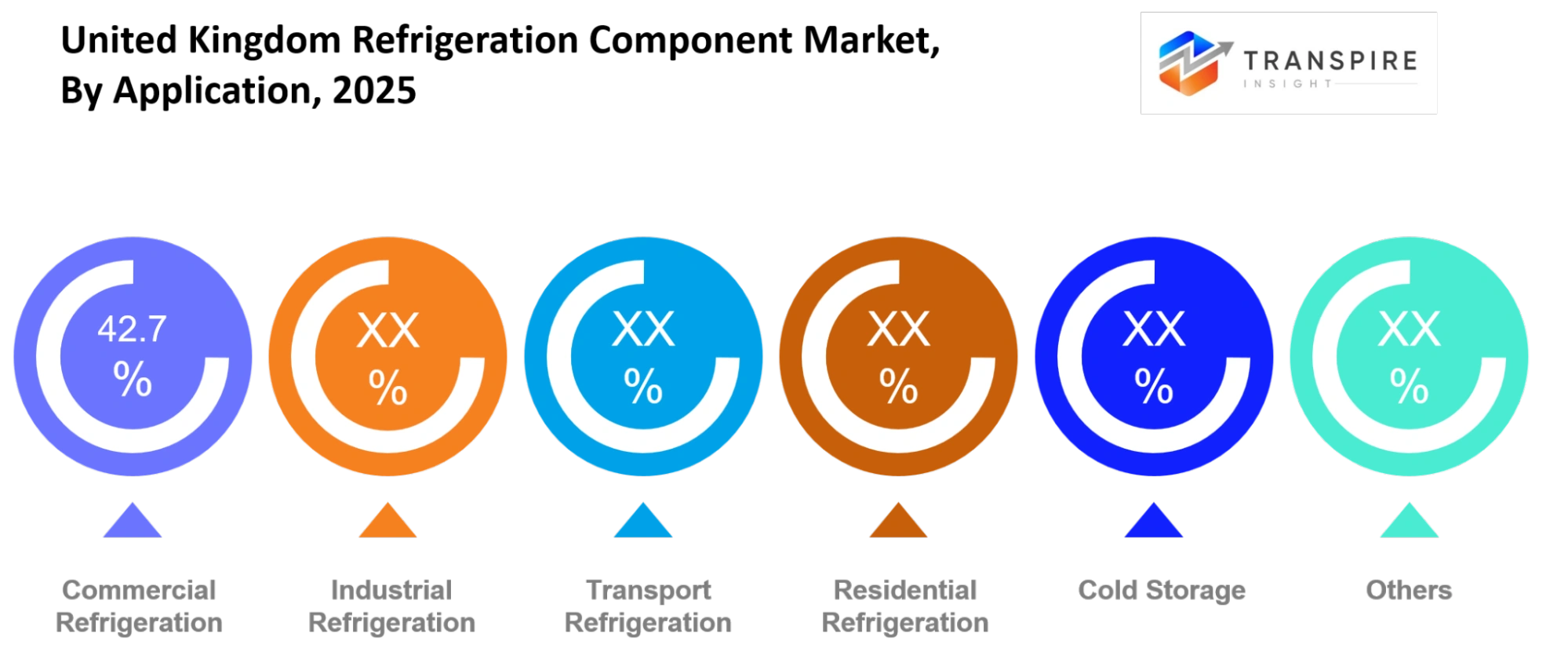
Commercial Refrigeration still holds the dominant place, largely because it gets used everywhere, supermarkets, corner shops, restaurants , and general food service places. The equipment sits closely together and it runs day after day, so people constantly need component swapping and system modernization. Industrial Refrigeration stays in the second big slot too, helped by food processing sites, manufacturing operations , and those massive temperature-controlled setups. Transport Refrigeration and Cold Storage keep pushing forward as temperature sensitive supply chains keep getting bigger and more connected.
Commercial Refrigeration is likely to keep leading while retailers pour money into energy efficient cooling infrastructure plus digital monitoring gear. Cold Storage should be the one that grows the fastest, since food logistics networks are expanding, pharmaceutical distribution still demands tight conditions, and e-commerce fulfillment is adding more stops and more handling. Transport Refrigeration may gain momentum as cold chain connectivity gets stronger and as temperature-control rules become tighter. Market participants are expected to craft options that raise day to day operational efficiency while also lowering lifecycle expenses, across a range of refrigeration environments.
To learn more about this report, Download Free Sample Report
By End User
The Food & Beverage Industry kind of holds the dominant position, because refrigeration systems are basically essential for product preservation, food safety compliance , and inventory management. Processing plants, cold-storage operators, and distribution facilities all rely a lot on refrigeration components to keep product quality stable across the supply chains. The Retail Sector sits as the second-largest segment, mainly due to wide refrigeration needs across supermarkets, grocery stores, and convenience retail formats. Meanwhile, Pharmaceutical and Logistics Industry applications keep expanding because temperature-sensitive products need more and more sophisticated cooling infrastructure, which is kind of the whole point.
For what happens next, the Food & Beverage Industry is expected to keep being the primary revenue contributor, driven by ongoing investments in cold-chain modernization and also processing capacity expansion. The Pharmaceutical Industry is projected to see the fastest growth as biologics , vaccines, and specialty medicines need highly controlled storage environments. Logistics Industry demand will also strengthen, supported by warehouse automation and temperature-controlled transportation investments. Suppliers are expected to concentrate on high-reliability refrigeration solutions that are digitally connected, so they can meet the evolving needs of critical end-user industries.
What are the Key Use Cases Driving the United Kingdom Refrigeration Component Market?
The biggest use case still sits in food and beverage preservation across processing plants, cold storage warehouses, supermarkets, and distribution hubs. In all those places they lean on refrigeration components to keep tight temperature conditions that help guard product quality , cut down waste, and meet food safety rules. Because the systems need to run continuously, component replacement and routine maintenance become one of those major, recurring spending things.
People are also expanding into pharmaceutical storage and broader healthcare logistics. Vaccine distribution centers, biologics manufacturers, and specialty medicine warehouses need refrigeration systems that are very dependable, plus temperature control that stays precise. On top of that, the growth of e-commerce grocery delivery and temperature managed logistics is pushing more buyers toward advanced refrigeration equipment, even when budgets feel squeezed.
More emerging use cases are showing up too, like automated cold storage facilities, and data driven smart warehouses that come with connected refrigeration controls. Sustainable industrial refrigeration systems that use natural refrigerants are getting more attention as well, since operators want to stay in line with environmental regulations and at the same time improve long term operating efficiency, without too much drama.
|
Report Metrics |
Details |
|
Market size value in 2025 |
USD 2.37 Billion |
|
Market size value in 2026 |
USD 2.51 Billion |
|
Revenue forecast in 2033 |
USD 3.76 Billion |
|
Growth rate |
CAGR of5.94% from 2026 to 2033 |
|
Base year |
2025 |
|
Historical data |
2021 - 2024 |
|
Forecast period |
2026 - 2033 |
|
Report coverage |
Revenue forecast, competitive landscape, growth factors, and trends |
|
Regional scope |
United Kingdom |
|
Key company profiled |
Danfoss, Emerson Electric, Carrier, Johnson Controls, Bitzer, GEA Group, Honeywell, Lennox International, Panasonic, Daikin Industries, Emerson Climate Technologies, Mayekawa, Tecumseh, CAREL Industries, Copeland. |
|
Customization scope |
Free report customization (country, regional & segment scope). Avail customized purchase options to meet your exact research needs. |
|
Report Segmentation |
By Component Type (Compressors, Condensers, Evaporators, Expansion Valves, Refrigerant Controls, Heat Exchangers, Others); By Refrigerant Type (HFC Refrigerants, Natural Refrigerants, Hydrocarbon Refrigerants, CO2 Refrigerants, Others); By Application (Commercial Refrigeration, Industrial Refrigeration, Transport Refrigeration, Residential Refrigeration, Cold Storage, Others); By End User (Food & Beverage Industry, Pharmaceutical Industry, Retail Sector, Logistics Industry, Others). |
Which Regions are Driving the United Kingdom Refrigeration Component Market Growth?
England remains the most dominant region in the United Kingdom Refrigeration Component Market, mostly because it has that dense cluster of food processing facilities, pharmaceutical manufacturing sites , distribution centers, and big retail chains. The major logistics routes, especially around London, Birmingham, Manchester and the Southeast, help sustain thick cold-chain infrastructure that really needs ongoing refrigeration system upgrades, plus frequent component replacement. On top of that , England gains momentum from tighter energy-efficiency enforcement in commercial buildings, which pulls forward demand for advanced compressors, condensers, and electronic controls. Then there’s also a fairly mature service atmosphere—meaning refrigeration contractors, engineering companies, and equipment distributors are all around—so England’s leadership position gets reinforced, almost naturally.
Scotland comes next as the second-largest contributor, but the way demand behaves is not exactly the same as England’s industrial plus retail pattern. Refrigeration demand in Scotland tends to be tied to seafood processing, food exports, and temperature-controlled warehousing that backs international trade. The region also benefits from steady funding for processing capability and a consistent push toward modernizing cold-storage operations , not so much the large urban retail sprawl. As a result, the component replacement cycle can be more predictable, and this helps manufacturers get a dependable long-term revenue runway.
Wales is showing up as the fastest-growing regional market. Industrial decarbonization initiatives, alongside new food manufacturing investment, is reshaping what refrigeration infrastructure needs in practice. More recently, energy-efficient processing facility investments and cold-storage modernization programs have sped up adoption of low-GWP refrigeration technologies.
Who are the Key Players in the United Kingdom Refrigeration Component Market and How Do They Compete?
Competition in the United Kingdom Refrigeration Component Market is sort of moderately consolidated, with big global refrigeration tech firms battling it out via efficiency gains, refrigerant compatibility, digital monitoring features, and aftermarket service networks. The whole scene feels different now, it’s gone from equipment-only comparisons toward lifecycle value creation, you know, predictive maintenance , remote monitoring , and energy optimization that now really shape buying decisions. Incumbents still try to hold their ground with tech upgrades, while specialized manufacturers show up with application specific competence and engineering assistance, kinda like a more tailored angle.
Danfoss stands out with electronic controls, low-GWP refrigeration technologies, and connected cooling platforms that assist operators in lowering energy use. They keep broadening their smart refrigeration range and more recently rolled out additional CO₂-based refrigeration solutions, fitting the changing environmental requirements. BITZER meanwhile is more focused on compressor engineering, industrial refrigeration dependability, and natural refrigerant compatibility. Their push around compressor training programs and technical support offerings helps keep customers, but also deepens aftermarket participation in a steady way.
Copeland competes using intelligent monitoring systems, connected cold-chain solutions, and predictive maintenance tools. They’re leaning harder into digital tracking and performance analytics across refrigeration operations. Johnson Controls takes a slightly different path, leveraging building automation knowledge so refrigeration systems can plug into wider facility management platforms. That creates operational efficiencies that do not stop at cooling performance alone, it kind of continues beyond it.
Company List
- Danfoss
- Emerson Electric
- Carrier
- Johnson Controls
- Bitzer
- GEA Group
- Honeywell
- Lennox International
- Panasonic
- Daikin Industries
- Emerson Climate Technologies
- Mayekawa
- Tecumseh
- CAREL Industries
- Copeland
Recent Development News
"In April 2026, Copeland launched GO Real-Time GL and GO Real-Time GL XL Trackers. The new monitoring platform delivers global 4G connectivity and real-time visibility for temperature-sensitive food and pharmaceutical shipments, strengthening cold-chain performance and refrigeration asset monitoring.
Source: http://www.copeland.com
"In April 2026, Danfoss launched the Optyma™ iCO₂ 37kW MT/20kW LT condensing unit. The product expands the company’s natural refrigerant portfolio and supports compliance with tightening F-gas regulations while improving energy efficiency in commercial refrigeration systems.
Source: http://www.danfoss.com
"In November 2025, BITZER and Mitsubishi Electric entered a joint venture through BITZER MEHITS Advanced Solutions GmbH. The partnership combines compressor development expertise and accelerates the creation of high-efficiency HVAC and IT cooling technologies for global refrigeration markets.
Source: http://gb.mitsubishielectric.com/
What Strategic Insights Define the Future of the United Kingdom Refrigeration Component Market?
The United Kingdom Refrigeration Component Market is sort of moving, structurally toward intelligent, low emission, and digitally managed refrigeration ecosystems. The main thing pushing this shift is the meeting point of energy-cost pressure, refrigerant rules, and the need for real time operational visibility. Over the next five to seven years, buying decisions for equipment will lean more toward lifecycle efficiency rather than the initial, up front capital price tag.
One risk that doesn’t always get enough attention is how much the industry is starting to rely on specialized materials , semiconductors, and electronic control systems. If supply chains get knocked around and those inputs get stuck or delayed, equipment availability can slow down and project costs may rise, even if demand stays strong. At the same time, liquid cooling approaches tied to data center expansion are becoming an actual opportunity. It also expands refrigeration know-how into more infrastructure categories that people didn’t always connect to this space before.
For market players, it makes sense to emphasize connected refrigeration platforms, predictive maintenance capabilities , and compatibility with natural refrigerants. Firms that blend hardware innovation with software-driven service models should be better set up to win recurring revenue and hold onto customers, as the market becomes more and more technology focused.
United Kingdom Refrigeration Component Market Report Segmentation
By Component Type
- Compressors
- Condensers
- Evaporators
- Expansion Valves
- Refrigerant Controls
- Heat Exchangers
- Others
By Refrigerant Type
- HFC Refrigerants
- Natural Refrigerants
- Hydrocarbon Refrigerants
- CO2 Refrigerants
- Others
By Application
- Commercial Refrigeration
- Industrial Refrigeration
- Transport Refrigeration
- Residential Refrigeration
- Cold Storage
- Others
By End User
- Food & Beverage Industry
- Pharmaceutical Industry
- Retail Sector
- Logistics Industry
- Others
Frequently Asked Questions
Find quick answers to common questions.
The expected United Kingdom Refrigeration Component Market size for the market will be USD 3.76 Billion in 2033.
Key segments for the United Kingdom Refrigeration Component Market are By Component Type (Compressors, Condensers, Evaporators, Expansion Valves, Refrigerant Controls, Heat Exchangers, Others); By Refrigerant Type (HFC Refrigerants, Natural Refrigerants, Hydrocarbon Refrigerants, CO2 Refrigerants, Others); By Application (Commercial Refrigeration, Industrial Refrigeration, Transport Refrigeration, Residential Refrigeration, Cold Storage, Others); By End User (Food & Beverage Industry, Pharmaceutical Industry, Retail Sector, Logistics Industry, Others).
Major United Kingdom Refrigeration Component Market players are Danfoss, Emerson Electric, Carrier, Johnson Controls, Bitzer, GEA Group, Honeywell, Lennox International, Panasonic, Daikin Industries, Emerson Climate Technologies, Mayekawa, Tecumseh, CAREL Industries, Copeland.
The United Kingdom Refrigeration Component Market size is USD 2.37 Billion in 2025.
The United Kingdom Refrigeration Component Market CAGR is 5.94% from 2026 to 2033.
- Danfoss
- Emerson Electric
- Carrier
- Johnson Controls
- Bitzer
- GEA Group
- Honeywell
- Lennox International
- Panasonic
- Daikin Industries
- Emerson Climate Technologies
- Mayekawa
- Tecumseh
- CAREL Industries
- Copeland
About the Authors

Avinash Kumar
I’m Avinash Kumar, a Senior Research Analyst at Transpire Insight, with expertise in the Electronics and Semiconductor and Energy & Power industry. My work focuses on analyzing emerging technologies, market trends, industry developments, and innovation across these sectors. I specialize in transforming complex technical and market insights into clear, research-backed content that helps professionals, businesses, and decision-makers stay informed. Through continuous industry research and data-driven analysis, I strive to deliver accurate, reliable, and practical perspectives on the latest advancements shaping the semiconductor and energy landscape.

Chakradhar Khansole
Chakradhar serves as the Research Director at Transpire Insight, bringing over 8 years of experience in technology, innovation, and strategic market intelligence. He specializes in transforming complex market data into actionable business insights that enable organizations to make informed, growth-oriented decisions. Recognized for his strategic vision and analytical expertise, Chakradhar leads high-impact research initiatives, delivering comprehensive market assessments, competitive intelligence, and forward-looking industry analysis.
Recently Published Reports
-
Apr 2026
Fiber Optic Faceplates Market
Fiber Optic Faceplates Market Size, Share & Analysis Report By Type (< 300 mm2, 300-350 mm2, and > 350 mm2, By Application (Night Vision, Holographic Imaging, Medical, and Others), and Geography (North America, Europe, Asia-Pacific, Middle East and Africa, South and Central America), 2021 - 2031
-
Apr 2026
High Temperature Superconductors Market
High Temperature Superconductors Market Size, Share & Analysis Report By Type (1G HTS, and 2G HTS), By Application (Power Cable, Fault Current Limiter, and Transformer), and Geography (North America, Europe, Asia-Pacific, Middle East and Africa, South and Central America), 2021 - 2031
-
Apr 2026
Industrial Plugs and Socket Market
Industrial Plugs and Socket Market Size, Share & Analysis Report By Type (Industrial Plugs, Industrial Sockets), By Current (Up to 32 A, 32 to 125 A, Above 125 A), By Protection (Dustproof and Splash Proof, Waterproof, Explosion Proof), By End User (Heavy Industries, Oil and Gas, Chemicals and Pharmaceuticals, Power Generation, Others), and Geography (North America, Europe, Asia-Pacific, Middle East and Africa, South and Central America), 2021 - 2031
-
Apr 2026
InGaAs Avalanche Photodiodes Market
InGaAs Avalanche Photodiodes Market Size, Share & Analysis Report By Type (1100 - 1700 nm, and 1000 - 1600 nm), By Application (Missile Warning System, Muzzle Flash Detection, Wafer Defect Inspection, Laser Rangefinders, and Others), and Geography (North America, Europe, Asia-Pacific, Middle East and Africa, South and Central America), 2021 - 2031