

United Kingdom Stone Retrieval Basket Market Size & Forecast:
- United Kingdom Stone Retrieval Basket Market Size 2025: USD 32.57 Million
- United Kingdom Stone Retrieval Basket Market Size 2033: USD 46.46 Million
- United Kingdom Stone Retrieval Basket Market CAGR: 4.54%
- United Kingdom Stone Retrieval Basket Market Segments: By Product Type (Tipless Stone Retrieval Baskets, Helical Stone Retrieval Baskets, Nitinol Baskets, Dormia Baskets, Zero-tip Baskets, Hybrid Baskets, Flexible Baskets, Others); By Application (Kidney Stone Removal, Ureteral Stone Removal, Biliary Stone Retrieval, Bladder Stone Removal, Endoscopic Procedures, Urology Procedures, GI Procedures, Others); By End User (Hospitals, Urology Clinics, Ambulatory Surgical Centers, Specialty Clinics, Diagnostic Centers, Research Institutes, Others); By Material (Nitinol Baskets, Stainless Steel Baskets, Hybrid Material Baskets, Polymer-coated Baskets, Others); By Procedure Type (Flexible Ureteroscopy, Rigid Ureteroscopy, Endoscopic Stone Removal, Laser Lithotripsy Support, Others)

United Kingdom Stone Retrieval Basket Market Summary
The United Kingdom Stone Retrieval Basket Market was valued at USD 32.57 Million in 2025. It is forecast to reach USD 46.46 Million by 2033. That is a CAGR of 4.54% over the period.
In the UK, stone retrieval baskets are kinda small wire based tools, mostly used by urologists during endoscopic procedures, to scoop up and pull out kidney or ureter stones. The idea is to restore urinary flow, and kinda avoid open surgery, it’s not just convenience though, it’s part of how the procedure gets managed. Over the last few years the market has changed, from reusable stainless steel instruments to nitinol based baskets, plus more single use options. Those newer baskets tend to be more flexible in complicated urinary anatomy, and they also help lower the cross infection worries, which matters a lot in busy clinical settings.
Also, the NHS backlog that built up after COVID-19 made demand rise for quicker, outpatient compatible stone treatment. So many hospitals started combining laser lithotripsy with basket retrieval all in one session, instead of splitting it up. At the same time, procurement hiccups made it obvious that hospitals needed more diversified suppliers, and devices that are available locally or through multiple channels.
All of that has nudged procedure throughput upward, and it’s also helped shorten recovery times. Then that directly supports higher device utilization across urology centers, and it keeps the revenue growth steady for manufacturers supplying both public and private hospitals.
Key Market Insights
- England is pretty much leading the United Kingdom Stone Retrieval Basket Market, with around 68% share in 2025, and that’s mostly because NHS procedure volumes are high and there are specialized urology centers, in practice.
- Scotland is showing the quickest growth path for 2024–2028 too, driven by outpatient endoscopic stone management infrastructure that’s still expanding steadily.
- Wales and Northern Ireland are contributing a smaller chunk, but they stay fairly steady, largely thanks to centralized referral networks and some hospital upgrades.
- Nitinol stone retrieval baskets sit on top in the United Kingdom market, about 54% share, mainly because the device is more flexible and it tends to feel safer during use.
- Next comes stainless-steel reusable baskets, they hold the second-largest share and usually it’s tied to cost-conscious NHS procurement environments.
- Single-use disposable baskets are projected to move the fastest through 2026, because infection control mandates keep getting tighter and hospitals want faster workflow efficiency, overall.
- When it comes to procedure types, ureteroscopy stone removal leads with nearly 72% share, and that’s linked to kidney stone prevalence.
- For applications, complex multi stone extraction procedures are expected to grow the quickest, with laser lithotripsy integration and advanced imaging tools backing that trend.
- Public hospitals under the NHS account for over 65% share, so yes they are the main end-user across the United Kingdom Stone Retrieval Basket Market.
- And ambulatory surgical centers are the fastest-growing end user group as same-day discharge procedures expand across the UK healthcare system.
What are the Key Drivers, Restraints, and Opportunities in the United Kingdom Stone Retrieval Basket Market?
In the United Kingdom Stone Retrieval Basket Market, the main push is basically the fast growth of minimally invasive urology actions in both NHS and private hospitals . A lot of the shift seems to be coming from ureteroscopy working together with laser lithotripsy, so there is less need for open stone surgery, and that naturally keeps demand steady for very precise retrieval tools. This momentum wasn’t random either, it was nudged by procedural efficiency targets, plus the kind of backlog clean up plans that followed the pandemic, and those efforts pushed hospitals to reach higher same-day discharge rates. So, device use per procedure goes up, and that directly supports revenue per case for manufacturers supplying advanced nitinol baskets in the United Kingdom Stone Retrieval Basket Market.
Still, you can’t ignore what slows things down. Growth is held back by ongoing NHS procurement pressure, and also by long device replacement cycles across public hospitals. In many cases, tendering driven by tight budgets tends to prefer reusable stainless-steel baskets rather than higher-cost disposable alternatives, which then slows uptake of newer technologies. This limitation is reinforced by centralized purchasing arrangements, and those arrangements make it harder to switch suppliers quickly. The end result is slower commercialization for advanced devices, meaning manufacturers may not scale revenues as fast as they ideally could, even when the clinical benefits are clear.
At the same time, a notable opening is starting to show up. Ambulatory surgical centers and hybrid outpatient urology clinics keep expanding in cities like London and Manchester. These places increasingly favor single-use, infection controlled devices to boost patient throughput. Firms that invest in compact, single-procedure retrieval setups designed for outpatient routines, are in a strong position to catch faster adoption during the next growth phase in the United Kingdom Stone Retrieval Basket Market.
What Has the Impact of Artificial Intelligence Been on the United Kingdom Stone Retrieval Basket Market?
Clinical workflows related to stone retrieval baskets are being redefined as a result of artificial intelligence (AI) and innovative digital technologies gradual transformation of urology departments' endoscopic procedure planning, execution, and optimization. Many NHS hospitals across the UK are now using AI-enabled imaging systems (e.g., image detection, sizing) that reside on their ureteroscopy platform to assist clinicians with real-time stone detection and identify adequate capture devices, enhancing procedural effectiveness using fewer unnecessary basket passes during stone retrieval.
Improvements have also taken place within operational controls through the use of automation in digital tracking tools. These tools allow hospitals to monitor utilization of their endoscopy suites, maintain sterilization protocols, track device lifecycle status, and ensure compliance while greatly reducing the administrative burden of manual processes.
When it comes to predictive functionality, increasingly more hospitals are utilizing analytical platforms, powered by advanced methods of machine learning algorithms, to estimate procedure duration; likelihood of stone fragmentation success; and wear patterns for lithotripsy and retrieval equipment. Using the aforementioned data, hospitals may schedule in a manner that minimizes late cancellation and increased efficiency (nominally 10–15% improvement) within the operating theatre of high-volume institutions across the UK. Thus, with greater operational efficiency, the penetration of advanced retrieval devices will continue to gain depth within the UK's stone retrieval basket market ecosystem.
The limited use of AI is primarily attributed to the fragmented nature of clinical datasets associated with deficit funding required for the integration of AI tools into established NHS IT infrastructures. Hospitals are further constrained by inaccuracy due to the shortage of annotated endoscopic images available for model training.
Key Market Trends
- From 2022 to 2025 UK hospitals started leaning more ,toward single-use retrieval baskets, which boosted infection-control compliance a bit more , and cut the sterilization turnaround delays by almost 30%—or so the internal reporting says.
- Between 2021–2026 nitinol-based baskets started replacing the stainless steel variants in those complex ureteroscopy cases, giving better flexibility and also lowering ureteral trauma during the procedure itself.
- After 2020 the NHS surgical backlog kinda nudged things forward, so the adoption of combined laser lithotripsy and basket retrieval workflows picked up faster, and that meant higher procedure throughput across tertiary hospitals, overall.
- In 2023 ambulatory surgical centres expanded their stone management services , and about 12–18% of procedures moved out of inpatient hospital settings which is a meaningful shift in practice.
- Centralised NHS procurement frameworks from 2022–2025 apparently made rapid device switching slower, so cost-controlled contracts ended up winning more often, compared with premium retrieval basket adoption.
- In 2024 AI-assisted ureteroscopy imaging came in more broadly , and it improved stone detection accuracy, which in turn reduced unnecessary basket passes in high-volume clinics.
- From 2021–2024 UK hospitals diversified their suppliers following COVID-related disruptions, so they relied less on single-source endoscopy device imports.
- Big names like Boston Scientific and Cook Medical increased their UK presence using disposable product releases plus NHS partnership agreements, and that whole approach seemed to help.
United Kingdom Stone Retrieval Basket Market Segmentation
By Product Type:
Basket designs such as the tipless, helical, nitinol, Dormia, zero-tip and hybrid flexible baskets are deployed depending on the anatomy and stone location, with increasing usage of nitinol baskets due to superior flexibility and reduced trauma in ureteroscopy in UK hospitals. Market selection continues to lean towards devices that assist precision retrieval.
Older Dormia and stainless-steel designs are now being replaced with a higher number of zero-tip and hybrid basket devices in the hospitals, with easier stone capture in a minimally invasive procedure and selection now increasingly dependent on performance and safety, driving slow adoption of modern retrieval systems among all surgical sites in the United Kingdom Stone Retrieval Basket Market.
By Application:
Stone removal from the kidney and ureteral stone retrieval remain the most frequent application within all of UK clinical practice, accommodating the large patient numbers in NHS hospitals and minimizing patient recovery times, with biliary, bladder and GI stone retrieval gaining traction in selected centers.
Ureteroscopic applications are being driven over recent years, by the increased rate of detection of urinary stones, where endoscopic procedures combined with laser treatment are predominantly implemented and open procedures, requiring removal baskets, are being minimized.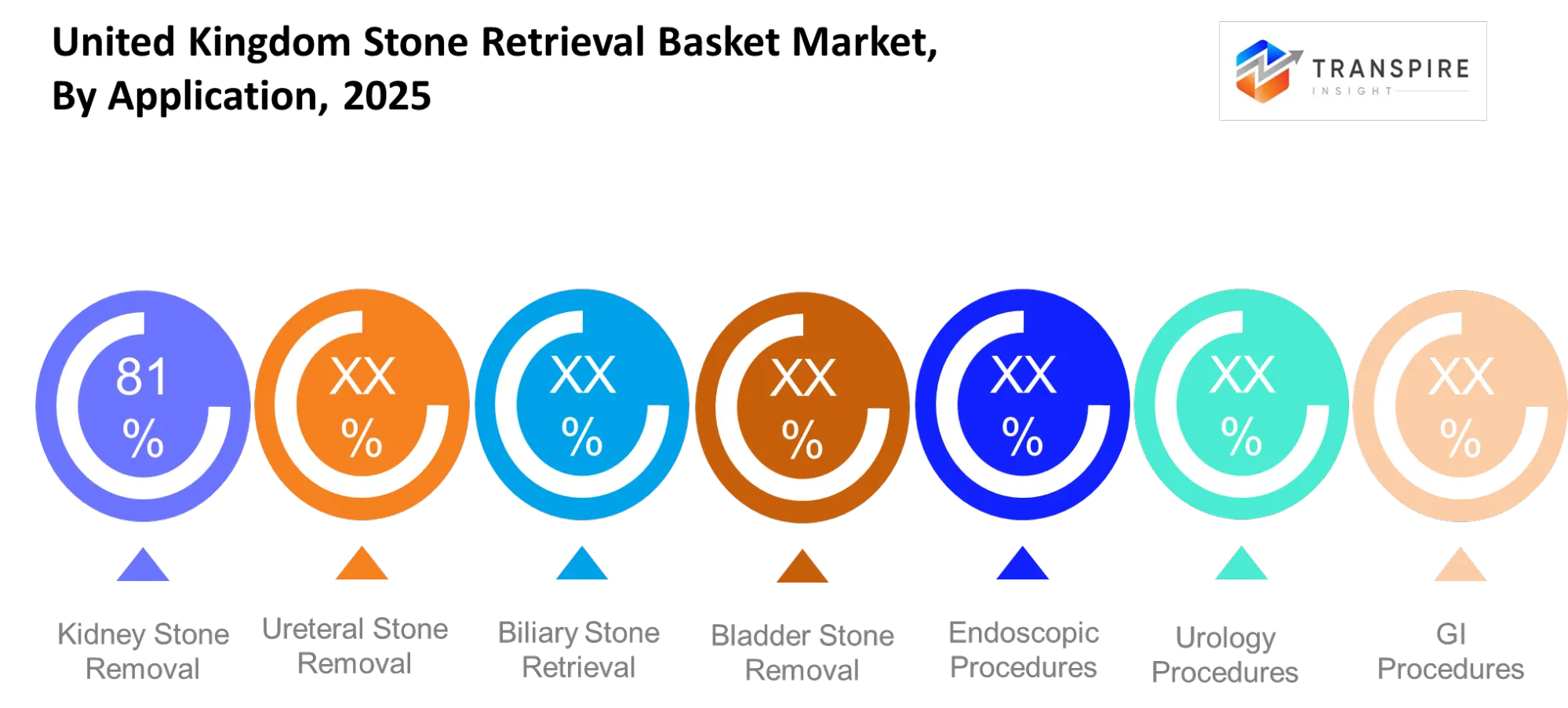
By End User:
Hospitals remain to be one of the major end-users with the support of the NHS framework and high throughput procedures in urology departments. The growing role of urology clinics and ambulatory surgical centers can also be anticipated along with the trend of rise of outpatient stone management practices within general urban healthcare organizations of UK Stone Retrieval Basket Market.
The increasing share of ambulatory surgical centers comes due to the increasing tendency towards reducing length of hospitalization and early discharge schemes of the healthcare organizations. Specialty clinics and diagnostic centers offer the capability of early diagnosis and prompt referral for the procedures. This aspect leads to greater accessibility to the stone retrieval baskets beyond just the hospitals.
By Material:
Nitinol baskets held majority share due to high elasticity and better navigability along the curved urinary tract. Stainless steel baskets continue to cater to the budget segment whereas, hybrid and polymer-coated materials used in certain special and advanced procedures necessitate extra security and handling for the procedure.
The preference for materials has shifted from that of economy and efficiency to safety and efficacy in the past few years. While hospitals are increasingly opting for the nitinol based systems in lieu of the conventional metallic ones, such transition is favorable to improve outcomes and minimize complications in the minimally invasive urology procedures in UK Stone Retrieval Basket Market.
By Procedure Type:
The type of procedures, flexible ureteroscopy, which enables access to less accessible parts of the urinary tract is predicted to grow and lead the type of procedures for the United Kingdom Stone Retrieval Basket Market, other clinical needs which drive procedure demand for in-hospital and in-patient surgery are support of rigid ureteroscopy and laser lithotripsy for endoscopic stone removal.
Procedural trends have become more combination type procedures using laser lithotripsy followed by basket retrieval which result in better stone clearance and decrease the rates of repetitive procedures. Increased use of flexible systems will replace previous rigid technologies, enhancing good clinical practice.
What are the Key Use Cases Driving the United Kingdom Stone Retrieval Basket Market?
The most commonly utilized use case in the UK Stone Retrieval Basket Market is ureteroscopic removal of kidney and ureteric stones in NHS hospitals. The demand for this use case is the highest as increasing rates of kidney stones in patients and rapidly expanding minimally invasive procedure rates are driving the need for a secure fragment retrieval technique in a single session following laser lithotripsy.
Broader application can be found in steps for common procedures such as biliary stone extraction for the gastroenterology service, as well as bladder stone removal for urology practice. These types of interventions are being attempted more frequently in the outpatient setting (ambulatory surgical centers) as healthcare infrastructure continues to emphasize streamline outpatient procedures away from inpatient institutions.
Emerging use cases are observed for complex multi-stone endoscopic procedures and combined imaging guided retrieval in hybrid operating rooms. These new applications are supported where tertiary care hospitals adopt new endoscopic platforms where accurate retrievals and targeted repeat procedures are clinical needs.
|
Report Metrics |
Details |
|
Market size value in 2025 |
USD 32.57 Million |
|
Market size value in 2026 |
USD 34.05 Million |
|
Revenue forecast in 2033 |
USD 46.46 Million |
|
Growth rate |
CAGR of 4.54% from 2026 to 2033 |
|
Base year |
2025 |
|
Historical data |
2021 - 2024 |
|
Forecast period |
2026 - 2033 |
|
Report coverage |
Revenue forecast, competitive landscape, growth factors, and trends |
|
Regional scope |
Middle East and Africa (Saudi Arabia, United Arab Emirates, South Africa, Rest of Middle East and Africa) |
|
Key company profiled |
Boston Scientific, Cook Medical, Olympus Corporation, Coloplast, Teleflex, Medi-Globe, Urovision, Becton Dickinson, Stryker, Richard Wolf, Rocamed, Advin Health Care, Karl Storz, Applied Medical, ConMed |
|
Customization scope |
Free report customization (country, regional & segment scope). Avail customized purchase options to meet your exact research needs. |
|
Report Segmentation |
By Product Type (Tipless Stone Retrieval Baskets, Helical Stone Retrieval Baskets, Nitinol Baskets, Dormia Baskets, Zero-tip Baskets, Hybrid Baskets, Flexible Baskets, Others); By Application (Kidney Stone Removal, Ureteral Stone Removal, Biliary Stone Retrieval, Bladder Stone Removal, Endoscopic Procedures, Urology Procedures, GI Procedures, Others); By End User (Hospitals, Urology Clinics, Ambulatory Surgical Centers, Specialty Clinics, Diagnostic Centers, Research Institutes, Others); By Material (Nitinol Baskets, Stainless Steel Baskets, Hybrid Material Baskets, Polymer-coated Baskets, Others); By Procedure Type (Flexible Ureteroscopy, Rigid Ureteroscopy, Endoscopic Stone Removal, Laser Lithotripsy Support, Others) |
Which Regions are Driving the United Kingdom Stone Retrieval Basket Market Growth?
As the largest market in the UK for the stone retrieval basket, England stands as the dominant segment due to its high density of NHS tertiary hospitals and consistent patient turnover for urology. Major teaching hospitals in cities such as London, Manchester, and Birmingham manage a large share of complex kidney stone procedures requiring advanced endoscopic retrieval devices. Centralized procurement processes, robust clinical specialization in urology, and referral patterns facilitate consistent usage in high-volume surgical centers. A well-established referral ecosystem means timely diagnoses and treatment are achieved, maintaining higher procedure volume compared to other UK regions.
Scotland holds a relatively constant position within the UK stone retrieval basket market due to its streamlined NHS Scotland system and consistent investment in its secondary and tertiary hospitals. Unlike England, market volume within Scotland is more reliant on access challenges and a patient base residing in geographically disparate locations relying on specific regional urology centers for care. Persistent investment in planned care recovery and facility modernization ensures the steady throughput of procedure volumes that support predictable uptake of stone retrieval devices across a spectrum of rural and urban healthcare facilities.
Wales is poised to become the fastest growing market due to substantial recent investment in healthcare facilities, accompanied by focused efforts to cut down surgical waiting lists. Numerous new ambulatory surgical units and additional endoscopy facilities are allowing for increased volumes of minimally invasive stone removal procedures to be performed each year. Focus on clearing backlogs in elective care has resulted in quick adoption of highly efficient retrieval devices across the district hospital settings and points to potential new entry markets in 2026 through 2033 for United Kingdom stone retrieval basket market participants.
Who are the Key Players in the United Kingdom Stone Retrieval Basket Market and How Do They Compete?
The competitive landscape for the UK Stone Retrieval Basket market is fairly consolidated, with a small pool of global medical device companies influencing a substantial part of NHS and private hospital tender and purchasing workflows. Leading incumbents protect market share via existing supply contracts, offering ongoing training services and seamless integration with existing endoscopy hardware, rather than a price focus. Technology has emerged as the primary differentiator, mainly centering around the flexibility of nitinol-based baskets, sterile disposable designs, and laser lithotripsy system compatibility. Nonetheless, NHS framework pricing constraints have fostered significant discipline, creating less room for smaller vendors to compete with pricing alone and making technological and clinical workflow gains the central arena.
Boston Scientific reinforces technology differentiation through enhancement of single-use, nitinol based basket series, targeting the most demanding high-volume ureteroscopy procedures in UK healthcare settings • Cook Medical enhances procedural utility through flexible basket design, focusing on effective large stone extraction and enabling customisation and intra-operative choice by surgeons • Olympus Corporation enhances efficiency by integrating the retrieval baskets within existing endoscopy imaging systems to drive total workflow improvement and packaged offerings for the surgical theatre • Teleflex drives adoption through established relationships with a large number of NHS hospital procurement systems and associated clinical education • Coloplast enhances penetration in urology specific niches by aligning its retrieval baskets with its comprehensive range of minimally invasive therapy and medical implant solutions for outpatient and hospital surgical procedures.
Company List
- Boston Scientific
- Cook Medical
- Olympus Corporation
- Coloplast
- Teleflex
- Medi-Globe
- Urovision
- Becton Dickinson
- Stryker
- Richard Wolf
- Rocamed
- Advin Health Care
- Karl Storz
- Applied Medical
- ConMed
Recent Development News
In March 2024, Boston Scientific Corporation entered into a strategic partnership with Cook Medical.” The collaboration focuses on co-developing and commercializing next-generation ureteroscopes integrated with stone retrieval technologies, enhancing procedural compatibility and driving innovation in endoscopic stone management systems used across European healthcare systems, including the UK. Sourcehttps://www.technavio.com/
In March 2026, Boston Scientific expanded its urology stone retrieval portfolio in Europe by updating and relisting its full stone retrieval device lineup, including baskets such as Zero Tip™, Escape™, OptiFlex™, and Dakota™ for flexible ureteroscopy procedures. The portfolio update reinforces the company’s continued commercialization and clinical positioning of advanced nitinol stone retrieval basket systems across European markets, including the UK, supporting minimally invasive urology procedures. Source https://www.bostonscientific.com/
What Strategic Insights Define the Future of the United Kingdom Stone Retrieval Basket Market?
The United Kingdom Stone Retrieval Basket Market is likely to transition to a technology-enabled completely disposable urology work flow over the long term based on an increasing focus on the expansion of outpatient care and stringent infection control measures. High precision, nitinol embedded devices coupled with laser lithotripsy equipment will dominate market trends in the 5-7 year period. Hospitals will no longer see the economic advantage in the re-usability factor but rather the cost efficiencies related to the duration of surgery and improved theater efficiency.
An indirect threat could potentially come from a shift to centralized procurement within the NHS whereby the long-term tendering processes are likely to impede technology implementation and trap hospitals with obsolete contracts hindering technology adoption at rates needed in the clinical context. An area for future opportunity could also be perceived with the growth in AI enhanced ureteroscopy technology being adopted within tertiary care centers where real time visual imaging will guide targeting stone capture and drive demand for smart-technology enhanced retrieval baskets.
United Kingdom Stone Retrieval Basket Market Report Segmentation
By Product Type
- Tipless Stone Retrieval Baskets
- Helical Stone Retrieval Baskets
- Nitinol Baskets
- Dormia Baskets
- Zero-tip Baskets
- Hybrid Baskets
- Flexible Baskets
By Application
- Kidney Stone Removal
- Ureteral Stone Removal
- Biliary Stone Retrieval
- Bladder Stone Removal
- Endoscopic Procedures
- Urology Procedures
- GI Procedures
By End User
- Hospitals
- Urology Clinics
- Ambulatory Surgical Centers
- Specialty Clinics
- Diagnostic Centers
- Research Institutes
By Material
- Nitinol Baskets
- Stainless Steel Baskets
- Hybrid Material Baskets
- Polymer-coated Baskets
By Procedure Type
- Flexible Ureteroscopy
- Rigid Ureteroscopy
- Endoscopic Stone Removal
- Laser Lithotripsy Support
Frequently Asked Questions
Find quick answers to common questions.
The United Kingdom Stone Retrieval Basket Market size is USD 46.46 Million in 2033.
Key Segments for the United Kingdom Stone Retrieval Basket Market are By Product Type (Tipless Stone Retrieval Baskets, Helical Stone Retrieval Baskets, Nitinol Baskets, Dormia Baskets, Zero-tip Baskets, Hybrid Baskets, Flexible Baskets, Others); By Application (Kidney Stone Removal, Ureteral Stone Removal, Biliary Stone Retrieval, Bladder Stone Removal, Endoscopic Procedures, Urology Procedures, GI Procedures, Others); By End User (Hospitals, Urology Clinics, Ambulatory Surgical Centers, Specialty Clinics, Diagnostic Centers, Research Institutes, Others); By Material (Nitinol Baskets, Stainless Steel Baskets, Hybrid Material Baskets, Polymer-coated Baskets, Others); By Procedure Type (Flexible Ureteroscopy, Rigid Ureteroscopy, Endoscopic Stone Removal, Laser Lithotripsy Support, Others).
Major United Kingdom Stone Retrieval Basket Market Players are Boston Scientific, Cook Medical, Olympus Corporation, Coloplast, Teleflex, Medi-Globe, Urovision, Becton Dickinson, Stryker, Richard Wolf, Rocamed, Advin Health Care, Karl Storz, Applied Medical, ConMed.
The Current United Kingdom Stone Retrieval Basket Market size is USD 32.57 Million in 2025.
The United Kingdom Stone Retrieval Basket Market CAGR is 4.54% from 2026 to 2033.
- Boston Scientific
- Cook Medical
- Olympus Corporation
- Coloplast
- Teleflex
- Medi-Globe
- Urovision
- Becton Dickinson
- Stryker
- Richard Wolf
- Rocamed
- Advin Health Care
- Karl Storz
- Applied Medical
- ConMed
Recently Published Reports
-
May 2026
Biosimilars Market
Biosimilars Market By Product Type (Monoclonal Antibodies, Recombinant Hormones, Erythropoietin, G-CSF, Others), By Indication (Oncology, Autoimmune Diseases, Blood Disorders, Diabetes, Others), By Manufacturing Type (In-House Manufacturing, Contract Manufacturing), By Distribution Channel (Hospital Pharmacies, Retail Pharmacies, Online Pharmacies), By Industry Analysis, Size, Share, Growth, Trends, and Forecasts 2021-2033
-
Apr 2026
Gastrointestinal Endoscopy Market
Gastrointestinal Endoscopy Market By Type (Rigid Gastrointestinal Endoscope, Flexible Gastrointestinal Endoscopes, Disposable Gastrointestinal Endoscope), By Procedure Type (Colonoscopy, Gastroscopy, Duodenoscopy, Enteroscopy, Flexible Sigmoidoscopy, Others), By Application (Diagnosis, Treatment), By End-Users (Hospitals, Ambulatory Surgical Centers, Specialty Clinics, Laboratories, Others), By Industry Analysis, Size, Share, Growth, Trends, and Forecasts 2021-2033
-
Apr 2026
Rare Inherited Metabolic Disorder Drug Market
Rare Inherited Metabolic Disorder Drug Market By Drug Class (Enzyme Replacement Drugs, Gene Therapy Drugs, Substrate Reduction Drugs, Small Module Drugs, Protein Drugs), By Route of Administration(Parenteral, Oral, Intrathecal), By Clinical Development (Marketed Drugs, Late Stage Clinical Phase III, Early Stage Clinical Phase I-II, Preclinical Candidates), By Indication (Lysosomal Storage Disorders, Urea Cycle Disorders, Amino Acid Metabolic Disorders, organic Acidemias, Peroximal Disorders), By Industry Analysis, Size, Share, Growth, Trends, and Forecasts 2021-2033
-
Jan 2026
Pharmaceutical Cleanroom Technology Market
Pharmaceutical Cleanroom Technology Market By Product (Equipment, Consumables, Services); By Cleanroom Type (Standard Cleanrooms, Modular Cleanrooms); By End Use (Pharmaceutical Companies, Biotechnology Companies), By Industry Analysis, Size, Share, Growth, Trends, and Forecasts 2021-2033