
Europe Stainless Steel Market Size & Forecast:
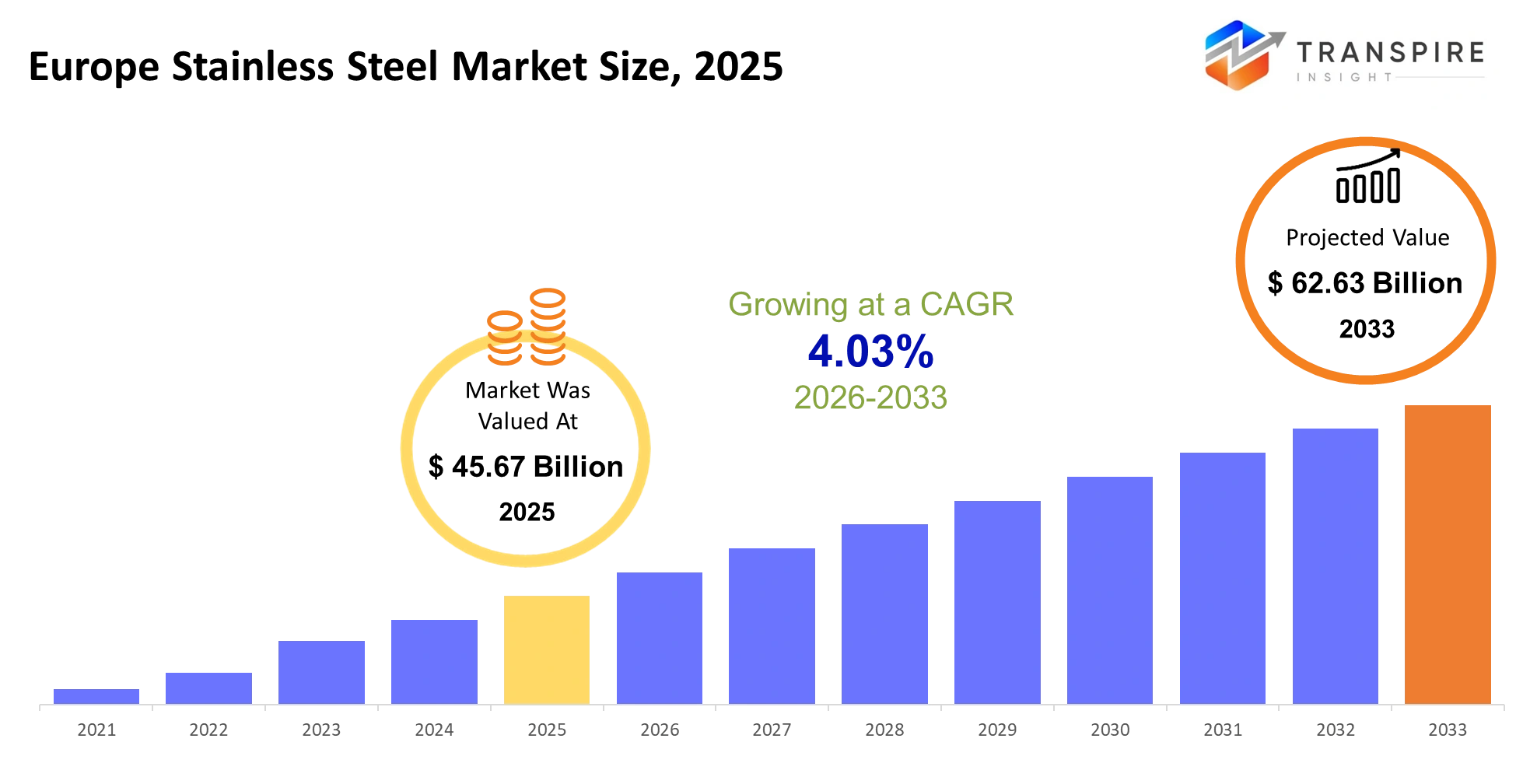
- Europe Stainless Steel Market Size 2025: USD 45.67 Billion
- Europe Stainless Steel Market Size 2033: USD 62.63 Billion
- Europe Stainless Steel Market CAGR: 4.03%
- Europe Stainless Steel Market Segments: By Type (Flat Products, Long Products, Tubular Products, Others); By Application (Construction, Automotive, Industrial Equipment, Consumer Goods, Others); By End-User (Construction Sector, Automotive Industry, Industrial Sector, Others); By Grade (Austenitic, Ferritic, Martensitic, Duplex, Others).
To learn more about this report,  Download Free Sample Report
Europe Stainless Steel Market Summary
The Europe Stainless Steel Market was valued at USD 45.67 Billion in 2025. It is forecast to reach USD 62.63 Billion by 2033. That is a CAGR of 4.03% over the period.
The Europe Stainless Steel Market provides essential industrial support to construction, transportation, energy, food processing, and advanced manufacturing sectors through its supply of corrosion-resistant materials which can endure extreme operational conditions and extended service periods. The railway systems and electric vehicle platforms and chemical processing equipment and offshore infrastructure and hygienic production environments all use stainless steel as their main material because it provides both durability and necessary legal standards for equipment performance and cost management.
The market changed its focus during the past five years from producing high volumes of products to manufacturing stainless steel that emits low emissions and contains high recycled materials. The European climate regulations together with carbon reporting requirements forced industrial buyers to choose traceable materials that produce lower carbon emissions for their procurement process. The Russia-Ukraine conflict caused energy prices to fluctuate and supply chains to break down which revealed the dangers associated with depending on imports and using inconsistent methods to obtain raw materials.The combination of these two forces led to increased regional investments in both recycling facilities and digital production technology and specialty alloy research. The modernization of manufacturing facilities together with the adoption of durable materials by infrastructure developers enables stainless steel manufacturers to increase their market control over premium-grade products used in transportation electrification and renewable energy systems and industrial modernization projects.
Key Market Insights
- The European Stainless Steel Market in 2025 showed Western Europe as its leading region because Western Europe operated with advanced manufacturing facilities while implementing tight sustainability standards.
- The Eastern European market between 2026 and 2033 reached its peak growth rate because automotive companies made investments in the area while industrial plants received modernization upgrades.
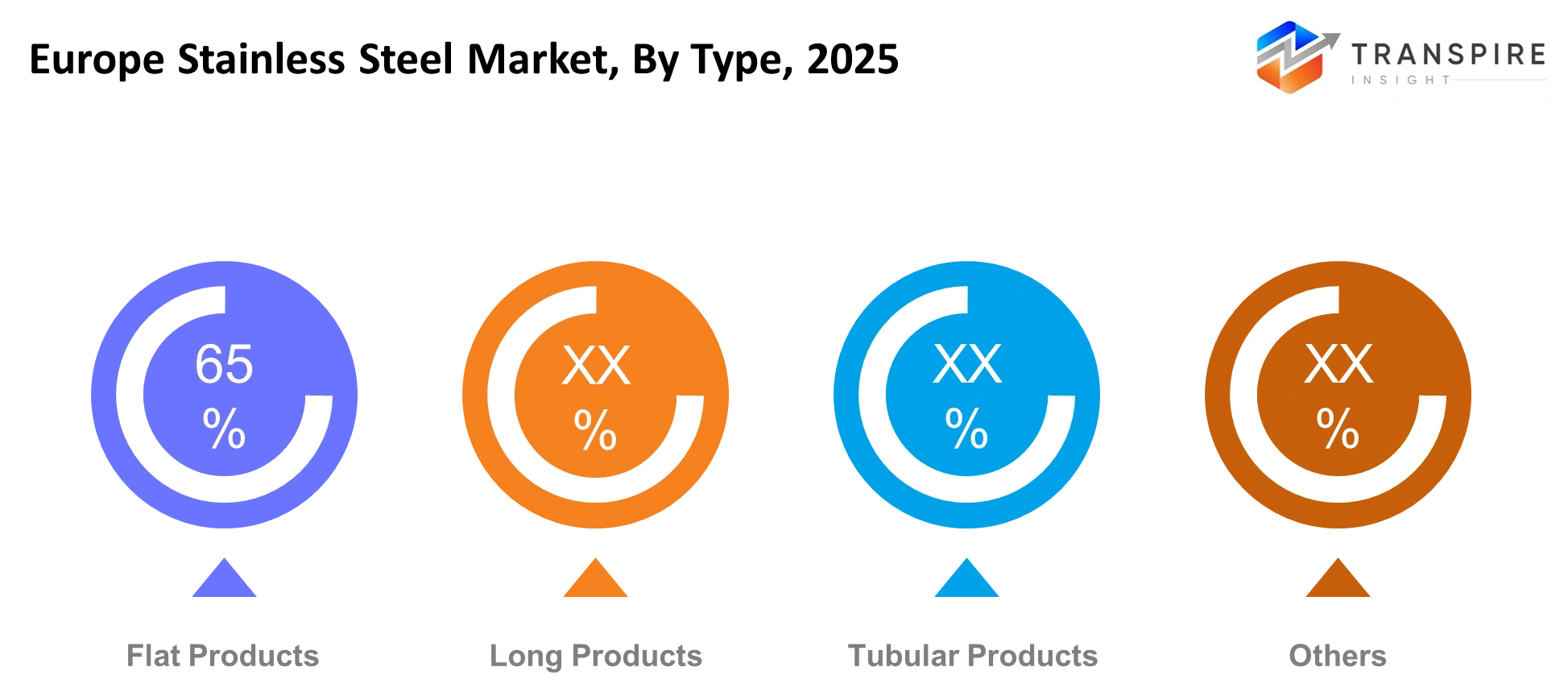
- The market of flat stainless steel products reached 50% market share in 2025 because the automotive and construction sectors required precise manufacturing materials.
- The market for tubular stainless steel products experienced its most rapid expansion after 2024 because hydrogen production and chemical processing facilities in Europe received increased funding.
- The construction sector maintained its position as the main application area because it accounted for 35% of the market share in 2025 through rail system development and urban renewal and energy-efficient building construction.
- The need for renewable energy systems and hydrogen infrastructure systems developed after 2025 because duplex stainless steel emerged as a required material for electrolyzers and storage systems.
- Corrosion-resistant materials used in transport and public infrastructure projects enabled the construction sector to become the main driver of end-user demand because they decreased expenses for maintenance throughout the projects' lifetime.
- Industrial equipment manufacturers increased their stainless steel purchasing activities between 2024 and 2026 to meet rising demand from food processing and pharmaceutical and chemical production sectors.
- Outokumpu developed its competitive edge through Circle Green low-emission stainless steel products which target automotive and transportation decarbonization initiatives.
- Through its Magnetec acquisition, Aperam expanded its specialty alloy capabilities which allowed the company to access electronics and energy infrastructure markets.
What are the Key Drivers, Restraints, and Opportunities in the Europe Stainless Steel Market?
The European market for stainless steel experiences its highest demand because of new regulations which control carbon emissions and establish energy efficiency standards and protect infrastructure longevity. European Union climate policies, which include tighter lifecycle emissions regulations for buildings and transportation systems and industrial equipment, compelled businesses to select materials that offer high recyclability and extended service life. Stainless steel producers expanded their product offerings by developing low-carbon products which contain recycled materials and produce lower greenhouse gas emissions. The transition led to increased procurement activities which included rail infrastructure and electric vehicles and food processing equipment and renewable energy systems, resulting in revenue growth for companies that supply premium-grade stainless steel.
The main obstacle for Europe continues to be its persistent high costs for energy and raw materials. The production process for stainless steel requires significant amounts of electricity and ferroalloys and nickel and chromium, which all experienced price changes after regional energy outages and geopolitical trade conflicts. Many mills still operate with outdated equipment that lacks the ability to switch quickly to affordable renewable energy sources. The cost burden led to reduced production flexibility and project delays for plant modernization work and the company faced difficulties competing with lower-priced Asian imports during times of weak industrial demand.
The development of hydrogen infrastructure combined with offshore renewable energy projects creates a major opportunity. The production of electrolyzers and hydrogen storage systems and desalination plants and offshore wind foundations requires duplex and corrosion-resistant stainless steel grades.Northern European governments and industrial investors maintain their financial support for hydrogen corridor projects, which will establish permanent demand for advanced stainless steel applications until the year 2033.
What Has the Impact of Artificial Intelligence Been on the Europe Stainless Steel Market?
European stainless steel production undergoes transformation through artificial intelligence and advanced digital technologies which enhance plant automation and emissions control and equipment performance. Steelmakers increasingly use AI-driven control systems to monitor furnace temperatures and rolling mill pressure and exhaust gas cleaning technology in real time. Outokumpu and thyssenkrupp AG expanded their digital manufacturing programs which integrate industrial sensors with cloud-based analytics to minimize energy waste while achieving process improvements. The automated monitoring systems enable operators to monitor their environmental compliance data throughout the day which results in faster reporting and decreased chances of receiving regulatory penalties from the stricter EU emissions regulations.
Machine learning models now support predictive maintenance across casting lines pumps compressors and heat treatment systems. The systems use vibration analysis and temperature monitoring and production-cycle data analysis to identify equipment failures which occur before complete system shutdowns. European stainless steel production facilities achieved measurable enhancements in operational uptime and decreased maintenance expenses and lower electricity usage after they implemented AI-based optimization systems into their manufacturing processes. Digital twin technology enables manufacturers to create virtual models of alloy performance which help them determine optimal material usage before their actual production process begins. The high integration costs that smaller plants face together with their lack of standardized historical data for building accurate predictive models still present obstacles to AI adoption.
Key Market Trends
- European manufacturers started to buy recycled stainless steel after 2023 because they needed to decrease their carbon emissions from their supply chains which would be affected by the new EU sustainability regulations.
- Outokumpu and Aperam increased their funding for environmentally friendly stainless steel products during the period from 2024 to 2026 because they wanted to obtain contracts in the automotive and transport sectors.
- European electric vehicle production in Germany and France created an increased need for stainless steel which manufacturers used to make battery enclosures and lightweight structural components.
- Since 2025 hydrogen infrastructure projects require more duplex stainless steel which they use to build electrolyzers and pipelines and high-pressure storage systems.
- European buyers decreased their dependence on Asian imports after energy price fluctuations and supply interruptions revealed weaknesses in long-distance sourcing methods.
- Food processing and pharmaceutical manufacturers adopted higher-grade stainless steel equipment after stricter EU hygiene compliance standards tightened operational requirements.
- Producers increasingly automated finishing and precision processing operations between 2024 and 2026 to offset labor shortages and improve manufacturing efficiency.
- Eastern European countries attracted new stainless steel fabrication investments as automotive suppliers expanded regional manufacturing and logistics operations after 2024.
- Steel manufacturers established more collaborative partnerships with transportation companies after rail operators selected sustainable materials for their metro and infrastructure upgrade initiatives.
- Producers in appliance manufacturing began to use ferritic stainless steel because they needed to decrease their dependence on nickel while achieving stable costs of raw materials.
Europe Stainless Steel Market Segmentation
By Type:
The largest share of stainless steel demand in Europe goes to flat products because automotive manufacturers appliance producers and construction contractors need sheets coils and plates for their large-scale production needs. The segment maintains its production levels because transport infrastructure and industrial processing equipment show continuous demand. The need for corrosion-resistant flat steel products with specific surface finishing and forming characteristics increases because energy-efficient buildings and electric vehicle platforms require such materials.
Structural engineering and reinforcement systems and heavy industrial fabrication projects create stable demand for long products. The demand for tubular products increases because chemical processing facilities and hydrogen transport networks and water management systems require products that provide pressure resistance and durability. Manufacturers will develop specialized processing plants for future market growth while buyers will increasingly choose recycled-content steel that meets low-emission production standards.
To learn more about this report, Download Free Sample Report
By Application:
The highest stainless steel consumption comes from construction applications because commercial buildings and transport hubs and bridges and public infrastructure projects need materials that can resist moisture and pollution and extended operational periods. The European sustainability standards which impose strict requirements drive urban development projects to adopt recyclable and low-maintenance materials. The architectural stainless steel market benefits from increased demand which results from major rail modernization projects and energy-efficient building initiatives.
The automotive and industrial equipment sectors experience market growth because lightweight materials and high-temperature resistant products and precisely designed materials are becoming more desirable to customers. Stainless steel use in kitchen appliances and medical equipment and premium household products is increasing among consumer goods manufacturers because these products require both hygiene and durability. The electric mobility and industrial automation and smart manufacturing sectors will create business opportunities for companies that provide custom material grades and advanced technology for surface treatment.
By End-User:
The construction sector represents the largest end-user category because infrastructure developers and commercial builders rely on stainless steel for long-life structural systems and corrosion-resistant exterior applications. Public investment programs across transportation, water infrastructure, and urban redevelopment projects continue supporting steady purchasing activity. The demand for stainless steel remains strong because it decreases maintenance expenses when used in environments with extreme conditions.
The automotive industry and industrial sector contribute significant growth through advanced manufacturing and energy-transition projects. Industrial buyers increasingly require specialized stainless steel grades for chemical plants, renewable energy systems, and food processing facilities where hygiene and thermal stability remain important operational requirements. During the forecast period customers will demand from suppliers low-carbon manufacturing processes and transparent material sourcing and specialized alloy production that meets new procurement requirements.
By Grade:
The market currently shows Austenitic stainless steel as the leading product because this material offers exceptional corrosion resistance and excellent welding capabilities and works well with different industrial needs in construction and transportation and food processing sectors. The ongoing production of kitchen equipment and chemical tanks and architectural structures creates a constant need for these materials. The availability of austenitic grades together with their demonstrated ability to perform throughout their entire lifespan makes these materials suitable for production processes that require high manufacturing rates.
Duplex and ferritic grades are gaining traction due to rising interest in cost efficiency and higher mechanical strength in demanding industrial applications. Energy infrastructure systems and marine systems and desalination projects now utilize duplex stainless steel because this material delivers better stress corrosion resistance and maintains strength through extreme operational conditions. Steelmakers will develop their alloy innovations and processing technologies because advanced grades will become more popular with industrial buyers who want to improve lifecycle performance instead of spending money on initial material costs.
What are the Key Use Cases Driving the Europe Stainless Steel Market?
The primary application of stainless steel in Europe remains construction and infrastructure work because this material provides essential protection against corrosion while maintaining its operational performance during extended periods and requires minimal upkeep in high-demand urban settings. The market shows continuous demand for structural elements together with bridges and building facades and public transportation systems which must meet strict durability and sustainability requirements.
The region experiences continuous growth in both automotive and food processing industries. Electric vehicle manufacturers increasingly use lightweight stainless steel components in battery enclosures and exhaust replacement systems, while food and beverage companies rely on hygienic stainless steel equipment for processing lines, storage tanks, and commercial kitchens that must comply with strict EU safety standards.
Hydrogen infrastructure and renewable energy systems stand as new development areas for these technologies. Stainless steel has become a preferred material for hydrogen storage tanks and electrolyzers and offshore wind support structures because of its ability to endure extreme operating conditions combined with its resistance to moisture and pressure and chemical damage.
|
Report Metrics |
Details |
|
Market size value in 2025 |
USD 45.67 Billion |
|
Market size value in 2026 |
USD 47.51 Billion |
|
Revenue forecast in 2033 |
USD 62.63 Billion |
|
Growth rate |
CAGR of 4.03% from 2026 to 2033 |
|
Base year |
2025 |
|
Historical data |
2021 - 2024 |
|
Forecast period |
2026 - 2033 |
|
Report coverage |
Revenue forecast, competitive landscape, growth factors, and trends |
|
Regional scope |
Europe (Germany, United Kingdom, France, Italy, Spain, Rest of Europe) |
|
Key company profiled |
ArcelorMittal, POSCO, Nippon Steel, Outokumpu, Acerinox, Thyssenkrupp, JFE Steel, Tata Steel, Baosteel, Aperam, AK Steel, Voestalpine, Nucor, Sandvik, Allegheny Technologies. |
|
Customization scope |
Free report customization (country, regional & segment scope). Avail customized purchase options to meet your exact research needs. |
|
Report Segmentation |
By Type (Flat Products, Long Products, Tubular Products, Others); By Application (Construction, Automotive, Industrial Equipment, Consumer Goods, Others); By End-User (Construction Sector, Automotive Industry, Industrial Sector, Others); By Grade (Austenitic, Ferritic, Martensitic, Duplex, Others). |
Which Regions are Driving the Europe Stainless Steel Market Growth?
The stainless steel market in Europe sees its largest share operating from Western Europe because this area combines its industrial capacity with strict environmental regulations and established recycling systems. Integrated stainless steel production facilities in Germany Italy and France serve automotive construction food processing and energy industries at large-scale production capacities. The region benefits from its extensive rail and port systems which enable smooth importing of raw materials and distribution throughout Europe. Producers have committed their resources to developing low-emission stainless steel materials because existing emissions policies and carbon reduction targets create financial rewards through reduced expenses for high-emission materials.
Northern Europe contributes differently to the market because its growth depends more on technological specialization and stable industrial demand than on production scale. Finland and Sweden maintain consistent stainless steel consumption through renewable energy production and marine engineering and high-performance manufacturing sectors which prioritize corrosion-resistant alloys. The region's companies invest in recycled-content stainless steel and energy-efficient smelting operations which establish sustainable product demand throughout economic downturns. Northern Europe depends more on premium-grade stainless steel applications with higher margins while Western Europe depends on high-volume production.
Eastern Europe has become the fastest-growing region because industrial modernization and infrastructure development across manufacturing and construction sectors have progressed at a rapid pace.The governments of Poland and Romania together with the Czech Republic have expanded their industrial incentives while upgrading their logistics systems to attract new manufacturing facilities and stainless steel processing plants. The region experiences increased demand for flat and specialty stainless steel products because foreign direct investment in automotive and appliance manufacturing has risen. Between 2026 and 2033 the sector will experience growth because manufacturing capacity and regional trade connections will expand, which will generate significant business prospects for suppliers and processors and investors.
Who are the Key Players in the Europe Stainless Steel Market and How Do They Compete?
The Europe stainless steel market is moderately consolidated, with competition centered around a handful of integrated producers that control large-scale melting, recycling, and finishing operations across the region. Incumbents are defending market share through low-carbon production technologies, specialty alloy development, and long-term industrial supply agreements rather than competing only on price. Competition increasingly depends on energy efficiency, recycled content, and proximity to automotive, construction, and industrial manufacturing hubs. European regulations on emissions and traceability are also pushing producers to differentiate through certified sustainable steel products and advanced processing capabilities.
Outokumpu competes through low-emission stainless steel production and circular manufacturing. The Circle Green product line of the company uses high recycled content and lower carbon intensity to provide the company with an advantage in automotive and transportation markets that require decarbonized supply chains. The company is expanding through partnerships such as its agreement with Alstom for metro car applications and collaborations tied to sustainable aviation fuel infrastructure. Aperam focuses on specialty alloys and high-value electrical steel applications rather than commodity-grade stainless products. The acquisition of Magnetec Group allowed the company to enhance its capabilities in producing magnetic materials that have applications in electronic devices and energy systems.
Acerinox uses its geographic diversity and its operations in downstream processing throughout Europe and North America to create a business model that protects against sudden changes in demand from specific regions. The organization maintains its investment in advanced stainless steel grades which exhibit superior performance for their industrial applications and energy sector use. thyssenkrupp AG focuses on providing tailored steel processing and cutting-edge industrial solutions to its automotive and engineering customer base. The company competes through its integrated service network and its expertise in delivering precise flat stainless steel products which enable it to measure technical performance and delivery reliability.
Company List
- ArcelorMittal
- POSCO
- Nippon Steel
- Outokumpu
- Acerinox
- Thyssenkrupp
- JFE Steel
- Tata Steel
- Baosteel
- Aperam
- AK Steel
- Voestalpine
- Nucor
- Sandvik
- Allegheny Technologies
Recent Development News
“In January 2026, Outokumpu entered a partnership with Norsk e-Fuel to develop a CO-to-SAF production facility in Tornio, Finland. The collaboration is expected to support sustainable aviation fuel production while enabling Outokumpu to reduce direct CO₂ emissions by approximately 200,000 tons annually, reinforcing Europe’s low-emission stainless steel ecosystem.
Source: https://www.outokumpu.com
“In June 2025, Outokumpu entered a partnership with Alstom for the supply of low-emission stainless steel for metro cars. The agreement enabled Alstom to integrate Outokumpu Circle Green® stainless steel into its next-generation Metropolis metro cars, supporting decarbonization goals across Europe’s rail and stainless steel sectors.
Source: https://news.cision.com
What Strategic Insights Define the Future of the Europe Stainless Steel Market?
The Europe stainless steel market is developing toward low-carbon high-performance production methods because of stricter emissions regulations and rising electrification and industrial production shifts from other countries to Europe. The market will increasingly focus on stainless steel grades that electric vehicles and hydrogen infrastructure and medical equipment and renewable energy systems use because these applications require products with corrosion resistance and long-lasting performance which justify higher costs. The European market faces an invisible risk because it relies on imported nickel and chromium which creates supply chain risks and price fluctuations that affect makers although demand for their products remains steady. The development of green stainless steel through electric arc furnace technology and recycled scrap integration creates a significant opportunity because carbon border adjustment mechanisms are starting to affect procurement choices in the construction and automotive sectors. Market participants should accelerate investment in circular production systems, scrap recovery networks, and renewable-powered processing capacity to secure long-term cost stability and maintain competitiveness as buyers increasingly evaluate embedded carbon intensity alongside product performance.
Europe Stainless Steel Market Report Segmentation
By Type
- Flat Products
- Long Products
- Tubular Products
- Others
By Application
- Construction
- Automotive
- Industrial Equipment
- Consumer Goods
- Others
By End-User
- Construction Sector
- Automotive Industry
- Industrial Sector
- Others
By Grade
- Austenitic
- Ferritic
- Martensitic
- Duplex
- Others
Frequently Asked Questions
Find quick answers to common questions.
The Europe Stainless Steel Market size is USD 62.63 Billion in 2033.
Key segments for the Europe Stainless Steel Market are By Type (Flat Products, Long Products, Tubular Products, Others); By Application (Construction, Automotive, Industrial Equipment, Consumer Goods, Others); By End-User (Construction Sector, Automotive Industry, Industrial Sector, Others); By Grade (Austenitic, Ferritic, Martensitic, Duplex, Others).
Major Europe Stainless Steel Market players are ArcelorMittal, POSCO, Nippon Steel, Outokumpu, Acerinox, Thyssenkrupp, JFE Steel, Tata Steel, Baosteel, Aperam, AK Steel, Voestalpine, Nucor, Sandvik, Allegheny Technologies.
The Europe Stainless Steel Market size is USD 45.67 Billion in 2025.
The Europe Stainless Steel Market CAGR is 4.03% from 2026 to 2033.
- ArcelorMittal
- POSCO
- Nippon Steel
- Outokumpu
- Acerinox
- Thyssenkrupp
- JFE Steel
- Tata Steel
- Baosteel
- Aperam
- AK Steel
- Voestalpine
- Nucor
- Sandvik
- Allegheny Technologies
Recently Published Reports
-
Apr 2026
Healthcare Polymer Packaging Market
Healthcare Polymer Packaging Market Size, Share & Analysis Report By Packaging Type (Syringes, IV Bottles and Pouches, Clamshells, Blisters, Bottles & Jars, Containers, Tubes, IV Parental Packaging, Others), By Type (Regulated, Non-regulated), By Polymer Type (LDPE (Low-Density Polyethylene), HDPE (High-Density Polyethylene), Homo-polymer (Homo), Random Copolymer (Random), Block Copolymer (Block), PET, Polystyrene, Polyvinyl Chloride, Polyamide/EVOH, Others), and Geography (North America, Europe, Asia-Pacific, Middle East and Africa, South and Central America), 2021 - 2031
-
Apr 2026
Hydrophilic Tape (Waterstop) Market
Hydrophilic Tape (Waterstop) Market Size, Share & Analysis Report By Type (Bentonite-Based Hydrophilic Tape, Rubber-Based Hydrophilic Tape), By Application (Residential Buildings, Commercial Buildings, Infrastructure Projects), and Geography (North America, Europe, Asia-Pacific, Middle East and Africa, South and Central America), 2021 - 2031
-
Apr 2026
Metalens Market
Metalens Market Size, Share & Analysis Report By Type (Visible Light Metalens, and Infrared Metalens), By Application (Consumer Electronics, Automotive Electronics, Industrial, Medical, and Others), and Geography (North America, Europe, Asia-Pacific, Middle East and Africa, South and Central America), 2021 - 2031
-
Apr 2026
PBT Resin Market
PBT Resin Market Size, Share & Analysis Report By Type (Reinforced PBT Resin, Unreinforced PBT Resin), By Processing Method (Injection Molding, Extrusion, Blow Molding, Others), By End-User (Automotive, Electrical & Electronics, Consumer Appliances, Industrial Machinery, Medical Devices, Packaging, Others), and Geography (North America, Europe, Asia-Pacific, Middle East and Africa, South and Central America), 2021 - 2031