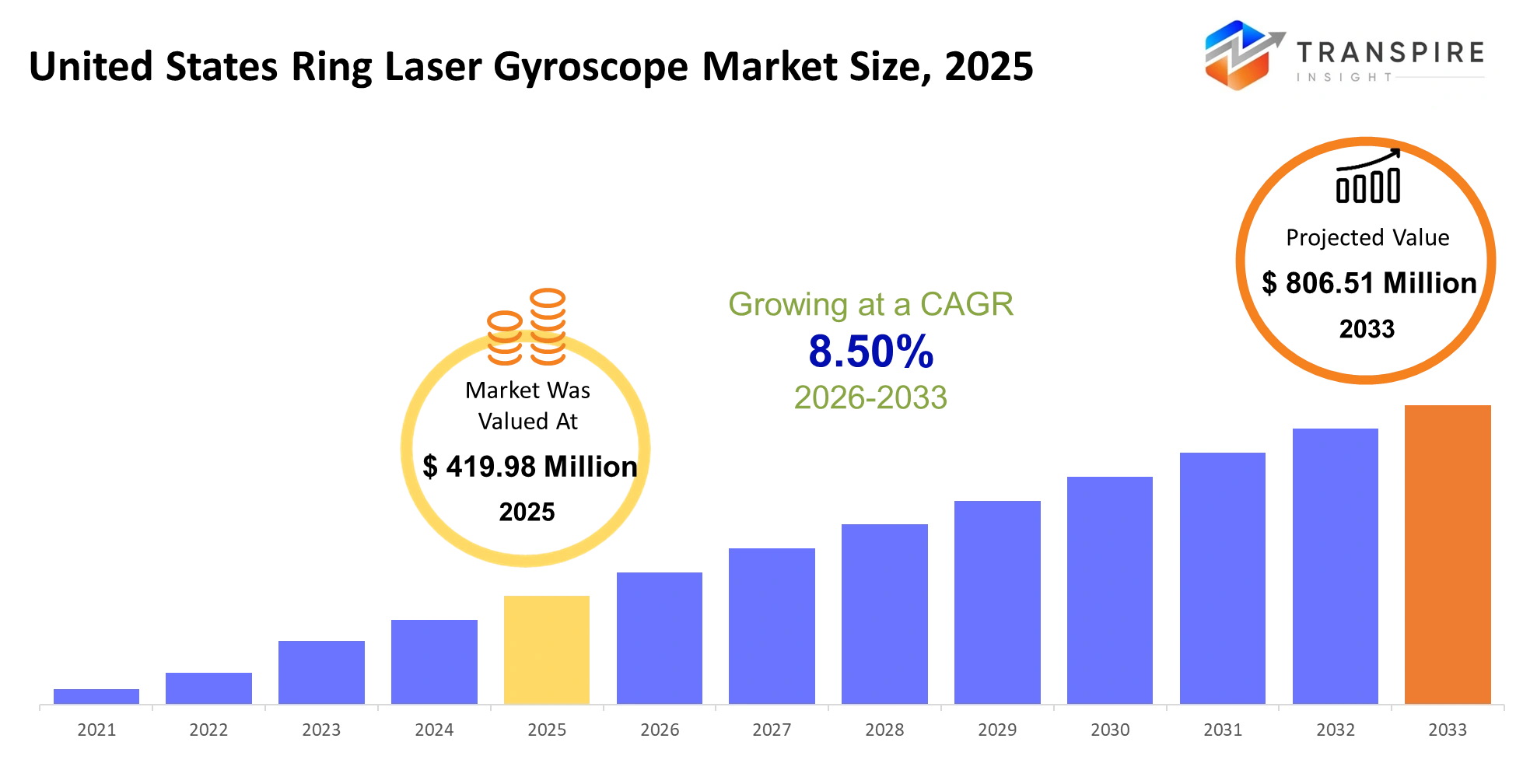
United States Ring Laser Gyroscope Market Size & Forecast:
- United States Ring Laser Gyroscope Market Size 2025: USD 419.98 Million
- United States Ring Laser Gyroscope Market Size 2033: USD 806.51 Million
- United States Ring Laser Gyroscope Market CAGR: 8.50%
- United States Ring Laser Gyroscope Market Segments: By Axis Type (Single-axis Gyroscopes, Dual-axis Gyroscopes, Triple-axis Gyroscopes, Others); By Application (Aircraft Navigation, Missile Guidance, Marine Navigation, Spacecraft Navigation, Industrial Robotics, Others); By End User (Aerospace & Defense, Marine Industry, Automotive Industry, Industrial Sector, Others); By Technology (Mechanical Gyroscopes, Optical Gyroscopes, Fiber Optic Gyroscopes, Others).
To learn more about this report,  Download Free Sample Report
United States Ring Laser Gyroscope Market Summary
The United States Ring Laser Gyroscope Market was valued at USD 419.98 Million in 2025. It is forecast to reach USD 806.51 Million by 2033. That is a CAGR of 8.50% over the period.
Ring laser gyroscopes deliver very ultra precise orientation along with angular rate sensing for platforms that still have to move, even when satellite signals aren’t so trustworthy—think submarines , naval ships, aircraft, and also top tier industrial automation setups. In real life, they help steady the inertial navigation systems that end up steering vehicles through GPS-denied areas, and long endurance missions that don’t really stop.
Over the last five years, the whole market kind of shifted, from mechanically based gyroscopes toward more completely solid-state inertial options, where ring laser and fiber optic technologies are merged with digital avionics. A major catalyst has been the growing electronic warfare exposure and the Ukraine conflict, it kinda stressed how GNSS signals can be fragile, and it sped up defense buying of navigation solutions that are harder to disrupt. So, US naval modernization efforts, together with autonomous platform development , have been leaning heavily on high precision inertial guidance. That tilt also drove higher integration work, and it lifted the value per unit since OEMs increasingly slot in redundant navigation designs, both in new builds and in retrofit programs.
Key Market Insights
- North America kind of dominates the United States Ring Laser Gyroscope Market, with almost 42% share in 2025 . This is mostly because of solid defense R&D spend, and it keeps pushing momentum forward.
- Over in the West Coast and also Virginia, the fastest growth shows up, driven by aerospace manufacturing hubs, plus naval defense procurement is expanding through 2030, kind of steadily.
- Navigation-grade ring laser gyroscope systems lead the United States market, taking roughly 48% share in 2025, so they are still the main course.
- For the segments, tactical-grade gyroscopes take the second-largest slice, they are used a lot in UAVs, submarines, and guided missile stabilization platforms, especially when the environment gets harsh.
- Miniaturized inertial navigation systems are the fastest-growing part, mainly due to demand for autonomous defense work and robotics integration, in that more compact “small-but-capable” direction.
- Aerospace and defense navigation kind of dominates with nearly 55% share, reflecting this strong reliance on high-precision inertial guidance system(s).
- Unmanned systems, and autonomous platforms are the fastest-growing application segment through 2026–2030, boosting demand for advanced sensor integration.
- Defense forces still remain the leading end-user in the United States Ring Laser Gyroscope Market with significant procurement-driven need, you know.
- Aerospace OEMs are the fastest-growing end-user group due to increased adoption of resilient inertial navigation architectures.
What are the Key Drivers, Restraints, and Opportunities in the United States Ring Laser Gyroscope Market?
The United States Ring Laser Gyroscope Market is mostly driven by faster defense modernization initiatives, aimed at navigation resilience when GPS is denied or basically unreliable. More exposure to electronic warfare, and the constant threat of signal jamming has nudged the U.S. Department of Defense into upgrading inertial navigation systems across submarines, fighter jets, and even autonomous platforms. In other words, this change isn’t just a small upgrade path but it feels more structural, because the older mechanical gyroscopes are being phased out, for solid-state ring laser setups that bring better precision, plus steadier operational endurance. Because of this, procurement timelines have sped up and OEM integration turned into a strong revenue multiplier, especially inside aerospace and naval program budgets.
Meanwhile the market has a major drag, mostly tied to high system-level costs, and complicated integration needs that can be painful for many buyers. Ring laser gyroscopes rely on precision optics, and very tight manufacturing tolerances , and that reality reduces how easily production can scale while keeping the unit price high. So, even if there is interest, adoption tends to slow down in cost-sensitive segments like commercial aviation retrofit programs and mid-tier industrial setups. On top of that, limited budgets and the long qualification cycles end up pushing deployments out, which then dampens the near term revenue growth, even when demand signals look strong.
It feels like a key opportunity is showing up pretty fast thanks to the rapid growth of autonomous defense and space navigation systems. You can see it in how money is flowing into programs like next generation unmanned aerial vehicles, and also low- Earth orbit satellite constellations , and that is basically making demand rise for compact, high reliability inertial sensors. Companies such as Honeywell Aerospace are already pushing forward with miniaturized inertial measurement units that blend ring laser technology with sensor fusion architectures. This mix should, in theory, open up new application layers beyond the usual defense platforms, especially since autonomous navigation is becoming more complicated, and it needs to run continuously without breaks.
What Has the Impact of Artificial Intelligence Been on the United States Ring Laser Gyroscope Market?
Artificial intelligence and advanced digital technologies are kind of reshaping the United States Ring Laser Gyroscope Market, mainly by changing how inertial navigation systems are calibrated, monitored, and maintained across defense and aerospace platforms. In modern aircraft and naval vessels, AI-enabled sensor fusion is pulling together ring laser gyroscope measurements with accelerometers and GPS signals, so the system can continuously fix drift and sharpen navigation accuracy, especially during long-duration, GPS-denied missions. As a result, manual calibration chores are less frequent and operational stability in messy mission settings seems to be noticeably better.
At the same time machine learning models are starting to be deployed for predictive maintenance of inertial navigation units. They look at vibration patterns, thermal behavior, and signal deviation trends, then they can estimate how components are likely to degrade before failure actually shows up, which boosts system uptime by roughly 10–20% in advanced defense use cases. On top of that digital twin simulations help optimize performance by recreating real-world operating conditions and running navigation accuracy tests under stress scenarios, this supports quicker system validation and reduces the back and forth during qualification.
Still though, AI adoption in the United States Ring Laser Gyroscope Market isn’t moving as fast as people would hope. A big issue is limited high-quality training data from real GNSS-denied environments. A lot of defense situations are classified or basically too hard to replicate, so model performance accuracy stays constrained and broad deployment gets slow. Also the integration expenses for adding AI layers into older inertial systems can be high, which keeps adoption mostly inside high-budget aerospace and military programs, so the commercial share remains pretty low overall.
Key Market Trends
- U.S. defense procurement kinda shifted after 2022, with a stronger push for ring laser gyroscopes instead of mechanical setups, mostly because GPS jamming incidents kept rising. Honeywell Aerospace did expand solid state inertial navigation production in 2024, which seems like a direct read on the growing demand coming from naval modernization programs.
- Northrop Grumman also went ahead and integrated advanced ring laser gyroscopes into next gen UAV systems, boosting autonomous navigation reliability since those 2023 deployments started showing up in the field.
- Collins Aerospace then increased sensor fusion adoption in 2025, mixing gyroscopes with AI based navigation correction to get better drift control accuracy.
- Safran Electronics & Defense strengthened U.S. supply partnerships in 2023, and this helped cut delivery delays tied to precision optics component shortages.
- Meanwhile, military aviation programs started leaning toward redundant inertial architectures after 2022, so they were less dependent on satellite navigation when operating in contested zones.
- At the same time, space and low Earth orbit missions expanded their gyroscope usage in 2024, because there’s more need for long duration, radiation resistant navigation stability systems.
- Miniaturized ring laser systems gained momentum in 2025 UAV platforms, replacing the bulkier inertial units, to support longer endurance missions.
- And overall, defense contractors have increased R&D spending by double digit figures since 2023, aiming to improve laser stability and shrink long term drift error rates.
United States Ring Laser Gyroscope Market Segmentation
By Axis Type :
Single-axis gyroscopes kind of support basic directional sensing, and they’re used in simpler navigation layouts where not much motion tracking is needed. These devices tend to be pretty cost-effective and show up in setups where you do n't need full 3D spatial tracking. Dual-axis gyroscopes, on the other hand, give a better kind of stability and they measure motion across two planes , which helps control systems stay more consistent.
Triple-axis gyroscopes deliver full motion detection across three dimensions, and they’re used a lot in advanced navigation environments like aerospace and defense. In general, these kinds of units help with high-precision demands, especially when conditions get complicated. There are also other configurations used in specialized scenarios where you want a tailored motion sensing approach for unusual operational needs.
By Application :
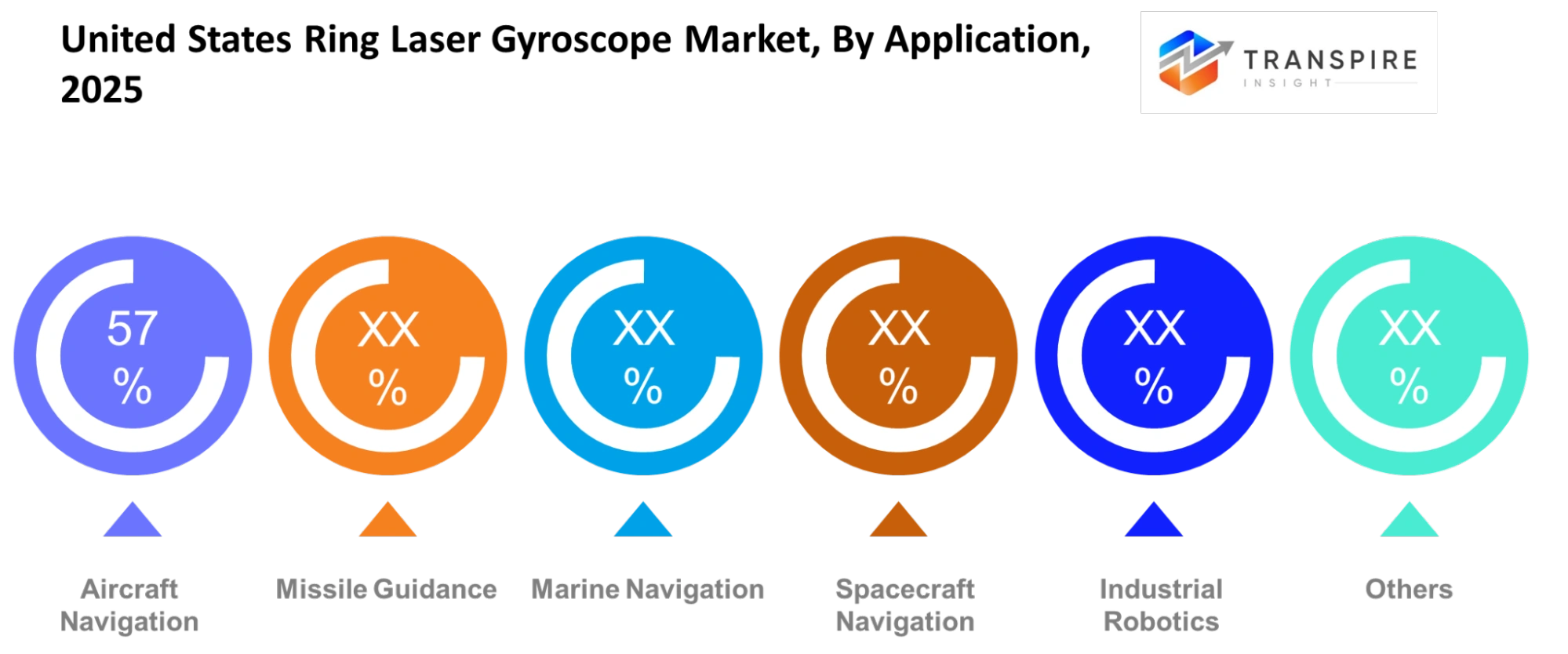
Aircraft navigation uses ring laser gyroscopes to keep flight control steady, helping maintain accurate orientation during long-distance travel and at higher speeds. Missile guidance depends on these gyroscopes so trajectory accuracy and target alignment remain stable even when things get extreme. For marine navigation, the main benefit is dependable heading control when the sea keeps shifting.
For spacecraft navigation, high-precision gyroscopes matter because they maintain orientation in zero-gravity conditions over long missions. Industrial robotics uses these systems to manage movements precisely, handle demanding tasks , and support automation inside manufacturing lines. Other uses include specialized scientific instruments and monitoring systems, where reliable motion detection and positioning accuracy are non-negotiable.
To learn more about this report, Download Free Sample Report
By End User :
The aerospace and defense sector is the leading end user, using ring laser gyroscopes in aircraft, missiles and defense systems where high reliability , and accuracy are kind of critical. The marine industry leans on these systems for navigation stability, plus safe route control during long sea operations.
Then there is automotive, which applies gyroscopes in advanced driver assistance functions and stability control features. In the industrial field they get used for robotics, automation and precision machinery, for controlled motions and consistent handling. Other end users show up as research organizations and niche engineering groups, all still needing accurate motion sensing and orientation tracking that does not drift too much.
By Technology :
Mechanical gyroscopes depend on spinning mass components, to sense orientation, and they show up in simpler navigation setups where durability matters. Over time , these are slowly swapped out in high-precision scenarios because of accuracy ceilings and slower response speed.
Optical gyroscopes, instead use light based measurement ideas, to capture rotation with better accuracy and steadier behavior. Fiber optic gyroscopes go one step further, using light transmission through fiber coils, so they can deliver solid performance in harsh conditions, and for demanding navigation needs. Overall these approaches fit modern systems where precision, dependability and less mechanical wear are the main goals.
What are the Key Use Cases Driving the United States Ring Laser Gyroscope Market?
In the United States , the main use case for the Ring Laser Gyroscope Market is basically precision inertial navigation, for aerospace and defense platforms such as fighter aircraft, submarines and guided missile systems. These setups need continuous orientation information that won’t really drift, especially when GPS signals are weakened, or even when they are intentionally jammed. In those moments ring laser gyroscopes become kind of the must-have piece, for mission-critical accuracy and also for survivability inside contested conditions.
More broadly, the applications are widening to autonomous unmanned aerial vehicles and advanced naval surface vessels that are fielded by defense units and aerospace OEMs. These platforms want compact high-stability navigation modules now, ones that can handle longer endurance missions and support real-time sensor fusion with onboard flight control. When ring laser gyroscopes get pulled into next-generation avionics, it also strengthens the demand coming from military aviation modernization programs, and that momentum is pretty noticeable.
On the emerging side, there are space navigation systems and hypersonic test vehicles, where extreme speeds plus radiation exposure means the inertial guidance has to be ultra-reliable. Defense-supported space efforts, along with reusable launch systems, are starting to trial ring laser gyroscopes for long-duration trajectory stability, which could point to future adoption beyond just traditional aircraft and maritime platforms.
|
Report Metrics |
Details |
|
Market size value in 2025 |
USD 419.98 Million |
|
Market size value in 2026 |
USD 455.67 Million |
|
Revenue forecast in 2033 |
USD 806.51 Million |
|
Growth rate |
CAGR of 8.50% from 2026 to 2033 |
|
Base year |
2025 |
|
Historical data |
2021 - 2024 |
|
Forecast period |
2026 - 2033 |
|
Report coverage |
Revenue forecast, competitive landscape, growth factors, and trends |
|
Geographic scope |
United States of America |
|
Key company profiled |
Honeywell, Northrop Grumman, Safran, Thales Group, Collins Aerospace, KVH Industries, EMCORE, iXblue, Analog Devices, Bosch Sensortec, General Dynamics, L3Harris Technologies, SBG Systems, Kearfott Corporation, Trimble. |
|
Customization scope |
Free report customization (country, regional & segment scope). Avail customized purchase options to meet your exact research needs. |
|
Report Segmentation |
By Axis Type (Single-axis Gyroscopes, Dual-axis Gyroscopes, Triple-axis Gyroscopes, Others); By Application (Aircraft Navigation, Missile Guidance, Marine Navigation, Spacecraft Navigation, Industrial Robotics, Others); By End User (Aerospace & Defense, Marine Industry, Automotive Industry, Industrial Sector, Others); By Technology (Mechanical Gyroscopes, Optical Gyroscopes, Fiber Optic Gyroscopes, Others). |
Which Regions are Driving the United States Ring Laser Gyroscope Market Growth?
North America sorta leads the United States Ring Laser Gyroscope Market , because of strong defense procurement frameworks and also ongoing modernization of inertial navigation systems across naval and aerospace fleets. The area seems to do well thanks to sustained funding from the U.S. Department of Defense , and they keep pushing GPS-independent guidance for submarines , fighter jets and strategic missiles. On top of that, advanced manufacturing ecosystems in places like California and Virginia back precision optics and avionics integration at scale. There’s also this well established defense contractor network that keeps things moving, so ring laser gyroscope systems can be deployed quickly on both new builds and retrofit platforms , even when schedules are tight.
Europe shows up as a stable secondary contributor , mostly due to structured defense collaboration programs and gradual but consistent avionics improvements across NATO aligned fleets. And unlike North America’s more high intensity procurement swings, Europe leans toward long term platform modernization. That means special attention for maritime patrol aircraft , and naval surface vessels, more than frantic buying cycles. France, Germany, and the UK keep predictable investment in inertial navigation systems through multi year defense planning. So demand stays continuous but moderate for advanced gyroscope technologies, without much sharp volatility or sudden demand spikes.
Asia-Pacific looks like the fastest-growing market, mostly because of sped up naval expansion, plus more geopolitical frictions going on across the Indo-Pacific corridor. In the last few years, there’s been a clear push with submarine fleets and domestic aerospace projects in India, Japan , and South Korea. Because of that, the need for high precision navigation systems has been climbing since 2023. At the same time China keeps working on autonomous defense platforms, and that kind of momentum makes countries nearby adopt advanced inertial technologies at a faster rate. So overall, this wave basically hints at strong chances for international suppliers trying to enter the United States Ring Laser Gyroscope Market supply chain. Especially if they set up joint ventures or localized production partnerships up through 2033.
Who are the Key Players in the United States Ring Laser Gyroscope Market and How Do They Compete?
The United States Ring Laser Gyroscope Market is sort of moderately consolidated, not wildly fragmented , where a small set of defense and aerospace players, mostly incumbents, hold most of the high-value inertial navigation contracts. In practice, rivalry comes down more to the real technical performance and long-term dependability than to pure pricing , because things like submarines, fighter jets and space systems still need certified precision in extreme, weather- like conditions. Getting in is still hard. Defense certification cycles are long , integration can be classified, and the whole qualification timeline can drag on. So the big companies tend to protect what they already have in the field, while they quietly refresh selected platforms using newer solid-state style designs, or better next-gen variants.
Honeywell Aerospace keeps an edge thanks to a vertically integrated approach in inertial navigation, where ring laser gyroscopes are combined with more advanced avionics suites. This setup lets them manage performance at the system level more closely, rather than treating each piece separately. They also reinforce their position through long-running U.S. defense agreements and ongoing upgrades to airborne navigation platforms. Northrop Grumman, meanwhile, leans into differentiation by putting highly reliable gyroscope modules directly into autonomous defense systems, especially UAVs and missile guidance applications where endurance during electronic warfare conditions is, honestly, the main point.
RTX (Collins Aerospace) seems to push forward via sensor fusion ideas, sort of combining gyroscopes with AI based navigation correction, so the drift accuracy stays better inside todays flight control systems, even if the inputs are messy. Safran Electronics & Defense also leans hard into precision optics engineering and the kind of dual-use aerospace certification that lets it support both military and civilian aircraft programs, in a more straightforward way. Thales Group meanwhile is moving its footprint ahead through cross border naval and aerospace partnerships, especially around integrated bridge plus combat system architectures, which kind of reinforces their role in multi platform defense modernization efforts.
Company List
- Honeywell
- Northrop Grumman
- Safran
- Thales Group
- Collins Aerospace
- KVH Industries
- EMCORE
- iXblue
- Analog Devices
- Bosch Sensortec
- General Dynamics
- L3Harris Technologies
- SBG Systems
- Kearfott Corporation
- Trimble
Recent Development News
In May 2026, ANELLO Photonics secured an additional $25 million Series B-2 financing round led by MESH, with participation from Lockheed Martin Ventures and other strategic investors. The funding will accelerate production and deployment of Silicon Photonics Optical Gyroscope (SiPhOG)-based navigation systems for GPS-denied environments, strengthening U.S. solid-state gyroscope innovation for defense and autonomous systems markets.
Source: https://www.prnewswire.com/
In January 2026, ANELLO Photonics launched its Aerial INS system featuring Silicon Photonics Optical Gyroscope technology at CES 2026. The product introduction expanded U.S.-based resilient inertial navigation offerings for UAVs and autonomous aerial platforms operating in contested environments, reinforcing demand for next-generation gyroscope alternatives in aerospace applications.
Source: https://www.prnewswire.com/
What Strategic Insights Define the Future of the United States Ring Laser Gyroscope Market?
The United States Ring Laser Gyroscope Market is moving, structurally, toward more complete digital, software-defined inertial navigation architectures over the next five to seven years. That change is largely pushed by steady electronic warfare threats, and also by the bigger need for autonomous platforms that don’t really want to depend on satellites. As defense systems keep evolving, ring laser gyroscopes will, more and more, end up being built in as embedded subsystems inside broader multi-sensor navigation ecosystems. Not just standing alone as “pure” precision instruments.
At the same time there’s a quieter kind of risk, it comes from substitution pressure from other technologies. Especially advanced fiber optic gyroscopes, and also early quantum navigation prototypes that might lessen the long-run reliance on laser-based systems. There’s another constraint too, the supply chain gets concentrated around precision optical components, and during defense surge cycles that can turn into procurement headaches and slowdowns, sometimes pretty fast.
Still, an opportunity is showing up. It’s mostly tied to hypersonic vehicle navigation and resilient space-based platforms. In those environments the conditions are extreme, so you need ultra-stable inertial performance that goes beyond what conventional systems can comfortably deliver. This area is pretty early in validation, but it’s already drawing focused defense R&D budgets in the United States. Market players should lean into hybrid navigation platforms that pair ring laser gyroscopes with AI-enabled sensor fusion, so they stay aligned as next-generation autonomous and space defense systems really scale up.
United States Ring Laser Gyroscope Market Report Segmentation
By Axis Type
- Single-axis Gyroscopes
- Dual-axis Gyroscopes
- Triple-axis Gyroscopes
By Application
- Aircraft Navigation
- Missile Guidance
- Marine Navigation
- Spacecraft Navigation
- Industrial Robotics
By End User
- Aerospace & Defense
- Marine Industry
- Automotive Industry
- Industrial Sector
By Technology
- Mechanical Gyroscopes
- Optical Gyroscopes
- Fiber Optic Gyroscopes
Frequently Asked Questions
Find quick answers to common questions.
The United States Ring Laser Gyroscope Market size is USD 806.51 Million in 2033.
Key segments for the United States Ring Laser Gyroscope Market are By Axis Type (Single-axis Gyroscopes, Dual-axis Gyroscopes, Triple-axis Gyroscopes, Others); By Application (Aircraft Navigation, Missile Guidance, Marine Navigation, Spacecraft Navigation, Industrial Robotics, Others); By End User (Aerospace & Defense, Marine Industry, Automotive Industry, Industrial Sector, Others); By Technology (Mechanical Gyroscopes, Optical Gyroscopes, Fiber Optic Gyroscopes, Others).
Major United States Ring Laser Gyroscope Market players are Honeywell, Northrop Grumman, Safran, Thales Group, Collins Aerospace, KVH Industries, EMCORE, iXblue, Analog Devices, Bosch Sensortec, General Dynamics, L3Harris Technologies, SBG Systems, Kearfott Corporation, Trimble.
The United States Ring Laser Gyroscope Market size is USD 419.98 Million in 2025.
The United States Ring Laser Gyroscope Market CAGR is 8.50% from 2026 to 2033.
- Honeywell
- Northrop Grumman
- Safran
- Thales Group
- Collins Aerospace
- KVH Industries
- EMCORE
- iXblue
- Analog Devices
- Bosch Sensortec
- General Dynamics
- L3Harris Technologies
- SBG Systems
- Kearfott Corporation
- Trimble
Recently Published Reports
-
Apr 2026
Aerospace Fluoropolymers Market
Aerospace Fluoropolymers Market Size, Share & Analysis Report By Type (PTFE, FEP, PFA, ETFE, and Others), By Application (Electrical Insulation, Seals & Gaskets, Coatings, and Others), By End User (Commercial Aviation, Military Aviation, General Aviation, and Others), and Geography (North America, Europe, Asia-Pacific, Middle East and Africa, South and Central America), 2021 - 2031
-
Apr 2026
Airborne SATCOM System Market
Airborne SATCOM System Market Size, Share & Analysis Report By Type (SATCOM Terminals, Transceivers, Airborne Radio, Modems and Routers, SATCOM Radomes, and Other), By Application (Government and Defense and Commercial), and Geography (North America, Europe, Asia-Pacific, Middle East and Africa, South and Central America), 2021 – 2031
-
Apr 2026
Ship Leasing Market
Ship Leasing Market Size, Share & Analysis Report By Vessel Type (Container Ships, Bulk Carriers, Tankers, and Specialized Vessels), By Lease Duration (Short-Term Lease (Less than 1 year), Medium-Term Lease (1-5 years), and Long-Term Lease (More than 5 years)), By Lease Type (Bareboat Charter, Time Charter, Financial Lease, and Others), By End-User Industry (Oil and Gas, Manufacturing and Industrial, Automotive, Agriculture and Food, Retail and Consumer Goods, and Others), and Geography (North America, Europe, Asia-Pacific, Middle East and Africa, South and Central America), 2021 – 2031
-
Apr 2026
Thread Rolling Dies Market
Thread Rolling Dies Market Size, Share & Analysis Report By Type (Flat Thread Rolling Dies, Circular (Cylindrical) Dies, Tangential Thread Rolling Dies, Planetary Thread Rolling Dies, and Other Types), By Material Type (High-Speed Steel (HSS), Carbide, Tool Steel, Alloy Steel, and Other Specialized Alloys), By Distribution Channel (Direct Sales, Distributors and Dealers, and Online Platforms), By Application (Automotive Industry, Aerospace and Defense, Construction and Infrastructure, Industrial Machinery, Electronics and Electrical Components, Medical Devices, and Fastener Production), and Geography (North America, Europe, Asia-Pacific, Middle East and Africa, South and Central America), 2021 – 2031
Our Clients