

United Kingdom RF Front End Module Market Size & Forecast:
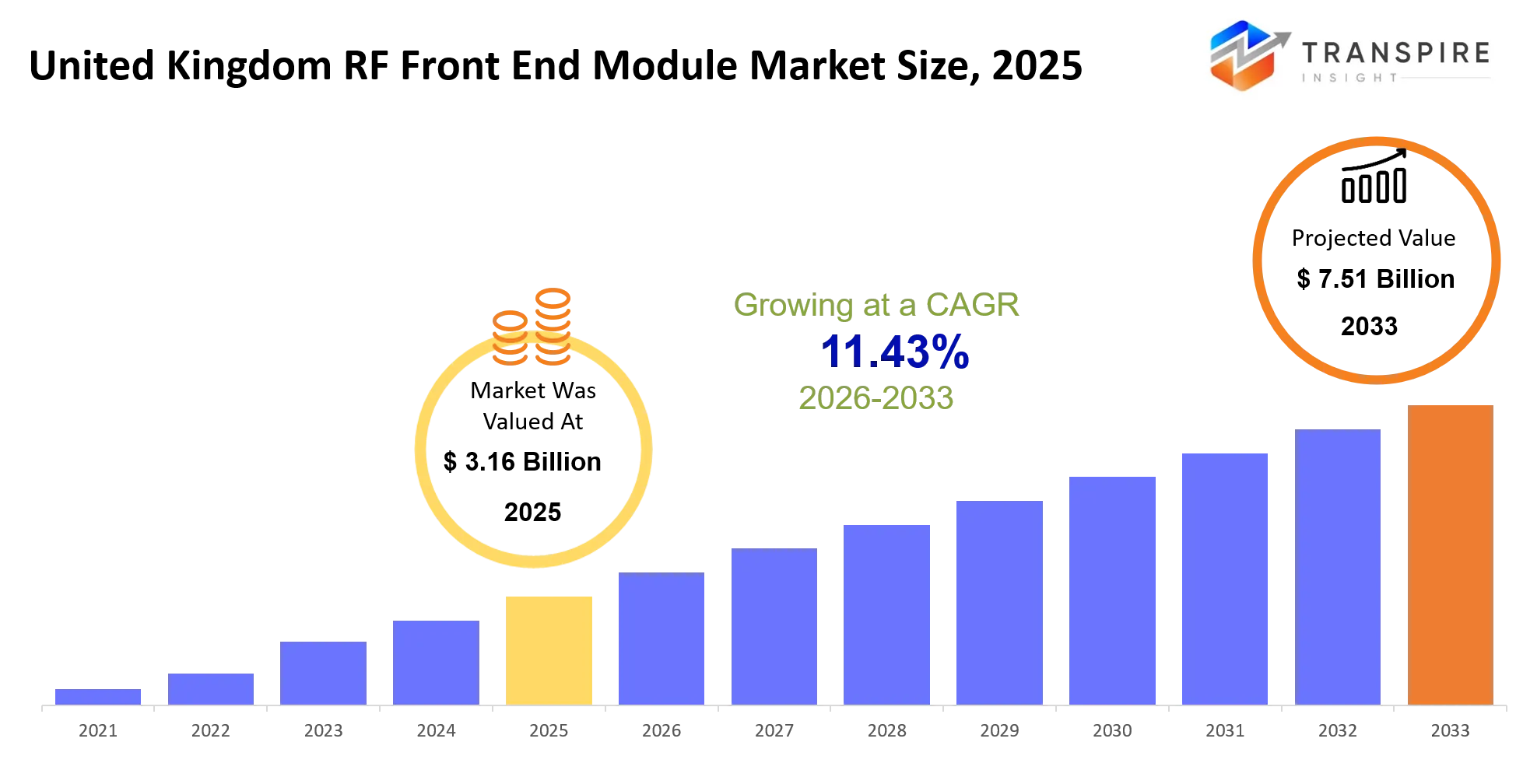
- United Kingdom RF Front End Module Market Size 2025:USD 3.16 Billion
- United Kingdom RF Front End Module Market Size 2033: USD 7.51 Billion
- United Kingdom RF Front End Module Market CAGR: 11.43%
- United Kingdom RF Front End Module Market Segments: By Component (Power Amplifiers, RF Switches, Filters, Duplexers, Antenna Tuners, Low Noise Amplifiers, Others); By Technology (5G RF Modules, LTE RF Modules, Wi‑Fi RF Modules, IoT RF Modules, Others); By Application (Smartphones, Tablets, IoT Devices, Automotive Electronics, Telecom Infrastructure, Others); By End User (Consumer Electronics, Automotive Industry, Telecom Industry, Industrial Sector, Others)
To learn more about this report,  Download Free Sample Report
United Kingdom RF Front End Module Market Summary
The United Kingdom RF Front End Module Market was worth USD 3.16 Billion in 2025. It is expected to reach USD 7.51 billion by 2033. That is an increase of 11.43% over the period.
The RF Front End Module Market in the United Kingdom is very important for communications. This is because it helps devices like smartphones, connected cars and machines in factories to connect to the internet and talk to each other. The RF Front End Module Market makes sure that these devices can send and receive signals clearly and quickly. This means that people can use their devices to access the internet and stay connected in areas with a lot of wireless traffic.
Over the five years the RF Front End Module Market has changed a lot. It used to be focused on LTE. Now it is getting ready for 5G. This means that the RF Front End Module Market is making complex products that can handle faster speeds and more data. These products include filters, power amplifiers and antenna management systems. The United Kingdom is rolling out 5G quickly. This is forcing device makers and network operators to upgrade their devices to support the new technology.
At the time there have been problems with getting the parts needed to make these devices. This has highlighted the need for reliable supply chains and new technologies. As a result the RF Front End Module Market is becoming more complicated. There are new opportunities for companies that make consumer electronics, car electronics and telecommunications equipment. The RF Front End Module Market is putting components into each device, which is making the devices more complex and creating new chances for companies to make money. The RF Front End Module Market is very important, for the United Kingdom. It will continue to grow and change in the coming years.
Key Market Insights
- Featured Snippet – UK RF Front End Module Market. Here are the main points to know about the UK RF Front End Module Market:
- The UK RF Front End Module Market is going to get a lot bigger. It will grow from USD 258.3 million in 2025 to USD 7.51 billion by 2033. This is because wireless communication technologies are getting better fast.
- The UK is rolling out 5G networks everywhere. This is a reason why the UK RF Front End Module Market is growing. People need high-performance RF front end solutions to make these networks work well.More and more people are using devices and smart technologies. This means we need RF modules that work well.
- In 2025 England will have the share of the UK RF Front End Module Market. This is because England has a lot of telecommunications infrastructure already.
- Scotland will grow the fastest from now until 2033. This is because Scotland is getting 5G coverage and is working on digitalization.
- Cities in the UK are investing a lot in connectivity infrastructure. This will help the UK RF Front End Module Market grow more.
- Power amplifiers are very important for the UK RF Front End Module Market. They will have, about 28% of the market share in 2025. This is because they help signals get through clearly.
- Filters are also very important. They will be the biggest component segment. This is because we need them for high-frequency networks and to manage spectrum well.
- The UK RF Front End Module Market is going to grow fast because of 5G RF modules. This is because the UK is expanding its generation mobile networks everywhere.
- Smartphones will still be the thing that uses RF front end modules.. As networks get more complicated we will need better filtering and antenna tuning technologies.
What are the Key Drivers, Restraints, and Opportunities in the United Kingdom RF Front End Module Market?
Driver
In the UK, 5G connectivity will be the key factor driving growth in the RF Front End Module Market. Mobile network operators are increasing their 5G coverage and device manufacturers are enabling support for multiple frequencies (multiple frequency bands) and Carrier Aggregation technologies. This transition is resulting in more sophisticated radio architecture requiring more advanced Power Amplifiers, Filters, Duplexers, and Antenna Tuners in each device. Consequently, the value of RF content will significantly increase per smartphone, per telecom base station, and per connected device. Ultimately, this will lead to increased revenue for RF Module suppliers as the types of components purchased are becoming more advanced/high-value devices than what existed before (e.g., discrete solutions).
Restraint
The dominant issue that will restrict the market is the structural dependency of the RF Front End Module family upon a very specialized semiconductor supply chain. For example, RF Front End Modules utilize sophisticated raw materials (advanced materials) and require high precision manufacturing processes and dedicated fabrication facilities, which only a few suppliers can produce. Expanding capacity through additional production capacity requires significant capital investment to build/fabricate additional capacity and have long development cycles when constructing new facilities. Thus, there is no rapid resolution to this constraint, and as such, will continue to create supply shortages, extended lead times, and elevated costs to procure components. As a result, there will be increased delays in product availability, slower deployment timelines for networks, and decreased potential revenues for the marketplace.
Opportunity
The opportunity is rapidly closing as Connected Vehicles and Industrial IoT converge to a place where they can no longer function separately; and there needs to be interoperability between the two.
What Has the Impact of Artificial Intelligence Been on the United Kingdom RF Front End Module Market?
Within the UK, AI is revolutionising the RF Front End Module market through innovations in how complex wireless communications are designed, optimised, developed, maintained, and deployed. As 5G networks, Wi-Fi 6/7, and industrial IoT network deployments become more complex, manufacturers leverage AI-based software to streamline the processes associated with optimising signal paths, selecting components, and tuning RFs. Consequently, AI technology reduces time spent on design and manufacturing as well as reduces the duration of the development cycle.
In telecommunications, machine learning models can also assist with predictive maintenance. Machine learning algorithms can evaluate RF performance data from RF modules, antennas and base station infrastructure to detect potential points of failure (i.e., RF modules) prior to impacting the availability of the network. Using AI-based analytics, telecom service providers can determine when an RF module will experience signal fading, thermal damage, or wear to make proactive adjustments or repairs to improve network availability and reduce service interruptions.
Additionally, AI improves spectrum management, power efficiency and network quality and performance. By dynamically adjusting RF signal parameters through intelligent RF optimization algorithms, telecommunications companies can enhance coverage while reducing the energy utilised to provide that coverage. As a result, businesses can achieve lower total cost of ownership and greater network efficiency for new wireless networks due to the implementation of AI.
Conditions under which organisations adopt AI continue to be problematic. Building an accurate machine learning model is contingent upon access to large amounts of high-quality RF performance data from various RF operating environments. Unfortunately for many organisations, fragmented data is present, and legacy
Key Market Trends
- Since 2021 companies that make things have started to use integrated front-end modules of separate radio frequency parts. This helps make devices smaller and use power.
- The rollout of 5G networks has made companies use better filters and antenna tuners that can handle higher frequency bands.
- Now smartphone companies need devices that can work with frequency bands than before. This means each device has radio frequency parts, which makes them more valuable.
- After the semiconductor shortage in 2021 and 2022 the companies that make devices have started to work with more suppliers. This helps them get the parts they need and reduces the risk of not being able to get them
- Companies that make car electronics have started to use radio frequency modules quickly. This is because connected cars need to be able to talk to everything around them.
- Telecom companies have started to invest more in cell towers. This means they need radio frequency solutions that're small and can cover a lot of area in cities.
- Tools that use intelligence to design radio frequency systems have become popular since 2023. These tools help engineers make devices more quickly and accurately.
- Big companies like Skyworks and Qorvo and Broadcom and Qualcomm have invested more in 5G front-end platforms. This helps them stand out from companies.
- Companies that use internet of things devices have started to prefer radio frequency modules that use power. These modules help devices stay connected in factories and other places.
- The use of Wi-Fi 6E and the new Wi-Fi 7 has made companies want to make radio frequency systems. These systems can handle bandwidth and are better, for the future.
United Kingdom RF Front End Module Market Segmentation
When we are designing the end of radio frequency modules a power amplifier is a really important part. This power amplifier makes the signal that is being sent stronger so people can communicate with each other over networks without any problems. The radio frequency switch is what decides which path the signals take to get to channels. This means that devices that use connections can stay connected to the network easily.
Filters are also very useful because they make the signal better by getting rid of any interference. This makes the signal cleaner when it is sent as data. Since people want to be able to communicate faster there is a growing need for these technologies in all kinds of electronic products.
Duplexers are special because they let a signal be sent and received at the time. This makes the network work better. The device work better too. An antenna tuner helps the antenna work perfectly when things around it change a lot. A low noise amplifier is good at making weak signals stronger without hurting the signal. This makes wireless communications more reliable. There are parts that help in other ways like making things work better working well with other components and making things more efficient.
A lot of the radio frequency products for 5G are based on technology. This is because many new high-speed communication networks are being set up all over the world. This has made people want devices and technologies that can handle information and work faster. As people get better at sending data and the industry starts to support communications that have less delay companies are making more devices that use 5G.
Radio frequency products for LTE will still be a big part of the market because they are used so much and people all, over the world use them.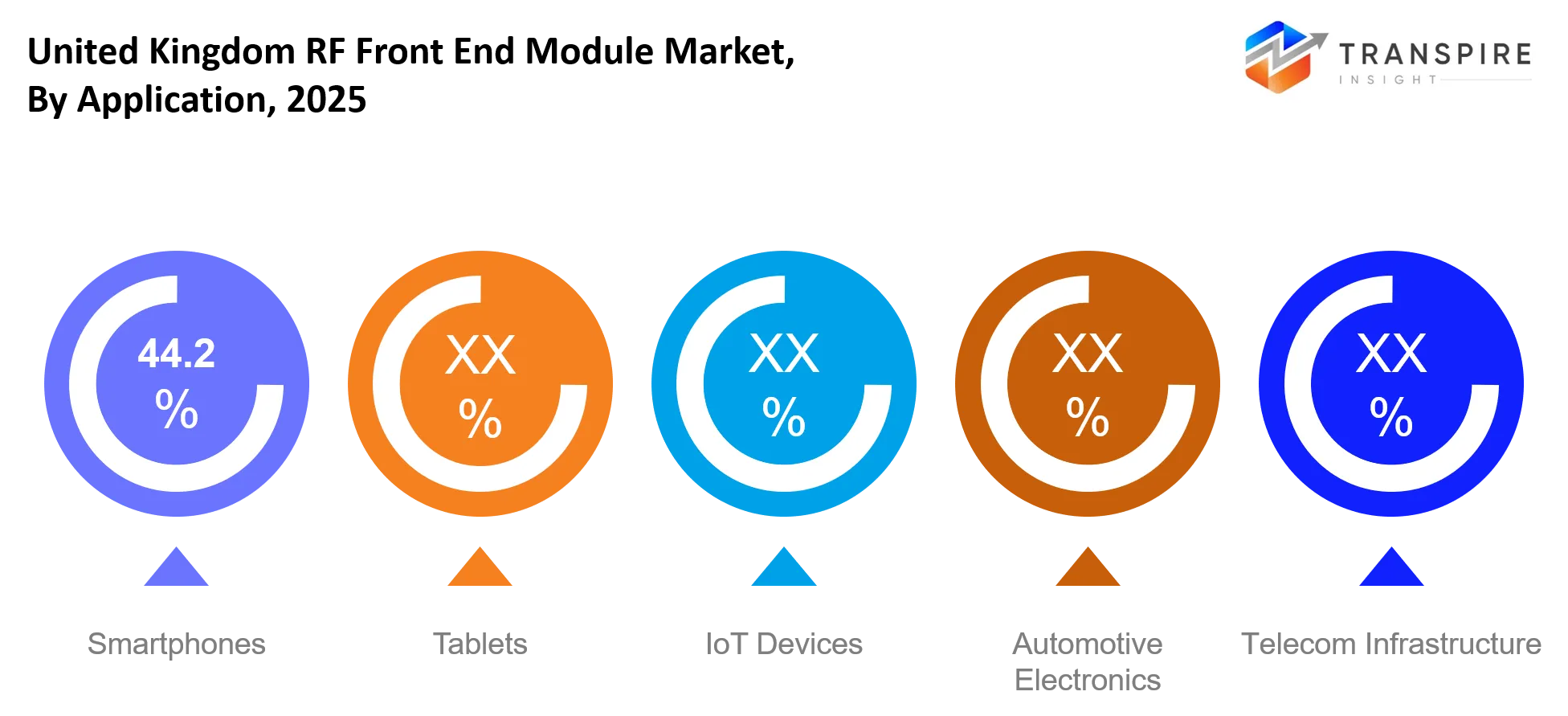
To learn more about this report, Download Free Sample Report
What are the Key Use Cases Driving the United Kingdom RF Front End Module Market?
The biggest part of people using radio frequency modules is from smartphones and other mobile devices, where these modules help signals go back and forth across different frequencies. To make 5G work and to get fast internet these modules need to be able to filter and boost signals and work well with antennas. Since people are always getting smartphones and using more data this is the most important area where companies make money from radio frequency modules.
There are areas where radio frequency modules are being used more and more like in cars and telecom equipment. Cars with wireless systems can do things like navigate, play music and even talk to other cars and things around them. Telecom companies also use radio frequency modules in cell towers and smaller networks to get better coverage and make the internet work faster in cities and factories.
New opportunities are coming up in places like factories with internet connected devices and private 5G networks. Factories are using sensors, automation and monitoring systems that need to be able to connect to the internet. In the future radio frequency modules will also be used in factories, machines that can work on their own and new kinds of computers that need to be able to connect to the internet really fast and stay connected all the time, which is really important, for radio frequency modules.
|
Report Metrics |
Details |
|
Market size value in 2025 |
USD 3.16 Billion |
|
Market size value in 2026 |
USD 3.52 Billion |
|
Revenue forecast in 2033 |
USD 7.51 Billion |
|
Growth rate |
CAGR of 11.43% from 2026 to 2033 |
|
Base year |
2025 |
|
Historical data |
2021 - 2024 |
|
Forecast period |
2026 - 2033 |
|
Report coverage |
Revenue forecast, competitive landscape, growth factors, and trends |
|
Regional scope |
United Kingdom |
|
Key company profiled |
Qorvo, Skyworks Solutions, Broadcom, Qualcomm, Murata Manufacturing, Samsung Electro-Mechanics, NXP Semiconductors, Infineon Technologies, Taiyo Yuden, TDK Corporation, MACOM, Analog Devices, Intel, MediaTek, Ampleon |
|
Customization scope |
Free report customization (country, regional & segment scope). Avail customized purchase options to meet your exact research needs. |
|
Report Segmentation |
By Component (Power Amplifiers, RF Switches, Filters, Duplexers, Antenna Tuners, Low Noise Amplifiers, Others); By Technology (5G RF Modules, LTE RF Modules, Wi‑Fi RF Modules, IoT RF Modules, Others); By Application (Smartphones, Tablets, IoT Devices, Automotive Electronics, Telecom Infrastructure, Others); By End User (Consumer Electronics, Automotive Industry, Telecom Industry, Industrial Sector, Others) |
Which Regions are Driving the United Kingdom RF Front End Module Market Growth?
The largest share of people using things comes from smartphones and mobile communication devices, where RF front end modules help with transmission across many frequency bands. Smartphones and mobile devices need to support 5G services, carrier aggregation and high-speed data connectivity so they need filtering, amplification and antenna tuning capabilities. People are always getting smartphones and using more data so this is the most important area where companies make money from RF front end modules. Other areas like electronics and telecom infrastructure are also important.
5G in Asia Pacific countries will make people want to buy wireless communication systems and this will make automotive and industrial technology manufacturers want to use RF front end modules. People want things that use energy are reliable and secure so this will make it easy for technology to be used in many areas.
The Asia-Pacific region will grow the fastest because of 5G making electronic products and using connected technologies, like those used in transport. These things will make people want to buy wireless communications systems and this will make automotive and industrial technology manufacturers want to buy more RF front end modules. People care about energy efficiency. They also want things that are reliable and secure so this will make it fair for technology to be used in many areas. RF front end modules will be used more because of this.
Who are the Key Players in the United Kingdom RF Front End Module Market and How Do They Compete?
- Qorvo
- Skyworks Solutions
- Broadcom
- Qualcomm
- Murata Manufacturing
- Samsung Electro-Mechanics
- NXP Semiconductors
- Infineon Technologies
- Taiyo Yuden
- TDK Corporation
- MACOM
- Analog Devices
- Intel
- MediaTek
- Ampleon
Recent Development News
In June 2025, Qorvo launched the QPB1034 and QPB1036 S-Band switched filter bank modules. The new RF modules improve radar frequency agility, spectral control, and compact system integration for efense and aerospace applications.https://www.qorvo.com (Qorvo)."
In February 2026, Broadcom launched BroadPeak™, a 6G-ready digital front-end system-on-chip for massive MIMO infrastructure. The platform delivers up to 40% lower power consumption and supports next-generation 5G Advanced and 6G wireless network deployments.https://www.broadcom.com (Broadcom)."
In March 2026, Skyworks Solutions entered a partnership with MediaTek to showcase early 6G FR3 and PC1 RF front-end innovations at Mobile World Congress 2026. The collaboration accelerated development of advanced RF power amplifier technologies designed for future 6G communication platforms.https://investors.skyworksinc.com (Skyworks Solutions)."
What Strategic Insights Define the Future of the United Kingdom RF Front End Module Market?
The United Kingdom RF Front End Module Market is moving towards integrated radio systems that work well with 5G Advanced and future 6G networks. These systems also support vehicles and industrial automation systems. The main reason for this change is that wireless communication is getting more complicated. It needs to use the spectrum efficiently use less power and work smoothly across many frequency bands.
The United Kingdom RF Front End Module Market will change a lot over the five to seven years. The value will come from platforms that combine advanced filtering, amplification and antenna management. These platforms will also have network optimization capabilities. This is different from the standalone RF components.
There is a risk that people may not see. The global semiconductor supply chain has a lot of market concentration. A few companies control the RF technologies, fabrication capacity and advanced packaging processes. If there are problems with tensions, export controls or manufacturing constraints it can affect the availability of components. It can also delay deployment schedules.
There is an opportunity in private 5G and industrial edge connectivity. Many manufacturing facilities, logistics centers and critical infrastructure operators are using wireless networks. This means the demand for RF solutions will increase. Companies should invest early in application- RF modules and work, with industrial technology providers. This will help them stay competitive in the term. The United Kingdom RF Front End Module Market will benefit from this.
United Kingdom RF Front End Module Market Report Segmentation
By Component
- Power Amplifiers
- RF Switches
- Filters
- Duplexers
- Antenna Tuners
- Low Noise Amplifiers
- Others
By Technology
- 5G RF Modules
- LTE RF Modules
- Wi-Fi RF Modules
- IoT RF Modules
- Others
By Application
- Smartphones
- Tablets
- IoT Devices
- Automotive Electronics
- Telecom Infrastructure
- Others
By End User
- Consumer Electronics
- Automotive Industry
- Telecom Industry
- Industrial Sector
- Others
Frequently Asked Questions
Find quick answers to common questions.
The Expected United Kingdom RF Front End Module Market size for the Market will be USD 7.51 Billion in 2033.
Key Segments for the United Kingdom RF Front End Module Market are Type By Component (Power Amplifiers, RF Switches, Filters, Duplexers, Antenna Tuners, Low Noise Amplifiers, Others); By Technology (5G RF Modules, LTE RF Modules, Wi‑Fi RF Modules, IoT RF Modules, Others); By Application (Smartphones, Tablets, IoT Devices, Automotive Electronics, Telecom Infrastructure, Others); By End User (Consumer Electronics, Automotive Industry, Telecom Industry, Industrial Sector, Others).
Major United Kingdom RF Front End Module Market Players are Qorvo, Skyworks Solutions, Broadcom, Qualcomm, Murata Manufacturing, Samsung Electro-Mechanics, NXP Semiconductors, Infineon Technologies, Taiyo Yuden, TDK Corporation, MACOM, Analog Devices, Intel, MediaTek, Ampleon .
The Current United Kingdom RF Front End Module Market size is USD 3.16 Billion in 2025.
The United Kingdom RF Front End Module Market CAGR is 11.43% from 2026 to 2033.
- Qorvo
- Skyworks Solutions
- Broadcom
- Qualcomm
- Murata Manufacturing
- Samsung Electro-Mechanics
- NXP Semiconductors
- Infineon Technologies
- Taiyo Yuden
- TDK Corporation
- MACOM
- Analog Devices
- Intel
- MediaTek
- Ampleon
About the Authors

Avinash Kumar
I’m Avinash Kumar, a Senior Research Analyst at Transpire Insight, with expertise in the Electronics and Semiconductor and Energy & Power industry. My work focuses on analyzing emerging technologies, market trends, industry developments, and innovation across these sectors. I specialize in transforming complex technical and market insights into clear, research-backed content that helps professionals, businesses, and decision-makers stay informed. Through continuous industry research and data-driven analysis, I strive to deliver accurate, reliable, and practical perspectives on the latest advancements shaping the semiconductor and energy landscape.

Chakradhar Khansole
Chakradhar serves as the Research Director at Transpire Insight, bringing over 8 years of experience in technology, innovation, and strategic market intelligence. He specializes in transforming complex market data into actionable business insights that enable organizations to make informed, growth-oriented decisions. Recognized for his strategic vision and analytical expertise, Chakradhar leads high-impact research initiatives, delivering comprehensive market assessments, competitive intelligence, and forward-looking industry analysis.
Recently Published Reports
-
Apr 2026
Fiber Optic Faceplates Market
Fiber Optic Faceplates Market Size, Share & Analysis Report By Type (< 300 mm2, 300-350 mm2, and > 350 mm2, By Application (Night Vision, Holographic Imaging, Medical, and Others), and Geography (North America, Europe, Asia-Pacific, Middle East and Africa, South and Central America), 2021 - 2031
-
Apr 2026
High Temperature Superconductors Market
High Temperature Superconductors Market Size, Share & Analysis Report By Type (1G HTS, and 2G HTS), By Application (Power Cable, Fault Current Limiter, and Transformer), and Geography (North America, Europe, Asia-Pacific, Middle East and Africa, South and Central America), 2021 - 2031
-
Apr 2026
Industrial Plugs and Socket Market
Industrial Plugs and Socket Market Size, Share & Analysis Report By Type (Industrial Plugs, Industrial Sockets), By Current (Up to 32 A, 32 to 125 A, Above 125 A), By Protection (Dustproof and Splash Proof, Waterproof, Explosion Proof), By End User (Heavy Industries, Oil and Gas, Chemicals and Pharmaceuticals, Power Generation, Others), and Geography (North America, Europe, Asia-Pacific, Middle East and Africa, South and Central America), 2021 - 2031
-
Apr 2026
InGaAs Avalanche Photodiodes Market
InGaAs Avalanche Photodiodes Market Size, Share & Analysis Report By Type (1100 - 1700 nm, and 1000 - 1600 nm), By Application (Missile Warning System, Muzzle Flash Detection, Wafer Defect Inspection, Laser Rangefinders, and Others), and Geography (North America, Europe, Asia-Pacific, Middle East and Africa, South and Central America), 2021 - 2031