
Middle East and Africa AI in ERP Market Size & Forecast:
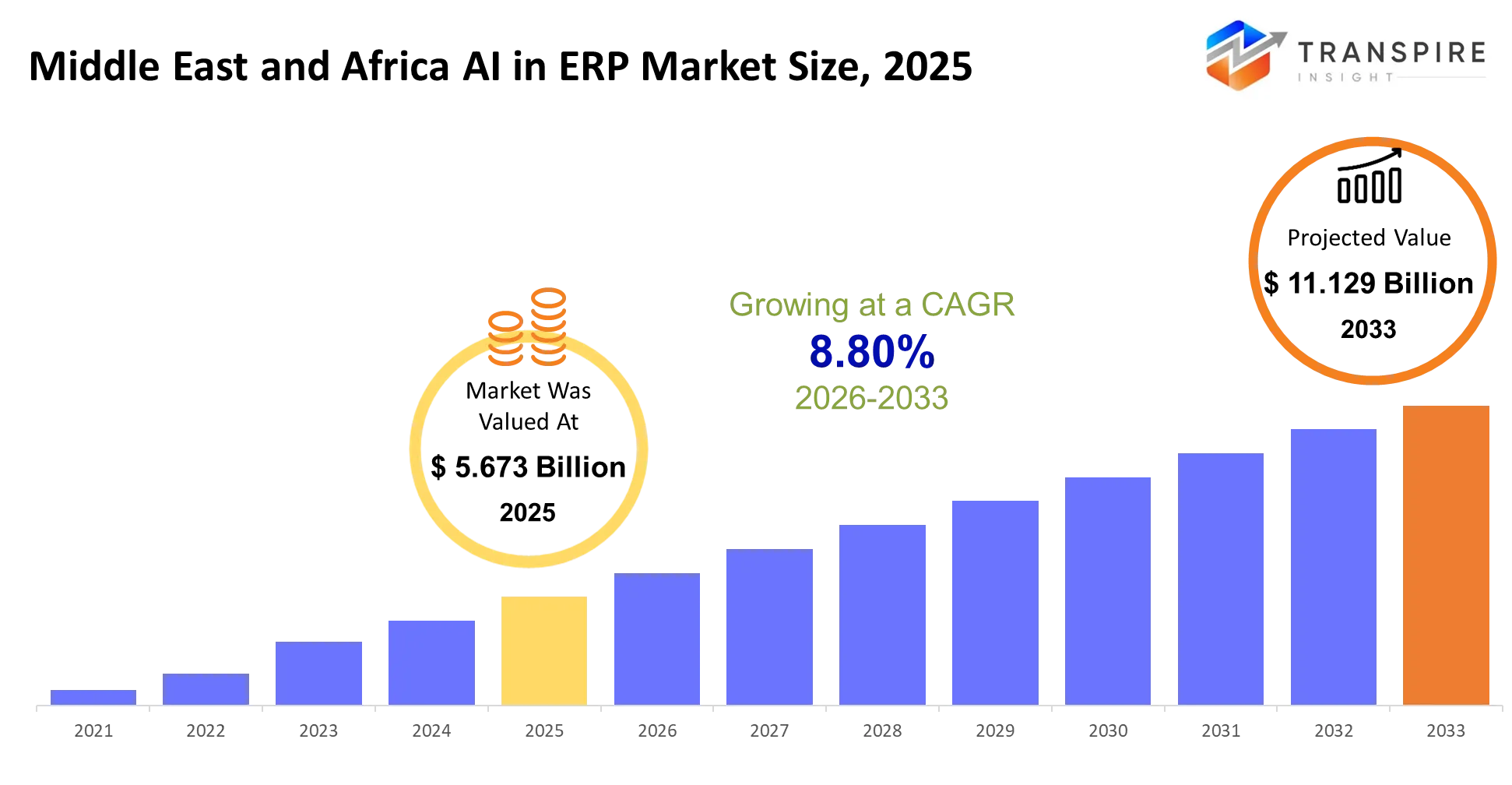
- Middle East and Africa AI in ERP Market Size 2025: USD 5.673 Billion
- Middle East and Africa AI in ERP Market Size 2033: USD 11.129 Billion
- Middle East and Africa AI in ERP Market CAGR: 8.80%
- Middle East and Africa AI in ERP Market Segments: By Type (Software, Services, Platforms, AI Modules, Others); By Application (Finance Management, HR Management, Supply Chain, Customer Management, Analytics, Risk Management, Others); By End-User (Enterprises, SMEs, Manufacturing Firms, Retailers, BFSI, Healthcare, Others); By Deployment (Cloud-based, On-premise, Hybrid, Others)
To learn more about this report,  Download Free Sample Report
Middle East and Africa AI in ERP Market Summary
The Middle East and Africa AI in ERP Market was valued at USD 5.673 Billion in 2025. It is forecast to reach USD 11.129 Billion by 2033. That is a CAGR of 8.80% over the period.
The AI market for ERP systems in the Middle East and Africa has become essential to enterprise financial management and procurement and inventory control and workforce planning and operational forecasting across manufacturing and energy and retail and logistics industries. The systems enable businesses to decrease their manual decision-making delays because they transform extensive operational data into automated insights which enhance their planning accuracy and resource distribution. The market has evolved during the past five years from basic process automation to predictive and cognitive ERP systems through the implementation of cloud services and the complete digital transformation of companies.
The COVID-19 pandemic caused supply chain disturbances which revealed weaknesses in traditional ERP systems because these systems lacked the ability to handle sudden demand changes and procurement hold-ups. Organizations started spending money on AI platforms which use data to predict system interruptions and provide immediate solution recommendations. The regional business sector has adopted AI technologies to enhance their operational resilience while organizations are increasing their spending on ERP system upgrades across their whole business operations.
Key Market Insights
- The UAE leads the Middle East and Africa AI sector which handles ERP systems because its smart enterprise initiatives have already achieved 28 percent of the market.
- Saudi Arabia represents the fastest-growing regional market through 2030, supported by Vision 2030 digital transformation programs and industrial automation investments.
- South Africa maintains significant market presence because its manufacturing, financial services, and retail sectors adopted cloud ERP systems at an early stage.
- AI-powered cloud ERP solutions dominate the market because they offer businesses reduced deployment expenses and flexible scaling options which account for 46 percent of the total industry size in 2026.
- On-premise intelligent ERP platforms remain the second-largest segment because energy and government organizations need to follow strict data governance requirements.
- The predictive analytics modules represent the most rapidly growing market segment, which businesses will expand through 2030 to establish proactive decision-making intelligence capabilities.
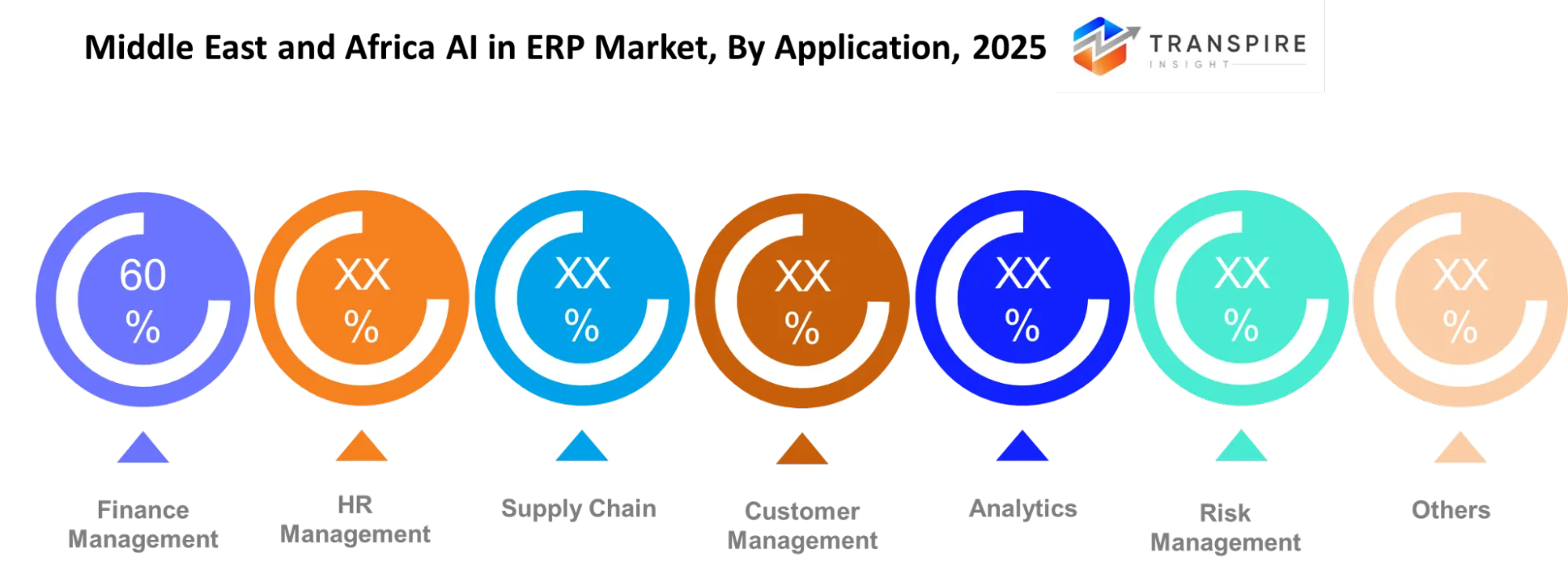
- Financial management applications hold over 31% market share, as enterprises deploy artificial intelligence to enhance their forecasting capabilities and compliance monitoring systems.
- Supply chain optimization demands the fastest growing application rate, which organizations use to create post-pandemic resilience plans and protect against procurement risks.
- Organizations increasingly adopt HR and workforce analytics applications to automate their talent planning processes and evaluate employee productivity.
- The manufacturing sector leads with approximately 24% market share, which shows that companies heavily invest in operational intelligence and production planning automation.
What are the Key Drivers, Restraints, and Opportunities in the Middle East and Africa AI in ERP Market?
The Middle East and Africa AI in ERP market experiences its highest growth rate because businesses increasingly adopt cloud-based enterprise systems which national digital transformation initiatives from Saudi Arabia and UAE smart economy programs promote. These programs have pushed enterprises to modernize their outdated ERP systems by implementing AI technologies which enhance their forecasting abilities and automate their workflows and decrease their operational inefficiencies. The shift results in increased vendor revenue because customers adopt more subscription software and purchase implementation services and conduct extended platform system upgrades.
The region struggles with two major challenges because its digital progress remains uneven while its business IT systems stay divided. Many organizations, particularly in parts of Africa, still operate on outdated on-premise systems with limited interoperability. The structural challenge requires extensive capital expenditures and workforce development and improved cloud network infrastructure before it can be solved. The solution providers who cannot expand their operations to markets with lower digital advancement face extended AI implementation delays and decreased deployment success and missed revenue opportunities.
Energy and logistics and retail industries present a significant growth potential through their implementation of AI ERP solutions which are tailored to their specific needs. Organizations in oil and gas operations use predictive maintenance modules to enhance their operational intelligence which enables them to decrease equipment downtime. Enterprise spending on AI platforms that focus on specific sectors is increasing in both the UAE and South Africa, which provides vendors with opportunities to develop specialized products that will help them expand their business and drive market growth.
What Has the Impact of Artificial Intelligence Been on the Middle East and Africa AI in ERP Market?
The Middle East and Africa are undergoing complete transformation of their enterprise resource planning systems because artificial intelligence and advanced digital technologies make ERP systems evolve from their original purpose as transactional recording systems to become intelligent systems that support decision-making. The automated system uses artificial intelligence to optimize all processes involved in handling invoices and obtaining procurement approvals and matching inventory items and organizing workforce schedules through robotic process automation and intelligent workflow orchestration. The systems used in manufacturing and logistics industries enable companies to execute their daily business operations with 40% less need for human workers which results in faster operational processes and greater business process efficiency.
The current ERP systems use machine learning models to enhance their prediction functions. Businesses are using predictive analytics to forecast inventory shortages, identify procurement bottlenecks, anticipate equipment maintenance needs, and optimize demand planning. The retail and distribution operations in the region have achieved a 20% to 30% increase in forecast accuracy through these capabilities which has resulted in lower inventory costs and improved supply availability. Financial planning modules use AI technology to identify financial irregularities and enhance cash flow predictions and assist in meeting regulatory reporting standards.
Organizations achieve operational improvements through these innovations which result in reduced administrative costs and quicker response times and enhanced system availability and better resource management. The high cost of integrating AI technology with existing fragmented ERP systems from the past presents a significant barrier to progress. The emerging African markets face challenges because many organizations lack sufficient historical data which decreases algorithm performance and delays their progress towards achieving complete business automation.
Key Market Trends
- Since 2022, over 55% of large Gulf enterprises have transitioned from standalone automation solutions toward complete AI-powered ERP systems which integrate their operations.
- The implementation of Saudi Arabia's Vision 2030 has compelled manufacturers and public-sector organizations to modernize their existing ERP systems by adopting cloud-based enterprise solutions which utilize predictive analytics.
- The period between 2021 and 2025 saw procurement automation adoption reach its highest level because supply chain disruptions throughout the region revealed the shortcomings of manual approval processes.
- SAP and Oracle have developed industry-specific ERP intelligence systems which replace their original basic AI functions to meet the energy and logistics sectors' unique requirements.
- African enterprises increasingly chose modular AI systems for their operations after 2023 because they wanted to balance their budget constraints with their slower pace of complete system upgrades.
- The implementation of regional data residency requirements which became effective in 2022 has resulted in hyperscale cloud providers forming partnerships with local companies to establish their data control systems and regulatory compliance procedures.
- ERP buyers have shifted their focus from cost reduction to resilience planning which leads them to invest in predictive inventory analytics as their main focus area.
- The development of generative AI copilots into enterprise platforms since 2024 has transformed the way finance and procurement teams handle operational data.
- Enterprises now choose to implement phased migration procedures because this method allows them to decrease operational downtime while mitigating integration challenges.
Middle East and Africa AI in ERP Market Segmentation
By Type:
The software functions as the foundation for AI technology implementation in ERP systems throughout the Middle East and Africa region. Organizations are implementing intelligent software solutions which enhance their planning abilities and automate their standard operational processes while delivering quick decision-making tools. Organizations maintain a strong demand for software solutions because these solutions enhance their internal communication processes and minimize interruptions to their operational workflows.
Services hold equal importance as implementation, maintenance, and system customization which needs specific technical expertise for their successful execution. The platform enables organizations to establish interlinked systems which allow their different business operations to function simultaneously while AI components deliver specific functions for prediction and automation tasks. The company offers various products which address specific business needs, enabling organizations to choose solutions that meet their operational objectives and their plans for digital transformation.
By Application:
Finance management ranks as one of the most important application fields because AI-powered ERP systems enable better forecasting and budgeting accuracy and monitoring of financial transactions. Automated analysis decreases the need for human work while it enables businesses to generate financial reports at a quicker pace which becomes essential for companies that manage high operational volumes in multiple locations.
Intelligent systems provide advantages to both HR management and supply chain operations through their capabilities in workforce planning and hiring assistance and inventory management and transportation monitoring. Businesses expand their customer management and analytics and risk management functions to achieve better operational visibility. Other applications support industry-specific requirements, allowing broader use across different organizational functions.
To learn more about this report, Download Free Sample Report
By End-User:
Large enterprises use AI-enabled ERP solutions because their extensive financial resources and established digital systems make these technologies accessible to them. The organizations aim to enhance their operational procedures through data-based systems which help them achieve their long-term business objectives and track their performance.
Small and medium-sized enterprises are showing stronger adoption as affordable cloud options become available. Manufacturing companies use these systems to enhance their production planning processes while retailers concentrate on gathering customer information and managing their stock levels. BFSI and healthcare sectors continue expanding adoption to improve compliance, service quality, and operational responsiveness, while other sectors adopt solutions based on growing automation needs.
By Deployment:
Organizations prefer cloud-based deployment options because these solutions provide them with flexible operations and cost-effective entry points and simple system expansion capabilities. Organizations throughout the Middle East and Africa now choose cloud solutions which enable employees to work remotely and deliver faster software updates and provide smooth connections to sophisticated AI technologies.
Organizations which must protect their data through strict security measures or regulatory guidelines need to maintain their use of on-premise deployment. Hybrid deployment has become popular because it enables organizations to use cloud technology while maintaining control over their confidential information and essential operational processes. Organizations can achieve digital transformation through this approach, which enables them to increase their productivity while preserving their current operational systems.
What are the Key Use Cases Driving the Middle East and Africa AI in ERP Market?
The Middle East and Africa maintain financial planning and procurement automation as the primary use cases that drive their organizations to implement AI-powered ERP systems. Manufacturing and energy and retail sectors depend on these systems to achieve better forecasting results and to automate their approval processes and to minimize operational delays that impact both their business operations and cash flow.
Companies are now implementing related technologies for managing their supply chains and analyzing their workforce performance. Logistics operators increasingly use AI-powered ERP modules to optimize inventory movement and supplier coordination, while financial institutions are adopting intelligent compliance monitoring to strengthen reporting accuracy and risk management.
The development of new enterprise applications has resulted in the creation of generative AI assistants for enterprise decision support and autonomous scenario modeling for strategic planning. Executives in Gulf-based conglomerates and technology-oriented sectors use conversational analytics tools to test their ability to analyze operational data and predict disruptions and create solutions for potential business problems.
|
Report Metrics |
Details |
|
Market size value in 2025 |
USD 5.673 Billion |
|
Market size value in 2026 |
USD 6.167 Billion |
|
Revenue forecast in 2033 |
USD 11.129 Billion |
|
Growth rate |
CAGR of 8.80% from 2026 to 2033 |
|
Base year |
2025 |
|
Historical data |
2021 - 2024 |
|
Forecast period |
2026 - 2033 |
|
Report coverage |
Revenue forecast, competitive landscape, growth factors, and trends |
|
Regional scope |
Middle East and Africa (Saudi Arabia, United Arab Emirates, South Africa, Rest of Middle East and Africa) |
|
Key company profiled |
SAP, Oracle, Microsoft, IBM, Infor, Workday, Sage, Epicor, Salesforce, Zoho, Odoo, NetSuite, QAD, IFS, Acumatica |
|
Customization scope |
Free report customization (country, regional & segment scope). Avail customized purchase options to meet your exact research needs. |
|
Report Segmentation |
By Type (Software, Services, Platforms, AI Modules, Others); By Application (Finance Management, HR Management, Supply Chain, Customer Management, Analytics, Risk Management, Others); By End-User (Enterprises, SMEs, Manufacturing Firms, Retailers, BFSI, Healthcare, Others); By Deployment (Cloud-based, On-premise, Hybrid, Others) |
Which Regions are Driving the Middle East and Africa AI in ERP Market Growth?
The Gulf Cooperation Council, led by the UAE and Saudi Arabia, represents the dominant regional force in the Middle East and Africa AI in the ERP market. The national digital transformation policies together with public-private technology partnerships and enterprise modernization budgets create the foundation for the country's leadership position. Government-backed programs such as Saudi Vision 2030 and the UAE Digital Economy Strategy have accelerated ERP cloud migration across manufacturing, energy, and logistics sectors. The organization maintains its leadership position through its established hyperscale cloud infrastructure ecosystem which includes regional implementation partners and localized compliance frameworks.
The second most powerful regional contributor to South Africa is enterprise stability instead of policy-driven acceleration which creates its strength. Gulf states differ from this region because corporate IT governance practices and constant technology investments from private companies together with international corporations drive their technology adoption. Financial services, retail, and industrial manufacturing have consistently invested in AI-enhanced enterprise platforms to improve planning precision and operational control. The reliable process of measured modernization establishes South Africa as a dependable source of recurring software and services revenue.
The wider African growth corridor demonstrates its strongest development progress to 2026-2033 through its three main markets of Kenya and Egypt and Nigeria. Intelligent ERP systems have gained better adoption rates because cloud data center expansion and better enterprise connectivity and government digital economy programs established more supportive conditions.Companies that postponed their modernization efforts because of infrastructure constraints have begun to implement their modern systems in scheduled deployment phases. Vendors and investors can take advantage of this transition to create initial business relationships while developing regional products that will help them attain sustained market dominance as companies increase their digital operational capabilities.
Who are the Key Players in the Middle East and Africa AI in ERP Market and How Do They Compete?
The Middle East and Africa AI in ERP market shows moderate consolidation because global enterprise software providers control most major deployments while regional implementation specialists handle local project execution. The market is not being disrupted by low-cost entrants because enterprise buyers continue to value product integration capacity and cybersecurity protection and extended support services more than they value price. Companies now compete with each other through their technological capabilities which include embedded machine learning and predictive analytics and generative AI features. Vendors compete with each other through their regional cloud infrastructure availability and their capacity to comply with data residency and compliance regulations which become more stringent.
SAP maintains its market position through its development of industry-specific AI modules which focus on manufacturing and energy-intensive operations, establishing a robust presence in Gulf industrial modernization initiatives. The company enables enterprises to upgrade their complex legacy systems through its localized cloud partnerships and extensive process integration capabilities, which help organizations achieve their goals with minimal operational impacts. Oracle uses its autonomous database design and AI-powered financial management solutions to create a unique value proposition that meets the needs of banking and public-sector organizations which demand high system reliability and precise compliance standards.
Microsoft expands its business operations through deep connections which link Dynamics 365 with Azure AI and existing productivity systems used by regional businesses. The system integration between these two systems enables organizations to implement their systems more easily while using less time for their system deployment process. IBM develops hybrid cloud ERP intelligence solutions specially designed for enterprises that handle confidential operational information in the energy and telecommunications sectors. The IFS company achieves success by concentrating on specific markets that require asset management, which enables its predictive maintenance and field service intelligence solutions to deliver tangible improvements in operational efficiency.
Company List
Recent Development News
In March 2026, IFS completed its acquisition of Softeon. The acquisition expanded IFS’s Industrial AI and cloud ERP capabilities into warehouse execution and supply chain orchestration, strengthening its position across asset-intensive industries in the Middle East and Africa. Source https://www.prnewswire.com/
In February 2026, RAK Ceramics entered a partnership with SAP to deploy cloud-based ERP infrastructure. The implementation supports AI-ready digital transformation across manufacturing operations in the UAE, reinforcing enterprise adoption of AI-enabled ERP systems across the Middle East. Source https://news.sap.com/
What Strategic Insights Define the Future of the Middle East and Africa AI in ERP Market?
The Middle East and Africa AI in ERP market will reach dedicated autonomous enterprise management systems which use automatic decision systems to run their operations within the next five to seven years. The present market direction develops from three factors which include sovereign cloud investment projects and the advanced capabilities of generative artificial intelligence and businesses needing to establish operational strength against supply chain disruptions and economic instability. The market will increasingly reward vendors that can deliver vertically tailored intelligence rather than broad, one-size-fits-all automation suites.
One less visible risk is market concentration around a small group of hyperscale cloud and software providers. The increasing platform dependency of regional enterprises will result in higher switching costs which will create both innovation delays and restrictions on buyer flexibility whenever pricing or compliance requirements change.
AI-native ERP solutions create an emerging opportunity which targets mid-sized businesses operating in high-growth African markets which include Kenya and Nigeria through their digital infrastructure development that exceeds traditional ERP system integration. The businesses can use modular cloud-first architectures to skip conventional deployment processes.
For market participants, the most effective strategy is to invest now in localized partner ecosystems and sector-specific AI models. Vendors that align solutions with regional compliance needs and operational realities will capture stronger long-term adoption.
Middle East and Africa AI in ERP Market Report Segmentation
By Type
- Software
- Services
- Platforms
- AI Modules
By Application
- Finance Management
- HR Management
- Supply Chain
- Customer Management
- Analytics
- Risk Management
By End-User
- Enterprises
- SMEs
- Manufacturing Firms
- Retailers
- BFSI
- Healthcare
By Deployment
- Cloud-based
- On-premise
- Hybrid
Frequently Asked Questions
Find quick answers to common questions.
The Middle East and Africa AI in ERP Market size is USD 11.129 Billion in 2033.
Key segments for the Middle East and Africa AI in ERP Market are By Type (Software, Services, Platforms, AI Modules, Others); By Application (Finance Management, HR Management, Supply Chain, Customer Management, Analytics, Risk Management, Others); By End-User (Enterprises, SMEs, Manufacturing Firms, Retailers, BFSI, Healthcare, Others); By Deployment (Cloud-based, On-premise, Hybrid, Others).
Major Middle East and Africa AI in ERP Market players are SAP, Oracle, Microsoft, IBM, Infor, Workday, Sage, Epicor, Salesforce, Zoho, Odoo, NetSuite, QAD, IFS, Acumatica.
The Middle East and Africa AI in ERP Market size is USD 5.673 Billion in 2025.
The Middle East and Africa AI in ERP Market CAGR is 8.80% from 2026 to 2033.
- SAP
- Oracle
- Microsoft
- IBM
- Infor
- Workday
- Sage
- Epicor
- Salesforce
- Zoho
- Odoo
- NetSuite
- QAD
- IFS
- Acumatica
Recently Published Reports
-
Apr 2026
3D Optical Profiler Market
3D Optical Profiler Market Size, Share & Analysis Report By Type (Desktop 3D Optical Profiler, and Portable 3D Optical Profiler), By Technology (Confocal Technology, and White Light Interference), By End-Use Industry (Manufacturing, Research Institutions, Automotive, Aerospace and Defense, Medical Devices, and Other), and Geography (North America, Europe, Asia-Pacific, Middle East and Africa, South and Central America), 2021 - 2031
-
Apr 2026
Depth Sensor Market
Depth Sensor Market Size, Share & Analysis Report By Type (Infrared Depth Sensors, Time-of-Flight (ToF) Sensors, Stereo Vision Sensors, Structured Light Sensors, Ultrasonic Depth Sensors), By Application (Automotive, Robotics, Gaming, Consumer Electronics, Industrial Automation, Healthcare, Security & Surveillance, Others), By End Users (Automotive Manufacturers, Consumer Electronics Companies, Healthcare Providers, Industrial Companies, Security Agencies, Gaming Companies, Robotics Companies, Others), and Geography (North America, Europe, Asia-Pacific, Middle East and Africa, South and Central America), 2021 – 2031
-
Apr 2026
Digital Manufacturing Market
Digital Manufacturing Market Size, Share & Analysis Report By Component (Hardware, Software, and Services), By Technology (Robotics, 3D Printing, Internet of Things (IoT), and Others), By Application (Automotive and Transportation, Aerospace and Defense, Consumer Electronics, Industrial Machinery, and Others), By Process Type (Computer-Based Designing, Computer-Based Simulation, Computer 3D Visualization, Analytics, and Others), and Geography (North America, Europe, Asia-Pacific, Middle East and Africa, South and Central America), 2021 – 2031
-
Apr 2026
Digital Visa Services Market
Digital Visa Services Market Size, Share & Analysis Report By Type (Individual Travelers, Group Travelers), By Application (Tourism, Business Travel, Others), and Geography (North America, Europe, Asia-Pacific, Middle East and Africa, South and Central America), 2021 – 2031