
South Korea Automotive Infotainment Market Size & Forecast:
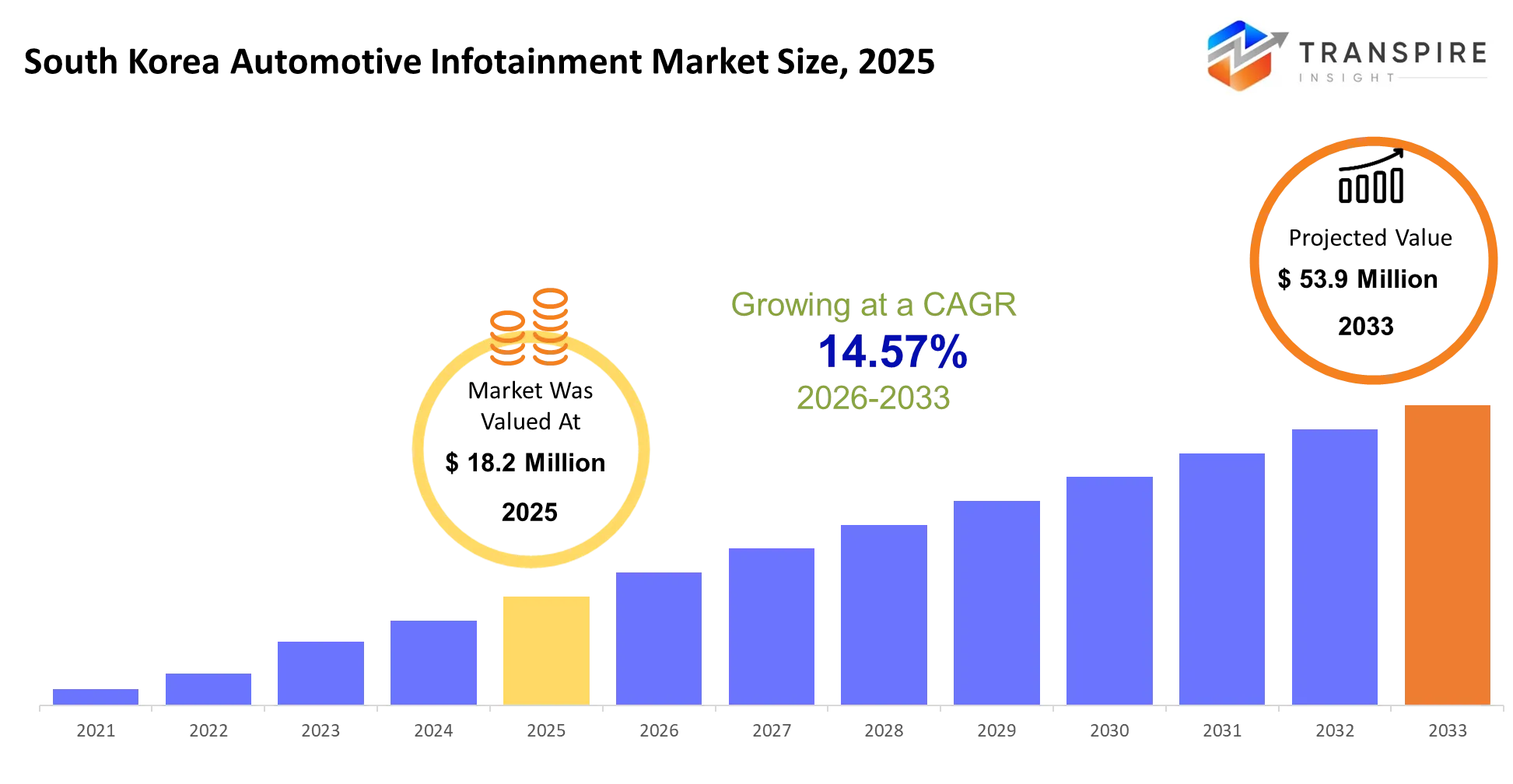
- South Korea Automotive Infotainment Market Size 2025: USD 18.2 Million
- South Korea Automotive Infotainment Market Size 2033: USD 53.9 Million
- South Korea Automotive Infotainment Market CAGR: 14.57%
- South Korea Automotive Infotainment Market Segments:By Component (Display Units, Audio Systems, Navigation Systems, Connectivity Modules, Telematics Units, Others); By Vehicle Type (Passenger Cars, Commercial Vehicles, Electric Vehicles, Luxury Vehicles, Others); By Technology (Connected Car Systems, AI-based Infotainment, Voice Recognition Systems, Cloud-based Infotainment, Others); By Application (In-car Entertainment, Navigation Assistance, Vehicle Diagnostics, Driver Assistance, Others); By End User (OEMs, Aftermarket Suppliers, Fleet Operators, Others)
To learn more about this report,  Download Free Sample Report
South Korea Automotive Infotainment Market Summary
The South Korea Automotive Infotainment Market was valued at USD 18.2 Million in 2025. It is forecast to reach USD 53.9 Million by 2033. That is a CAGR of 14.57% over the period.
In South Korea, automotive infotainment systems kinda work like the digital control hub in vehicles, they bring together navigation, music and video, voice help, and also real time vehicle diagnostics, all inside one interface that drivers end up depending on for safer and more linked mobility. The market has changed quite a lot, because cars are acting less like just mechanical stuff now and more like software driven platforms, so infotainment moved from a comfort add-on to something closer to a cockpit must have.
Over the last 3–5 years, there has been a big structural shift toward Android based and connected operating systems, and that basically rewired how the whole system is built. It replaced those older fragmented legacy setups with more unified digital ecosystems, and it got faster during the pandemic, when global semiconductor and display supply issues made automakers standardize their platforms and simplify the integration. So now OEMs tend to push scalable infotainment architectures that allow over-the-air updates, plus third party app integration. This improves upgrade cycles, and it also helps aftermarket monetization more directly. With all that, the demand for high performance chipsets and software defined vehicle interfaces also rose, which then created more revenue possibilities across the whole value chain, in a pretty sustained way.
Key Market Insights
- South Korea Automotive Infotainment Market is kind of switching from hardware led systems into software defined cockpit ecosystems with constant OTA updates, ya know.
- In the premium space, connected vehicle penetration in this South Korea Automotive Infotainment Market goes past 70% and that’s largely tied to EV adoption trends.
- Android Automotive OS is taking the lead for fresh infotainment integrations, and it helps cut down fragmentation while making developer ecosystem scalability feel more manageable.
- Also, Seoul and Gyeonggi region alone take up nearly 45% share, mostly because there are a lot of OEM clusters there and the EV infrastructure is more advanced.
- Meanwhile the fastest-growing regional adoption looks to be popping up in Southeast industrial zones, supported by EV manufacturing expansion, and the momentum is pretty clear.
- For segments, in dash navigation is still the leading segment, but voice enabled infotainment is seeing the quickest growth, through AI integration and smarter interactions.
- Passenger vehicles clearly dominate the demand, yet commercial fleet infotainment is rising fast as logistics digitalization keeps accelerating.
- When it comes to applications, EV infotainment integration holds the largest share since vehicles are moving toward digital cockpit architectures.
- And at the end user level, commercial mobility platforms are the fastest-growing, mainly from fleet telematics integration demand.
What are the Key Drivers, Restraints, and Opportunities in the South Korea Automotive Infotainment Market?
The main driver of the South Korea Automotive Infotainment Market is the quick pivot toward software defined vehicles, where the infotainment unit kind of becomes the main gateway for navigation, safety warnings, and connected services. This movement is also getting a nudge from the growth of EV platforms from big Korean automakers, they basically need bundled digital cockpits so they can handle battery analytics, different drive modes, and cloud connectivity. As OEMs start to standardize infotainment across various vehicle grades, a lot of income is shifting toward software licensing and subscription style features, not really the one time hardware sales.
A major restraint that holds back faster growth is the pretty high integration burden between infotainment platforms and older, legacy vehicle architectures. A lot of mid tier suppliers get stuck with compatibility across several operating systems and chipset setups, and that stretches the development timeline, then it delays deployment. This kind of structural bottleneck pushes production expenses upward and it can slow take up in price sensitive vehicle categories, especially when OEMs are still choosing mechanical upgrades over digital transformation.
An interesting opportunity is showing up with AI enabled predictive infotainment systems that are tied in with vehicle health monitoring and customized driving help. Firms putting money into edge AI processing plus cloud connected infotainment environments are now enabling near real time route tuning, driver habit adaptation, and maintenance alerts that show up before something actually fails. This feels especially relevant in South Korea, since the EV fleet ecosystem is widening there, and the connectivity infrastructure keeps becoming more mature and more commercially sensible.
What Has the Impact of Artificial Intelligence Been on the South Korea Automotive Infotainment Market?
Artificial intelligence is quietly reshaping automotive infotainment systems in South Korea, turning them into adaptive digital helpers rather than fixed, almost static media panels. With AI-driven automation getting more common, car systems are now able to handle in-vehicle management more smoothly like adjusting display modes on the fly, improving voice recognition precision, and learning driver preferences over time. Result? less tapping , fewer manual steps and, in general, a safer drive because the driver's attention stays where it should.
On top of that, predictive features based on machine learning are being built directly into infotainment platforms to anticipate possible system issues, nudge users toward smarter maintenance timing, and boost route efficiency by reading traffic flow together with how people actually drive. For electric vehicles, these same models can also help manage energy use more intelligently, syncing navigation guidance with battery analytics, which tends to improve operational efficiency and may help extend component lifespan too.
From an operational angle, these AI additions have made the systems more responsive and cut down infotainment delay, so the experience feels steadier across connected vehicle fleets. Still, there’s a big drawback: everything leans heavily on dependable connectivity and on the quality of real-world training data. In South Korea, infotainment systems still struggle in edge-case driving conditions, where limited dataset coverage can pull predictive accuracy down, especially in those mixed urban plus highway situations.
Key Market Trends
- South Korea Automotive Infotainment Market kind of shifted from proprietary systems into Android-based platforms, between 2022 and 2026 and honestly it felt faster than expected.
- OEMs worked to cut down hardware diversity by about 30% just to streamline infotainment integration and push software deployment cycles ahead a lot sooner.
- AI voice assistants then took over from the older touch-only setups in premium vehicles, across the South Korea Automotive Infotainment Market ecosystem, and not just in one place.
- With EV adoption moving quicker, infotainment upgrades also sped up, and they started linking battery management systems with real-time cockpit analytics which is a pretty big step.
- After 2023 over-the-air update adoption rose sharply, so continuous infotainment feature monetization became more normal rather than occasional.
- Tier-1 suppliers also increased collaboration with tech firms, aiming to integrate a cloud-native infotainment architecture more cleanly, and more quickly.
- And yeah the demand for multi-display cockpit systems jumped significantly, as luxury models and EV production climbed.
- Semiconductor shortages earlier disrupted supply chains, so manufacturers leaned toward standardized infotainment chipsets instead of keeping everything bespoke.
- Connected vehicle subscription models, meanwhile expanded revenue streams beyond the old automotive hardware sales structures, it’s like the business model pivoted too.
South Korea Automotive Infotainment Market Segmentation
By Component
Display Units kinda hold a leading spot in the South Korea Automotive Infotainment Market ,especially now that big touchscreen interfaces and multi display cockpit arrangements are becoming the norm in newer cars. There is also strong pull coming from electric vehicles and premium passenger models ,since digital dashboards make driver interaction smoother and they also lessen how much the driver depends on physical controls. On top of that, high alignment with the instrument clusters makes OEM adoption even stronger, across most manufacturer platforms in the region
This segment is moving forward because of the quick shift toward multi-screen cockpit architectures and because automakers are leaning more heavily on high resolution visual interfaces for navigation and entertainment command. Navigation Systems are seeing steady growth from people wanting real-time traffic tuning in dense city travel conditions. Connectivity Modules are picking up pace faster, mainly because 5G enabled vehicles need nonstop data exchange for cloud based services and updates. Telematics Units still stay crucial for fleet monitoring and diagnostic checks, particularly within commercial mobility environments. “Others” usually cover embedded control hardware plus supporting interface parts and auxiliary controls. During the forecast window, display led cockpit convergence will speed up too, so suppliers are pushed toward more unified screen ecosystems and there will be less need for standalone hardware pieces over time.
By Vehicle Type
Passenger Cars sort of hold the dominant position because there’s a lot of infotainment penetration across private vehicle ownership and strong demand for in vehicle entertainment and navigation solutions, and honestly the whole connected vibe just sticks. In cities, daily commuting routes plus heavy traffic make people lean harder on digital cockpit systems that stay online. Even OEMs pushing infotainment standardization in mid range vehicles also keeps this leadership trend going.
Now, the growth in this segment comes from consumers gradually wanting more connected driving experiences, and also the way smartphone ecosystems start getting integrated into vehicles. Electric Vehicles, though, are the fastest expanding group, since software defined platforms really push the need for more advanced infotainment, especially for battery monitoring and driving optimization. Commercial Vehicles still get steady adoption, mostly tied to logistics tracking and fleet efficiency management, nothing wild but consistent. Luxury Vehicles stay ahead by introducing premium multi display setups and AI driven infotainment features earlier than most mass market models. “Others” then covers specialty fleets and mobility service vehicles.
Over the forecast period, EV integration will keep reshaping infotainment design priorities. That means developers get pushed toward scalable software platforms and modular cockpit systems, so the design is easier to reuse across different models and scenarios.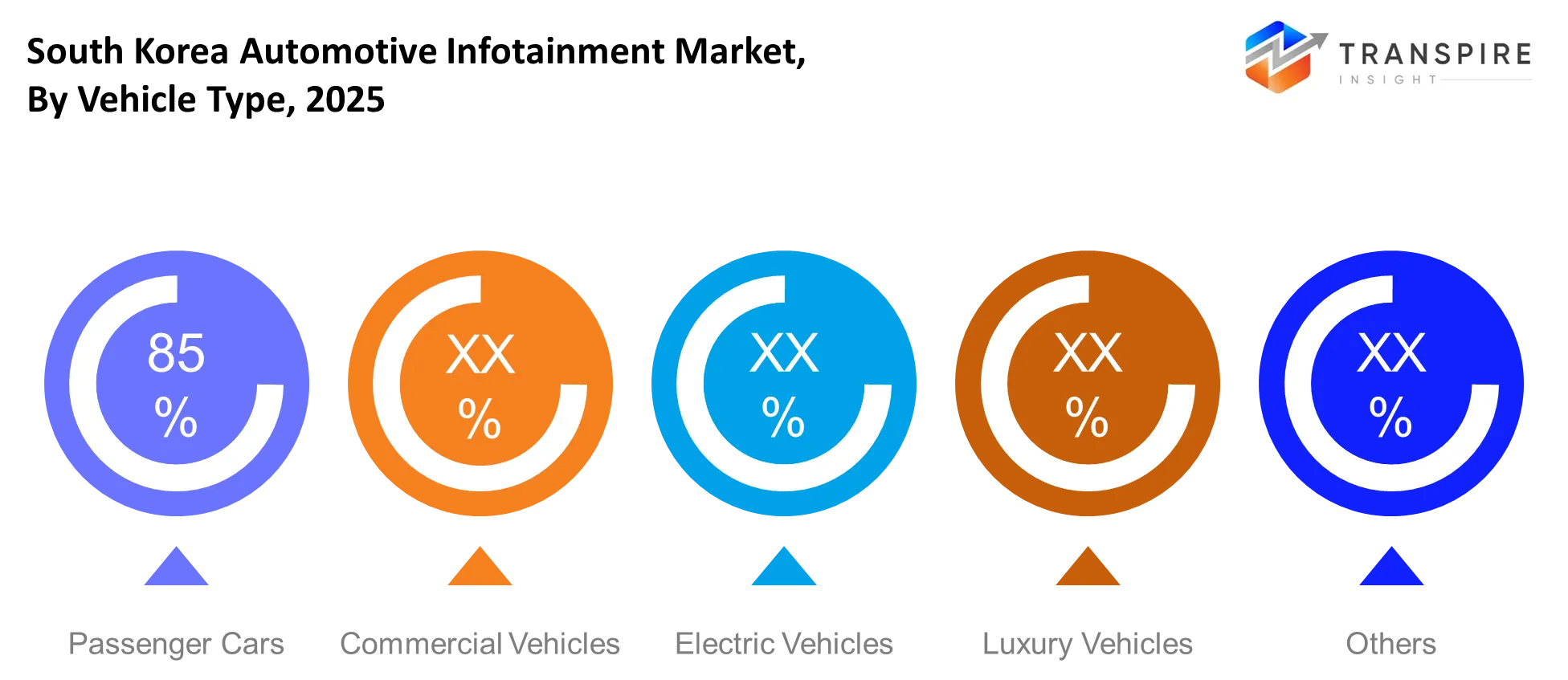
To learn more about this report, Download Free Sample Report
By Technology
Connected Car Systems seem to have the strongest position, mainly because vehicles are now leaning on constant network connectivity for navigation, updates, and even entertainment. OEM adoption is really strong across new vehicle models, and that helps a lot—especially on EV platforms where digital integration is sort of built-in. This area also gains a lot from ecosystem-level binding with mobile services and cloud platforms, the whole “together” thing that feels seamless.
Growth is happening as the need for real time data exchange keeps going up, not just between vehicles, but also with infrastructure then cloud platforms too. AI driven Infotainment is expanding fast, mostly tied to personalized user experiences, and interfaces that adapt using driver behavior patterns, which is a bit like smarter guidance. Voice Recognition Systems are getting more traction as safety rules push hands free control, and that’s becoming more common. Cloud based Infotainment is also showing up as a scalable setup for continuous software updates and service monetization, kind of a steady revenue path. Other approaches still matter, like hybrid solutions and edge computing based systems, though the balance shifts. Over the forecast period, AI enabled and cloud native infotainment platforms will end up redefining system architecture, so value creation shifts from hardware toward software ecosystems, more than before.
By Application
In-car entertainment kind of takes the leading position, mostly because people really want integrated audio, video, and streaming services right inside connected vehicles. You can see high usage during those urban commutes, and also on long-distance trips, so there’s this steady feeling of continuous engagement with the infotainment systems. On top of that, when OEMs bundle the entertainment features together with navigation systems, it kinda makes the whole dominance situation stronger, and more “sticky” for buyers.
The growth here is being pulled forward by more and more consumers adopting subscription based media services that get layered into vehicle dashboards. Navigation assistance is expanding steadily too, mainly because traffic congestion is getting worse, and because metro areas are demanding optimized routes that actually make sense. Vehicle diagnostics is also becoming more important, since infotainment systems increasingly link up with onboard sensors, enabling real-time system health monitoring. Meanwhile, driver assistance applications are rising, due to safety focused regulatory pressure and the broader integration of ADAS. Other areas include personalization, and even vehicle-to-everything communication features.
Over the forecast period, diagnostics along with driver assistance functions will get more deeply embedded, and that shift will turn infotainment systems into centralized mobility intelligence platforms.
By End User
OEMs basically stay in the dominant spot because infotainment systems are usually put in during vehicle making, so the hardware and software kind of lock in together without much hassle. There is also strong cooperation between automakers and Tier-1 suppliers, and that helps with standardized rollouts across many different vehicle models. This whole setup, it kinda gives OEMs a solid edge across almost every vehicle category.
On the growth side, this segment moves forward due to rising OEM spending on software-defined vehicle platforms and the long-term desire to manage the infotainment ecosystem. Aftermarket suppliers are also pushing ahead with retrofit infotainment solutions especially for older cars that want connectivity upgrades, you know more seamless access to modern features. Fleet operators, meanwhile, are growing quickly because people want telematics, route optimization, and driver monitoring systems. Others include mobility service providers, plus institutional vehicle operators. Through the forecast period OEM dominance should still look strong, but fleet operators will gather momentum faster as commercial mobility turns more and more data-driven and digitally managed.
What are the Key Use Cases Driving the South Korea Automotive Infotainment Market?
In South Korea, the main thing the Automotive Infotainment Market is really driven by, is integrated navigation plus media control inside connected passenger vehicles. it’s mostly the big, obvious demand driver, because it bundles real time traffic updates with entertainment, and even vehicle diagnostics all in one cockpit style interface. that setup tends to help with driver convenience and safety too, since a bunch of functions stay in one place, rather than scattered around, if you know what I mean.
Then you have the secondary use cases, like fleet telematics and logistics monitoring. this is especially visible among commercial vehicle operators and ride hailing platforms. these platforms tend to back up things such as route optimization, driver behavior tracking, and fuel efficiency monitoring, so operational costs are easier to manage, particularly in transport heavy industries.
Looking ahead, emerging applications are starting to show up, including AI based in cabin personalization and augmented reality navigation overlays. these capabilities are slowly working their way into higher priced EV segments, where OEMs are basically experimenting with adaptive interfaces that respond to driver behavior, and environmental conditions.
|
Report Metrics |
Details |
|
Market size value in 2025 |
USD 18.2 Million |
|
Market size value in 2026 |
USD 20.8 Million |
|
Revenue forecast in 2033 |
USD 53.9 Million |
|
Growth rate |
CAGR of 14.57% from 2026 to 2033 |
|
Base year |
2025 |
|
Historical data |
2021 - 2024 |
|
Forecast period |
2026 - 2033 |
|
Report coverage |
Revenue forecast, competitive landscape, growth factors, and trends |
|
Regional scope |
United States; Canada; Mexico; United Kingdom; Germany; France; Italy; Spain; Denmark; Sweden; Norway; China; Japan; India; Australia; South Korea; Thailand; Brazil; Argentina; South Africa; Saudi Arabia; United Arab Emirates |
|
Key company profiled |
Hyundai Mobis, LG Electronics, Harman International, Bosch, Continental AG, Denso, Panasonic Automotive, Visteon, Pioneer Corporation, Garmin, TomTom, Samsung Electronics, HERE Technologies, Aptiv, Mitsubishi Electric |
|
Customization scope |
Free report customization (country, regional & segment scope). Avail customized purchase options to meet your exact research needs. |
|
Report Segmentation |
By Component (Display Units, Audio Systems, Navigation Systems, Connectivity Modules, Telematics Units, Others); By Vehicle Type (Passenger Cars, Commercial Vehicles, Electric Vehicles, Luxury Vehicles, Others); By Technology (Connected Car Systems, AI-based Infotainment, Voice Recognition Systems, Cloud-based Infotainment, Others); By Application (In-car Entertainment, Navigation Assistance, Vehicle Diagnostics, Driver Assistance, Others); By End User (OEMs, Aftermarket Suppliers, Fleet Operators, Others) |
Which Regions are Driving the South Korea Automotive Infotainment Market Growth?
Seoul and the Gyeonggi area really dominate the South Korea Automotive Infotainment Market , mostly because the OEM headquarters are clustered there, plus there’s this pretty solid semiconductor ecosystem and EV penetration is high. On top of that, the whole place kind of leans on tight collaboration between vehicle makers and tech providers, so next-generation infotainment systems get rolled out quicker, rather than waiting around. The dense city style of commuting also pushes people toward connected cockpit features, more and more. And honestly , stronger enforcement around vehicle safety tech also helps early adoption hold up in this cluster, even when the market is moving fast.
Meanwhile the southeastern industrial corridor , including Busan and Ulsan , keeps a more stable secondary position. It’s not the same “innovation-first” vibe as Seoul. Instead, this region is anchored by large scale automotive manufacturing and export focused production facilities. Global automakers keep investing steadily, so infotainment gets integrated pretty consistently right inside the production lines. Because of long term OEM contracts and continuous vehicle output the contribution stays steady, rather than chasing quick experiments or rapid trial cycles.
Then there’s the fastest-growing area, the inland EV manufacturing zones. These zones are being strengthened by industrial diversification policies that are pretty recent. As new money flows into battery and EV assembly plants, demand rises for more advanced infotainment integration, and at scale. That change is basically creating fresh supply chain nodes outside the usual automotive hubs. Over the 2026–2033 period, this expansion should open up clearer opportunities for infotainment suppliers to move into the newly developing OEM clusters.
Who are the Key Players in the South Korea Automotive Infotainment Market and How Do They Compete?
South Korea Automotive Infotainment Market is pretty moderately consolidated, with a real strong influence from global Tier-1 suppliers plus domestic electronics giants. The competition kinda feels like it is pushed more by software capability, the ability to do system integration and working relationships with OEMs, not just price alone, and in practice that makes a big difference. The established companies are defending themselves by moving toward platform based infotainment ecosystems, while the tech firms are basically disrupting older automotive suppliers, using AI, and cloud-native approaches that can be deployed faster.
Hyundai Mobis leans into integrated cockpit platforms that are tightly matched with Hyundai Motor Group vehicles so it gets a strong ecosystem edge with the OEM side. LG Electronics uses display and smart interface technologies, and that helps it grow inside EV infotainment systems. Samsung Electronics is also tightening its role thanks to semiconductor and display innovation, which then supports next generation infotainment hardware, more reliably than before.
Harman International is competing with premium connected audio and infotainment platforms that are built to integrate with major automakers. Bosch and Continental AG both push modular cockpit systems, and software defined vehicle architectures which makes scaling easier. Lately these players are making more partnerships with Korean OEMs as well, to speed up AI integration, expand EV infotainment abilities, and lock in long-term platform supply agreements, sort of like securing the pipeline early, before everyone else catches up.
Company List
- Hyundai Mobis
- LG Electronics
- Harman International
- Bosch
- Continental AG
- Denso
- Panasonic Automotive
- Visteon
- Pioneer Corporation
- Garmin
- TomTom
- Samsung Electronics
- HERE Technologies
- Aptiv
- Mitsubishi Electric
Recent Development News
In January 2026, Sonatus presented AI-powered software-defined vehicle infotainment and cockpit technologies at CES 2026. The company showcased edge AI, diagnostics, and in-vehicle software platforms aimed at improving infotainment intelligence and reducing development cycles for OEMs.https://en.wikipedia.org/wiki/Sonatus
In September 2025, Hyundai Mobis unveiled its integrated cockpit and infotainment innovation strategy at IAA Mobility 2025. The initiative focused on enhancing digital cockpit UX, AI-based interfaces, and software-defined vehicle architectures for global automotive clients.https://www.prnewswire.com
What Strategic Insights Define the Future of the South Korea Automotive Infotainment Market?
The South Korea Automotive Infotainment Market is sorta moving, structurally speaking, toward fully software-defined mobility ecosystems where infotainment turns into the main control layer of the whole vehicle experience. This trend is pushed by EV expansion, OS standardization, and the nonstop connectivity expectations from consumers and also fleet operators. In the next 5–7 years, money will move more and more away from hardware sales and toward subscription-based digital services and AI-driven in-car applications, which is kind of the real shift here.
There is also a risk that is less obvious, like platform concentration, where relying on just a few operating systems and chipset providers might suddenly expose OEMs to supply bottlenecks and pricing pressure. Meanwhile, there’s a pretty big emerging opportunity too: tying infotainment together with vehicle energy optimization systems in EV fleets, so they can enable real-time efficiency monetization.
For market participants, it makes sense to emphasize modular infotainment architectures that allow quick software integration, and cross-platform compatibility, even when requirements change fast. The companies that start early with AI-driven cockpit ecosystems and scalable cloud connectivity will likely be best positioned to capture long-term value as this market continues to evolve.
South Korea Automotive Infotainment Market Report Segmentation
By Component
- Display Units
- Audio Systems
- Navigation Systems
- Connectivity Modules
- Telematics Units
- Others
By Vehicle Type
- Passenger Cars
- Commercial Vehicles
- Electric Vehicles
- Luxury Vehicles
- Others
By Technology
- Connected Car Systems
- AI-based Infotainment
- Voice Recognition Systems
- Cloud-based Infotainment
- Others
By Application
- In-car Entertainment
- Navigation Assistance
- Vehicle Diagnostics
- Driver Assistance
- Others
By End User
- OEMs
- Aftermarket Suppliers
- Fleet Operators
- Other
Frequently Asked Questions
Find quick answers to common questions.
The Estimated South Korea Automotive Infotainment Market size for the Market will be USD 53.9 Million in 2033.
Key Segments for the South Korea Automotive Infotainment Market are By Component (Display Units, Audio Systems, Navigation Systems, Connectivity Modules, Telematics Units, Others); By Vehicle Type (Passenger Cars, Commercial Vehicles, Electric Vehicles, Luxury Vehicles, Others); By Technology (Connected Car Systems, AI-based Infotainment, Voice Recognition Systems, Cloud-based Infotainment, Others); By Application (In-car Entertainment, Navigation Assistance, Vehicle Diagnostics, Driver Assistance, Others); By End User (OEMs, Aftermarket Suppliers, Fleet Operators, Others)
Major South Korea Automotive Infotainment Market Players are Hyundai Mobis, LG Electronics, Harman International, Bosch, Continental AG, Denso, Panasonic Automotive, Visteon, Pioneer Corporation, Garmin, TomTom, Samsung Electronics, HERE Technologies, Aptiv, Mitsubishi Electric.
The Current South Korea Automotive Infotainment Market size is USD 18.2 Million in 2025.
The South Korea Automotive Infotainment Market CAGR is 14.57% from 2026 to 2033.
- Hyundai Mobis
- LG Electronics
- Harman International
- Bosch
- Continental AG
- Denso
- Panasonic Automotive
- Visteon
- Pioneer Corporation
- Garmin
- TomTom
- Samsung Electronics
- HERE Technologies
- Aptiv
- Mitsubishi Electric
Recently Published Reports
-
Apr 2026
ATV & UTV Market
ATV & UTV Market Size, Share & Analysis Report By Type (ATV, and UTV), By Variants (Less Than 400 CC, 400 CC To 800 CC, and More Than 800 CC), and Geography (North America, Europe, Asia-Pacific, Middle East and Africa, South and Central America), 2021 - 2031
-
Apr 2026
Automotive Central Gateway Module Market
Automotive Central Gateway Module Market Size, Share & Analysis Report By Type (Ethernet Central Gateway Module, CAN Central Gateway Module, LIN Central Gateway Module, and FlexRay), By Application (Powertrain Control, Body Control, Infotainment System, Advanced Driver Assistance Systems (ADAS), and Others), By End User (Passenger Vehicles, and Commercial Vehicles), and Geography (North America, Europe, Asia-Pacific, Middle East and Africa, South and Central America), 2021 - 2031
-
Apr 2026
Automotive Engine Oil Filter Market
Automotive Engine Oil Filter Market Size, Share & Analysis Report By Filter Type (Fuel Filter, Engine Oil Filter, Hydraulic Oil Filter, and Others), By Filter Media (Cellulose, Synthetic, and Micro), By Sales Channel (OEMs, and Aftermarket), By Vehicle Type (Passenger Cars, Light Commercial Vehicles, Heavy Duty Trucks, Buses and Coaches, and Off-road Vehicles), and Geography (North America, Europe, Asia-Pacific, Middle East and Africa, South and Central America), 2021 - 2031
-
Apr 2026
Automotive Parts Aluminium Die Casting Market
Automotive Parts Aluminium Die Casting Market Size, Share & Analysis Report By Production Process (Pressure Die Casting, Vacuum Die Casting, Squeeze Die Casting, Gravity Die Casting), By Application (Body Parts, Engine Parts, Transmission Parts, Battery And Related Components, Other Application Types), and Geography (North America, Europe, Asia-Pacific, Middle East and Africa, South and Central America), 2021 - 2031
Our Clients