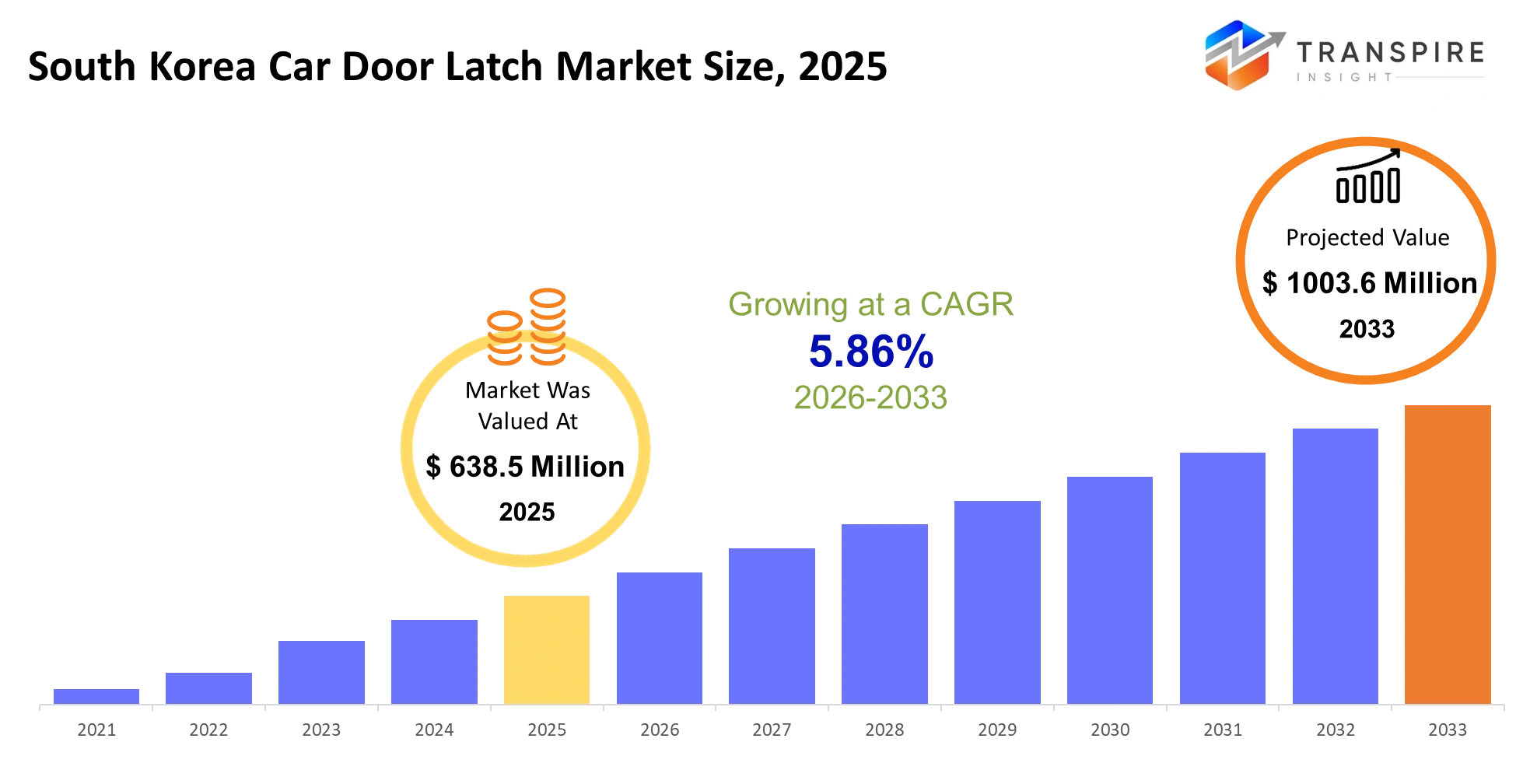
South Korea Car Door Latch Market Size & Forecast:
- South Korea Car Door Latch Market Size 2025: USD 638.5 Million
- South Korea Car Door Latch Market Size 2033: USD 1003.6 Million
- South Korea Car Door Latch Market CAGR: 5.86%
- South Korea Car Door Latch Market Segments: By Product Type (Electronic Door Latches, Mechanical Door Latches, Child Safety Latches, Smart Door Latches, Others); By Vehicle Type (Passenger Cars, Commercial Vehicles, Electric Vehicles, Luxury Vehicles, Others); By Application (Front Side Doors, Rear Side Doors, Tailgates, Sliding Doors, Others); By Material (Steel Latches, Aluminum Latches, Composite Material Latches, Others); By End User (OEMs, Aftermarket Suppliers, Fleet Operators, Others).
To learn more about this report,  Download Free Sample Report
South Korea Car Door Latch Market Summary
The South Korea Car Door Latch Market was valued at USD 638.5 Million in 2025. It is forecast to reach USD 1003.6 Million by 2033. That is a CAGR of 5.86% over the period.
In South Korea, the car door latch market really underpins a pretty practical job in modern cars: it helps keep doors locked tightly while the vehicle is moving but still lets passengers get in, with fairly smooth access control, somehow. Over time door latches have gotten more important, since automakers keep adding electronic locking systems, child safety features, anti theft protection, and smart entry add-ons into passenger vehicles, including electric cars. If we look back across the last five years, the market has moved away from mostly mechanical latch assemblies and, instead, leaned more toward electronically controlled solutions that tie into vehicle sensors and the central body control unit.
This shift sped up after semiconductor shortages, and also during the pandemic era supply disruptions, because those events showed the cracks in older sourcing for traditional automotive parts. So manufacturers responded by localizing production and using electronic modules that carry more value. Right now, South Korea’s solid electric vehicle output, plus premium vehicle exports, is also changing where money can be made for latch suppliers, since EV platforms tend to need lighter door systems that are integrated with sensors and still work with software. And as car makers compete harder on vehicle safety, cabin convenience, and these smart access functions, latch companies are edging past basic commodity hardware and moving toward smarter locking technologies that can bring higher margins.
Key Market Insights
- In 2025, Gyeonggi Province kinda dominated the South Korea Car Door Latch Market , taking almost 38% share because there’s a lot of clustered automotive manufacturing facilities.
- Meanwhile, export focused automotive clusters keep pushing overall market size growth throughout southeastern South Korea, with steady OEM purchasing activity happening more and more.
- When you look at it by product, electronic door latch systems led the South Korea Car Door Latch Market with around 52% of revenue in 2025.
- Mechanical latch systems stayed in the second spot, largely due to continued integration inside entry-level as well as commercial vehicle platforms, not just fancy models.
- For the forecast window, smart sensor based latch systems are showing the fastest expansion since connected vehicle adoption trends keep accelerating.
- And lightweight aluminum latch assemblies have been gaining momentum too , because automakers are prioritizing vehicle efficiency plus improving battery range optimization, so it all kind of ties together.
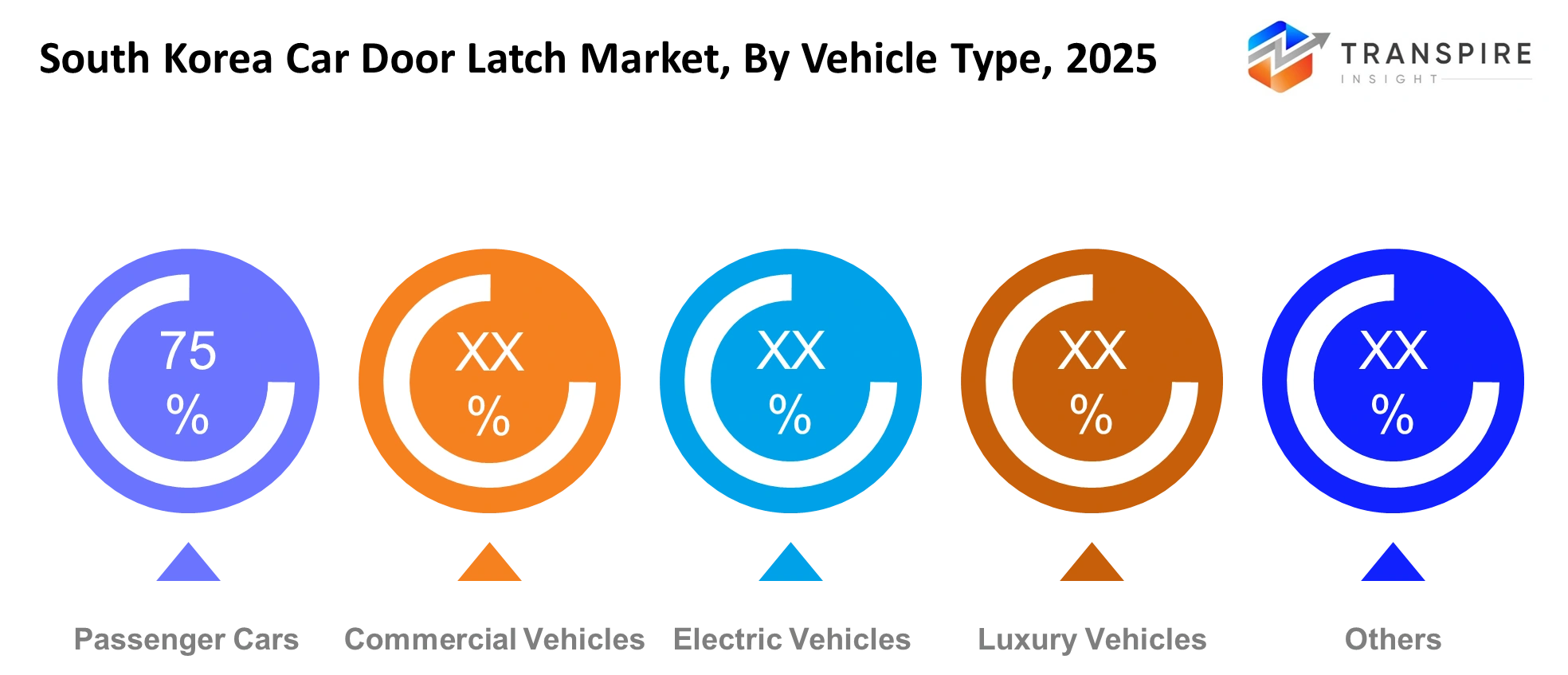
- Passenger vehicles made up around 68% of the market share in 2025, helped along by strong homegrown sedan and SUV output volumes that kept going.
- Electric vehicles kind of showed up as the quickest growing application segment because EV exports kept climbing, and because more advanced safety integration requirements are being asked for.
- Luxury vehicle uses also kept edging upward, not all at once, but steadily, as automakers rolled out hands free entry and intelligent locking solutions.
- Commercial vehicles saw firmer demand as well, with broader use of durable latch systems for logistics and fleet transportation operations, which made it easier to keep things moving.
What are the Key Drivers, Restraints, and Opportunities in the South Korea Car Door Latch Market?
The main driver molding the South Korea car door latch market is the fast shift toward electric and connected vehicles, kinda changing everything. Since 2021 South Korean automakers have been scaling up EV output quite aggressively, aiming to boost export position in North America and Europe, where safety plus smart access features are now more and more part of the buying logic. Because of this transition OEMs are moving away from the old-fashioned mechanical latches and moving toward electronic and sensor- based setups that enable centralized locking, automated door behaviors, and safety routines that are actually integrated. Because of that latch suppliers are seeing stronger revenue per vehicle too, not just unit growth , electronic assemblies bring higher component value and they also need deeper software integration
At the same time the market has a notable brake, basically its heavy reliance on semiconductor availability and high-precision electronic components. Electronic latch systems depend on microcontrollers , sensors, and communication parts that come from global supply networks that are tightly linked. If manufacturers want to build backup sourcing routes, or push for more domestic chip capacity, they usually need years of capital spending and careful technical validation. This kind of structural pressure keeps manufacturers exposed to production slowdowns, procurement costs that creep upward, and delivery dates that can be all over the place, which then restrains adoption especially on mid-range vehicle models where buyers are still cost aware
One major chance is also starting to show up with autonomous and premium mobility platforms. South Korean suppliers are investing in smarter side door systems, including touchless entry and automatic opening functions, for robotaxis and luxury EVs. As mobility pilots roll out further in cities like Seoul, the demand for intelligent latch architectures is expected to form a fresh higher-margin product space for automotive component manufacturers.
What Has the Impact of Artificial Intelligence Been on the South Korea Car Door Latch Market?
Artificial intelligence and more advanced digital technologies are, kinda reshaping the South Korea car door latch industry , in a way that touches manufacturing precision quality control, and also predictive maintenance across the automotive production lines. Automotive component suppliers are starting to lean harder on AI-enabled machine vision approaches to check latch alignment , sensor calibration, and electronic locking behavior while the parts are still being assembled. These systems catch extremely small defects and they also cut down on those little human inspection mistakes. So manufacturers usually see fewer rejects and better production steadiness, especially for those high-volume vehicle projects.
At the same time, machine learning is getting built into smart latch development for connected and electric vehicles. Suppliers use predictive analytics to keep an eye on actuator performance , spot odd locking patterns, and forecast how component wear may progress before failure even shows up. In practice this can help automakers reduce warranty headaches, reduce surprise repairs, and keep vehicle uptime higher. There are also digital simulation platforms involved, which basically let teams stress-test latch durability across vibration, temperature, and crash-impact scenarios before any physical production starts. That tends to shorten development cycles and lower engineering spend, even if timelines were tight.
Many factories that adopted industrial automation and AI-assisted robotics have reported clear gains in assembly speed and less stoppage time during electronic component installation. Still, AI adoption hits a serious wall because integrating software-driven quality systems into older, legacy automotive manufacturing infrastructure is expensive. Smaller suppliers often do not have the data architecture, nor the semiconductor know-how, needed to roll out these predictive systems at scale, or at least not quickly enough.
Key Market Trends
- Since 2021 electronic latch adoption sort of jumped quickly, i mean sharply as South Korean EV makers started folding smart entry plus centralized locking tech into their higher-end vehicle platforms, and yeah it looked integrated.
- Hyundai Mobis kept moving forward on sensor-integrated latch systems after other global automakers basically started putting extra weight on advanced passenger safety, and anti-theft functions for export cars.
- During the semiconductor shortages in 2021 and 2022, latch manufacturers had to do more than usual… they diversified suppliers and localized electronic component sourcing across domestic production networks, which was not easy at the time.
- Mechanical latch systems started to lose traction once automakers leaned into lighter electronic modules, these days that support software-first vehicle architecture and OTA features, sometimes it felt like a full swap in approach.
- By 2025, premium SUVs and electric sedans increasingly used hands-free door access, and that sped up demand for actuator-driven latch technologies.
- Between 2023 and 2025 South Korean suppliers put serious investment into AI-based quality inspection tooling to lower defect rates in the electronic locking assemblies, even when production volumes rose.
- Automotive OEMs also backed off from relying on just a one-country sourcing approach after pandemic-related logistics disruptions caused extra delivery delays and made component pricing more volatile, so they adjusted.
- And then vehicle safety rules in North America and Europe nudged Korean exporters to redo latch assemblies for higher crash resistance, plus tighter child-lock performance expectations.
South Korea Car Door Latch Market Segmentation
By Product Type:
Electronic door latches are getting a lot more traction in today’s cars, mostly because car makers are bundling smart entry stuff , sensor controls and automatic locking into the same package, yeah it sounds simple but it helps. These latch systems boost everyday comfort as well as safety, and they also line up with connected vehicle services. In South Korea, demand is likely to keep climbing , as electric models and premium vehicles become more common across the market.
Still, mechanical door latches stay in a pretty solid spot. They’re valued for durability, lower costs, and the maintenance side is usually much easier. A lot of entry-level vehicles and commercial models keep using these arrangements for long term reliability. For family cars, child safety latches remain very relevant, while smart door latches are drawing attention through contactless access, and also mobile based vehicle entry methods. Some people call it “touch-free convenience”, others just say “smarter entry”, either way, it’s the same direction.
By Vehicle Type:
Passenger cars make up a major portion because South Korea has strong domestic output , and the export efforts from local automotive manufacturers are also active. Vehicle companies are emphasizing comfort, safety, and advanced locking architectures so they can meet customer expectations , at home and abroad.
Commercial vehicles need latch units that can take heavy cycles, frequent use, and rough conditions. Electric vehicles are opening new opportunities because lightweight, electronically managed latch systems fit nicely into modern EV platforms. Luxury vehicles are following too , with higher adoption of intelligent door setups that enable automated access and add premium safety features.
To learn more about this report, Download Free Sample Report
By Application:
Front side doors are, I guess, one of the biggest application areas because these doors need advanced locking systems for driver safety, central locking, and also smart access integration. In practice, vehicle manufacturers are constantly improving latch performance so they can reduce noise, enhance sealing, and back up electronic security systems in today’s modern cars.
Rear side doors get advanced latch systems as well, mainly for passenger safety plus child protection related functions. Tailgates meanwhile are seeing more electronic latch integration especially on SUVs and crossover vehicles, often aimed at hands-free opening capabilities. Sliding doors, particularly on vans and mobility vehicles, really depend on latch systems that are strong and reliable, so they can handle repeated operation without a noticeable drop in performance over time.
By Material:
Steel latches still stay widely used because of their high strength, durability, and cost effectiveness when it comes to large scale vehicle production. Automotive companies continue to prefer steel materials for heavy duty uses where a long service life and structural stability matter a lot for overall vehicle safety.
Aluminum latches are becoming more common too, largely because automakers try to cut vehicle mass to boost fuel efficiency and battery performance, especially in electric vehicles. Composite material latches are also getting more attention for corrosion resistance and that lightweight advantage. Material innovation will stay important, because manufacturers are still focusing on efficiency, plus advanced vehicle engineering, in general.
By End User:
OEMs hold a leading share because vehicle manufacturers like direct relationships with latch suppliers , so they can manage quality control better, do more product customization, and keep large scale production moving. In the meantime , automotive companies are working even closer with component makers to design integrated electronic locking systems for next-gen vehicles.
On the other hand , aftermarket suppliers keep handling replacement demand for worn out or damaged latch systems in cars that are already on the road. Fleet operators are turning into major purchasers too, since commercial transportation groups need door systems that are dependable , and built to last, to cut down maintenance expenses and push operational efficiency forward.
What are the Key Use Cases Driving the South Korea Car Door Latch Market?
Passenger car vehicle manufacturing is still basically the main use case pushing adoption in the South Korea Car Door Latch Market. The front and rear door locking systems are what generate the biggest demand, since domestic automakers and export driven OEMs need consistent safety, anti theft, and central locking performance, across large scale sedan as well as SUV production lines.
There are also secondary uses that are quietly growing, mostly tied to electric vehicles and fleet managed transport. EV makers are putting electronic latches together with smart entry, sensor control and lighter vehicle platforms, and fleet operators tend to favor sturdy systems that cut down on maintenance interruptions, plus they can handle repeated door use all day long.
More new use cases are starting to show up too, especially with autonomous mobility and premium vehicle programs. Automated door access, touchless entry, and software connected locking mechanisms are getting more attention, as South Korea keeps moving forward with connected mobility and urban transport technologies.
|
Report Metrics |
Details |
|
Market size value in 2025 |
USD 638.5 Million |
|
Market size value in 2026 |
USD 673.8 Million |
|
Revenue forecast in 2033 |
USD 1003.6 Million |
|
Growth rate |
CAGR of 5.86% from 2026 to 2033 |
|
Base year |
2025 |
|
Historical data |
2021 - 2024 |
|
Forecast period |
2026 - 2033 |
|
Report coverage |
Revenue forecast, competitive landscape, growth factors, and trends |
|
Country scope |
South Korea |
|
Key company profiled |
Hyundai Mobis, Kiekert AG, Magna International, Mitsui Kinzoku, Inteva Products, AISIN Corporation, Strattec Security, U-Shin Ltd., Brose Fahrzeugteile, Huf Hülsbeck & Fürst, Minda Corporation, Valeo, Dura Automotive Systems, Gestamp, Toyoda Gosei. |
|
Customization scope |
Free report customization (country, regional & segment scope). Avail customized purchase options to meet your exact research needs. |
|
Report Segmentation |
By Product Type (Electronic Door Latches, Mechanical Door Latches, Child Safety Latches, Smart Door Latches, Others); By Vehicle Type (Passenger Cars, Commercial Vehicles, Electric Vehicles, Luxury Vehicles, Others); By Application (Front Side Doors, Rear Side Doors, Tailgates, Sliding Doors, Others); By Material (Steel Latches, Aluminum Latches, Composite Material Latches, Others); By End User (OEMs, Aftermarket Suppliers, Fleet Operators, Others). |
Which Regions are Driving the South Korea Car Door Latch Market Growth?
Gyeonggi Province kind of leads the South Korea car door latch market, mainly because the area has this dense automotive manufacturing ecosystem that’s linked to big OEM assembly plants, and also to component suppliers. There’s strong industrial infrastructure too, plus advanced robotics use, and that near-research facilities advantage lets producers develop and try out electronic latch tech on a larger level. On top of that, government backed smart mobility plans have nudged more money into connected vehicle systems and automotive electronics. And then there are established logistics networks along with export routes, so the whole thing ends up making the region more like a key production plus innovation center for advanced door latch systems.
Ulsan remains the second most important regional market, but the growth path looks a bit different, since Ulsan leans more on large scale vehicle exports, and on steady commercial manufacturing, than on fast experimentation. Major automotive producers have put long term capital there, which builds a supply chain that focuses on steady output instead of rapid technological trials. The region has industrial resilience and plenty of experienced workforce available, and it also gets direct access to export shipping infrastructure. So even when conditions shift, demand for durable, high performance latch systems stays steady, because automakers keep sending passenger cars and commercial vehicles to international markets.
Chungcheong Province seems to be showing up as the fastest-growing regional market lately, mostly because electric vehicle component manufacturing keeps expanding and investment in smart automotive systems keeps climbing. In the last few years suppliers have bumped up their production capacity for lightweight electronic latches, meant for EV platforms and also for premium mobility uses. On top of that, government backing for battery manufacturing and whatever they call future mobility development has pushed automotive tech firms to open new operations in the region. So, this overall momentum is expected to open up solid chances for new suppliers, automation providers and electronic component manufacturers somewhere between 2026 and 2033, as vehicle electrification keeps speeding up across South Korea.
Who are the Key Players in the South Korea Car Door Latch Market and How Do They Compete?
In South Korea’s car door latch market you can see a kind of moderately consolidated setup, where the bigger automotive component players keep very close ties with domestic OEMs. At the same time, the more specialized technology companies still push into it, mostly via electronic innovation and, sort of, lighter-weight system design. Over the last stretch of time competition has moved away from just manufacturing costs, and it’s more about software integration and smart locking features. Also, OEMs care a lot about supply continuity for the long run, so reliability now matters more than it used to. Existing suppliers protect their position by putting money into intelligent latch platforms that work well with electric vehicles and connected vehicle architectures. New entrants find it hard because automotive safety validation isn’t light work, plus electronic integration demands are strict. On top of that OEM qualification means a lot of engineering effort and long testing cycles, so the barrier is pretty high.
Hyundai Mobis leans hard into technology integration, and it also gets advantages from tight coordination with South Korean vehicle manufacturers, especially those building electric and autonomous mobility platforms. The company stands out with sensor-driven latch systems that connect back to centralized vehicle control architectures. Their ongoing investment in smart mobility research and software-enabled automotive systems also helps reinforce long-term OEM relationships. This is part of why they’re able to expand into global export vehicle programs, without losing traction.
Kiekert AG competes by focusing on precision engineered electronic locking systems, made for premium as well as high safety vehicle uses. Lately the company expanded its work with Asian automakers, with the aim of boosting take up of smart side-door solutions and also extra child safety features. AISIN Corporation on the other hand leans on its big automotive systems to deliver end to end latch and access solutions that are tuned for hybrid and electric vehicles. Magna International differentiates itself with lightweight material engineering, plus automated door access technologies that back luxury EV products and future mobility in general.
Company List
- Hyundai Mobis
- Kiekert AG
- Magna International
- Mitsui Kinzoku
- Inteva Products
- AISIN Corporation
- Strattec Security
- U-Shin Ltd.
- Brose Fahrzeugteile
- Huf Hülsbeck & Fürst
- Minda Corporation
- Valeo
- Dura Automotive Systems
- Gestamp
- Toyoda Gosei
Recent Development News
In April 2026, KBI Dongguk Industrial entered a supply partnership with Hyundai Motor and Kia. The company began supplying eco-friendly crash pads using a recyclable spray hot-melt bonding technology designed for end-of-life vehicle material separation, strengthening Hyundai Motor Group’s broader shift toward sustainable closure and interior component systems that include integrated door modules and latch-adjacent assemblies.
Source: https://en.sedaily.com/
In July 2025, Hyundai Corporation acquired a 77.6% stake in Sigma, an automotive interior components manufacturer. The acquisition expanded Hyundai Corporation’s entry into automotive manufacturing, with Sigma supplying interior lighting and electronic components used in multiple Hyundai and Kia models—components closely integrated with door systems and electronic closure ecosystems relevant to modern latch modules.
Source: http://www.hyundaicorp.com/
What Strategic Insights Define the Future of the South Korea Car Door Latch Market?
The South Korea car door latch market seems to be drifting toward more and more integrated electronic entry systems, kind of tied in with software defined vehicle architecture, autonomous mobility features, and the rest of the advanced passenger safety stack. In the next five to seven years, the pace of growth will likely hinge on how well suppliers mix mechanical sturdiness with embedded electronics, different sensors, and real cybersecurity know-how. The biggest driver that really pushes this change is the ongoing rise in electric and connected vehicle output for export destinations, where the rules are strict—safety first, plus smart mobility expectations.
There is a less obvious risk too, one that feels easy to ignore at first. As demand increases, the industry is getting more dependent on a smallish semiconductor and electronic component supply base. So even if overall vehicle assembly rises , some concentrated sourcing pathways could still trigger pricing pressure, production lags and a weaker negotiating position for smaller latch makers. But alongside that, there’s also an opening that’s starting to look interesting. Automated side door systems, tuned for robotaxis, premium EVs, and shared city mobility fleets, especially in places like Seoul, could create demand pockets that didn’t exist before.
So market players probably should act early—build software compatible latch platforms and lock in longer term semiconductor partnerships, instead of just going head to head on raw production costs.
South Korea Car Door Latch Market Report Segmentation
By Product Type
- Electronic Door Latches
- Mechanical Door Latches
- Child Safety Latches
- Smart Door Latches
By Vehicle Type
- Passenger Cars
- Commercial Vehicles
- Electric Vehicles
- Luxury Vehicles
By Application
- Front Side Doors
- Rear Side Doors
- Tailgates
- Sliding Doors
By Material
- Steel Latches
- Aluminum Latches
- Composite Material Latches
By End User
- OEMs
- Aftermarket Suppliers
- Fleet Operators
Frequently Asked Questions
Find quick answers to common questions.
The South Korea Car Door Latch Market size is USD 1003.6 Million in 2033.
Key segments for the South Korea Car Door Latch Market are By Product Type (Electronic Door Latches, Mechanical Door Latches, Child Safety Latches, Smart Door Latches, Others); By Vehicle Type (Passenger Cars, Commercial Vehicles, Electric Vehicles, Luxury Vehicles, Others); By Application (Front Side Doors, Rear Side Doors, Tailgates, Sliding Doors, Others); By Material (Steel Latches, Aluminum Latches, Composite Material Latches, Others); By End User (OEMs, Aftermarket Suppliers, Fleet Operators, Others).
Major South Korea Car Door Latch Market players are Hyundai Mobis, Kiekert AG, Magna International, Mitsui Kinzoku, Inteva Products, AISIN Corporation, Strattec Security, U-Shin Ltd., Brose Fahrzeugteile, Huf Hülsbeck & Fürst, Minda Corporation, Valeo, Dura Automotive Systems, Gestamp, Toyoda Gosei.
The South Korea Car Door Latch Market size is USD 638.5 Million in 2025.
The South Korea Car Door Latch Market CAGR is 5.86% from 2026 to 2033.
- Hyundai Mobis
- Kiekert AG
- Magna International
- Mitsui Kinzoku
- Inteva Products
- AISIN Corporation
- Strattec Security
- U-Shin Ltd.
- Brose Fahrzeugteile
- Huf Hülsbeck & Fürst
- Minda Corporation
- Valeo
- Dura Automotive Systems
- Gestamp
- Toyoda Gosei
Recently Published Reports
-
Apr 2026
ATV & UTV Market
ATV & UTV Market Size, Share & Analysis Report By Type (ATV, and UTV), By Variants (Less Than 400 CC, 400 CC To 800 CC, and More Than 800 CC), and Geography (North America, Europe, Asia-Pacific, Middle East and Africa, South and Central America), 2021 - 2031
-
Apr 2026
Automotive Central Gateway Module Market
Automotive Central Gateway Module Market Size, Share & Analysis Report By Type (Ethernet Central Gateway Module, CAN Central Gateway Module, LIN Central Gateway Module, and FlexRay), By Application (Powertrain Control, Body Control, Infotainment System, Advanced Driver Assistance Systems (ADAS), and Others), By End User (Passenger Vehicles, and Commercial Vehicles), and Geography (North America, Europe, Asia-Pacific, Middle East and Africa, South and Central America), 2021 - 2031
-
Apr 2026
Automotive Engine Oil Filter Market
Automotive Engine Oil Filter Market Size, Share & Analysis Report By Filter Type (Fuel Filter, Engine Oil Filter, Hydraulic Oil Filter, and Others), By Filter Media (Cellulose, Synthetic, and Micro), By Sales Channel (OEMs, and Aftermarket), By Vehicle Type (Passenger Cars, Light Commercial Vehicles, Heavy Duty Trucks, Buses and Coaches, and Off-road Vehicles), and Geography (North America, Europe, Asia-Pacific, Middle East and Africa, South and Central America), 2021 - 2031
-
Apr 2026
Automotive Parts Aluminium Die Casting Market
Automotive Parts Aluminium Die Casting Market Size, Share & Analysis Report By Production Process (Pressure Die Casting, Vacuum Die Casting, Squeeze Die Casting, Gravity Die Casting), By Application (Body Parts, Engine Parts, Transmission Parts, Battery And Related Components, Other Application Types), and Geography (North America, Europe, Asia-Pacific, Middle East and Africa, South and Central America), 2021 - 2031
Our Clients