

France Aluminum Alloys Market Size & Forecast
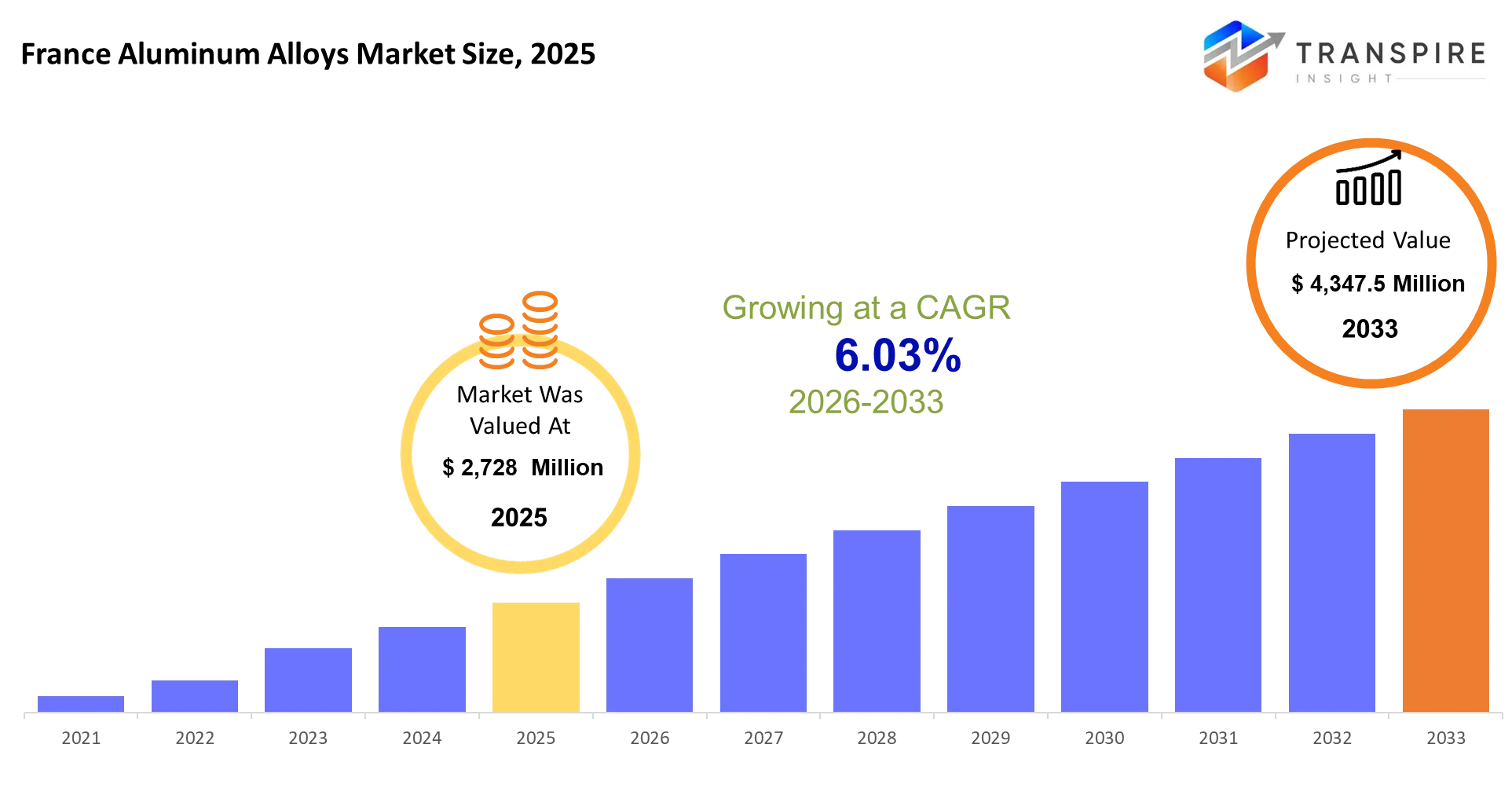
- France Aluminum Alloys Market Size 2025: USD 2,728 Million
- France Aluminum Alloys Market Size 2033: USD 4,347.5 Million
- France Aluminum Alloys Market CAGR: 6.03%
- France Aluminum Alloys Market Segments: By Type (Wrought Alloys, Cast Alloys, Others); By Application (Automotive, Aerospace, Construction, Packaging, Electrical, Others); By End-User (Automotive Industry, Aerospace Industry, Construction Sector, Packaging Industry, Electronics, Others); By Form (Sheets, Plates, Extrusions, Others)
To learn more about this report,  Download Free Sample Report
France Aluminum Alloys Market Summary
The France aluminum alloys market reached USD 2,728 Million in 2025 and is projected to expand to USD 4,347.5 Million by 2033, growing at a 6.03% CAGR. France's paprika market breaks down into three extremely competitive tiers: large multinational ingredient suppliers with a global network for sourcing and processing paprika, mid-sized regional suppliers with highly specialized product lines, and much smaller niche players serving very select or premium market areas. McCormick and Olam really lead the pack because of their size, holding a combined 38% market share thanks to well-established distribution networks, long-standing customer relationships in industry, and consistently high-quality delivery. These suppliers compete mainly on price, reliability, and how consistent their supply chain is - especially for commodity paprika products.
Mid-tier suppliers like Sensient, Everest, and Givaudan compete more intensely through specialization in premium and specialty paprika variants such as smoked, organic, and concentrated types. These suppliers differentiate themselves through innovative products, a highly responsive customer service team, and a willingness to support smaller customer orders that larger suppliers might deem too costly. Sensient's major investment in French manufacturing facilities in 2024 sets the company up to gain more of the market share from imported paprika, allowing them to have a competitive edge in terms of delivery speed and avoiding tariffs altogether. Givaudan's great skill in flavor science and product customization gives them a competitive edge in developing specialty applications.
The strategic turning point for smaller suppliers is building direct relationships with very discerning food manufacturers and premium restaurants looking for unique paprika variants. As opposed to buying commodity paprika where price and quantity are the main factors, premium paprika purchasing focuses more on a supplier's ability to create custom products, provide very small order quantities, and offer a lot of technical expertise. Suppliers who can form direct relationships with premium food producers will get to capture margins that commodity suppliers just can't touch. Kerry's expansion of its French specialty ingredients portfolio and direct connections with premium sauce manufacturers really shows off this strategy.
Key France Aluminum Alloys Market Insights
- Automotive industry accounts for 65% of France aluminum alloys market revenue in 2025, spanning body structures, chassis components, engine blocks, and transmission housings across passenger vehicles, commercial vehicles, and electric vehicle platforms.
- Wrought alloys command 58% of market revenue, driven by automotive body panel applications and structural components where formability and strength characteristics provide superior performance to cast alternatives.
- Aerospace applications generate 18% of market revenue and grow at 7.8% CAGR, supported by sustained commercial aircraft production and increasing use of aluminum-lithium alloys in advanced aircraft designs.
- Construction and building applications represent 12% of market revenue and grow at 5.2% CAGR, driven by renovation of aging building stock and thermal efficiency regulations promoting aluminum window and door systems.
- Sheets and plates represent 52% of market by form, concentrated in automotive body panels, aerospace fuselage applications, and construction cladding systems.
- Extrusions account for 28% of market by form, serving architectural applications, automotive frames, and consumer goods manufacturing requiring complex cross-sectional geometry.
- Constellium and Novelis collectively control 35% of France aluminum alloys market, leveraging integrated operations spanning smelting, rolling, and value-added finishing.
- Demand elasticity to automotive production is 1.4x, meaning a 10% increase in vehicle production drives 14% aluminum alloy consumption growth due to multi-generational fleet replacement cycles.
- Price volatility in aluminum alloys is highly sensitive to raw aluminum commodity pricing, with a 10% move in LME aluminum futures translating to 7-8% movement in downstream alloy prices.
- Supply chain resilience became critical concern in 2023-2024, with automotive manufacturers increasing strategic inventory of critical alloy grades to buffer against supply disruptions from geopolitical tension.
What are the Key Drivers, Restraints, and Opportunities in the France Aluminum Alloys Market?
Primary expansion forces include European Union emission regulations requiring vehicle fleets to decrease CO2 output - a direct motivator for automotive weight reduction. A typical mid-size sedan would need to drop its curb weight by 180-220 kg to meet 2030 emissions standards once you factor in regulatory testing methods. Achieving such a weight loss via traditional steel structures is practically and economically impossible. Automotive OEMs have widely adopted aluminium alloys for body structures as their main technology path to meet these regulations. This regulatory requirement is completely strict and non-negotiable, equating to structural demand growth quite apart from economic cycles or consumer preferences. France's role as the core of European automotive manufacturing really means French aluminium alloy producers get quite a large share of this demand since OEMs are retooling their facilities and developing new platforms.
The most significant obstacle is raw aluminium commodity pricing volatility that reduces margins and brings about purchasing uncertainty. Raw aluminium traded on the London Metal Exchange exhibits price swings of 15-25% over a 12-month period, really due to Chinese supply dynamics, US tariff policies, and geopolitical factors affecting Russian and Middle Eastern production. French alloy producers working on conversion margins of 4-6% per ton see their profitability severely compressed whenever commodity input costs jump. This volatility also creates hedging costs that smaller producers can't really manage very well, giving large integrated producers a competitive edge. The lack of long-term fixed-price aluminium supply contracts further limits smaller producers, constraining their ability to get a larger market share.
The highest-growth opportunity is really the development of advanced aluminium-lithium alloys that offer even more weight savings compared to conventional 7000 and 2000 series alloys already dominant in aerospace and automotive applications. Third-generation aluminium-lithium alloys reduce density by 3-5% compared to conventional alloys while improving fatigue and fracture properties. French aerospace primes including Airbus are putting a lot of money into aluminium-lithium adoption for both commercial and defence platforms. Aluminium alloy producers that develop their own proprietary aluminium-lithium formulations and secure exclusive supply agreements with airframe manufacturers set themselves up for premium pricing and margin expansion. This really represents the highest-value market segment within aluminium alloys.
What Has the Impact of Artificial Intelligence Been on the France Aluminum Alloys Market?
Machine learning algorithms are really optimising aluminium alloy composition and manufacturing processes so that they get an even better strength-to-weight ratio - and also better resistance to fatigue. AI systems have a look at huge amounts of data on alloy composition, heat treatment parameters, and what the resulting material properties turn out to be - and find routes to improvement that are beyond what any human designer can do. Constellium - and other major producers too - are putting AI right into their materials design workflows, cutting down the number of iterations needed to develop new alloys from 18 to 24 months down to 8 to 12 months. This speed-up gives a significant competitive advantage to producers who put money into AI materials science capabilities.
Predictive maintenance applications of AI are really decreasing manufacturing equipment downtime and improving asset use in aluminium rolling and extruding plants. Real-time monitoring of equipment vibrations, temperatures, and acoustic signals lets us predict equipment failures weeks before there's actually a mechanical failure. French producers using AI-powered predictive maintenance say they see about a 15 to 20 percent improvement in factory uptime - and a corresponding decrease in production cost per unit. The investment required for AI implementation keeps this efficiency advantage with the biggest integrated producers.
Key Market Trends
- Automotive applications account for 65% of market revenue and grow at 7.8% CAGR through 2033, significantly outpacing overall market growth due to structural regulatory requirements for vehicle lightweighting.
- Wrought alloys command 58% of market revenue and maintain stable share through 2033, as automotive body structures remain the primary application for rolled aluminum sheet and plate.
- Aerospace applications generate 18% of market revenue and grow at 7.8% CAGR, supported by replacement demand for aging commercial aircraft fleets and new aircraft platform development.
- Construction and building applications represent 12% of market revenue and grow at 5.2% CAGR as renovation of aging building stock and thermal efficiency standards drive aluminum window and cladding demand.
- Sheets and plates represent 52% of market revenue by form, driven by automotive body panel demand and aerospace fuselage applications.
- Extrusions account for 28% of market revenue and grow at 6.8% CAGR through architectural applications and automotive structural component development.
- Constellium and Novelis expanded combined market share to 35% through strategic investments in automotive-focused capacity expansion and advanced alloy development.
- Electric vehicle transition accelerated aluminum alloy demand growth in 2023-2024, with battery electric vehicle production increasing from 8% of French vehicle production in 2022 to 18% in 2024.
- Supply chain diversification accelerated in response to geopolitical tension, with automotive manufacturers increasing strategic inventory of critical aluminum alloy grades by 15-20%.
- Recycled aluminum content requirements embedded in EU Green Deal commitments are driving investment in secondary aluminum production and closed-loop automotive recycling systems.
France Aluminum Alloys Market Segmentation
By Type
Wrought alloys, produced through rolling, forging, and extrusion of aluminum ingots, command 58% of market revenue. These alloys achieve optimized strength-to-weight characteristics through controlled deformation processes. Automotive body panels, aerospace fuselage applications, and structural components represent the primary end uses. 5000 and 6000 series alloys dominate the segment due to superior corrosion resistance and formability. Growth through 2033 will be sustained by automotive lightweighting regulations and electric vehicle platform development.
Cast alloys, produced through casting of molten aluminum into molds, account for 35% of market revenue. Engine blocks, transmission housings, and structural components requiring complex geometry are primary applications. Castings enable mass production of complex shapes without subsequent machining. Growth is constrained by competition from lighter wrought alternatives in weight-sensitive applications. However, demand remains stable in applications where complex geometry and casting process economics justify alloy selection.
By Application
Automotive applications generate 65% of market revenue, spanning body structures, chassis frames, engine components, and transmission housings. Lightweighting regulations create structural demand that will sustain 7.8% CAGR through 2033. Electric vehicle platforms are driving design innovation and new alloy demand as manufacturers optimize for battery integration and range extension.
Aerospace applications represent 18% of market revenue and grow at consistent rates driven by commercial aircraft replacement cycles. Advanced alloys including aluminum-lithium formulations are increasingly specified in new aircraft programs, supporting premium pricing for specialized alloy producers.
Construction and packaging applications generate 17% of combined market revenue and grow at moderate rates of 5-6% through 2033. Building renovations and thermal efficiency standards drive window and door demand, while sustainable packaging requirements maintain steady aluminum foil and container demand.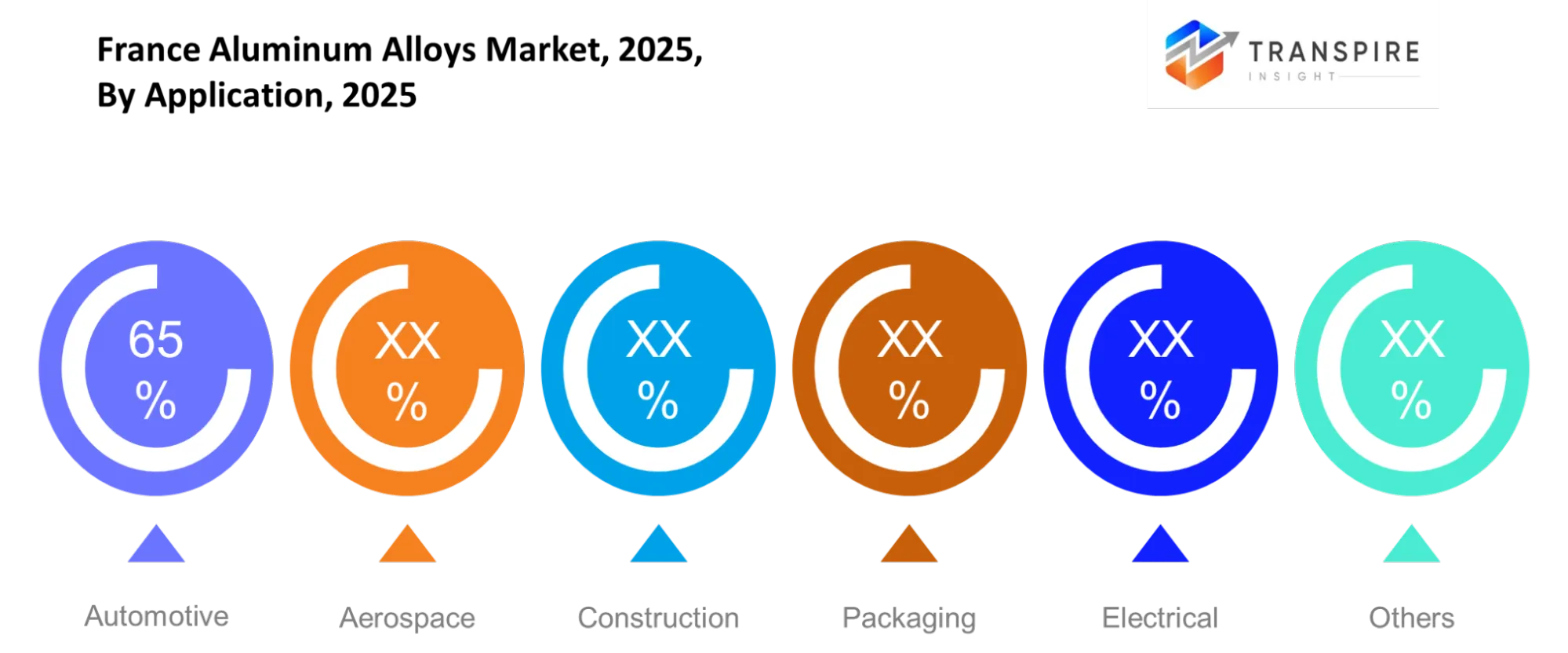
To learn more about this report, Download Free Sample Report
By End-User
Automotive manufacturers account for 65% of market revenue as primary consumers of aluminum sheets, plates, and extrusions. Supply relationships are characterized by long-term contracts with quarterly price negotiations tied to commodity aluminum pricing plus conversion cost. Quality and delivery reliability are critical competitive factors as automotive OEM production schedules operate with minimal inventory buffers.
Aerospace OEMs and tier-1 suppliers represent 18% of market revenue. Supply relationships involve rigorous supplier qualification processes and extensive material certification requirements. Aerospace applications command premium pricing due to demanding performance specifications and regulatory certification requirements.
Construction, packaging, and electronics industries collectively represent 17% of market revenue with diverse supply chain structures ranging from direct OEM relationships to distribution through aluminum service centers. These segments show lower price sensitivity but higher volume volatility compared to automotive segments.
By Form
Sheets and plates represent 52% of market revenue by form, dominated by automotive body panel applications. Standardized thickness ranges and availability enable efficient supply chains. Competitive pricing pressure is significant as standardized products reduce differentiation between suppliers.
Extrusions represent 28% of market revenue, serving architectural applications, automotive structural components, and consumer goods manufacturing. Complex cross-sectional geometry and specialized tooling requirements create modest barriers to competition. Extrusion producers benefit from customer switching costs associated with tool investment and design qualification.
|
Report Metrics |
Details |
|
Market size value in 2025 |
USD 2,728 Million |
|
Market size value in 2026 |
USD 2,886.1 Million |
|
Revenue forecast in 2033 |
USD 4,347.5 Million |
|
Growth rate |
CAGR of 6.03% from 2026 to 2033 |
|
Base year |
2025 |
|
Historical data |
2021 - 2024 |
|
Forecast period |
2026 - 2033 |
|
Report coverage |
Revenue forecast, competitive landscape, growth factors, and trends |
|
Geographic scope |
France |
|
Key companies profiled |
Alcoa, Rio Tinto, Norsk Hydro, Constellium, Novelis, Kaiser Aluminum, UACJ, Hindalco, China Hongqiao, Emirates Global Aluminium, Arconic, Vedanta, Aleris, Chalco, Granges |
|
Customization scope |
Free report customization (regional & segment scope). Avail customized purchase options to meet your exact research needs. |
|
Report Segmentation |
By Type (Wrought Alloys, Cast Alloys, Others); By Application (Automotive, Aerospace, Construction, Packaging, Electrical, Others); By End-User (Automotive Industry, Aerospace Industry, Construction Sector, Packaging Industry, Electronics, Others); By Form (Sheets, Plates, Extrusions, Others) |
Regional Analysis
France is the center of Western Europe aluminum alloys production, accounting for approximately 28% of the broader Western Europe market. French manufacturers benefit from proximity to major automotive OEMs and a highly developed industrial supply chain ecosystem. The remaining Western Europe market grows at 5.2% CAGR, with production concentrated in Germany, Italy, and Benelux countries serving regional automotive and aerospace manufacturers.
Within France, production capacity is concentrated in east-central regions including Rhone-Alpes and Alsace-Lorraine where hydroelectric power availability and historical industrial infrastructure support aluminum smelting and rolling operations. Southern regions including Provence and Languedoc-Roussillon have emerged as secondary production centers following capacity expansion to serve automotive cluster development. Northern regions are developing as finishing centers specializing in aerospace-grade alloy production serving Airbus and tier-1 aerospace suppliers.
Who are the Key Players in the France Aluminum Alloys Market and How Do They Compete?
France's aluminium alloys market splits into two very competitive groups: extremely large integrated producers - handling smelting, rolling, and finishing operations - and special downstream processors focused on particular applications. Constellium and Novelis hold the biggest market shares thanks to integrated operations controlling raw material supply, thus completely avoiding commodity price fluctuations affecting smaller producers. These companies really take advantage of scale economies in production, procurement, and research and development to keep their competitive edge in high-volume applications just like automotive body panels.
Alcoa, Rio Tinto, and Norsk Hydro compete as big global producers with facilities in France and a wider European presence. These companies focus on high-end alloy grades and special applications where brand reputation and technical expertise get them paid a premium price. Specialised regional producers including Arconic and smaller independent rollers capture small niches in specific applications or customer relationships where service responsiveness gives them an edge of difference.
The strategic turning point for all producers is investing in advanced alloy development and more sustainable production methods. Producers investing in aluminium-lithium alloys for aerospace applications and low-carbon production techniques backing EU Green Deal commitments position themselves for margin expansion and market share gains.
France Aluminum Alloys Market Companies
- Alcoa
- Rio Tinto
- Norsk Hydro
- Constellium
- Novelis
- Kaiser Aluminum
- UACJ
- Hindalco
- China Hongqiao
- Emirates Global Aluminium
- Arconic
- Vedanta
- Aleris
- Chalco
- Granges
Recent Developments
In March 2026, Constellium announced expansion of its automotive-focused rolling capacity in France with investment in new hot-rolling equipment designed specifically for electric vehicle body panel applications. The capacity expansion is backed by long-term supply agreements with major European OEMs. https://www.constellium.com
In February 2026, Novelis launched production of ultra-thin aluminum sheets for EV battery enclosure applications at its French manufacturing facility, addressing specialized demand from electric vehicle OEMs for lightweight thermal management components. https://www.novelis.com
What Strategic Insights Define the Future of the France Aluminum Alloys Market?
Over the next five to seven years, the France aluminum alloys market will see a consolidation around integrated producers with an entire process spectrum from smelting to finished alloy production. The competitive advantage really accrues to producers who have direct control over raw aluminum supply - it eliminates commodity price exposure and gives them much more stable margins. Smaller downstream processors, lacking vertical integration, will face margin compression - and might even be acquired by larger integrated players trying to consolidate market share further.
The hidden risk is that automotive lightweighting could really slow down if electric vehicle adoption stalls because of delays in charging infrastructure development or battery costs not meeting consumer affordability expectations. If EV market penetration peaks below 50% of fleet production, automotive aluminum demand growth will really slow down from our current trajectory quite a bit. Producers should really develop some contingency plans addressing aerospace and construction segment growth acceleration to offset potential automotive demand deceleration.
The biggest opportunity really is capturing market share in advanced aluminum-lithium alloys for aerospace applications. Airbus, commercial aircraft OEMs, and defense primes are actively qualifying new aluminum-lithium alloy grades for next-generation aircraft. Producers that get those exclusive supply relationships for proprietary aluminum-lithium formulations will gain a multi-year competitive advantage - and even premium pricing power. Strategic recommendation is to prioritize aerospace alloy development - and build closer relationships with Airbus and major tier-1 aerospace suppliers throughout 2027.
By Type
- Wrought Alloys
- Cast Alloys
- Others
By Application
- Automotive
- Aerospace
- Construction
- Packaging
- Electrical
- Others
By End-User
- Automotive Industry
- Aerospace Industry
- Construction Sector
- Packaging Industry
- Electronics
- Others
By Form
- Sheets
- Plates
- Extrusions
- Others
Frequently Asked Questions
Find quick answers to common questions.
The France Aluminum Alloys Market size is expected to reach USD 4,347.5 Million by 2033.
The key Segments are By Type (Wrought Alloys, Cast Alloys, Others); By Application (Automotive, Aerospace, Construction, Packaging, Electrical, Others); By End-User (Automotive Industry, Aerospace Industry, Construction Sector, Packaging Industry, Electronics, Others); By Form (Sheets, Plates, Extrusions, Others).
Major Players include Alcoa, Rio Tinto, Norsk Hydro, Constellium, Novelis, Kaiser Aluminum, UACJ, Hindalco, China Hongqiao, Emirates Global Aluminium, Arconic, Vedanta, Aleris, Chalco, and Granges.
The Current France Aluminum Alloys Market size is USD 2,728 Million in 2025.
The France Aluminum Alloys Market CAGR is 6.03% from 2026 to 2033.
- Alcoa
- Rio Tinto
- Norsk Hydro
- Constellium
- Novelis
- Kaiser Aluminum
- UACJ
- Hindalco
- China Hongqiao
- Emirates Global Aluminium
- Arconic
- Vedanta
- Aleris
- Chalco
- Granges
Recently Published Reports
-
Apr 2026
Healthcare Polymer Packaging Market
Healthcare Polymer Packaging Market Size, Share & Analysis Report By Packaging Type (Syringes, IV Bottles and Pouches, Clamshells, Blisters, Bottles & Jars, Containers, Tubes, IV Parental Packaging, Others), By Type (Regulated, Non-regulated), By Polymer Type (LDPE (Low-Density Polyethylene), HDPE (High-Density Polyethylene), Homo-polymer (Homo), Random Copolymer (Random), Block Copolymer (Block), PET, Polystyrene, Polyvinyl Chloride, Polyamide/EVOH, Others), and Geography (North America, Europe, Asia-Pacific, Middle East and Africa, South and Central America), 2021 - 2031
-
Apr 2026
Hydrophilic Tape (Waterstop) Market
Hydrophilic Tape (Waterstop) Market Size, Share & Analysis Report By Type (Bentonite-Based Hydrophilic Tape, Rubber-Based Hydrophilic Tape), By Application (Residential Buildings, Commercial Buildings, Infrastructure Projects), and Geography (North America, Europe, Asia-Pacific, Middle East and Africa, South and Central America), 2021 - 2031
-
Apr 2026
Metalens Market
Metalens Market Size, Share & Analysis Report By Type (Visible Light Metalens, and Infrared Metalens), By Application (Consumer Electronics, Automotive Electronics, Industrial, Medical, and Others), and Geography (North America, Europe, Asia-Pacific, Middle East and Africa, South and Central America), 2021 - 2031
-
Apr 2026
PBT Resin Market
PBT Resin Market Size, Share & Analysis Report By Type (Reinforced PBT Resin, Unreinforced PBT Resin), By Processing Method (Injection Molding, Extrusion, Blow Molding, Others), By End-User (Automotive, Electrical & Electronics, Consumer Appliances, Industrial Machinery, Medical Devices, Packaging, Others), and Geography (North America, Europe, Asia-Pacific, Middle East and Africa, South and Central America), 2021 - 2031