
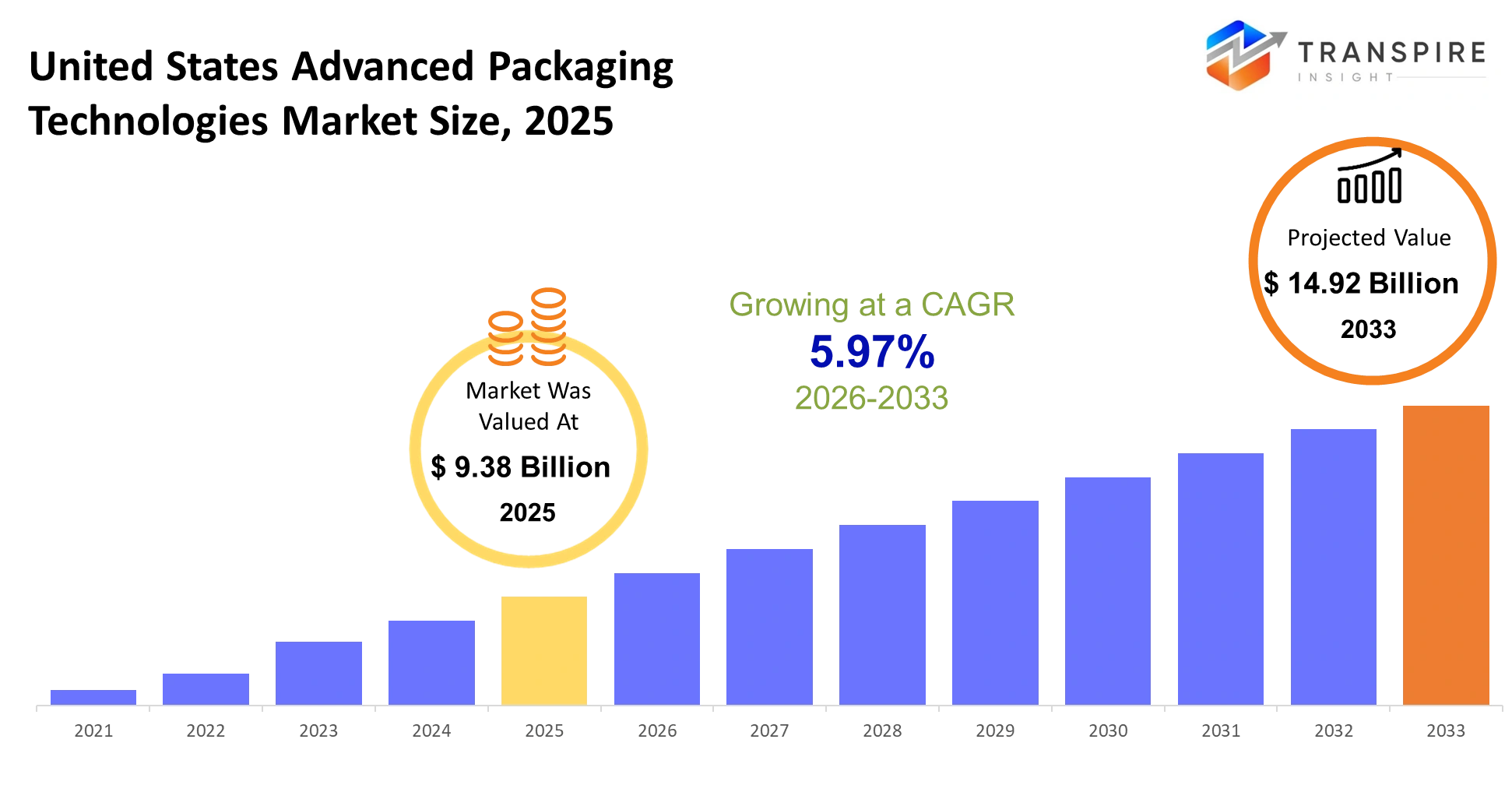
United States Advanced Packaging Technologies Market Size & Forecast:
- United States Advanced Packaging Technologies Market Size 2025: USD 9.38 Billion
- United States Advanced Packaging Technologies Market Size 2033: USD 14.92 Billion
- United States Advanced Packaging Technologies Market CAGR: 5.97%
- United States Advanced Packaging Technologies Market Segments: By Type (2.5D Packaging, 3D Packaging, Fan-out Packaging, Wafer-level Packaging, System-in-Package, Others), By Application (Consumer Electronics, Automotive, Telecom, AI Chips, HPC, Others), By End-User (Semiconductor Companies, Foundries, Electronics, Automotive, IT, Others), By Material (Silicon, Organic Substrates, Ceramics, Polymers, Metals, Others).
To learn more about this report,  Download Free Sample Report
United States Advanced Packaging Technologies Market Summary:
The United States Advanced Packaging Technologies Market size is estimated at USD 9.38 Billion in 2025 and is anticipated to reach USD 14.92 Billion by 2033, growing at a CAGR of 5.97% from 2026 to 2033. The United States Advanced Packaging Technologies Market kind of sits right in the middle of modern semiconductor performance. Like, advanced packaging lets chipmakers bring together multiple dies into smaller, quicker, and more power efficient systems, and then you see that showing up in AI servers, electric vehicles, defense electronics, smartphones, and industrial automation. Basically it fixes this big, real industry problem, because traditional chip scaling by itself doesn’t really keep up anymore, not when next generation computing workloads are asking for both processing speed and tighter energy efficiency.
Over the last five years, the market has been drifting away from simple 2D packaging toward heterogeneous integration, chiplets, and 3D stacking architectures. The momentum sped up after the global semiconductor supply chain disruptions made it painfully obvious that the U.S. was depending too much on overseas fabrication and packaging capacity. So as a reaction, federal incentives connected to domestic semiconductor manufacturing initiatives helped nudge investment into advanced packaging facilities and these surrounding R&D ecosystems.
AI infrastructure, high bandwidth memory demand, and edge computing applications all want higher interconnect density, plus better thermal handling. And because of that, the technical needs are pushing broader adoption of advanced packaging platforms. Which then turns into more spending on equipment, more outsourced semiconductor assembly demand, and longer term domestic manufacturing revenue opportunities.
Key Market Insights
- In the Western United States, the United States Advanced Packaging Technologies Market kind of dominated, with almost 38% market share in 2025, mostly because the semiconductor manufacturing ecosystems are really strong over there.
- Arizona and California keep leading the advanced semiconductor packaging investments, helped by big fab expansions plus federal incentive programs.
- The Southern United States is expected to become the fastest-growing regional market through 2032 , supported by new chip assembly and testing facilities, and honestly that momentum feels pretty clear.
- Texas showed up as a strategic semiconductor packaging hub since AI server manufacturing is scaling, and defense electronics production is also growing fast.
- Flip-chip packaging captured the biggest slice, taking more than 32% of revenue share in 2025, mainly because it delivers superior electrical performance and a cleaner signal path.
- Fan-out wafer-level packaging stayed second in terms of industry size share, driven by steady smartphone demand wearable units and automotive semiconductor needs.
- 2.5D and 3D packaging technologies are becoming the fastest-growing segment during the forecast period, pushed by AI accelerator workloads and HPC applications.
- Heterogeneous integration solutions are gaining strong market traction too, since chipmakers are leaning toward smaller form factors and better thermal management capabilities.
- Consumer electronics accounted for around 35% market share in 2025, because demand stayed steady for advanced processors, and for compact devices that people carry every day.
- AI data centers became the fastest-growing application segment , as cloud providers expanded high-bandwidth computing infrastructure across the United States.
- On top of that, automotive electronics packaging demand accelerated noticeably, as electric vehicle production keeps rising, and advanced driver-assistance system integration is getting more common.
What are the Key Drivers, Restraints, and Opportunities in the United States Advanced Packaging Technologies Market?
The main force driving the United States Advanced Packaging Technologies Market is kind of the fast commercialization of AI infrastructure and high-performance computing setups. Normal transistor scaling has hit those kind of economic and thermal efficiency boundaries, so semiconductor companies are basically pushed to use chiplet architectures, 2.5D integration, and also 3D stacking techniques. When generative AI platforms started spreading widely and data centers expanded a lot after 2022, demand jumped for processors that can manage bigger bandwidth and smaller latency tasks. That whole move boosted revenue pretty directly, from wafer-level packaging through advanced substrates, and even into semiconductor assembly equipment. Also the U.S. government side, with manufacturing incentives, sped up spending on domestic packaging plants. So integrated device manufacturers and fabless chip businesses adopted these solutions faster.
Still, the market also has a big structural snag: not enough domestic advanced packaging supply chain coverage, plus not enough skilled workforce availability. Advanced packaging needs very specific materials, specialized lithography tools, thermal management systems, and precision engineering know-how that cannot just be scaled quickly. Even when companies want to build new packaging facilities, they’re looking at multi-billion-dollar capital commitments and long qualification cycles with semiconductor customers. So capacity growth tends to lag behind processor demand, by quite a margin. This mismatch ends up slowing production schedules for AI accelerators and advanced automotive chips, which in turn reduces possible market revenue, and it raises reliance on overseas outsourced semiconductor assembly providers.
A big future opportunity kinda sits in heterogeneous integration for defense, automotive, and edge AI uses. U.S. investments aimed at secure homegrown semiconductor ecosystems are making it easier, not just easier, but more plausible for advanced packaging to get adopted in mission critical electronics. The firms working on chiplet based architectures for self driving cars and military grade computing systems are now, more and more, putting extra focus on localized packaging abilities. Arizona, and Texas are also showing up as important investment corridors where semiconductor fabrication, packaging and testing activities are being folded into regional manufacturing clusters.
What Has the Impact of Artificial Intelligence Been on the United States Advanced Packaging Technologies Market?
Artificial intelligence, and advanced digital technologies, are quietly shifting the United States Advanced Packaging Technologies Market, by making manufacturing precision better, yield management more steady, and process automation more automatic across semiconductor packaging facilities. AI enabled inspection systems, now sort out wafer defects bonding accuracy and thermal behavior in real time, so companies can spot packaging failures before final assembly, usually without waiting for later stages. Meanwhile, automated vision systems with machine learning logic baked in, have cut the defect detection duration quite a bit and, at the same time, lifted production throughput on those high density packaging lines.
Also, predictive analytics platforms are changing the way equipment upkeep works, plus they help tune processes in a less painful way. Semiconductor makers use machine learning models to keep track on vibration patterns, temperature oscillations, and material strain during wafer-level packaging, plus 3D stacking operations. Usually, these systems can forecast equipment breakdowns earlier than you’d expect, before a sudden shutdown shows up. That helps with stronger factory uptime and it cuts down on costly interruptions during production, which is kind of the whole point. In advanced packaging facilities that serve AI accelerators and high bandwidth memory, even slight yield improvements can turn into meaningful revenue benefits, because those semiconductor components are valued so highly.
Digital twins and AI driven simulation software are also pushing forward thermal management, and improving interconnect design efficiency for heterogeneous integration architectures. Still, AI adoption has a big snag, integrating AI systems into older semiconductor packaging equipment demands heavy capital spending, and it also needs large amounts of high quality production data, which many mid sized packaging providers just don’t have.
Key Market Trends
- Since 2022, AI accelerator demand sort of pushed manufacturers toward 2.5D and 3D packaging methods , that actually support higher bandwidth plus lower latency for processing.
- In the U.S. semiconductor policy world , incentive programs kicked off multi-billion-dollar packaging facility investments across Arizona , Texas and Ohio , spanning 2023 through 2026.
- More and more advanced packaging buyers leaned toward domestic sourcing , especially after pandemic-era disruptions made it obvious that dependence on Asian assembly and substrate suppliers was not great.
- Firms like Intel Corporation and Amkor Technology kept expanding their U.S. packaging operations, mainly so they could reduce geopolitical supply chain exposure.
- High-bandwidth memory integration moved from “niche use” into mainstream deployment as generative AI server installs grew quickly after 2023.
- Semiconductor manufacturers increasingly swapped monolithic chip designs for chiplet-based architectures, aiming to reduce production costs but also boost design flexibility at the same time.
- Since 2021, automated AI-driven wafer inspection systems have cut the defect detection cycle, and in turn improved packaging yield rates across advanced asseSince 2022, the AI accelerator demand sort of pushed manufacturers toward 2.5D and 3D packaging technologies, that help with higher bandwidth and lower latency processing, overall.
- In the U.S. semiconductor policy space, incentive signals kicked off multi-billion-dollar packaging facility investments in Arizona , Texas, and Ohio during 2023 to 2026 , roughly.
- Advanced packaging buyers more and more started preferring domestic sourcing, after pandemic-era disruptions made the dependence on Asian assembly and substrate suppliers painfully obvious.
- Firms like Intel Corporation and Amkor Technology have been expanding their U.S. packaging operations, mainly to cut down geopolitical supply chain risk , and keep things steadier.
- High-bandwidth memory integration moved from “kinda niche” use to mainstream deployment as generative AI server installs ramped up after 2023.
- Semiconductor manufacturers increasingly swapped out monolithic chip designs for chiplet-based architectures, so they could reduce production costs and also gain more design flexibility , easier.
- Since 2021, automated AI-guided wafer inspection systems shortened defect detection time and boosted packaging yield outcomes across advanced assembly facilities.
- Automotive semiconductor companies sped up advanced packaging adoption because electric vehicles need more computing density for ADAS plus autonomous driving system workloads.
- Outsourced semiconductor assembly providers got squeezed on margins as customers kept asking for shorter lead times, localized production , and stricter quality traceability requirements.
- Thermal management innovation turned into a real competitive focus after advanced AI processors started creating much higher heat loads than earlier semiconductor generations.mbly facilities.
- Automotive semiconductor companies also accelerated advanced packaging adoption , because electric vehicles needed higher computing density for ADAS and autonomous driving systems.
- Outsourced semiconductor assembly providers ran into margin pressure as customers asked for shorter lead times , localized production , and stricter quality traceability requirements.
- Thermal management innovation turned into a competitive necessity once advanced AI processors started producing meaningfully higher heat loads than earlier semiconductor generations.
United States Advanced Packaging Technologies Market Segmentation
By Type
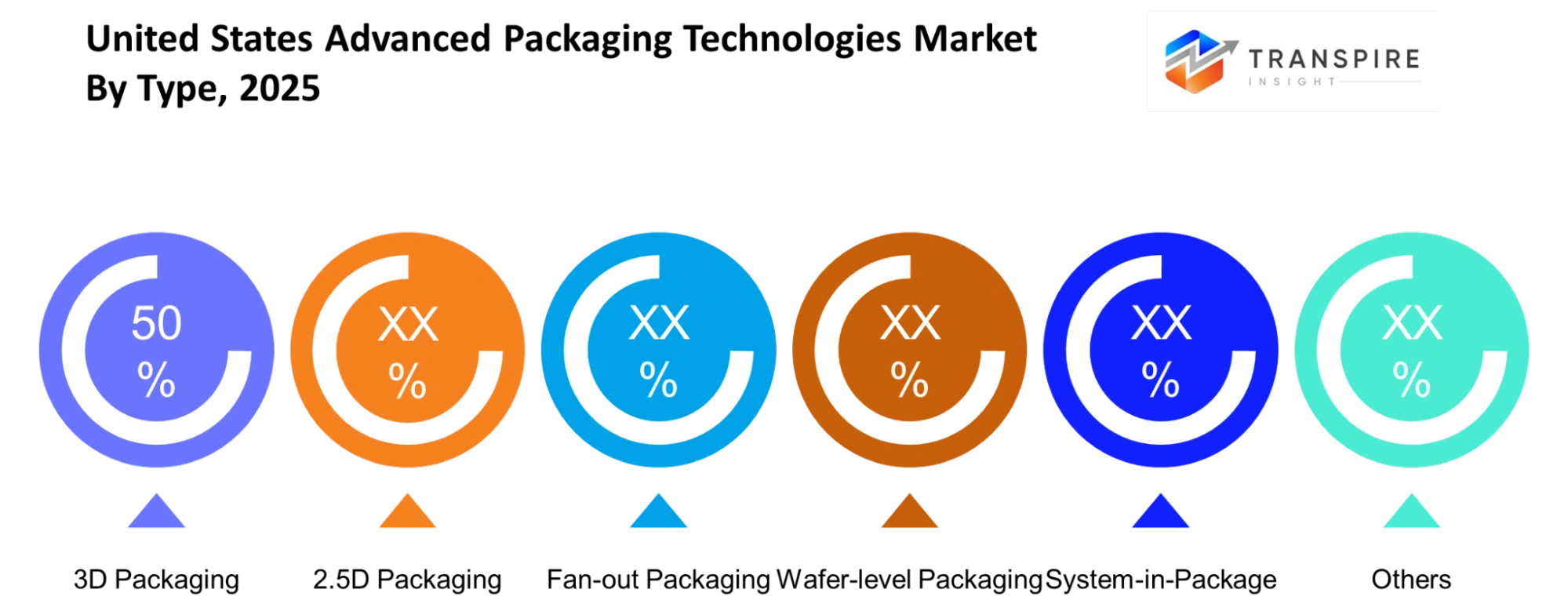
By type , fan-out packaging and wafer-level packaging currently sit in the strongest market position, in a sense, because both techs support compact semiconductor layouts , high input/output density and generally lower power usage. Consumer electronics makers and mobile processor manufacturers keep choosing these formats for smartphones wearable devices, and edge computing products. System-in-package solutions still get solid traction in networking and industrial uses, mostly because multi-chip integration is a kind of advantage that keeps paying off.
Meanwhile, 2.5D and 3D packaging are the quickest growing slice, mainly since AI accelerators and high-performance computing processors need improved thermal control plus faster data transfer. Still, the added manufacturing complexity and the higher substrate costs act like a drag on more universal take up, especially when it comes to fully integrated 3D configurations. Over the next few years, manufacturers are expected to ramp up spending on heterogeneous integration, and also on chiplet based packaging architectures. That shift should open up fresh revenue avenues for substrate vendors, packaging equipment providers, and semiconductor assembly firms that specialize in high-density interconnect technologies, even if adoption timing may vary by product class.
To learn more about this report, Download Free Sample Report
By Application
In application, consumer electronics still stays dominant, kinda like smartphone processors gaming devices and wearable electronics just keep needing compact, energy-efficient semiconductor integration. Telecom infrastructure also keeps a sizable share , since 5G rollout is pushing demand for more capable radio frequency and networking chips. Automotive use cases are growing at a steady pace too, mainly because electric vehicle output is rising along with advanced driver-assistance systems, which in turn ask for greater compute density and thermal dependability.
Still, AI chips and high-performance computing systems are, right now, the biggest growth driver across the whole ecosystem. Cloud service providers and enterprise data center operators are moving pretty fast toward advanced packaging technologies, to handle generative AI workloads and to fit high-bandwidth memory in more efficient ways. That change is nudging semiconductor design goals toward less latency and better processing efficiency. Looking ahead, new investment is likely to concentrate on packaging platforms that can back large AI clusters, edge AI devices, and the next generation data processing groundwork.
By End-User
End user segments , semiconductor companies take the biggest market share. That’s because integrated device manufacturers still keep steering the major packaging development programs and the higher-value processor output, more or less. On the other hand, foundries have a solid hold too, since fabless chip designers increasingly send wafer fabrication out, and they pair it with advanced packaging integration. Electronics manufacturers are also still big buyers, largely due to ongoing production cycles for smartphones , laptops , industrial electronics, and networking equipment. Automotive as well as IT companies are gradually raising adoption levels, because computing performance is becoming kinda central for vehicle automation and for enterprise cloud infrastructure .
Demand does shift quite a lot across these end users, mostly because packaging needs don’t match up: thermal efficiency, die dimensions, and processing intensity all change the equation. Semiconductor firms tend to chase advanced interconnect density , while auto buyers lean much more toward durability and long service life. Looking ahead , the market seems to move toward more collaboration between foundries, outsourced assembly providers , and hyperscale computing organizations. Their goal is secure and localized semiconductor packaging ecosystems, especially within the United States.
By Material
By material, silicon substrates still kind of lead the industry, because silicon gives better electrical behavior, it fits well with the semiconductor fabrication flow, and it also has reliable thermal conductivity for dense integration. Organic substrates keep a noticeable role too, since production is cheaper, and they are widely used for consumer electronics packaging, in quite a broad way. Metals like copper and certain specialized alloys are still essential, mainly for forming interconnect paths and for coping with heat dissipation in AI processors and high performance computing systems.
Ceramics remain in a smaller but very real corner, where high durability and thermal steadiness matter most, for example within aerospace and defense electronics. Polymer materials are also gaining ground, as manufacturers look for lighter yet more flexible packaging approaches, for compact electronic assemblies. In practice, selection is starting to hinge on balancing performance needs with cost efficiency , and the ability to scale up across production. Looking ahead, growth is expected in advanced substrate engineering and in thermal interface materials that can support chiplet integration, larger AI workloads, and next generation semiconductor designs, those with higher power density.
What are the Key Use Cases Driving the United States Advanced Packaging Technologies Market?
Consumer electronics still seems like the main reason advanced packaging technologies keep getting picked up in the United States. Smartphone processors, gaming chips, and wearable devices need tight layouts, quicker data transfer, and less power draw so fan-out setups, plus wafer-level packaging, become kind of a must if you want big semiconductor production in volume.
Automotive and telecom are also moving up fast. Electric vehicles, advanced driver assistance features, and 5G infrastructure are all pushing for greater computing density along with dependable thermal performance. On top of that, cloud service providers and the hyperscale data center people are rolling out advanced packaging more often, especially for AI accelerators and for combining high-bandwidth memory with less friction.
There are newer directions too, like edge AI devices, defense electronics, and even autonomous industrial robotics. These scenarios lean on heterogeneous integration and chiplet-based architectures that can handle secure, low-latency processing in cramped spaces. Advanced packaging is even starting to show early interest in quantum computing research and in next-gen aerospace systems where efficiency, honestly, is the whole point.
|
Report Metrics |
Details |
|
Market size value in 2025 |
USD 9.38 Billion |
|
Market size value in 2026 |
USD 9.94 Billion |
|
Revenue forecast in 2033 |
USD 14.92 Billion |
|
Growth rate |
CAGR of 5.97% from 2026 to 2033 |
|
Base year |
2025 |
|
Historical data |
2021 - 2024 |
|
Forecast period |
2026 - 2033 |
|
Report coverage |
Revenue forecast, competitive landscape, growth factors, and trends |
|
Geographic scope |
United States of America |
|
Key company profiled |
TSMC, Intel, Samsung, ASE Technology, Amkor, JCET, Powertech, GlobalFoundries, STATS ChipPAC, Broadcom, Qualcomm, NVIDIA, Micron, Texas Instruments, Infineon |
|
Customization scope |
Free report customization (country, regional & segment scope). Avail customized purchase options to meet your exact research needs. |
|
Report Segmentation |
By Type (2.5D Packaging, 3D Packaging, Fan-out Packaging, Wafer-level Packaging, System-in-Package, Others), By Application (Consumer Electronics, Automotive, Telecom, AI Chips, HPC, Others), By End-User (Semiconductor Companies, Foundries, Electronics, Automotive, IT, Others), By Material (Silicon, Organic Substrates, Ceramics, Polymers, Metals, Others) |
Which Regions are Driving the United States Advanced Packaging Technologies Market Growth?
The Western United States is still sort of the biggest regional center for advanced packaging techniques because California , Arizona, and Oregon have matured semiconductor manufacturing ecosystems plus serious research groundwork. After 2022, federal semiconductor incentive efforts basically pushed more money into advanced packaging plants, substrate production lines and wafer processing routines. Chip designers, foundries, equipment vendors, and research organizations keep collaborating in a very real way, and that ongoing coordination keeps the technology leadership strong there. On top of that, the region has major AI processor development work, and it’s also fairly close to hyperscale cloud computing companies, which stays driving heavy packaging demand across the area.
Meanwhile the Southern United States keeps the second-largest spot, yet the growth pattern looks a bit different, because the expansion seems more tied to manufacturing steadiness and broader industrial diversification than to research clustering. Texas and nearby states gain from lower operating costs, well established electronics manufacturing networks, and long term corporate investment playbooks. Automotive semiconductor needs, along with telecommunications infrastructure rollouts, keeps feeding steady packaging adoption across industrial and enterprise use cases. Add consistent state level incentives, plus dependable energy infrastructure, and the region becomes a reliable contributor to semiconductor assembly and testing earnings.
The Midwest is showing up as the fastest-growing regional market, as new semiconductor fabrication and packaging projects kinda shift the domestic supply chain landscape around. In the last few years, federal funding initiatives plus private investment commitments helped nudge large scale manufacturing expansion in Ohio and nearby states starting in 2023. Regional universities and workforce development programs are also putting more weight on semiconductor engineering, and on skills training for advanced packaging. All this momentum is creating favorable conditions for packaging equipment suppliers, substrate manufacturers, and outsourced assembly providers that are looking for steadier expansion opportunities, from 2026 through 2033.
Who are the Key Players in the United States Advanced Packaging Technologies Market and How Do They Compete?
The United States Advanced Packaging Technologies Market shows moderate consolidation, but honestly the competition is more about what they can do technologically, and how well they handle substrate integration, plus the domestic manufacturing scale, not so much pricing pressure. Big, established semiconductor players still try to defend their market share with heavy investment in chiplet architectures and heterogeneous integration, plus pushing interconnect density higher. At the same time, outsourced semiconductor assembly providers, and also specialized packaging firms, are picking up momentum by giving more flexible manufacturing capacity and quicker commercialization cycles for AI ,and high performance computing, use cases. More and more, competition feels like it depends on having access to advanced packaging infrastructure, better thermal management innovation, and also longer term relationships with cloud computing, automotive, and defense customers.
Intel Corporation sets itself apart with vertically integrated semiconductor production and its own proprietary packaging platforms, like Foveros and EMIB. In practice it lets the company keep a tighter grip on processor performance, thermal efficiency, plus supply chain security, especially for AI and data center customers. Intel also keeps pushing advanced packaging investment around Arizona and Ohio, which is meant to help domestic manufacturing capacity grow, and to cut back on reliance on overseas assembly ecosystems. Meanwhile Amkor Technology competes through outsourced packaging specialization, and through large-scale assembly capability that fits fabless semiconductor companies who want less capital exposure. The company continues building partnerships with automotive and high-performance computing customers, especially those that need advanced wafer level packaging services.
Advanced Micro Devices leans into a chiplet based processor setup pretty hard , which enables quicker product scaling and also keeps manufacturing costs lower than those huge monolithic chip designs. In other words, this layout helps AMD with a performance lift, especially in AI accelerator workloads and enterprise computing systems where high bandwidth integration really matters a lot. NVIDIA Corporation, on the other hand, builds its competitive stance via advanced packaging partnerships , aiming at high bandwidth memory integration that fits generative AI infrastructure. Then there’s Micron Technology, which keeps pushing on memory packaging innovation and thermal tuning methods , improving throughput in AI servers and other high density computing environments.
Company List
- TSMC
- Intel
- Samsung
- ASE Technology
- Amkor
- JCET
- Powertech
- GlobalFoundries
- STATS ChipPAC
- Broadcom
- Qualcomm
- NVIDIA
- Micron
- Texas Instruments
- Infineon
Recent Development News
In April 2026, Intel Expands EMIB-T Advanced Packaging for AI Chips: Intel is accelerating deployment of its next-generation EMIB-T advanced packaging technology, aimed at AI accelerator designs. The company is targeting “billions per year” in packaging-related revenue as demand for 2.5D integration grows sharply in the U.S. AI chip ecosystem.
Source: https://www.tomshardware.com
In May 2026, Intel & SK hynix Explore 2.5D Packaging Collaboration: Intel and SK hynix are reportedly testing EMIB-based 2.5D packaging integration for HBM memory, strengthening U.S.-linked AI chip supply chains. The collaboration focuses on improving bandwidth efficiency for next-gen AI workloads.
Source: https://www.tomshardware.com
What Strategic Insights Define the Future of the United States Advanced Packaging Technologies Market?
The United States Advanced Packaging Technologies Market is kinda moving, structurally toward heterogeneous integration ecosystems where chiplets , high bandwidth memory, and advanced substrates become more commercially important than transistor miniaturization just by itself. Over the next five to seven years AI infrastructure expansion , defense electronics localization, and edge computing deployment will pull this change forward as semiconductor firms want better processing efficiency without depending exclusively on next generation lithography scaling. Packaging technology is expected to shift from being a backend manufacturing step into something like a strategic performance differentiator, directly connected to processor architecture and overall system design.
One underappreciated risk has to do with substrate material concentration and a dependency on advanced equipment. A relatively small set of global suppliers currently control key packaging substrates, thermal interface materials, and lithography tools, so bottlenecks can still show up even if domestic semiconductor fabrication capacity expands. At the same time, advanced packaging uptake in quantum computing and defense grade edge AI systems is also a big emerging opportunity, especially for Midwest semiconductor corridors that are getting federal investment support.
Market participants should really emphasize long term partnerships across substrate manufacturing, equipment engineering, and AI processor development rather than trying to outcompete everyone just through packaging capacity expansion.
United States Advanced Packaging Technologies Market Report Segmentation
By Type
- 2.5D Packaging
- 3D Packaging
- Fan-out Packaging
- Wafer-level Packaging
- System-in-Package
- Others
By Application
- Consumer Electronics
- Automotive
- Telecom
- AI Chips
- HPC
- Others
By End-User
- Semiconductor Companies
- Foundries
- Electronics
- Automotive
- IT
- Others
By Material
- Silicon
- Organic Substrates
- Ceramics
- Polymers
- Metals
- Others
Frequently Asked Questions
Find quick answers to common questions.
The approximate United States Advanced Packaging Technologies Market size for the market will be USD 14.92 Billion in 2033.
The key segments of the United States Advanced Packaging Technologies Market are By Type (2.5D Packaging, 3D Packaging, Fan-out Packaging, Wafer-level Packaging, System-in-Package, Others), By Application (Consumer Electronics, Automotive, Telecom, AI Chips, HPC, Others), By End-User (Semiconductor Companies, Foundries, Electronics, Automotive, IT, Others), By Material (Silicon, Organic Substrates, Ceramics, Polymers, Metals, Others).
Major players in the United States Advanced Packaging Technologies Market are TSMC, Intel, Samsung, ASE Technology, Amkor, JCET, Powertech, GlobalFoundries, STATS ChipPAC, Broadcom, Qualcomm, NVIDIA, Micron, Texas Instruments, Infineon.
The current market size of the United States Advanced Packaging Technologies Market is USD 9.38 Billion in 2025.
The United States Advanced Packaging Technologies Market CAGR is 5.97%.
- TSMC
- Intel
- Samsung
- ASE Technology
- Amkor
- JCET
- Powertech
- GlobalFoundries
- STATS ChipPAC
- Broadcom
- Qualcomm
- NVIDIA
- Micron
- Texas Instruments
- Infineon
Recently Published Reports
-
Apr 2026
Healthcare Polymer Packaging Market
Healthcare Polymer Packaging Market Size, Share & Analysis Report By Packaging Type (Syringes, IV Bottles and Pouches, Clamshells, Blisters, Bottles & Jars, Containers, Tubes, IV Parental Packaging, Others), By Type (Regulated, Non-regulated), By Polymer Type (LDPE (Low-Density Polyethylene), HDPE (High-Density Polyethylene), Homo-polymer (Homo), Random Copolymer (Random), Block Copolymer (Block), PET, Polystyrene, Polyvinyl Chloride, Polyamide/EVOH, Others), and Geography (North America, Europe, Asia-Pacific, Middle East and Africa, South and Central America), 2021 - 2031
-
Apr 2026
Hydrophilic Tape (Waterstop) Market
Hydrophilic Tape (Waterstop) Market Size, Share & Analysis Report By Type (Bentonite-Based Hydrophilic Tape, Rubber-Based Hydrophilic Tape), By Application (Residential Buildings, Commercial Buildings, Infrastructure Projects), and Geography (North America, Europe, Asia-Pacific, Middle East and Africa, South and Central America), 2021 - 2031
-
Apr 2026
Metalens Market
Metalens Market Size, Share & Analysis Report By Type (Visible Light Metalens, and Infrared Metalens), By Application (Consumer Electronics, Automotive Electronics, Industrial, Medical, and Others), and Geography (North America, Europe, Asia-Pacific, Middle East and Africa, South and Central America), 2021 - 2031
-
Apr 2026
PBT Resin Market
PBT Resin Market Size, Share & Analysis Report By Type (Reinforced PBT Resin, Unreinforced PBT Resin), By Processing Method (Injection Molding, Extrusion, Blow Molding, Others), By End-User (Automotive, Electrical & Electronics, Consumer Appliances, Industrial Machinery, Medical Devices, Packaging, Others), and Geography (North America, Europe, Asia-Pacific, Middle East and Africa, South and Central America), 2021 - 2031