

Europe Automation in Electronic Manufacturing Services (EMS) Market Size & Forecast:
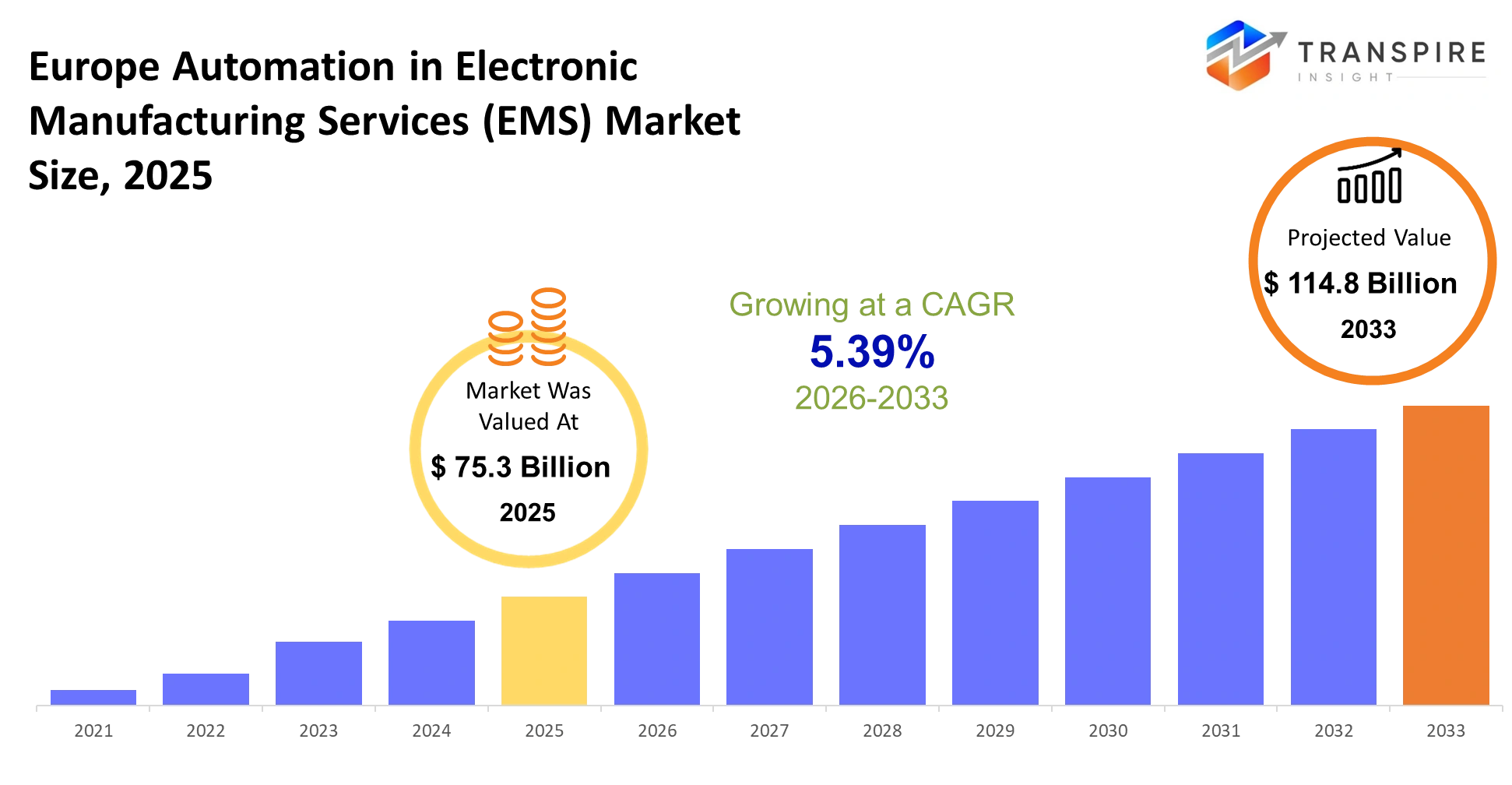
- Europe Automation in Electronic Manufacturing Services (EMS) Market Size 2025: USD 75.3 Billion
- Europe Automation in Electronic Manufacturing Services (EMS) Market Size 2033: USD 114.8 Billion
- Europe Automation in Electronic Manufacturing Services (EMS) Market CAGR: 5.39%
- Europe Automation in Electronic Manufacturing Services (EMS) Market Segments: By Type (Robotics, AI Systems, Machine Vision, Control Systems, Others), By Application (PCB Assembly, Testing, Packaging, Inspection, Material Handling, Others), By End-User (Electronics Manufacturers, EMS Providers, Semiconductor Companies, Automotive Electronics Firms, Industrial Firms, Others), By Technology (SMT Automation, IoT Integration, AI-based Systems, Edge Computing, Others).
To learn more about this report,  Download Free Sample Report
Europe Automation in Electronic Manufacturing Services (EMS) Market Summary:
The Europe Automation in Electronic Manufacturing Services (EMS) Market size is estimated at USD 75.3 Billion in 2025 and is anticipated to reach USD 114.8 Billion by 2033, growing at a CAGR of 5.39% from 2026 to 2033. The European Electronic Manufacturing Services EMS market uses automation to transform its intricate operations which handle extensive electronic product manufacturing into a system that operates with exactness and repeated results and known expenses. The EMSC providers use robotic systems together with artificial intelligence inspection systems and their digital production technology to create circuit boards while testing their components and executing supply chain operations with reduced human involvement. The solution provides a direct answer to the problem of sustaining product quality and operational speed when working with modern automotive systems and industrial equipment and telecom networks which contain extremely small and complicated electronic components.
The previous three to five years have seen an important structural change which led factories to adopt smart factory technology systems that use machine data to improve production processes throughout the day. The COVID-19 supply chain disruption created a major trigger which revealed that Europe depended on overseas manufacturing operations. Companies increased their automation efforts to restore production to domestic facilities while keeping their labor costs stable. The investment has created flexible manufacturing systems which use software-defined manufacturing technology to enable EMS companies to produce small custom orders while increasing their operational strength and delivery performance.
Key Market Insights
- Western Europe dominates the Europe Automation in Electronic Manufacturing Services (EMS) Market with over 45% share in 2025, driven by Germany's advanced industrial base.
- Eastern Europe will grow at more than 8% until 2030 because businesses use cost-saving advantages together with nearshoring methods.
- Industrial robotics maintains the highest market share because EMS companies use it to automate their assembly and testing processes.
- The machine vision systems market stands as the second largest segment because manufacturers need accurate inspection systems for their small electronic products.
- The AI-enabled process automation market represents the fastest expanding area because its growth rate will exceed 10% per year until 2030 through its predictive manufacturing abilities.
- Automotive electronics dominates the market with approximately 30% share because European countries are implementing more ADAS and EV technologies.
- Telecom infrastructure stands as the fastest expanding market sector because 5G networks are being established and there is increasing need for high-frequency electronic components.
- The automotive original equipment manufacturers (OEMs) market will reach 32% in 2025 because there is a strong demand for automated EMS solutions dedicated to EV and autonomous systems.
- The industrial electronics manufacturing sector represents the most rapidly expanding end-user market because businesses implement smart factory systems together with digital transformation programs.
What are the Key Drivers, Restraints, and Opportunities in the Europe Automation in Electronic Manufacturing Services (EMS) Market?
The economic benefits of reshoring operations through advanced automation technology create the main driver which advances the Europe Automation in Electronic Manufacturing Services (EMS) Market. European OEMs needed to change their approach to offshore operations because both labor costs in Asia have increased and supply chain problems from the pandemic. The industry started using advanced robotics and AI-driven inspection and digital production systems at this time because these technologies reduced the labor costs needed for production. EMS providers can now produce high-mix low-volume products through their European operations because they have achieved operational capacity. The company will experience an increase in contract work together with service contracts which will result in the company investing more in automation while generating regular income from software and maintenance services.
Automated EMS line facilities require high capital investment because this creates a major obstacle that prevents operation. Facilities need advanced robots together with machine vision systems and integrated software platforms which require companies to make significant capital investments that reach seven digits per facility. Smaller EMS companies need long-term contracts to justify their spending because they have to make this investment for deployment which requires complex integration work. The existing situation prevents companies from entering the market while it hinders technology advancement which creates product adoption delays that limit revenue growth in particular market segments.
The main opportunity exists because software-defined manufacturing expands through digital twins and artificial intelligence process optimization solutions. Eastern European countries have become appealing business centers because their operational expenses decrease while their digital infrastructure development continues. EMS providers can achieve rapid growth through cloud-connected production lines which use real-time simulation to optimize workflows because they need to expand physical resources. The process establishes a route that leads to the development of manufacturing models which combine operational flexibility with high profit margins.
What Has the Impact of Artificial Intelligence Been on the Europe Automation in Electronic Manufacturing Services (EMS) Market?
Artificial intelligence and advanced digital technologies are moving EMS automation from fixed programming to adaptive, data-driven control. On SMT lines, AI-driven machine vision systems now inspect solder joints and micro-components in real time, automatically adjusting placement parameters and rejecting defects with higher accuracy than rule-based systems. Manufacturers use digital twins of production lines to simulate throughput which they use to rebalance workloads while optimizing changeovers that lead to shorter cycle times and better first-pass yield.
Machine learning models enable predictive maintenance for pick-and-place machines and reflow ovens and testing equipment. The systems use vibration and temperature and cycle data analysis to predict component wear which allows them to schedule maintenance before failures occur, thus decreasing unplanned downtime and enhancing output stability. Some EMS providers achieve double-digit equipment uptime improvements together with substantial reductions in scrap and rework costs. AI-based demand sensing enables better alignment between procurement processes and production planning thus reducing inventory requirements while ensuring delivery reliability.
The process of integration continues to present challenges for progress. Many EMS facilities operate with heterogeneous legacy equipment that lacks standardized data interfaces which makes AI deployment both expensive and time-consuming. Data quality gaps during line changeovers also limit model accuracy which results in slow progress toward full-scale implementation.
Key Market Trends
- European OEMs have brought back from Asia 15 to 20 percent of their electronics assembly work since 2020 which requires EMS providers to build production lines that use automated technology for efficient operations.
- The period from 2021 to 2024 saw organizations adopting AI-based optical inspection systems which replaced manual quality checks and delivered better results through fewer defects in high-density PCB assembly.
- EMS companies have moved away from using fixed assembly lines and now operate modular systems that can be reconfigured to meet production needs and handle multiple product changes in low-volume manufacturing operations.
- The manufacturing industry has experienced labor shortages for skilled positions since 2022 which has led companies in Germany and the Czech Republic to implement collaborative robot technology.
- Machine data utilization has developed swiftly because more than 60 percent of major EMS companies plan to use real-time production analytics for crucial throughput enhancement by 2025.
- The automotive electronics market now requires electric vehicle and advanced driver assistance system components which need precise manufacturing processes that require companies to invest in advanced automation solutions.
- The combination of geopolitical conflicts and semiconductor shortages since 2021 has led EMS companies to establish multiple supply partnerships which they manage through digital platforms that provide supply chain visibility.
- Siemens, ABB and Schneider Electric have added digital twin technology and industrial IoT solutions which enable their EMS customers to predict production outcomes and minimize equipment downtime.
- Mid-tier EMS providers implemented cloud-based manufacturing execution systems in 2024 which allowed them to cut IT costs while gaining better remote production monitoring capabilities.
Europe Automation in Electronic Manufacturing Services (EMS) Market Segmentation
By Type
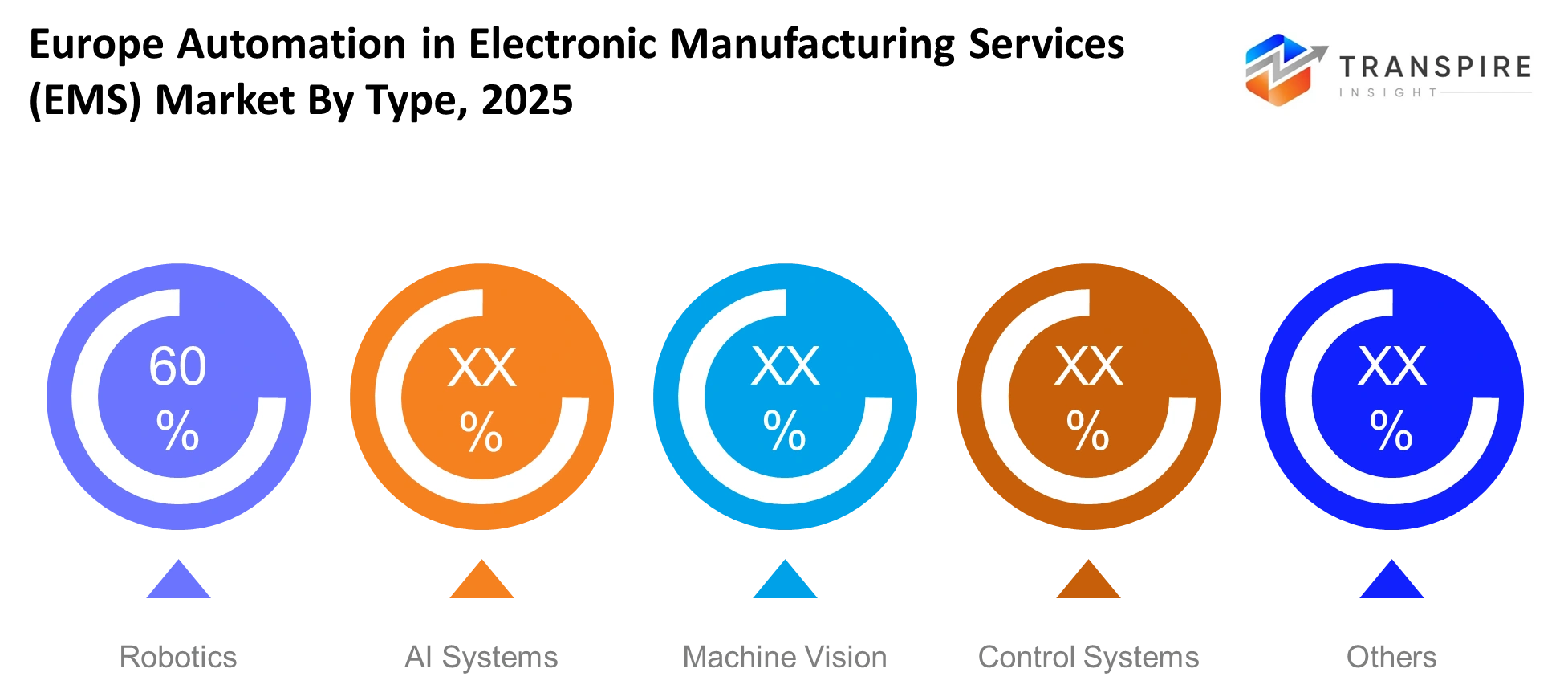
Industrial robotics operates as the primary technology which EMS providers select because they need systems which can execute automated placement and soldering and material handling tasks to achieve constant operational output with precise results. Machine vision systems follow closely, driven by the need for high-accuracy inspection in miniaturized electronics, while control systems and AI platforms expand as integration layers that coordinate operations.
The robotics industry experiences growth because companies use robots to replace human workers while they pursue steady production costs, and vision systems become more popular because automotive and telecom electronics require higher quality standards. The adoption of AI systems experiences delays because the systems require complex integration processes and organizations do not have their necessary data for operational needs. Robotics will merge with AI control systems to create hybrid production systems which enable manufacturers to adapt their operations according to changing market needs and product requirements.
To learn more about this report, Download Free Sample Report
By Application
The PCB assembly process maintains its position as the leading application because it serves as the fundamental component of electronics production while automated systems directly affect the production output and operational efficiency of the process. The testing and inspection sections hold substantial market share because product complexity has increased which makes it essential to identify defects and confirm compliance with regulations. Material handling and packaging operations experience continuous growth because end-to-end automation systems gain traction in industrial facilities.
The PCB assembly process experiences automation growth because manufacturers need to adapt to new component designs which emerge more frequently and products that have shorter market presence. Testing and inspection processes develop through two drivers which include regulatory requirements and customer demands that expect companies to deliver products without any defects. Future assembly and inspection and testing process integration will establish closed-loop systems which minimize errors while enhancing traceability to boost operational productivity.
By End-User
The end-user electronics industry together with EMS providers from manufacturing companies lead the market through their combined efforts to achieve production flexibility and cost-effective operations. Automotive electronics companies form a vital secondary market because electric vehicle and advanced driver assistance system components require manufacturers to achieve high standards of precision and reliability.
Semiconductor companies invest selectively in automation within backend processes, while industrial firms focus on scalable solutions for diversified product lines. EMS providers experience growth through two factors: their contract manufacturing expansion and their ability to manage different production needs. Automotive companies pursue advanced automation solutions to achieve their safety requirements and performance targets. OEMs and EMS providers will strengthen their partnership through shared automation platform investments for their flexible manufacturing systems which will operate in multiple local production sites.
By Technology
The existing technology of SMT automation serves as the primary production system which achieves the highest market share because it already functions effectively for fast component placement. The combination of IoT integration with AI-based systems enables organizations to conduct real-time monitoring while making critical decisions which edge computing technology enables organizations to process information on their manufacturing floor with minimal delay.
The demand for IoT solutions arises from industries needing interconnected machines which deliver nonstop operational data whereas AI implementation requires organizations to develop methods for transforming their data into useful business intelligence. The implementation of edge computing provides solutions for both latency issues and data security problems although it needs complete system upgrades. The future will see AI together with IoT and edge technologies working as one system to create autonomous production systems which will operate in EMS environments with self-managed performance optimization.
What are the Key Use Cases Driving the Europe Automation in Electronic Manufacturing Services (EMS) Market?
The main purpose of automated PCB assembly exists to support high-density board production needs of automotive electronics and industrial control unit manufacturing. The system enables accurate component placement while its soldering capabilities decrease production errors and enable quick design modifications, which leads to increased production capacity and higher contract amounts for EMS companies.
The field of testing and inspection has seen rapid expansion throughout the automotive electronics industry and the telecom equipment manufacturing sector. The advanced optical inspection system together with the functional testing system enables testing of EV modules and 5G elements to verify their safety and performance specifications.
The new use cases that have emerged for AI technology now include production planning through AI systems and digital twin simulation for high-mix manufacturing systems. The EMS applications let providers create production scenarios which they use to streamline operational processes, which enables them to develop production systems that can operate at multiple sites.
By Type
|
Report Metrics |
Details |
|
Market size value in 2025 |
USD 75.3 Billion |
|
Market size value in 2026 |
USD 79.5 Billion |
|
Revenue forecast in 2033 |
USD 114.8 Billion |
|
Growth rate |
CAGR of 5.39% from 2026 to 2033 |
|
Base year |
2025 |
|
Historical data |
2021 - 2024 |
|
Forecast period |
2026 - 2033 |
|
Report coverage |
Revenue forecast, competitive landscape, growth factors, and trends |
|
Regional scope |
Europe (Germany, United Kingdom, France, Italy, Spain and Rest of Europe) |
|
Key company profiled |
Foxconn, Jabil, Flex, Sanmina, Celestica, Benchmark Electronics, Plexus, Wistron, Pegatron, Siemens, ABB, Schneider Electric, Panasonic, Yamaha, Fuji |
|
Customization scope |
Free report customization (country, regional & segment scope). Avail customized purchase options to meet your exact research needs. |
|
Report Segmentation |
By Type (Robotics, AI Systems, Machine Vision, Control Systems, Others), By Application (PCB Assembly, Testing, Packaging, Inspection, Material Handling, Others), By End-User (Electronics Manufacturers, EMS Providers, Semiconductor Companies, Automotive Electronics Firms, Industrial Firms, Others), By Technology (SMT Automation, IoT Integration, AI-based Systems, Edge Computing, Others) |
Which Regions are Driving the Europe Automation in Electronic Manufacturing Services (EMS) Market Growth?
The market in Western Europe operates as its strongest area because the region has developed effective industrial policies and adopted Industry 4.0 standards. Germany and France establish stringent requirements for quality control and traceability, which compel EMS providers to implement advanced automation technologies. The local market contains multiple automation companies and software development firms and engineering professionals, which enables businesses to develop new products and bring them to market quickly. The system, which combines all elements, enables manufacturers to achieve their productivity targets while managing their intricate processes for producing valuable electronic items.
Northern Europe maintains its manufacturing stability through ongoing investments into producing high-reliability electronic components. Sweden and Finland direct their industrial focus toward telecom and defense and industrial electronics, which require ongoing automation improvements because their products have long development periods. The region experiences growth through technological advancement and operational stability because it depends less on reshoring than Western Europe. EMS companies benefit from their close partnerships with OEMs because these relationships help them predict market needs and generate ongoing revenue.
The fastest expansion of Eastern Europe results from businesses nearshoring their operations from Asia. Since 2022, Poland and Hungary and the Czech Republic have developed their industrial sector while drawing international investments into electronics manufacturing. Companies find it financially feasible to invest in automation because of decreasing labor expenses and their rising digital skills. The period between 2026 and 2033 will enable automation companies and EMS providers to enter the market, which requires them to develop adaptable manufacturing methods.
Who are the Key Players in the Europe Automation in Electronic Manufacturing Services (EMS) Market and How Do They Compete?
The Europe Automation in Electronic Manufacturing Services market displays a competitive landscape which combines consolidated and independent market elements because major automation companies control technological development while mid-tier system integrators specialize in customized solutions and rapid system implementation. Existing companies maintain their market position through extensive system integration capabilities and their established OEM partnerships, while new companies introduce disruptive innovations in specific markets which include AI-based inspection technologies and cloud-based manufacturing solutions. The competition between companies has shifted from cost advantages to the requirement of technology depth and system interoperability. The current evaluation process for buyers assesses vendors based on their capacity to provide adaptable production solutions through software systems instead of their hardware products.
Siemens achieves complete digital transformation by using its industrial software platform which combines digital twin technology with manufacturing execution systems to enable closed-loop production management. Through this method Siemens secures client relationships because customers depend on their ecosystems while Siemens earns revenue through extended service agreements. ABB achieves market differentiation through its high-precision robotics system and its flexible automation modules which enable production of multiple automotive electronic products. ABB establishes strategic partnerships with EMS providers which enable the company to implement robotics solutions directly into manufacturing systems, thereby enhancing customer adoption rates and expanding its customer base.
Schneider Electric focuses on developing Iot-enabled control systems which support energy-efficient automation technologies to help manufacturers achieve their objectives of reducing operational expenses and meeting sustainability standards. Flex and Jabil operate their businesses through a strategy which centers on achieving operational efficiency by utilizing their worldwide production facilities together with their state-of-the-art automation technologies to provide unified design-to-production solutions. These companies intend to grow their operations in Eastern Europe because the region provides better access to Western markets while maintaining lower business expenditures.
Company List
- Foxconn
- Jabil
- Flex
- Sanmina
- Celestica
- Benchmark Electronics
- Plexus
- Wistron
- Pegatron
- Siemens
- ABB
- Schneider Electric
- Panasonic
- Yamaha
- Fuji
Recent Development News
In January 2026, Voltatron AG acquires KOMITEC electronics GmbH to expand EMS capabilities: Voltatron AG completed the acquisition of KOMITEC electronics GmbH to significantly strengthen its EMS production capacity in Europe. The deal expands electronics manufacturing, R&D, and medium-to-large scale production capabilities, while integrating KOMITEC’s management into the group. The move is positioned as a key driver for scaling automation-led EMS operations in 2026.
Source: https://www.finanzwire.com
In January 2026, Siemens acquires ASTER Technologies to enhance PCB automation software: Siemens announced the acquisition of ASTER Technologies, a leading PCB test engineering software company. This strengthens Siemens’ digital manufacturing ecosystem by integrating advanced “shift-left” design-for-test (DFT) capabilities into its electronics manufacturing software portfolio, improving automation and defect detection in EMS workflows across Europe.
Source: https://news.siemens.com
What Strategic Insights Define the Future of the Europe Automation in Electronic Manufacturing Services (EMS) Market?
The Europe Automation in Electronic Manufacturing Services (EMS) Market has reached a new phase that now requires complete software-driven manufacturing systems which use data intelligence to achieve operational efficiency. The upcoming 5 to 7 years will experience growth because AI along with robotics and cloud-based manufacturing execution systems will create flexible production networks that operate throughout Europe.
The primary danger arises from a growing pattern in which a few automation and software vendors gain more control over technology resources because this situation will create dependency bottlenecks that restrict EMS operators from adjusting their prices. The development of digital factories across international borders will face difficulties because current interoperability standards do not function as a unified system.
Cross-border micro-factory models which use localized automated EMS hubs to meet Western European OEM needs present an emerging business opportunity in Eastern Europe. Automotive and industrial electronics companies are watching these setups because they want to build supply chain protection.
To achieve competitive advantage through distributed production networks market participants need to construct automation systems which operate across multiple platforms.
Europe Automation in Electronic Manufacturing Services (EMS) Market Report Segmentation
By Type
- Robotics
- AI Systems
- Machine Vision
- Control Systems
- Others
By Application
- PCB Assembly
- Testing
- Packaging
- Inspection
- Material Handling
- Others
By End-User
- Electronics Manufacturers
- EMS Providers
- Semiconductor Companies
- Automotive Electronics Firms
- Industrial Firms
- Others
By Technology
- SMT Automation
- IoT Integration
- AI-based Systems
- Edge Computing
- Others
Frequently Asked Questions
Find quick answers to common questions.
The approximate Europe Automation in Electronic Manufacturing Services (EMS) Market size for the market will be USD 114.8 Billion in 2033.
The key segments of the Europe Automation in Electronic Manufacturing Services (EMS) Market are By Type (Robotics, AI Systems, Machine Vision, Control Systems, Others), By Application (PCB Assembly, Testing, Packaging, Inspection, Material Handling, Others), By End-User (Electronics Manufacturers, EMS Providers, Semiconductor Companies, Automotive Electronics Firms, Industrial Firms, Others), By Technology (SMT Automation, IoT Integration, AI-based Systems, Edge Computing, Others).
Major players in the Europe Automation in Electronic Manufacturing Services (EMS) Market are Foxconn, Jabil, Flex, Sanmina, Celestica, Benchmark Electronics, Plexus, Wistron, Pegatron, Siemens, ABB, Schneider Electric, Panasonic, Yamaha, Fuji.
The current market size of the Europe Automation in Electronic Manufacturing Services (EMS) Market is USD 75.3 Billion in 2025.
The Europe Automation in Electronic Manufacturing Services (EMS) Market CAGR is 5.39%.
- Foxconn
- Jabil
- Flex
- Sanmina
- Celestica
- Benchmark Electronics
- Plexus
- Wistron
- Pegatron
- Siemens
- ABB
- Schneider Electric
- Panasonic
- Yamaha
- Fuji
Recently Published Reports
-
Apr 2026
Fiber Optic Faceplates Market
Fiber Optic Faceplates Market Size, Share & Analysis Report By Type (< 300 mm2, 300-350 mm2, and > 350 mm2, By Application (Night Vision, Holographic Imaging, Medical, and Others), and Geography (North America, Europe, Asia-Pacific, Middle East and Africa, South and Central America), 2021 - 2031
-
Apr 2026
High Temperature Superconductors Market
High Temperature Superconductors Market Size, Share & Analysis Report By Type (1G HTS, and 2G HTS), By Application (Power Cable, Fault Current Limiter, and Transformer), and Geography (North America, Europe, Asia-Pacific, Middle East and Africa, South and Central America), 2021 - 2031
-
Apr 2026
Industrial Plugs and Socket Market
Industrial Plugs and Socket Market Size, Share & Analysis Report By Type (Industrial Plugs, Industrial Sockets), By Current (Up to 32 A, 32 to 125 A, Above 125 A), By Protection (Dustproof and Splash Proof, Waterproof, Explosion Proof), By End User (Heavy Industries, Oil and Gas, Chemicals and Pharmaceuticals, Power Generation, Others), and Geography (North America, Europe, Asia-Pacific, Middle East and Africa, South and Central America), 2021 - 2031
-
Apr 2026
InGaAs Avalanche Photodiodes Market
InGaAs Avalanche Photodiodes Market Size, Share & Analysis Report By Type (1100 - 1700 nm, and 1000 - 1600 nm), By Application (Missile Warning System, Muzzle Flash Detection, Wafer Defect Inspection, Laser Rangefinders, and Others), and Geography (North America, Europe, Asia-Pacific, Middle East and Africa, South and Central America), 2021 - 2031