

Japan Discrete Semiconductor Market Size & Forecast:
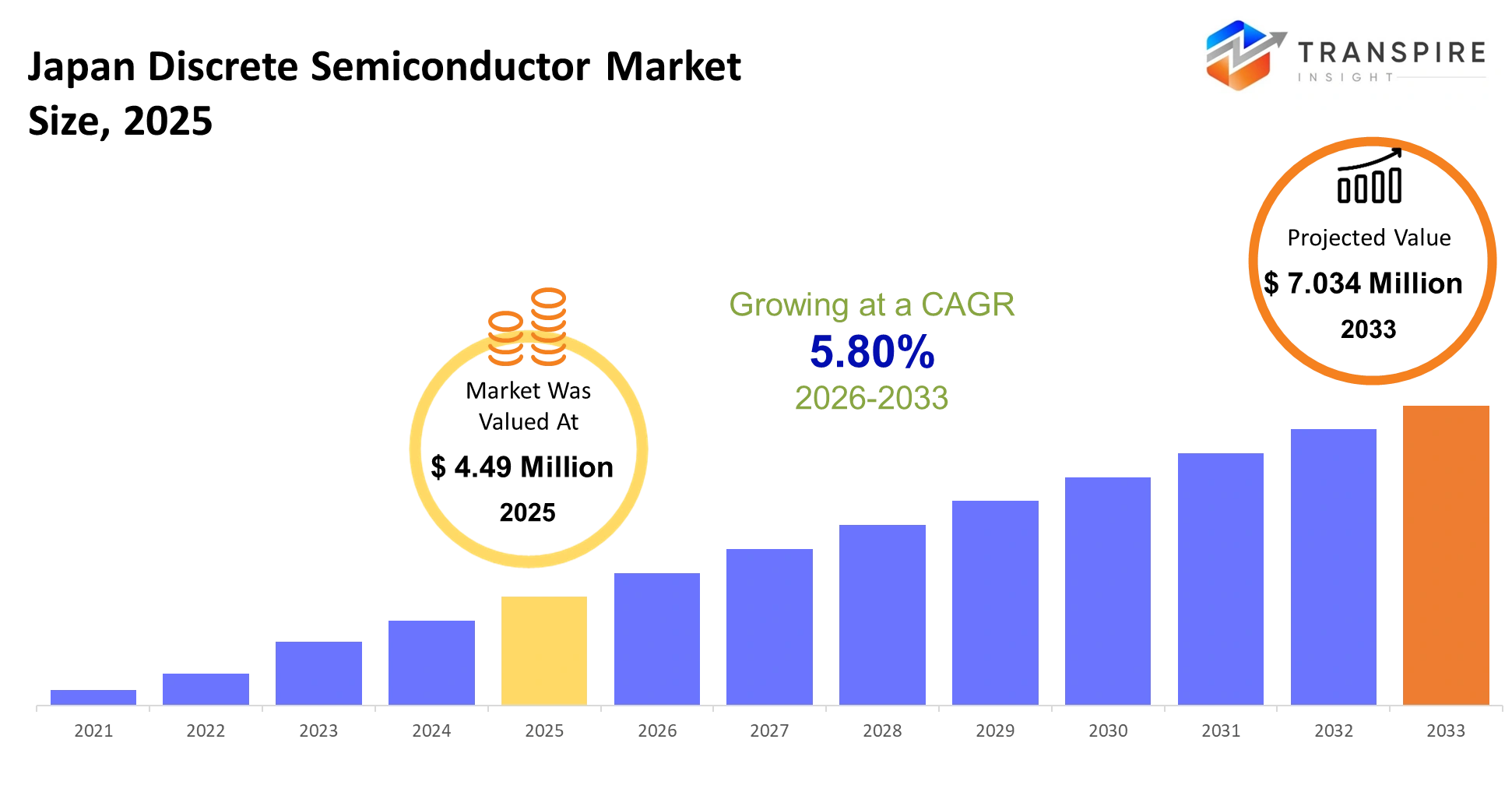
- Japan Discrete Semiconductor Market Size 2025: USD 4.49 Billion
- Japan Discrete Semiconductor Market Size 2033: USD 7.034 Billion
- Japan Discrete Semiconductor Market CAGR: 5.80%
- Japan Discrete Semiconductor Market Segments: By Type (Diodes, Transistors, Thyristors, Rectifiers, Others); By Application (Consumer Electronics, Automotive, Industrial, Telecom, Power Electronics, Others); By End-User (Electronics Manufacturers, Automotive Companies, Industrial Firms, Telecom Operators, Energy Sector, Others); By Technology (Silicon, SiC, GaN, Others)
To learn more about this report,  Download Free Sample Report
Japan Discrete Semiconductor Market Summary
The Japan Discrete Semiconductor Market was valued at USD 4.49 Billion in 2025. It is forecast to reach USD 7.034 Billion by 2033. That is a CAGR of 5.80% over the period.
The Japan Discrete Semiconductor Market enables projects which control and convert electrical power throughout electric vehicles and industrial robots and factory automation systems and maritime power management systems. These components operate high-load environments through their capacity to achieve efficient switching and voltage regulation and energy control. The market has experienced a fundamental transformation over the past three to five years because the electrification of mobility and industrial systems has become mainstream, which drives the increased use of silicon carbide and gallium nitride devices that provide superior efficiency and thermal performance compared to silicon.
Japan manufacturers used the semiconductor supply chain disruptions which occurred between 2020 and 2022 to realize their excessive reliance on foreign suppliers, which led them to boost domestic manufacturing capabilities while they developed new methods for managing their supply chains. The combination of these elements requires original equipment manufacturers to implement more efficient discrete components during their product development processes, which positions power electronics as a key technology that supports the expansion of electric vehicles and renewable energy systems and advanced automation throughout Japan's industrial sector.
Key Market Insights
- The Kanto region leads the Japan Discrete Semiconductor Market because it has an estimated market share of 35% which results from its strong base of electronics and automotive manufacturing activities in 2025.
- Power MOSFETs hold the largest share in the Japan Discrete Semiconductor Market, driven by EV inverters and industrial switching applications.
- IGBTs rank as the second-largest segment, widely used in high-voltage industrial motor control systems.
- Silicon carbide (SiC) devices represent the fastest-growing market segment which will experience rapid growth between 2025 and 2031 because of their ability to deliver high efficiency.
- The automotive electrification sector maintains its leading position which represents 40% of total applications because EV production and hybrid vehicles are increasing in Japan.
- The industrial sector experiences its most rapid growth through the implementation of industrial automation which relies on robotics systems and the development of smart factory environments.
- The increasing use of renewable energy systems depends on discrete semiconductors which enable both effective power conversion and grid stabilization.
- The Japan Discrete Semiconductor Market sees its highest demand from automotive original equipment manufacturers who lead all other user groups in market share.
- The industrial equipment manufacturing sector experiences fast expansion because manufacturing facilities implement AI-based automation systems and energy-saving technologies.
- Energy utilities are beginning to adopt new technologies which require them to increase semiconductor usage for smart grid systems and renewable energy integration initiatives.
What are the Key Drivers, Restraints, and Opportunities in the Japan Discrete Semiconductor Market?
The main factor driving development today stems from the fast expansion of electric power systems which include electric vehicles and energy-saving industrial automation technologies. The implementation of government-sponsored carbon neutrality goals for 2050 together with increased vehicle emission requirements has driven companies to adopt efficient power solutions that use silicon carbide technology and advanced MOSFET devices. Automakers and industrial equipment manufacturers reached their performance limits with conventional silicon technology, which marked the beginning of this transition. Discrete semiconductors now serve a vital function because they help decrease energy waste while enhancing thermal performance and enabling operation of higher power systems, which leads to increased income streams for manufacturers of advanced components.
The most significant constraint is Japan’s dependence on specialized raw materials and advanced fabrication equipment imported from global suppliers. The existing system forces manufacturers to depend on international suppliers because it requires specific materials which they cannot produce themselves. The current system hinders companies from scaling their operations because it leads to supply chain interruptions, which became evident during the worldwide semiconductor crisis. Establishing ultra-pure material supply chains and fabrication facilities requires lengthy financial commitments that need several years to complete, which makes immediate solutions impossible. The production process faces delays because production scaling takes time to complete and because the market needs certain product features which need time to develop.
The semiconductor industry can benefit from its domestic production of SiC and GaN semiconductors which requires investment in the Kyushu and Tohoku semiconductor clusters. Japanese industrial groups and global chipmakers have established joint initiatives which enable them to produce next-generation power devices at local facilities. The new development will improve supply security for electric vehicle platforms and renewable energy systems while boosting their market adoption.
What Has the Impact of Artificial Intelligence Been on the Japan Discrete Semiconductor Market?
The combination of artificial intelligence together with advanced digital technologies brings new improvements to scrubber performance systems while developing more effective marine emission control systems which use discrete semiconductor components in both industrial and maritime operations. Japanese power electronics now use AI-enabled monitoring systems to automate scrubber operation which includes real-time flow rate and temperature and chemical dosing adjustments based on engine load conditions. This process brings about two advantages because it decreases the need for workers to operate equipment while creating better results which meet International Maritime Organization emission standards.
The power semiconductor modules send their sensor data to machine learning models which use this information to determine when maintenance needs to take place because of device degradation and thermal stress problems. The system enables operators to select proper maintenance times which results in system uptime increases of 10 to 15 percent during advanced installations together with decreases in costs that occur during unexpected shutdowns. AI-based systems use optimization processes to improve fuel consumption in hybrid propulsion systems together with industrial motor systems by distributing power loads between multiple semiconductor-based converters.
The introduction process faces challenges because the maritime sector lacks sufficient high-quality training data while sea operations depend on unstable network access which affects both model performance and cloud system analysis. The existing gap between laboratory-controlled AI testing and actual system deployment creates a barrier which prevents organizations from utilizing their complete digital transformation potential despite having access to advanced technologies.
Key Market Trends
- The electrification of automotive systems has led to a quick increase in the use of SiC-based discrete semiconductors which now power inverter systems to replace traditional silicon components that were used in high-voltage systems.
- Japanese manufacturers established domestic production for discrete semiconductor manufacturing after 2020 semiconductor shortages because they wanted to decrease their reliance on foreign production facilities which would help them maintain consistent production rates.
- Between 2023 and 2026 Japanese automakers strengthened their partnerships with ROHM and Toshiba to secure power semiconductor production for their electric vehicle programs.
- Since 2022 silicon carbide devices have become the preferred choice for high-efficiency applications because their thermal performance exceeds that of traditional silicon devices in compact industrial systems.
- Since 2021 Japanese industries have increased their use of industrial robotics which drives up demand for discrete semiconductors that enable precise motor control and energy-saving automation systems.
- After 2022 AI-based predictive maintenance tools now enhance the operational efficiency of discrete semiconductor manufacturing equipment by decreasing unexpected factory shutdowns.
- Infineon and ON Semiconductor established new strategic partnerships in Japan starting from 2023 which has increased their competitive pressure against domestic companies such as Mitsubishi Electric.
- Since 2022 renewable energy sources have become more important for Japan's grid stabilization systems which now require more discrete semiconductors to support the development of its power infrastructure.
Japan Discrete Semiconductor Market Segmentation
By Type:
The discrete semiconductor market in Japan uses diodes and transistors because these components demonstrate reliable performance in handling signal control and switching operations used in electronic devices and consumer products. The components maintain constant efficiency to enable common electronic functions in all applications.
Thyristors and rectifiers handle power management and conversion tasks while additional components deliver specific functions that provide support for specialized circuits used in industrial and automotive applications. The continuous operation of systems depends on these discrete devices with maintenance scheduled throughout their lifecycle.
By Application:
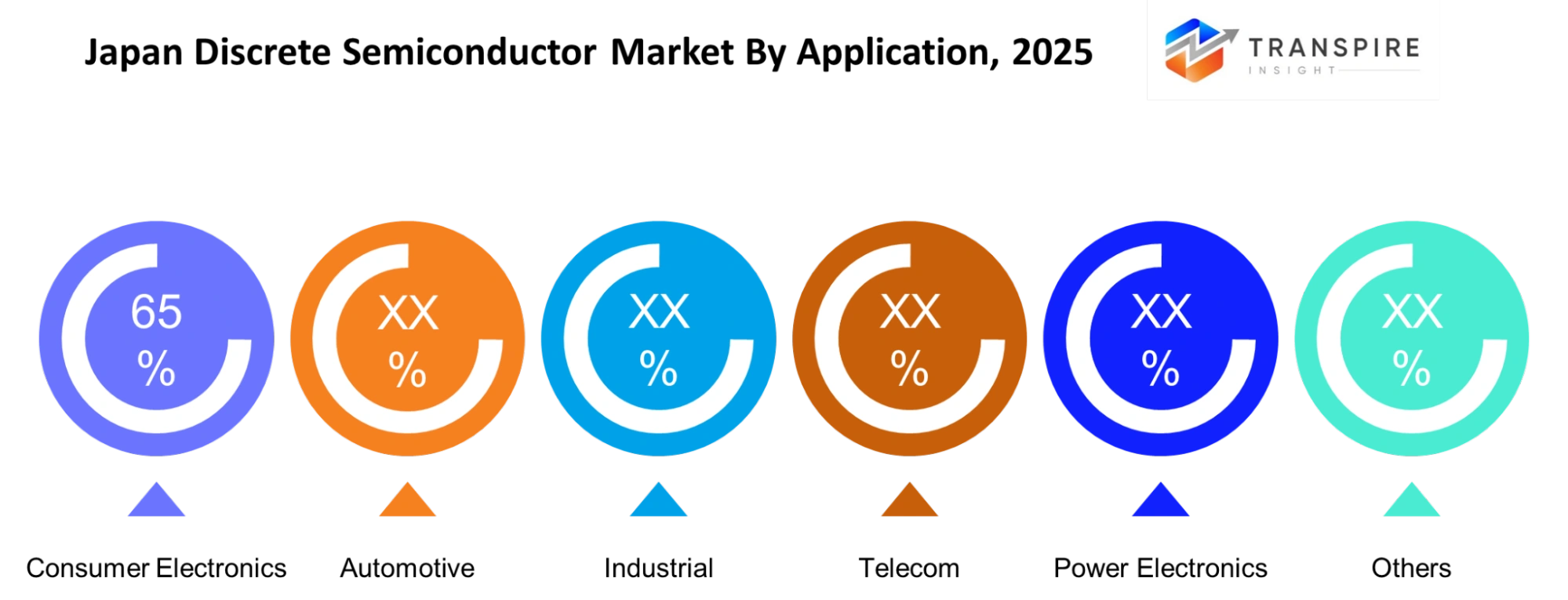
Discrete components find use in modern equipment through power control and charging systems and device regulation needs which drive demand from consumer electronics and automotive applications. The increasing use of electronics leads to a steady need for component integration into devices.
The industrial telecom and power electronics sectors maintain their current adoption rates while other sectors progress through automated systems and energy-saving technologies which drive the growth of the Japanese market. The increasing system upgrades lead to the broader use of discrete semiconductor solutions in various applications.
To learn more about this report, Download Free Sample Report
By End-User:
Electronics manufacturers and automotive companies use discrete semiconductors to achieve efficient circuit design and system reliability and system stability. These industries depend on consistent component performance for product development.
Industrial firms and telecom operators and the energy sector enable broader adoption while specialized users in different industries select specific operational needs. Semiconductor-based solutions maintain constant demand because multiple industries adopt this technology.
By Technology:
The semiconductor production process in Japan uses silicon as its primary material because it delivers cost-effective and consistent operational capabilities throughout the industry. The technology enables various applications within standard electronic systems.
The automotive and industrial systems use SiC and GaN technologies to achieve energy-efficient and high-power performance. These materials are increasingly used for next-generation power solutions.
What are the Key Use Cases Driving the Japan Discrete Semiconductor Market?
The main application of the Japan Discrete Semiconductor Market operates in automotive electrification which employs power devices to control high-voltage switching that occurs in EV inverters and battery systems and motor drives. The automotive sector creates the greatest need because Japanese car manufacturers are expanding their hybrid and electric vehicle output to achieve carbon neutrality and comply with new emissions regulations.
The applications of discrete semiconductors have expanded to industrial automation and robotics which use these components to achieve precise motor control and create energy-saving factory equipment and enable fast switching operations in smart manufacturing systems. Energy utilities use these components to build renewable integration systems which help maintain consistent solar and wind power generation during periods of industrial grid upgrades.
New applications are emerging through smart maritime systems and industrial machinery AI-enabled predictive maintenance platforms. The advanced power semiconductors in these applications enable onboard energy efficiency improvements and fuel consumption reduction and real-time equipment diagnostics. The rate of adoption will increase during the forecast period as digitization processes advance through logistics fleets, which utilize automated systems for their industrial operations.
|
Report Metrics |
Details |
|
Market size value in 2025 |
USD 4.49 Billion |
|
Market size value in 2026 |
USD 4.741 Billion |
|
Revenue forecast in 2033 |
USD 7.034 Billion |
|
Growth rate |
CAGR of 5.80% from 2026 to 2033 |
|
Base year |
2025 |
|
Historical data |
2021 - 2024 |
|
Forecast period |
2026 - 2033 |
|
Report coverage |
Revenue forecast, competitive landscape, growth factors, and trends |
|
Country scope |
Japan |
|
Key company profiled |
Infineon, ON Semiconductor, STMicroelectronics, Toshiba, Renesas, NXP, Vishay, Rohm, Mitsubishi Electric, Fuji Electric, Texas Instruments, Analog Devices, Hitachi, Samsung, Broadcom |
|
Customization scope |
Free report customization (country, regional & segment scope). Avail customized purchase options to meet your exact research needs. |
|
Report Segmentation |
By Type (Diodes, Transistors, Thyristors, Rectifiers, Others); By Application (Consumer Electronics, Automotive, Industrial, Telecom, Power Electronics, Others); By End-User (Electronics Manufacturers, Automotive Companies, Industrial Firms, Telecom Operators, Energy Sector, Others); By Technology (Silicon, SiC, GaN, Others) |
Which Regions are Driving the Japan Discrete Semiconductor Market Growth?
The Japan Discrete Semiconductor Market maintains its highest market share in Kanto because the region contains numerous automotive OEM headquarters and electronics manufacturers and research and development facilities. The Tokyo and Kanagawa areas contain multiple innovation ecosystems which bring together semiconductor design and electric vehicle and industrial automation systems. The Yokohama and Chiba ports possess strong infrastructure which enables the export of high-value electronics and the import of precise materials. The region sees ongoing power semiconductor investments because government-funded mobility electrification initiatives create better business conditions for the technology.
Kansai operates as a reliable secondary hub which depends on Osaka and Kyoto and Kobe to create its economic strength through various industrial sectors that include machinery and chemicals and precision equipment production. The Kanto region achieves its economic success through innovation while Kansai develops its industrial base through both regular capital investments and partnerships with equipment manufacturers. The research institutions and universities in Kyoto work on small advancements which contribute to the development of power electronics technology. The semiconductor market maintains stability because the automotive and export markets experience periodic downturns while semiconductor demand remains constant.
Kyushu experiences rapid growth because the region brings back semiconductor production to its facilities and TSMC leads the development of the Kumamoto fabrication ecosystem with its extensive investments. The cluster development process has gained speed since 2022 because government subsidies and infrastructure growth have created new opportunities for international and local suppliers to establish operations. The manufacturing capabilities of Kyushu have evolved to support the production of advanced power devices. The region presents strong growth potential for investors according to market entrants because Japan plans to boost its domestic semiconductor production capabilities until 2033.
Who are the Key Players in the Japan Discrete Semiconductor Market and How Do They Compete?
The Japan Discrete Semiconductor Market shows moderate competition because established domestic companies control the market while international suppliers win design projects for automotive and industrial markets. The incumbents maintain their market position by establishing deep partnerships with Japanese OEMs who require extended power device testing before they can qualify products for use. The market competition focuses on three elements which include advancements in SiC and GaN technology and the ability to maintain high-temperature performance and the ability to provide long-term product availability. New market entrants achieve success through their ability to deliver products which operate with better efficiency and enable faster switching capabilities.
Toshiba develops silicon carbide power semiconductors which serve as the core components for electric vehicle traction systems through its close relationships with Japanese car manufacturers to obtain ongoing design contracts and consistent production agreements. ROHM Semiconductor establishes its market position by providing exclusive SiC wafer manufacturing technology. The company develops low-loss systems which operate at higher efficiency while expanding its production capabilities throughout western Japan to satisfy the increasing demand for electric vehicle inverters. Mitsubishi Electric uses its internal manufacturing management systems to produce highly dependable industrial power modules which support robotics and factory automation applications. Infineon Technologies establishes its market presence through automotive collaborations with Japanese original equipment manufacturers which integrate its power semiconductor products into upcoming electric vehicle systems. The company ON Semiconductor increases its production capacity for SiC while establishing supply contracts with both international and Japanese automotive manufacturers to fulfill upcoming high-voltage system requirements.
Company List
- Infineon
- ON Semiconductor
- STMicroelectronics
- Toshiba
- Renesas
- NXP
- Vishay
- Rohm
- Mitsubishi Electric
- Fuji Electric
- Texas Instruments
- Analog Devices
- Hitachi
- Samsung
- Broadcom
Recent Development News
In February 2026, SiTime Corporation entered into a definitive agreement with Renesas Electronics to acquire its timing business. The transaction also includes a strategic partnership to integrate SiTime’s MEMS resonator technology into Renesas’ embedded computing products, strengthening precision timing solutions for AI, datacenter, and communications applications in Japan’s semiconductor ecosystem.Source https://www.renesas.com/
In March 2026, ROHM, Toshiba, and Mitsubishi Electric entered formal negotiations to merge their power semiconductor businesses into a unified entity. The proposed integration focuses on SiC and GaN-based discrete power devices to improve global competitiveness in EVs, renewable energy systems, and industrial power control markets.
Source https://www.reuters.com/
What Strategic Insights Define the Future of the Japan Discrete Semiconductor Market?
The Japan Discrete Semiconductor Market is moving toward high-efficiency wide-bandgap power electronics because electrification will increase in mobility and industrial automation and energy systems during the upcoming 5 to 7 years. The shift occurs because companies require solutions that minimize energy waste in high-voltage systems while enabling compact and thermally stable products for electric vehicles and smart industrial equipment. Advanced SiC substrate manufacturing experiences a hidden risk because supply concentration has increased in that sector, which creates potential bottlenecks from limited global suppliers who face growing demand, thus exposing manufacturers to pricing fluctuations and delayed capacity expansions.
Kyushu presents an emerging opportunity because it is developing its compound semiconductor ecosystem through local production of integrated wafer fabrication and packaging facilities that connect to new foreign and domestic investments. Power device manufacturers will experience major benefits because this technology will enable shorter supply chains which will lead to faster design-to-production processes. The companies should implement vertical integration approaches or establish extended-term material agreements because these methods will help them reduce upstream resource reliance while gaining first access to Japan's developing wide-bandgap semiconductor market.
Japan Discrete Semiconductor Market Report Segmentation
By Type
- Diodes
- Transistors
- Thyristors
- Rectifiers
By Application
- Consumer Electronics
- Automotive
- Industrial
- Telecom
- Power Electronics
By End-User
- Electronics Manufacturers
- Automotive Companies
- Industrial Firms
- Telecom Operators
- Energy Sector
By Technology
- Silicon
- SiC
- GaN
Frequently Asked Questions
Find quick answers to common questions.
The Japan Discrete Semiconductor Market size is USD 7.034 Billion in 2033.
Key segments for the Japan Discrete Semiconductor Market are By Type (Diodes, Transistors, Thyristors, Rectifiers, Others); By Application (Consumer Electronics, Automotive, Industrial, Telecom, Power Electronics, Others); By End-User (Electronics Manufacturers, Automotive Companies, Industrial Firms, Telecom Operators, Energy Sector, Others); By Technology (Silicon, SiC, GaN, Others).
Major Japan Discrete Semiconductor Market players are Infineon, ON Semiconductor, STMicroelectronics, Toshiba, Renesas, NXP, Vishay, Rohm, Mitsubishi Electric, Fuji Electric, Texas Instruments, Analog Devices, Hitachi, Samsung, Broadcom.
The Japan Discrete Semiconductor Market size is USD 4.49 Billion in 2025.
The Japan Discrete Semiconductor Market CAGR is 5.80% from 2026 to 2033.
- Infineon
- ON Semiconductor
- STMicroelectronics
- Toshiba
- Renesas
- NXP
- Vishay
- Rohm
- Mitsubishi Electric
- Fuji Electric
- Texas Instruments
- Analog Devices
- Hitachi
- Samsung
- Broadcom
Recently Published Reports
-
Apr 2026
Fiber Optic Faceplates Market
Fiber Optic Faceplates Market Size, Share & Analysis Report By Type (< 300 mm2, 300-350 mm2, and > 350 mm2, By Application (Night Vision, Holographic Imaging, Medical, and Others), and Geography (North America, Europe, Asia-Pacific, Middle East and Africa, South and Central America), 2021 - 2031
-
Apr 2026
High Temperature Superconductors Market
High Temperature Superconductors Market Size, Share & Analysis Report By Type (1G HTS, and 2G HTS), By Application (Power Cable, Fault Current Limiter, and Transformer), and Geography (North America, Europe, Asia-Pacific, Middle East and Africa, South and Central America), 2021 - 2031
-
Apr 2026
Industrial Plugs and Socket Market
Industrial Plugs and Socket Market Size, Share & Analysis Report By Type (Industrial Plugs, Industrial Sockets), By Current (Up to 32 A, 32 to 125 A, Above 125 A), By Protection (Dustproof and Splash Proof, Waterproof, Explosion Proof), By End User (Heavy Industries, Oil and Gas, Chemicals and Pharmaceuticals, Power Generation, Others), and Geography (North America, Europe, Asia-Pacific, Middle East and Africa, South and Central America), 2021 - 2031
-
Apr 2026
InGaAs Avalanche Photodiodes Market
InGaAs Avalanche Photodiodes Market Size, Share & Analysis Report By Type (1100 - 1700 nm, and 1000 - 1600 nm), By Application (Missile Warning System, Muzzle Flash Detection, Wafer Defect Inspection, Laser Rangefinders, and Others), and Geography (North America, Europe, Asia-Pacific, Middle East and Africa, South and Central America), 2021 - 2031