
United States Automotive Quality Service Market Size & Forecast:
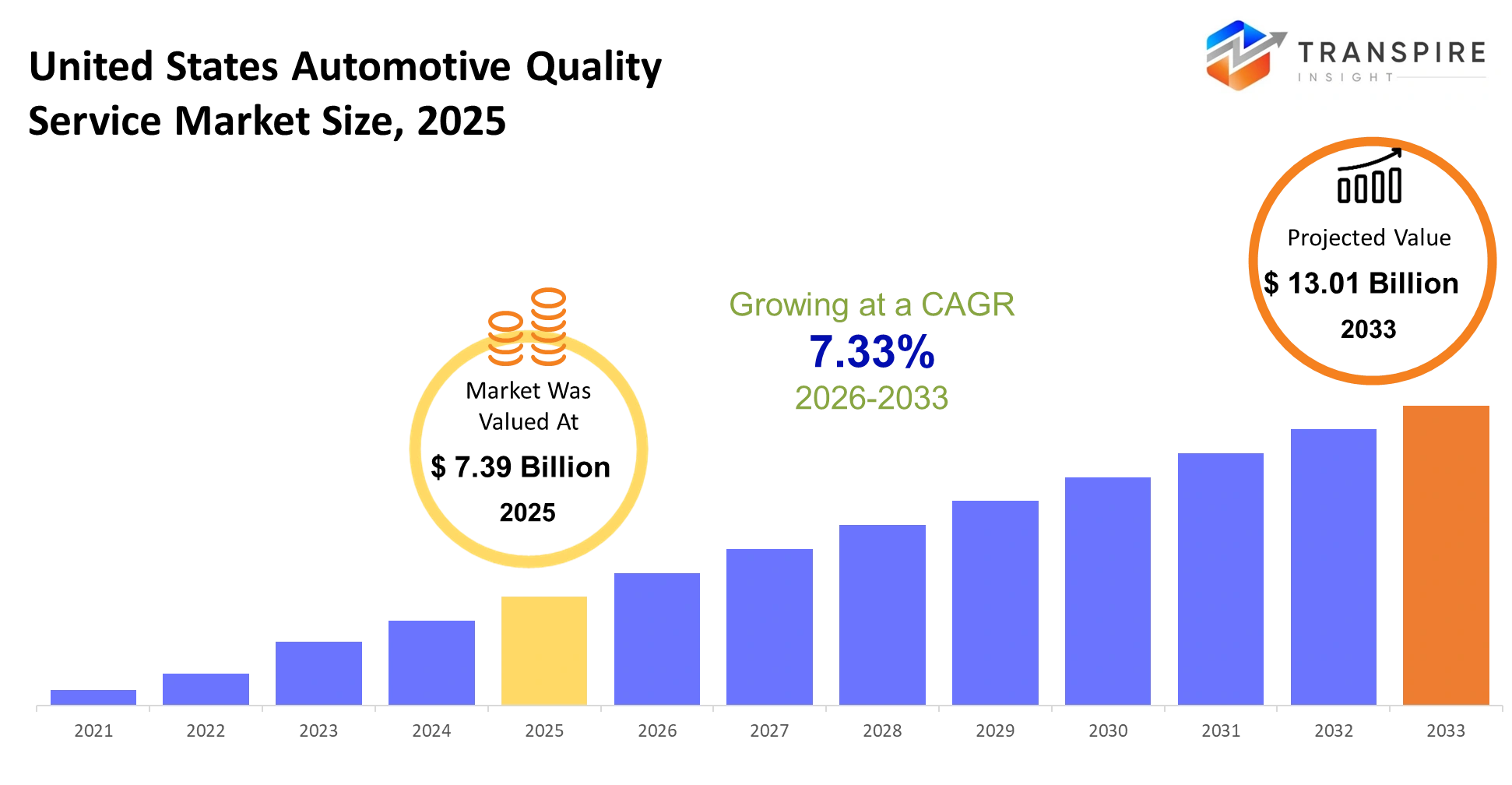
- United States Automotive Quality Service Market Size 2025: USD 7.39 Billion
- United States Automotive Quality Service Market Size 2033: USD 13.01 Billion
- United States Automotive Quality Service Market CAGR: 7.33%
- United States Automotive Quality Service Market Segments: By Service Type (Inspection Services, Testing Services, Calibration Services, Certification Services, Quality Audits, Others); By Vehicle Type (Passenger Cars, Commercial Vehicles, Electric Vehicles, Luxury Vehicles, Others); By Application (Manufacturing Quality Control, Supplier Quality Assurance, Vehicle Testing, Compliance Management, Others); By End User (OEMs, Component Suppliers, Dealerships, Fleet Operators, Others)
To learn more about this report,  Download Free Sample Report
United States Automotive Quality Service Market Summary
The United States Automotive Quality Service Market was valued at USD 7.39 Billion in 2025. It is forecast to reach USD 13.01 Billion by 2033. That is a CAGR of 7.33% over the period.
The United States Automotive Quality Service Market plays a pretty critical role in keeping vehicle manufacturing and aftermarket operations compliant, efficient, and honestly commercially viable. These kinds of services cover inspection , testing, calibration, certification supplier audits and defect analysis that help automakers and component suppliers cut down recalls, stay within safety requirements, and keep production steady across vehicle platforms that get more and more complex each year. In real practice, the market ends up acting like a risk-control layer for an industry where even small quality glitches can turn into huge financial liabilities , plus brand harm too.
Over the last five years, the market has kinda moved away from the older mechanical quality checks toward software-integrated validation that is linked with electric vehicles, advanced driver assistance systems, and connected vehicle architectures. The semiconductor shortage plus the post-pandemic supply chain disruptions, they basically exposed weaknesses in supplier quality oversight. So manufacturers had to reinforce third-party inspection and traceability programs. As a result the demand keeps growing for predictive analytics, digital twins , and AI-assisted testing tools. And since modern vehicles are increasingly software dependent, quality service providers are getting pulled into lifecycle monitoring and cybersecurity validation, which in turn supports longer-term service agreements and recurring revenue streams across OEMs and Tier-1 ecosystems.
Key Market Insights
- The Midwest sort of dominated the United States Automotive Quality Service Market, with about 38% share in 2025, mainly because automotive manufacturing hubs are more concentrated there, and that really stacks up.
- Meanwhile the Southern region shows the quickest momentum all the way through 2031, backed by EV battery plants and fresh OEM assembly investments that keep rolling in, not just in theory.
- For services, Inspection and testing took the lead in the United States Automotive Quality Service Market, claiming roughly 34% of revenue share in 2025, by a noticeable margin.
- Certification and compliance auditing stayed as the second-largest segment because stricter federal vehicle safety, and emissions regulations keep tightening over time.
- On the growth side, AI-powered predictive quality analytics came up as the fastest-moving segment, expected to expand rapidly during the 2026–2031 window, especially as adoption accelerates.
- Lastly, cybersecurity validation services started gaining emerging demand, as connected vehicles increase their reliance on cloud-based automotive software systems, so the need keeps surfacing.
- Passenger vehicle manufacturing basically took up about 57% of the market in 2025, mainly because production volumes stayed high and recall prevention requirements were more strictly handled.
- Electric vehicle production turned into the fastest-growing application segment too, since automakers pushed harder on battery and ADAS quality verification checks, you know.
- Supplier quality monitoring tools also started getting real traction as OEMs bolstered traceability, and defect reduction efforts across global sourcing networks, at least that’s how it looks.
- Automotive OEMs were the ones who dominated the market, with roughly 49% share in 2025 , because they kept investing in integrated quality control throughout assembly operations.
What are the Key Drivers, Restraints, and Opportunities in the United States Automotive Quality Service Market?
The main force molding the United States Automotive Quality Service Market is the fast move toward software-defined vehicle systems, plus the more grownup driver assistance technologies. Right now automakers are dealing with way more electronic control units, sensors, and connected functions than they did just five years back. That change got sped up by stricter federal safety review ,and a few very visible vehicle recalls tied to software glitches and battery defects. So OEMs and Tier-1 suppliers have been ramping up spend on validation tests, cybersecurity checks, and predictive quality analytics, basically to shrink warranty risk and keep production from getting derailed. In practice, quality service providers are seeing longer contract windows, and ongoing revenue linked to continuous software verification.
The largest drag still comes from how split up the supplier ecosystem is across the North American automotive manufacturing chain. A lot of mid-sized suppliers are still leaning on older inspection tools and separate data platforms that don’t really click well with AI quality solutions. Swapping these out means major capital outlay, training for the workforce, and yes production downtime. This built in mismatch slows down digital quality takeup ,and it also holds back how quickly manufacturers can standardize compliance workflows and traceability processes.
One big chance is forming via EV battery manufacturing expansion along southern United States production corridors. Fresh gigafactory projects in Tennessee, Georgia, and Texas are pulling in demand for specialized battery cell inspection, thermal testing, and contamination analysis services. Quality companies that build automated battery validation capabilities are, sort of already set, to grab the next wave of higher margin service deals.
What Has the Impact of Artificial Intelligence Been on the United States Automotive Quality Service Market?
Artificial intelligence along with advanced digital technologies are messing a bit with how the United States Automotive Quality Service Market works, because quality management is shifting away from reactive inspection and toward a continuous, data driven validation approach. Lately, automotive manufacturers are rolling out AI enabled machine vision on production lines to catch weld defects , paint inconsistencies, battery cell contamination, and component misalignment while the parts are moving, basically in real time. These automated inspection setups cut down the hours spent on manual checking and lift defect detection precision, especially for electric vehicle assembly, where tolerances are smaller and software integration feels more tangled than before.
At the same time, machine learning is stepping up predictive maintenance and manufacturing reliability across automotive plants. Quality service providers are using sensor data pulled from robotic arms, stamping equipment, and battery production systems to guess equipment failures ahead of time, before a breakdown happens. This model lets manufacturers limit unplanned downtime, stretch equipment life , and increase overall production flow. Some OEM sites have even seen double digit reductions in inspection cycle times, and they’ve reported clear drops in warranty related quality costs after switching to AI based analytics platforms.
There’s also more momentum behind digital twins plus cloud connected compliance systems, and together they’re making traceability stronger across supplier networks, so manufacturers can pinpoint where defects really started faster and lower recall risk. Still, the big catch is that the integration costs are high , which stays a major limitation. A lot of Tier 2 and Tier 3 suppliers are stuck with fragmented legacy systems, and those older setups don’t really support AI driven quality infrastructure without serious capital upgrades and some workforce retraining too.
Key Market Trends
- Since 2021, automakers have been growing AI enabled visual inspection systems to catch battery defects and software failures earlier, before the last stages of vehicle assembly.
- After 2022, electric vehicle production ramped up , and that change has really accelerated demand for thermal testing, battery contamination analysis , and high voltage component validation services.
- When semiconductor shortages hit in 2021 and 2022, OEMs also tightened supplier traceability programs and they increased spending on third-party quality audits across North America .
- Automotive manufacturers started drifting away from periodic inspections, and instead leaned into continuous digital monitoring platforms. These systems track production deviations in real time across more than one facility, pretty much everywhere.
- Companies like SGS and Intertek expanded EV centered testing laboratories closer to the southern United States manufacturing corridors after 2023, kind of following the manufacturing wave.
- Federal safety attention climbed after multiple software related recalls between 2022 and 2025, so manufacturers are now moving toward cybersecurity validation and over the air update testing.
- Tier-1 suppliers more and more adopted cloud connected compliance systems , which can shorten defect response times and boost production transparency across distributed supply chains.
- Since 2024, premium vehicle makers have increased adoption of digital twin technology , using simulations to model quality failures before physical production even begins.
- Automotive quality providers are shifting from project based inspection agreements toward subscription style monitoring services, linked to lifecycle software validation and predictive maintenance.
- Regional competition has intensified as Tennessee, Georgia, and Texas pulled in multi billion dollar EV and battery manufacturing investments, and that reshaped the way automotive testing demand gets formed.
United States Automotive Quality Service Market Segmentation
By Service Type :
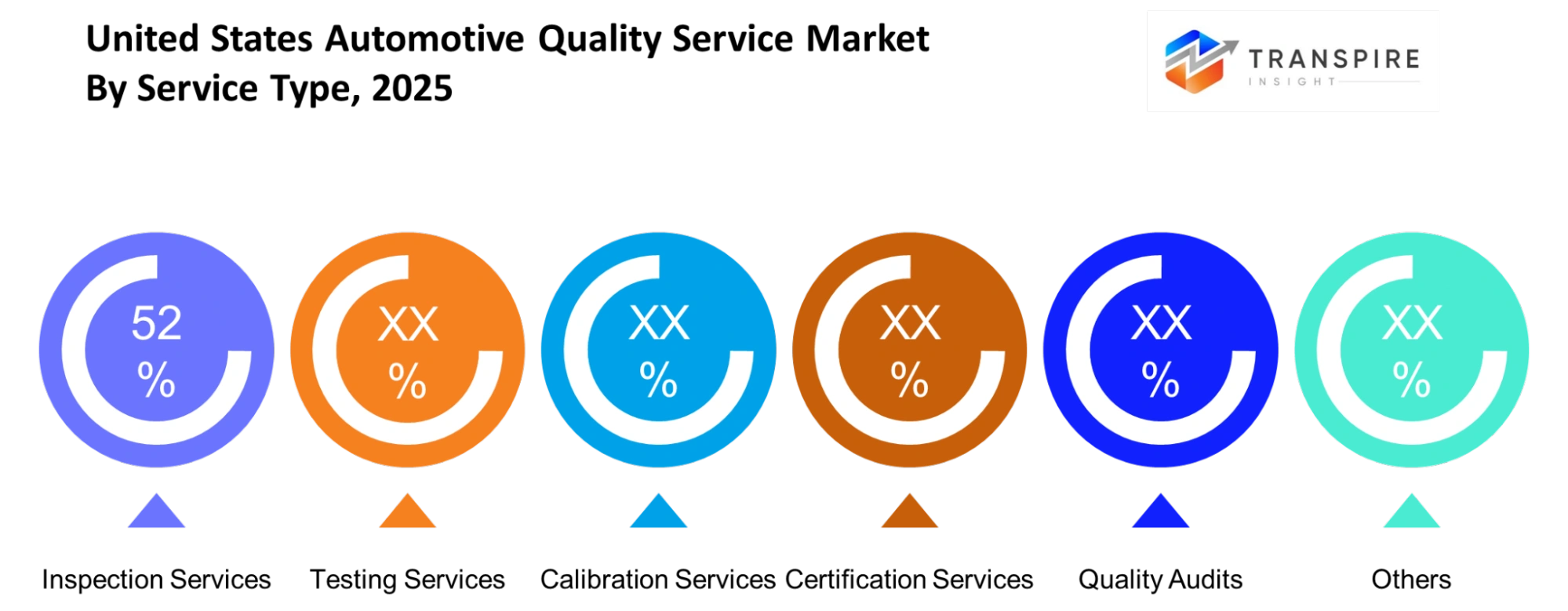
Inspection services have an important role in the United States Automotive Quality Service Market, mostly because car makers keep paying close attention to catching problems before vehicles actually reach customers. In this way, these services help maintain production standards, and they also lower the chances of expensive product recalls. At the same time, vehicle complexity is getting higher, and the growing reliance on electronic systems keeps pushing up the need for routine inspection work across different manufacturing sites.
Meanwhile testing services are moving forward in a steady manner too, as manufacturers run durability, safety, and performance evaluations to stay aligned with strict requirements. Calibration services back up precision in automotive instruments and measurement systems , while certification services help organizations keep compliance with relevant industry standards. Quality audits and adjacent support services are getting more focus, since both suppliers and manufacturers want better operational efficiency and more even vehicle quality across production networks, not just in one single factory.
To learn more about this report, Download Free Sample Report
By Vehicle Type :
Passenger cars really take up a big chunk of the service demand, mainly because production volumes are so huge and there are continuous quality checks that keep happening. Automotive firms also put a lot of money into quality management systems, just to keep customer satisfaction steady and protect the brand’s value. Regular inspection and testing, plus certification work, basically helps makers boost reliability, and also cut down the long- term maintenance worries for passenger vehicles.
Commercial vehicles still need broad quality backing too, since fleet reliability and day to day operational safety have to stay front and center for transportation companies. On top of that, electric vehicles are opening extra pathways, thanks to more advanced battery systems, deeper software integration, and safety needs that keep changing. Luxury cars, meanwhile, demand very strict quality validation, because buyers expect top tier performance and refined, new features. This pushes manufacturers to use more granular testing, calibration procedures during development phases ,and also throughout production.
By Application :
Manufacturing quality control is a pretty important use case because auto companies really try to cut down on defects while things are being produced. With ongoing monitoring of the assembly steps, they can keep things steady, and overall, it helps the final vehicle performance come out better. Quality service providers also back manufacturers by doing inspections, running data analysis, and performing process evaluations, which in turn bolster operational norms and help trim those production losses in automotive plants.
Supplier quality assurance is getting more and more critical too, since manufacturers rely on broad supplier networks for parts and raw materials. Then there are vehicle testing services that help verify safety, endurance, and overall performance before a product goes out commercially. Also compliance management services are rising steadily, since automotive regulations tied to emissions, safety, and environmental standards keep getting more strict , and that pushes companies to improve documentation and certification procedures, in a more disciplined way.
By End User :
OEMs stay the leading end users, because vehicle manufacturers keep investing in quality improvement programs, to remain competitive in the market. They kinda rely on inspection, testing, certification and auditing services, so vehicles actually meet the industry rules and what customers expect. There’s a strong push toward production efficiency and product dependability that keeps feeding demand for automotive quality services from the big manufacturers.
Component suppliers add a lot too, since automotive parts need rigorous validation before they get slotted into final vehicle assembly. Dealerships lean on quality services to back up vehicle inspections and keep customer satisfaction programs running smoothly, while fleet operators concentrate on vehicle performance, safety, and less day-to-day downtime. There are also other end users, like independent service providers and mobility companies, and they’re increasingly adopting quality related solutions to boost their operating standards.
What are the Key Use Cases Driving the United States Automotive Quality Service Market?
In the United States, the biggest “use case” within the Automotive Quality Service Market is still production-line inspection and validation for passenger vehicle manufacturing. Automakers sort of rely on these services so they can find assembly defects, check software integration, and avoid expensive recalls, before the vehicles even leave the production facilities. The demand stays strongest in EV assembly plants, where battery safety plus electronic system accuracy calls for continuous testing all the time.
Other, secondary use cases are spreading too, especially across Tier-1 supplier operations and aftermarket service networks. Component manufacturers are starting to lean harder on predictive quality analytics and supplier audit programs, mainly to satisfy tougher OEM traceability requirements. At the same time, fleet operators and commercial vehicle manufacturers are adopting remote diagnostics and compliance monitoring tools too, aiming to cut maintenance downtime a bit, and to support better lifecycle performance.
On top of that, the emerging stuff includes cybersecurity validation for connected vehicles and digital twin simulation for autonomous driving systems. These ideas are still in early adoption, but they’re picking up pace as regulators tighten software safety oversight and automakers push faster toward software-defined vehicle platforms.
|
Report Metrics |
Details |
|
Market size value in 2025 |
USD 7.39 Billion |
|
Market size value in 2026 |
USD 7.93 Billion |
|
Revenue forecast in 2033 |
USD 13.01 Billion |
|
Growth rate |
CAGR of 7.33% from 2026 to 2033 |
|
Base year |
2025 |
|
Historical data |
2021 - 2024 |
|
Forecast period |
2026 - 2033 |
|
Report coverage |
Revenue forecast, competitive landscape, growth factors, and trends |
|
Geographic scope |
United States of America |
|
Key company profiled |
TÜV SÜD, SGS, Bureau Veritas, Intertek, DEKRA, Applus+, UL Solutions, Eurofins Scientific, Element Materials Technology, Mistras Group, TÜV Rheinland, A2LA, NSF International, DNV, Kiwa |
|
Customization scope |
Free report customization (country, regional & segment scope). Avail customized purchase options to meet your exact research needs. |
|
Report Segmentation |
By Service Type (Inspection Services, Testing Services, Calibration Services, Certification Services, Quality Audits, Others); By Vehicle Type (Passenger Cars, Commercial Vehicles, Electric Vehicles, Luxury Vehicles, Others); By Application (Manufacturing Quality Control, Supplier Quality Assurance, Vehicle Testing, Compliance Management, Others); By End User (OEMs, Component Suppliers, Dealerships, Fleet Operators, Others) |
Which Regions are Driving the United States Automotive Quality Service Market Growth?
The Midwest still seems like the leading place in the United States Automotive Quality Service Market, mostly because it holds the country’s biggest cluster of long-standing automotive manufacturing infrastructure. Michigan, Ohio, and Indiana keep on anchoring major OEM assembly plants, plus engineering centers, and supplier networks that really need nonstop inspection , testing , and compliance services. The area also leans on decades of built up manufacturing know-how, decent logistics connectivity, and this tight cooperation between automakers and certification providers. On top of that, the regulatory attention around vehicle safety recalls and emissions results helps keep demand steady for more advanced validation and quality assurance initiatives across the whole regional production web.
The Western United States kind of plays a different part, it leans more toward software validation, connected vehicle systems, and autonomous driving technologies. California especially, generates fairly stable market revenue from EV related experimentation, mobility startups, and advanced driver assistance testing, instead of relying as much on huge traditional assembly activities. Tech firms, semiconductor developers, and premium EV brands create this quality service environment that’s often centered on cybersecurity verification and software reliability checks. This setup gives the region resilience, in the sense that revenue is tied less to vehicle production cycles and more to ongoing technology development efforts.
The Southern United States seems to be growing as the quickest regional market , largely because EV manufacturing is ramping up pretty aggressively and the battery supply chain is getting localized too. Starting around 2022, places like Tennessee, Georgia, and Texas have pulled in multi-billion-dollar money for battery plants, EV assembly sites and even semiconductor production. So, these efforts—kind of right away—turned into a noticeable need for battery cell inspection, contamination analysis and automated production quality systems, things that before were more limited in the region. Looking at the 2026–2033 window, this whole move should generate real momentum for testing providers , AI inspection companies , and calibration service firms that want early positioning close to these new automotive manufacturing corridors.
Who are the Key Players in the United States Automotive Quality Service Market and How Do They Compete?
The United States Automotive Quality Service Market is still, kind of moderately fragmented, with global testing and certification firms going head to head alongside specialized software validation providers and more regional engineering service companies . In practice, competition is switching emphasis toward tech integration, not just the usual inspection pricing. Automakers now tend to choose partners that can bundle AI driven defect detection, cybersecurity validation, predictive analytics, and supplier traceability into one unified service platform, or at least one tightly connected ecosystem. The bigger, older incumbents still keep a lot of OEM relationships , but newer digital quality players are making traditional workflows feel slower by rolling out cloud-connected monitoring systems and quicker software verification.
SGS sort of stands out with integrated compliance management plus advanced EV battery testing capabilities across North American manufacturing corridors. They’ve also been putting more money into automated laboratory infrastructure and digital audit platforms , aimed at supporting automakers that are moving toward software-defined vehicles. DEKRA leans very hard into connected vehicle validation and functional safety certification, so it lands a strong position in autonomous driving and cybersecurity testing programs. Their growth plan tends to revolve around specialized mobility testing facilities near newer EV production clusters, particularly in the southern United States .
Intertek kind of competes via fast inspection turnaround time, and also data driven supplier quality management tools that help manufacturers lower the risk of recall exposure, you know. TÜV SÜD meanwhile has strengthened its standing through high voltage battery certification and more advanced driver assistance system validation services, especially ones tailored for the premium EV makers. At the same time, Bureau Veritas is expanding its partnerships with automotive suppliers in order to deliver ongoing production monitoring and cloud based traceability systems, which in turn improve quality visibility across multi tier sourcing networks, kind of overall.
Company List
- TÜV SÜD
- SGS
- Bureau Veritas
- Intertek
- DEKRA
- Applus+
- UL Solutions
- Eurofins Scientific
- Element Materials Technology
- Mistras Group
- TÜV Rheinland
- A2LA
- NSF International
- DNV
- Kiwa
Recent Development News
In February 2026, Cox Automotive and UVeye launched AI-powered retail service lane vehicle inspection solutions. The partnership integrated AI-driven inspection and condition intelligence tools into dealership workflows, helping U.S. dealers accelerate vehicle appraisals, automate merchandising, and improve repair transparency and operational efficiency.
Source https://www.motor.com/
In January 2026, CCC Intelligent Solutions launched its OEM Repair Certification Management Solution with Nissan as the first participant in the CCC OEM Link Network. The platform was introduced to streamline OEM collision repair certification processes and strengthen quality assurance visibility for approximately 2,000 certified repair facilities across the U.S. market.
Source https://www.nasdaq.com/
What Strategic Insights Define the Future of the United States Automotive Quality Service Market?
The United States Automotive Quality Service Market is moving, structurally speaking, toward continuous software-centric quality assurance models that run across the whole vehicle lifecycle, not just during manufacturing. The real driver behind this shift is the fast turn to software-defined vehicles, where over-the-air updates, battery management systems, and autonomous driving functions need constant validation long after the car is already rolling out of production. Over the next five to seven years, quality service providers will more and more make recurring revenue via subscription-style monitoring, predictive analytics, and cybersecurity verification platforms that connect into the broader connected vehicle ecosystem.
One not-so-obvious risk is the growing concentration of advanced testing capabilities among a relatively small set of global certification firms and AI platform providers. That situation might spark pricing pressure for automakers and also reduce flexibility in supplier choice if regulatory requirements get more technically specialized over time. But there’s also an emerging opportunity: battery recycling and second-life EV battery certification services, especially along southern United States manufacturing corridors where battery production capacity is expanding pretty fast. Companies trying to enter here should put resources in early on AI-enabled battery diagnostics and traceability tooling before the industry standards get fully pinned down, and before it all gets more competitive.
United States Automotive Quality Service Market Report Segmentation
By Service Type
- Inspection Services
- Testing Services
- Calibration Services
- Certification Services
- Quality Audits
By Vehicle Type
- Passenger Cars
- Commercial Vehicles
- Electric Vehicles
- Luxury Vehicles
By Application
- Manufacturing Quality Control
- Supplier Quality Assurance
- Vehicle Testing
- Compliance Management
By End User
- OEMs
- Component Suppliers
- Dealerships
- Fleet Operators
Frequently Asked Questions
Find quick answers to common questions.
The United States Automotive Quality Service Market size is USD 13.01 Billion in 2033.
Key segments for the United States Automotive Quality Service Market are By Service Type (Inspection Services, Testing Services, Calibration Services, Certification Services, Quality Audits, Others); By Vehicle Type (Passenger Cars, Commercial Vehicles, Electric Vehicles, Luxury Vehicles, Others); By Application (Manufacturing Quality Control, Supplier Quality Assurance, Vehicle Testing, Compliance Management, Others); By End User (OEMs, Component Suppliers, Dealerships, Fleet Operators, Others).
Major United States Automotive Quality Service Market players are TÜV SÜD, SGS, Bureau Veritas, Intertek, DEKRA, Applus+, UL Solutions, Eurofins Scientific, Element Materials Technology, Mistras Group, TÜV Rheinland, A2LA, NSF International, DNV, Kiwa.
The United States Automotive Quality Service Market size is USD 7.39 Billion in 2025.
The United States Automotive Quality Service Market CAGR is 7.33% from 2026 to 2033.
- TÜV SÜD
- SGS
- Bureau Veritas
- Intertek
- DEKRA
- Applus+
- UL Solutions
- Eurofins Scientific
- Element Materials Technology
- Mistras Group
- TÜV Rheinland
- A2LA
- NSF International
- DNV
- Kiwa
Recently Published Reports
-
Apr 2026
ATV & UTV Market
ATV & UTV Market Size, Share & Analysis Report By Type (ATV, and UTV), By Variants (Less Than 400 CC, 400 CC To 800 CC, and More Than 800 CC), and Geography (North America, Europe, Asia-Pacific, Middle East and Africa, South and Central America), 2021 - 2031
-
Apr 2026
Automotive Central Gateway Module Market
Automotive Central Gateway Module Market Size, Share & Analysis Report By Type (Ethernet Central Gateway Module, CAN Central Gateway Module, LIN Central Gateway Module, and FlexRay), By Application (Powertrain Control, Body Control, Infotainment System, Advanced Driver Assistance Systems (ADAS), and Others), By End User (Passenger Vehicles, and Commercial Vehicles), and Geography (North America, Europe, Asia-Pacific, Middle East and Africa, South and Central America), 2021 - 2031
-
Apr 2026
Automotive Engine Oil Filter Market
Automotive Engine Oil Filter Market Size, Share & Analysis Report By Filter Type (Fuel Filter, Engine Oil Filter, Hydraulic Oil Filter, and Others), By Filter Media (Cellulose, Synthetic, and Micro), By Sales Channel (OEMs, and Aftermarket), By Vehicle Type (Passenger Cars, Light Commercial Vehicles, Heavy Duty Trucks, Buses and Coaches, and Off-road Vehicles), and Geography (North America, Europe, Asia-Pacific, Middle East and Africa, South and Central America), 2021 - 2031
-
Apr 2026
Automotive Parts Aluminium Die Casting Market
Automotive Parts Aluminium Die Casting Market Size, Share & Analysis Report By Production Process (Pressure Die Casting, Vacuum Die Casting, Squeeze Die Casting, Gravity Die Casting), By Application (Body Parts, Engine Parts, Transmission Parts, Battery And Related Components, Other Application Types), and Geography (North America, Europe, Asia-Pacific, Middle East and Africa, South and Central America), 2021 - 2031
Our Clients