United States Automotive Adaptive Cruise Control Market Size & Forecast:
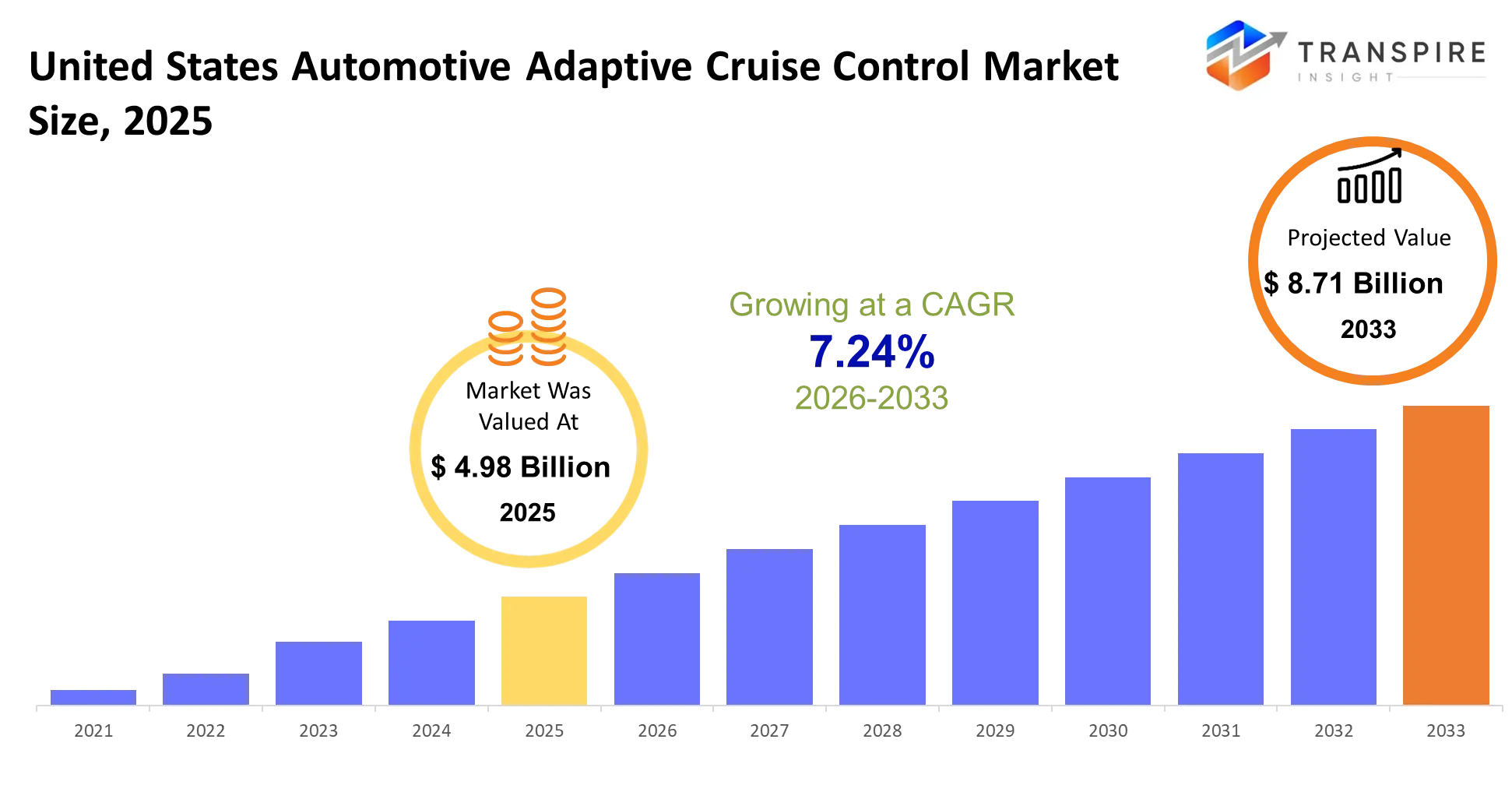
- United States Automotive Adaptive Cruise Control Market Size 2025: USD 4.98 Billion
- United States Automotive Adaptive Cruise Control Market Size 2033: USD 8.71 Billion
- United States Automotive Adaptive Cruise Control Market CAGR: 7.24%
- United States Automotive Adaptive Cruise Control Market Segments: By Component (Radar Sensors, Cameras, LiDAR Sensors, Electronic Control Units, Software Systems, Others); By Vehicle Type (Passenger Cars, SUVs, Commercial Vehicles, Electric Vehicles, Others); By Technology (Conventional ACC, Predictive ACC, AI-based ACC, Cooperative ACC, Others); By Sales Channel (OEMs, Aftermarket, Others)
To learn more about this report,  Download Free Sample Report
United States Automotive Adaptive Cruise Control Market Summary
The United States Automotive Adaptive Cruise Control Market was valued at USD 4.98 Billion in 2025. It is forecast to reach USD 8.71 Billion by 2033. That is a CAGR of 7.24% over the period.
Adaptive cruise control has kind of shifted from a premium convenience thing to a core driver assistance system, you know, that actually manages vehicle speed and following distance in normal real world traffic, so it helps reduce driver fatigue, rear end collision risk and also addresses that inconsistent highway fuel efficiency. In the United States, the market has moved quite a bit over the past five years, as automakers went from camera-only designs toward radar camera sensor fusion platforms. These newer setups tend to enable smoother, more dependable operation in thick traffic, and in poor visibility too. A big structural pivot happened when Level 2 driver assistance packages started getting integrated more broadly across mid-range vehicle segments, mostly because OEMs faced competitive pressure and also because regulators and insurers started holding higher safety expectations, it’s kind of intertwined.
The semiconductor shortage that disrupted North American vehicle production in 2021 and 2022 temporarily slowed down installations but it also forced manufacturers to rethink electronic control architectures for more resilience, not just for “good enough” operation. That redesign is now supporting faster rollout, and it lets automakers bundle adaptive cruise control into standard safety suites. As a result adoption rates rise and it also opens up stronger recurring revenue potential for sensor, software, and systems suppliers.
Key Market Insights
- The Midwest kind of dominates the United States Automotive Adaptive Cruise Control Market, with about 38% market share in 2025, mainly because automotive manufacturing hubs are pretty concentrated there.
- Meanwhile, the Southern United States is acting like the fastest-growing region—expected to grow a lot through 2032, largely driven by EV production investments, and an expanded supplier ecosystem, yeah.
- Western states are showing newer demand patterns too, pushed by premium EV adoption and more technology-minded buyer preferences, which in turn is accelerating advanced driver-assistance installation rates.
- Radar-based adaptive cruise control systems end up leading overall, taking more than 47% of the industry size share in 2025 because they deliver stronger dependability across different weather conditions.
- Camera-assisted systems basically take the next spot, holding the second-largest market share as OEMs roll out affordable sensor fusion technologies inside mid-range vehicle platforms.
- LiDAR-assisted ACC options are arguably the fastest growing part, and they’re expected to pick up some momentum between 2026 and 2032, mainly since overall costs start sliding.
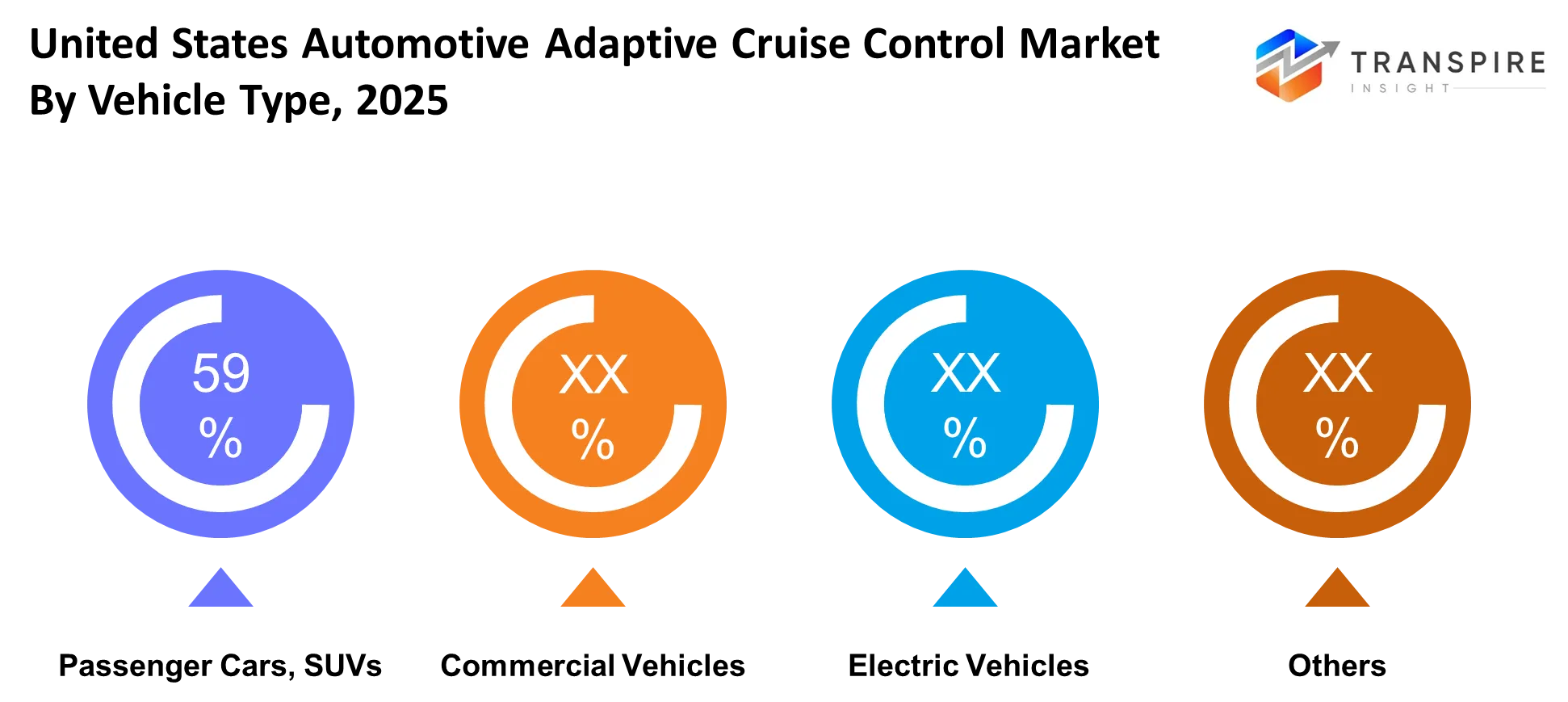
- In terms of what people actually buy, passenger vehicles are dominating at roughly 72% of the market share, which is basically showing strong installation rates across SUVs, sedans, and electric crossover platforms.
- When it comes to who installs it, OEM installations lead the United States Automotive Adaptive Cruise Control Market, bringing in nearly 81% of the revenue because the ADAS is deployed factory integrated, more or less.
- Meanwhile, the aftermarket slice is moving forward pretty quick all the way through 2030, because retrofit demand keeps rising, especially for fleet modernization programs.
- At the end-user level, premium and luxury drivers stay the main category. Still, mid priced consumer adoption is accelerating in a pretty noticeable way these days.
What are the Key Drivers, Restraints, and Opportunities in the United States Automotive Adaptive Cruise Control Market?
The strongest force pushing the United States automotive adaptive cruise control market forward is kinda the fast move of advanced driver assistance systems from premium vehicles into regular mass-market models. It all got a boost as radar sensor costs kept dropping, and because software-defined vehicle architectures became more common during the last five years, not just in higher trim lines. So automakers can now roll out adaptive cruise control as part of more standard safety packages, without a big jump in the actual production expenses. At the same time, tighter vehicle safety evaluation frameworks, plus insurance-linked safety incentives, have nudged manufacturers to fit more vehicles with collision mitigation tools. As a result installation rates have widened across mid-range sedans and SUVs, and that directly supports system revenues for sensor vendors, software developers and Tier 1 automotive electronics manufacturers.
Still, the market’s most important structural problem is semiconductor dependency, along with how hard it is to validate adaptive cruise control across all kinds of U.S. driving environments. This isn’t like a short term hiccup, the problem sits inside the automotive electronics supply chain. Fixing it takes multiple years of scaling manufacturing and doing qualification testing. Sensor shortages, longer validation timelines, and the need for functional safety certification all end up delaying production schedules and dampening revenue, because rollout gets slower on the high-volume vehicle platforms.
The next phase of growth, kinda sits in adaptive cruise control integration for electric and connected commercial fleets, and well it seems obvious but not in a simple way. U.S. logistics operators are more and more putting money into fleet automation platforms, where ACC is tied together with predictive route optimization plus telematics, somehow all at once. And as the bigger electrified delivery fleets roll out across places like Texas, California, and other states, suppliers who can deliver those integrated driver assistance ecosystems are positioned to win meaningful long term revenue opportunities.
What Has the Impact of Artificial Intelligence Been on the United States Automotive Adaptive Cruise Control Market?
Artificial intelligence and advanced digital technologies are, kinda, reshaping adaptive cruise control in the United States by making it more predictive, faster to react, and generally more operationally efficient. In many newer ACC setups the system leans on AI sensor fusion, where radar, cameras, LiDAR, and the vehicle’s own onboard computing all work together, so the car can manage real time speed changes, do lane aware distance handling, and react to traffic flow with less fuss. With this kind of automation, drivers end up stepping in less during congested highway stretches , and vehicle spacing stays steadier, which may improve fuel efficiency by something like 3% to 7% thanks to smoother acceleration and braking behavior.
At the same time, machine learning models are boosting prediction across connected vehicle ecosystems, too. Automakers use AI analytics to sift through historical driving logs, weather context, and even component performance signals, to foresee sensor deterioration, software calibration drift, and actuator wear long before the failure shows up. That “predictive maintenance” angle supports higher system uptime, cuts down on unexpected service visits, and tends to reduce warranty expenses for OEMs. For fleet operators, AI powered telematics platforms also help tune adaptive driving patterns using route specific conditions, which can mean less fuel burn and better alignment with fleet safety benchmarks.
Still, there is a big sticking point: the integration cost. Validating AI driven control algorithms across highly variable U.S. driving conditions, including severe weather and inconsistent road markings, is expensive and time consuming. Plus, limited edge case training data leaves some accuracy gaps, especially when the traffic gets dense in complex urban areas, and this slows wider rollout in the lower priced vehicle segments even though the overall tech progress looks promising.
Key Market Trends
- From 2020 to 2025, the costs for radar sensors dropped to almost 30%, and this made it easier for makers like Ford Motor Company and General Motors to push ACC into more mainstream models.
- After 2022, many automakers have sort of moved away from standalone ACC setups ,and gone toward integrated Level 2 driver-assistance bundles; in the process they’re adding more software content per car, and it supports those repeating update driven revenue patterns.
- During 2021 and 2022, semiconductor shortages basically pushed OEMs into redesigning how they source parts, so they leaned harder on domestic electronics partners and cut back on relying on a single region for components .
- By 2025, more than 60% of newly introduced U.S. crossover and SUV platform releases include adaptive cruise features, while in 2019 it was below 35%—not really close.
- Since 2023, consumer buying choices have changed too, with people now paying more attention to highway-assist capabilities rather than just classic infotainment upgrades when they’re deciding on a vehicle.
- Suppliers like Robert Bosch GmbH and Continental AG have increased their AI driven sensor fusion spending, to make low visibility performance better, and to improve how vehicles react in city traffic situations.
- Insurance-linked safety incentives also broadened after 2022 ,which nudged wider ACC rollout ,as insurers started treating collision mitigation capabilities as part of premium calculations.
- And for electric-vehicle makers, there’s been more predictive cruise optimization built in from 2023 through 2025, helping energy efficiency by tuning acceleration behavior to route elevation and to the way traffic is flowing.
- At the same time, competition has shifted away from pure hardware differences and toward software calibration accuracy ,with OEMs using over the air updates to smooth adaptive braking and to boost driver confidence overall.
United States Automotive Adaptive Cruise Control Market Segmentation
By Component:
The component structure of the United States Automotive Adaptive Cruise Control Market is sorta centered on a mix of hardware and software that kind of work together, to help driving feel safer and more responsive. Radar sensors are one of the most used parts, mainly because they offer solid performance for gauging vehicle distance and speed, even when the weather gets kinda rough. Cameras are showing up more and more too, because improved image processing supports sharper object detection, lane recognition, and a better look at surrounding traffic flows. LiDAR sensors, while not yet everywhere and often tied to higher priced vehicle classes due to costs, are slowly getting broader acceptance because their precision helps with detailed environmental mapping.
Electronic Control Units act like the processing hub that links up all sensor inputs and helps with faster decision making for acceleration plus braking adjustments. On the software side, things are getting smarter as artificial intelligence and predictive analytics improve the response timing and the system’s general road awareness. Then you also have the other supporting pieces like actuators, connectors, communication modules, and integrated braking interfaces, which help keep everything coordinated without hiccups. Also there is a rising emphasis on sensor fusion, and it’s expected to boost accuracy and cut down response delays across different road conditions.
By Vehicle Type:
Passenger cars take up a major share of demand in the United States Automotive Adaptive Cruise Control Market, mostly because more consumers seem to want convenience plus safety, so manufacturers end up pushing in driver assistance features even into mid-range and premium cars. Also, growing awareness about crash prevention and fatigue relief over long distance drives has helped the technology spread, across city lanes as well as highway corridors. For this reason, the system is no longer just for luxury sedans or whatever, compact cars and family oriented vehicles are now offering adaptive cruise control as a normal, everyday feature.
SUVs are another key slice of the market, driven by continued sales across domestic areas and the kind of consumer taste that leans toward bigger vehicles, with richer comfort options. Meanwhile commercial vehicles are also starting to adopt adaptive cruise control to raise operational efficiency , improve fuel optimization, and add driver support for those extended logistics routes. Electric vehicles contribute too, since modern EV platforms are built around a digital architecture that makes integration of advanced assistance systems feel simpler. Other groups of vehicles, like specialty units and fleet cars, are beginning to adopt similar capabilities, as the regulatory focus on road safety keeps climbing, and people notice.
To learn more about this report, Download Free Sample Report
By Technology:
Conventional adaptive cruise control still is the base of this market and it ends up mostly trying to keep a safe following distance, via radar monitoring, then automated speed tweaking follow. People use it a lot because it is dependable, and the setup costs are usually a bit less compared with solutions that are more advanced, also it just works in day to day scenarios. Predictive adaptive cruise control is starting to get more attention too, because as systems improve they can read navigation data, road bends, and even elevation shifts, then they do smoother driving adjustments before the immediate traffic situation shows up.
Then there is the AI based adaptive cruise control side, which is now a growth thing, since machine learning models let the system interpret driving behavior and the surrounding traffic signs in a smarter way. Cooperative adaptive cruise control is also drawing interest, especially as vehicle to vehicle communication keeps improving, so connected vehicles can coordinate their speed regulation rather than each one acting alone. Beyond that, other in development tech leans toward hybrid models that mix different sensing routes, aiming to boost accuracy, cut down false detections, and give a more natural driving feel. And as automation keeps leveling up, it will probably make these approaches show up more across future vehicle platforms, even in places where they weren’t expected earlier.
By Sales Channel:
Original Equipment Manufacturers still really dominate the United States Automotive Adaptive Cruise Control Market sales channel structure, mainly because most adaptive cruise systems get installed right during vehicle production. In practice, manufacturers keep reinforcing relationships with technology providers so they can plug in advanced systems more directly into new vehicle models. It kind of helps with the right calibration, plus it gives better compatibility with the vehicle architecture, and it tends to boost consumer confidence about performance reliability. Also, the growing competition among automakers to ship safety focused features is pushing this portion further.
Meanwhile the aftermarket segment is moving forward steadily, since vehicle owners want upgrades that enhance driving assistance, but they don’t necessarily want to buy brand new cars. Technological improvements have made it possible for more flexible retrofit systems to show up in the market, even if some compatibility issues still show up for older vehicle models. Other sales channels include fleet service integrations as well as specialized changes for commercial vehicles. Over the next few years, expansion of distribution networks and higher technical know-how among service providers are expected to help widen adoption through those other routes.
What are the Key Use Cases Driving the United States Automotive Adaptive Cruise Control Market?
Highway driving in passenger vehicles still looks like the main thing adaptive cruise control is used for in the United States. Long-distance interstate trips, commuter gridlock on major corridors, and a noticeable consumer pull toward semi-automated driving support kind of keep turning this into the biggest wellspring of both system installs and OEM income.
After that, commercial fleet operations are becoming more of a real secondary use, especially for logistics providers and regional delivery outfits. Fleet managers are moving toward adaptive cruise systems, not only to help with fuel steadiness, but also to lessen driver weariness and to keep to corporate safety expectations, at least in spirit and in practice. At the same time premium electric vehicles are continuing to fold in newer cruise features as part of broader connected mobility networks.
Then there are the emerging roles, like autonomous-ready ride hailing fleets and next-generation electric delivery vans. These vehicles are leaning more and more on adaptive cruise tie-ins together with predictive route management and vehicle-to-infrastructure chatter. And since smarter roadway spending is expanding across states such as California and Texas, these connected scenarios should start getting more meaningful commercial momentum during the forecast period.
|
Report Metrics |
Details |
|
Market size value in 2025 |
USD 4.98 Billion |
|
Market size value in 2026 |
USD 5.34 Billion |
|
Revenue forecast in 2033 |
USD 8.71 Billion |
|
Growth rate |
CAGR of 7.24% from 2026 to 2033 |
|
Base year |
2025 |
|
Historical data |
2021 - 2024 |
|
Forecast period |
2026 - 2033 |
|
Report coverage |
Revenue forecast, competitive landscape, growth factors, and trends |
|
Geographic scope |
United States of America |
|
Key company profiled |
Bosch, Continental AG, Denso, ZF Friedrichshafen, Valeo, Aptiv, Hyundai Mobis, Magna International, Autoliv, Hitachi Astemo, Veoneer, Mobileye, NXP Semiconductors, Infineon Technologies, HELLA |
|
Customization scope |
Free report customization (country, regional & segment scope). Avail customized purchase options to meet your exact research needs. |
|
Report Segmentation |
By Component (Radar Sensors, Cameras, LiDAR Sensors, Electronic Control Units, Software Systems, Others); By Vehicle Type (Passenger Cars, SUVs, Commercial Vehicles, Electric Vehicles, Others); By Technology (Conventional ACC, Predictive ACC, AI-based ACC, Cooperative ACC, Others); By Sales Channel (OEMs, Aftermarket, Others) |
Which Regions are Driving the United States Automotive Adaptive Cruise Control Market Growth?
The Midwest is still sort of the dominant region in the United States adaptive cruise control market, kind of because it hosts the biggest clump of vehicle assembly plants and Tier 1 automotive suppliers. States like Michigan , Ohio, and Indiana tend to pull ahead thanks to old school deep-rooted automotive engineering ecosystems, which seems to enable quicker uptake of advanced driver assistance technologies into high-volume production platforms. Those ecosystems also support near constant, back-and-forth collaboration between OEMs semiconductor suppliers, and automotive software developers, and in practice that shortens validation cycles for things like adaptive cruise systems. Since the manufacturing network is already mature and well integrated, the Midwest can keep its edge by sticking with production scale, technical know-how, and that established supply-chain resilience.
The South shows up as the second most meaningful regional contributor, yet the momentum feels less like legacy automotive concentration and more like manufacturing diversification. Regions such as Tennessee, Alabama, and South Carolina have attracted sizable foreign direct investment from global automakers , mostly because they want cost-efficient production and long term operational stability. And in contrast to the Midwest’s more legacy built advantage, the South’s position leans on modernized production lines that are built for connected and electric vehicle architectures. So, that ends up making the region a dependable revenue driver as automakers raise adaptive cruise control deployment across newly launched vehicle platforms, steadily.
The Western United States is kinda emerging as the fastest growing region, mostly because electric vehicle adoption is moving quickly, and the smart mobility investments are pretty aggressive too. In California, the zero emission vehicle mandates, and then these expanding autonomous vehicle testing programs, have helped speed up the deployment of software heavy adaptive cruise technologies since 2023, and yeah it’s noticeable. There are also technology partnerships between automakers and Silicon Valley based AI firms which are pushing innovation in predictive cruise optimization and sensor fusion capabilities in a steady sort of way. For market entrants, as well as investors , this overall growth reads like strong chances between 2026 and 2033, especially around software integration validation services and next generation autonomous driving support systems.
Who are the Key Players in the United States Automotive Adaptive Cruise Control Market and How Do They Compete?
The competitive landscape for the United States automotive adaptive cruise control market is, kinda moderately consolidated, competition seems to be more about technological precision then pure pricing pressure. Long standing Tier 1 suppliers keep trying to defend their share via deep OEM integration, but newer software focused entrants are quietly changing things by upgrading perception algorithms and strengthening real time decision making, in a way that feels more agile. Where the battle used to be more about hardware scale , it’s moved toward software calibration, sensor fusion accuracy, and the capability to enable over-the-air system refinement. Firms that can pair production reliability with AI enabled control logic are, generally, getting stronger positions since automakers want driver assistance platforms that are both more adaptive and more scalable.
Robert Bosch GmbH competes by doing system level integration, bringing radar, camera, and braking controls into one unified ADAS module setup that can cut down automaker validation time. Its edge comes from long term engineering relationships with U.S. and European OEMs, which helps it roll out faster across several vehicle platforms, almost like the same recipe with slight tweaks. Continental AG, on the other hand differentiates using high resolution radar architectures tuned for dense traffic, which helps manufacturers make stop and go cruise feel smoother. It also keeps pushing forward through software partnerships aimed at predictive driving behavior modeling.
Aptiv PLC really leans into software defined vehicle platforms, sort of giving automakers more malleable ACC integration by using centralized compute systems instead of those isolated electronic control units. Denso Corporation meanwhile uses compact sensor packaging and low power designs, which kind of syncs up nicely with the efficiency needs of electric vehicles. And then, ZF Friedrichshafen AG is pushing forward via partnerships for autonomous mobility testing, tapping real world U.S. driving datasets to better tune adaptive cruise performance in roads that are getting more and more complex, day by day.
Company List
- Bosch
- Continental AG
- Denso
- ZF Friedrichshafen
- Valeo
- Aptiv
- Hyundai Mobis
- Magna International
- Autoliv
- Hitachi Astemo
- Veoneer
- Mobileye
- NXP Semiconductors
- Infineon Technologies
- HELLA
Recent Development News
In January 2026, Mobileye secured a strategic ADAS supply agreement with a major unnamed U.S. automaker. The deal covers Mobileye’s EyeQ6H-powered Surround ADAS platform, which includes next-generation adaptive cruise control capabilities and is expected to accelerate large-scale deployment of ACC-enabled systems across millions of U.S. vehicles, strengthening domestic ACC market penetration. Source https://www.reuters.com/
In April 2026, Bosch expanded its strategic partnership with Qualcomm Technologies to jointly advance scalable ADAS and vehicle computing platforms. The collaboration strengthens development of radar- and sensor-fusion-based adaptive cruise control systems for North American automakers, supporting broader commercialization of higher-performance ACC architectures in the U.S. market. Source https://themachinemaker.com/
What Strategic Insights Define the Future of the United States Automotive Adaptive Cruise Control Market?
Over the next five to seven years, the United States automotive adaptive cruise control market is kind of structurally moving toward software defined continuously upgradable driving-assistance ecosystems, rather than those more fixed function hardware deployments. This direction is being driven by centralized vehicle computing architectures,and also by automakers’ push to monetize advanced driver-assistance capabilities via subscription based feature activation, plus over-the-air software enhancements. And as adaptive cruise control turns into a foundational layer for broader Level 2 and Level 3 automation, the competitive edge will increasingly depend on algorithm refinement, not just sensor hardware alone.
There’s also a quieter risk,that feels less obvious at first—market concentration is growing around a small set of semiconductor and perception software suppliers. So if anything happens in advanced chip fabrication, or if next generation compute platform certification gets delayed, you could see deployment bottlenecks. Those bottlenecks would then slow adoption across high volume vehicle segments, in a way that’s pretty hard to unwind quickly.
On the opportunity side, one emerging angle is the integration of adaptive cruise systems with vehicle-to-infrastructure networks,especially inside smart mobility corridors that are developing across California, Texas, and Arizona. Market participants should prioritize investment in edge computing partnerships and real world software validation programs, because early positioning in connected roadway ecosystems will likely shape long term market leadership.
United States Automotive Adaptive Cruise Control Market Report Segmentation
By Component
- Radar Sensors
- Cameras
- LiDAR Sensors
- Electronic Control Units
- Software Systems
By Vehicle Type
- Passenger Cars
- SUVs
- Commercial Vehicles
- Electric Vehicles
By Technology
- Conventional ACC
- Predictive ACC
- AI-based ACC
- Cooperative ACC
By Sales Channel
- OEMs
- Aftermarket
Frequently Asked Questions
Find quick answers to common questions.
The United States Automotive Adaptive Cruise Control Market size is USD 8.71 Billion in 2033.
Key segments for the United States Automotive Adaptive Cruise Control Market are By Component (Radar Sensors, Cameras, LiDAR Sensors, Electronic Control Units, Software Systems, Others); By Vehicle Type (Passenger Cars, SUVs, Commercial Vehicles, Electric Vehicles, Others); By Technology (Conventional ACC, Predictive ACC, AI-based ACC, Cooperative ACC, Others); By Sales Channel (OEMs, Aftermarket, Others).
Major United States Automotive Adaptive Cruise Control Market players are Bosch, Continental AG, Denso, ZF Friedrichshafen, Valeo, Aptiv, Hyundai Mobis, Magna International, Autoliv, Hitachi Astemo, Veoneer, Mobileye, NXP Semiconductors, Infineon Technologies, HELLA.
The United States Automotive Adaptive Cruise Control Market size is USD 4.98 Billion in 2025.
The United States Automotive Adaptive Cruise Control Market CAGR is 7.24% from 2026 to 2033.
- Bosch
- Continental AG
- Denso
- ZF Friedrichshafen
- Valeo
- Aptiv
- Hyundai Mobis
- Magna International
- Autoliv
- Hitachi Astemo
- Veoneer
- Mobileye
- NXP Semiconductors
- Infineon Technologies
- HELLA
Recently Published Reports
-
Apr 2026
ATV & UTV Market
ATV & UTV Market Size, Share & Analysis Report By Type (ATV, and UTV), By Variants (Less Than 400 CC, 400 CC To 800 CC, and More Than 800 CC), and Geography (North America, Europe, Asia-Pacific, Middle East and Africa, South and Central America), 2021 - 2031
-
Apr 2026
Automotive Central Gateway Module Market
Automotive Central Gateway Module Market Size, Share & Analysis Report By Type (Ethernet Central Gateway Module, CAN Central Gateway Module, LIN Central Gateway Module, and FlexRay), By Application (Powertrain Control, Body Control, Infotainment System, Advanced Driver Assistance Systems (ADAS), and Others), By End User (Passenger Vehicles, and Commercial Vehicles), and Geography (North America, Europe, Asia-Pacific, Middle East and Africa, South and Central America), 2021 - 2031
-
Apr 2026
Automotive Engine Oil Filter Market
Automotive Engine Oil Filter Market Size, Share & Analysis Report By Filter Type (Fuel Filter, Engine Oil Filter, Hydraulic Oil Filter, and Others), By Filter Media (Cellulose, Synthetic, and Micro), By Sales Channel (OEMs, and Aftermarket), By Vehicle Type (Passenger Cars, Light Commercial Vehicles, Heavy Duty Trucks, Buses and Coaches, and Off-road Vehicles), and Geography (North America, Europe, Asia-Pacific, Middle East and Africa, South and Central America), 2021 - 2031
-
Apr 2026
Automotive Parts Aluminium Die Casting Market
Automotive Parts Aluminium Die Casting Market Size, Share & Analysis Report By Production Process (Pressure Die Casting, Vacuum Die Casting, Squeeze Die Casting, Gravity Die Casting), By Application (Body Parts, Engine Parts, Transmission Parts, Battery And Related Components, Other Application Types), and Geography (North America, Europe, Asia-Pacific, Middle East and Africa, South and Central America), 2021 - 2031
Our Clients