

France Luxury Goods Market Size & Forecast:
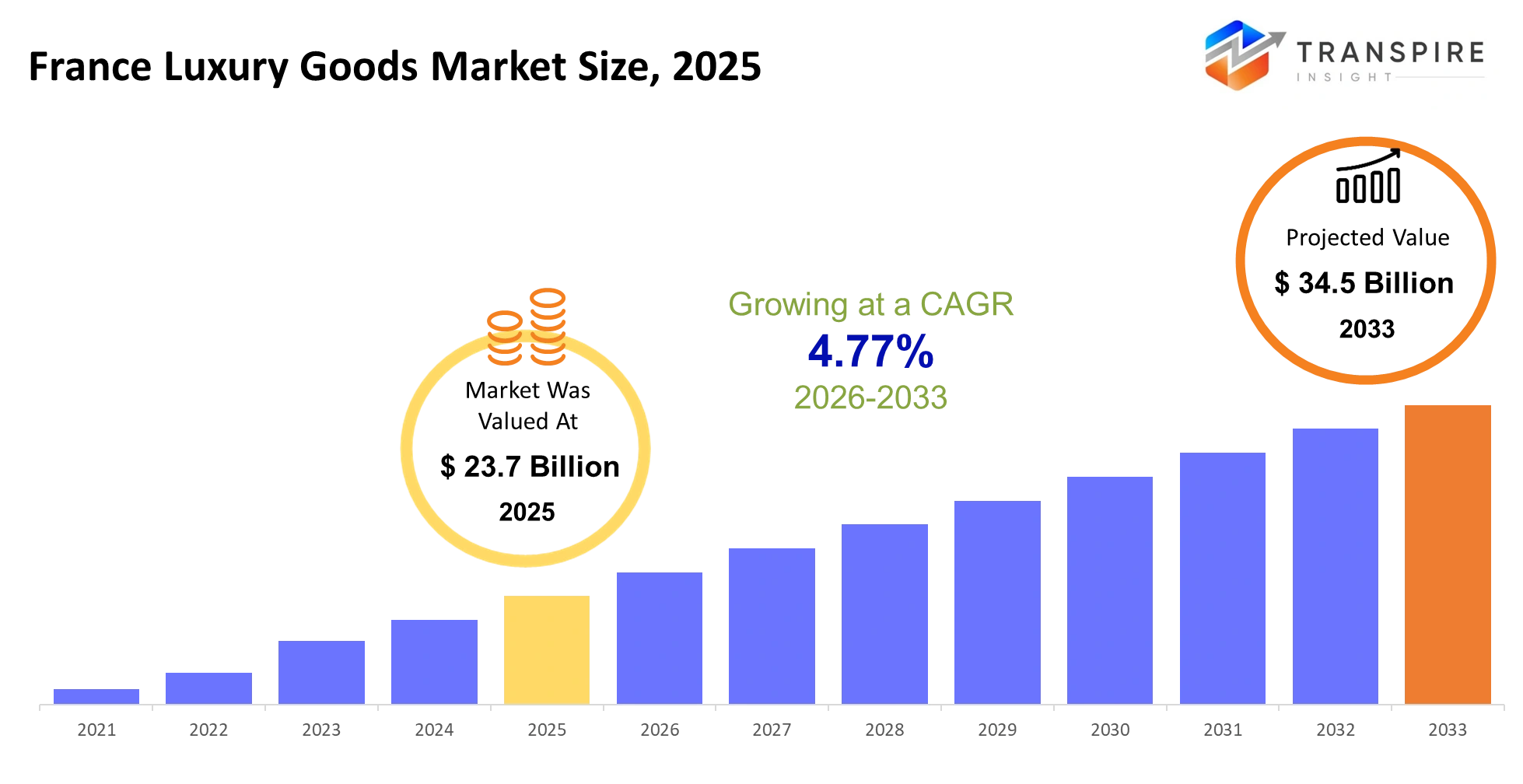
- France Luxury Goods Market Size 2025: USD 23.7 Billion
- France Luxury Goods Market Size 2033: USD 34.5 Billion
- France Luxury Goods Market CAGR: 4.77%
- France Luxury Goods Market Segments: By Type (Apparel, Accessories, Watches, Jewelry, Others); By Application (Fashion, Travel Retail, Gifting, Investment, Others); By End-User (High Net Worth Individuals, Consumers, Tourists, Collectors, Others); By Distribution (Retail Boutiques, Online Stores, Duty-free Shops, Others).
To learn more about this report,  Download Free Sample Report
France Luxury Goods Market Summary
The France Luxury Goods Market was valued at USD 23.7 Billion in 2025. It is forecast to reach USD 34.5 Billion by 2033. That is a CAGR of 4.77% over the period.
The France luxury goods market functions as an international standard for high-quality craftsmanship and traditional brand heritage and products that consumers aspire to own. The platform enables retail activities which depend on tourist spending and gift-giving traditions and wealthy customers who buy products from flagship stores and airports. The market has evolved from its previous structure into a digital-first luxury model which operates through online platforms and omnichannel systems that work together with physical retail stores.
International travel especially from Asia and the Middle East experienced a post-pandemic recovery which resulted in new shopping patterns that helped retail operations return to normal. As a result of this trend, brands now combine customized services with customer data analysis and special product releases. The current revenue growth combines three elements: experiential retail and international traveler spending and digital interactions which together enhance customer reach and strengthen brand loyalty.
Key Market Insights
- The Paris region controls more than 60% of the French luxury goods market in 2025 because it has flagship stores which attract tourists to the area.
- The southern part of France will experience its highest growth rate until 2033 because luxury tourism develops in Côte d'Azur destinations.
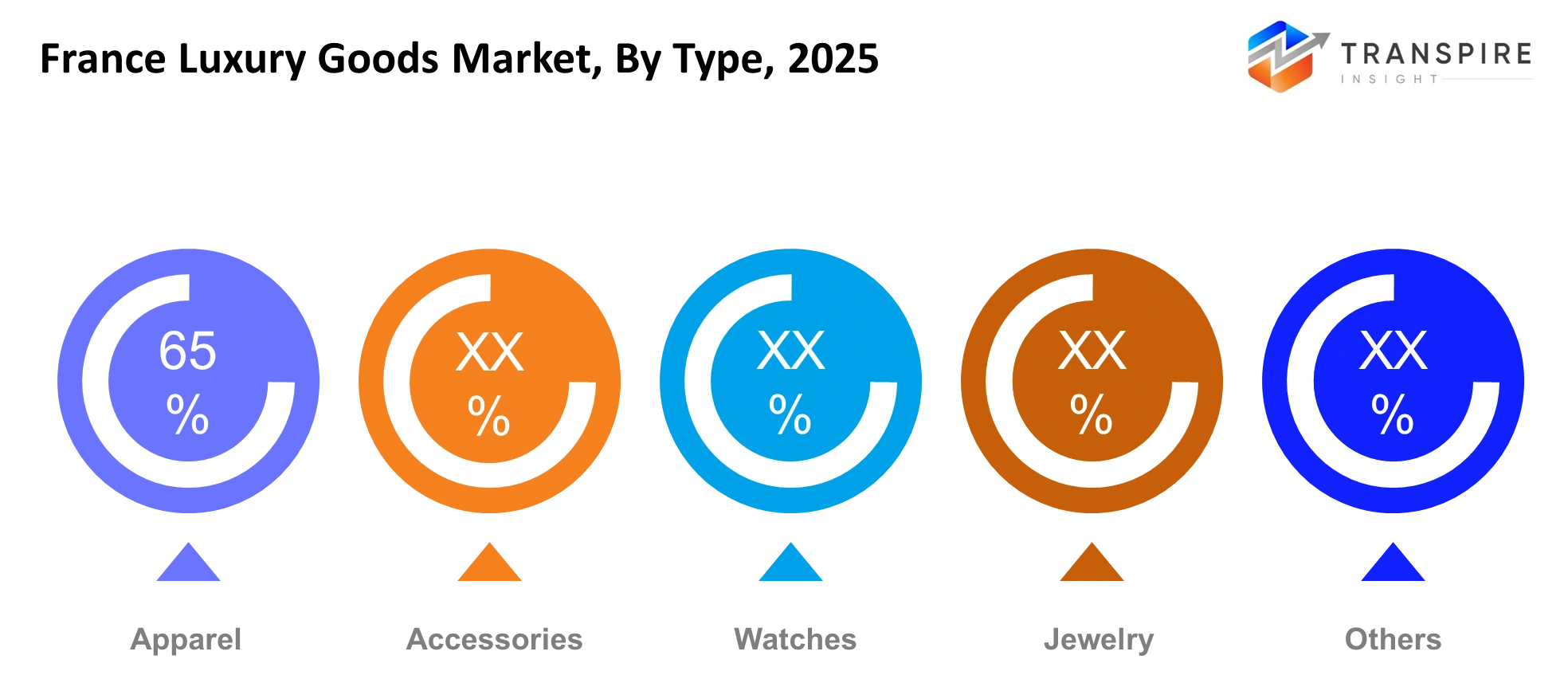
- The apparel industry leads the market with almost 35% share in 2025 because fashion houses maintain their brand heritage and introduce new seasonal collections.
- Jewelry ranks as the second biggest market segment because customers create high-value purchases for their gifting requirements.
- The watches market experiences its highest growth rate until 2033 because more people buy watches as investment products.
- The fashion application exists as the market leader with approximately 40% market share because seasonal trends and runway events drive consumer buying patterns.
- The gifting market segment experiences rapid growth because consumers worldwide demand premium personalized gifts during festive periods.
- High net worth individuals dominate with over 45% share which results from wealth concentration and brand exclusivity.
- Tax-free shopping together with increased international travel creates the most rapid growth of tourist spending.
- Companies develop exclusive products through limited edition releases and sustainable materials which enhance their product value.
- The brand expands its visibility among younger audiences through strategic partnerships with digital platforms and influencers.
- The company expands its travel retail operations and builds stores that target Asian customers which will enhance its international revenue streams.
- Businesses use AI technology to create personalized experiences which boost customer interactions and sales success.
What are the Key Drivers, Restraints, and Opportunities in the France Luxury Goods Market?
The luxury goods market in France exists because international tourism has returned and wealthy people have become more numerous throughout the world. The removal of travel restrictions together with improved currency exchange rates has resulted in higher spending by non-European visitors who primarily visit Paris. The directly impacts retail sales forces because it increases revenue from duty-free stores and flagship locations which sell their highest profit items.
The existing system depends on two major factors which include global economic stability and actual tourist arrivals. The luxury market requires consumer spending to maintain its business operations because geopolitical conflicts and currency market fluctuations and inflation trends in major economies such as China and the United States impede luxury market growth. The described elements require extended periods for stabilization which results in customers postponing their purchases and merchants losing potential sales which impacts revenue generation during the upcoming period.
Digital luxury ecosystems and resale markets are currently developing into a massive opportunity which companies can pursue. Platforms that provide verified secondhand luxury items are becoming popular because they draw younger buyers while also increasing the time products remain in use. Businesses will create new methods to generate revenue while building global customer relationships through their investments in blockchain verification systems and online virtual showroom development.
What Has the Impact of Artificial Intelligence Been on the France Luxury Goods Market?
The France luxury goods market undergoes transformation through artificial intelligence which improves personalization and operational efficiency and improves demand forecasting capabilities.Luxury brands use AI recommendation systems to analyze customer data which includes their shopping history and online activity to generate customized product suggestions for customers who shop both online and in physical stores. Businesses use automation their operations which results in improved customer acquisition. The process of using automation to enhance business operations results in increased customer acquisition rates for companies together with improved customer loyalty.
Brands employ machine learning models to predict inventory needs when they forecast product demand across different geographic regions and seasonal changes. The system prevents excessive inventory accumulation and stock shortages which leads to better supply chain operations and increased financial gains. AI technology enables businesses to develop pricing models that adapt to market conditions while creating marketing campaigns that specifically address customer preferences.
Through its operational functions AI provides sales associates with real-time customer data which allows them to create better customer experiences during in-store visits. The system protects online transactions by detecting fraudulent activities while it enhances brand security in resale markets.
The primary obstacle arises from the expensive and difficult process of connecting AI systems to existing retail technology. The traditional craftsmanship methods of heritage brands create difficulties when they try to implement modern digital systems which results in delayed adoption of complete AI solutions.
Key Market Trends
- Luxury brands adopted omnichannel retail operations which combine digital platforms with physical store operations to provide customers with enhanced personalized shopping experiences starting 2021.
- The new business model enables brands to establish better customer connections while achieving higher sales results through their online and physical customer interactions.
- Paris experienced a strong tourism recovery from 2022 which led to increased luxury sales because international visitors now account for more than half of total retail spending. The recovery process established the city as an international luxury shopping destination.
- Brands use limited-edition collections and capsule drops as their main marketing strategies because they create purchasing pressure through restricted product availability which results in limited product availability.
- After 2023, sustainability efforts reached their peak when brands started using traceable sourcing methods and eco-certified materials to meet new regulatory requirements and emerging consumer demands.
- The resale market has expanded quickly because platforms attract younger buyers who want to buy affordable luxury items.
- Since 2024, retail businesses have adopted AI-driven personalization as their standard strategy which helps brands to improve customer targeting and product recommendations and marketing activities.
- The travel retail industry has experienced strong growth because airport and major tourist hub operations have resumed their function as important revenue sources for global luxury companies.
- Consumers now consider watches and jewelry as investment alternatives because economic uncertainty has made them view these items as valuable assets.
- Luxury brands are deepening their partnerships with digital influencers because they need to develop new methods for reaching Gen Z consumers who live around the world.
France Luxury Goods Market Segmentation
By Type
The type-based segmentation shows apparel as the leading category which generates the biggest market share because established heritage brands and seasonal product releases lead to continuous customer purchases. The brand achieves high consumer recognition through its fashion shows which create worldwide visibility and its products maintain their market presence because consumers buy them for both gifting purposes and status display. The market for watches and lifestyle luxury products maintains its position because of high quality craftsmanship and their products' extended active lifespan. The apparel industry experiences its expansion through fashion trends and storytelling from brands while watches attract customers because of their investment value and special edition products.
The future growth of type segments will show a greater preference for exclusive personalized products because brands will start creating their high-end items with restricted manufacturing processes and premium-grade materials. The apparel market will keep its leading position because of its continuous market presence but rising manufacturing expenses will decrease its profit margins. Customers who want to preserve their investment value will choose jewelry and watches which will attract more buyers. Product developers are using their budgets to create sustainable sourcing systems and digital customization platforms which will help them develop unique product features. Investors will choose market segments that offer both international reach and higher resale value particularly in the watch and jewelry market.
To learn more about this report, Download Free Sample Report
By Application
The application-based segmentation system selects fashion as its primary use case because fashion products are constantly introduced and fashion products match the lifestyles of customers who use them. Travel retail has regained momentum because international travel has become more common and international tourists spend money at major retail sites. Gifting remains a consistent contributor, supported by cultural practices and premium packaging strategies, while investment-driven purchases are gaining traction in high-value categories. Fashion products show seasonal demand while travel retail shows spending patterns that depend on specific geographic locations.
The upcoming period will bring changes to application behavior which will lead to users adopting hybrid consumption patterns that involve both experiential elements and product ownership. Travel retail will experience additional expansion through infrastructure upgrades which will attract more tourists and investment-oriented applications will see growth because customers want to build diverse asset portfolios. Brands are aligning product strategies with specific use cases, including exclusive travel editions and personalized gifting solutions. The evolution of this process leads to improved customer segmentation through better marketing methods and product position strategies.
By End-User
The primary contributors to end-user segmentation research emerge as high net worth individuals who drive this research through their extensive wealth and preference for exclusive products. The consumer base spends at moderate levels while their purchasing decisions stem from their brand perceptions and the seasonal product trends. Tourists represent a vital customer group who drive purchases at urban retail locations through their ability to access global brands and benefit from tax-free shopping. The collector community holds a small market space but their activities show significant effects on the market through their dedication to acquiring rare items that retain value over time.
The future development of end-user behavior will create a need for users to adopt multiple digital platforms throughout various user groups. High net worth individuals will require businesses to provide them with custom services and access to exclusive collections while tourist behavior will determine which retail locations succeed. The collector market expansion will create new opportunities for both secondary markets and platforms that offer verified resale items. Businesses will develop better customer segmentation methods through data analytics to improve their targeting and retention efforts.
By Distribution
The retail boutiques lead distribution segmentation because they create brand experiences which enable customers to interact with their products directly. Online stores have expanded rapidly, supported by improved digital interfaces and secure payment systems, while duty-free shops benefit from travel-driven demand. Multi-brand outlets and other channels operate as secondary distribution systems that improve access to various markets. The distribution channels of our system provide two opposing elements which customers must evaluate during their choosing process.
The future distribution landscape will move toward integrated omnichannel models that combine physical and digital touchpoints. Retail boutiques will transform into experience centers, while online platforms will enhance personalization through data-driven insights. International travel patterns will dictate duty-free shop operations but the shops will start using digital pre-order systems. The shift to this new system requires companies to spend money on technology and logistics systems which will enable customers to buy goods from any available purchasing channel.
What are the Key Use Cases Driving the France Luxury Goods Market?
The main reason people use luxury fashion products is because they want to buy clothes and accessories which help them show their identity and status through specific brands. The flagship stores which operate in Paris and major retail locations bring in both local customers and international visitors who generate substantial shopping activity. The company generates most of its revenue through this application because customers make repeat purchases during seasonal collections and fashion events which help them develop brand loyalty.
Tourists and wealthy individuals have made gifting and travel retail into major secondary use cases. The combination of tax-free shopping regulations and airport retail systems enables customers to make high-value purchases while personalized gifting options boost spending during holiday periods and corporate events. The use cases establish direct connections with jewelry and accessories markets which rely on emotional and symbolic value to drive customer purchasing behavior.
People are starting to buy investment items which include watches and expensive jewelry. Select luxury products are increasingly being treated by buyers as alternative investment assets which they can resell. The digital resale market together with authentication systems enables this transformation by establishing new methods for customers to gain lasting value.
|
Report Metrics |
Details |
|
Market size value in 2025 |
USD 23.7 Billion |
|
Market size value in 2026 |
USD 24.9 Billion |
|
Revenue forecast in 2033 |
USD 34.5 Billion |
|
Growth rate |
CAGR of 4.77% from 2026 to 2033 |
|
Base year |
2025 |
|
Historical data |
2021 - 2024 |
|
Forecast period |
2026 - 2033 |
|
Report coverage |
Revenue forecast, competitive landscape, growth factors, and trends |
|
Regional scope |
France |
|
Key company profiled |
LVMH, Kering, Richemont, Chanel, Hermes, Rolex, Prada, Gucci, Burberry, Cartier, Tiffany & Co, Dior, Louis Vuitton, Bulgari, Armani. |
|
Customization scope |
Free report customization (country, regional & segment scope). Avail customized purchase options to meet your exact research needs. |
|
Report Segmentation |
By Type (Apparel, Accessories, Watches, Jewelry, Others); By Application (Fashion, Travel Retail, Gifting, Investment, Others); By End-User (High Net Worth Individuals, Consumers, Tourists, Collectors, Others); By Distribution (Retail Boutiques, Online Stores, Duty-free Shops, Others). |
Which Regions are Driving the France Luxury Goods Market Growth?
The Paris region leads market growth because it contains both main luxury stores and its government supports tourist activities and retail operations. The combination of tax-free shopping and major airports which connect to international destinations maintains steady sales performance. The area maintains its leading position through its combination of fashion houses and skilled workers and high-end shopping facilities. Paris serves as the primary location for luxury consumption and distribution because brand heritage and global visibility establish its status.
The metropolitan areas of Lyon and Marseille achieve continuous growth through their combination of domestic spending and regional tourist activities. The areas outside Paris depend more on their existing local customer base and their ability to recover from economic challenges than on international tourist traffic. The ongoing development of retail spaces together with urban infrastructure projects will create sustained business expansion. The regions maintain reliable operations because of their stable conditions which allow them to function normally when international air travel experiences disruptions.
The Côte d’Azur region of southern France currently experiences its most rapid growth because luxury tourists visit the area during the summer months. The region has become more attractive to wealthy visitors because recent expansions of hotels and marinas have occurred. The international film festivals and yacht exhibitions have increased public spending to purchase luxurious products. The growth creates excellent chances for brands to expand their seasonal retail operations while investors focus on luxury consumer behavior that relates to tourism.
Who are the Key Players in the France Luxury Goods Market and How Do They Compete?
The market environment shows high consolidation because global companies with multiple brands control most of the market share. Companies compete on brand value and exclusive products and product quality and their ability to sell products through limited distribution channels instead of using price as their competitive advantage. Existing companies use vertical integration methods together with restricted manufacturing techniques and extensive distribution networks to protect their existing market territory. New companies encounter substantial challenges because established brands create consumer loyalty through their historical value and supply chain networks operate with high complexity.
The company LVMH establishes its market position through its extensive business operations which include fashion, jewelry and cosmetics product lines while using controlled store expansion and company purchases to meet customer needs worldwide. Kering uses its creative leadership to change brand image through its high-growth business segment which includes Gucci to attract younger customers. Chanel achieves exclusive product distribution through its restricted online sales channels while its customers must visit physical stores which help establish high-end product pricing.
Hermès uses its restricted manufacturing methods together with its artisan production techniques to create product scarcity which enables the company to maintain its market value and sustain resale demand. Richemont strengthens its position in the timepiece and jewelry markets through company acquisitions and investments in digital platforms that support online luxury retail operations. The strategies show that heritage-based identity and product scarcity and digital technology implementation create sustainable competitive advantages.
Company List
- LVMH
- Kering
- Richemont
- Chanel
- Hermès
- Rolex
- Prada
- Gucci
- Burberry
- Cartier
- Tiffany & Co.
- Dior
- Louis Vuitton
- Bulgari
- Armani
Recent Development News
In November 2025, LVMH announced acquisition of a minority stake in La Joux-Perret. The deal strengthened watchmaking capabilities and innovation across brands like TAG Heuer and Hublot, enhancing vertical integration in the luxury watch segment.
Source: https://www.reuters.com
In early 2026, Kering announced the sale of its beauty division to L’Oréal. The €4 billion transaction enabled strategic collaboration in wellness and fragrance innovation while allowing Kering to refocus on core luxury fashion operations.
Source: https://apnews.com
What Strategic Insights Define the Future of the France Luxury Goods Market?
The market is developing a hybrid model which combines physical product exclusivity with digital customer interaction because consumer demands and worldwide access to products continue to evolve. Brands will achieve growth through successful combination of personalized services with data analysis and immersive shopping environments. The current trend shows that people now prefer to consume experiences instead of owning physical products.
The organization faces hidden dangers because it relies too much on tourism from international markets which draw customers primarily from wealthy regions. The company's revenue streams for essential urban areas will experience rapid decline because of any interruptions to travel patterns or changes in currency values. The company faces hidden risks which extend beyond total projected business development for the upcoming period.
Authenticated resale systems which operate on blockchain technology and digital authentication methods create new business opportunities for development. The trend enables businesses to create additional income sources while attracting young consumers who want to become luxury brand owners. Market participants should invest in controlled resale platforms and digital infrastructure to maintain brand value while capturing secondary market demand.
France Luxury Goods Market Report Segmentation
By Type
- Apparel
- Accessories
- Watches
- Jewelry
- Others
By Application
- Fashion
- Travel Retail
- Gifting
- Investment
- Others
By End-User
- High Net Worth Individuals
- Consumers
- Tourists
- Collectors
- Others
By Distribution
- Retail Boutiques
- Online Stores
- Duty-free Shops
- Others
Frequently Asked Questions
Find quick answers to common questions.
The confirmed 2033 market size figure in USD 34.5 Billion.
Key segments for the France Luxury Goods Market are By Type (Apparel, Accessories, Watches, Jewelry, Others); By Application (Fashion, Travel Retail, Gifting, Investment, Others); By End-User (High Net Worth Individuals, Consumers, Tourists, Collectors, Others); By Distribution (Retail Boutiques, Online Stores, Duty-free Shops, Others).
Major France Luxury Goods Market players are LVMH, Kering, Richemont, Chanel, Hermes, Rolex, Prada, Gucci, Burberry, Cartier, Tiffany & Co, Dior, Louis Vuitton, Bulgari, Armani.
The France Luxury Goods Market size is USD 23.7 Billion in 2025.
The France Luxury Goods Market CAGR is 4.77% from 2026 to 2033.
- LVMH
- Kering
- Richemont
- Chanel
- Hermès
- Rolex
- Prada
- Gucci
- Burberry
- Cartier
- Tiffany & Co.
- Dior
- Louis Vuitton
- Bulgari
- Armani
Recently Published Reports
-
Apr 2026
Bottled Water Market
Bottled Water Market Size, Share & Analysis Report By Product Type (Still Bottled Water, Carbonated Bottled Water, Functional Bottled Water, and Others), By Packaging (PET, Cans, and Others), By Sales Channel (Supermarkets/Hypermarkets, Convenience Stores/Drug Stores, Grocery Stores/Club Stores, Foodservice, and Others) and Geography (North America, Europe, Asia-Pacific, Middle East and Africa, South and Central America), 2021 - 2032
-
Apr 2026
Color Cosmetic Packaging Market
Color Cosmetic Packaging Market Size, Share & Analysis Report By Application (Mascara Packaging, Liquid Packaging, and Liquid Face), By Type (Tubes & Bottles, Pens & Markers, Compacts & Containers, and Droppers & Pumps), and Geography (North America, Europe, Asia-Pacific, Middle East and Africa, South and Central America), 2021 - 2031
-
Apr 2026
External Microphone For Camera Market
External Microphone For Camera Market Size, Share & Analysis Report By Type (Shotgun Microphone, Lavalier Microphone, and Others), By Application (Digital Camera, Professional Video Camera, and Others), and Geography (North America, Europe, Asia-Pacific, Middle East and Africa, South and Central America), 2021 - 2031
-
Apr 2026
Foot Orthotic Insoles Market
Foot Orthotic Insoles Market Size, Share & Analysis Report By Type (Pre-fabricated, and Custom-made), By Material (Thermoplastic, Composite Carbon Fiber, and Others), By Distribution Channel (Drug Stores, Hospitals & Clinics, and Others), and Geography (North America, Europe, Asia-Pacific, Middle East and Africa, South and Central America), 2021 - 2031