
Europe Vehicle Roof Control Module Market Size & Forecast:
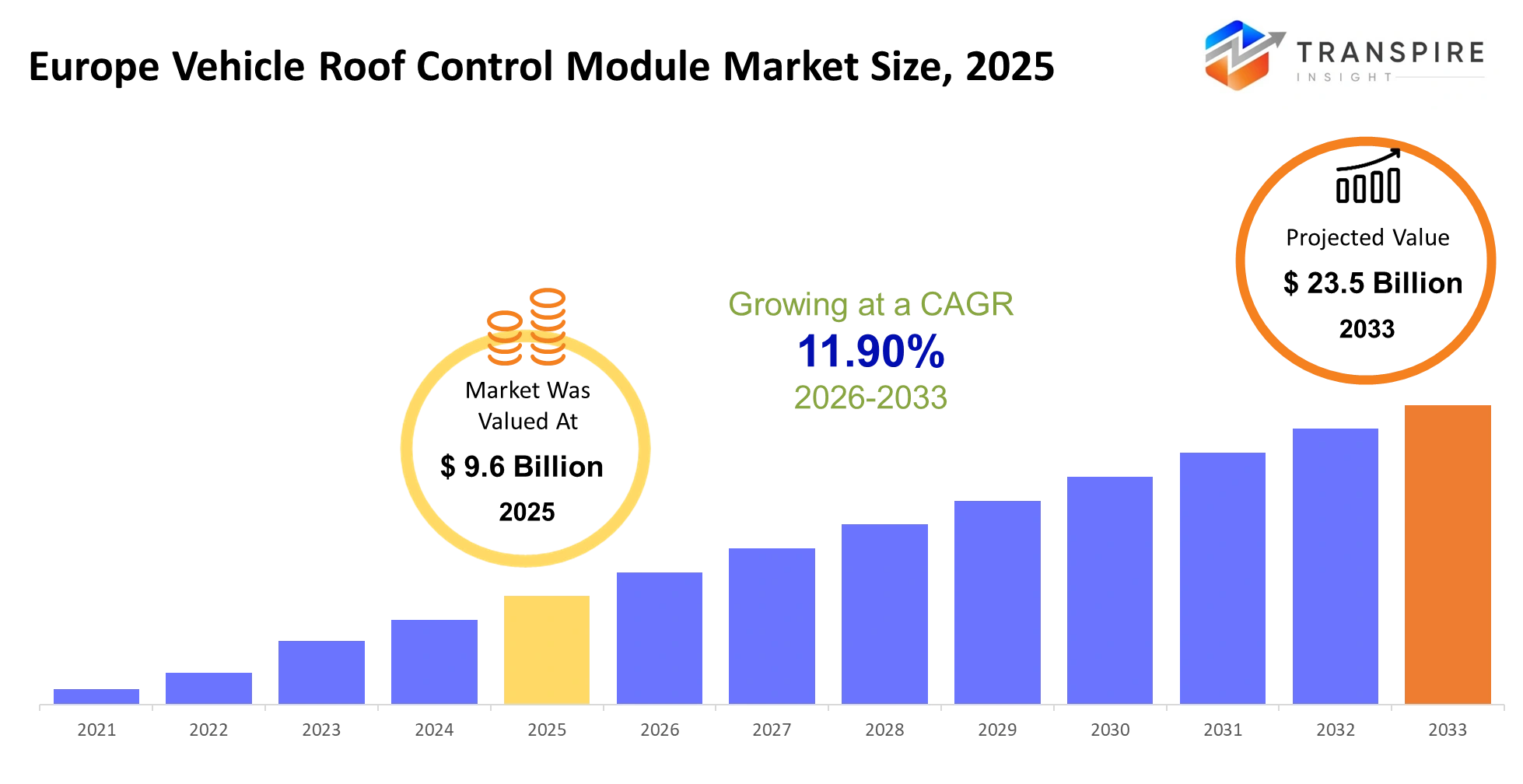
- Europe Vehicle Roof Control Module Market Size 2025: USD 9.6 Billion
- Europe Vehicle Roof Control Module Market Size 2033: USD 23.5 Billion
- Europe Vehicle Roof Control Module Market CAGR: 11.90%
- Europe Vehicle Roof Control Module Market Segments: By Type (Sunroof Control Modules, Convertible Roof Modules, Panoramic Roof Modules, Others); By Application (Passenger Cars, Luxury Vehicles, SUVs, Others); By End-User (OEMs, Aftermarket, Others); By Component (Control Units, Sensors, Actuators, Others).
To learn more about this report,  Download Free Sample Report
Europe Vehicle Roof Control Module Market Summary
The Europe Vehicle Roof Control Module Market was valued at USD 9.6 Billion in 2025. It is forecast to reach USD 23.5 Billion by 2033. That is a CAGR of 11.90% over the period.
The Europe Vehicle Roof Control Module Market is about the electronic bits that control sunroofs, panoramic roofs, convertible tops, and also smart glass technologies inside modern rides. In other words, these modules keep track of roof motion, safety locking, anti-pinch protection, rain sensing, and cabin comfort needs, so automakers can add that kind of high-end convenience feel without piling on more mechanical complication. In the last five years, the market sort of moved away from standalone roof electronics, toward software built control systems that connect with more centralized vehicle designs, especially on electric vehicle platforms. During the 2021–2023 supply chain disruption, semiconductor shortages were a big deal, which made automakers rethink their sourcing plans and push modular electronic systems that offer more software flexibility, and well, fewer surprises later.
Right now, the growth of the market is linked tightly with how fast electric SUVs and premium passenger vehicles are expanding across Germany, France and Scandinavia. Automakers are using panoramic roofs and intelligent roof controls more and more to stand out for EV platform differentiation in a crowded competition. This shift has raised the electronic content value per vehicle, and it opens up better revenue paths for suppliers that focus on sensors, actuators, lightweight control units, plus connected vehicle software integration, rather than only hardware.
Key Market Insights
- Germany kinda dominated the Europe Vehicle Roof Control Module Market, grabbing roughly 32% market share in 2025, mainly because premium automotive production and this pretty solid supplier ecosystem stuff.
- Asia-Pacific however showed the fastest growth trajectory between 2026 and 2033, since Chinese EV producers kept pushing for smart roof technology integration, more or less.
- In 2025 sunroof control modules actually held more than 38% of the overall industry share, because mid-range passenger cars increasingly wanted automated comfort plus safety features, you know.
- After 2024 panoramic roof modules became the quickest rising product segment, as electric SUV manufacturers leaned harder into premium cabin styling and natural-light optimization, slightly like it.
- Passenger cars made up about 46% of total market demand, driven by mass production activities across Germany, France Italy, and Spain, all together.
- For the outlook, luxury electric SUVs look like they’ll grow the most, since automakers ramped up adaptive glass roof systems and intelligent climate-responsive roof technologies after 2023.
- On ownership, OEMs captured nearly 68% of the market, which makes sense because advanced roof modules need deep integration with centralized vehicle electronics plus safety architectures.
- Meanwhile aftermarket demand picked up across Western Europe after 2022, as older vehicle fleets needed replacement actuators sensors, and electronic roof control units that inevitably wear out.
- Continental AG also improved its competitive stance with software-integrated roof electronics that fit centralized EV control architectures, plus advanced driver assistance systems.
- Bosch, for its part, expanded intelligent roof automation by tying in predictive diagnostics, anti-pinch safety measures, and energy-efficient electronic controls into premium vehicle platforms.
What are the Key Drivers, Restraints, and Opportunities in the Europe Vehicle Roof Control Module Market?
The strongest driver shaping the Europe Vehicle Roof Control Module Market is the rapid shift toward electric and software-defined vehicles across Germany, France , and Scandinavia. Automakers started pushing forward the integration of advanced roof electronics after 2021, partly because EV platforms need lighter vehicle structures, a centralized software command layer, and energy aware cabin management systems. Panoramic glass roofs, adaptive tint technologies, and automated comfort functions evolved fast from premium “extras” into real market differentiators, especially for electric SUVs and luxury sedans. That move directly boosted demand for intelligent roof control modules that can communicate with vehicle wide electronic architectures, so component value per vehicle rose and longer term supplier revenue possibilities expanded, more or less at the same time.
The most significant restraint is still the high integration complexity between advanced roof modules and the older vehicle electrical systems. Roof control systems now have to align with sensors, body control units, thermal management software, and safety electronics, which raises validation costs and extends engineering timelines. This is kind of structural, because automotive production cycles regularly stretch past five years, so manufacturers cannot easily redesign architectures for newer module platforms quickly enough. When integration lags, adoption slows for mid range vehicle makers and the market stays harder to penetrate outside premium classes.
One major opportunity is emerging via intelligent roof sensor platforms tailored for autonomous and connected vehicles.Companies like Webasto Group are really putting their money into roof-integrated lidar and camera systems, where basically you get a sensor housing plus thermal protection, and the electronic control too, packed into one modular build. And as Europe keeps expanding the testing and roll-out of autonomous mobility services from 2026, up to 2033 there’s a chance these sort of multi-purpose roof arrangements could open fresh high-margin chances for electronics suppliers, also for software focused automotive firms.
What Has the Impact of Artificial Intelligence Been on the Europe Vehicle Roof Control Module Market?
Artificial intelligence plus advanced digital technologies are kinda reshaping vehicle roof control systems across Europe, turning those old school electronic modules into more adaptive and software driven platforms. Automakers are more and more using AI enabled control routines to handle roof positioning automatically , rain detection, anti pinch reactions, and even thermal tuning based on stuff like driving conditions and the way the cabin gets occupied. Connected diagnostic setups now keep an eye on actuator loads, the reliability of sensors, and how motors behave in real time, so manufacturers and fleet owners can cut down on those annoying, sudden component breakdowns. A few premium car makers have also rolled out predictive maintenance models, they look at usage cycles and environmental exposure to figure out likely wear before operational faults show up.
Machine learning is doing another thing too, it’s improving energy optimization in electric vehicles by coordinating smart glass tinting, ventilation management, and roof insulation oversight, all with the goal of lowering cabin cooling needs. The idea helps battery efficiency and passenger comfort at the same time , while still aligning with tougher European vehicle efficiency rules. On top of that, advanced digital architectures support over the air software updates, meaning roof features can be upgraded without swapping hardware parts. Still, the integration overhead stays high, and interoperability is limited between legacy vehicle electronics and the next generation software platforms, which is slowing wider rollout—especially for mid range automakers and smaller suppliers.
Key Market Trends
- Since 2022, European automakers kind of been doing more panoramic roof installs on electric SUVs, to firm up the premium vibe, and also improve how the cabin-space feels to people.
- Bosch, Continental AG, and Webasto moved their development focus toward more centralized electronic architectures, rather than having isolated roof control hardware modules, after 2023.
- The semiconductor shortages in 2021–2023 really showed how risky supplier concentration can be, and that pushed OEMs to diversify sourcing methods for automotive control electronics.
- Between 2024 and 2026, German luxury brands expanded smart-glass roof integration, mainly to boost thermal efficiency, and to cut down battery usage on EV platforms.
- European safety rules then speeded up the use of anti-pinch sensors, plus automated roof diagnostics, across passenger cars, and even the premium crossover category.
- At the same time, Chinese EV competition basically forced European manufacturers to move faster on software-driven comfort features, like adaptive roof controls, and intelligent cabin personalization systems.
- After 2023, the aftermarket demand also shifted, people started preferring plug-and-play replacement modules, because aging fleets across Western Europe needed cheaper electronic roof repairs.
- Webasto put more money into roof sensor modules that integrate lidar and camera systems, as autonomous driving development ramped up during 2025 and 2026.
- Meanwhile, Scandinavian and German automakers increasingly went with lightweight composite roof structures, mostly to balance out battery weight growth in long-range electric vehicle production.
- And after 2024, Tier-1 suppliers broadened their partnerships with EV manufacturers, in order to secure early integration roles within next-generation software-defined vehicle platforms.
Europe Vehicle Roof Control Module Market Segmentation
By Type:
Sunroof control modules keep hold of the largest share, because normal sunroof systems stay broadly integrated through mid-range passenger vehicles and compact SUVs all across Europe. There is solid take-up during high volume vehicle production, which helps keep demand steady for standardized control architectures and cost efficient electronic parts. Automakers tend to prefer these solutions since the installation complexity is relatively low , while comfort improvement is still pretty high for end users. Plus , replacement needs coming from older vehicle fleets keeps supporting longer term aftermarket income for this product group.
Panoramic roof modules are moving faster now, especially as electric vehicle makers increasingly treat big glass roofs as a premium identity feature. Luxury brands and higher end SUV manufacturers commonly choose advanced panoramic layouts to lift cabin look, enhance daylight feel , and increase the sense of extra interior space. With smart glass implementations and sensor linked roof automation getting mixed in more often, product teams will likely lean toward multifunctional module platforms, with more software capability. Convertible roof modules stay a smaller but still attractive lane in sports and luxury categories, while specialized roof systems for commercial mobility, continue opening selective chances for custom module suppliers.

To learn more about this report, Download Free Sample Report
By Application:
Passenger cars take the leading market spot , mainly because large scale production in Germany, France, Italy , and Spain keeps the installation rhythm consistent for automated roof systems. People seem to like comfort centered cabin elements and more premium interior styling. So, even in mid-segment cars, electronically controlled roof technologies are being adopted more widely.Vehicle manufacturers often lean on roof automation features to, sort of, reinforce trim differentiation plans and to raise profit margins from add-on packages. Put together , this mix of scale, affordability, and feature integration helps keep the demand steady over time, especially within the segment.
Luxury vehicles and SUVs are showing faster revenue expansion , mainly because these classes depend on panoramic roofs, responsive roof controls, and bundled comfort electronics. In particular, premium electric SUV platforms are increasingly pairing roof modules with ambient lighting, better thermal insulation, and smart glass technologies, to strengthen how the brand is positioned. As Europe keeps expanding electric mobility adoption, it should nudge more investment toward lighter roof electronics that are tuned for energy efficiency and for centralized vehicle software routines. Meanwhile, smaller niche uses, like performance convertibles and executive mobility fleets, will keep funding focused module development during the forecast window.
By End-User:
OEMs still hold the biggest share of market revenue , because factory-installed roof control systems are tightly connected with vehicle electronics, safety mechanisms, and body control frameworks. Automakers more and more ask suppliers to provide customized modules that fit advanced software platforms and lightweight vehicle designs. The long development cycles, plus rigid validation expectations, makes the entry curve steep, which benefits suppliers that are already established, with proven engineering depth and broad-scale manufacturing capacity. Solid cooperation between OEMs and Tier-1 electronics providers keeps reinforcing longer supply agreements across Europe.
The aftermarket segment is expanding, pretty steadily, because older vehicles start needing replacement actuators, sensors, and control units, due to wear linked failures and electronic degradation, kinda like a gradual decline in reliability. Independent repair networks plus automotive service providers are seeing more demand for compatible replacement modules that enable cost-effective maintenance, without too much hassle. Digital diagnostics and plug-and-play replacement systems will likely improve aftermarket accessibility over the next few years, perhaps faster than expected. Also, other end-user groups, like specialty vehicle manufacturers and custom automotive builders, will shape targeted growth chances for flexible module suppliers that can handle low-volume customization, and still keep quality.
By Component:
Control units currently hold the leading share, not only because they manage the whole process, but because electronic processing systems function as the operational core of roof automation tasks across passenger vehicles, luxury cars, and electric SUVs. More integration with central vehicle software architecture has made advanced processing capability feel even more important, especially fault detection and real-time sensor communication. Automakers are prioritizing compact plus energy efficient control units, that support multiple roof configurations, while reducing wiring complexity and overall vehicle weight, which matters a lot. This direction keeps fueling investment into software enabled module platforms with scalable functionality, more or less.
Sensors and actuators are also moving quicker, technologically, as safety requirements and automated comfort functions get more sophisticated. Anti-pinch systems, rain detection features, and intelligent roof positioning mechanisms depend heavily on precise sensing and responsive actuation systems, basically the “hands and eyes” of the module.In the near future, growth probably leans toward suppliers who can blend solid, durable hardware with predictive diagnostics and also connected-vehicle compatibility too , sort of like that. Meanwhile the smaller component categories, such as connectors and auxiliary electronics, will keep gaining weight, because roof systems are evolving into multifunctional smart platforms that get tied in with autonomous features, plus energy-management technologies. It’s not just hardware anymore, it’s that whole connected diagnostic dance, and that’s where things seem to go.
What are the Key Use Cases Driving the Europe Vehicle Roof Control Module Market?
Passenger vehicles keep being the main use case for roof control modules across Europe, especially in premium sedans, SUVs, and electric vehicles with panoramic sunroofs and automated roof systems. Automakers depend on these modules to handle motorized roof travel, anti pinch safety logic, and cabin comfort routines, which has made them feel sort of standard on higher value vehicle platforms, at least in practice.
At the same time demand is growing in convertible sports cars and upscale crossover models, where roof automation really supports product distinction and day to day user experience. Fleet operators in executive mobility plus premium ride hailing services are also starting to take up vehicles with more advanced roof systems, mostly because comfort focused features seem to help with customer stay rates and later resale value.
More recently, some emerging applications show up in autonomous, and software defined vehicles that combine roof mounted sensing, smart glass elements, and climate responsive roof solutions. Electric commercial vans and next generation mobility shuttles are adding even more room for multifunction roof control modules tied into energy management and connected vehicle architectures.
|
Report Metrics |
Details |
|
Market size value in 2025 |
USD 9.6 Billion |
|
Market size value in 2026 |
USD 10.7 Billion |
|
Revenue forecast in 2033 |
USD 23.5 Billion |
|
Growth rate |
CAGR of 11.90% from 2026 to 2033 |
|
Base year |
2025 |
|
Historical data |
2021 - 2024 |
|
Forecast period |
2026 - 2033 |
|
Report coverage |
Revenue forecast, competitive landscape, growth factors, and trends |
|
Regional scope |
Europe (Germany, United Kingdom, France, Italy, Spain, Rest of Europe) |
|
Key company profiled |
Bosch, Continental, Denso, Valeo, Magna, Webasto, Inalfa Roof Systems, AISIN, Hyundai Mobis, Hella, Lear Corporation, Faurecia, Delphi Technologies, Hitachi Automotive, Gentex. |
|
Customization scope |
Free report customization (country, regional & segment scope). Avail customized purchase options to meet your exact research needs. |
|
Report Segmentation |
By Type (Sunroof Control Modules, Convertible Roof Modules, Panoramic Roof Modules, Others); By Application (Passenger Cars, Luxury Vehicles, SUVs, Others); By End-User (OEMs, Aftermarket, Others); By Component (Control Units, Sensors, Actuators, Others). |
Which Regions are Driving the Europe Vehicle Roof Control Module Market Growth?
Europe still looks like the dominant region for the Vehicle Roof Control Module Market because the area kind of mixes strict safety rules for vehicles with a solid premium car manufacturing base. Germany , France , and Italy keep showing up at the front as automakers roll in panoramic roof panels, smart glass systems and electronic comfort add-ons into both the more luxurious models and the mid-range trims. At the same time, the regulatory push on vehicle efficiency and occupant safety also kinda speeds up the appetite for lighter roof electronics, plus anti-pinch control technologies. And this leading position is supported by a fairly mature supplier ecosystem, you know, with semiconductor firms, mechatronics specialists, advanced material providers, and Tier-1 automotive electronics manufacturers, all working through closely tied OEM supply channels which are more integrated than people think.
North America comes next, with a more distinct market feel that is basically driven by steady consumer demand for SUVs, pickup trucks and premium utility vehicles that use bigger roof setups. Compared with Europe, the region leans less on regulation pressure, and more on persistent customer preference for comfort-focused vehicle features and higher-margin trim packages. Major automakers across the United States and Canada continue putting money into electronic roof integration in a consistent way, since these functions help the brand stand out and also help keep value when it comes to resale, or even aftermarket scenarios. With strong buying power, predictable replacement cycles, and long established supplier partnerships, North America stays as a dependable contributor to global market revenue even when the wider auto sector is going through choppy moments.
Asia-Pacific is currently the fastest-growing region, mostly because China , South Korea , and India are ramping up electric vehicle production and upgrading domestic manufacturing skills.Over the past few years, government backed EV incentives and steady investments in smart mobility infrastructure kind a helped push automakers to adopt software integrated roof control systems for newer vehicle platforms. In particular , Chinese manufacturers are expanding the use of panoramic smart roofs and sensor integrated roof modules as a sort of competitive feature inside many domestic EV brands. And yeah this momentum is opening up big chances for component suppliers, software developers, and electronics manufacturers who are looking for long term partnerships with regional OEMs between 2026 and 2033.
Who are the Key Players in the Europe Vehicle Roof Control Module Market and How Do They Compete?
The Europe Vehicle Roof Control Module market stays kind of moderately consolidated, with well known automotive electronics suppliers keeping long run contracts with OEMs, while smaller engineering firms try to win by quicker customization and integration. Most of the rivalry happens around electronic reliability, compact module design, and compatibility for panoramic roofs, convertible setups, plus newer smart vehicle architectures. The big players still defend share mainly with software enabled roof automation and closer coupling to body control systems, not so much by pushing price down. Meanwhile, EV production across Europe has opened doors for newer suppliers that focus on lightweight electronic control units and energy efficient module platforms.
Continental AG leans hard on software driven vehicle electronics and it uses its strong relationships with German automakers, to land integration programs for premium passenger vehicles. Its roof control modules are notable for smooth connectivity with ADAS and central body electronics, which in turn cuts down wiring complexity for OEMs. The company keeps expanding via partnerships tied to electric vehicle platforms and centralized vehicle architecture programs across Europe. Bosch, on the other hand, competes with a high volume manufacturing base and dependable system performance, especially for vehicles that need advanced sunroof automation plus anti pinch safety systems. Its wide aftermarket plus OEM network throughout Western Europe supports it in both replacement demand and factory installed systems.
Valeo differentiates itself using lightweight mechatronic systems aimed at boosting vehicle efficiency and lowering cabin noise, particularly in electric vehicles.The company has put serious money into intelligent comfort features , like sensor enabled roof actuation systems that kinda line up with the premium EV market demand. Webasto Group seems to follow a niche specialization approach, focused much more on roof systems, not so much on wide automotive electronics in general. Their skill set around panoramic and convertible roof integration, lets them team up closely with luxury and performance vehicle manufacturers, for customized vehicle platforms. More recently they have pushed further across Europe using advanced roof technologies for hybrid, also electric vehicle segments, and there is this growing appetite for bigger glass roof systems, which keeps accelerating over time.
Company List
- Bosch
- Continental
- Denso
- Valeo
- Magna
- Webasto
- Inalfa Roof Systems
- AISIN
- Hyundai Mobis
- Hella
- Lear Corporation
- Faurecia
- Delphi Technologies
- Hitachi Automotive
- Gentex
Recent Development News
In March 2026, Bosch introduced the FCPM C100 fuel-cell power module designed for roof-mounted integration in European city buses. The compact system supports next-generation vehicle electronics and roof integration architectures, strengthening Bosch’s position in advanced vehicle control and rooftop mobility systems for commercial transport applications.
Source: https://www.busworldeurope.org
In April 2026, Webasto Group launched the Cool Top 120-e electric rooftop air-conditioning system for electric minibuses and light commercial vehicles. The launch expanded Webasto’s roof-mounted electronics and thermal management portfolio, reinforcing demand for integrated roof control and smart module technologies in Europe’s electric mobility segment.
Source: https://truckandbusbuilder.com
What Strategic Insights Define the Future of the Europe Vehicle Roof Control Module Market?
The Europe Vehicle Roof Control Module Market is moving toward pretty much fully integrated smart roof ecosystems, where electronic control is bundled together with sensor fusion, thermal management, and vehicle connectivity, all inside a centralized vehicle architecture. And this shift is being pushed hard by the fast growth of electric and software-defined vehicles, where automakers focus on lightweight electronic integration and energy efficient cabin systems. Over the next five to seven years, roof control modules are going to keep changing, not just from standalone mechanical controllers, but into multifunctional platforms that tie in with ADAS , autonomous driving features, and predictive comfort systems, kinda like a broader roof intelligence layer.
One less noticed risk is semiconductor concentration and a heavy dependence on specialized sensors, especially once advanced roof modules start folding in lidar cameras, and intelligent actuation. If there is a supply disruption in those niche automotive chips, OEM production can get delayed even when overall vehicle demand stays pretty stable. Meanwhile there is also an emerging opportunity that a lot of people are overlooking, like panoramic smart glass roofs with dynamic tint control. This looks especially strong in premium EV segments across Germany and Scandinavia. Market participants really should prioritize modular, software-compatible platforms that can be adapted across several vehicle classes, so they can respond quicker to changing OEM architecture requirements, and also cut down redesign costs during long production cycles.
Europe Vehicle Roof Control Module Market Report Segmentation
By Type
- Sunroof Control Modules
- Convertible Roof Modules
- Panoramic Roof Modules
- Others
By Application
- Passenger Cars
- Luxury Vehicles
- SUVs
- Others
By End-User
- OEMs
- Aftermarket
- Others
By Component
- Control Units
- Sensors
- Actuators
- Others
Frequently Asked Questions
Find quick answers to common questions.
The Europe Vehicle Roof Control Module Market size is USD 23.5 Billion in 2033.
Key segments for the Europe Vehicle Roof Control Module Market are By Type (Sunroof Control Modules, Convertible Roof Modules, Panoramic Roof Modules, Others); By Application (Passenger Cars, Luxury Vehicles, SUVs, Others); By End-User (OEMs, Aftermarket, Others); By Component (Control Units, Sensors, Actuators, Others).
Major Europe Vehicle Roof Control Module Market players are Bosch, Continental, Denso, Valeo, Magna, Webasto, Inalfa Roof Systems, AISIN, Hyundai Mobis, Hella, Lear Corporation, Faurecia, Delphi Technologies, Hitachi Automotive, Gentex.
The Europe Vehicle Roof Control Module Market size is USD 9.6 Billion in 2025.
The Europe Vehicle Roof Control Module Market CAGR is 11.90% from 2026 to 2033.
- Bosch
- Continental
- Denso
- Valeo
- Magna
- Webasto
- Inalfa Roof Systems
- AISIN
- Hyundai Mobis
- Hella
- Lear Corporation
- Faurecia
- Delphi Technologies
- Hitachi Automotive
- Gentex
Recently Published Reports
-
Apr 2026
ATV & UTV Market
ATV & UTV Market Size, Share & Analysis Report By Type (ATV, and UTV), By Variants (Less Than 400 CC, 400 CC To 800 CC, and More Than 800 CC), and Geography (North America, Europe, Asia-Pacific, Middle East and Africa, South and Central America), 2021 - 2031
-
Apr 2026
Automotive Central Gateway Module Market
Automotive Central Gateway Module Market Size, Share & Analysis Report By Type (Ethernet Central Gateway Module, CAN Central Gateway Module, LIN Central Gateway Module, and FlexRay), By Application (Powertrain Control, Body Control, Infotainment System, Advanced Driver Assistance Systems (ADAS), and Others), By End User (Passenger Vehicles, and Commercial Vehicles), and Geography (North America, Europe, Asia-Pacific, Middle East and Africa, South and Central America), 2021 - 2031
-
Apr 2026
Automotive Engine Oil Filter Market
Automotive Engine Oil Filter Market Size, Share & Analysis Report By Filter Type (Fuel Filter, Engine Oil Filter, Hydraulic Oil Filter, and Others), By Filter Media (Cellulose, Synthetic, and Micro), By Sales Channel (OEMs, and Aftermarket), By Vehicle Type (Passenger Cars, Light Commercial Vehicles, Heavy Duty Trucks, Buses and Coaches, and Off-road Vehicles), and Geography (North America, Europe, Asia-Pacific, Middle East and Africa, South and Central America), 2021 - 2031
-
Apr 2026
Automotive Parts Aluminium Die Casting Market
Automotive Parts Aluminium Die Casting Market Size, Share & Analysis Report By Production Process (Pressure Die Casting, Vacuum Die Casting, Squeeze Die Casting, Gravity Die Casting), By Application (Body Parts, Engine Parts, Transmission Parts, Battery And Related Components, Other Application Types), and Geography (North America, Europe, Asia-Pacific, Middle East and Africa, South and Central America), 2021 - 2031
Our Clients