
Asia Pacific Lightweight Cars Market Size & Forecast:
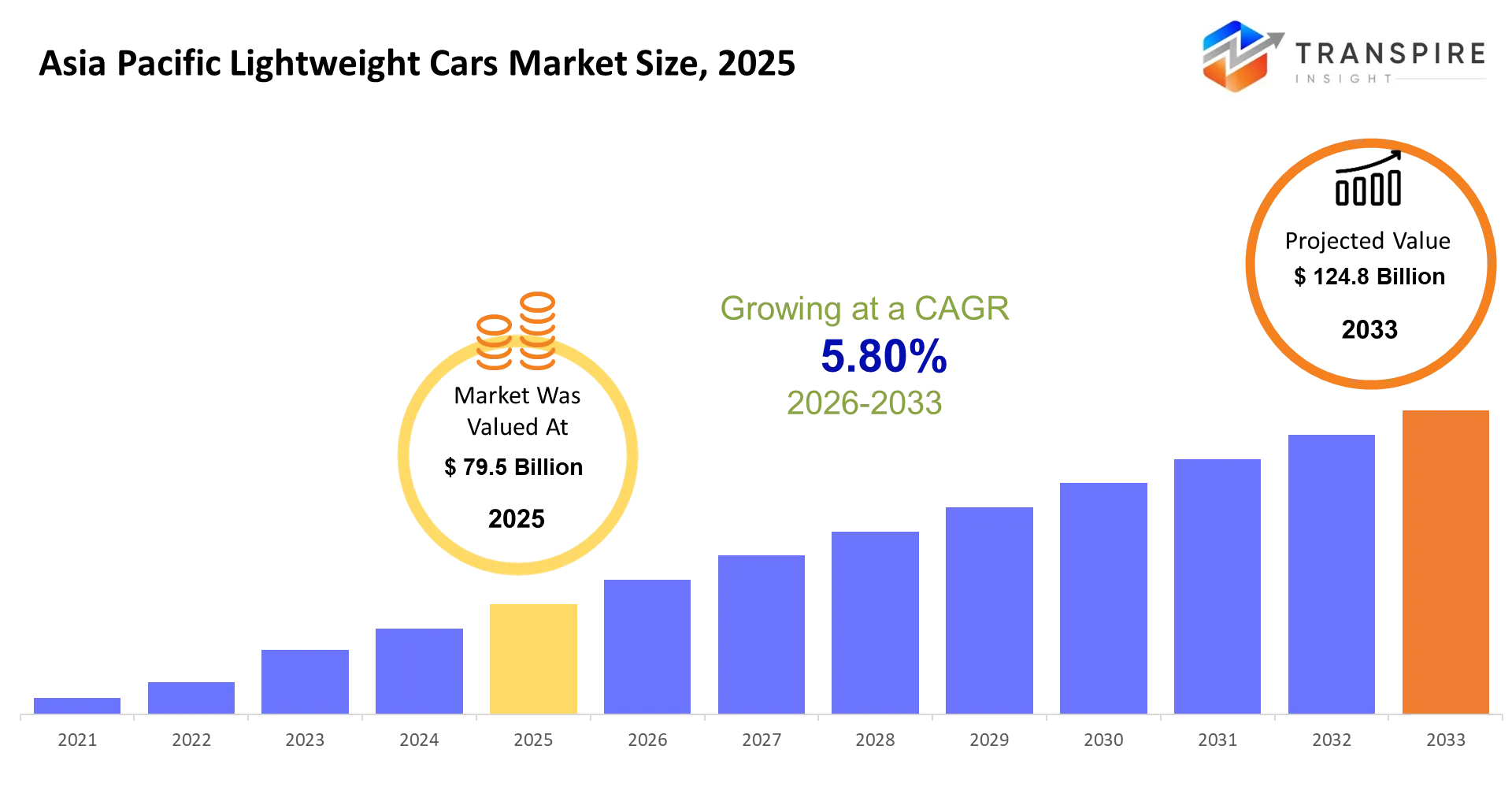
- Asia Pacific Lightweight Cars Market Size 2025: USD 79.5 Billion
- Asia Pacific Lightweight Cars Market Size 2033: USD 124.8 Billion
- Asia Pacific Lightweight Cars Market CAGR: 5.80%
- Asia Pacific Lightweight Cars Market Segments: By Type (Hatchback, Sedan, SUV, Electric Vehicles, Others); By Application (Passenger Vehicles, Commercial Vehicles, Ride Sharing, Fleet Vehicles, Others); By End-User (Consumers, Fleet Operators, Automotive Companies, Ride-sharing Firms, Government, Others); By Material (Aluminum, Carbon Fiber, High-strength Steel, Others)
To learn more about this report,  Download Free Sample Report
Asia Pacific Lightweight Cars Market Summary
The Asia Pacific Lightweight Cars Market was valued at USD 79.5 Billion in 2025. It is forecast to reach USD 124.8 Billion by 2033. That is a CAGR of 5.80% over the period.
The Asia Pacific lightweight cars market shows how car manufacturers and transportation service providers need to decrease vehicle weight. This weight reduction will help them achieve better fuel economy and longer electric vehicle range. The new regulations force manufacturers to develop products which meet expanding emissions and safety requirements while maintaining optimal performance. The application of lightweight vehicle engineering enables car manufacturers to decrease their expenses through improved vehicle performance which meets regional efficiency standards. This practice has become essential to the development of contemporary automotive production methods.
The market has transformed during the last three to five years because to its shift from using selective material substitution toward its current use of multi-material vehicle architecture which integrates advanced high-strength steel with aluminum and composites and engineered plastics into standard vehicle platforms. The industry experienced this change because post-pandemic supply chain disruptions exposed material sourcing methods to cost risks which required manufacturers to change their material procurement and production processes. The automotive industry faced more rigorous carbon reduction requirements from China and Japan and South Korea which resulted in manufacturers using lightweight materials to decrease their vehicle fleet emissions. The company now supports material research and development through its enhanced supplier network which also helps various vehicle types from electric to internal combustion increase their market entry which leads to higher revenue potential throughout the automotive industry.
Key Market Insights
- China controls almost 46% of the Asia Pacific Lightweight Cars Market which will reach that figure in 2025 because of its extensive electric vehicle production capabilities.
- The domestic electric vehicle production incentives and lightweight material sourcing through local facilities drive India to become the fastest-growing regional market until 2032.
- Japan retains a major market position because of its advanced lightweight steel technology and its strong production of hybrid vehicles.
- Advanced high-strength steel dominates the market with a 42% market share because it offers cost-effective solutions which manufacturers can use to produce passenger vehicles in large quantities.
- Aluminum-based lightweight structures hold the second-largest share because premium vehicle manufacturers need them to meet their crash-performance standards.
- The segment of carbon fiber composites will experience its most rapid growth until 2032 because their costs will decrease while performance and electric vehicle platforms enhance their value.
- The Asia Pacific Lightweight Cars Market now defines its main market trend through multi-material architecture systems which enhance structural strength and decrease vehicle mass.
- The market for passenger cars leads with more than 68% of total market share because consumers show strong interest in fuel-efficient urban transportation and compact electric vehicle usage.
- The application segment of battery electric vehicles shows the highest growth rate because lightweighting technology enables vehicles to increase their driving range between 8% and 12% through weight reduction.
- The Asia Pacific Lightweight Cars Market remains under OEM manufacturers control because they maintain almost 74% market share through direct integration of lightweight platforms.
What are the Key Drivers, Restraints, and Opportunities in the Asia Pacific Lightweight Cars Market?
The primary factor driving market growth for lightweight vehicles across the Asia Pacific region results from stricter emission standards and fuel economy requirements which different countries implement, especially China, Japan and India. The government regulations gained strength because governments established links between carbon reduction objectives and the automotive manufacturing standards. Automakers changed their approach to weight reduction by adopting platform-based lightweight design methods instead of their previous incremental weight reduction methods. The market shift enables advanced steel manufacturers, aluminum producers, and composite material suppliers to create new sales channels, which electric vehicle manufacturers use to enhance battery performance without increasing battery pack expenses.
Manufacturers face an important obstacle which consists of needing to spend large amounts of money for their production facilities to switch to making vehicles with multiple materials. The structural problem exists because lightweight vehicle designs require manufacturers to have access to special equipment and joining methods and a network of suppliers to create their products. Regional manufacturers continue to use traditional assembly systems which depend on steel, so they face high costs when switching to new systems. The process takes more time because it creates delays in mid-tier automakers' technology adoption and reduces the possible revenue which would have come from more extensive material changes.
The Southeast Asian region especially Thailand and Vietnam presents a significant business opportunity through its development of localized carbon fiber and advanced composite manufacturing facilities. The recent investments made in the establishment of EV component clusters and material processing facilities have created operational conditions that enable the manufacturing of lightweight components at scale which will drive the upcoming phase of market growth in the region.
What Has the Impact of Artificial Intelligence Been on the Asia Pacific Lightweight Cars Market?
Digital manufacturing environments now utilize AI-driven automation to track material forming and robotic joining accuracy and structural assembly stability of lightweight vehicle components. The automotive industry in China, Japan and South Korea uses AI-powered control systems to enhance aluminum stamping and composite molding operations which leads to a material waste reduction of 10 to 15 percent and an increase in production cycle efficiency. Machine learning models enable predictive maintenance through their ability to analyze vibration and temperature and tooling wear data which helps predict equipment failures that would disrupt production.
Predictive simulation platforms help improve lightweight architecture performance which enables them to forecast crash behavior and battery efficiency impacts and aerodynamic interactions before physical prototyping begins. This technology enables manufacturers to enhance electric vehicle range through better weight distribution modeling which shortens development times by 20 percent. AI-based digital twins enable manufacturers to make real-time production changes which improve quality compliance and decrease defect rates.
The main limitation remains integration complexity. Many regional automakers still operate legacy manufacturing systems which lack essential sensor infrastructure and data systems for accurate AI implementation, making the process expensive while diminishing model performance in actual factory settings.
Key Market Trends
- The steel-heavy designs of vehicles faced elimination because China and Japan implemented stricter emission regulations starting from 2022.
- Automakers during the period from 2020 to 2025 developed multi-material architectures which combined aluminum with composites and high-strength steel, after they had previously used only one material for their products.
- Electric vehicle adoption used lightweighting solutions which enabled battery-powered passenger vehicles to achieve driving range increases between 8 and 12 percent.
- India and Southeast Asia established local component production facilities after 2023, which allowed them to decrease their reliance on imported lightweight materials while developing stronger supply chains.
- Toyota Motor Corporation and Hyundai Motor Company implemented AI-based digital twin systems after 2024, which enabled them to enhance structural optimization while cutting prototype development time by almost 20 percent.
- Manufacturers used hybrid composite materials and cost-stabilized lightweight design strategies because aluminum prices during the period from 2021 to 2024 experienced unpredictable fluctuations.
- The partnerships between OEMs and material suppliers reached new heights after 2023, which allowed both parties to create lightweight platforms that could withstand crashes for upcoming electric vehicle models.
- BYD Company Ltd. and SAIC Motor Corporation increased their electric vehicle production, which forced them to redesign chassis components so that they could achieve better energy efficiency.
Asia Pacific Lightweight Cars Market Segmentation
By Type :
The hatchback segment in the Asia Pacific Lightweight Cars Market will continue to hold strong demand because its compact size and fuel efficiency make it ideal for both city driving and daily travel. Users who prefer sedans will choose these vehicles because they provide comfortable driving experience and balanced performance capabilities.
As more people prefer higher ground clearance vehicles which offer larger cabins the demand for SUV vehicles will increase. The market for electric vehicles will experience rapid growth because of upcoming emission regulations and development of better charging networks. Other vehicle types will serve niche needs with limited but steady adoption across specific user groups.
By Application :
The Asia Pacific Lightweight Cars Market will identify passenger vehicles as its primary application segment because of increasing personal mobility requirements and urban population expansion. The commercial vehicle sector will start to use lightweight materials more frequently because these materials help to decrease operating expenses while enhancing fuel efficiency.
Ride sharing services will create rising demand for vehicles that combine high durability with effective performance. Fleet vehicles will prioritize financial savings and extended operational life while other vehicles will be used for specialized transportation purposes that occur during specific, infrequent times.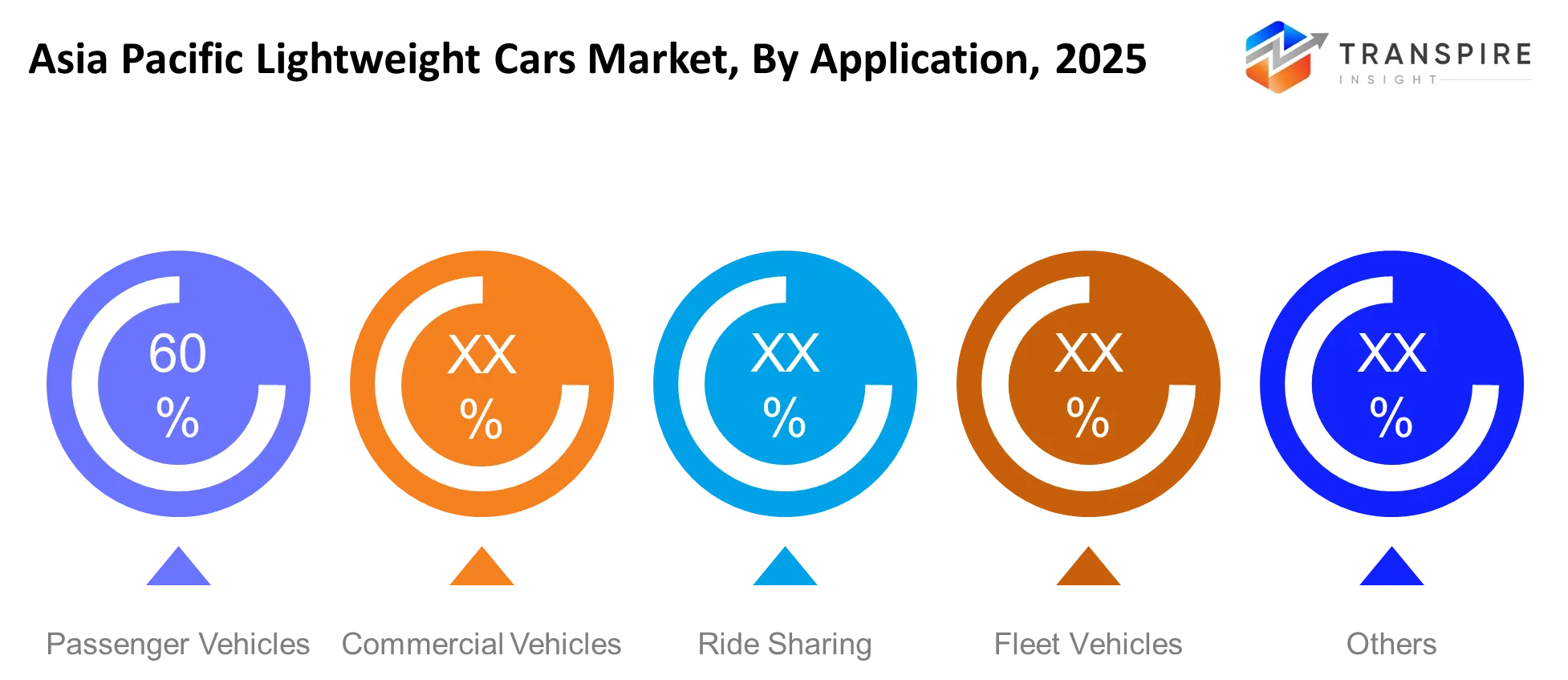
To learn more about this report, Download Free Sample Report
By End-User :
The Asia Pacific Lightweight Cars Market, the largest end-user group, will consist of consumers because vehicle ownership increases and people seek fuel-efficient cars. Fleet operators will work to achieve two goals which include decreasing their maintenance expenses and extending the operational life of their vehicles.
Automotive companies will invest in lightweight design for better performance standards. Ride-sharing firms will choose vehicles that provide both cost savings and long-lasting durability. Government agencies will use vehicles to fulfill their transportation requirements and administrative functions while institutional users and specialized service providers will also use the vehicles.
By Material :
Aluminum will remain the primary material for the Asia Pacific Lightweight Cars Market because it provides an optimal combination of strength and lightweight properties which enhance fuel efficiency. Carbon fiber will see increased use in high-performance and premium vehicles because of its high strength-to-weight ratio, though cost will limit mass adoption.
High-strength steel will continue to dominate due to its affordable price and its ability to provide safety advantages. The vehicle will use other materials which include composite materials and hybrid material combinations that engineers will apply for specific purposes to enhance the structural integrity and overall performance.
What are the Key Use Cases Driving the Asia Pacific Lightweight Cars Market?
Passenger cars remain the dominant use case in the Asia Pacific lightweight cars market because current urban mobility needs and upcoming fuel efficiency regulations compel car manufacturers to build lighter vehicles which will provide better energy efficiency. Lightweight structures directly improve electric vehicle range and reduce lifecycle emissions, making them essential for high-volume passenger platforms.
Electric and hybrid vehicles are expanding as secondary use cases, especially within OEM-driven production systems in China and Japan. The applications depend on aluminum body structures and composite reinforcements to balance battery weight, while fleet operators use lightweight designs to reduce their operational expenses.
Shared mobility fleets and next-generation urban micro-EVs currently represent emerging applications which focus on densely populated cities in India and Southeast Asia. The use cases currently under development are gaining traction because governments introduce low-emission urban zones which promote compact energy-efficient vehicle deployment through the forecast period.
|
Report Metrics |
Details |
|
Market size value in 2025 |
USD 79.5 Billion |
|
Market size value in 2026 |
USD 84.1 Billion |
|
Revenue forecast in 2033 |
USD 124.8 Billion |
|
Growth rate |
CAGR of 5.80% from 2026 to 2033 |
|
Base year |
2025 |
|
Historical data |
2021 - 2024 |
|
Forecast period |
2026 - 2033 |
|
Report coverage |
Revenue forecast, competitive landscape, growth factors, and trends |
|
Regional scope |
Asia Pacific (China, India, Japan, South Korea, Australia, Rest of Asia Pacific) |
|
Key company profiled |
Toyota, Honda, Hyundai, Suzuki, Tata Motors, BYD, Tesla, Nissan, Kia, Volkswagen, Ford, General Motors, Renault, Geely, SAIC |
|
Customization scope |
Free report customization (country, regional & segment scope). Avail customized purchase options to meet your exact research needs. |
|
Report Segmentation |
By Type (Hatchback, Sedan, SUV, Electric Vehicles, Others); By Application (Passenger Vehicles, Commercial Vehicles, Ride Sharing, Fleet Vehicles, Others); By End-User (Consumers, Fleet Operators, Automotive Companies, Ride-sharing Firms, Government, Others); By Material (Aluminum, Carbon Fiber, High-strength Steel, Others) |
Which Regions are Driving the Asia Pacific Lightweight Cars Market Growth?
China serves as the primary market for lightweight vehicles which dominates the Asia Pacific market because its electrification initiatives and vehicle emission standards determine how manufacturers will develop their automobiles. The country maintains operational efficiency through its complete supply chain network which links battery manufacturers and aluminum producers with major automotive companies such as BYD and SAIC. The extensive production capacity that both domestic and international electric vehicle manufacturing operations have established creates a strong need for lightweight design solutions. The system enables quick market entry of new materials which helps China maintain its leading position in implementation speed and cost-effective solutions.
Japan operates as a reliable market which supports innovation through its hybrid vehicle market and advanced manufacturing methods. Japanese manufacturers like Toyota and Honda maintain their competitive edge through dedicated funding while their suppliers provide essential manufacturing components. Automotive companies can implement their lightweight platform upgrades because regulations develop at a known rate from their current enforcement level. The organization generates consistent revenue through gradual material development which supports business growth without major changes.
India currently experiences its highest expansion rate because recent electric vehicle incentives and localization regulations have increased the adoption of lightweight vehicles. India maintains its growth through rapid fleet updates and demand for affordable transportation options in urban areas which differs from mature markets that depend on high-end vehicle development. Automakers are establishing local production facilities for aluminum and composite materials to achieve lower production expenses and decrease their reliance on imported materials. The period between 2026 and 2033 will transform India into an essential expansion center for international lightweight vehicle manufacturers who wish to expand their operations in high-volume markets.
Who are the Key Players in the Asia Pacific Lightweight Cars Market and How Do They Compete?
The Asia Pacific lightweight car market shows moderate competition because major original equipment manufacturers (OEMs) control platform development while specialized material suppliers compete in upstream value chains. Existing market players defend their market share by integrating lightweighting into vehicle design which they use as a core component instead of treating it as an optional enhancement. Companies now compete based on their ability to implement complete technological solutions which include multi-material engineering and electric vehicle platform optimization. The automotive industry has entered a new phase where newcomers, especially electric vehicle manufacturers, are transforming established design practices through their dedication to developing more effective structural components instead of using traditional vehicle chassis.
Toyota Motor Corporation uses its extended research and development cycles to create advanced technologies which need high-strength steel and hybrid aluminum materials to construct its vehicles that operate in all markets. The company establishes its competitive edge through strong supplier partnerships which enable them to implement lightweight solutions while maintaining product safety through established crash testing systems. Hyundai Motor Company develops its electric vehicle range through lightweight modular platforms which enable the company to create new vehicle models while reducing manufacturing costs and enhancing product performance. The company establishes a stronger market presence through manufacturing facilities located in multiple regions which enable faster product distribution to different Asian Pacific countries.
BYD Company Ltd. and SAIC Motor Corporation compete through their electric vehicle designs which use lightweight materials and their battery and chassis systems vertical integration to manage weight and expenses. BYD differentiates its products through its complete integration of battery systems with vehicle body structures while SAIC Motor Corporation focuses on modular electric vehicle platforms which achieve mass production through scale expansion. The two companies establish their presence in Southeast Asia and Indian mobility markets through joint ventures and regional electric vehicle export initiatives.
Company List
- Toyota
- Honda
- Hyundai
- Suzuki
- Tata Motors
- BYD
- Tesla
- Nissan
- Kia
- Volkswagen
- Ford
- General Motors
- Renault
- Geely
- SAIC
Recent Development News
In May 2026, Stellantis and Leapmotor announced their intention to expand their strategic partnership, including increased production of compact electric models at Stellantis’ Zaragoza plant and deeper integration of Leapmotor’s cost-efficient EV architecture into European and Asia-Pacific supply chains. This move strengthens cross-regional manufacturing efficiency and accelerates the rollout of lightweight, affordable EV platforms across multiple markets including Asia Pacific. Source https://www.stellantis.com/
In January 2025, GAC Group and ride-hailing platform Grab formed a strategic partnership to deploy up to 20,000 electric vehicles across Southeast Asia, supporting large-scale adoption of lightweight EV fleets optimized for urban mobility. The collaboration focuses on accelerating electrified transport ecosystems in Asia Pacific cities through high-volume, low-weight EV deployment. Source https://www.gacgroup.com/
What Strategic Insights Define the Future of the Asia Pacific Lightweight Cars Market?
The Asia Pacific lightweight cars market will develop complete vehicle digitalization within the next 5 to 7 years because contemporary design processes now require lightweighting decisions to be integrated into AI-based systems and electric platform designs. The market shift occurs because electric vehicle adoption increases while countries like China and Japan and India strengthen their emission regulations which require manufacturers to enhance system-level weight optimization for better range performance and operational efficiency.
The production process faces hidden dangers because the industry relies too heavily on aluminum and advanced composite materials which come from a small group of regional manufacturing partners. The current energy pricing situation together with export control measures will result in material shortages which will hinder production growth because of decreased electric vehicle demand.
The automotive industry in Southeast Asia has started to adopt closed-loop recycling systems for automotive-grade aluminum through partnerships between original equipment manufacturers and local suppliers. The system enables organizations to decrease material volatility while achieving better sustainability results.To achieve sustained cost savings and flexible design capabilities in electric vehicle systems market players must establish direct connections with material recyclers and digital engineering platforms.
Asia Pacific Lightweight Cars Market Report Segmentation
By Type
- Hatchback
- Sedan
- SUV
- Electric Vehicles
By Application
- Passenger Vehicles
- Commercial Vehicles
- Ride Sharing
- Fleet Vehicles
By End-User
- Consumers
- Fleet Operators
- Automotive Companies
- Ride-sharing Firms
- Government
By Material
- Aluminum
- Carbon Fiber
- High-strength Steel
Frequently Asked Questions
Find quick answers to common questions.
The Asia Pacific Lightweight Cars Market size is USD 124.8 Billion in 2033.
Key Segments for the Asia Pacific Lightweight Cars Market are By Type (Hatchback, Sedan, SUV, Electric Vehicles, Others); By Application (Passenger Vehicles, Commercial Vehicles, Ride Sharing, Fleet Vehicles, Others); By End-User (Consumers, Fleet Operators, Automotive Companies, Ride-sharing Firms, Government, Others); By Material (Aluminum, Carbon Fiber, High-strength Steel, Others).
Major Asia Pacific Lightweight Cars Market Players are Toyota, Honda, Hyundai, Suzuki, Tata Motors, BYD, Tesla, Nissan, Kia, Volkswagen, Ford, General Motors, Renault, Geely, SAIC.
The Current Asia Pacific Lightweight Cars Market size is USD 79.5 Billion in 2025.
The Asia Pacific Lightweight Cars Market CAGR is 5.80% from 2026 to 2033.
- Toyota
- Honda
- Hyundai
- Suzuki
- Tata Motors
- BYD
- Tesla
- Nissan
- Kia
- Volkswagen
- Ford
- General Motors
- Renault
- Geely
- SAIC
Recently Published Reports
-
Apr 2026
ATV & UTV Market
ATV & UTV Market Size, Share & Analysis Report By Type (ATV, and UTV), By Variants (Less Than 400 CC, 400 CC To 800 CC, and More Than 800 CC), and Geography (North America, Europe, Asia-Pacific, Middle East and Africa, South and Central America), 2021 - 2031
-
Apr 2026
Automotive Central Gateway Module Market
Automotive Central Gateway Module Market Size, Share & Analysis Report By Type (Ethernet Central Gateway Module, CAN Central Gateway Module, LIN Central Gateway Module, and FlexRay), By Application (Powertrain Control, Body Control, Infotainment System, Advanced Driver Assistance Systems (ADAS), and Others), By End User (Passenger Vehicles, and Commercial Vehicles), and Geography (North America, Europe, Asia-Pacific, Middle East and Africa, South and Central America), 2021 - 2031
-
Apr 2026
Automotive Engine Oil Filter Market
Automotive Engine Oil Filter Market Size, Share & Analysis Report By Filter Type (Fuel Filter, Engine Oil Filter, Hydraulic Oil Filter, and Others), By Filter Media (Cellulose, Synthetic, and Micro), By Sales Channel (OEMs, and Aftermarket), By Vehicle Type (Passenger Cars, Light Commercial Vehicles, Heavy Duty Trucks, Buses and Coaches, and Off-road Vehicles), and Geography (North America, Europe, Asia-Pacific, Middle East and Africa, South and Central America), 2021 - 2031
-
Apr 2026
Automotive Parts Aluminium Die Casting Market
Automotive Parts Aluminium Die Casting Market Size, Share & Analysis Report By Production Process (Pressure Die Casting, Vacuum Die Casting, Squeeze Die Casting, Gravity Die Casting), By Application (Body Parts, Engine Parts, Transmission Parts, Battery And Related Components, Other Application Types), and Geography (North America, Europe, Asia-Pacific, Middle East and Africa, South and Central America), 2021 - 2031
Our Clients