
Europe Engineered Polymers in Electric Charging Infrastructure Market Size & Forecast:
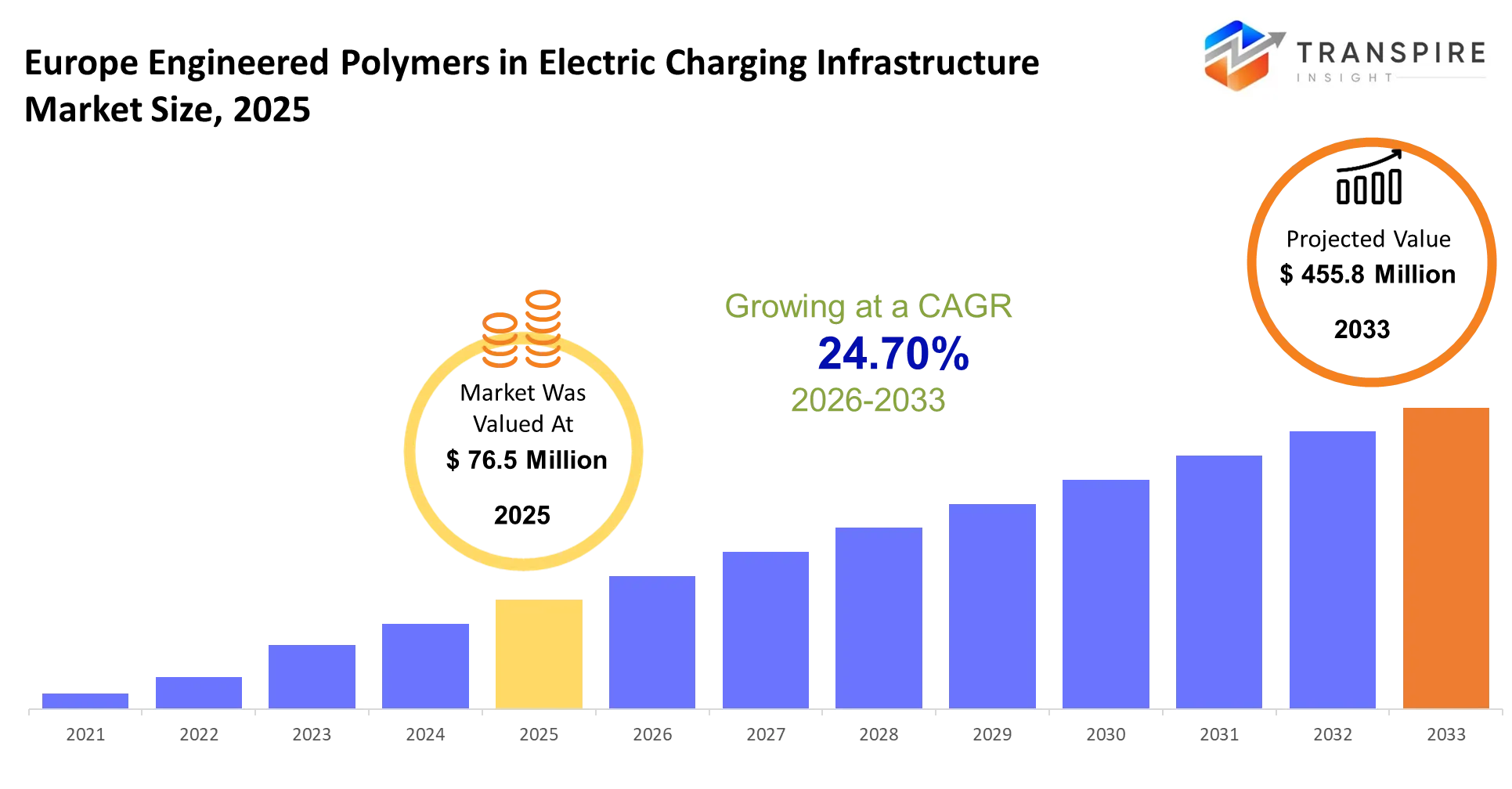
- Europe Engineered Polymers in Electric Charging Infrastructure Market Size 2025: USD 76.5 Million
- Europe Engineered Polymers in Electric Charging Infrastructure Market Size 2033: USD 455.8 Million
- Europe Engineered Polymers in Electric Charging Infrastructure Market CAGR: 24.70%
- Europe Engineered Polymers in Electric Charging Infrastructure Market Segments: By Type (Polycarbonate, Polyamide, Polyurethane, ABS, Others), By Application (Charging Stations, Connectors, Cables, Enclosures, Thermal Management, Others), By End-User (EV Manufacturers, Charging Infrastructure Providers, Utilities, Industrial Firms, Automotive Suppliers, Others), By Form (Resins, Compounds, Fibers, Sheets, Others).
To learn more about this report,  Download Free Sample Report
Europe Engineered Polymers in Electric Charging Infrastructure Market Summary:
The Europe Engineered Polymers in Electric Charging Infrastructure Market size is estimated at USD 76.5 Million in 2025 and is anticipated to reach USD 455.8 Million by 2033, growing at a CAGR of 24.70% from 2026 to 2033. The use of engineered polymers for electric charging infrastructure solves a European Union problem because these materials enable charging systems to function correctly during extreme temperatures and voltage changes and various weather conditions and intense operation while maintaining their lightweight properties and affordable price. The materials provide essential functions in connectors and cable insulation and housings and thermal management components, which require total reliability because their components cannot experience failure.
The market has developed during the past three to five years from traditional plastics toward advanced polymers which provide flame resistance and recyclability and comply with EU safety regulations together with sustainability requirements. The European Green Deal combined with post-pandemic recovery funding increased the adoption of electric vehicles which created a need for public charging infrastructure to expand rapidly.
The combination of these elements has created new patterns in purchasing. OEMs and infrastructure developers now prioritize durable products which meet compliance standards and provide cost-effective solutions throughout their entire lifespan instead of focusing on material expenses at the beginning. Polymer suppliers are advancing their business operations by developing performance engineering capabilities that enable them to create materials which result in higher product prices and extended partnership agreements with customers.
Key Market Insights
- Western Europe holds the primary market position in the Europe Engineered Polymers for Electric Charging Infrastructure Market with Germany, France, and the Netherlands driving their market share of approximately 55% for 2025.
- The Nordic countries show the fastest growth rate because they will achieve annual growth of more than 9% until 2030 through their strong electric vehicle adoption and their renewable energy systems.
- The market for high-performance thermoplastics will maintain its position as the leading material because these thermoplastics provide better thermal protection and electrical insulation than other materials.
- Engineering resins rank second in market share by achieving approximately 27% of the market because they serve as essential components for connectors and cable management systems.
- The market for bio-based and recyclable polymers shows the fastest growth rate because these materials will expand at a compound annual growth rate of more than 10% until 2030 because of European Union sustainability requirements.
- The 2025 market demand will see charging connectors and cable insulation take the lead because these two elements will deliver about 42% of total demand while their capacity to withstand extreme conditions and thermal energy remains essential.
- The market for thermal management components will experience the most rapid expansion because ultra-fast charging systems will generate greater heat demands which will drive their market growth to exceed 11% compound annual growth rate.
- Public charging infrastructure operators lead demand, accounting for about 50% market share in 2025, driven by government-backed network expansion.
- The commercial fleet operator market segment shows the fastest growth rate because their fleet electrification will drive adoption rates above 10% each year.
What are the Key Drivers, Restraints, and Opportunities in the Europe Engineered Polymers in Electric Charging Infrastructure Market?
The European Engineered Polymers Market for Electric Charging Infrastructure expands because European Union regulations which include the Alternative Fuels Infrastructure Regulation require fast electric vehicle charging stations with high power output. All operators must install chargers which operate above 150 kW because this standard requires ultra-fast charging stations. The extreme operating conditions of these chargers make conventional plastics unsuitable for use, which necessitates the use of high-performance engineered polymers that provide better protection against heat and flames and electrical insulation. The new approach increases the value of materials which manufacturers use for each charging session, which enables polymer providers to earn greater profits because their product demand rises with more charging stations.
Engineered polymers used for electrical infrastructure face two main challenges because they require sustained qualification and certification processes which extend over multiple years. The materials must comply with rigorous safety standards and durability requirements as well as various EU compliance regulations, which necessitate multiple years of testing with both original equipment manufacturers and component suppliers. The process of introducing new products to the market gets delayed because companies need to spend multiple years testing their products before entering production. The suppliers experience revenue delays while infrastructure developers remain bound to existing material systems which they had already approved, even though superior materials have become available.
Charging infrastructure represents a significant market for recyclable and bio-attributed polymer materials, especially in Northern and Western European regions. The Netherlands has started testing circular procurement models which enable public charging networks to select charging equipment based on their lifecycle carbon emissions.
What Has the Impact of Artificial Intelligence Been on the Europe Engineered Polymers in Electric Charging Infrastructure Market?
AI systems and digital technologies that use advanced digital systems have started to change the ways engineers create and test and deploy engineered polymers in electric charging systems. The manufacturing industry has adopted AI-powered simulation technologies for automatic material selection and component development which enables them to create polymer materials with enhanced heat resistance and dielectric strength and high-power charging systems mechanical properties. Operators use digital twins of charging systems to observe thermal loads and insulation performance through live monitoring which helps them decrease the possibilities of equipment breakdowns.
Charging networks use machine learning models to analyze temperature cycles and load patterns and environmental exposure for predictive maintenance purposes. The systems possess capability to predict connector degradation and insulation breakdown before actual breakdown occurs which results in decreased downtime and lower unplanned maintenance expenses. The first implementations of predictive analytics show that they can decrease maintenance costs between 10 and 15 percent while enhancing the operational duration of system components.
AI technology enhances business operations through its ability to maintain continuous performance evaluation which enables automatic compliance verification of European safety standards during changing load testing. The system decreases operational downtime while improving system reliability during fast charging operations. The process of adopting new technology continues to face obstacles because organizations need to spend large amounts for system integration while they deal with inadequate historical data about newer polymer materials which decreases the correctness of predictive modeling for actual system performance.
Key Market Trends
- Since 2020, charging systems above 150 kW requirements for thermal and electrical stress led OEMs to change their sourcing from commodity plastics to high-performance polymers.
- The 2021 to 2024 EU regulatory updates established more stringent fire safety and recyclability requirements which compelled manufacturers to create new polymer formulations that would meet these standards while ensuring long-lasting product performance.
- Charging infrastructure developers have switched their acquisition methods from cost-based purchasing to sustainability-based acquisition which emphasizes using materials that minimize maintenance needs by 20% during a five-year period.
- Material suppliers such as BASF SE and Covestro AG expanded their product lines to include flame-retardant and bio-attributed polymers after 2022 sustainability mandates accelerated.
- European buyers have changed their purchasing methods since 2021 because petrochemical supply chain interruptions make it necessary to use multiple suppliers which helps to create more local polymer production while decreasing their need for foreign goods.
- The introduction of ultra-fast charging after 2022 created a need for advanced thermal management polymers which resulted in more than 30% use of these polymers in cooling components of new installations.
- Public charging operators need pre-certified polymer systems which lengthens the time required for supplier qualification but helps to establish permanent contracts while decreasing the chances of material replacement.
- The Netherlands and other countries launched circular economy programs between 2022 and 2025 which focused on procuring recyclable polymers to shape the design practices of infrastructure OEMs.
- The use of digital simulation and AI-based material testing became more popular after 2023 because it helps to shorten product development times by almost 25% while speeding up the introduction of new polymer grades to market.
Europe Engineered Polymers in Electric Charging Infrastructure Market Segmentation
By Type
The market shows its strongest position through polyamide and polycarbonate because these materials deliver required three properties to support high-power charging systems. Polyamide performs well in connectors and cable systems where durability under repeated load cycles is critical, while polycarbonate dominates enclosures due to impact resistance and transparency for monitoring components.
Polyurethane and ABS maintain smaller shares, mainly in flexible and cost-sensitive applications, but face limitations under extreme heat conditions. The trend of rising demand makes manufacturers prefer flame-retardant and glass-reinforced grades because charging speeds have increased. The upcoming market development will create space for specialized blends and bio-based polymers which manufacturers can use to achieve distinct market appeal through sustainable products that meet new environmental laws.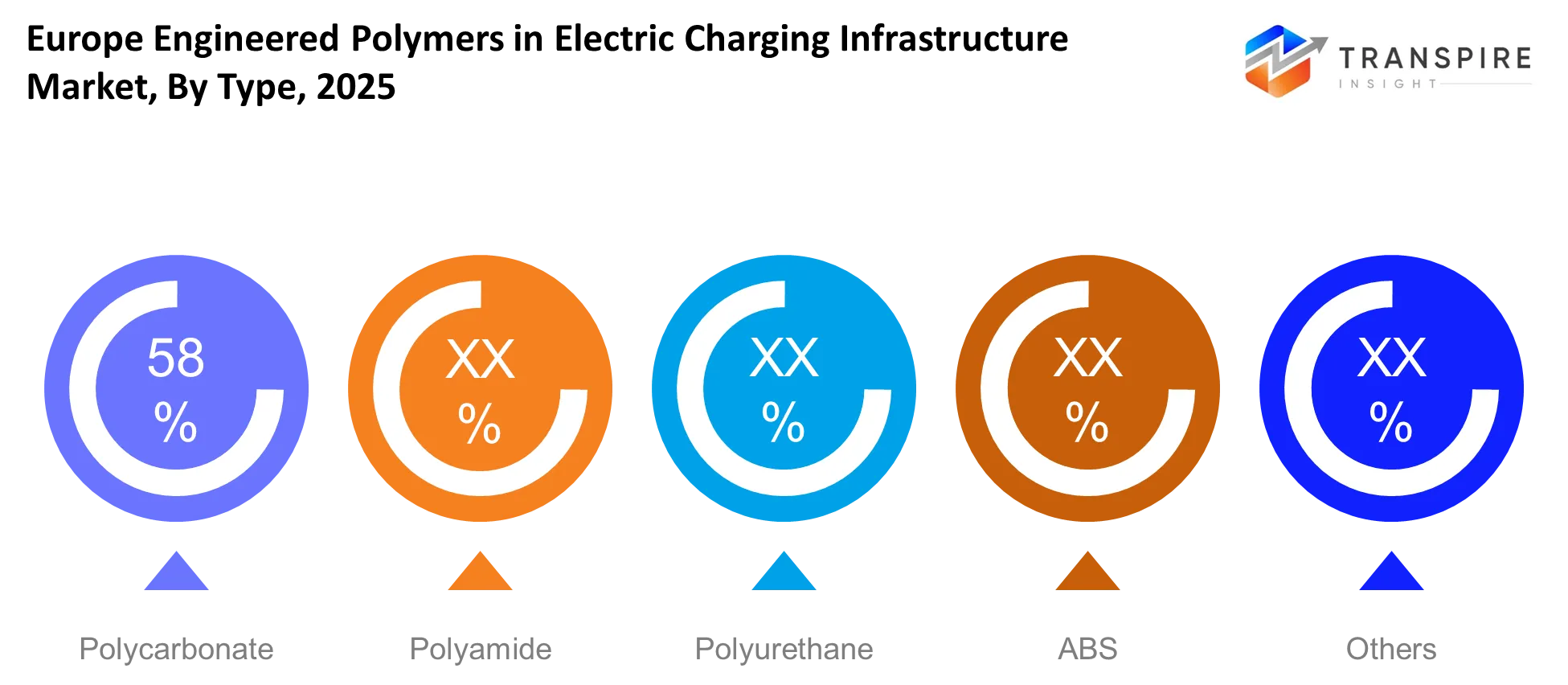
To learn more about this report, Download Free Sample Report
By Application
The application of connectors and cables shows their dominance because they face permanent electrical load and thermal exposure and environmental challenges which test their material performance ability to withstand these conditions. The need for structural and safety requirements in public and commercial installations creates high demand for charging stations and enclosures. Thermal management components show the fastest growth as ultra-fast charging systems increase heat generation, creating demand for polymers with advanced heat dissipation properties.
Other applications such as insulation layers and protective housings remain stable but show less unique features. The growth logic focuses on high voltage and temperature performance because it establishes the significance of engineered materials. Future implications suggest increased integration of multifunctional polymers that combine insulation, strength, and thermal control within single components.
By End-User
The market remains dominated by charging infrastructure providers who operate both public and private charging networks throughout Europe. The automotive suppliers and EV manufacturers follow behind because they need to incorporate charging components into their vehicles and establish partnerships within their ecosystem. The demand from utilities and industrial firms remains low because they only need charging stations for their electric vehicle fleets and their workspaces.
The different segments establish their unique buying patterns because infrastructure providers assess their expenses and legal requirements while automotive companies need to verify their systems and products. The fast-charging corridor network growth together with the electrification of logistics fleets creates new business opportunities. The future will see material suppliers working more closely with OEMs to create custom polymer solutions that meet the needs of upcoming charging technologies and new regulatory requirements.
By Form
The direct application of resins in molding and extrusion processes leads to their dominant use in producing connectors and enclosures and insulation components. Manufacturers now demand custom material properties which include flame retardancy and UV resistance and mechanical reinforcement, so compounds have become the second most used material. The demand patterns show a preference shift from standard resins toward engineered compounds which fulfill specific technical requirements.
Product development and supplier selection processes now depend on material science skills because of this transition. The future direction of advanced compounding technologies and recyclable material development will enable suppliers to deliver more valuable solutions which also help achieve circular economy targets in charging infrastructure projects.
What are the Key Use Cases Driving the Europe Engineered Polymers in Electric Charging Infrastructure Market?
Engineered polymers provide essential insulation and heat resistance and mechanical durability for permanent load applications which serve as the primary application of connectors and high-voltage cables. The fast-charging networks used by the public require these materials because they help maintain operational integrity while complying with European Union safety requirements, which results in the highest level of demand for this product.
The deployment of urban and highway networks by utilities and charging infrastructure providers creates new applications for enclosure systems and charging station housings. The charging hubs used by fleets now require thermal management components because their operational needs create continuous heat generation.
The new application of polymer components involves their use in ultra-fast charging modules designed to operate above 350 kW while they also function in smart charging systems that use integrated sensors. These applications enable the development of future mobility corridors and advanced commercial electric vehicle ecosystems.
|
Report Metrics |
Details |
|
Market size value in 2025 |
USD 76.5 Million |
|
Market size value in 2026 |
USD 97.2 Million |
|
Revenue forecast in 2033 |
USD 455.8 Million |
|
Growth rate |
CAGR of 24.70% from 2026 to 2033 |
|
Base year |
2025 |
|
Historical data |
2021 - 2024 |
|
Forecast period |
2026 - 2033 |
|
Report coverage |
Revenue forecast, competitive landscape, growth factors, and trends |
|
Regional scope |
Europe (Germany, United Kingdom, France, Italy, Spain and Rest of Europe) |
|
Key company profiled |
BASF, SABIC, Covestro, DuPont, Arkema, Solvay, Celanese, LG Chem, Mitsubishi Chemical, Toray, DSM, Evonik, LANXESS, RTP Company, Ensinger |
|
Customization scope |
Free report customization (country, regional & segment scope). Avail customized purchase options to meet your exact research needs. |
|
Report Segmentation |
By Type (Polycarbonate, Polyamide, Polyurethane, ABS, Others), By Application (Charging Stations, Connectors, Cables, Enclosures, Thermal Management, Others), By End-User (EV Manufacturers, Charging Infrastructure Providers, Utilities, Industrial Firms, Automotive Suppliers, Others), By Form (Resins, Compounds, Fibers, Sheets, Others) |
Which Regions are Driving the Europe Engineered Polymers in Electric Charging Infrastructure Market Growth?
The strong policy framework combined with extensive EV charging networks in Germany France and the Netherlands gives Western Europe its current leadership position. The strict enforcement of EU safety and sustainability standards forces operators to use high-performance engineered polymers for their essential components. The existing supplier ecosystem which includes international material manufacturers and established OEM agreements enables companies to quickly deploy new technologies while they create innovative products. The combination of high EV adoption rates and government funding initiatives helps to fund ongoing improvements to infrastructure and increases demand for materials.
The economic stability of Southern Europe together with infrastructure development creates a unique growth pattern that differs from other regions. Spain and Italy demonstrate their dedication to building public charging infrastructure through their ongoing financial commitment which receives support from EU recovery funds and national electrification initiatives. Cost-sensitivity drives material choices because customers require products that provide both reasonable performance and reasonable pricing. The region generates dependable income through infrastructure development which occurs at a steady and foreseeable speed.
The Nordic and Eastern European regions experience their fastest growth period because of accelerated policy development and their ambitious decarbonization objectives. Sweden and Poland have built more charging corridors which offer incentives for high-power charging systems since 2022. The demand for advanced polymers arises from the need to create materials that can withstand extreme weather conditions and support heavy operational loads. The upcoming development between 2026 and 2033 will provide material innovators and investors with strong market entry points to create next-generation charging solutions in these regions.
Who are the Key Players in the Europe Engineered Polymers in Electric Charging Infrastructure Market and How Do They Compete?
Competition shows an intermediate degree of market consolidation because major European chemical companies control a significant portion of high-performance polymer distribution while smaller companies focus on specific market segments. Existing companies maintain market share through their extensive research and development resources together with their established original equipment manufacturer certifications, which establish substantial obstacles for new material entrants. The main competitive factor has evolved from cost-based competition to technology performance and compliance requirements, because charging systems now operate beyond 150 kW, which necessitates superior thermal and electrical system capabilities. After supply chain disruptions, buyers select suppliers based on their geographic distance and delivery dependability.
BASF SE develops flame-retardant and glass-fiber-reinforced polymers for high-voltage charging components through its technology-driven business strategy. The company achieves long-term material supply agreements through its strong partnership with automotive original equipment manufacturers, which enables it to test materials at early development stages. Covestro AG provides bio-attributed polycarbonates as circular material solutions, which help fulfill EU sustainability requirements and improve its chances of winning public infrastructure contracts.
Solvay S.A. develops specialty polymers with extreme thermal stability for high-end applications within ultra-fast charging markets. Through its development partnerships with charging equipment manufacturers Arkema S.A. establishes new business operations, which focus on creating recyclable lightweight materials. DSM Engineering Materials establishes itself in new charging technologies through application-specific material development and strategic partnerships with top-tier suppliers to create unique products.
Company List
- BASF
- SABIC
- Covestro
- DuPont
- Arkema
- Solvay
- Celanese
- LG Chem
- Mitsubishi Chemical
- Toray
- DSM
- Evonik
- LANXESS
- RTP Company
- Ensinger
Recent Development News
In April 2026, Eleport secures EIB-backed funding for 250 new HPC charging parks: Eleport, a Central and Eastern European charging operator, received European Investment Bank support to expand more than 250 high-power charging parks across eight countries. The rollout accelerates demand for durable, heat-resistant engineered polymers used in fast-charging enclosures, cable management, and thermal protection systems required for ultra-fast charging deployments.
Source: https://www.electrive.com
In March 2026, Elli (Volkswagen Group) surpasses 1 million charging points across Europe: Elli Mobility, the Volkswagen Group’s e-mobility subsidiary, announced it now provides access to over 1 million public charging points across 28 European countries. The expansion strengthens its role as a key interoperability layer in Europe’s EV charging infrastructure, where engineered polymer-based components are widely used in connectors, housings, and insulation systems for high-volume charging networks.
Source: https://www.elli.eco
What Strategic Insights Define the Future of the Europe Engineered Polymers in Electric Charging Infrastructure Market?
The market is shifting towards a system that connects performance evaluation with regulatory requirements because engineered polymers have become essential to system reliability instead of serving as interchangeable materials. The development of ultra-fast charging together with stricter EU safety and circularity requirements has created a need for suppliers who can work with OEMs to develop new material specifications. In the next five to seven years advanced compounds together with digital validation capabilities will create value through long-term supply agreements that organizations establish during early design phases of their infrastructure projects.
The entire supply chain becomes a less predictable threat because specialty chemicals depend on raw materials while their upstream market fluctuations create an environment that can reduce profit margins and interrupt supply agreements even as demand from customers increases. The public charging networks in Northern Europe present an opportunity to use recyclable and traceable polymers because circular procurement criteria have started to become popular in this region.
Market participants should invest in application-specific R&D partnerships with charging equipment manufacturers to secure early design wins and lock in future revenue streams.
Europe Engineered Polymers in Electric Charging Infrastructure Market Report Segmentation
By Type
- Polycarbonate
- Polyamide
- Polyurethane
- ABS
- Others
By Application
- Charging Stations
- Connectors
- Cables
- Enclosures
- Thermal Management
- Others
By End-User
- EV Manufacturers
- Charging Infrastructure Providers
- Utilities
- Industrial Firms
- Automotive Suppliers
- Others
By Form
- Resins
- Compounds
- Fibers
- Sheets
- Others
Frequently Asked Questions
Find quick answers to common questions.
The Approximate Europe Engineered Polymers in Electric Charging Infrastructure Market size for the Market will be USD 455.8 Million in 2033.
The key Segments of the Europe Engineered Polymers in Electric Charging Infrastructure Market are By Type (Polycarbonate, Polyamide, Polyurethane, ABS, Others), By Application (Charging Stations, Connectors, Cables, Enclosures, Thermal Management, Others), By End-User (EV Manufacturers, Charging Infrastructure Providers, Utilities, Industrial Firms, Automotive Suppliers, Others), By Form (Resins, Compounds, Fibers, Sheets, Others).
Major Players in the Europe Engineered Polymers in Electric Charging Infrastructure Market are BASF, SABIC, Covestro, DuPont, Arkema, Solvay, Celanese, LG Chem, Mitsubishi Chemical, Toray, DSM, Evonik, LANXESS, RTP Company, Ensinger.
The Current Market size of the Europe Engineered Polymers in Electric Charging Infrastructure Market is USD 76.5 Million in 2025.
The Europe Engineered Polymers in Electric Charging Infrastructure Market CAGR is 24.70%.
- BASF
- SABIC
- Covestro
- DuPont
- Arkema
- Solvay
- Celanese
- LG Chem
- Mitsubishi Chemical
- Toray
- DSM
- Evonik
- LANXESS
- RTP Company
- Ensinger
Recently Published Reports
-
Apr 2026
Healthcare Polymer Packaging Market
Healthcare Polymer Packaging Market Size, Share & Analysis Report By Packaging Type (Syringes, IV Bottles and Pouches, Clamshells, Blisters, Bottles & Jars, Containers, Tubes, IV Parental Packaging, Others), By Type (Regulated, Non-regulated), By Polymer Type (LDPE (Low-Density Polyethylene), HDPE (High-Density Polyethylene), Homo-polymer (Homo), Random Copolymer (Random), Block Copolymer (Block), PET, Polystyrene, Polyvinyl Chloride, Polyamide/EVOH, Others), and Geography (North America, Europe, Asia-Pacific, Middle East and Africa, South and Central America), 2021 - 2031
-
Apr 2026
Hydrophilic Tape (Waterstop) Market
Hydrophilic Tape (Waterstop) Market Size, Share & Analysis Report By Type (Bentonite-Based Hydrophilic Tape, Rubber-Based Hydrophilic Tape), By Application (Residential Buildings, Commercial Buildings, Infrastructure Projects), and Geography (North America, Europe, Asia-Pacific, Middle East and Africa, South and Central America), 2021 - 2031
-
Apr 2026
Metalens Market
Metalens Market Size, Share & Analysis Report By Type (Visible Light Metalens, and Infrared Metalens), By Application (Consumer Electronics, Automotive Electronics, Industrial, Medical, and Others), and Geography (North America, Europe, Asia-Pacific, Middle East and Africa, South and Central America), 2021 - 2031
-
Apr 2026
PBT Resin Market
PBT Resin Market Size, Share & Analysis Report By Type (Reinforced PBT Resin, Unreinforced PBT Resin), By Processing Method (Injection Molding, Extrusion, Blow Molding, Others), By End-User (Automotive, Electrical & Electronics, Consumer Appliances, Industrial Machinery, Medical Devices, Packaging, Others), and Geography (North America, Europe, Asia-Pacific, Middle East and Africa, South and Central America), 2021 - 2031