

United Kingdom Retail Logistics Market Size & Forecast:
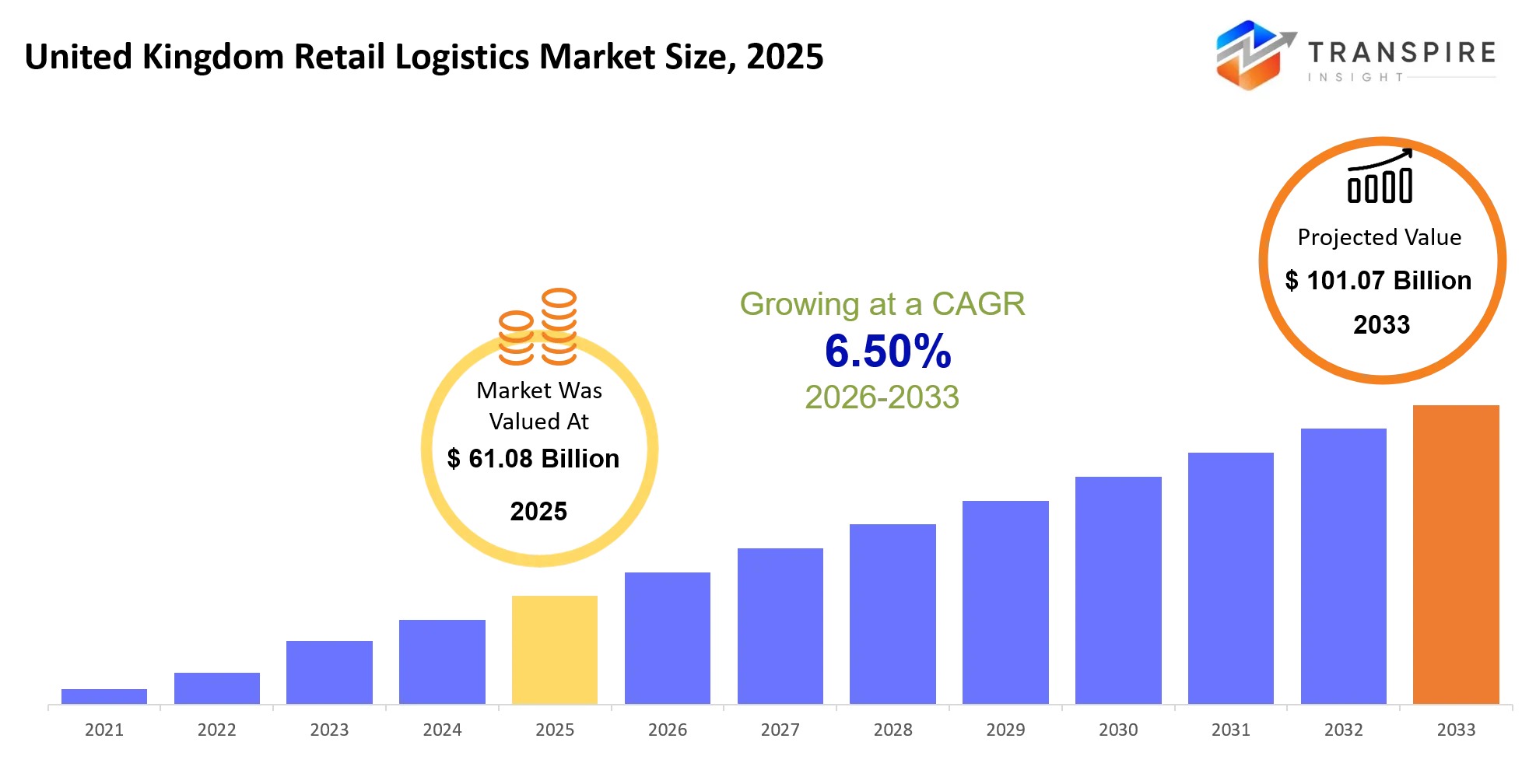
- United Kingdom Retail Logistics Market Size 2025: USD 61.08 Billion
- United Kingdom Retail Logistics Market Size 2033: USD 101.07 Billion
- United Kingdom Retail Logistics Market CAGR: 6.50%
- United Kingdom Retail Logistics Market Segments: By Service Type (Transportation Services, Warehousing Services, Inventory Management, Last-mile Delivery, Reverse Logistics, Cold Chain Logistics, Others); By Mode of Transport (Road Freight, Rail Freight, Air Freight, Sea Freight, Intermodal Transport, Others); By Application (E-commerce Retail, Grocery Retail, Fashion Retail, Electronics Retail, FMCG Retail, Others); By End User (Retailers, E-commerce Companies, Supermarkets, SMEs, Others)
To learn more about this report,  Download Free Sample Report
United Kingdom Retail Logistics Market Summary
The United Kingdom Retail Logistics Market was valued at USD 61.08 Billion in 2025. It is forecast to reach USD 101.07 Billion by 2033. That is a CAGR of 6.50% over the period.
The United Kingdom retail logistics market is kind of the working backbone that, you know, moves products from manufacturers and distribution centers to shops and then to consumers, making sure stock is there when it is needed. Basically it addresses a key commercial headache: trying to meet fast delivery expectations but still keep inventory under control in a way that does not get crazy expensive, across retail networks that are getting more and more complicated.
In the last three to five years the whole thing has shifted in a more omnichannel direction. Retailers are tying together store locations, warehouses, and e-commerce platforms into one logistics system, so the flow is less fragmented, more coordinated. The COVID-19 pandemic, plus the follow-on supply chain disruptions, pushed the move faster, and it highlighted weaknesses in older inventory models. That’s when a lot of players started putting money into automation, real time monitoring, and building up regional fulfillment ability.
\Right now the market keeps growing because retailers want more supply chain resilience and quicker order turnaround. Since online shopping and click-and-collect have really become part of everyday consumer habits, logistics providers are rolling out more tech-enabled services. This, in turn, opens up additional income streams, like enhanced warehousing, last mile transport, and also inventory refinement solutions that help reduce waste and improve availability.
Key Market Insights
- England kind of dominates the United Kingdom Retail Logistics Market, making up around 75% of the industry revenue in 2025, largely because of the big distribution hubs and that dense customer demand that just keeps stacking up.
- The Midlands logistics corridor keeps drawing major capital investment , mostly due to its central situation and the fact it gives nationwide distribution advantages, pretty straightforward.
- Greater London still holds a notable market share, mainly from heavy retail activity and those rising same-day delivery needs that everyone seems to want now.
- Transportation services are leading the market, with an estimated 40%+ share in 2025 ,and it’s backed by the steady growth in retail delivery volumes.
- Warehousing and distribution services come in as the second-largest segment , benefiting from inventory decentralization and the continuing expansion of fulfillment centers.
- Last-mile delivery services are the quickest mover between 2025 and 2030, driven by how consumer delivery expectations are evolving, and honestly they change fast.
- For applications, e-commerce fulfillment seems to take the lead, contributing close to 45% of market demand in 2025 thanks to the high-volume online retail activity.
- Grocery and food retail logistics keep a meaningful portion too, because replenishment is frequent and temperature-controlled distribution is not optional.
- Click-and-collect operations are the fastest-growing application area, as retailers blend physical stores with digital sales channels , more and more.
- Finally, reverse logistics solutions are starting to see real demand as return volumes online rise across the broader retail landscape.
What are the Key Drivers, Restraints, and Opportunities in the United Kingdom Retail Logistics Market?
The most powerful force pushing the United Kingdom retail logistics market forward is, kind of, that structural drift into omnichannel retail. Retailers now tend to run a more connected web, where e-commerce platforms sit alongside physical stores and click-and-collect options. This move got boosted during the pandemic, when buying patterns shifted , and it seems those newer expectations for faster and more adaptive fulfillment are here to stay. So to actually handle all that, retailers and logistics providers have been adding warehouse capacity, putting money into automation , and rolling out more sophisticated stock and inventory control systems. Those kinds of investments end up making money by lifting order throughput, cutting down fulfillment mistakes, and also enabling higher-touch delivery offerings like same-day and next-day shipping.
One big roadblock for further market growth is the lack of warehouse space in well-positioned areas, plus a shortage of logistics labor. This is structural, because building fresh distribution facilities means a lot of capital, longer planning authorizations, and getting land that is close to the main consumption hubs. Meanwhile, hiring problems keep showing up across warehousing as well as transportation work. As a result , these limits raise day to day costs, slow down network expansion projects, and reduce how easily logistics providers can scale capacity to match retail demand, which in turn dampens the revenue growth that could otherwise show up.
One of the most promising opportunities is in putting artificial intelligence and robotics into fulfillment operations. There is steady momentum behind investments in automated picking systems, predictive inventory planning, and autonomous material handling techs. You can already see this scaling across big distribution hubs in England and the Midlands, kind of quietly but noticeably. Since labor costs stay high and delivery speed turns into a differentiator, these tools can meaningfully boost throughput, lower the cost per order fulfillment and in general help open the next phase of productivity led market growth.
What Has the Impact of Artificial Intelligence Been on the United Kingdom Retail Logistics Market?
Artificial intelligence, and advanced digital technologies, are quietly reshaping the United Kingdom retail logistics market by pushing up warehouse productivity, making transportation run smoother, and improving overall supply chain visibility a lot. In practice logistics operators are more and more putting AI based warehouse management systems to work, basically to automate order picking, inventory allocation and even fulfillment scheduling . Some teams also rely on computer vision together with robotics inside distribution centers, so there is less hand work and order processing speeds up, especially in the hectic peak retail periods .
Meanwhile machine learning models are starting to matter even more for predictive decisions. Retail logistics providers use demand forecasting algorithms so they can anticipate what inventory will be needed, fine tune stock positioning, and lower the chances of costly stockouts. On top of that, predictive maintenance platforms analyze data from delivery fleets, conveyors and automated sorting equipment, so potential failures can be spotted earlier , before they mess up day to day operations. This lets operators plan maintenance ahead of time and it also improves how well assets get utilized.
The operational upsides are pretty clear. AI enabled route optimization can cut transportation expenses and fuel consumption by finding delivery schedules that are more efficient, while automated fulfillment setups tend to raise throughput and keep order accuracy steadier. Better forecasting also supports stronger inventory availability, which often means shorter delivery times, and that generally helps customer service performance , in a noticeable way.
Still , there are obstacles, mainly the integration costs. A lot of retailers and logistics providers still run legacy IT infrastructure, so connecting AI platforms with existing warehouse , transportation and inventory management systems ends up being expensive, and sometimes painfully slow, to pull off .
Key Market Trends
- Since 2020, retailers have kind of slid inventory nearer to consumers, so they upped spending on regional fulfillment centers across the Midlands and Northern England a bit.
- Same day , and next day delivery went from “nice-to-have” to something people expect without thinking, and that changed where warehouses sit, plus the whole transport plan.
- After 2021, automated picking systems and warehouse robotics got a lot more traction. This happened partly because labor shortages kept pushing operating costs up across distribution networks.
- Retailers also lean on stores as micro fulfillment hubs more and more. That shortens the last mile travel, and it makes click and collect work better, in practice.
- AI driven demand forecasting has largely taken over from older inventory planning habits, letting operators cut down on stock imbalances and keep product availability steadier.
- Logistics providers like DHL Supply Chain and GXO Logistics have been doubling down on automation investments, so they can handle larger order volumes without losing efficiency.
- Ever since Brexit implementation, companies have reworked sourcing and distribution strategies, trying to reduce border related delays and avoid inventory disruptions.
- Electric delivery fleets really picked up after 2022 , as retailers matched logistics work with corporate carbon reduction targets and stricter urban emissions rules.
- Reverse logistics has turned into a priority , because online return volumes rose a lot. So they’ve started investing in dedicated processing and refurbishment facilities.
- Data visibility platforms also moved from optional utilities to core infrastructure, which means real time shipment tracking, inventory monitoring, and network optimization are now built in, not just extra.
United Kingdom Retail Logistics Market Segmentation
By Service Type:
Transportation services kinda help with moving goods, you know, from the suppliers side through warehouses, into stores, and then all the way to the final delivery places. Warehousing services give that storage capacity that keeps product availability steady and it also helps inventory flow stay smooth across the whole retail network. Inventory management services then zoom in on stock tracking, replenishment strategy, and even order precision, so it can cut down on both shortages, and too much inventory.
Last-mile delivery services handle the very last step from distribution centers to customers, making quick fulfillment possible without too much delay. Reverse logistics deals with returns, exchanges, and the recovery part after a product comes back. Cold chain logistics supports temperature-sensitive items like groceries and perishables. And the others category includes add-on, value added kinds of support, like packaging, labeling, and fulfillment assistance that really strengthen retail supply chains.
By Mode of Transport:
Road freight is a big transport option because of the wide connectivity between warehouses, retail outlets, and customer areas. Rail freight supports moving bigger shipment volumes over longer distances, while also improving overall transport efficiency a lot. Air freight works best when deliveries are time critical and need rapid movement across regions.
Sea freight is typically used for imported retail goods coming from overseas suppliers, and from manufacturing hubs too. Intermodal transport mixes a few transportation types in one logistics trip, which improves flexibility and gives better cost control. The other segment covers specialized transport solutions, for cargo that needs something particular, and for distribution requirements that show up in retail logistics operations.
By Application:
E-commerce retail logistics is mostly about online order fulfilment, juggling inventory ,and running direct-to-consumer delivery services. Grocery retail logistics has these reoccurring replenishment cycles, it also backs the distribution of fresh stuff plus boxed and packaged products. Fashion retail logistics ends up tracking seasonal inventory motion and supporting both in-store presence and digital sales, which sounds simple but it isn't.
Electronics retail logistics needs extra attention, like careful handling, secure transportation, and real time inventory visibility ,because those items carry a higher price tag. FMCG retail logistics supports high-volume product movement with quicker stock turnover, and it also has strict distribution requirements that come up often. The others segment covers retail categories that need more specialized logistics workflows, basically depending on the product nature, and what customers expect.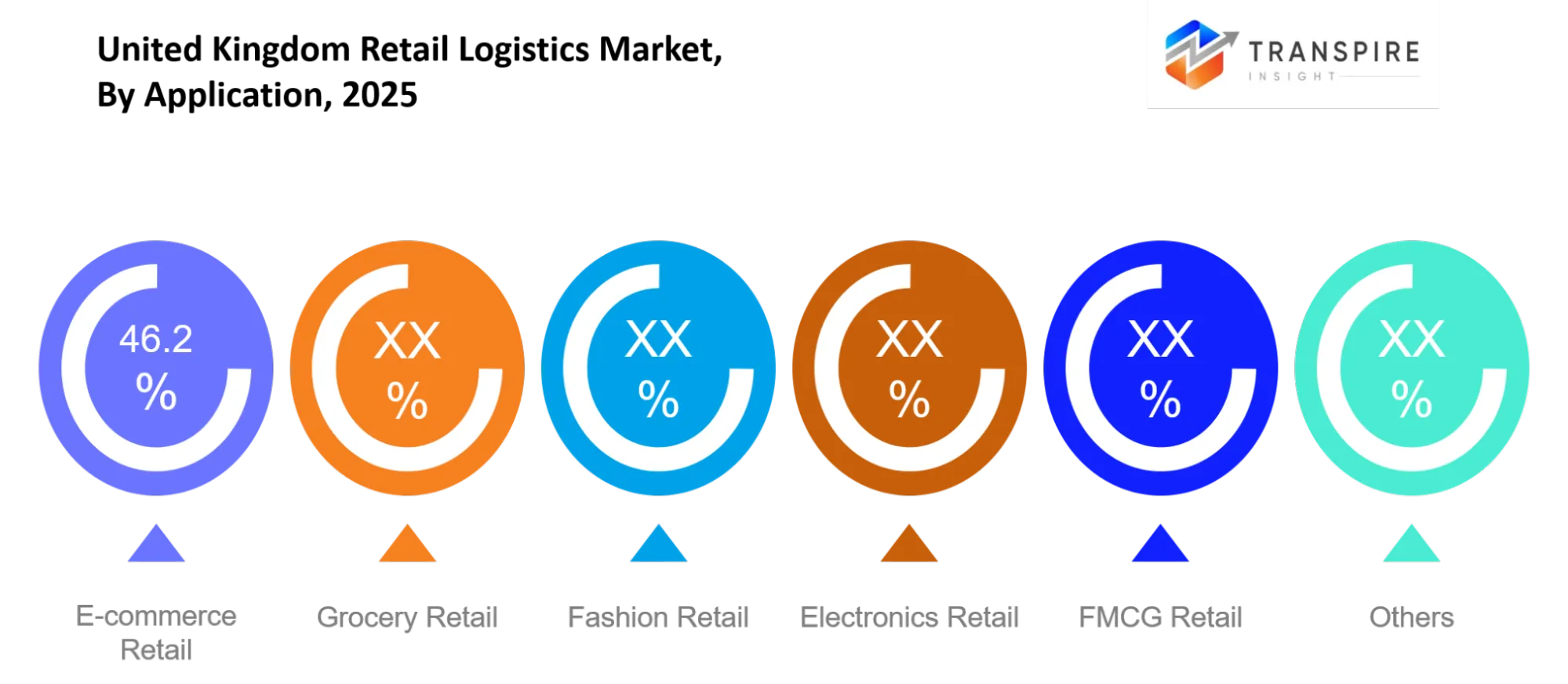
To learn more about this report, Download Free Sample Report
By End User:
Retailers are a major end-user group, since logistics services help with store replenishment, inventory control, and customer order completion. E-commerce companies lean on logistics networks that are efficient, so they can process orders faster and hit delivery expectations on time. Supermarkets ,in particular, need heavy logistics support because they move huge quantities of goods and they keep updating inventory pretty often.
SMEs use retail logistics services to tap transportation, warehousing, and fulfillment capacity without building a big internal logistics setup. The other category includes businesses involved in retail distribution ,and they typically want tailor-made logistics solutions that keep product availability up, improve operational efficiency, and support customer service goals across the United Kingdom Retail Logistics Market.
What are the Key Use Cases Driving the United Kingdom Retail Logistics Market?
E-commerce order fulfillment is still, kinda, the main reason people are adopting solutions across the United Kingdom retail logistics market. With really high online shopping volumes, businesses need fast inventory processing, tidy warehousing operations, and dependable last mile delivery networks. Retailers keep putting money into logistics infrastructure, to satisfy customer expectations around next day and same day delivery services.
Grocery distribution and fashion retail logistics are also getting more momentum and in fact, they’re turning into the bigger expansion areas. Supermarkets tend to rely on constant replenishment, plus temperature controlled transportation, so products stay available. On the other hand, fashion retailers want a more adaptable logistics setup, one that can juggle seasonal inventory changes, omnichannel sales, and those high return volumes that come with the territory.
There are newer use cases too, including micro-fulfillment centers that sit close to city zones and AI enabled inventory positioning. These setups let retailers shrink delivery times and raise the accuracy of stock availability. Automated reverse logistics for handling e-commerce returns is getting noticed as well, because retailers want smarter ways to recover value from returned items and also lower operational costs over the forecast period, without losing speed.
|
Report Metrics |
Details |
|
Market size value in 2025 |
USD 61.08 Billion |
|
Market size value in 2026 |
USD 65.05 Billion |
|
Revenue forecast in 2033 |
USD 101.07 Billion |
|
Growth rate |
CAGR of 6.50% from 2026 to 2033 |
|
Base year |
2025 |
|
Historical data |
2021 - 2024 |
|
Forecast period |
2026 - 2033 |
|
Report coverage |
Revenue forecast, competitive landscape, growth factors, and trends |
|
Regional scope |
Middle East and Africa (Saudi Arabia, United Arab Emirates, South Africa, Rest of Middle East and Africa) |
|
Key company profiled |
DHL Supply Chain, Kuehne+Nagel, GXO Logistics, XPO Logistics, FedEx Logistics, UPS Supply Chain Solutions, DB Schenker, CEVA Logistics, Ryder System, DSV, CJ Logistics, Nippon Express, Expeditors, Maersk Logistics, C.H. Robinson |
|
Customization scope |
Free report customization (country, regional & segment scope). Avail customized purchase options to meet your exact research needs. |
|
Report Segmentation |
By Service Type (Transportation Services, Warehousing Services, Inventory Management, Last-mile Delivery, Reverse Logistics, Cold Chain Logistics, Others); By Mode of Transport (Road Freight, Rail Freight, Air Freight, Sea Freight, Intermodal Transport, Others); By Application (E-commerce Retail, Grocery Retail, Fashion Retail, Electronics Retail, FMCG Retail, Others); By End User (Retailers, E-commerce Companies, Supermarkets, SMEs, Others) |
Which Regions are Driving the United Kingdom Retail Logistics Market Growth?
England still feels like the top region in the United Kingdom retail logistics market, mostly because population density, day to day retail movement, and the distribution system are all sort of clustered there. The main logistics corridors running through the Midlands and the Southeast let freight reach national consumer areas in a more direct way , and that helps with high volume shipping. Big fulfillment centers, well organized warehouse networks and decent road links let retailers handle stock and customer deliveries with better speed and on a larger scale. Plus you get the whole mix of major retailers, online commerce operators, and third party logistics providers which together keep strengthening England's position, even when things shift.
Scotland brings in a smaller slice of market revenue, but it has a different job inside the broader logistics picture. In Scotland the momentum comes from steady shopper demand, ongoing upgrades to infrastructure, and long range money going into regional distribution facilities. Retailers often lean on warehouses placed in strategically good locations so they can serve both city areas and more isolated communities without too many hiccups . In the end, that emphasis on dependable operations, and coverage that actually reaches far, makes Scotland a steady contributor to the overall market result.
Wales is kind of emerging as the fastest growing region, as logistics operators keep pushing beyond the old fashioned distribution hubs to get more network resilience and delivery reach, more or less. In recent times, there have been investments in industrial parks, transport connections, and fulfillment facilities , which has made the area feel more appealing for retail logistics operations.Also, the rise in e-commerce activity has basically nudged retailers to set up extra distribution capacity nearer to markets that were a bit underserved. From 2026 until 2033, this momentum is expected to generate really attractive opportunities for logistics providers, warehouse developers, and technology investors who are hunting for expansion potential.
Who are the Key Players in the United Kingdom Retail Logistics Market and How Do They Compete?
In the United Kingdom retail logistics arena there is a blend of big, integrated logistics providers and also smaller regional operators, so overall it feels moderately consolidated but still competitive. These days the contest is more about how fast you can fulfill, how much warehouse automation you’ve got, how good your data visibility becomes, and whether you can cover deliveries across the whole country, not just raw transportation capacity. Existing players keep trying to hold shares by putting money into technology and pushing their networks out, while those more niche logistics firms tend to win business by being oddly specific—tailored arrangements for certain retail categories. Also, the capability to back omnichannel retail activities has turned into a big deal for contract wins, and for keeping customers over the long run.
DHL Supply Chain stands out with deep fulfillment infrastructure, modern warehouse automation, and a whole end-to-end supply chain approach that’s meant to connect everything. They keep investing in robotics, digital inventory systems, and logistics methods that are more sustainable, which helps them run more efficiently for major retail accounts. GXO Logistics meanwhile leans hard into tech enabled warehouse operations, leaning on automation, artificial intelligence, and data analytics to raise throughput and keep order accuracy high. Their growth includes more automated fulfillment locations and partnerships that are pretty strategically chosen, which supports their edge in high volume retail distribution.
Wincanton operates mostly on the strength of its domestic logistics coverage, plus know-how for dealing with intricate retail supply chain stuff all across the United Kingdom. It also keeps putting money into transport optimization platforms, and into warehouse modernization, that together helps keep the whole operation cost- efficient.
Kuehne+Nagel, on the other hand, sets itself apart with integrated international freight and retail logistics services, so retailers can handle import flows and, at the same time, domestic distribution more smoothly. CEVA Logistics keeps pushing forward via multi-channel fulfillment capabilities, building regional warehouses, and offering supply chain solutions made for the sort of demand that comes with growing e-commerce, and omnichannel retail.
Company List
- DHL Supply Chain
- Kuehne+Nagel
- GXO Logistics
- XPO Logistics
- FedEx Logistics
- UPS Supply Chain Solutions
- DB Schenker
- CEVA Logistics
- Ryder System
- DSV
- CJ Logistics
- Nippon Express
- Expeditors
- Maersk Logistics
- C.H. Robinson
Recent Development News
In May 2026, Asda entered a strategic partnership with Ocado Group. The agreement will deploy Ocado’s e-commerce, fulfillment, and last-mile delivery technology across Asda’s online grocery operations, strengthening automation and delivery capabilities in the UK retail logistics market. Source https://www.reuters.com/
In April 2026, CEVA Logistics renewed its long-term partnership with Ocado Retail. The renewed agreement expands CEVA’s role in managing bulk storage and distribution to Ocado’s customer fulfillment centers, supporting rising online grocery volumes and improving warehouse efficiency through facility reconfiguration. Source https://www.cevalogistics.com/
What Strategic Insights Define the Future of the United Kingdom Retail Logistics Market?
The United Kingdom retail logistics market is, kinda, drifting toward very automated, data led fulfillment networks over the next five to seven years. What’s pushing this change is mostly the growing need to juggle faster delivery expectations , while also dealing with labor costs, transportation expenses and real estate pricing that just keep going up. Logistics providers that can stitch together artificial intelligence, warehouse automation, and forward looking inventory planning into one operating model will be more likely to boost efficiency without losing service quality.
There’s also a risk that’s quieter, more under the radar. It has to do with how the market is concentrated around big fulfillment hubs and the largest logistics operators. If retailers keep leaning on only a handful of strategic distribution corridors and a few service providers, then any disruption—like labor shortages, infrastructure limits or pure capacity bottlenecks—could ripple through supply chains more broadly than the usual growth signals are showing.
At the same time, there’s an opportunity that’s starting to show up more clearly. Think urban micro fulfillment centers , backed by automation technologies. These setups can shorten delivery times and reduce last mile costs, especially in densely populated zones. Market players should focus investments on adaptable regional fulfillment infrastructure and on digital platforms that deliver real time visibility across inventory, transportation , and customer delivery activities.
United Kingdom Retail Logistics Market Report Segmentation
By Service Type
- Transportation Services
- Warehousing Services
- Inventory Management
- Last-mile Delivery
- Reverse Logistics
- Cold Chain Logistics
By Mode of Transport
- Road Freight
- Rail Freight
- Air Freight
- Sea Freight
- Intermodal Transport
By Application
- E-commerce Retail
- Grocery Retail
- Fashion Retail
- Electronics Retail
- FMCG Retail
By End User
- Retailers
- E-commerce Companies
- Supermarkets
- SMEs
Frequently Asked Questions
Find quick answers to common questions.
The United Kingdom Retail Logistics Market size is USD 101.07 Billion in 2033.
Key Segments for the United Kingdom Retail Logistics Market are By Service Type (Transportation Services, Warehousing Services, Inventory Management, Last-mile Delivery, Reverse Logistics, Cold Chain Logistics, Others); By Mode of Transport (Road Freight, Rail Freight, Air Freight, Sea Freight, Intermodal Transport, Others); By Application (E-commerce Retail, Grocery Retail, Fashion Retail, Electronics Retail, FMCG Retail, Others); By End User (Retailers, E-commerce Companies, Supermarkets, SMEs, Others).
Major United Kingdom Retail Logistics Market Players are DHL Supply Chain, Kuehne+Nagel, GXO Logistics, XPO Logistics, FedEx Logistics, UPS Supply Chain Solutions, DB Schenker, CEVA Logistics, Ryder System, DSV, CJ Logistics, Nippon Express, Expeditors, Maersk Logistics, C.H. Robinson.
The Current United Kingdom Retail Logistics Market size is USD 61.08 Billion in 2025.
The United Kingdom Retail Logistics Market CAGR is 6.50% from 2026 to 2033.
- DHL Supply Chain
- Kuehne+Nagel
- GXO Logistics
- XPO Logistics
- FedEx Logistics
- UPS Supply Chain Solutions
- DB Schenker
- CEVA Logistics
- Ryder System
- DSV
- CJ Logistics
- Nippon Express
- Expeditors
- Maersk Logistics
- C.H. Robinson
About the Authors

Mayur Shinde
I am Mayur Shinde, a Senior Research Analyst at Transpire Insight, specializing in the Automotive & Transportation and Information & Communication Technology (ICT) Industry. My work focuses on analyzing emerging market trends, technological advancements, competitive landscapes, and industry developments to deliver accurate, data-driven insights. I am passionate about transforming complex market information into clear, actionable content that helps businesses, professionals, and decision-makers stay informed and make confident strategic decisions.

Chakradhar Khansole
Chakradhar serves as the Research Director at Transpire Insight, bringing over 8 years of experience in technology, innovation, and strategic market intelligence. He specializes in transforming complex market data into actionable business insights that enable organizations to make informed, growth-oriented decisions. Recognized for his strategic vision and analytical expertise, Chakradhar leads high-impact research initiatives, delivering comprehensive market assessments, competitive intelligence, and forward-looking industry analysis.
Recently Published Reports
-
Apr 2026
ATV & UTV Market
ATV & UTV Market Size, Share & Analysis Report By Type (ATV, and UTV), By Variants (Less Than 400 CC, 400 CC To 800 CC, and More Than 800 CC), and Geography (North America, Europe, Asia-Pacific, Middle East and Africa, South and Central America), 2021 - 2031
-
Apr 2026
Automotive Central Gateway Module Market
Automotive Central Gateway Module Market Size, Share & Analysis Report By Type (Ethernet Central Gateway Module, CAN Central Gateway Module, LIN Central Gateway Module, and FlexRay), By Application (Powertrain Control, Body Control, Infotainment System, Advanced Driver Assistance Systems (ADAS), and Others), By End User (Passenger Vehicles, and Commercial Vehicles), and Geography (North America, Europe, Asia-Pacific, Middle East and Africa, South and Central America), 2021 - 2031
-
Apr 2026
Automotive Engine Oil Filter Market
Automotive Engine Oil Filter Market Size, Share & Analysis Report By Filter Type (Fuel Filter, Engine Oil Filter, Hydraulic Oil Filter, and Others), By Filter Media (Cellulose, Synthetic, and Micro), By Sales Channel (OEMs, and Aftermarket), By Vehicle Type (Passenger Cars, Light Commercial Vehicles, Heavy Duty Trucks, Buses and Coaches, and Off-road Vehicles), and Geography (North America, Europe, Asia-Pacific, Middle East and Africa, South and Central America), 2021 - 2031
-
Apr 2026
Automotive Parts Aluminium Die Casting Market
Automotive Parts Aluminium Die Casting Market Size, Share & Analysis Report By Production Process (Pressure Die Casting, Vacuum Die Casting, Squeeze Die Casting, Gravity Die Casting), By Application (Body Parts, Engine Parts, Transmission Parts, Battery And Related Components, Other Application Types), and Geography (North America, Europe, Asia-Pacific, Middle East and Africa, South and Central America), 2021 - 2031
Our Clients



