

United Kingdom Online Salvage Auctions Market Size & Forecast:
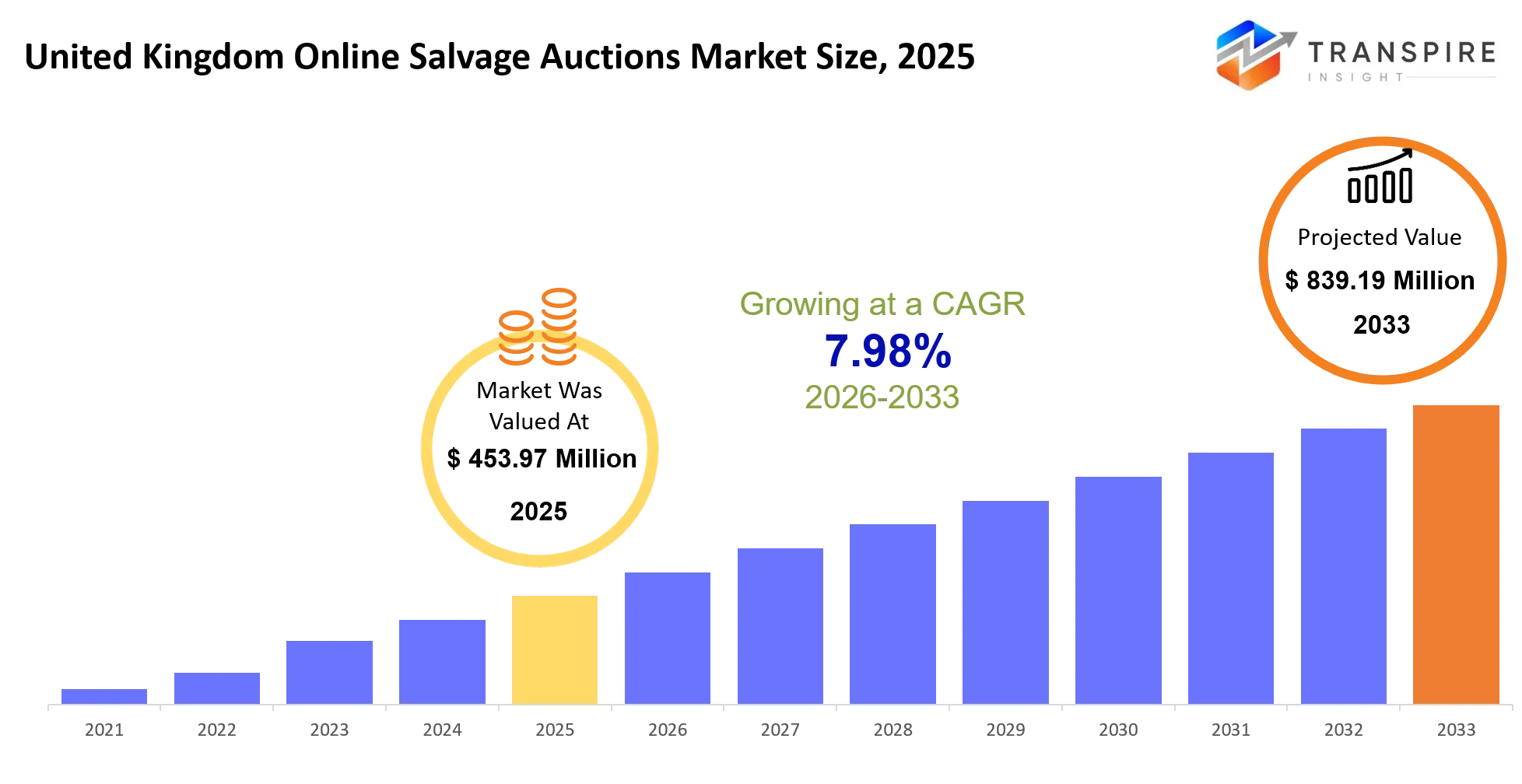
- United Kingdom Online Salvage Auctions Market Size 2025: USD 453.97 Million
- United Kingdom Online Salvage Auctions Market Size 2033: USD 839.19 Million
- United Kingdom Online Salvage Auctions Market CAGR: 7.98%
- United Kingdom Online Salvage Auctions Market Segments: By Vehicle Type (Passenger Vehicles, Commercial Vehicles, Luxury Vehicles, Electric Vehicles, Motorcycles, Others); By Auction Type (Insurance Salvage Auctions, Dealer Auctions, Public Auctions, Online-only Auctions, Hybrid Auctions, Others); By Application (Vehicle Resale, Spare Parts Recovery, Scrap Recycling, Vehicle Restoration, Others); By End User (Dealers, Repair Workshops, Individual Buyers, Scrap Processors, Others)
To learn more about this report,  Download Free Sample Report
United Kingdom Online Salvage Auctions Market Summary
The United Kingdom Online Salvage Auctions Market was valued at USD 453.97 Million in 2025. It is forecast to reach USD 839.19 Million by 2033. That is a CAGR of 7.98% over the period.
The United Kingdom online salvage auctions market gives a kind of digital route for insurers, fleet operators, leasing companies , and vehicle recovery firms to get rid of damaged, stolen then recovered, or end-of-life assets in a more efficient way. Basically it helps nudge residual value upward, while also linking up buyers like dismantlers, exporters, repair workshops, and used vehicle traders with a bigger pool of inventory. Over the last five years, you can see a noticeable structural change, moving away from physical salvage yards and face to face bidding, and instead toward fully digital auction setups that lean on vehicle imaging, condition details, and remote dealing management.
One big driver was the supply chain disruption and the vehicle scarcity that came after the COVID-19 period. That period pushed up demand for vehicles that could be repaired and for parts that can be reused, so buyer habits shifted as well, and more participants joined in online auctions. Current growth is being fueled by the economic payback of asset recovery, the quicker turnover of stock, and broader buyer reach, so auction platforms can handle larger transaction counts and bring in steadier fee based revenues, without as many friction points.
Key Market Insights
- England kinda dominates the United Kingdom online salvage auctions market, with an estimated 70%+ market share in 2025 ,and it seems backed by high vehicle density plus insurance activity too.
- Wales is also moving the fastest through 2030, mainly because more online bidder access keeps opening up and digital salvage disposal channels are being adopted more and more.
- In terms of types, salvage vehicle auctions take the lead, roughly 60%+ of the market in 2025, which points to real demand for repairable vehicles and dismantling-grade stock.
- Used parts and recovered asset auctions land in the second spot, supported by circular economy initiatives and a noticeable trend toward parts reuse.
- When you look at auction models, fully digital auction services are the fastest-growing segment through 2030 , since buyers increasingly like remote bidding and want instant transaction processing.
- For applications, vehicle recycling and dismantling are leading, contributing nearly 45% of market demand in 2025 because the recovery of reusable components keeps rising.
- Vehicle refurbishment and resale still keeps a strong presence too, because repair businesses look for cost-effective inventory sources.
- On the end-user side, automotive dismantlers and recyclers are the ones steering the market, about 40%+ share in 2025 , driven by steady demand for reusable parts.
- Independent vehicle traders and repair workshops sit as the second-largest end user category across the United Kingdom salvage auction industry.
- And online vehicle resellers are growing the quickest, they use digital sourcing channels to build and refresh inventory in a more efficient way.
What are the Key Drivers, Restraints, and Opportunities in the United Kingdom Online Salvage Auctions Market?
The main force pushing the United Kingdom Online Salvage Auctions Market forward is the digitization of vehicle remarketing, plus how insurance claims are actually disposed of. In the last several years , insurers have been dealing with more and more pressure to cut down storage costs for vehicles, move settlements along faster, and still squeeze out the best possible recovery values from total-loss items. Online auction platforms help with that by putting salvage inventory in front of a nationwide—and, increasingly, international—set of bidders. With that wider competition, bids tend to get stronger and deals close quicker, so revenue recovery improves for insurers and fleet operators, and the auction platforms themselves also see bigger volume overall.
The biggest hurdle , though , is still the whole complexity around judging vehicle condition and then estimating value when the buying happens remotely. Salvage vehicles aren’t all the same: damage severity differs , repair possibilities can be wildly inconsistent, and residual value may shift a lot depending on the scenario. Even with digital inspection tools getting better at showing what’s going on, buyers often still feel uncertainty, and that can quietly change how aggressively they bid. It becomes a structural issue, because the “right” assessment still ultimately relies on the physical state of the vehicle, which technology can never fully standardize. So, you end up with pricing swings, reduced interest in some categories of assets, and transaction value that never quite turns into realized outcomes across the market.
A big growth opening is coming from the rising share of electric vehicles that are now flowing into salvage channels. As EV ownership keeps expanding around the United Kingdom, there’s room for specialized battery diagnostics, more digital condition reporting, and even certified EV dismantling know-how. Together, these can unlock new higher-value auction segments. Platforms that invest early in EV-specific remarketing setup, infrastructure, and related workflows are probably positioned to take a larger piece of the future salvage transaction growth.
What Has the Impact of Artificial Intelligence Been on the United Kingdom Online Salvage Auctions Market?
Artificial intelligence plus advanced digital technologies are, kind of, reshaping the United Kingdom online salvage auctions market, mainly by changing how damaged vehicles get evaluated, valued, publicized, and eventually sold. More and more auction operators are leaning on AI driven image recognition setups that look at vehicle photos, flag what damage is visible, and help with semi automated condition writeups. In practice this cuts down the heavy manual checking, and it also speeds up the vehicle listing rush, so inventory moves quicker and auction cycles get compressed.
At the same time, machine learning models are getting put to work to forecast salvage values using past auction results, typical repair outlays, vehicle age, mileage, and shifting demand behaviors. With those predictions, insurers and fleet operators can set reserve prices that feel closer to reality, which in turn improves asset recovery rates. It also lowers the chance of selling too cheaply, because underpricing becomes less likely. On top of that, advanced analytics tools try to fine tune bidder outreach, by pairing the available stock with buyers who are most apt, basically, to buy specific vehicle types.
From an operations angle, digital valuations and automated workflows make transactions happen sooner, trim administrative overhead, and boost inventory turnover. Real time dashboard views add a layer of transparency for both sides—buyers and sellers—so participation tends to rise and bidding becomes more competitive too.
Still, there’s a key limitation with AI rollouts. Model accuracy relies on large amounts of clean, high quality damage records. If accident severity varies a lot, if repair standards differ, or if image quality is uneven, then prediction accuracy can slide. Plus, when you try to connect AI systems with older insurer and auction platforms, there’s often a non-trivial upfront spend, and you also need real technical know-how.
Key Market Trends
- Since 2020, online bidding has mostly, kind of replaced the whole physical auction attendance thing, so buyers can grab salvage vehicles across the country without having to worry about location, not really.
- Insurers now use digital disposal platforms more often, which shortens the time vehicles spend in storage and helps claims get settled sooner than in the pre-pandemic way of doing things.
- Between 2021 and 2025, AI driven image assessment tools started showing up. That made it easier for auction operators to move more vehicles through the process while doing fewer manual inspections, which is a bit of a shift.
- After supply chain disruptions pushed up used vehicle prices, and stretched out how long new vehicles take to arrive, demand for repairable salvage vehicles also got stronger.
- Electric vehicle salvage volumes have been climbing steadily since 2022, so the market now needs battery diagnostics, specialized dismantling, and also certified recycling capabilities.
- Some of the big names, like Copart UK and SYNETIQ, expanded their digital vehicle imaging and condition-reporting systems. The goal was basically to boost bidder confidence, and transparency too, for sure.
- There’s also more cross-border purchasing activity lately. International buyers can access United Kingdom salvage inventory more easily, largely because auctions are fully digital now.
- Data analytics has been shaping reserve pricing decisions more and more, which replaces the older valuation approaches that leaned heavily on manual market assessments.
- Buyers have been leaning toward parts recovery strategies as component shortages, and higher replacement costs, improved the overall math for vehicle dismantling.
- And competitive differentiation has moved away from just “how many cars can you park in the yard” toward technology capabilities, transaction speed, digital customer experience, and inventory visibility, more or less.
United Kingdom Online Salvage Auctions Market Segmentation
By Vehicle Type :
Passenger Vehicles, like everyday cars for personal transport, show up a lot in online salvage auction listings. You can often see these vehicles arriving at auctions after accidents, theft recovery, or insurance write-offs. Buyers usually grab these units to do repairs , turn around for resale, or for spare parts recovery and those smaller, practical uses too.
Commercial Vehicles cover vans , trucks and other business-use vehicles. Luxury Vehicles are the higher-end brands that tend to pull in specialized buyers who are looking for refurbishment opportunities. Electric Vehicles are getting more attention lately because EV ownership keeps rising, and Motorcycles and Others cover two-wheelers and other niche vehicle types that show up through digital auction platforms.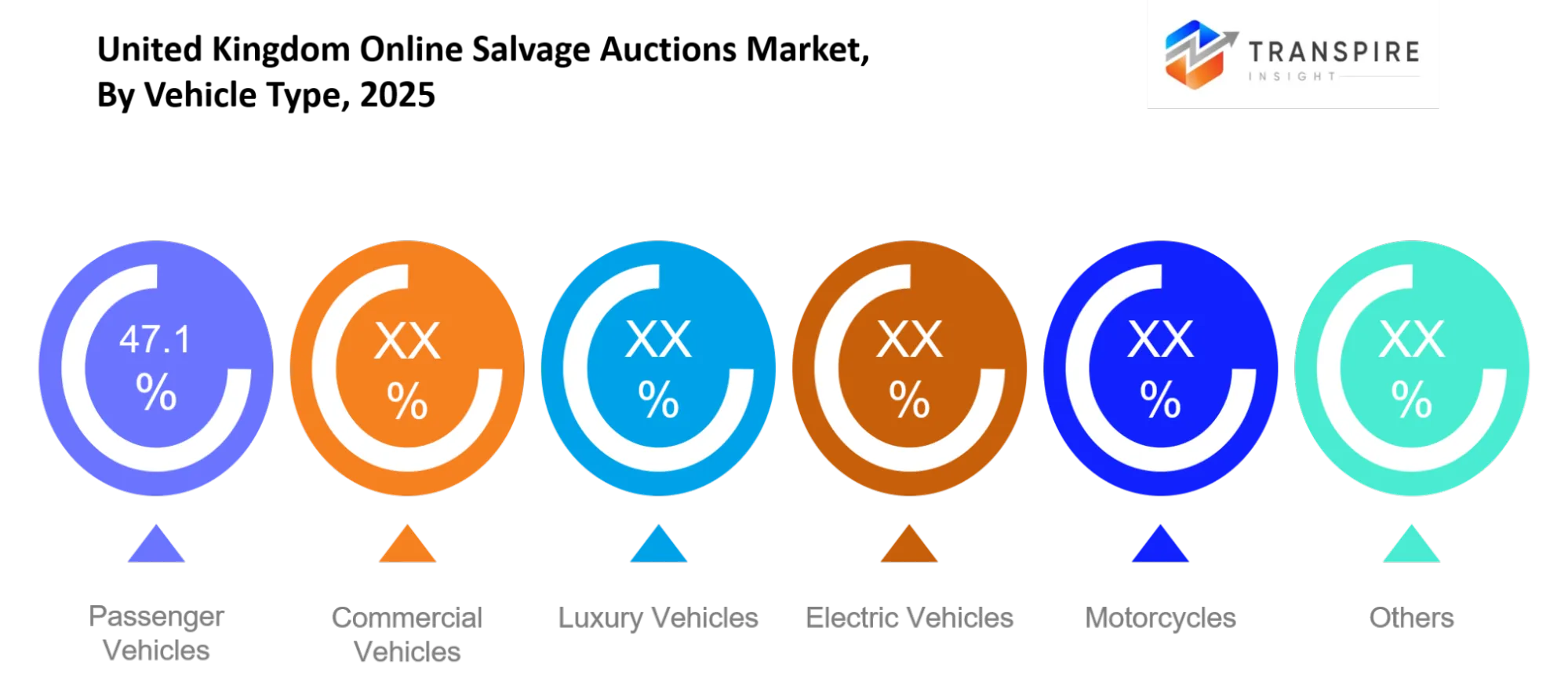
To learn more about this report, Download Free Sample Report
By Auction Type :
Insurance Salvage Auctions are for vehicles insurance companies dispose of after claims settlements. Dealer Auctions are where inventory swaps hands between automotive businesses. Public Auctions open the door to a broader buyer base, so individuals and companies can actually bid on vehicles.
Online-only Auctions have become pretty common, mostly because digital platforms are everywhere and remote bidding is easier. Hybrid Auctions mix online participation with a physical presence. Others include specialized auction formats, meant for certain vehicle categories , fleet disposals, or institutional sale requirements that don’t fit the usual pattern.
By Application :
Vehicle resale is still this big application, where buyers repair damaged vehicles, sort of bring them back, and then return them to the used vehicle market. Spare parts recovery also comes into play with dismantling activities, so that reusable components can be sold separately. That basically extends the value of salvage assets, even if they look pretty rough at first.
Scrap recycling is more about extracting metals and other materials from cars that are beyond economic repair. Vehicle restoration tends to attract buyers who want to rebuild damaged units for later use. Then there are other options, like educational or training purposes, plus specialized industrial uses, where salvaged vehicles end up having some operational value.
By End User :
Dealers take part in online salvage auctions, to grab inventory, then sell it again later after some refurbishment. Repair workshops buy vehicles that can be fixed with the technical knowhow available, along with replacement components. This leads to chances for profitable resale work, and yes it can stack up.
Individual buyers often look for affordable vehicles, or they want a project restoration chance through the auction platforms. Scrap processors work on material recovery, and the recycling side of things. Other participants include exporters, dismantlers, fleet operators, and specialized automotive businesses that use salvage vehicles for commercial purposes.
What are the Key Use Cases Driving the United Kingdom Online Salvage Auctions Market?
The main thing pushing people to adopt the United Kingdom Online Salvage Auctions Market is, basically the resale of repairable vehicles. Insurance companies, fleet operators and leasing firms use these online auctions to get rid of damaged assets fast while dealers and repair businesses buy vehicles to refurbish and then resell them. Because of that, this kind of use pattern is seeing the most transactions overall, since it brings a cheap, convenient source of inventory into the used vehicle ecosystem.
Then there are the secondary use cases which are quietly growing in spare parts recovery and vehicle dismantling. Repair workshops and automotive recyclers increasingly go for salvage vehicles to pull out reusable parts, especially now since replacement part pricing is still pretty high. On top of that, buyers who are more export-leaning are also showing up on digital auction platforms, sourcing vehicles for overseas resale and rebuilding operations.
After that, the emerging use cases are circling electric vehicle salvage management and battery value recovery. As more electric vehicles keep ending up in insurance write off channels, more specialized buyers are hunting for chances in battery testing, refurbishment, and recycling. At the same time data-led vehicle valuation and automated condition assessment services are picking up speed too. These changes are opening new revenue streams for auction operators and helping make asset disposition processes more efficient, in a more organized way.
|
Report Metrics |
Details |
|
Market size value in 2025 |
USD 453.97 Million |
|
Market size value in 2026 |
USD 490.21 Million |
|
Revenue forecast in 2033 |
USD 839.19 Million |
|
Growth rate |
CAGR of 7.98% from 2026 to 2033 |
|
Base year |
2025 |
|
Historical data |
2021 - 2024 |
|
Forecast period |
2026 - 2033 |
|
Report coverage |
Revenue forecast, competitive landscape, growth factors, and trends |
|
Regional scope |
Middle East and Africa (Saudi Arabia, United Arab Emirates, South Africa, Rest of Middle East and Africa) |
|
Key company profiled |
Copart, IAA Holdings, SalvageBid, AutoBidMaster, Synetiq, Manheim, BCA Marketplace, RAW2K, Autobid, eRepairables, SCA Auctions, A Better Bid, CrashedToys, Marhaba Auctions, SalvageMarket |
|
Customization scope |
Free report customization (country, regional & segment scope). Avail customized purchase options to meet your exact research needs. |
|
Report Segmentation |
By Vehicle Type (Passenger Vehicles, Commercial Vehicles, Luxury Vehicles, Electric Vehicles, Motorcycles, Others); By Auction Type (Insurance Salvage Auctions, Dealer Auctions, Public Auctions, Online-only Auctions, Hybrid Auctions, Others); By Application (Vehicle Resale, Spare Parts Recovery, Scrap Recycling, Vehicle Restoration, Others); By End User (Dealers, Repair Workshops, Individual Buyers, Scrap Processors, Others) |
Which Regions are Driving the United Kingdom Online Salvage Auctions Market Growth?
England still comes out as the leading region within the United Kingdom Online Salvage Auctions Market, partly because of its big vehicle population, plus higher insurance claim volumes and the fact that major auction operators tend to cluster there. It also helps that England has well-established transport connections, which makes it simpler to handle vehicle pickup, keep them in storage, and then move them again for resale. On top of that, more insurers, fleet companies and leasing providers have been leaning into digital auction platforms, and that extra comfort basically keeps the whole market moving. You can also see a kind of whole local chain around it: repair centers, dismantlers, logistics providers, and vehicle traders, all of which keeps England’s dominant position supported.
Scotland sits as the second largest regional market , but the momentum there is more steady and controlled rather than “huge” in scale. If you compare it with England, Scotland often leans more on regular involvement from local dealers, recyclers, and independent repair businesses, so the auction pipeline feels consistent. With stable economic conditions and recovery networks that already run in a familiar rhythm, auction volumes stay fairly predictable across the year. This balanced way of operating is why Scotland tends to work as a dependable contributor to overall market revenue and transaction activity, not exactly by blasting growth, but by staying reliable.
Wales is where the pace looks fastest , as online auction access keeps expanding beyond the usual automotive strongholds. More investment in vehicle recovery infrastructure, alongside wider involvement from regional buyers, has given the market more momentum in recent years. With online bidding platforms in place, the geographic barriers get knocked down a bit , so Welsh businesses can compete for inventory across the country rather than just locally. Looking ahead, between 2026 and 2033, this trend should translate into solid opportunities for auction operators, technology providers, and investors who are actively searching for less crowded regional markets.
Who are the Key Players in the United Kingdom Online Salvage Auctions Market and How Do They Compete?
The competitive landscape of the United Kingdom Online Salvage Auctions Market looks like it has some moderate consolidation, not all locked up though, where a few big auction operators manage a big chunk of transaction volumes, and then regional specialists are still around competing in those more targeted segments. Lately the contest feels less about auction yard size alone and more about digital capabilities , vehicle inspection quality, inventory scale, and how fast transactions actually happen. Larger, established players keep reinforcing their market position by putting money into technology, while smaller firms seem to lean into specialized services, regional coverage , or smaller niche buyer networks. With online participation continuing to grow, platform transparency and smoother vehicle remarketing have become pretty obvious differentiators.
Copart UK is mostly known for technology driven auction operations, and it leans on extensive vehicle logistics plus nationwide storage infrastructure. Things like high resolution imaging, detailed condition reporting , and having a large inventory base help pull in both domestic and international buyers. The company keeps expanding its collection and processing capabilities, which supports quicker vehicle turnover and a wider commercial reach. SYNETIQ stands out a bit differently, it uses an integrated method that links salvage auctions with vehicle recycling, parts recovery, and data driven asset management. That setup creates several revenue pathways from the same vehicle, and it tends to improve value recovery for insurance partners.
ASM Auto Recycling kind of competes on the basis of knowledge in eco-friendly vehicle dismantling and verified parts retrieval, kind of serving folks who want quality recycled components. Motorhog boosts its position by blending salvage auctions with direct-to-consumer sales of parts , so it ends up with extra customer touchpoints beyond just bidding on vehicles. RAW2K focuses more on web based vehicle disposal and remarketing services for insurers and fleet operators, with an emphasis on fast digital transactions and orderly asset liquidation. In the end, these approaches help each company create a separate edge, while also growing relationships across different parts of the salvage value chain .
Company List
- Copart
- IAA Holdings
- SalvageBid
- AutoBidMaster
- Synetiq
- Manheim
- BCA Marketplace
- RAW2K
- Autobid
- eRepairables
- SCA Auctions
- A Better Bid
- CrashedToys
- Marhaba Auctions
- SalvageMarket
Recent Development News
In April 2026, America’s Auto Auction announced the acquisition of G3 Remarketing, marking its entry into the UK market through the purchase of a leading independent online salvage and vehicle auction operator. The deal gives the company its first international footprint and strengthens consolidation trends in UK digital salvage remarketing platforms.
Source https://www.americasaa.com/
In April 2026, G3 Vehicle Auctions confirmed its acquisition by America’s Auto Auction, expanding cross-border integration between US and UK salvage auction ecosystems and reinforcing the UK’s position as a strategic hub for digitally enabled vehicle remarketing.
Source https://www.prnewswire.com/
What Strategic Insights Define the Future of the United Kingdom Online Salvage Auctions Market?
Over the next five to seven years the United Kingdom Online Salvage Auctions Market is likely to shift toward a more data-centric and specialized kind of running model, yeah sort of. The main push is the increasing complexity of vehicle fleets, especially electric, and more technology rich vehicles, which means they need higher level valuation methods, deeper diagnostics and careful remarketing abilities. So the market value creation is going to hinge more on the ability to pull together, study, and monetize vehicle condition data, not only on the act of moving cars through auctions.
There is also a risk that’s less obvious, more like a slow background issue: market concentration. A small set of big auction platforms and inventory providers could come to dominate, and then insurers and fleet operators may rely on fewer digital channels. When that happens the competitive pressure can soften, and that may reduce pricing transparency, plus it can narrow access for smaller players in the market. In other words, even if the overall market keeps expanding, certain segments might not see as much innovation as they should.
At the same time one emerging opportunity is building dedicated electric vehicle salvage ecosystems, including battery health evaluation, refurbishment, and later secondary battery uses. Market players may want to start early with EV specific inspection tech and with certified technical knowledge, plus tools for data-driven valuation. Firms that develop these skills before EV salvage volumes really hit scale will be better placed to take hold of future high-value transaction streams, instead of chasing them too late.
United Kingdom Online Salvage Auctions Market Report Segmentation
By Vehicle Type
- Passenger Vehicles
- Commercial Vehicles
- Luxury Vehicles
- Electric Vehicles
- Motorcycles
By Auction Type
- Insurance Salvage Auctions
- Dealer Auctions
- Public Auctions
- Online-only Auctions
- Hybrid Auctions
By Application
- Vehicle Resale
- Spare Parts Recovery
- Scrap Recycling
- Vehicle Restoration
By End User
- Dealers
- Repair Workshops
- Individual Buyers
- Scrap Processors
Frequently Asked Questions
Find quick answers to common questions.
The United Kingdom Online Salvage Auctions Market size is USD 839.19 Million in 2033.
Key Segments for the United Kingdom Online Salvage Auctions Market are By Vehicle Type (Passenger Vehicles, Commercial Vehicles, Luxury Vehicles, Electric Vehicles, Motorcycles, Others); By Auction Type (Insurance Salvage Auctions, Dealer Auctions, Public Auctions, Online-only Auctions, Hybrid Auctions, Others); By Application (Vehicle Resale, Spare Parts Recovery, Scrap Recycling, Vehicle Restoration, Others); By End User (Dealers, Repair Workshops, Individual Buyers, Scrap Processors, Others).
Major United Kingdom Online Salvage Auctions Market Players are Copart, IAA Holdings, SalvageBid, AutoBidMaster, Synetiq, Manheim, BCA Marketplace, RAW2K, Autobid, eRepairables, SCA Auctions, A Better Bid, CrashedToys, Marhaba Auctions, SalvageMarket.
The United Kingdom Online Salvage Auctions Market size is USD 453.97 Million in 2025.
The United Kingdom Online Salvage Auctions Market CAGR is 7.98% from 2026 to 2033
- Copart
- IAA Holdings
- SalvageBid
- AutoBidMaster
- Synetiq
- Manheim
- BCA Marketplace
- RAW2K
- Autobid
- eRepairables
- SCA Auctions
- A Better Bid
- CrashedToys
- Marhaba Auctions
- SalvageMarket
About the Authors

Mayur Shinde
I am Mayur Shinde, a Senior Research Analyst at Transpire Insight, specializing in the Automotive & Transportation and Information & Communication Technology (ICT) Industry. My work focuses on analyzing emerging market trends, technological advancements, competitive landscapes, and industry developments to deliver accurate, data-driven insights. I am passionate about transforming complex market information into clear, actionable content that helps businesses, professionals, and decision-makers stay informed and make confident strategic decisions.

Chakradhar Khansole
Chakradhar serves as the Research Director at Transpire Insight, bringing over 8 years of experience in technology, innovation, and strategic market intelligence. He specializes in transforming complex market data into actionable business insights that enable organizations to make informed, growth-oriented decisions. Recognized for his strategic vision and analytical expertise, Chakradhar leads high-impact research initiatives, delivering comprehensive market assessments, competitive intelligence, and forward-looking industry analysis.
Recently Published Reports
-
Apr 2026
ATV & UTV Market
ATV & UTV Market Size, Share & Analysis Report By Type (ATV, and UTV), By Variants (Less Than 400 CC, 400 CC To 800 CC, and More Than 800 CC), and Geography (North America, Europe, Asia-Pacific, Middle East and Africa, South and Central America), 2021 - 2031
-
Apr 2026
Automotive Central Gateway Module Market
Automotive Central Gateway Module Market Size, Share & Analysis Report By Type (Ethernet Central Gateway Module, CAN Central Gateway Module, LIN Central Gateway Module, and FlexRay), By Application (Powertrain Control, Body Control, Infotainment System, Advanced Driver Assistance Systems (ADAS), and Others), By End User (Passenger Vehicles, and Commercial Vehicles), and Geography (North America, Europe, Asia-Pacific, Middle East and Africa, South and Central America), 2021 - 2031
-
Apr 2026
Automotive Engine Oil Filter Market
Automotive Engine Oil Filter Market Size, Share & Analysis Report By Filter Type (Fuel Filter, Engine Oil Filter, Hydraulic Oil Filter, and Others), By Filter Media (Cellulose, Synthetic, and Micro), By Sales Channel (OEMs, and Aftermarket), By Vehicle Type (Passenger Cars, Light Commercial Vehicles, Heavy Duty Trucks, Buses and Coaches, and Off-road Vehicles), and Geography (North America, Europe, Asia-Pacific, Middle East and Africa, South and Central America), 2021 - 2031
-
Apr 2026
Automotive Parts Aluminium Die Casting Market
Automotive Parts Aluminium Die Casting Market Size, Share & Analysis Report By Production Process (Pressure Die Casting, Vacuum Die Casting, Squeeze Die Casting, Gravity Die Casting), By Application (Body Parts, Engine Parts, Transmission Parts, Battery And Related Components, Other Application Types), and Geography (North America, Europe, Asia-Pacific, Middle East and Africa, South and Central America), 2021 - 2031
Our Clients



