

United Kingdom Commercial Vehicles Market Size & Forecast:
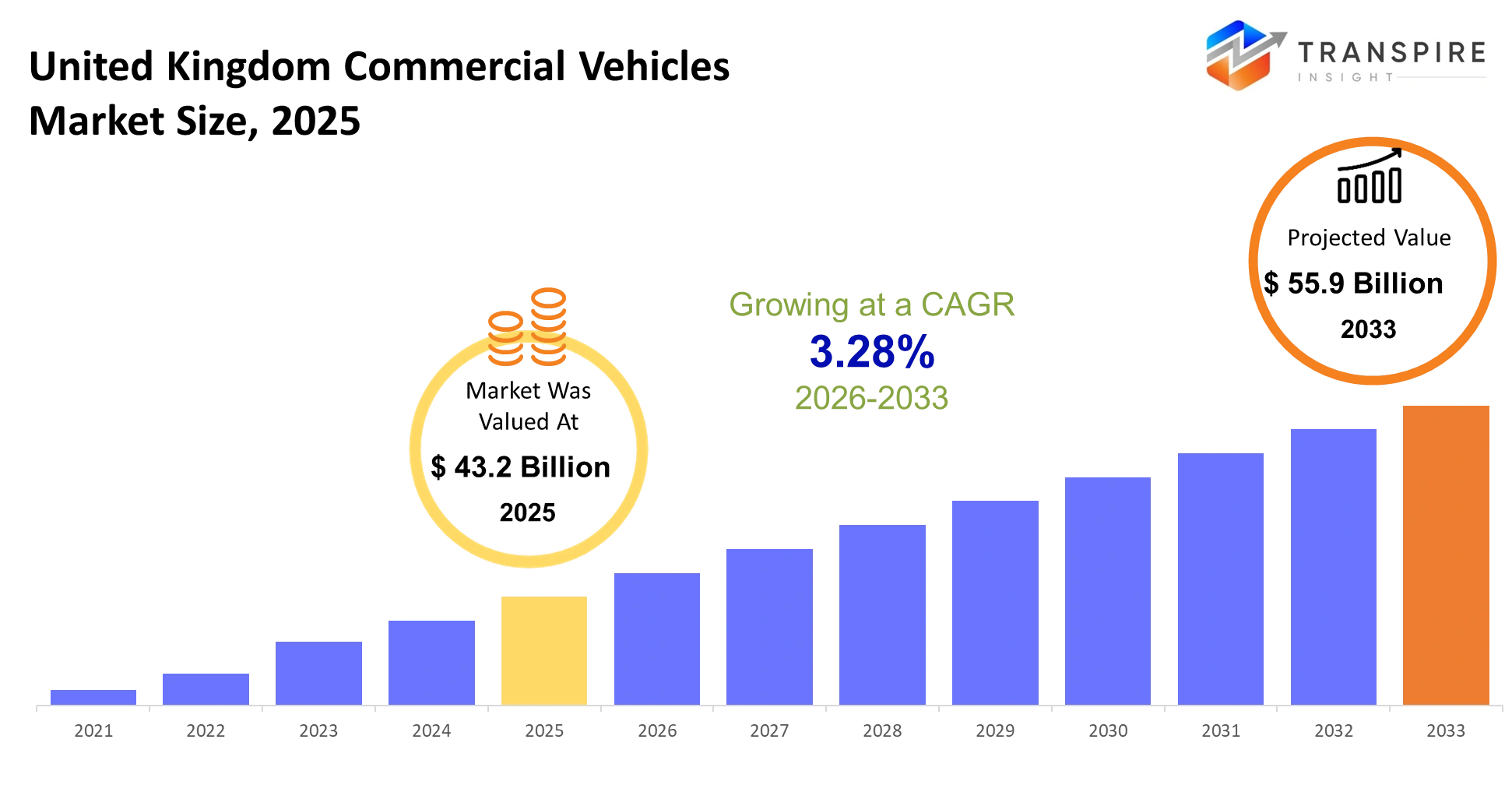
- United Kingdom Commercial Vehicles Market Size 2025: USD 43.2 Billion
- United Kingdom Commercial Vehicles Market Size 2033: USD 55.9 Billion
- United Kingdom Commercial Vehicles Market CAGR: 3.28%
- United Kingdom Commercial Vehicles Market Segments: By Vehicle Type (Light Commercial Vehicles, Medium Commercial Vehicles, Heavy Commercial Vehicles, Electric Commercial Vehicles, Hybrid Commercial Vehicles, Autonomous Commercial Vehicles, Others); By Fuel Type (Diesel Vehicles, Electric Vehicles, Hybrid Vehicles, Hydrogen-powered Vehicles, CNG Vehicles, Others); By Application (Logistics & Transportation, Construction, Mining, Agriculture, Public Transportation, Waste Management, Others); By End User (Fleet Operators, Logistics Companies, Government Agencies, Construction Firms, SMEs, Others); By Component (Engines, Transmission Systems, Axles, Braking Systems, ADAS Systems, Others)
To learn more about this report,  Download Free Sample Report
United Kingdom Commercial Vehicles Market Summary
The United Kingdom Commercial Vehicles Market was valued at USD 43.2 Billion in 2025. It is forecast to reach USD 55.9 Billion by 2033. That is a CAGR of 3.28% over the period.
In the United Kingdom commercial vehicles market, operators try to keep goods, parcels, construction materials and essential services moving across cities, ports and industrial corridors, without too much delay. You can see that fleets of vans, rigid trucks and heavy-duty vehicles really do the backbone work for last-mile delivery, retail distribution, and infrastructure activity, and that sort of thing directly impacts supply chain reliability ,and also day to day business continuity. Over the last five years the market has been moving in a more structural direction toward electrified , and low-emission fleets, mostly due to urban access rules that tightened a bit, and corporate net-zero promises that started steering procurement choices in a quieter way.
At the same time, the 2022 energy price shock plus the post-pandemic e-commerce lift helped speed up fleet renewal cycles, so operators basically had to lean harder on fuel efficiency and route optimization. This whole mix has increased adoption of telematics electric vans, and leasing models , because operators want a stronger grip on total operating costs, not only the initial purchase price. And as a result there’s sustained revenue growth across OEMs, leasing firms, and charging infrastructure providers.
Key Market Insights
- England sort of dominates the United Kingdom Commercial Vehicles Market, with around 70% share because the logistics web is tight, plus you’ve got the ports and those industrial hubs close by.
- London and the Southeast England area also look like the quickest movers , mainly because zero-emission zones are rolling out and electric fleet deployment is happening pretty fast.
- In terms of vehicle type, Light commercial vehicles basically take the lead , holding about 55% share, mostly from last mile delivery demand.
- Heavy commercial vehicles stay second, with construction work and intercity freight transport keeping things steady.
- Meanwhile electric commercial vehicles are the fastest growing segment , and they are expected to ramp up quickly through 2025–2030 on emission mandates.
- On the freight side, Logistics and e-commerce distribution kind of lead the United Kingdom Commercial Vehicles Market, accounting for nearly 45% share in freight movement.
- For applications, last-mile delivery is the one growing fastest, pushed by online retail expansion and same day delivery expectations.
- When you look at end users, logistics companies represent the top segment, helped by big fleet ownership and longer haul transportation contracts.
- And e-commerce retailers are growing quickest too, which is boosting demand for vans and electric delivery fleets.
What are the Key Drivers, Restraints, and Opportunities in the United Kingdom Commercial Vehicles Market?
In the United Kingdom commercial vehicles market, the main driver is basically a regulatory, and cost driven push toward fleet electrification, even if it sounds simple on paper. Expanding low-emission zones in major cities, plus the on and off volatility in diesel pricing since 2022, has made operators look at total cost of ownership more than they do the upfront purchase cost. That change is pushing more electric vans and fuel efficient trucks into the mix, especially for last mile delivery and municipal fleets. So, in practice OEM revenues are getting more and more linked to EV platforms , software enabled fleet management, and long term service agreements, rather than just one time vehicle sales.
The biggest holdback is still the charging and depot infrastructure situation, it’s not really mature enough yet. That limitation keeps electric commercial vehicles from scaling quickly, at least not across the board. It is kind of structural too, because it relies on grid upgrades, land that can be used for depots, and a lot of coordinated investment between utilities and private operators. A lot of smaller, and mid-sized logistics firms end up delaying the transition, mainly due to high initial vehicle costs, and also because charging access feels uncertain. All of this can suppress near term replacement cycles and slow down penetration of zero emission vehicles even though the regulatory pressure keeps building.
A promising opportunity is depot based smart charging paired with vehicle to grid integration, especially in logistics hotspots around London , Birmingham, and Manchester. With government backed funding programs and private capital stepping in, pilot projects are starting to show up, where fleets can optimize charging during off peak hours while also pushing energy back to the grid. That approach lowers operating costs and can create additional revenue streams too. In the end it helps position electrified fleet ecosystems as the next growth phase for the United Kingdom commercial vehicles market, you know, the next chapter rather than a short detour.
What Has the Impact of Artificial Intelligence Been on the United Kingdom Commercial Vehicles Market?
Artificial intelligence and more advanced digital systems are reshaping fleet operations across the United Kingdom's commercial vehicle ecosystem, sort of turning transport networks into continuously monitored, data driven arrangements. Operators are increasingly adopting AI enabled telematics platforms, to automate compliance tracking, including real time checking of driver hours, vehicle load states, and emission-zone entry requirements. In practice, this cuts down on manual reporting mistakes , and it also helps fleet managers respond right away when there’s a regulatory breach, particularly in crowded urban delivery corridors where everything feels faster and more compressed.
Meanwhile, machine learning models are being rolled out for predictive upkeep, where sensor data from engines, braking mechanisms and battery packs is reviewed to anticipate component failures before they even start. That kind of approach reduces surprise downtime, and also extends asset life, especially for high utilization logistics fleets that are always running. At the same time, AI based route optimization tools boost fuel efficiency by fine tuning delivery order, based on traffic, weather ,and congestion behavior. They often end up producing measurable reductions in fuel consumption, and also in idle time, which nobody really likes paying for.
Still, adoption is not fully smooth because integration costs can be high, and legacy fleet infrastructure is fragmented ,especially for smaller operators. Many fleets don’t have standardized data systems, and that limits model performance, plus it slows down deployments at scale. Even so, early adopters often mention operational efficiency gains in the range of 10–15 percent, which sort of reinforces AI as a longer term productivity engine for the commercial vehicle sector.
Key Market Trends
- Since 2023 the expansion of urban low-emission zones kind of pushed fleet replacement timing more toward electric vans, and at the same time it sped up compliance led buying strategies, not just “plan and wait”.
- Ford Motor Company in 2024, started adding more electric commercial vehicle options ,and it feels like a straight reaction to fleet electrification contracts that kept going up.
- Between 2022 and 2025, lots of logistics operators moved away from ownership and toward leasing models, which reduced capital exposure a bit ,but also made fleet modernization happen much faster.
- For last mile delivery, battery electric vehicle uptake rose by over 25% since 2022 , so there’s that momentum too.
- That jump seems tied to e-commerce delivery volumes growing, more orders, more runs, so fleets needed different lifts.
- Volvo Trucks and other original equipment makers also drifted toward software defined vehicles, because that helps with predictive maintenance and it improves uptime efficiency, kind of like less guesswork.
- After 2023, investments in depot charging infrastructure grew a lot. Fleet operators were reacting to range anxiety and the risk of operational downtime, so they built out charging as they went.
- After 2022, AI powered telematics systems kind of became the norm in large fleets , and it did help smooth route flow a lot while cutting fuel use by as much as 15%.
- In 2021–2022, the supply chain stuff—those disruptions really made manufacturers shift toward more local sourcing approaches, then production schedules stayed more or less on track across commercial vehicle supply chains.
- And then the government backed ZEV policies that started rolling out in 2024, sort of changed how agencies and buyers procure vehicles, so fleet operators had to push their zero emission transition plans earlier than they thought .
United Kingdom Commercial Vehicles Market Segmentation
By Vehicle Type:
Light commercial vehicles, medium commercial vehicles, heavy commercial vehicles, electric commercial vehicles, hybrid commercial vehicles, autonomous commercial vehicles, and others form this vehicle demand structure across freight movement, last mile delivery , and industrial transport needs too. In day to day usage light commercial vehicles still have strong pull in urban logistics, whereas heavy commercial vehicles help with long distance freight, plus infrastructure movement along highways, and around industrial zones.
Electric commercial vehicles are being adopted more quickly these days because of emission rules, and also because operational costs keep squeezing fleets. Hybrid commercial vehicles and autonomous commercial vehicles get noticed more slowly, as operators trial efficiency gains and safety improvements. Medium commercial vehicles, on the other hand, keep a stable demand level, for balanced load capacity needs across regional distribution networks. Meanwhile diesel based models continue to slide, due to tighter emission compliance norms and the higher running costs that come with them.
By Fuel Type:
Diesel vehicles, electric vehicles, hybrid vehicles, hydrogen-powered vehicles, CNG vehicles, and others kinda represent the shifting energy setup for commercial transport operations. Diesel vehicles still dominate the current fleets because of older ownership patterns, yet the replacement cycles are moving more and more toward cleaner energy options, driven by policy restrictions and also by fuel cost volatility.
Electric vehicles are showing strong growth as charging infrastructure keeps expanding along urban logistics corridors, and this is really key. Hybrid vehicles function like a transitional bridge, for operators who handle mixed route situations. Hydrogen-powered vehicles are still in an early rollout stage since the infrastructure is limited, so deployment is slower than people expect. Meanwhile CNG vehicles stay in more narrow use cases, mainly in niche fleet applications where operators want lower emission output compared to diesel systems.
By Application:
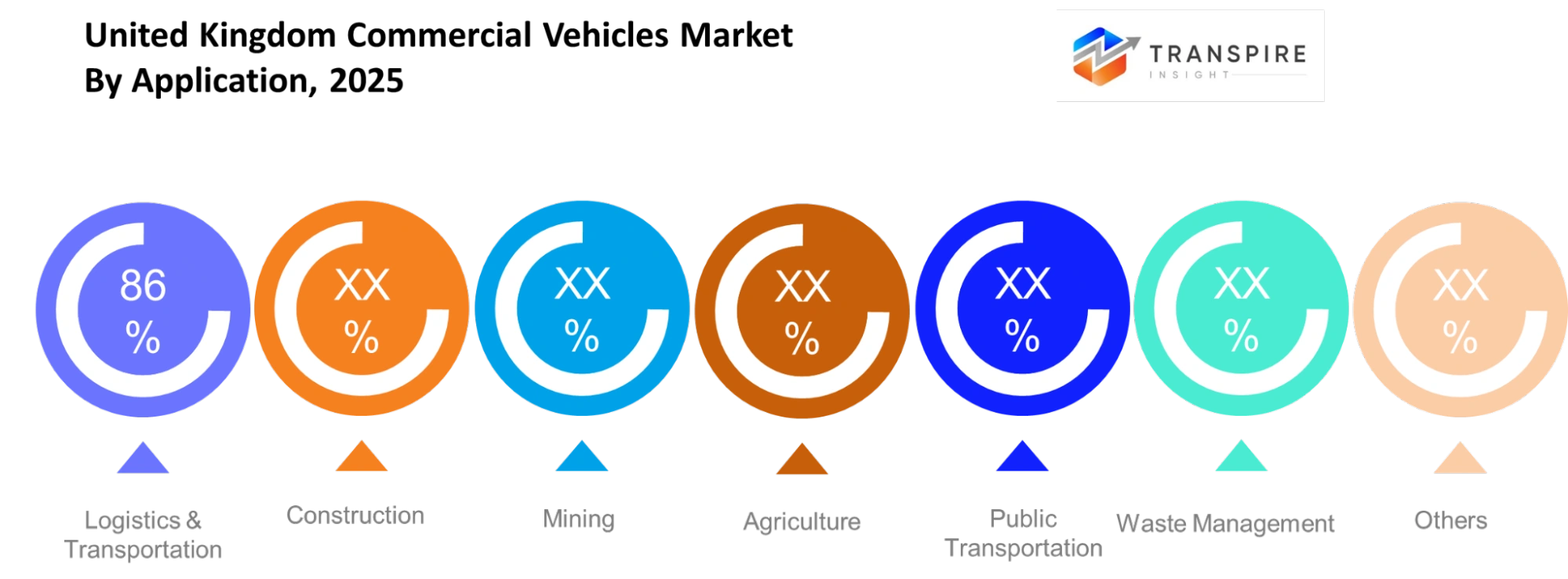
Logistics & transportation, construction, mining, agriculture, public transportation, waste management, others kinda define operational usage across commercial fleet networks. Logistics and transportation lead demand because parcel movement is intense, retail distribution keeps going, and e-commerce delivery requirements are growing through cities and regional hubs.
Construction applications keep supporting steady vehicle utilization, tied to infrastructure development and housing projects. Waste management fleets are expanding due to stricter urban environmental standards, not really optional anymore. Agriculture keeps seasonal vehicle demand, while public transportation depends on structured fleet deployment for mobility services. Mining and other industrial uses stay specialized, but they still look stable in demand patterns.
To learn more about this report, Download Free Sample Report
By End User:
Fleet operators, logistics companies, government agencies, construction firms, SMEs, others represent ownership and usage patterns across commercial transport systems. Fleet operators and logistics companies dominate usage, mainly due to large-scale vehicle deployment and constant delivery requirements across supply chains.
Government agencies back municipal services like waste collection and public mobility systems, so there’s always that scheduled motion going on, sort of. Construction firms tend to rely on heavy-duty vehicle fleets for material conveyance and site tasks, day to day. SMEs go with smaller fleets and use flexible leasing terms, which resembles cost-sensitive uptake behavior and slower renovation of transport assets throughout typical business operations.
By Component:
Engines, transmission systems, axles, braking systems, ADAS systems, others kind of define the core mechanical and electronic systems that back up vehicle performance and safety, even if it’s not always obvious at first. Engines and transmission systems keep showing up as critical value components, mainly because of how they help with power delivery and efficiency management.
ADAS systems are also getting more and more weight, specially as safety regulations tighten, and fleet operators push harder for accident reduction along with driver assist technologies. Meanwhile axles and braking systems stay with their essential jobs in load handling and safety performance. Component demand is also starting to shift toward electrified powertrain systems since commercial vehicle manufacturing is moving toward low-emission models and software integrated architectures.
What are the Key Use Cases Driving the United Kingdom Commercial Vehicles Market?
Logistics and last-mile delivery kind of sit right at the center of the United Kingdom Commercial Vehicles Market use case, mainly because e-commerce is growing fast and those urban routes are pretty dense. With high parcel volumes and delivery deadlines that feel strict, fleets get pushed to keep vehicles running all the time, so vans and light commercial vehicles become pretty much daily necessities for operations across cities , and also along regional corridors.
Then there are construction supply transports plus municipal services , which are quietly becoming more important too. Infrastructure upgrades help a lot, and the public sector keeps modernizing its fleets. In construction, medium and heavy commercial vehicles are used for hauling materials. Waste management operators, meanwhile, roll out specialized fleets to handle tougher urban environmental compliance rules.
On top of that, electric fleet operations along with autonomous delivery pilot programs are showing up more often as emerging use cases, and they’re getting noticeable attention from logistics firms , plus technology providers. Depot-based electric charging systems and those early-stage autonomous vans look promising for cutting labor costs and emissions, especially inside limited urban delivery areas where routes are more controlled, and also where oversight is easier, kind of.
|
Report Metrics |
Details |
|
Market size value in 2025 |
USD 43.2 Billion |
|
Market size value in 2026 |
USd 44.6 Billion |
|
Revenue forecast in 2033 |
USD 55.9 Billion |
|
Growth rate |
CAGR of 3.28% from 2026 to 2033 |
|
Base year |
2025 |
|
Historical data |
2021 - 2024 |
|
Forecast period |
2026 - 2033 |
|
Report coverage |
Revenue forecast, competitive landscape, growth factors, and trends |
|
Regional scope |
Middle East and Africa (Saudi Arabia, United Arab Emirates, South Africa, Rest of Middle East and Africa) |
|
Key company profiled |
Daimler Truck, Volvo Group, Scania, MAN Truck & Bus, Iveco, Ford Motor Company, Tata Motors, Ashok Leyland, BYD, Hyundai Motor Company, Isuzu Motors, Hino Motors, Renault Trucks, PACCAR, Nikola Corporation |
|
Customization scope |
Free report customization (country, regional & segment scope). Avail customized purchase options to meet your exact research needs. |
|
Report Segmentation |
By Vehicle Type (Light Commercial Vehicles, Medium Commercial Vehicles, Heavy Commercial Vehicles, Electric Commercial Vehicles, Hybrid Commercial Vehicles, Autonomous Commercial Vehicles, Others); By Fuel Type (Diesel Vehicles, Electric Vehicles, Hybrid Vehicles, Hydrogen-powered Vehicles, CNG Vehicles, Others); By Application (Logistics & Transportation, Construction, Mining, Agriculture, Public Transportation, Waste Management, Others); By End User (Fleet Operators, Logistics Companies, Government Agencies, Construction Firms, SMEs, Others); By Component (Engines, Transmission Systems, Axles, Braking Systems, ADAS Systems, Others) |
Which Regions are Driving the United Kingdom Commercial Vehicles Market Growth?
England still feels like the main driving region in the United Kingdom Commercial Vehicles Market, mostly because of its dense logistics web , lots of vehicles concentrated in the same areas, and very solid port infrastructure. Ports such as Felixstowe, Southampton, and London Gateway keep freight moving without too much pause between domestic distribution hubs and the international trade routes. On top of that, the tighter rules on emissions in city regions sort of forces operators to modernize their vehicles faster than you might see elsewhere. And then there’s the whole backing system around it—OEM service networks, leasing providers, and logistics hubs all together, which kind of locks in England’s leading position.
Scotland, meanwhile, plays more like a steady , structurally consistent contributor. The momentum comes from longer-haul freight movement and industrial activity tied to energy, construction, and even rural distribution needs. Unlike England, growth here is not so much pushed by strict urban emission enforcement, instead it leans on ongoing infrastructure investment plus predictable fleet replacement timing. Operators in Scotland tend to favor durability and day-to-day reliability , since the routes are longer and the terrain can be a bit tougher. So demand for medium and heavy commercial vehicles stays fairly consistent, giving the market a more balanced overall look, but with less volatility
London, and Southeast England is kind of the fastest-growing region , because of the rapid expansion of zero-emission zones and the accelerated electrification of city fleets. Since 2023 , policy tightening has already pushed logistics firms to move quickly, toward electric vans and charging setups that are depot-based, not just on-street. At the same time public as well as private investment in charging infrastructure, is giving adoption that extra push across last-mile delivery networks. Over the 2026–2033 stretch, this area will pull in a lot of fleet modernization, so there are strong entry opportunities for EV manufacturers, infrastructure providers and technology-enabled fleet service companies.
Who are the Key Players in the United Kingdom Commercial Vehicles Market and How Do They Compete?
In the United Kingdom Commercial Vehicles Market the competitive scene feels sort of moderately consolidated, where big global OEMs have most of the weight, but smaller EV focused entrants are still slowly messing with , especially the urban fleet side. Basically the fight is not just about vehicle pricing anymore, it’s more about electrification know-how, software integration and the total cost of ownership. The older players keep their ground by pushing faster electric rollouts and by upgrading their fleet service coverage, while the new entrants look at last mile delivery niches with nimble electric platforms and fleet subscription style arrangements.
Daimler Truck is leaning into technology driven differentiation , by growing its electric truck range and pairing it with advanced fleet telematics so predictive uptime management becomes a thing. It also improves its stance via collaborations with charging infrastructure providers and through long term service agreements that tend to keep fleet operators tied in. Volvo Trucks goes heavy on electrified transport for tough duty operations, using safety systems and tuning energy efficiency to attract logistics customers who are under emission pressure. It expands largely through pilot deployments with UK logistics firms, to prove real world results and the ability to scale.
Ford Motor Company keeps its momentum in light commercial vehicles by concentrating on cost efficient electric vans for urban delivery networks. Stellantis differentiates with multi-brand EV platforms, plus broad distribution through fleet leasing channels. Iveco Group aims at tighter niches like medium-duty transport and alternative fuel experiments, while Scania pushes connected truck ecosystems and modular powertrain upgrade paths, growing adoption by offering digital fleet optimization services for long haul operators.
Company List
- Daimler Truck
- Volvo Group
- Scania
- MAN Truck & Bus
- Iveco
- Ford Motor Company
- Tata Motors
- Ashok Leyland
- BYD
- Hyundai Motor Company
- Isuzu Motors
- Hino Motors
- Renault Trucks
- PACCAR
- Nikola Corporation
Recent Development News
In March 2025, Stellantis Pro One entered a partnership with Iveco Group to supply two electric vans under the Iveco brand. The agreement enables the production and European commercialization of two battery-electric light commercial vehicles based on Stellantis’ mid-size and large van platforms, strengthening the UK-linked EV van supply ecosystem and expanding OEM collaboration in the commercial vehicle sector.
Source https://www.media.stellantis.com/
In March 2026, Peugeot (Stellantis UK) launched continued support for the UK government’s Zero Emissions Van Grant (ZEVG), reinforcing its electric van offering across its entire LCV range. The initiative maintains up to £5,000 in customer savings per electric van and strengthens adoption incentives for fleet electrification in the UK commercial vehicle market, directly supporting the shift toward zero-emission delivery and logistics fleets.
Source https://www.media.stellantis.com/
What Strategic Insights Define the Future of the United Kingdom Commercial Vehicles Market?
The United Kingdom Commercial Vehicles Market is basically leaning, in a kind of sideways way , toward a digitally enabled and electrified fleet ecosystem, where value creation no longer just sits on vehicle ownership. Instead, it sort of shifts into integrated mobility services . This movement is pulled along by tighter urban emission rules and the gradual adoption of AI based fleet optimization tools which together, are changing how commercial transport efficiency is calculated across the next 5 to 7 years.
One risk that feels less visible is the rising reliance on grid stability and on raw material supply chains that are needed for battery manufacturing. Even if demand for electric commercial vehicles keeps speeding up, hiccups in lithium sourcing and uneven grid upgrades may turn into bottlenecks that slow down the fleetwide transition , especially for mid-sized operators that don’t really have large capital reserves.
There’s also an opportunity starting to show up: depot-level energy management systems paired with vehicle-to-grid infrastructure, mainly within logistics clusters near major UK cities. This approach is still pretty early , but it is picking up momentum as operators look for ways to monetize idle energy capacity. Market participants should therefore push for end-to-end EV ecosystem offerings that blend vehicles, charging infrastructure, and software platforms—so they can lock in long term, contract based revenue, rather than leaning only on unit sales .
United Kingdom Commercial Vehicles Market Report Segmentation
By Vehicle Type
- Light Commercial Vehicles
- Medium Commercial Vehicles
- Heavy Commercial Vehicles
- Electric Commercial Vehicles
- Hybrid Commercial Vehicles
- Autonomous Commercial Vehicles
By Fuel Type
- Diesel Vehicles
- Electric Vehicles
- Hybrid Vehicles
- Hydrogen-powered Vehicles
- CNG Vehicles
By Application
- Logistics & Transportation
- Construction
- Mining
- Agriculture
- Public Transportation
- Waste Management
By End User
- Fleet Operators
- Logistics Companies
- Government Agencies
- Construction Firms
- SMEs
By Component
- Engines
- Transmission Systems
- Axles
- Braking Systems
- ADAS Systems
Frequently Asked Questions
Find quick answers to common questions.
The United Kingdom Commercial Vehicles Market size is USD 55.9 Billion in 2033.
Key segments for the United Kingdom Commercial Vehicles Market are By Vehicle Type (Light Commercial Vehicles, Medium Commercial Vehicles, Heavy Commercial Vehicles, Electric Commercial Vehicles, Hybrid Commercial Vehicles, Autonomous Commercial Vehicles, Others); By Fuel Type (Diesel Vehicles, Electric Vehicles, Hybrid Vehicles, Hydrogen-powered Vehicles, CNG Vehicles, Others); By Application (Logistics & Transportation, Construction, Mining, Agriculture, Public Transportation, Waste Management, Others); By End User (Fleet Operators, Logistics Companies, Government Agencies, Construction Firms, SMEs, Others); By Component (Engines, Transmission Systems, Axles, Braking Systems, ADAS Systems, Others).
Major United Kingdom Commercial Vehicles Market players are Daimler Truck, Volvo Group, Scania, MAN Truck & Bus, Iveco, Ford Motor Company, Tata Motors, Ashok Leyland, BYD, Hyundai Motor Company, Isuzu Motors, Hino Motors, Renault Trucks, PACCAR, Nikola Corporation.
The United Kingdom Commercial Vehicles Market size is USD 43.2 Billion in 2025.
The United Kingdom Commercial Vehicles Market CAGR is 3.28% from 2026 to 2033.
- Daimler Truck
- Volvo Group
- Scania
- MAN Truck & Bus
- Iveco
- Ford Motor Company
- Tata Motors
- Ashok Leyland
- BYD
- Hyundai Motor Company
- Isuzu Motors
- Hino Motors
- Renault Trucks
- PACCAR
- Nikola Corporation
About the Authors

Mayur Shinde
I am Mayur Shinde, a Senior Research Analyst at Transpire Insight, specializing in the Automotive & Transportation and Information & Communication Technology (ICT) Industry. My work focuses on analyzing emerging market trends, technological advancements, competitive landscapes, and industry developments to deliver accurate, data-driven insights. I am passionate about transforming complex market information into clear, actionable content that helps businesses, professionals, and decision-makers stay informed and make confident strategic decisions.

Chakradhar Khansole
Chakradhar serves as the Research Director at Transpire Insight, bringing over 8 years of experience in technology, innovation, and strategic market intelligence. He specializes in transforming complex market data into actionable business insights that enable organizations to make informed, growth-oriented decisions. Recognized for his strategic vision and analytical expertise, Chakradhar leads high-impact research initiatives, delivering comprehensive market assessments, competitive intelligence, and forward-looking industry analysis.
Recently Published Reports
-
Apr 2026
ATV & UTV Market
ATV & UTV Market Size, Share & Analysis Report By Type (ATV, and UTV), By Variants (Less Than 400 CC, 400 CC To 800 CC, and More Than 800 CC), and Geography (North America, Europe, Asia-Pacific, Middle East and Africa, South and Central America), 2021 - 2031
-
Apr 2026
Automotive Central Gateway Module Market
Automotive Central Gateway Module Market Size, Share & Analysis Report By Type (Ethernet Central Gateway Module, CAN Central Gateway Module, LIN Central Gateway Module, and FlexRay), By Application (Powertrain Control, Body Control, Infotainment System, Advanced Driver Assistance Systems (ADAS), and Others), By End User (Passenger Vehicles, and Commercial Vehicles), and Geography (North America, Europe, Asia-Pacific, Middle East and Africa, South and Central America), 2021 - 2031
-
Apr 2026
Automotive Engine Oil Filter Market
Automotive Engine Oil Filter Market Size, Share & Analysis Report By Filter Type (Fuel Filter, Engine Oil Filter, Hydraulic Oil Filter, and Others), By Filter Media (Cellulose, Synthetic, and Micro), By Sales Channel (OEMs, and Aftermarket), By Vehicle Type (Passenger Cars, Light Commercial Vehicles, Heavy Duty Trucks, Buses and Coaches, and Off-road Vehicles), and Geography (North America, Europe, Asia-Pacific, Middle East and Africa, South and Central America), 2021 - 2031
-
Apr 2026
Automotive Parts Aluminium Die Casting Market
Automotive Parts Aluminium Die Casting Market Size, Share & Analysis Report By Production Process (Pressure Die Casting, Vacuum Die Casting, Squeeze Die Casting, Gravity Die Casting), By Application (Body Parts, Engine Parts, Transmission Parts, Battery And Related Components, Other Application Types), and Geography (North America, Europe, Asia-Pacific, Middle East and Africa, South and Central America), 2021 - 2031
Our Clients



