

United Kingdom Third-party Logistics Market Size & Forecast:
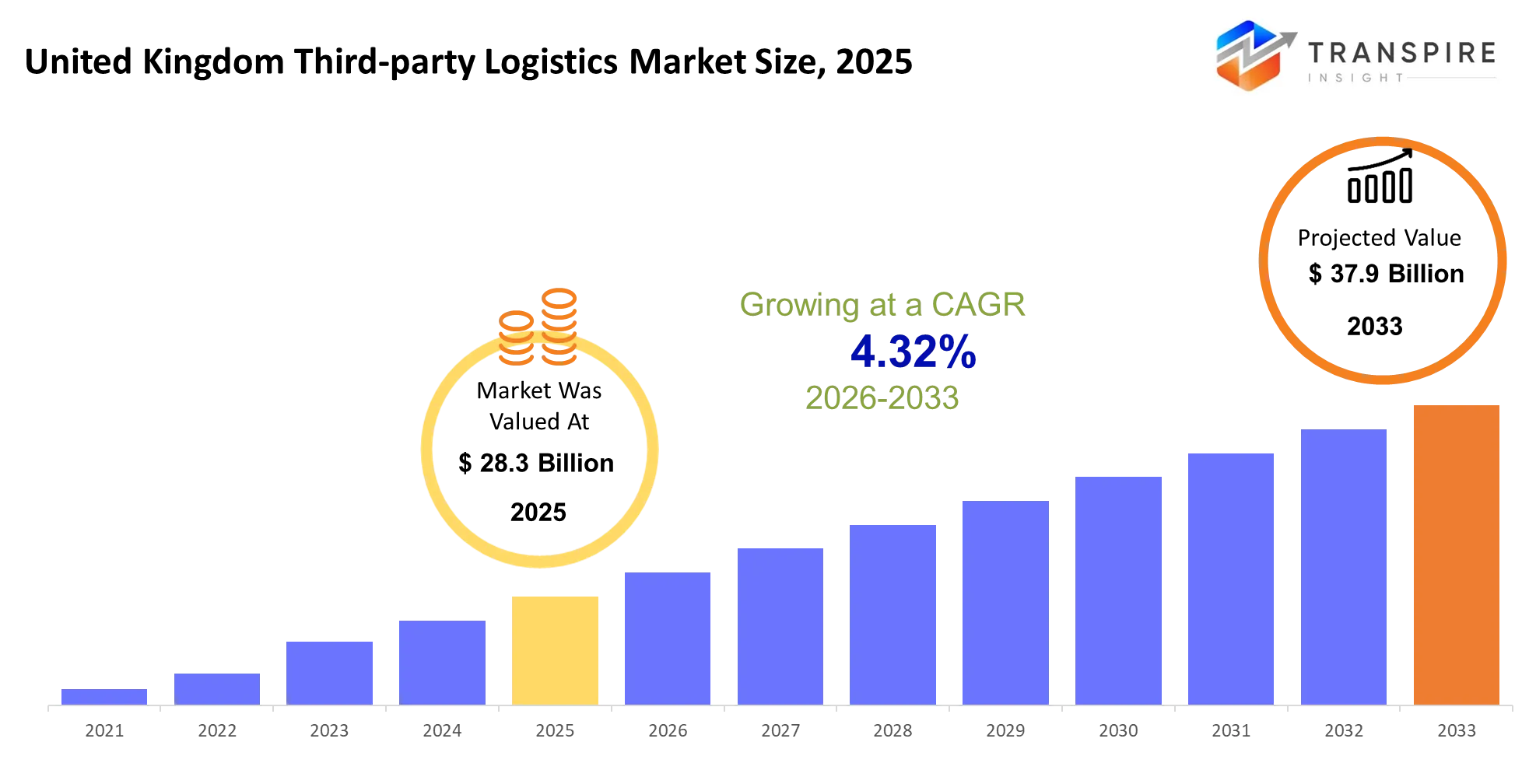
- United Kingdom Third-party Logistics Market Size 2025: USD 28.3 Billion
- United Kingdom Third-party Logistics Market Size 2033: USD 37.9 Billion
- United Kingdom Third-party Logistics Market CAGR: 4.32%
- United Kingdom Third-party Logistics Market Segments: By Service Type (Transportation Services, Warehousing Services, Freight Forwarding, Inventory Management, Value-added Logistics Services, Reverse Logistics, Others); By Transportation Mode (Road Transport, Rail Transport, Air Freight, Sea Freight, Intermodal Transport, Others); By Application (Retail Logistics, Automotive Logistics, Healthcare Logistics, Manufacturing Logistics, E-commerce Logistics, Others); By End User (Retailers, Manufacturers, Healthcare Providers, Automotive Companies, SMEs, Others); By Deployment (Asset-based Logistics, Non-asset-based Logistics, Digital Logistics Platforms, Others)
To learn more about this report,  Download Free Sample Report
United Kingdom Third-party Logistics Market Summary
The United Kingdom Third-party Logistics Market was valued at USD 28.3 Billion in 2025. It is forecast to reach USD 37.9 Billion by 2033. That is a CAGR of 4.32% over the period.
The United Kingdom Third-party Logistics Market does a kind of central job in making sure retail, manufacturing, pharmaceutical, and e-commerce supply chains keep moving, efficiently through domestic and international trade corridors . In practice, third-party logistics providers take care of warehousing, inventory handling, transportation, customs coordination, and last-mile delivery, for companies that are trying to cut operating costs , while also pushing delivery speed and fulfillment accuracy forward.
In the last five years , the whole market has kind of moved away from plain transport outsourcing and toward something more technology-enabled, like logistics orchestration . Cloud-based warehouse management systems, AI-assisted route planning, and real-time shipment visibility are now seen as core operational needs, not just “nice to have” upgrades.
Brexit, by contrast , really changed logistics behavior , bringing in customs complexity and border documentation requirements. That meant businesses leaned harder on specialized logistics partners, and it became less optional to get it right . At the same time, e-commerce fulfillment volumes kept growing after pandemic-era disruptions reshaped how consumers buy things in general. Put together, this has boosted long-term outsourcing demand, widened contract logistics revenue streams , and also sped up investment in automated distribution infrastructure across the United Kingdom.
Key Market Insights
- In the United Kingdom Third-party Logistics market, it will hit about USD 28.3 billion in 2025, supported by e-commerce fulfillment retail outsourcing, and also the customs management kind of demand.
- England still leads the United Kingdom Third-party Logistics market, with more than 70% of the industry share, mostly because warehousing is concentrated and the distribution routes are tied to ports, which feels pretty important.
- Scotland is coming up as the fastest-growing regional logistics hub through 2033 , largely fueled by renewable energy initiatives and cold-chain investments that keep temperature control in mind.
- Transportation management services take the largest slice, since retailers are pushing for quicker delivery cycles, and optimized fleet use, not just “move stuff”.
- Warehouse and fulfillment services sit in the second place, and this segment benefits from automated inventory systems and omnichannel retail operations that kind of run like clockwork.
- For applications, e-commerce logistics stays the leading segment, while pharmaceutical cold-chain distribution is expected to grow the quickest, through 2033, despite the complexity.
- On the end-user side, retail and consumer goods companies hold the top share, while healthcare logistics adoption is rising quickly after 2021, when supply chain disruptions created stronger urgency.
- Big names like DHL Supply Chain, Kuehne+Nagel, DB Schenker, Wincanton, and CEVA Logistics are expanding their robotics-enabled fulfillment networks, more than before.
- Logistics providers are also rolling out AI-based route optimization and predictive inventory planning more often, aiming to cut delivery delays and lower warehouse operating costs.
- And then there are partnerships between retailers and third-party operators that picked up momentum after Brexit, especially around customs brokerage, and cross-border freight consolidation services.
What are the Key Drivers, Restraints, and Opportunities in the United Kingdom Third-party Logistics Market?
The strongest growth driver in the United Kingdom Third-party Logistics Market is basically the structural reshaping of retail fulfillment, after that rapid expansion of e-commerce and omnichannel distribution models. Retailers and manufacturers now rely on external logistics specialists a lot more, to handle inventory positioning, same-day delivery expectations, returns processing, and even cross-border customs coordination. Brexit kind of pushed this change too, because it increased customs paperwork, border delays , and compliance complexity for UK–EU trade flows. So, companies outsourced more significant parts of their logistics operations to providers that already have warehousing networks and customs experience.In the end, this transition kinda expanded recurring contract logistics revenue and it also helped speed up investment in automated fulfillment centers across England and, especially, the Midlands logistics corridor.
At the same time the market is still held back by structural labor and infrastructure issues, which is frustrating. Driver shortages, warehouse staffing gaps, and rising fuel and energy costs have lifted operating expenses across transportation and distribution networks. Those problems are not easy to untangle fast, because they lean on long-term workforce training, infrastructure expansion, plus changes in transport policy, overall.On top of that, persistent congestion at ports and urban delivery hubs reduces delivery efficiency, and quietly presses profit margins for logistics operators.
One major opportunity is AI-enabled smart warehousing and green logistics infrastructure. Logistics providers are investing in robotic picking systems, electric delivery fleets, and digital freight visibility platforms to improve day to day operational efficiency and regulatory compliance. Cold-chain logistics for pharmaceuticals and biologics is also another high potential segment
What Has the Impact of Artificial Intelligence Been on the United Kingdom Third-party Logistics Market?
Artificial intelligence has reshaped logistics work in the United Kingdom, mostly by pushing up warehouse productivity, making transportation more efficient, and giving better supply chain visibility. Large logistics operators now often lean on AI-powered warehouse management platforms, to kind of automate inventory allocation, improve picking routes, and shorten the order processing stretch inside those high-volume fulfillment centers. Then machine learning models go through traffic patterns, fuel consumption, and delivery timelines, so route planning becomes smarter and fleet utilization gets better, which lets operators cut transport expenses while also boosting delivery reliability, even when conditions get messy.
Predictive analytics has also quietly strengthened preventive maintenance approaches for commercial fleets and automated handling equipment. Logistics firms increasingly set up sensor based monitoring, that spot equipment wear before it turns into a real operational failure, so downtime drops and asset utilization improves.For cold-chain logistics AI-supported monitoring systems help keep temperature compliance kinda on track for pharmaceutical and food shipments, lowering spoilage risks and giving a stronger nod during regulatory checks.
More recently, advanced digital twins together with demand forecasting tools support inventory balancing across nearby regional warehouses, and this helps retailers dodge both overstock and stockouts. In practice, these tools can boost delivery speed and raise warehouse throughput, especially during peak seasonal demand periods, when everything seems to move faster then expected, or at least that’s the idea.
That said, AI adoption still runs into a couple walls. The integration costs can be quite high, legacy infrastructure is often fragmented , and data quality can be inconsistent across supply chain networks which drags deployment out, particularly for mid-sized logistics operators with limited digital investment capacity.
Key Market Trends
- Since 2021, UK retailers have been raising outsourcing deals for customs handling plus inventory management, after Brexit related changes to the border papers.
- Around the same time, automated fulfillment centers started popping up fast along the Midlands logistics corridor, because e-commerce delivery expectations turned from days into hours, pretty quickly.
- AI route planning platforms—kind of optimization engines—helped cut fuel use and reduce fleet “sitting time” for big logistics operators between 2022 and 2025.
- For pharmaceuticals, cold chain logistics got more investment right after healthcare distributors leaned harder into temperature controlled storage, and compliance monitoring routines.
- Electric delivery vans, plus low emission transport fleets, became more common after tougher urban emissions rules came in around London and other large metropolitan regions.
- Logistics providers also more and more used robotics assisted picking systems, partly to counter warehouse labor shortages, and partly to boost fulfillment accuracy.
- Real time shipment viewing platforms then became basically standard inside many contract logistics arrangements, because manufacturers wanted end to end supply chain visibility.
- Bigger firms like DHL Supply Chain and Wincanton moved further into multi client warehousing models, to gain operational flexibility, and make better use of their assets.
- Retailers started placing stock nearer to urban delivery areas after pandemic era disruptions showed how fragile centralized warehousing could be.
- And sustainability tied logistics contracts grew too, since manufacturers focused on carbon measurement and energy efficient transportation partnerships, a lot.
United Kingdom Third-party Logistics Market Segmentation
By Service Type
Transportation Services hold the leading market position, kind of, because retailers, manufacturers, and e-commerce operators keep prioritizing fast reliable freight movement across both local and cross-border supply chains. There’s a big reliance on road freight distribution, and also on time-sensitive delivery schedules, and that supports strong revenue concentration in this segment. Warehousing Services stay in the second-largest spot mainly due to more investment in automated fulfillment centers, regional storage hubs, and temperature-controlled facilities, especially for healthcare and food distribution. Freight Forwarding keeps picking up momentum after Brexit, because customs complexity went up and the paperwork and documentation needs for UK-EU trade activity became more involved. Inventory Management and Value-added Logistics Services are also benefiting, driven by demand for real-time stock visibility, packaging customization, and order consolidation, all of which matter a lot. Reverse Logistics remains strategically important too, since online retail platforms handle huge volumes of product returns that need inspection , then redistribution, and later disposal management.
Transportation Services are expected to keep the lead, since same-day and next-day delivery expectations continue reshaping the logistics network design across the United Kingdom. Warehousing operators are likely to push harder on robotics deployment and AI-supported inventory orchestration, just to improve throughput efficiency and reduce labor dependency. Freight forwarding providers will also continue expanding customs compliance and digital tracking capabilities, as international trade regulations evolve further.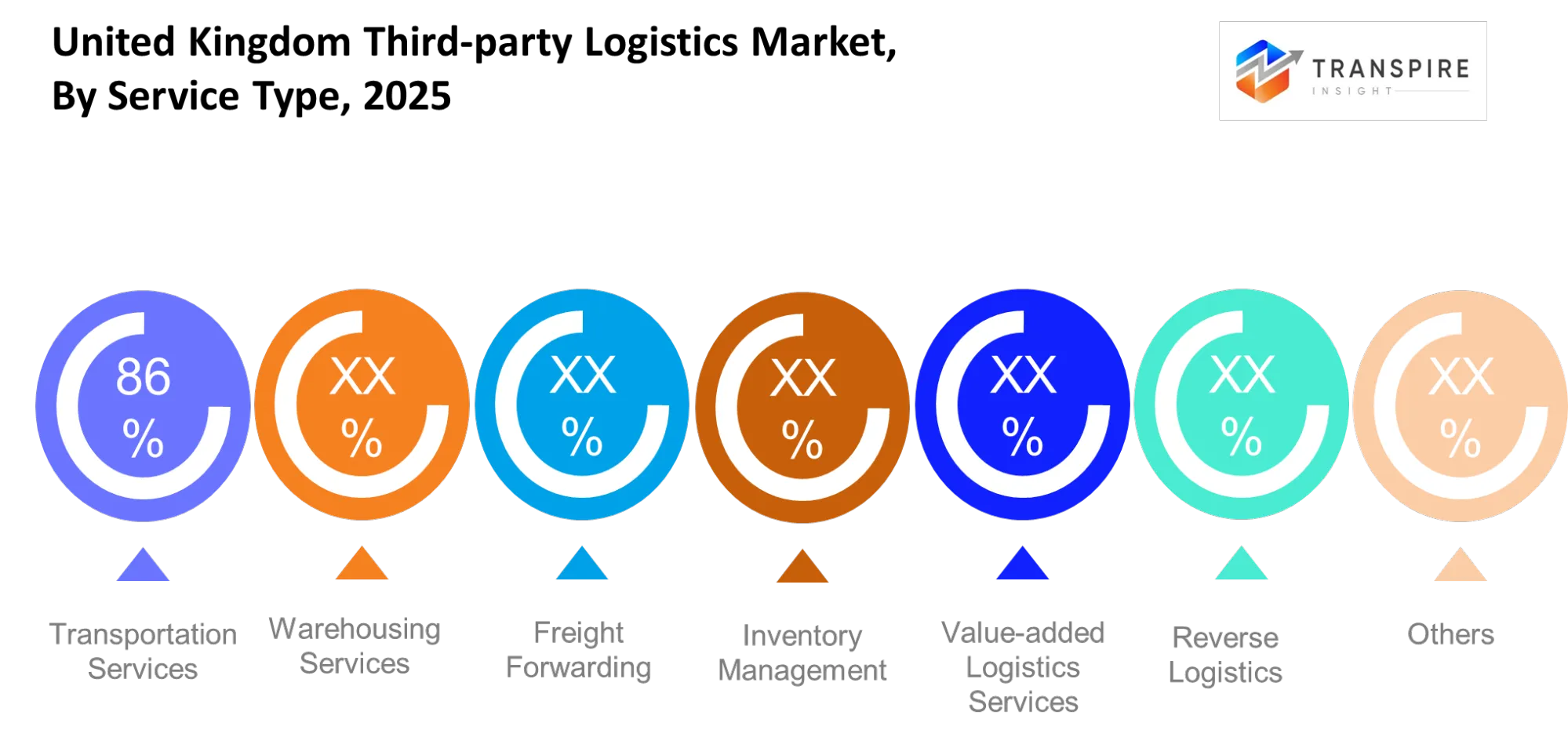
To learn more about this report, Download Free Sample Report
By Transportation Mode
Road Transport basically holds the biggest market share, because the United Kingdom leans quite a lot on countrywide trucking networks for retail delivery, e-commerce picking and packing fulfillment, plus industrial cargo hauling. There’s also strong linkage between ports, warehouses, city areas and regional drop zones, and that keeps road-based logistics systems in everyday use. Sea Freight sort of sits in a secondary, but still meaningful role , mostly because huge container movements keep flowing through ports like Felixstowe, Southampton, and London Gateway. Air Freight is still mainly reserved for high-value, extremely time- sensitive shipments, for example pharmaceuticals, electronics, and urgent industrial work, where speed truly matters. Rail Transport keeps growing little by little , as sustainability targets nudge companies toward lower-emission freight alternatives. Intermodal Transport is gaining even more traction, partly because logistics teams increasingly knit together rail , road,and sea paths to raise overall efficiency and also reduce those fuel- related running costs.
Road freight is expected to keep its structural dominance , since city fulfillment routines and short-haul distribution trips are not easy to swap out for other options. Over the longer term, rail services and intermodal logistics will likely widen faster, helped by infrastructure upgrades programs and carbon reduction policies that end up reshaping how freight is actually sourced. Sea freight operators should continue leaning on stable global trade routes and the steady movement loop of containerized goods that links manufacturing pull with retail supply chains.Air freight growth is likely to be more selective, landing mainly in premium logistics areas where fast transit and shipment protection feel worth the higher transport costs.
By Application
Retail Logistics seems to keep the dominant application position, basically because supermarkets, consumer goods companies, and omnichannel retailers need continual inventory restocking and quick store delivery options. When order frequency stays high, and fulfillment has to reach across the whole country, the transportation alongside warehousing workload ramps up big time through the retail supply chains. E-commerce Logistics on the other hand shows the fastest-growing behavior, mostly due to quicker online buying habits and customers wanting same-day service plus smoother returns oversight management. Manufacturing Logistics keeps a solid market footprint, since industrial producers lean on synchronized inbound material handling and outbound distribution flows, so production disruptions don’t happen. Automotive Logistics delivers a steady revenue stream, bolstered by just-in-time part arrivals plus established aftermarket spare parts distribution channels. Healthcare Logistics is still rising, because it requires temperature-controlled storage, and compliance-heavy pharmaceutical transport frameworks, in a more serious way than before.
In the next phase, retail and e-commerce logistics are expected to remain the top revenue engines, since digital commerce platforms keep reshaping how inventory is arranged and how fulfillment actually gets carried out. Healthcare logistics should grow faster too, because pharmaceutical distribution is getting more tangled, and cold-chain compliance rules are becoming stricter each year. Manufacturing applications, and automotive use-cases, will probably stay fairly stable over the long run, propelled by industrial modernization and supply chain diversification across different regions.
During the forecast period, logistics providers that focus on high-precision order execution, real-time digital shipment visibility, and sector-specific compliance features are expected to pull ahead, and gain a competitive advantage, overall.
By End User
Retailers keep the dominant end-user role, mainly because national supermarket chains, fashion brands, and online marketplaces keep producing high-volume warehousing and transportation activity almost the entire year. Omnichannel retail setups need pretty flexible fulfillment systems, able to handle store replenishment and the direct-to-consumer delivery approach, at the same time. Manufacturers stay in a major secondary spot, since industrial supply chains rely on coordinated transportation, inventory synchronization, and inbound material handling support. Healthcare Providers are still pushing more logistics outsourcing, aiming to boost pharmaceutical distribution efficiency, and also keep regulatory compliance inside temperature-sensitive delivery environments. Automotive Companies depend on specialized logistics networks to move components in sync, plus aftermarket distribution operations. SMEs remain active users of outsourced logistics, because third-party providers help reduce infrastructure investments , and they also raise operational scalability.
Retail demand is expected to keep long-term leadership, because consumer buying habits continue drifting toward digitally integrated fulfillment models. Healthcare Providers are likely to show the fastest expansion, since biologics, vaccines, and specialty medicines require advanced cold-chain capabilities, together with traceability systems. Manufacturers and automotive companies will keep putting money into resilient logistics partnerships, those reduce supply disruption exposure and help preserve production continuity. SMEs are set for gradual expansion too, since cloud-based logistics platforms lower entry hurdles , and improve access to nationwide distribution infrastructure.
By Deployment
Asset-based Logistics still seem to hold the dominant market position because large retailers and manufacturers often favor operators who can directly control fleets, warehouses and their distribution infrastructure. When a company actually owns transportation assets and fulfillment facilities , it tends to support service reliability, make delivery scheduling more stable, and give better operational visibility across those complicated supply chains. Non-asset-based Logistics sits in a strong secondary spot too, mainly by providing flexible brokerage, freight coordination, and network optimization services without those heavy infrastructure ownership expenses. Digital Logistics Platforms keep pulling ahead because AI-enabled freight matching, more consistent shipment tracking, and cloud-based transport management systems improve operational efficiency, plus customer responsiveness . Meanwhile other deployment models hang around in more limited forms, like niche collaborative logistics structures or specialized outsourcing arrangements.
Asset-based operators are expected to keep strong market influence because owning infrastructure backs long-term contracts and supports high-volume fulfillment operations over time. Digital Logistics Platforms are basically positioned for the fastest growth since shippers are increasingly leaning toward real-time visibility, predictive analytics, and automated freight coordination features. Non-asset-based providers should also keep benefiting from the ongoing demand for flexible transportation sourcing and for operating models that are less capital intense. Through the forecast period, the competitive race among deployments will shift more toward data integration, automation capability, and network scalability, not just fleet size, alone.
What are the Key Use Cases Driving the United Kingdom Third-party Logistics Market?
E-commerce fulfillment is still the major use case in the United Kingdom Third-party Logistics Market, like honestly it just keeps showing up everywhere. Retailers lean on third-party operators for warehousing ,inventory synchronization, packaging, reverse logistics ,and fast last-mile delivery. With high parcel volumes and same-day delivery expectations, outsourcing fulfillment tends to look more cost-efficient than running everything in-house.
Meanwhile, pharmaceutical and healthcare logistics applications are growing steadily, especially around temperature-controlled transportation and cold-chain warehousing. Food and beverage manufacturers also increasingly pick specialized logistics partners for distribution that has to meet compliance rules, plus for inventory traceability across supermarket supply chains and export routes.
Some newer things are now emerging too, like AI-enabled micro fulfillment centers and sustainable urban delivery networks, supported by electric fleets. Logistics providers are also backing renewable energy projects through oversized cargo transportation and specialized industrial equipment handling, which is starting to open up fresh long-term revenue paths across regional infrastructure markets.
|
Report Metrics |
Details |
|
Market size value in 2025 |
USD 28.3 Billion |
|
Market size value in 2026 |
USD 29.4 Billion |
|
Revenue forecast in 2033 |
USD 37.9 Billion |
|
Growth rate |
CAGR of 4.32% from 2026 to 2033 |
|
Base year |
2025 |
|
Historical data |
2021 - 2024 |
|
Forecast period |
2026 - 2033 |
|
Report coverage |
Revenue forecast, competitive landscape, growth factors, and trends |
|
Regional scope |
South Korea |
|
Key company profiled |
DHL Supply Chain, Kuehne+Nagel, DB Schenker, XPO Logistics, CEVA Logistics, Nippon Express, UPS Supply Chain Solutions, FedEx Logistics, GXO Logistics, DSV, CJ Logistics, Sinotrans, Expeditors International, C.H. Robinson, Ryder System |
|
Customization scope |
Free report customization (country, regional & segment scope). Avail customized purchase options to meet your exact research needs. |
|
Report Segmentation |
By Service Type (Transportation Services, Warehousing Services, Freight Forwarding, Inventory Management, Value-added Logistics Services, Reverse Logistics, Others); By Transportation Mode (Road Transport, Rail Transport, Air Freight, Sea Freight, Intermodal Transport, Others); By Application (Retail Logistics, Automotive Logistics, Healthcare Logistics, Manufacturing Logistics, E-commerce Logistics, Others); By End User (Retailers, Manufacturers, Healthcare Providers, Automotive Companies, SMEs, Others); By Deployment (Asset-based Logistics, Non-asset-based Logistics, Digital Logistics Platforms, Others) |
Which Regions are Driving the United Kingdom Third-party Logistics Market Growth?
England still looks like the leading region in the United Kingdom Third-party Logistics Market, simply because it brings together the biggest consumer base with the most solid warehousing and transport backbone, in one place. A bunch of major freight routes feeding the Port of Felixstowe, Southampton, London Gateway and then the Midlands logistics belt also help sustain high volume shipping, both inside the country and across borders. On top of that, England is seeing continued spending on automated fulfillment centers, customs brokerage work and AI enabled warehouse management systems. Big retailers, manufacturers, and e commerce players keep choosing England to house their national distribution, since the road rail and port mix feels genuinely connected and reliable.
Scotland, however, contributes in a more different way, almost like its pace is anchored less to dense retail order fulfillment and more to industrial sturdiness plus specialized logistics needs. Energy schemes, offshore infrastructure activity, and food export operations keep logistics budgets steady across Scottish ports and the regional transport corridors. It’s also kept a consistent push for cold chain distribution, especially for seafood, pharmaceuticals, and healthcare related shipments. If you compare it with England’s big volume distribution approach, Scotland’s scene feels more focused on dependable delivery, compliance driven transport, and longer term industrial supply agreements that help revenue stay calmer.
Wales is starting to show up as the quickest growing regional market because port modernization projects plus renewable energy investment are basically reshaping how freight moves around. Newer improvements at ports like Milford Haven and Holyhead boosted cargo handling capacity, and they also reinforced links with Irish and European trade lanes.
Who are the Key Players in the United Kingdom Third-party Logistics Market and How Do They Compete?
In the United Kingdom Third-party Logistics Market, competition is sort of moderately consolidated, where big multinational operators sit next to more specialized domestic logistics providers. Firms usually end up competing not just on price, but on the whole package, like automation ability, how fast they can fulfill orders, how far they can stretch geographically, and how well they understand specific sectors. At the same time, e-commerce keeps growing and the post-Brexit customs situation adds friction, so technology-enabled warehousing, integrated transport management, and real-time shipment visibility became much more important.
Meanwhile, the bigger incumbent players are trying to defend their share by pouring money into automation upgrades and building long-term relationships with retailers. Smaller niche operators, however , often lean into healthcare logistics, cold-chain handling, and more sustainable transportation models.
DHL Supply Chain stands out with its very forceful automation roll-out and a shared-user fulfillment approach. The business expanded its UK logistics presence through a £550 million investment effort centered on robotics-powered e-commerce hubs and AI-assisted warehouse operations. On top of that, its partnership with George at Asda and Waitrose helps reinforce DHL’s position in big retail fulfillment, while also lifting delivery efficiency and supporting carbon reduction goals.
Wincanton, on the other hand, tends to compete through sector-specific contract logistics, plus distribution know-how that’s tied to infrastructure programs. It built a notable role in industrial and infrastructure supply chains via long-term partnerships, including work tied to projects like Hinkley Point C. Their playbook mixes eFulfillment expansion, carbon-neutral delivery services, and continued regional warehousing growth, which is intended to keep hold of higher-value retail and industrial contracts.
Company List
- DHL Supply Chain
- Kuehne+Nagel
- DB Schenker
- XPO Logistics
- CEVA Logistics
- Nippon Express
- UPS Supply Chain Solutions
- FedEx Logistics
- GXO Logistics
- DSV
- CJ Logistics
- Sinotrans
- Expeditors International
- C.H. Robinson
- Ryder System
Recent Development News
“In March 2026, DHL Supply Chain announced a partnership with George at Asda to develop a next-generation e-commerce fulfillment hub in Derby. The investment introduced advanced automation and shared-user logistics infrastructure, strengthening high-volume retail fulfillment capacity across the United Kingdom.http://www.dhl.com
“In June 2025, GXO Logistics completed the regulatory approval process for its acquisition of Wincanton. The transaction expanded GXO’s warehousing and contract logistics footprint across grocery, retail, aerospace, and industrial supply chains in the United Kingdom.http://www.multimodal.org.uk/article/gxo-announces-completion-of-uk-regulatory-review-of-wincanton-acquisition-raises-full-year-2025-guidance-new-ceo
“In June 2025, Competition and Markets Authority approved the GXO-Wincanton merger subject to divestment of Wincanton’s grocery warehousing business. The decision enabled integration of most operations while maintaining competition in UK grocery logistics and warehousing services.http://www.logisticsmanager.com
What Strategic Insights Define the Future of the United Kingdom Third-party Logistics Market?
The United Kingdom Third-party Logistics Market is kind of quietly moving toward very automated, data- driven, and regionally spread out fulfillment networks. The thing pushing this shift is mostly the mix of e-commerce delivery compression, post- Brexit customs headaches, and those higher day-to-day operating costs that hit labor-heavy logistics teams. In the next five to seven years, logistics providers that bring together AI-enabled inventory orchestration, robotics-assisted warehousing, and low-emission transport systems will likely snag a bigger slice of market share, more than you’d expect.
There’s also a less obvious risk sitting underneath all this: market concentration is increasing, and it is happening among a few large operators that already have advanced automation capabilities. Smaller providers might not be able to take in the escalating technology investment expenses, and then pricing flexibility can shrink, while dependence on a small set of dominant infrastructure owners grows. Meanwhile, micro-fulfillment infrastructure that ties into urban delivery networks is starting to look like a real opening, but it still seems underpenetrated in many places outside the biggest metro areas.
Market participants should lean toward modular automation investment instead of going all-in on huge fixed infrastructure builds. More flexible warehouse systems, regional fulfillment collaborations, and AI-supported transport optimization should, in many cases, deliver steadier long-term returns than the older conventional play of expanding the overall network footprint.
United Kingdom Third-party Logistics Market Report Segmentation
By Service Type
- Transportation Services
- Warehousing Services
- Freight Forwarding
- Inventory Management
- Value-added Logistics Services
- Reverse Logistics
- Others
By Transportation Mode
- Road Transport
- Rail Transport
- Air Freight
- Sea Freight
- Intermodal Transport
- Others
By Application
- Retail Logistics
- Automotive Logistics
- Healthcare Logistics
- Manufacturing Logistics
- E-commerce Logistics
- Others
By End User
- Retailers
- Manufacturers
- Healthcare Providers
- Automotive Companies
- SMEs
- Others
By Deployment
- Asset-based Logistics
- Non-asset-based Logistics
- Digital Logistics Platforms
- Othe
Frequently Asked Questions
Find quick answers to common questions.
The Estimated United Kingdom Third-party Logistics Market size for the Market will be USD 37.9 Billion in 2033.
Key Segments for the United Kingdom Third-party Logistics Market are By Service Type (Transportation Services, Warehousing Services, Freight Forwarding, Inventory Management, Value-added Logistics Services, Reverse Logistics, Others); By Transportation Mode (Road Transport, Rail Transport, Air Freight, Sea Freight, Intermodal Transport, Others); By Application (Retail Logistics, Automotive Logistics, Healthcare Logistics, Manufacturing Logistics, E-commerce Logistics, Others); By End User (Retailers, Manufacturers, Healthcare Providers, Automotive Companies, SMEs, Others); By Deployment (Asset-based Logistics, Non-asset-based Logistics, Digital Logistics Platforms, Others).
Major United Kingdom Third-party Logistics Market Players are DHL Supply Chain, Kuehne+Nagel, DB Schenker, XPO Logistics, CEVA Logistics, Nippon Express, UPS Supply Chain Solutions, FedEx Logistics, GXO Logistics, DSV, CJ Logistics, Sinotrans, Expeditors International, C.H. Robinson, Ryder System.
The Current United Kingdom Third-party Logistics Market size is USD 28.3 Billion in 2025.
The United Kingdom Third-party Logistics Market CAGR is 4.32% from 2026 to 2033.
- DHL Supply Chain
- Kuehne+Nagel
- DB Schenker
- XPO Logistics
- CEVA Logistics
- Nippon Express
- UPS Supply Chain Solutions
- FedEx Logistics
- GXO Logistics
- DSV
- CJ Logistics
- Sinotrans
- Expeditors International
- C.H. Robinson
- Ryder System
About the Authors

Mayur Shinde
I am Mayur Shinde, a Senior Research Analyst at Transpire Insight, specializing in the Automotive & Transportation and Information & Communication Technology (ICT) Industry. My work focuses on analyzing emerging market trends, technological advancements, competitive landscapes, and industry developments to deliver accurate, data-driven insights. I am passionate about transforming complex market information into clear, actionable content that helps businesses, professionals, and decision-makers stay informed and make confident strategic decisions.

Chakradhar Khansole
Chakradhar serves as the Research Director at Transpire Insight, bringing over 8 years of experience in technology, innovation, and strategic market intelligence. He specializes in transforming complex market data into actionable business insights that enable organizations to make informed, growth-oriented decisions. Recognized for his strategic vision and analytical expertise, Chakradhar leads high-impact research initiatives, delivering comprehensive market assessments, competitive intelligence, and forward-looking industry analysis.
Recently Published Reports
-
Apr 2026
ATV & UTV Market
ATV & UTV Market Size, Share & Analysis Report By Type (ATV, and UTV), By Variants (Less Than 400 CC, 400 CC To 800 CC, and More Than 800 CC), and Geography (North America, Europe, Asia-Pacific, Middle East and Africa, South and Central America), 2021 - 2031
-
Apr 2026
Automotive Central Gateway Module Market
Automotive Central Gateway Module Market Size, Share & Analysis Report By Type (Ethernet Central Gateway Module, CAN Central Gateway Module, LIN Central Gateway Module, and FlexRay), By Application (Powertrain Control, Body Control, Infotainment System, Advanced Driver Assistance Systems (ADAS), and Others), By End User (Passenger Vehicles, and Commercial Vehicles), and Geography (North America, Europe, Asia-Pacific, Middle East and Africa, South and Central America), 2021 - 2031
-
Apr 2026
Automotive Engine Oil Filter Market
Automotive Engine Oil Filter Market Size, Share & Analysis Report By Filter Type (Fuel Filter, Engine Oil Filter, Hydraulic Oil Filter, and Others), By Filter Media (Cellulose, Synthetic, and Micro), By Sales Channel (OEMs, and Aftermarket), By Vehicle Type (Passenger Cars, Light Commercial Vehicles, Heavy Duty Trucks, Buses and Coaches, and Off-road Vehicles), and Geography (North America, Europe, Asia-Pacific, Middle East and Africa, South and Central America), 2021 - 2031
-
Apr 2026
Automotive Parts Aluminium Die Casting Market
Automotive Parts Aluminium Die Casting Market Size, Share & Analysis Report By Production Process (Pressure Die Casting, Vacuum Die Casting, Squeeze Die Casting, Gravity Die Casting), By Application (Body Parts, Engine Parts, Transmission Parts, Battery And Related Components, Other Application Types), and Geography (North America, Europe, Asia-Pacific, Middle East and Africa, South and Central America), 2021 - 2031
Our Clients



