

France Third-party Logistics Market Size & Forecast:
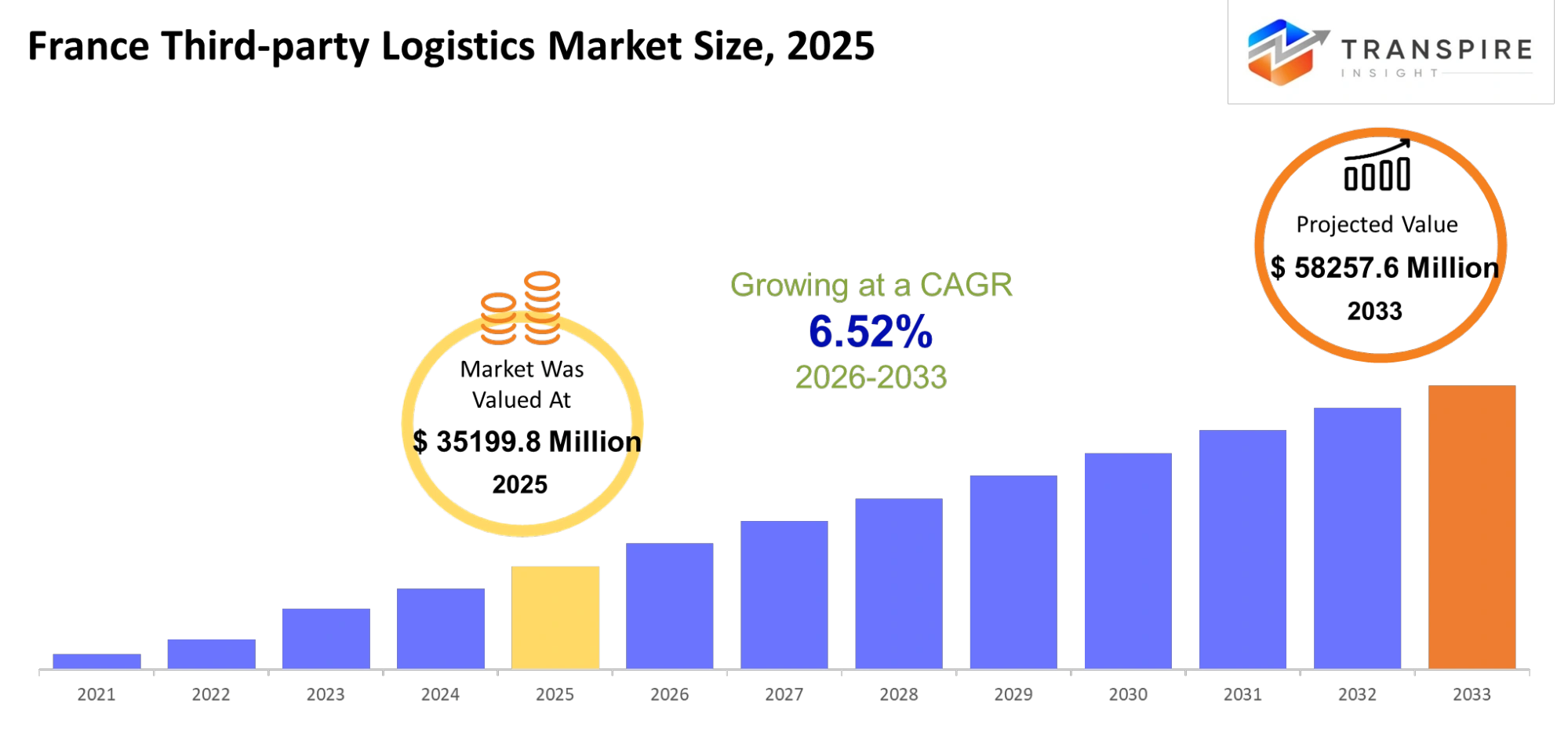
- France Third-party Logistics Market Size 2025: USD 35199.8 Million
- France Third-party Logistics Market Size 2033: USD 58257.6 Million
- France Third-party Logistics Market CAGR: 6.52%
- France Third-party Logistics Market Segments: By Type (Transportation, Warehousing, Distribution, Freight Forwarding, Value-added Services, Others); By Application (Retail, Automotive, Healthcare, Manufacturing, Others); By End-User (Enterprises, SMEs, Others); By Mode (Road, Rail, Air, Sea, Others)
To learn more about this report,  Download Free Sample Report
France Third-party Logistics Market Summary:
The France Third-party Logistics Market size is estimated at USD 35199.8 Million in 2025 and is anticipated to reach USD 58257.6 Million by 2033, growing at a CAGR of 6.52% from 2026 to 2033. The france third-party logistics market shows steady growth because e-commerce demand and manufacturing activity and supply chain solutions need better efficiency. Logistics providers enhance their transportation and warehousing and distribution capabilities to fulfill the evolving needs of their customers. The strong infrastructure together with access to important European trade routes enables continuous goods movement and international business activities.
Technology adoption serves as the primary factor that determines the development of the france third-party logistics market because companies choose to invest their resources into automation and real-time tracking and data-driven decision systems. The use of artificial intelligence together with predictive analytics and smart warehouse solutions enables organizations to achieve higher operational efficiency while minimizing their expenses. These technological advancements enable organizations from various industries to achieve faster delivery times while managing their inventory systems more effectively.
The retail and automotive and healthcare and manufacturing sectors create multiple demands which drive market growth. The industry requires specialized services because last-mile delivery and cold-chain logistics have become critical operational areas. The operational strategies and long-term development of organizations will face ongoing changes because sustainability initiatives which include green transportation and optimized routing solutions.
The competitive environment remains intense because both global and regional companies expand their operational networks while developing new service capabilities. The combination of strategic partnerships together with digital integration and personalized logistics solutions will drive business development while establishing market differentiation. The france third-party logistics market will progress through three main factors which include new market possibilities and the ability to grow and existing demand across important industry sectors.
What Has the Impact of Artificial Intelligence Been on the France Third-party Logistics Market?
Artificial intelligence is playing a transformative role in this market, reshaping how logistics providers manage operations, analyze data, and respond to demand shifts. The France third-party logistics market employs artificial intelligence to provide companies with advanced market research capabilities and real-time data analysis tools which enable them to discover patterns that enhance their decision-making process while they quickly respond to supply chain interruptions. Machine learning tools process large datasets to uncover insights that support pricing strategies, route planning, and service optimization.
The market benefits from artificial intelligence because it improves demand forecasting and predictive analytics capabilities. AI-driven models analyze historical shipment data, seasonal demand, and external factors to improve accuracy in inventory planning and delivery scheduling. The system achieves three benefits which include reduced stock shortages and minimized delays and improved customer satisfaction. The implementation of smart warehouse automation together with robotics and automated sorting systems delivers operational efficiency gains while decreasing manual errors and total costs.
The France third-party logistics market uses AI to enhance supply chain management and develop competitive advantages. The combination of real-time tracking systems with intelligent route optimization and automated fleet management delivers improved delivery performance together with reduced fuel usage and decreased operational costs. The logistics capabilities enable providers to deliver customized services which help them keep pace with market developments while building significant market advantages. The France third-party logistics market will experience growth and innovation through digital transformation because AI technology investments continue to increase.
Key Market Trends & Insights:
- The French third-party logistics market is expanding because of growing e-commerce which leads to more businesses adopting digital supply chain systems resulting in an expected annual growth rate between 6 and 8 percent through 2030.
- The French third-party logistics market will develop positively because businesses need faster delivery times and require warehouse automation together with complete logistics solutions.
- Northern France dominates with nearly 35% share in 2025 due to strong trade routes, while southern regions show fastest-growing demand through 2030.
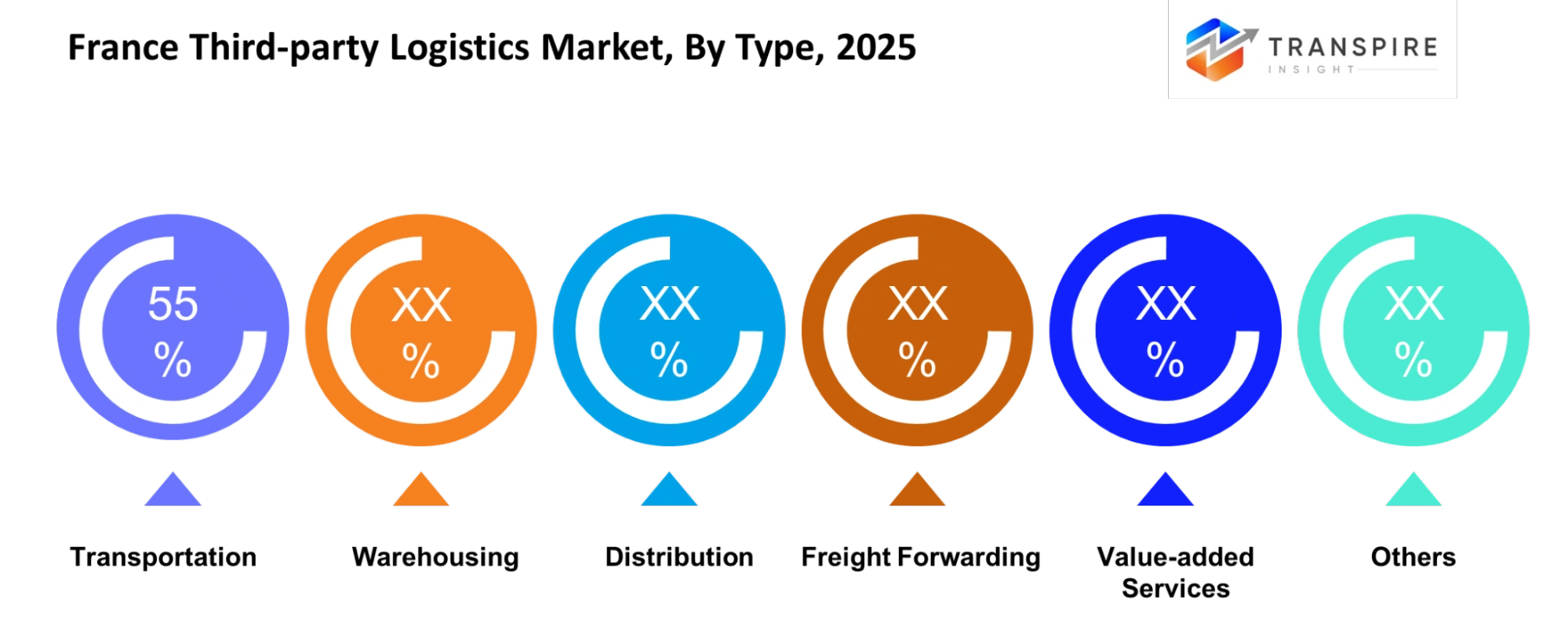
- The transportation sector holds the largest market share, which exceeds 40%, while warehousing stands as the second-biggest market, and value-added services will develop into the most rapidly expanding market segment until 2028.
- E-commerce demand drives retail to control approximately 30% market share, while healthcare logistics grows fastest because of its cold-chain requirements and compliance needs.
- Large enterprises hold around 60% market share due to complex supply chains, while SMEs represent the fastest-growing segment supported by outsourcing and flexible logistics models.
- The main companies in the market including DHL, Kuehne+Nagel, DB Schenker, Geodis, and DSV control the industry through their use of automated systems and their digital expansion and their development of new digital platforms.
- The development of operational efficiency in smart logistics systems results from AI-oriented tracking systems together with warehouse automation tools and instantaneous data analysis systems, which all lead to operational efficiency gains. More than 50% of providers plan to make investments in smart logistics technologies before 2027.
- The French third-party logistics market will experience sustained growth because cross-border trade and urban delivery requirements and environmentally friendly practices drive the adoption of green logistics solutions.
France Third-party Logistics Market Segmentation
By Type
The core transportation segment will experience growth because of rising demand for efficient domestic and international goods movement. Road transport will become the primary method of transportation because it provides flexible options for reaching various locations and rail and air transport systems will handle bulk shipments and urgent deliveries. The increasing fuel prices together with new emission regulations will force companies to implement route optimization which requires them to use environmentally friendly fleet management solutions.
The warehousing and distribution services sector will experience expansion because of increasing e-commerce activities and rising demands for inventory control solutions. The new generation of warehouses will implement automated systems and continuous tracking technologies to enhance their storage capabilities and achieve precise order fulfillment. The freight forwarding industry enables international trade by managing both customs procedures and shipment planning activities. The development of value-added services, which include packaging, labeling, and reverse logistics, will enhance customer satisfaction while allowing supply chains to adapt more effectively.
To learn more about this report, Download Free Sample Report
By Application
The expansion of online shopping combined with the requirement for quick delivery services will create strong demand for retail. Efficient inventory management together with last-mile delivery services will be essential for businesses to achieve customer satisfaction. Automotive companies will use just-in-time delivery systems because these systems help them avoid production delays while they maintain stable supply chains. Healthcare logistics will use temperature-controlled storage together with strict compliance procedures to protect the safe transport of medical products.
Manufacturing will depend on logistics providers for raw material movement and finished goods distribution. The combination of dependable transportation systems and effective storage solutions will enable businesses to maintain their production timelines while decreasing operational interruptions. The delivery of food and beverage products to industrial goods will require safe and timely delivery solutions which will see increased demand in upcoming years. Companies will create customized logistics solutions because their specific requirements will drive business growth in their operational areas.
By End-User
Enterprises will lead demand due to large-scale operations and complex supply chain requirements. The organizations will invest in integrated logistics solutions because these systems will improve efficiency and decrease their operational expenses. The establishment of strong partnerships with logistics providers will enable worldwide trade operations and guarantee steady delivery capabilities in different international markets.
SMEs will increase adoption as outsourcing logistics will help reduce infrastructure investment and improve service quality. The service models will provide smaller businesses with flexible options to adjust their operational capacity according to customer demand. The other end-users will include startups and niche businesses that need specialized logistics solutions. This segment will drive market expansion and enable the development of additional services.
By Mode
The accessibility and cost efficiency of road transport make it the best option for traveling short to medium distances. Rail transport will support bulk goods movement with lower environmental impact and better fuel efficiency. Air transport will handle high-value and time-sensitive shipments, ensuring fast delivery across long distances.
Sea transport will remain essential for international trade and large cargo volumes, offering cost-effective solutions for global shipping. The system will use multimodal transport, which combines different transportation systems to achieve better operational efficiency and shorter transit times. The growing need for unified transportation systems will help all transportation modes achieve equal development.
What are the Main Challenges for the France Third-party Logistics Market Growth?
The France third-party logistics market encounters multiple technical and operational obstacles which disrupt its operational efficiency and ability to grow. Logistics providers must sustain service quality because supply chain networks become more complex while fuel prices increase and customer demand patterns become unpredictable. The absence of real-time system visibility through different systems keeps organizations from achieving effective route planning and inventory control and timely order delivery.
It faces operational challenges because manufacturing and commercialization processes need to meet strict regulatory requirements and they face high operational expenses. European transport regulations together with environmental rules and safety standards create additional financial obligations which providers must meet for compliance. The need for advanced warehouse automation and cold-chain infrastructure and digital systems demands financial investments which result in expansion delays while smaller companies struggle to increase their business operations.
They have adoption challenges because of existing gaps in infrastructure and insufficient workforce capacity. The warehouse management and transport operations sector suffers from a labor shortage which decreases operational efficiency. The combination of obsolete infrastructure and poor digital system adoption in certain areas decreases logistics efficiency which creates problems when managing high shipping demands and complex supply chain operations.
This market growth faces two main obstacles which include competitive market pressures and emerging operational risks. The presence of strong global competitors creates intense competition which results in price decreases and lower profit margins. Organizations face operational risk growth because they must continuously fund new technologies and meet sustainability requirements.
Country Insights
The logistics sector in Northern France will maintain its vital role because of its closeness to European trade routes and port facilities. The combination of high warehouse density together with advanced transport networks and cross-border connectivity will enable efficient distribution operations. The region will experience increased demand for integrated logistics solutions and expedited delivery services because of industrial cluster development and rising e-commerce activities.
The Paris and Île-de-France area will serve as a central logistics hub because its urban population density and consumer demand remain high. The demand for fulfillment centers will rise because of strong last-mile delivery networks and the increasing e-commerce activities. Urban distribution will benefit from infrastructure development together with smart logistics solutions which will enhance both delivery speed and operational efficiency.
Southern France will experience continuous development because of its port activities and international trade connections. Mediterranean route access will enable cities to experience higher import and export traffic. The logistics industry will concentrate on multimodal transportation together with regional distribution to meet the operational needs of food and retail and manufacturing businesses.
The regions will experience development because of three factors which include infrastructure upgrades and digital logistics implementation and increasing demand from essential industrial sectors. The combination of strategic location benefits and better connectivity together with warehouse expansion will enhance supply chain efficiency which will drive long-term logistics growth throughout the country.
Recent Development News
In April 2026, DHL Group reported operational updates: DHL highlighted stable jet fuel supply across European logistics operations while warning of potential disruptions in Asia, reflecting rising demand and supply chain pressure on air freight networks.https://www.reuters.com
In April 2026, DHL Supply Chain launched expansion initiative: DHL expanded supply chain operations through a new airport logistics management partnership, strengthening air cargo handling capabilities and improving efficiency in international freight movement.https://supplychaindigital.com
|
Report Metrics |
Details |
|
Market size value in 2025 |
USD 35199.8 Million |
|
Market size value in 2026 |
USD 37452.1 Million |
|
Revenue forecast in 2033 |
USD 58257.6 Million |
|
Growth rate |
CAGR of 6.52% from 2026 to 2033 |
|
Base year |
2025 |
|
Historical data |
2021 - 2024 |
|
Forecast period |
2026 - 2033 |
|
Report coverage |
Revenue forecast, competitive landscape, growth factors, and trends |
|
Regional scope |
France |
|
Key company profiled |
DHL, Kuehne+Nagel, DB Schenker, XPO Logistics, UPS, FedEx, CEVA Logistics, Geodis, DSV, Nippon Express, Expeditors, Ryder, Penske, Agility, Sinotrans. |
|
Customization scope |
Free report customization (country, regional & segment scope). Avail customized purchase options to meet your exact research needs. |
|
Report Segmentation |
By Type (Transportation, Warehousing, Distribution, Freight Forwarding, Value-added Services, Others); By Application (Retail, Automotive, Healthcare, Manufacturing, Others); By End-User (Enterprises, SMEs, Others); By Mode (Road, Rail, Air, Sea, Others) |
How Can New Companies Establish a Strong Foothold in the France Third-party Logistics Market?
New market entrants in France's third-party logistics sector can create profitable business operations by emphasizing specific markets which currently experience increasing demand but lack adequate service delivery. Businesses that enter the market through cold-chain healthcare logistics or automotive spare parts distribution or e-commerce same-day delivery services will achieve immediate market presence. The company will establish its market presence through value propositions which demonstrate speed and reliability and compliance.
The France third-party logistics sector requires businesses to enter the market through technology-led innovation. AI-based demand forecasting systems and real-time shipment tracking technology and warehouse automation solutions help startups achieve operational efficiency while decreasing expenses. The French market features emerging player Shippeo which utilizes predictive visibility platforms to improve supply chain visibility while Cubyn-type startups develop adaptable fulfillment services for online retailers which showcase their ability to grow through technology.
The use of strategic partnerships will enable businesses to enter new markets more effectively while decreasing the difficulties they encounter during market entry. New companies can extend their network reach through partnerships with local transport operators and e-commerce platforms and industrial clusters which require minimal financial commitment. Last-mile delivery in congested areas of France third-party logistics market improves through partnerships between smart city projects and urban mobility service providers.
Key France Third-party Logistics Market Company Insights
The France third-party logistics market operates through a combination of international logistics companies and local logistics providers who keep developing their transportation and warehousing and supply chain management capacities. The market players will develop complete solutions which will link their freight forwarding services with their contract logistics operations and last-mile delivery system. The retail and manufacturing and healthcare sectors will achieve better operational efficiency through this solution which meets their increasing business requirements.
The France third-party logistics market operates with high competitive intensity as businesses develop their service capabilities through automation and digital tracking systems and data-driven operational practices. Technology adoption will remain a key factor, allowing better route optimization, inventory visibility, and faster delivery timelines. The company will enhance its market presence through strategic partnerships and acquisitions which will enable it to enter new territories.
The company will create its strategic plans through two main driving forces which include sustainability requirements and cost control needs. The logistics industry will implement environmentally friendly transportation methods while improving fuel efficiency and warehouse operational efficiency to minimize their expenses. The developed logistics solutions will enable businesses to meet their specific sector requirements while providing operational flexibility which will build lasting client relationships in the automotive and e-commerce and pharmaceutical industries.
The future growth of the France third party logistics market depends on two critical factors which are system scalability and innovative solutions. Companies will continue to invest in smart warehouses, AI-based forecasting, and real-time tracking systems to handle increasing shipment volumes. The system will generate new chances for businesses to create unique service offerings while it enables them to deliver steady results in an unstable supply chain environment.
Company List
- DHL
- Kuehne+Nagel
- DB Schenker
- XPO Logistics
- UPS
- FedEx
- CEVA Logistics
- Geodis
- DSV
- Nippon Express
- Expeditors
- Ryder
- Penske
- Agility
- Sinotrans.
What are the Key Use-Cases Driving the Growth of the France Third-party Logistics Market?
The france third-party logistics market is experiencing rapid growth because of increasing e-commerce and omnichannel retail activities. Retailers use 3PL services to handle their warehousing needs and last-mile delivery operations and reverse logistics tasks because they need to adjust to changing customer demands and their need for speedier delivery times. The major online platforms and direct-to-consumer brands are choosing to outsource their fulfillment operations because this decision helps them simplify their business operations which in turn drives faster growth throughout French urban and semi-urban markets.
The automotive and manufacturing industries in France are driving the growth of the third-party logistics market through their adoption of just-in-time delivery systems and methodologies that require complex supply chain management. Automotive original equipment manufacturers and component suppliers use 3PL solutions to manage their inventory needs and their inbound shipping and international shipping processes. 3PL partnerships become essential for businesses because they decrease downtime while boosting production capabilities and supporting their need to meet European supply chain regulations.
The healthcare and pharmaceutical sectors depend on specialized logistics solutions to create effective logistics systems that develop through their entire supply chain operations. The industry requires specialized 3PL providers because it needs temperature-controlled transportation and secure medical supply handling and compliance with stringent regulations. Logistics outsourcing has become essential for businesses dealing with vaccines and biologics and medical devices because it delivers reliable and traceable and scalable solutions for their delicate supply chains.
France Third-party Logistics Market Report Segmentation
By Type
- Transportation
- Warehousing
- Distribution
- Freight Forwarding
- Value-added Services
- Others)
By Application
- Retail
- Automotive
- Healthcare
- Manufacturing
- Others
By End-User
- Enterprises
- SMEs
- Others
By Mode
- Road
- Rail
- Air
- Sea
- Others
Frequently Asked Questions
Find quick answers to common questions.
The approximate France Third-party Logistics Market size for the market will be USD 58257.6 Million in 2033.
Key segments for the France Third-party Logistics Market are By Type (Transportation, Warehousing, Distribution, Freight Forwarding, Value-added Services, Others); By Application (Retail, Automotive, Healthcare, Manufacturing, Others); By End-User (Enterprises, SMEs, Others); By Mode (Road, Rail, Air, Sea, Others).
Major France Third-party Logistics Market players are DHL, Kuehne+Nagel, DB Schenker, XPO Logistics, UPS, FedEx, CEVA Logistics, Geodis, DSV, Nippon Express, Expeditors, Ryder, Penske, Agility, Sinotrans.
The France Third-party Logistics Market size is USD 35199.8 Million in 2025.
The France Third-party Logistics Market CAGR is 6.52%.
- DHL
- Kuehne+Nagel
- DB Schenker
- XPO Logistics
- UPS
- FedEx
- CEVA Logistics
- Geodis
- DSV
- Nippon Express
- Expeditors
- Ryder
- Penske
- Agility
- Sinotrans.
Recently Published Reports
-
Apr 2026
Handling and Lifting Equipment Market
Handling and Lifting Equipment Market Size, Share & Analysis Report By Product (Cranes and Hoists, Forklifts, Conveyor Systems, Aerial Work Platforms, Others), By Application (E-Commerce, Automotive and Railway, Food and Beverages, Aviation, Others), and Geography (North America, Europe, Asia-Pacific, Middle East and Africa, South and Central America), 2021 - 2031
-
Apr 2026
HVAC Equipment Market
HVAC Equipment Market Size, Share & Analysis Report By Heating Equipment Type (Boilers and Furnaces, Heat Pumps, and Unitary Heaters), By Ventilation Equipment (Air Handling Units, Humidifiers and Dehumidifiers, Air Filters, and Fan Coiling Units), By Air Conditioning Equipment (Unitary Air Conditioners, Room Air Conditioners, Packaged Terminal Air Conditioners, and Chillers), By End User (Commercial, Residential, Industrial, and others), and Geography (North America, Europe, Asia-Pacific, Middle East and Africa, South and Central America), 2021 – 2031
-
Apr 2026
Refrigeration Valves Market
Refrigeration Valves Market Size, Share & Analysis Report By Type (Solenoid Valves, Expansion Valves, Check Valves, Service Valves, Others), By Application (Commercial Refrigeration, Industrial Refrigeration, Transport Refrigeration, Residential Refrigeration, Air Conditioning Systems), By End User (Food and Beverage Industry, Pharmaceutical Industry, HVAC Industry, Chemical Industry, Others), and Geography (North America, Europe, Asia-Pacific, Middle East and Africa, South and Central America), 2021 – 2031
-
Apr 2026
E-Commerce Packaging Materials Market
E-Commerce Packaging Materials Market By Material Type (Corrugated Boxes, Paper & Paperboard, Foam & Cushioning Materials, Plastic Packaging, Flexible Packaging, Protective Packaging, Others), By Product(Primary Packaging, Secondary Packaging, Tertiary Packaging), By Packaging Function (Protective Packaging, Branding & Presentation Packaging, Transit & Logistic Packaging, Sustainable Packaging, Tamper Evidence Packaging), By End-User (Retail & Consumer Goods, Electronic Appliances, Food & Beverages, Healthcare & Pharmaceutical, Fashion & Apparel, Home & Furnishing, Others); By Industry Analysis, Size, Share, Growth, Trends, and Forecasts 2021-2033