

United Kingdom Medical Gas Pipeline Systems Market Size & Forecast:
- United Kingdom Medical Gas Pipeline Systems Market Size 2025: USD 0.19 Billion
- United Kingdom Medical Gas Pipeline Systems Market Size 2033: USD 0.323 Billion
- United Kingdom Medical Gas Pipeline Systems Market CAGR: 6.86%
- United Kingdom Medical Gas Pipeline Systems Market Segments: By Product Type (Manifolds, Alarm Systems, Vacuum Systems, Medical Air Systems, Oxygen Supply Systems, Control Panels, Monitoring Systems, Others); By Application (Hospitals, Ambulatory Surgical Centers, Clinics, Home Healthcare, Emergency Care, ICUs, Laboratories, Others); By Gas Type (Oxygen Systems, Nitrous Oxide Systems, Medical Air Systems, Vacuum Systems, Carbon Dioxide Systems, Nitrogen Systems, AGSS Systems, Others); By End User (Hospitals, Specialty Clinics, Diagnostic Centers, Research Institutes, Healthcare Facilities, Nursing Homes, Laboratories, Others); By Installation Type (New Installations, Retrofit Installations, Expansion Projects, Underground Installations, Modular Installations, Wall-mounted Installations, Ceiling Installations, Others)

To learn more about this report,  Download Free Sample Report
United Kingdom Medical Gas Pipeline Systems Market Summary
The United Kingdom Medical Gas Pipeline Systems Market was valued at USD 0.19 Billion in 2025. It is forecast to reach USD 0.323 Billion by 2033. That is a CAGR of 6.86% over the period.
Medical gas pipeline systems, they kind of sit behind the daily functioning of hospitals across the UK , quietly moving oxygen, nitrous oxide, medical air, and vacuum services from centralized supply units to operating theatres, intensive care wards, and emergency departments. Their job was less obvious before, but after the pandemic it became much more visible, because it showed just how vulnerable healthcare facilities were to oxygen shortages and temporary piping limitations. Over the last five years, the market has shifted away from straightforward infrastructure replacement, and instead toward digitally monitored, plus redundancy-focused systems that help handle higher patient loads, meet infection control requirements, and keep uptime expectations far stricter.
The rapid expansion of ICU capacity during COVID-19 acted like a major trigger, basically pushing hospitals to upgrade older pipe networks, add backup manifolds , install alarm systems, and bring in automated monitoring technologies. Because of that, procurement behavior has changed across both public and private healthcare providers. Revenue growth now comes less from brand new hospital construction, and more from retrofit work, compliance-driven modernization, and long term maintenance contracts that get tied to healthcare resilience planning.
Key Market Insights
- The United Kingdom Medical Gas Pipeline Systems Market keeps gaining momentum, mostly because ICU expansion projects, hospital refurbishments, and more installs of automated alarm monitoring systems. You know, that whole “keep things running steady” idea.
- Manifold systems still lead the product segment with around 34% market share in 2025, since hospitals often push for centralized gas supply setups that stay uninterrupted.
- In the same time, medical vacuum systems sit as the second-largest segment, helped by growth in surgical procedures and stricter infection-control needs across acute healthcare facilities.
- Digital monitoring and alarm systems are expected to be the fastest-growing segment from 2026 to 2030, largely due to predictive maintenance routines and the compliance driven demand that keeps rising.
- On the application side, hospitals will dominate with nearly 72% revenue share in 2025, because critical care units really need dependable oxygen and vacuum infrastructure all the time.
- Public healthcare facilities also remain on top as an end-user group, holding over 64% share, backed by NHS infrastructure redevelopment efforts and capacity optimization programs.
- Meanwhile, private multi-specialty hospitals are the fastest-moving end-user category, since premium providers invest more in advanced patient safety infrastructure technologies.
- Over in the broader United Kingdom medical gas infrastructure space, there is a growing trend toward IoT enabled pressure monitoring systems, to improve day to day operational efficiency and reduce downtime risks.
- At the same time sustainability is starting to shape procurement decisions, so healthcare operators are adopting energy-efficient compressors along with leak-detection technologies, aiming to lower operating costs, and not just for the optics.
- Finally, healthcare construction firms are putting more focus on modular pipeline installation systems, because they can cut project completion timelines and reduce disruption inside hospitals that are still operational.
What are the Key Drivers, Restraints, and Opportunities in the United Kingdom Medical Gas Pipeline Systems Market?
One of the most powerful forces pushing the United Kingdom Medical Gas Pipeline Systems Market forward is the post-pandemic reshaping of hospital oxygen infrastructure, yeah it’s kinda like that. During COVID-19, multiple NHS sites encountered oxygen pressure instability when ICU occupancy went way past the designed capacity. That episode nudged stricter infrastructure planning expectations and it also sped up investment in centralized gas distribution systems, backup manifolds and automated monitoring tools. Nowadays hospitals tend to see medical gas infrastructure as a resilience resource not just some background service. And this change directly opens revenue pathways for pipeline installers, alarm system providers and long-term maintenance specialists, since healthcare operators are now pushing for complete system modernization, rather than doing only piece-by-piece fixes.
A major obstacle still sits in the way: the expense and day to day operational intricacy tied to retrofitting older hospital buildings. A lot of healthcare facilities across the United Kingdom were created decades ago, with outdated piping arrangements, tight plant room space and utility networks that feel disconnected. Improving those locations frequently needs phased construction while the hospital keeps running, so labor costs rise and the overall schedules stretch out, sometimes more than expected. Plus since NHS capital budgets stay tight across several regions, many facilities put off full replacements and choose temporary upgrades instead, which ends up dampening quicker market growth.
A big future opportunity is in smart medical gas management systems, but not just by themself—more like paired with predictive maintenance software and IoT-based monitoring, you know. Healthcare providers, they’re leaning more and more toward real time pressure analytics, plus automated leak detection, and even remote diagnostics so downtime risks get pushed down. Also, the large redevelopment projects happening in England and Scotland are basically setting a favorable stage for digital pipeline infrastructure suppliers. These suppliers can blend compliance management with day to day operational efficiency, even if it sounds a bit “standard” on paper, it still matters.
What Has the Impact of Artificial Intelligence Been on the United Kingdom Medical Gas Pipeline Systems Market?
Artificial intelligence and advanced digital technologies are kind of changing the way hospitals run their medical gas infrastructure, all across the United Kingdom. In practice healthcare sites increasingly use AI enabled building management platforms that keep an eye on oxygen pressure, flow rates, vacuum performance and even those alarm conditions across the pipeline systems. With these setups, abnormal pressure drops, gas leakage patterns or odd valve behavior can get spotted automatically, and then the platform triggers corrective actions before clinical work actually gets interrupted. A number of NHS hospitals are also turning to centralized digital dashboards that handle compliance tracking, maintenance scheduling, and real time asset monitoring across critical care areas, sometimes as if it’s one continuous workflow.
Then, there’s machine learning too, which is boosting predictive maintenance by looking at past equipment behavior from compressors, manifolds, and vacuum pumps. Instead of sticking to rigid inspection cycles, hospitals can sometimes flag parts that are likely to fail weeks ahead, and that’s a pretty big shift. The result is fewer emergency shutdowns, less money spent on maintenance, and better uptime in high dependency wards and surgical theaters. On top of that, smart monitoring helps engineering teams fine tune how much gas is used and cut down waste, especially in large facilities where oxygen consumption is intense, all the time.
Still though, AI adoption is not seamless. A lot of older healthcare buildings run with fragmented setups and legacy analog equipment, which does not connect so easily to newer digital monitoring tools. Integration costs stay high, and when historical performance data is inconsistent, predictive models can lose some accuracy depending on the hospital environment.
Key Market Trends
- Between 2022 and 2025 , hospitals started swapping standalone alarm units for more centralized digital monitoring platforms, and those are now tied into building management systems in a way that is more “always on” and less patchy.
- Healthcare operators also shifted their buying approach toward long term maintenance contracts, mainly because emergency repair bills went up fast during the peak ICU utilization windows , and nobody wanted that kind of spike again .
- By 2025 , more than 60% of large redevelopment projects are using automated manifold monitoring , plus remote diagnostics , to keep unplanned system downtime from happening as often.
- Companies like Dräger and BeaconMedaes kept widening their smart monitoring offerings , because hospitals were basically prioritizing predictive maintenance capabilities, not only reactive fixes .
- Since 2023 , retrofit work across older NHS facilities has been moving ahead faster than new build installations . The reason is simple-ish , operational hospitals need phased infrastructure modernization , so renovations can’t just pause everything.
- Engineering contractors have increasingly adopted modular pipeline installation methods , which helped cut hospital disruption timeframes by almost 20% during refurbishment projects , even when things had to stay running.
- Regulatory audits that followed COVID 19 , made healthcare providers strengthen redundancy systems , add backup manifolds , and increase emergency oxygen reserve capacity across critical care wards. It felt like compliance got sharper.
- Meanwhile private multi specialty hospitals raised spending on IoT enabled gas monitoring systems, to make compliance tracking and day to day operational efficiency smoother from 2024 through 2026.
United Kingdom Medical Gas Pipeline Systems Market Segmentation
By Product Type:
Manifolds help a lot with keeping a steady gas supply flowing between healthcare facilities, kind of like you need the pipeline to stay consistent. Hospitals usually go for more advanced manifold systems because continuous oxygen and medical air delivery will stay vital for surgical work and intensive care procedures. Alarm systems and monitoring systems also help with fast fault detection, while control panels make centralized management of medical gas networks a bit more straightforward.
Lately vacuum systems and medical air systems keep getting more attention , since healthcare providers put a bigger focus on infection control and respiratory support services. Oxygen supply systems still hold a strong position because emergency wards and ICUs rely on uninterrupted gas flow. Modular monitoring technologies will also back operational efficiency across both public and private healthcare institutions, without so much manual hassle.
By Application:
Hospitals take up a big share overall, since critical care treatment surgeries, and emergency response services depend on reliable medical gas infrastructure. ICUs and emergency care units keep expanding throughout the United Kingdom , so you see higher installation of oxygen pipelines, vacuum systems, and alarm technologies that support patient safety and ongoing operations.
Meanwhile ambulatory surgical centers and clinics are also pushing demand for compact and efficient gas delivery setups. Home healthcare applications will rise gradually as respiratory care services move beyond usual hospital settings. Laboratories and specialty care units depend on stable medical gas support too, for testing, research activities, and controlled treatment environments where conditions have to be maintained.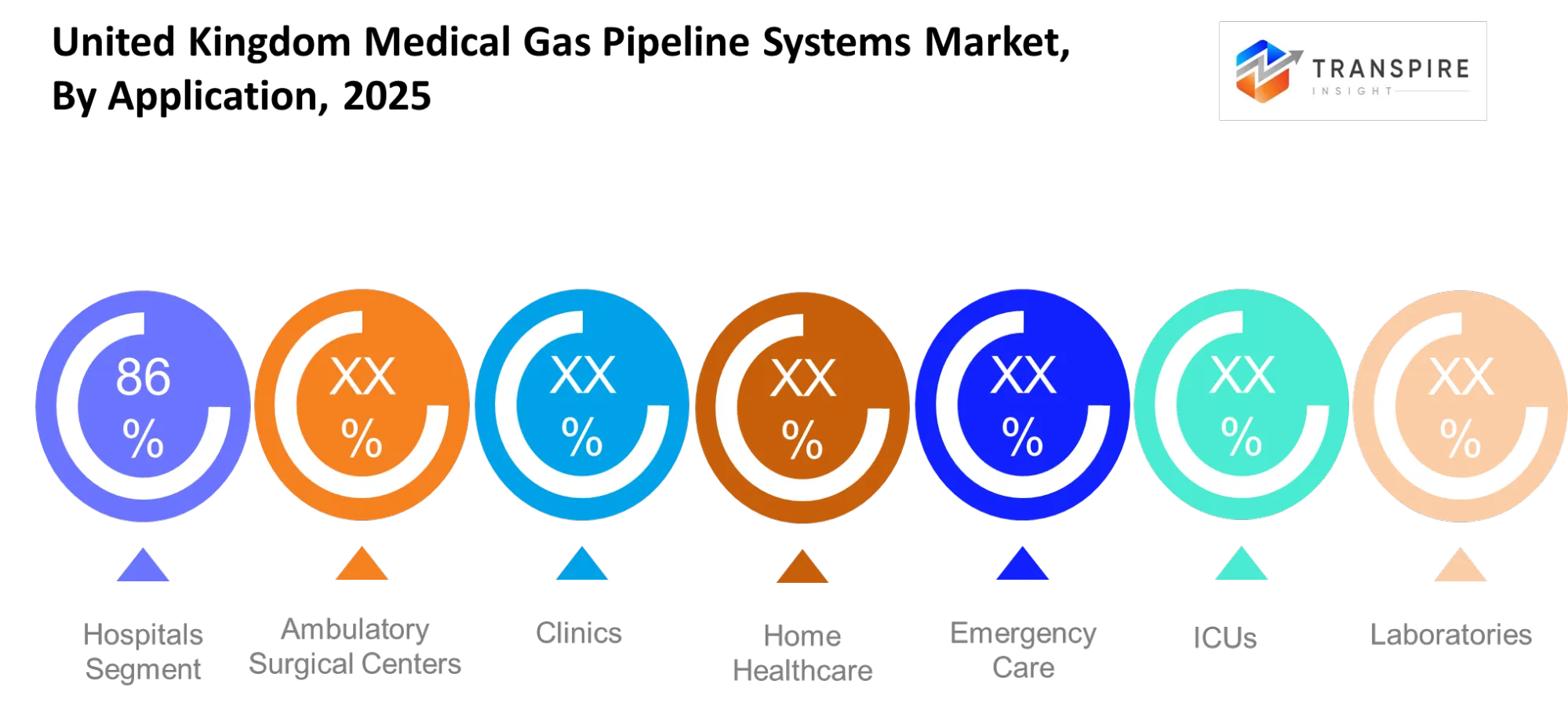
To learn more about this report, Download Free Sample Report
By Gas Type:
Oxygen systems still remain the leading segment because respiratory care and intensive care treatments depend a lot on steady oxygen delivery , you know the continuous kind. Medical air systems and vacuum systems also stay in strong demand as healthcare providers keep improving patient monitoring, surgical support , and infection management infrastructure all around healthcare facilities.
Nitrous oxide systems remain useful for anesthesia related procedures in operating theaters and for dental applications, while Carbon dioxide systems and nitrogen systems get used in laboratory functions and medical storage activities. AGSS systems will get even more attention because many facilities are now focusing on cleaner and safer clinical environments , not just for patients but also for staff.
By End User:
Hospitals continue leading the market, mainly because big healthcare institutions need extensive medical gas pipeline infrastructure, especially for surgeries, intensive care and emergency response services. Healthcare facilities and specialty clinics are also investing in upgraded gas systems as patient volumes rise, and treatment capabilities keep expanding across urban healthcare centers.
Diagnostic centers and laboratories add extra demand through testing and research, they need controlled gas distribution systems for that. Nursing homes are gradually increasing adoption too, since long term respiratory care services are still expanding for aging patient populations. Research institutes will also contribute, via modernization of healthcare infrastructure and various laboratory development projects.
By Installation Type:
Retrofit installations are pretty significant because, in the United Kingdom many healthcare facilities still work with aging infrastructure that really needs modernization. At the same time, expansion projects keep climbing, since hospitals are pushing harder on ICU capacity and stronger emergency treatment capabilities. All these installation activities will also back replacement demand for older pipeline systems and monitoring technologies that have become outdated.
On the other hand, new installations still matter a lot too, especially in newly developed healthcare buildings and private medical centers. Underground installations , as well as ceiling installations, help improve operational safety and better space management inside big healthcare facilities. More and more, modular installations and wall-mounted systems are being preferred, because they allow quicker deployment and less day-to-day disruption. This means healthcare providers can keep clinical operations running without interruption while infrastructure upgrades are underway.
What are the Key Use Cases Driving the United Kingdom Medical Gas Pipeline Systems Market?
Hospitals still kind of stay the main use case for medical gas pipeline systems across the United Kingdom, and honestly it’s not just one thing. Intensive care units, surgical theaters , and emergency departments rely on continuous oxygen vacuum, plus medical air delivery to help critical patient treatment. Demand remains high because NHS hospitals keep upgrading older infrastructure after the pandemic related strain and those capacity issues.
More and more ambulatory surgical centers and specialty clinics are turning into secondary users as outpatient procedures keep rising across busy urban healthcare networks. Diagnostic laboratories too and private healthcare providers need carefully controlled gas distribution setups for things like testing, anesthesia support, and respiratory treatment services. Because of that, there's a growing need for compact pipeline installations that are also digitally monitored.
Looking ahead, newer applications are showing up, like modular healthcare facilities and temporary emergency treatment centers built for quick deployment during healthcare surges. There’s also home based respiratory care systems connected to centralized monitoring platforms, and that setup seems like it could have solid long term potential as some selected chronic care shifts away from the typical hospital environment.
|
Report Metrics |
Details |
|
Market size value in 2025 |
USD 0.19 Billion |
|
Market size value in 2026 |
USD 0.203 Billion |
|
Revenue forecast in 2033 |
USD 0.323 Billion |
|
Growth rate |
CAGR of 6.86% from 2026 to 2033 |
|
Base year |
2025 |
|
Historical data |
2021 - 2024 |
|
Forecast period |
2026 - 2033 |
|
Report coverage |
Revenue forecast, competitive landscape, growth factors, and trends |
|
Regional scope |
Middle East and Africa (Saudi Arabia, United Arab Emirates, South Africa, Rest of Middle East and Africa) |
|
Key company profiled |
BeaconMedaes, Amico Group, Dräger, Atlas Copco, Precision UK, GCE Group, Ohio Medical, Powerex, Tri-Tech Medical, ESCO Medicon, Genstar Technologies, SILBERMANN Technologies, Pattons Medical, INMED Karczewscy, Delta P |
|
Customization scope |
Free report customization (country, regional & segment scope). Avail customized purchase options to meet your exact research needs. |
|
Report Segmentation |
By Product Type (Manifolds, Alarm Systems, Vacuum Systems, Medical Air Systems, Oxygen Supply Systems, Control Panels, Monitoring Systems, Others); By Application (Hospitals, Ambulatory Surgical Centers, Clinics, Home Healthcare, Emergency Care, ICUs, Laboratories, Others); By Gas Type (Oxygen Systems, Nitrous Oxide Systems, Medical Air Systems, Vacuum Systems, Carbon Dioxide Systems, Nitrogen Systems, AGSS Systems, Others); By End User (Hospitals, Specialty Clinics, Diagnostic Centers, Research Institutes, Healthcare Facilities, Nursing Homes, Laboratories, Others); By Installation Type (New Installations, Retrofit Installations, Expansion Projects, Underground Installations, Modular Installations, Wall-mounted Installations, Ceiling Installations, Others) |
Which Regions are Driving the United Kingdom Medical Gas Pipeline Systems Market Growth?
England comes out ahead in the United Kingdom Medical Gas Pipeline Systems Market, mainly because big NHS redevelopment efforts plus a really high hospital density keep pulling money toward infrastructure. You can see it in the key healthcare centers, London , Manchester, Birmingham and Leeds, where steady needs for oxygen delivery setups, vacuum networks and digital monitoring platforms just keep showing up. After the pandemic, regulatory supervision tightened up, and that pushed many hospitals to revamp older gas pipeline systems and boost emergency oxygen readiness. There’s also a well-established, kinda mature network of engineering contractors, medical equipment sellers and maintenance service providers, and it keeps England’s lead position pretty locked in.
Scotland, meanwhile, looks more steady and slowly, reliably growing. The growth seems driven less by sudden emergency capacity work, and more by long term healthcare infrastructure planning. Regional health authorities keep funding modernization initiatives across city hospitals as well as remote healthcare sites, so the demand stays balanced between retrofit installs and expansion projects. In comparison with England , Scotland leans harder toward operational dependability and energy efficient healthcare infrastructure, especially since areas are colder and more spread out geographically. With consistent public healthcare budgets and upgrades rolled out in phases, suppliers and installation contractors usually get predictable market momentum without too many surprises.
Wales is kinda emerging as the fastest-growing regional market, as healthcare modernization projects speed up across district hospitals and community care facilities. Lately investments in critical care preparedness as well as decentralized healthcare delivery, created fresh opportunities for modular pipeline systems and remote monitoring tech. Meanwhile smaller healthcare facilities are being more and more likely to swap outdated gas distribution systems, in order to match updated safety and compliance expectations. This whole growth movement should generate quite appealing chances for specialized installation firms and digital infrastructure providers between 2026 and 2033, especially where retrofit-focused healthcare projects are involved.
Who are the Key Players in the United Kingdom Medical Gas Pipeline Systems Market and How Do They Compete?
The competitive landscape of the United Kingdom Medical Gas Pipeline Systems Market is still kind of moderately consolidated, with a blend of multinational engineering firms and specialized health-care infrastructure providers that seem to chase NHS and private hospital contracts. Lately, competition is more about digital monitoring features, long term maintenance services, and compliance know-how, instead of price alone—though of course price still matters. Most established companies keep trying to hold onto market share by leaning on integrated service packages, where they bundle installation, monitoring, and lifecycle upkeep support into one. Meanwhile, smaller specialist contractors are also getting chances, especially in retrofit work, where hospitals need more flexible installation timelines and tailored infrastructure improvements.
Dräger stands out mainly by using advanced monitoring platforms that connect medical gas alarms with wider hospital management systems. It puts a lot of emphasis on digital infrastructure and predictive maintenance capabilities, and that helps hospitals lower the probability of downtime in the busiest critical care areas. BeaconMeades goes at it differently, focusing on turnkey pipeline engineering along with centralized gas management solutions, aimed at big hospital redevelopment programs. Their strong track record in full hospital wide installations gives them leverage in complicated NHS modernization initiatives, where compliance and system redundancy continue to be essential, not optional.
Atlas Copco seems to be pushing its market footprint with energy-saving compressor units and vacuum technologies, aiming to trim day to day operational costs in healthcare spaces. They also get an edge from their after sales servicing strength, plus remote monitoring support that keeps working across bigger institutional sites. GCE Group meanwhile leans into precision flow control gear and modular gas delivery approaches, which fit well with phased retrofit programs especially in older hospital buildings. And AmcareMed is expanding with cost friendly pipeline components and tailored install assistance, mostly for private healthcare facilities and mid size clinical infrastructure projects.
Company List
- BeaconMedaes
- Amico Group
- Dräger
- Atlas Copco
- Precision UK
- GCE Group
- Ohio Medical
- Powerex
- Tri-Tech Medical
- ESCO Medicon
- Genstar Technologies
- SILBERMANN Technologies
- Pattons Medical
- INMED Karczewscy
- Delta P
Recent Development News
In January 2025, Atlas Copco Group announced the acquisition of UK-based Medi-teknique Ltd. The deal expanded Atlas Copco’s regional medical gas pipeline system maintenance and installation capabilities in the United Kingdom, strengthening its aftermarket service presence for healthcare infrastructure projects.Source https://www.atlascopcogroup.com/
In February 2026, BeaconMedas launched three new pipeline solutions — the MPR Pressure Reducing Set, MER Emergency Reserve Manifold, and LBV Line Ball Valve Assemblies. The product launch enhanced safety, compliance, and operational flexibility for medical gas supply systems used across hospitals and healthcare facilities, supporting modernization of pipeline infrastructure in the UK and wider European market.Source https://www.beaconmedaes.com/
What Strategic Insights Define the Future of the United Kingdom Medical Gas Pipeline Systems Market?
The United Kingdom Medical Gas Pipeline Systems Market is heading, more or less, toward fully integrated and digitally managed healthcare infrastructure over the next five to seven years. In a way, the market is slowly moving away from buying individual equipment pieces, and toward long term resilience planning , mainly pushed by tougher hospital safety standards, older healthcare facilities, and the growing stress on critical care capacity. Digital monitoring , predictive maintenance, plus centralized control systems will start to look like requirements, not just optional upgrades, especially during the big NHS redevelopment initiatives.
There’s also this kind of quieter, hidden risk. It’s about supply chain concentration in specialized valves, compressors, and monitoring components that come from just a few international manufacturers. If something happens to imported healthcare engineering components, the ripple effect could be delays in retrofit timetables and higher project costs. That’s a problem for public healthcare providers who are already stuck with fixed capital budgets, so they can’t just flex spending at will.
On the opportunity side, things are opening up around modular and rapidly deployable healthcare infrastructure, especially for temporary treatment centers and more decentralized community healthcare settings. Firms that go early on interoperable digital monitoring platforms, along with retrofit friendly installation models, should end up with a stronger position later. And strategic partnerships with NHS infrastructure contractors, plus regional healthcare engineering firms , will likely be the most solid path to lasting market expansion through 2033.
United Kingdom Medical Gas Pipeline Systems Market Report Segmentation
By Product Type
- Manifolds
- Alarm Systems
- Vacuum Systems
- Medical Air Systems
- Oxygen Supply Systems
- Control Panels
- Monitoring Systems
By Application
- Hospitals
- Ambulatory Surgical Centers
- Clinics
- Home Healthcare
- Emergency Care
- ICUs
- Laboratories
By Gas Type
- Oxygen Systems
- Nitrous Oxide Systems
- Medical Air Systems
- Vacuum Systems
- Carbon Dioxide Systems
- Nitrogen Systems
- AGSS Systems
By End User
- Hospitals
- Specialty Clinics
- Diagnostic Centers
- Research Institutes
- Healthcare Facilities
- Nursing Homes
- Laboratories
By Installation Type
- New Installations
- Retrofit Installations
- Expansion Projects
- Underground Installations
- Modular Installations
- Wall-mounted Installations
- Ceiling Installations
Frequently Asked Questions
Find quick answers to common questions.
The United Kingdom Medical Gas Pipeline Systems Market size is USD 0.323 Billion in 2033.
Key Segments for the United Kingdom Medical Gas Pipeline Systems Market are By Product Type (Manifolds, Alarm Systems, Vacuum Systems, Medical Air Systems, Oxygen Supply Systems, Control Panels, Monitoring Systems, Others); By Application (Hospitals, Ambulatory Surgical Centers, Clinics, Home Healthcare, Emergency Care, ICUs, Laboratories, Others); By Gas Type (Oxygen Systems, Nitrous Oxide Systems, Medical Air Systems, Vacuum Systems, Carbon Dioxide Systems, Nitrogen Systems, AGSS Systems, Others); By End User (Hospitals, Specialty Clinics, Diagnostic Centers, Research Institutes, Healthcare Facilities, Nursing Homes, Laboratories, Others); By Installation Type (New Installations, Retrofit Installations, Expansion Projects, Underground Installations, Modular Installations, Wall-mounted Installations, Ceiling Installations, Others).
Major United Kingdom Medical Gas Pipeline Systems Market Players are BeaconMedaes, Amico Group, Dräger, Atlas Copco, Precision UK, GCE Group, Ohio Medical, Powerex, Tri-Tech Medical, ESCO Medicon, Genstar Technologies, SILBERMANN Technologies, Pattons Medical, INMED Karczewscy, Delta P.
The Current United Kingdom Medical Gas Pipeline Systems Market size is USD 0.19 Billion in 2025.
The United Kingdom Medical Gas Pipeline Systems Market CAGR is 6.86% from 2026 to 2033.
- BeaconMedaes
- Amico Group
- Dräger
- Atlas Copco
- Precision UK
- GCE Group
- Ohio Medical
- Powerex
- Tri-Tech Medical
- ESCO Medicon
- Genstar Technologies
- SILBERMANN Technologies
- Pattons Medical
- INMED Karczewscy
- Delta P
Recently Published Reports
-
May 2026
Biosimilars Market
Biosimilars Market By Product Type (Monoclonal Antibodies, Recombinant Hormones, Erythropoietin, G-CSF, Others), By Indication (Oncology, Autoimmune Diseases, Blood Disorders, Diabetes, Others), By Manufacturing Type (In-House Manufacturing, Contract Manufacturing), By Distribution Channel (Hospital Pharmacies, Retail Pharmacies, Online Pharmacies), By Industry Analysis, Size, Share, Growth, Trends, and Forecasts 2021-2033
-
Apr 2026
Gastrointestinal Endoscopy Market
Gastrointestinal Endoscopy Market By Type (Rigid Gastrointestinal Endoscope, Flexible Gastrointestinal Endoscopes, Disposable Gastrointestinal Endoscope), By Procedure Type (Colonoscopy, Gastroscopy, Duodenoscopy, Enteroscopy, Flexible Sigmoidoscopy, Others), By Application (Diagnosis, Treatment), By End-Users (Hospitals, Ambulatory Surgical Centers, Specialty Clinics, Laboratories, Others), By Industry Analysis, Size, Share, Growth, Trends, and Forecasts 2021-2033
-
Apr 2026
Rare Inherited Metabolic Disorder Drug Market
Rare Inherited Metabolic Disorder Drug Market By Drug Class (Enzyme Replacement Drugs, Gene Therapy Drugs, Substrate Reduction Drugs, Small Module Drugs, Protein Drugs), By Route of Administration(Parenteral, Oral, Intrathecal), By Clinical Development (Marketed Drugs, Late Stage Clinical Phase III, Early Stage Clinical Phase I-II, Preclinical Candidates), By Indication (Lysosomal Storage Disorders, Urea Cycle Disorders, Amino Acid Metabolic Disorders, organic Acidemias, Peroximal Disorders), By Industry Analysis, Size, Share, Growth, Trends, and Forecasts 2021-2033
-
Jan 2026
Pharmaceutical Cleanroom Technology Market
Pharmaceutical Cleanroom Technology Market By Product (Equipment, Consumables, Services); By Cleanroom Type (Standard Cleanrooms, Modular Cleanrooms); By End Use (Pharmaceutical Companies, Biotechnology Companies), By Industry Analysis, Size, Share, Growth, Trends, and Forecasts 2021-2033