

United Kingdom Industrial Ovens Market Size & Forecast:
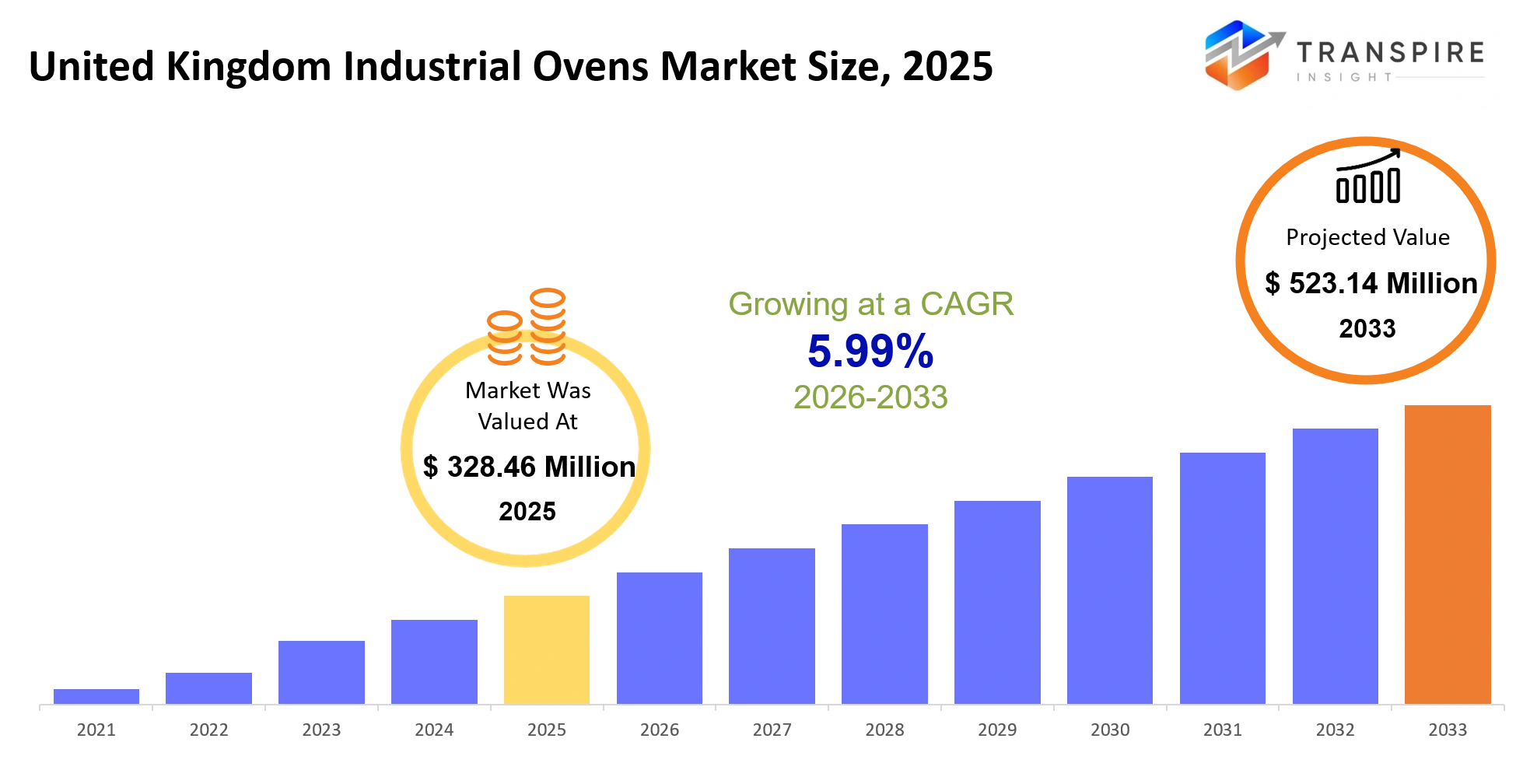
- United Kingdom Industrial Ovens Market Size 2025: USD 328.46 Million
- United Kingdom Industrial Ovens Market Size 2033: USD 523.14 Million
- United Kingdom Industrial Ovens Market CAGR: 5.99%
- United Kingdom Industrial Ovens Market Segments: By Product Type (Batch Ovens, Conveyor Ovens, Curing Ovens, Drying Ovens, Vacuum Ovens, Cleanroom Ovens, Infrared Ovens, Others); By Heating Medium (Electric Ovens, Gas-fired Ovens, Steam Ovens, Hybrid Ovens, Others); By Application (Food Processing, Automotive Manufacturing, Electronics Manufacturing, Pharmaceuticals, Aerospace, Others); By End User (Manufacturing Industry, Food Industry, Chemical Industry, Automotive Industry, Others).
To learn more about this report,  Download Free Sample Report
United Kingdom Industrial Ovens Market Summary
The United Kingdom Industrial Ovens Market was valued at USD 328.46 Million in 2025. It is forecast to reach USD 523.14 Million by 2033. That is a CAGR of 5.99% over the period.
The United Kingdom industrial ovens market plays a pretty key role in manufacturing, because it supports controlled heating , curing, drying, baking and heat-treatment routines across different sectors like automotive , aerospace, food processing, electronics and advanced materials. In practice, these oven systems help producers reach reliable product quality, align with regulatory requirements, and boost production efficiency especially in high-volume industrial settings, where downtime is costly.
In the last five years, the market kind of shifted in a more structural way toward energy-efficient and digitally connected oven solutions. A lot of manufacturers are swapping older style units for smarter ovens, these include sensors, automation and real time performance tracking, all to cut running costs and also to back decarbonization efforts. This momentum sped up after the energy price volatility and the supply chain disruptions that became more visible following the Russia-Ukraine conflict. That period basically highlighted the financial danger of energy-hungry production. Because of that, industrial operators are now giving priority to equipment upgrades that lower energy use, while also strengthening process control. As a direct result, this investment cycle is spreading into multiple industries, which is opening up new sales channels for equipment suppliers and aftermarket service providers.
Key Market Insights
- In the United Kingdom Industrial Ovens Market, England kinda dominates, pulling in around 70% of industry revenue for 2025, mostly because the manufacturing base is so concentrated there.
- Meanwhile Scotland is starting to see newer demand signals for industrial ovens from areas like food processing , renewable energy ,and engineering, not all at once but noticeably growing.
- By oven type, batch ovens seem to lead the pack, with an estimated 45% market share in 2025, mainly because they offer operational flexibility and a bit more control.
- Conveyor ovens sit in the second spot, helped along by high volume manufacturing and those continuous production needs that just keep rolling.
- Vacuum ovens are the quickest mover across the forecast window, with growth pushed by precision manufacturing plus electronics applications.
- Also, electrically heated industrial ovens are picking up share as manufacturers look to reduce emissions and improve energy efficiency, which is becoming a bigger deal.
- On applications, heat treatment is close to 35% of market revenue, so it ends up being the dominant application segment in 2025.
- For the fastest growth though, electronics and advanced materials processing lead the way through 2030.
- Food processing applications keep expanding, largely because investments are going into automated production setups and quality control systems.
- And for end users, manufacturing industries remain on top, contributing about 50% of total market demand in 2025, generally staying strongest.
What are the Key Drivers, Restraints, and Opportunities in the United Kingdom Industrial Ovens Market?
The most powerful thing pushing growth in the United Kingdom industrial ovens market is a kind of modernization of the production facilities, so they can improve energy productivity and keep the process more steady. The change really got going once industrial energy costs jumped sharply , and it made clear the problems with older gas-fired oven setups that are manually controlled. Companies working in automotive, aerospace, food processing, and advanced materials are putting money into digitally controlled industrial ovens, with sensors, automation, and heat recovery features. With these updates, energy use drops, production losses are reduced, and the overall throughput climbs. Because of that, equipment changeovers are happening faster than before, and it opens a straight route for higher equipment sales, retrofit work , and long-run service income.
Still, high capital expenditure remains the biggest structural hurdle. Industrial ovens are frequently built into wider production lines, so replacing them isn’t only about buying the oven, but also involves facility modifications, process validation, and some period of production downtime. A lot of small and mid sized manufacturers end up delaying improvements, because those initial costs end up competing with other capital needs. This pressure limits adoption pace, and it also postpones when suppliers can actually see the revenues, especially in industries that operate on tight margins.
The growth of battery manufacturing and the push toward advanced electronics production kind of opens up a big opportunity for expansion. In these fields they need thermal processing setups that are very precise, like for drying, curing and even general material treatment. Since the United Kingdom is pulling in investments for electric vehicle supply chains and also semiconductor related manufacturing, there should be a noticeable rise in demand for specialized industrial ovens with advanced temperature control features, not just basic heating.
What Has the Impact of Artificial Intelligence Been on the United Kingdom Industrial Ovens Market?
Artificial intelligence and more advanced digital technologies are transforming the United Kingdom industrial ovens market, by boosting process control, equipment dependability, and overall output efficiency. Nowadays industrial ovens often have AI-enabled control systems built in, and they keep watching temperature patterns, airflow behavior, how much energy is being used, and the different production parameters all the time. Then the systems start changing the operating conditions in real time, which in turn cuts down on process inconsistency and also reduces material losses in areas like aerospace, automotive, electronics, and food processing.
On top of that, machine learning models are getting used for predictive upkeep, not just basic maintenance. By looking at sensor signals from heating elements, fans, motors, and the control parts, these setups can spot early warning signs of wear or deterioration before anything actually fails. That ability helps manufacturers reduce surprise downtime, make the equipment last longer, and improve the way assets are utilized. In lots of plants, digital monitoring platforms have shown real, measurable gains in availability, while also lowering maintenance expenses and even energy use, thanks to better, more tuned operating schedules.
Meanwhile advanced analytics assist with optimization too, because they can point out inefficient heating cycles and suggest process changes that reduce energy consumption, without hurting product quality. Still, there’s a big snag: the expense of tying AI platforms into older oven infrastructure can be quite high. Many older production sites don’t have the right sensor networks or digital connections, so they can’t collect the huge amounts of operational data needed for accurate machine learning, and adoption ends up being slower across many parts of the market.
Key Market Trends
- Since 2021, many manufacturers have been speeding up the replacement of old gas-fired ovens, swapping them for digitally controlled systems, to curb energy exposure and also get better process consistency , even if the transition sometimes feels slower in practice.
- After 2022 , industrial energy price swings pushed buyers to look past purchase price only, and instead weigh lifetime operating cost and efficiency indicators more carefully.
- In aerospace and automotive, producers increasingly used sensor enabled ovens, which lets teams do real-time process monitoring, and keeps quality standards tighter than before.
- Electrically heated oven installs actually gained more share from 2022 through 2025 , partly because decarbonization targets steered capital equipment spending toward cleaner heating options.
- Predictive maintenance platforms started showing up as a real competitive edge , they help operators cut back on unexpected downtime , and also extend the service life of the hardware.
- Rather than just taking standardized units, manufacturers more often asked for tailored thermal processing solutions, which mirrors specialized production needs and not just generic throughput goals.
- Bigger suppliers like Carbolite Gero, Despatch Industries, and Nabertherm expanded their digital control know-how, in order to stay ahead in the market position, and to keep up with customer expectations.
- Heat recovery tech moved from “only for a few cases” into more mainstream consideration, because industrial operators wanted numbers , measurable reductions in energy use, not just theoretical savings.
- Investment energy and attention increasingly drifted toward battery materials, advanced electronics, and precision engineering applications that demand tighter temperature tolerances , across the board.
- Service contracts, remote diagnostics, and aftermarket help became more meaningful revenue sources too, since many customers prioritize long term equipment performance, rather than doing a simple one-time buy.
United Kingdom Industrial Ovens Market Segmentation
By Product Type :
Batch ovens are pretty widely used for handling products in separate loads, where the ability to shift between tasks and keep heating under control really matters. Conveyor ovens, meanwhile, back up continuous output and they help manufacturers keep a steady level of quality across huge production runs. Curing ovens are for toughening up coatings , sealants and finishes , while drying ovens remove the moisture from materials during the run.
Vacuum ovens are built for situations where you need a low pressure environment, so delicate materials stay protected and overall product results improve. Cleanroom ovens get used in areas where contamination control is a must, especially in electronics and pharmaceutical production. Infrared ovens heat fast using radiation technology, which can cut down the total processing time. There are also other oven types that cover special industrial needs, when the thermal treatment has to follow a very specific set of conditions.
By Heating Medium :
Electric ovens are getting more attention because temperature regulation is precise, emissions can be lower, and they fit better with current automation setups. A lot of plants lean toward electric systems, mainly when accuracy and stable warming conditions are required. Gas-fired ovens still have a strong place too, mostly because operating costs can be lower in certain high-volume manufacturing.
Steam ovens are often chosen when a gentle, even kind of heating is needed. Hybrid ovens mix more than one heating method, which boosts efficiency and gives more day to day flexibility across different production needs. Other heating approaches are used for niche jobs, where a standard heating setup might not perform well, or may not meet the exact process requirements.
By Application :
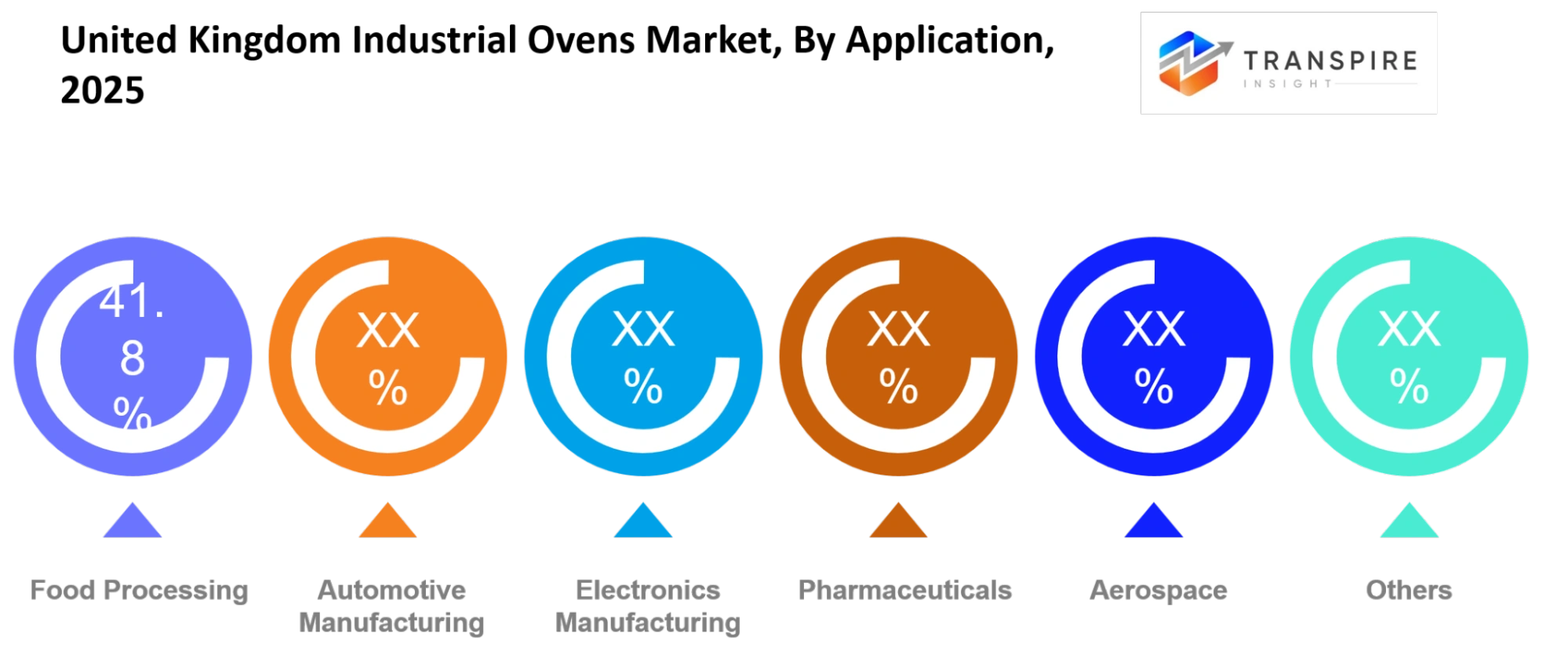
Food processing is still one of the biggest application zones where industrial ovens are used for baking, drying, cooking,and all sorts of product prep that ends up kind of unifying everything. In automotive manufacturing , companies use thermal processing gear mainly for paint curing, coating tasks, and component conditioning. Electronics manufacturing also taps into advanced oven systems so the production stays precise, and the final goods keep that reliability which matters a lot in practice.
Pharmaceutical companies lean on industrial ovens for sterilization , drying , and those more controlled process runs. Aerospace manufacturers go for specialized thermal equipment because they need to hit strict performance plus quality targets for critical parts. Beyond that, there are other industrial areas where controlled heating cycles are necessary, often to improve product capability and the overall manufacturing tempo.
To learn more about this report, Download Free Sample Report
By End User :
For end-use, the manufacturing industry stands out as a major consumer group, because industrial ovens handle a lot of the production , treatment, and finishing steps. Their demand keeps getting bolstered by ongoing investments in automation, energy efficiency, and process refinement. Industrial sites keep upgrading machines, partly to boost throughput and also to keep product uniformity more stable.
The food industry uses industrial ovens for high-volume production and quality checks that need to be repeatable. The chemical industry relies on thermal processing systems for drying, curing, and various material treatments. Automotive is still a key user too, especially for coating work and component processing. Other end users are basically firms that need governed heating solutions , to support specialized manufacturing activities and day to day operational needs.
What are the Key Use Cases Driving the United Kingdom Industrial Ovens Market?
Industrial ovens are pretty widely used in manufacturing for heat treatment, curing, and drying jobs, like the whole package. In automotive, metal fabrication, and engineering firms, these processes help boost product staying power, make coatings behave better, and increase material strength overall. Because the thermal processing requirements are so consistent, this is turning out to be the biggest driver of equipment demand across the United Kingdom, overall.
More use is also starting to show up in food processing and electronics manufacturing, sort of in parallel. Food producers use industrial ovens for big batch baking, drying, and staging of products, while still holding to the quality targets they need. For electronics, manufacturers are leaning harder on careful thermal processing for circuit boards , individual components, and the more advanced materials that go into high-performance devices. That precision matters, and you can’t really improvise it.
New opportunities are forming too, especially around battery production and advanced aerospace manufacturing. Investments in the electric vehicle supply chain are fueling demand for highly controlled drying and curing applications, so the process is stable, and repeatable. Meanwhile, companies making advanced composites and lighter aerospace parts are adopting specialized thermal processing systems to hit strict performance and certification rules, which should help the market keep expanding later on.
|
Report Metrics |
Details |
|
Market size value in 2025 |
USD 328.46 Million |
|
Market size value in 2026 |
USD 348.12 Million |
|
Revenue forecast in 2033 |
USD 523.14 Million |
|
Growth rate |
CAGR of 5.99% from 2026 to 2033 |
|
Base year |
2025 |
|
Historical data |
2021 - 2024 |
|
Forecast period |
2026 - 2033 |
|
Report coverage |
Revenue forecast, competitive landscape, growth factors, and trends |
|
Regional scope |
Middle East and Africa (Saudi Arabia, United Arab Emirates, South Africa, Rest of Middle East and Africa) |
|
Key company profiled |
Despatch Industries, Wisconsin Oven, Grieve Corporation, LEWCO, JPW Ovens & Furnaces, Memmert, Thermcraft, Carbolite Gero, Davron Technologies, Harper International, Blue M, Eastman Manufacturing, Heraeus, Nabertherm, Baxter. |
|
Customization scope |
Free report customization (country, regional & segment scope). Avail customized purchase options to meet your exact research needs. |
|
Report Segmentation |
By Product Type (Batch Ovens, Conveyor Ovens, Curing Ovens, Drying Ovens, Vacuum Ovens, Cleanroom Ovens, Infrared Ovens, Others); By Heating Medium (Electric Ovens, Gas-fired Ovens, Steam Ovens, Hybrid Ovens, Others); By Application (Food Processing, Automotive Manufacturing, Electronics Manufacturing, Pharmaceuticals, Aerospace, Others); By End User (Manufacturing Industry, Food Industry, Chemical Industry, Automotive Industry, Others). |
Which Regions are Driving the United Kingdom Industrial Ovens Market Growth?
England still stays the top region for the United Kingdom Industrial Ovens Market, mostly because it has a big clustering of manufacturing facilities, strong industrial infrastructure, and continued funding into automation, you know, that sort of thing. Big automotive, aerospace, food processing, and electronics production hubs keep producing steady needs for thermal processing units. On top of that, industrial decarbonization rules and energy-efficiency campaigns have pushed factories to swap older oven setups for newer upgrades. There’s also a pretty mature web of equipment vendors, engineering companies, and maintenance service providers that keeps the regional momentum.
Scotland, in contrast, works more like a dependable source of market revenue, even if the growth picture looks a bit different. Here demand is carried by a broader industrial mix, including food processing, pharmaceuticals, renewable energy components, and precision engineering. Instead of relying on giant manufacturing clusters, the region leans on careful capital outlay and long-term modernization plans. That steadier investment climate helps keep consumption for industrial ovens fairly consistent across several industries, not only one.
Northern England seems to be showing up as the quickest expanding region, as manufacturers keep broadening advanced production skills and also upgrade older facilities a bit more. In the last stretch, new spending tied to battery supply chains, electronics fabrication, and higher-value engineering has pushed up demand for dedicated thermal processing systems. On top of that, government-backed industrial growth programs plus local regeneration projects have, in a manner of speaking, added a lot more confidence to ongoing investment. From 2026 through 2033, that momentum should mean solid openings for equipment suppliers, technology providers , and investors looking for real exposure to these growing manufacturing areas.
Who are the Key Players in the United Kingdom Industrial Ovens Market and How Do They Compete?
In the United Kingdom Industrial Ovens Market, the competitive landscape is kind of moderately fragmented, and rivalry is often guided more by technology, customization ability ,and after sales support than by price only. When manufacturers buy industrial ovens, they usually need units fitted to their exact production flow. So engineering knows how to become a big differentiator. Many older suppliers keep their positions by using advanced control systems, energy efficient engineering and also longer service arrangements. New entrants tend to chase specialized use cases instead of pushing across the entire product set, which means major shakeups are less likely on a large scale.
Carbolite Gero really leans into technical specialization for high temperature ovens and controlled atmosphere systems, especially for aerospace, research, and advanced manufacturing settings. It stands out with very precise temperature behavior, and with application tuned designs that can handle tough process needs. Its growth plan centers on digitally linked equipment and on improving assistance for advanced materials work as well as lab centered industries. Nabertherm follows a parallel technology led approach ,but it puts more weight on a wide portfolio that fits both industrial production and research work, which in turn gives customers more entry points.
Despatch Industries really leans into thermal processing setups meant for consistent warming, and kind of reliable output each time. That whole ability becomes a clear advantage in electronics, battery manufacturing, and also in precision industrial uses where the process must stay steady, not drift. Thermcraft meanwhile kind of stands out by offering custom built, engineered solutions that fit the client’s specific requirements, instead of taking a one size approach. Wisconsin Oven Corporation expands in a different way, with bigger scale industrial projects, plus specialized heat treatment systems. They’re backed by long term engineering support and field service capabilities, so it feels more hands on, more responsive.
Company List
- Despatch Industries
- Wisconsin Oven
- Grieve Corporation
- LEWCO
- JPW Ovens & Furnaces
- Memmert
- Thermcraft
- Carbolite Gero
- Davron Technologies
- Harper International
- Blue M
- Eastman Manufacturing
- Heraeus
- Nabertherm
- Baxter
Recent Development News
In April 2026, Trent Refractories Ltd supported the commissioning of a £2.9 million seven-tonne Electric Arc Furnace at the Materials Processing Institute Green Steel Centre. The investment created the UK’s only research and production-scale EAF facility of its kind, strengthening industrial furnace innovation and accelerating low-carbon steel manufacturing development.
Source: https://www.trentrefractories.com/
In April 2025, SDI Group plc announced the acquisition of Collins Walker Ltd for approximately £1.85 million. The acquisition expanded SDI Group’s industrial thermal-processing portfolio and increased manufacturing capacity in the growing industrial electric heating and process equipment market.
Source: https://www.investegate.co.uk/
What Strategic Insights Define the Future of the United Kingdom Industrial Ovens Market?
The United Kingdom Industrial Ovens Market is moving pretty quickly toward more automated , data driven thermal processing systems that blend energy efficiency, predictive upkeep, and improved process control. The main reason behind this shift is that manufacturers really need to push throughput, keep energy costs in check, and hit tighter operational performance targets. Over the next five to seven years, competitive advantage is probably going to hinge on providing combined solutions, not only on selling standalone heating hardware.
One risk that still feels a little under looked is how concentrated the market is across a few high value end use sectors. If automotive output slows, aerospace investment cools down , or the big manufacturing capex cycles take a pause, suppliers whose portfolios lean mostly toward a small set of customers could get affected sooner than others. That dependence could also cause revenue swings even if the wider industrial picture seems steadier.
Meanwhile, there’s also a genuine opportunity beginning to show up. Battery materials processing and advanced electronics manufacturing are gaining traction, in particular where investment is tied to electric vehicle supply chains. Companies here should aim to build digitally connected, purpose specific oven systems, and simultaneously expand their technical service capabilities. In general, suppliers that behave like long term process optimization partners— rather than only equipment vendors— should be better placed to capture new growth and keep customers for the long run.
United Kingdom Industrial Ovens Market Report Segmentation
By Product Type
- Batch Ovens
- Conveyor Ovens
- Curing Ovens
- Drying Ovens
- Vacuum Ovens
- Cleanroom Ovens
- Infrared Ovens
By Heating Medium
- Electric Ovens
- Gas-fired Ovens
- Steam Ovens
- Hybrid Ovens
By Application
- Food Processing
- Automotive Manufacturing
- Electronics Manufacturing
- Pharmaceuticals
- Aerospace
By End User
- Manufacturing Industry
- Food Industry
- Chemical Industry
- Automotive Industry
Frequently Asked Questions
Find quick answers to common questions.
The United Kingdom Industrial Ovens Market size is USD 523.14 Million in 2033.
Key segments for the United Kingdom Industrial Ovens Market are By Product Type (Batch Ovens, Conveyor Ovens, Curing Ovens, Drying Ovens, Vacuum Ovens, Cleanroom Ovens, Infrared Ovens, Others); By Heating Medium (Electric Ovens, Gas-fired Ovens, Steam Ovens, Hybrid Ovens, Others); By Application (Food Processing, Automotive Manufacturing, Electronics Manufacturing, Pharmaceuticals, Aerospace, Others); By End User (Manufacturing Industry, Food Industry, Chemical Industry, Automotive Industry, Others).
Major United Kingdom Industrial Ovens Market players are Despatch Industries, Wisconsin Oven, Grieve Corporation, LEWCO, JPW Ovens & Furnaces, Memmert, Thermcraft, Carbolite Gero, Davron Technologies, Harper International, Blue M, Eastman Manufacturing, Heraeus, Nabertherm, Baxter.
The United Kingdom Industrial Ovens Market size is USD 328.46 Million in 2025.
The United Kingdom Industrial Ovens Market CAGR is 5.99% from 2026 to 2033.
- Despatch Industries
- Wisconsin Oven
- Grieve Corporation
- LEWCO
- JPW Ovens & Furnaces
- Memmert
- Thermcraft
- Carbolite Gero
- Davron Technologies
- Harper International
- Blue M
- Eastman Manufacturing
- Heraeus
- Nabertherm
- Baxter
About the Authors

Chetan Dhatrak
I’m Chetan Dhatrak, a Senior Research Analyst at Transpire Insight, specializing in the Consumer Goods, Foods and Beverages industry. I focus on analyzing market trends, consumer behavior, competitive landscapes, and industry developments to deliver accurate, data-driven insights. My research at Transpire Insight is built on credible sources and in-depth analysis, helping businesses and readers better understand market dynamics, emerging opportunities, and evolving consumer preferences. I’m committed to creating reliable, well-researched content that supports informed decision-making and reflects the latest developments in the consumer goods and food & beverage sectors.

Chakradhar Khansole
Chakradhar serves as the Research Director at Transpire Insight, bringing over 8 years of experience in technology, innovation, and strategic market intelligence. He specializes in transforming complex market data into actionable business insights that enable organizations to make informed, growth-oriented decisions. Recognized for his strategic vision and analytical expertise, Chakradhar leads high-impact research initiatives, delivering comprehensive market assessments, competitive intelligence, and forward-looking industry analysis.
Recently Published Reports
-
Apr 2026
Bottled Water Market
Bottled Water Market Size, Share & Analysis Report By Product Type (Still Bottled Water, Carbonated Bottled Water, Functional Bottled Water, and Others), By Packaging (PET, Cans, and Others), By Sales Channel (Supermarkets/Hypermarkets, Convenience Stores/Drug Stores, Grocery Stores/Club Stores, Foodservice, and Others) and Geography (North America, Europe, Asia-Pacific, Middle East and Africa, South and Central America), 2021 - 2032
-
Apr 2026
Color Cosmetic Packaging Market
Color Cosmetic Packaging Market Size, Share & Analysis Report By Application (Mascara Packaging, Liquid Packaging, and Liquid Face), By Type (Tubes & Bottles, Pens & Markers, Compacts & Containers, and Droppers & Pumps), and Geography (North America, Europe, Asia-Pacific, Middle East and Africa, South and Central America), 2021 - 2031
-
Apr 2026
External Microphone For Camera Market
External Microphone For Camera Market Size, Share & Analysis Report By Type (Shotgun Microphone, Lavalier Microphone, and Others), By Application (Digital Camera, Professional Video Camera, and Others), and Geography (North America, Europe, Asia-Pacific, Middle East and Africa, South and Central America), 2021 - 2031
-
Apr 2026
Foot Orthotic Insoles Market
Foot Orthotic Insoles Market Size, Share & Analysis Report By Type (Pre-fabricated, and Custom-made), By Material (Thermoplastic, Composite Carbon Fiber, and Others), By Distribution Channel (Drug Stores, Hospitals & Clinics, and Others), and Geography (North America, Europe, Asia-Pacific, Middle East and Africa, South and Central America), 2021 - 2031