
Europe Green Electronics Manufacturing Market Size & Forecast:
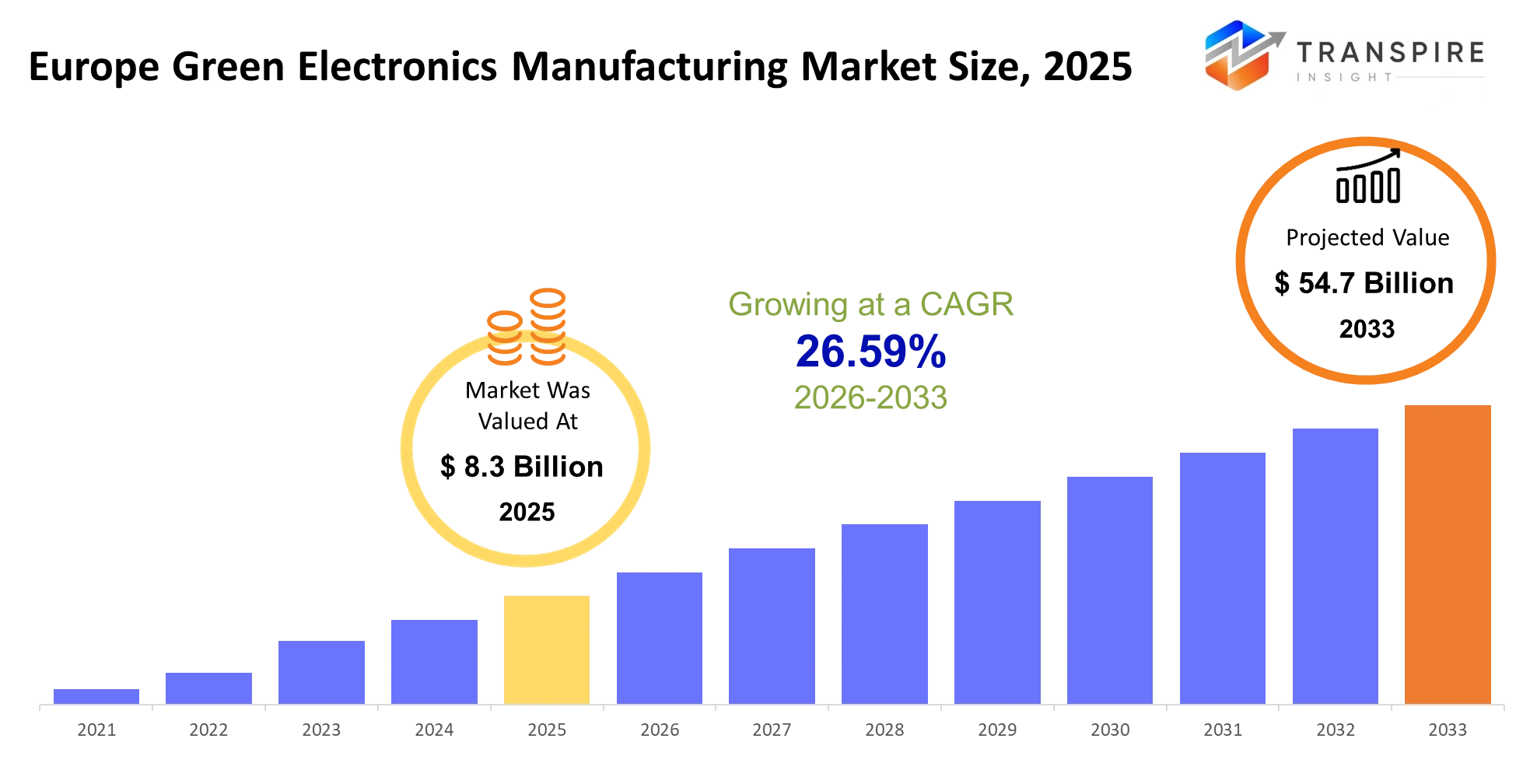
- Europe Green Electronics Manufacturing Market Size 2025: USD 8.3 Billion
- Europe Green Electronics Manufacturing Market Size 2033: USD 54.7 Billion
- Europe Green Electronics Manufacturing Market CAGR: 26.59%
- Europe Green Electronics Manufacturing Market Segments: By Type (Eco-friendly Components, Energy-efficient Devices, Recyclable Electronics, Others); By Application (Consumer Electronics, Industrial Electronics, Automotive Electronics, Others); By End-User (Electronics Manufacturers, OEMs, Others); By Process (Sustainable Manufacturing, Recycling, Waste Reduction, Others).
To learn more about this report,  Download Free Sample Report
Europe Green Electronics Manufacturing Market Summary
The Europe Green Electronics Manufacturing Market was valued at USD 8.3 Billion in 2025. It is forecast to reach USD 54.7 Billion by 2033. That is a CAGR of 26.59% over the period.
The Europe Green Electronics Manufacturing Market focuses on producing electronic systems that consume less energy and use fewer hazardous materials while achieving better recyclability across semiconductor manufacturing and industrial control systems and consumer electronics production lines. The solution enables manufacturers to maintain their industrial operations while achieving compliance with EU regulations through their high-volume electronics production processes.
The past three to five years have seen a complete change in production methods which now implement circular design systems that enable component reuse and material recovery instead of traditional linear manufacturing. The EU Green Deal together with stricter RoHS and WEEE regulations has compelled factories to rethink their complete systems for sourcing materials and operating energy and managing waste materials. The post-2022 supply chain crisis became a main driver which pushed European manufacturers to build local production facilities because they had to stop importing semiconductor parts.
The market is seeing increasing adoption rates because organizations must meet compliance standards to receive market access and contract rights. Manufacturers who use low-carbon production methods and recycling technologies achieve operational cost control while developing stronger relationships with OEMs, but non-compliant companies experience product delivery delays and decreased market interest.
Key Market Insights
- The Green Electronics Manufacturing Market in Europe gets controlled by Western Europe which holds a 2025 market share of almost 42% because Germany and France maintain strong semiconductor manufacturing centers.
- The clean energy systems and advanced circular electronics initiatives of Nordic countries create Northern Europe as the most rapidly expanding region until 2030.
- The product segmentation of the market results from eco-friendly components which achieve more than 35% market share in 2025 because of strict EU RoHS regulations and sustainable sourcing requirements.
- The market experiences its fastest growth rate through the period from 2024 to 2030 because recyclable electronics have become a leading product segment which supports circular economy initiatives and extended producer responsibility regulations.
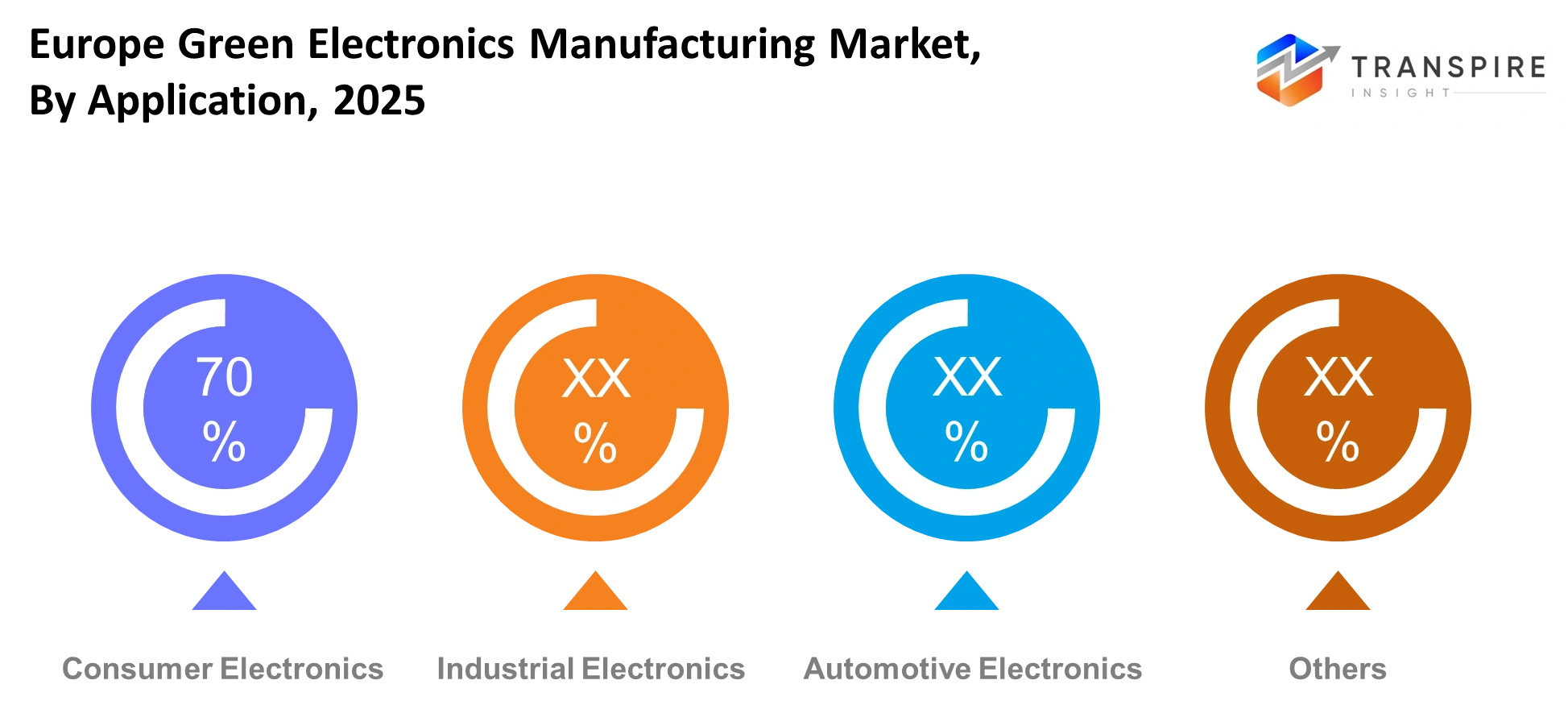
- The European Green Electronics Manufacturing Market sees consumer electronics reach almost 38% of its application share because smart device and wearable production reaches high volumes.
- The automotive electronics sector experiences its most rapid growth because European OEM platforms adopt EV technology and deploy energy-efficient sensors.
- The end-user segment of electronics manufacturing industry shows the highest dominance through electronics manufacturers who control 45% of this market because their firms operate large production facilities and their purchasing processes require compliance with regulations.
- The fastest growth path for OEMs results from their ability to establish control over sustainable supply chain standards and material traceability requirements.
- Companies achieve competitive advantages through their use of AI-enabled energy optimization systems and their development of low-carbon chip designs and their establishment of strategic partnerships with European Union sustainability programs.
- The Green Electronics Manufacturing Market in Europe experiences strategic expansion through the establishment of local production facilities and the development of environmentally friendly factories and the implementation of circular electronics research and development initiatives.
What are the Key Drivers, Restraints, and Opportunities in the Europe Green Electronics Manufacturing Market?
Driver:
The European green electronics manufacturing sector reaches its highest expansion level because of the increased enforcement of EU environmental rules which include RoHS and WEEE and the European Green Deal implementation timeline. The frameworks established hazardous substance reduction requirements together with the creation of more detailed product lifecycle tracking systems which became effective after 2020, which resulted in original equipment manufacturers and component manufacturers having to revise their manufacturing processes. The compliance regulations enable manufacturers to boost their revenue through procurement contracts which require certified low-emission materials and energy-efficient fabrication systems, particularly in the semiconductor and consumer electronics supply chains where market access depends on compliance.
Restraint:
The most persistent barrier remains fragmented legacy manufacturing infrastructure across older European electronics plants. Many facilities still operate on non-digitalized production lines which lack proper energy monitoring systems and only use basic sensor technology, which creates challenges for implementing real-time emissions control and building automated systems. The structural constraints of the system increase expenses for retrofitting and create delays for AI-powered optimization while holding back productivity improvements and making it harder to establish circular manufacturing processes. Most mid-sized suppliers face financial challenges because they must upgrade their outdated PCB fabrication equipment and coating systems.
Opportunity:
The EU-supported investment in circular semiconductor ecosystems creates a significant future opportunity which mostly develops in Germany and the Netherlands. Projects which combine advanced silicon wafer recycling with AI-driven material recovery systems are receiving support through Horizon Europe program funding.The initiatives create closed-loop production systems which decrease the need for imported raw materials and generate additional revenue through the recovery of electronic components and high-purity material reuse.
What Has the Impact of Artificial Intelligence Been on the Europe Green Electronics Manufacturing Market?
European green electronics manufacturing facilities now use artificial intelligence technology to operate their exhaust gas cleaning systems and their administration of factory energy management systems and their original equipment manufacturer supply chain compliance tracking systems. AI-powered automation systems in manufacturing facilities for advanced semiconductors and PCBs use real-time data analysis to optimize scrubber systems through continuous performance evaluation of emission control equipment. The system improves pollution management results through automation because it decreases the need for human work while maintaining consistent results across all manufacturing operations that handle substantial production volumes.
Production facilities use machine learning models to perform predictive maintenance on their equipment which detects early signs of deterioration in etching devices and coating equipment and high-energy furnace systems. The models enable operators to decrease unexpected equipment breakdowns while extending equipment operational time, with most facilities experiencing better uptime results that reach single-digit percentages and substantial decreases in maintenance-related energy consumption. AI-based emissions forecasting further supports regulatory compliance under EU environmental frameworks by simulating output variations and optimizing production schedules accordingly.
Gains in operational efficiency typically lead to manufacturing processes that require less energy for each product unit while achieving better resource efficiency throughout all production stages. The high costs of system integration together with the scattered data systems of traditional electronics manufacturing facilities prevent companies from adopting AI technology because their sensors produce inconsistent readings which hinders machine learning model performance during actual business use.
Key Market Trends
- The EU strengthened its enforcement of RoHS and WEEE regulations in 2022 which required manufacturers to use environmentally safe semiconductor and PCB materials instead of hazardous substances.
- The period from 2020 to 2025 showed a shift in OEM sourcing strategies which began to focus on recyclable electronics and this change resulted in more supplier audits and lifecycle transparency requirements throughout Europe.
- After 2023, automotive OEMs started using more EV electronics which created a higher demand for energy-efficient sensors while decreasing their use of standard electronic components.
- The industrial manufacturing sector implemented closed-loop recycling systems after 2021 which resulted in a substantial reduction of electronic waste disposal from their large production operations.
- After 2022, consumer electronics brands started using more bio-based packaging materials while designing their devices to be modular which allowed customers to repair and maintain their products throughout an extended lifespan.
- European companies began establishing local supply chains after 2023 which decreased their need to rely on Asian imports for essential electronic parts.
- The manufacturing sector experienced a substantial increase in sustainable automation investment since 2021 because companies began using AI-powered energy optimization systems to improve their PCB manufacturing processes.
- After 2020, EU Green Deal initiatives created regulatory pressure that forced SMEs to implement waste reduction programs which determined their eligibility for OEM contracts.
- After 2022, semiconductor manufacturers began developing low-carbon production methods which decreased energy usage per wafer in major European manufacturing facilities.
Europe Green Electronics Manufacturing Market Segmentation
By Type
The European Green Electronics Manufacturing Market depends on eco-friendly components because European Union material restrictions and original equipment manufacturers use them in their supply chains. Semiconductor producers and PCB manufacturers focus on low-toxicity materials together with energy-efficient inputs because these factors enable them to produce consumer and automotive electronics at industrial scale.
The circular economy mandates together with extended producer responsibility rules create fast-growing markets for energy-efficient devices and recyclable electronics. The demand for modular and repairable systems increases because automotive electronics and industrial automation drive this need, whereas recyclability standards establish procurement requirements for OEM networks. The recyclable electronics segment will expand because design-for-disassembly becomes the industry standard, which enables manufacturers and investors who pursue sustainable production ecosystems to achieve cost savings and compliance benefits.
By Application
The European Green Electronics Manufacturing Market identifies consumer electronics as its leading segment because the market demands high volumes of smartphones, laptops, and wearable devices that meet EU sustainability requirements. The material requirement together with energy-efficient assembly implementation receives support from the ongoing product development activities at large OEMs.
Automotive electronics show their strongest growth through electric vehicle adoption and European emission control requirements. The industrial electronics market expands due to smart factory solutions and energy management technologies. The forecasted growth path shows continuous development for both automotive and industrial markets, which leads manufacturers to develop eco-friendly supply networks and recycle systems that help them achieve regulatory requirements while saving expenses.
To learn more about this report, Download Free Sample Report
By End-User
The Europe Green Electronics Manufacturing Market gives OEMs major power because they determine product development standards and their supplier selection processes. Sustainable sourcing has become a mandatory requirement for procurement frameworks, which leads component suppliers to establish upstream compliance with this requirement.
Electronics manufacturers now adopt sustainable production practices because they face regulatory requirements and seek to reduce costs through better energy efficiency. The future will bring more OEMs who create standards for eco-friendly materials and recycling processes, which will affect how suppliers operate and prevent non-compliant manufacturers from entering the market.
By Process
European facilities use energy-efficient production lines and low-emission assembly systems to create sustainable manufacturing processes that now dominate the market.
The implementation of circular economy regulations together with extended producer responsibility frameworks, which require recycling and waste reduction, has created a growing momentum for these waste management processes. The future will see faster investments in closed-loop systems, which will help electronics manufacturers in Europe to recover materials, lower production expenses, and meet regulatory standards.
What are the Key Use Cases Driving the Europe Green Electronics Manufacturing Market?
The European market for green electronics manufacturing depends mainly on consumer electronics manufacturing which includes smartphones and laptops and wearables that follow EU sustainability standards and RoHS regulations. The OEMs use low-emission materials together with energy-efficient assembly methods and recyclable components to fulfill the increasing need for sustainable products which customers and regulatory bodies demand.
The automotive electronics sector is experiencing growth in green manufacturing because electric vehicle manufacturers now use sustainable circuit boards together with energy-efficient sensors. The industrial automation sector adopts sustainable production practices for its robotics and smart factory systems because EU decarbonization goals and supply chain sustainability standards require such changes.
Medical electronics together with diagnostic devices and portable monitoring systems and IoT-enabled smart home products represent emerging use cases. The growing trend of designing these applications for modular repairability and circular economy compliance demonstrates their potential for long-term development.
|
Report Metrics |
Details |
|
Market size value in 2025 |
USD 8.3 Billion |
|
Market size value in 2026 |
USD 10.5 Billion |
|
Revenue forecast in 2033 |
USD 54.7 Billion |
|
Growth rate |
CAGR of 26.59% from 2026 to 2033 |
|
Base year |
2025 |
|
Historical data |
2021 - 2024 |
|
Forecast period |
2026 - 2033 |
|
Report coverage |
Revenue forecast, competitive landscape, growth factors, and trends |
|
Regional scope |
Europe (Germany, United Kingdom, France, Italy, Spain, Rest of Europe) |
|
Key company profiled |
Apple, Samsung Electronics, Sony, LG Electronics, Panasonic, Intel, Dell, HP, Lenovo, Cisco, Siemens, Philips, Bosch, Toshiba, Hitachi. |
|
Customization scope |
Free report customization (country, regional & segment scope). Avail customized purchase options to meet your exact research needs. |
|
Report Segmentation |
By Type (Eco-friendly Components, Energy-efficient Devices, Recyclable Electronics, Others); By Application (Consumer Electronics, Industrial Electronics, Automotive Electronics, Others); By End-User (Electronics Manufacturers, OEMs, Others); By Process (Sustainable Manufacturing, Recycling, Waste Reduction, Others). |
Which Regions are Driving the Europe Green Electronics Manufacturing Market Growth?
The Europe Green Electronics Manufacturing Market in Europe receives its leading position from Western Europe because the region contains multiple semiconductor manufacturing sites that operate in Germany, France, and the Netherlands. The EU environmental directives require manufacturers to implement strong emission reduction practices and design products for recycling because EU environmental laws enforce strict regulatory requirements. The existing research and development infrastructure enables ongoing development of energy-saving manufacturing processes and next-generation chip fabrication methods. The company maintains its leadership position through its network of integrated suppliers and established original equipment manufacturer clusters while producing high-value products for both industrial and consumer electronic markets.
Southern Europe holds the second position, which Italy and Spain provide through their stable industrial manufacturing bases. The region uses cost-effective production methods to meet stable demand for automotive electronic products, which contrasts with Western Europe's innovation-driven business model. The EU sustainability funding programs have implemented their funding programs, which now support factory modernization efforts without requiring complete disruptive operational changes. The global original equipment manufacturers maintain their investment activities, which generate steady revenue streams for the company, while technology adoption proceeds at a gradual but determined rate.
The fastest growth in Eastern Europe occurs through Poland, Czech Republic, and Hungary, which experience rapid manufacturing growth. The period after 2022 has seen companies establish new assembly plants and component production facilities because they want to diversify their supply chains through nearshoring practices.
Who are the Key Players in the Europe Green Electronics Manufacturing Market and How Do They Compete?
The current state of competition shows moderate consolidation because established industrial electronics and semiconductor companies maintain control. The industry faces competition from niche companies that focus on sustainability which develop specific green manufacturing solutions. The competition between companies now depends on their ability to demonstrate energy efficiency, their capacity to achieve regulatory certifications, and their implementation of circular manufacturing practices. Companies establish their unique market position through digital platforms which monitor emissions and material recovery and factory production efficiency in real time.
Siemens uses industrial automation and digital twin technology to enhance factory energy usage and greenhouse gas emissions management which helps it establish a competitive edge through its complete manufacturing software suite. Schneider Electric develops advanced energy management systems which lower electricity consumption throughout the product lifecycle in electronics manufacturing facilities while establishing partnerships with European industrial clusters to expand its business. STMicroelectronics concentrates on developing low-power semiconductor solutions while expanding its operations by updating manufacturing facilities to meet EU environmental standards and carbon emission reduction objectives.
Infineon Technologies establishes its competitive edge through automotive-grade semiconductor products which cater to electric mobility systems while it expands its partnerships with German car manufacturers to obtain continuous supply agreements. Nokia develops sustainable telecom hardware designs which enable circular electronics systems while Ericsson builds energy-efficient 5G infrastructure equipment and expands its business through partnerships with operators.
Company List
- Apple
- Samsung Electronics
- Sony
- LG Electronics
- Panasonic
- Intel
- Dell
- HP
- Lenovo
- Cisco
- Siemens
- Philips
- Bosch
- Toshiba
- Hitachi
Recent Development News
“In May 2025, Siemens announced acquisition of ASTER Technologies.” The deal strengthened PCB assembly verification software capabilities and improved design-for-manufacturing efficiency across European electronics production ecosystems.
Source: https://www.siemens.com
“In March 2026, Siemens launched an edge-native AI manufacturing solution through Siemens Xcelerator.” The system reduced parasitic load and improved production efficiency in industrial electronics plants, accelerating sustainable factory automation adoption in Europe.
Source: https://www.siemens.com
What Strategic Insights Define the Future of the Europe Green Electronics Manufacturing Market?
The European Green Electronics Manufacturing Market develops into a tightly regulated industry which uses digital technologies to create sustainable production systems. The markets in this period will experience their main growth through European Union industrial policy regulations which require manufacturers to implement decarbonization targets instead of developing additional production capacity.
Supply chain networks face hidden threats which occur because operations depend on a restricted group of certified green material suppliers and advanced semiconductor fabrication facilities. The supply chain could face interruptions because of geopolitical conflicts or export restrictions which hinder access to essential materials including high-purity silicon and uncommon rare earth elements. At present, AI-verified lifecycle tracking systems for electronics create significant market potential because EU digital product passports will soon become mandatory for multiple industrial sectors.
Market participants should prioritize integrated sustainability software capabilities alongside hardware innovation which enables real-time compliance verification and material recovery optimization. Organizations which adopt digital traceability standards will enhance their business capabilities through better OEM partnerships while decreasing their exposure to emerging European Union procurement regulations.
Europe Green Electronics Manufacturing Market Report Segmentation
By Type
- Eco-friendly Components
- Energy-efficient Devices
- Recyclable Electronics
- Others
By Application
- Consumer Electronics
- Industrial Electronics
- Automotive Electronics
- Others
By End-User
- Electronics Manufacturers
- OEMs
- Others
By Process
- Sustainable Manufacturing
- Recycling
- Waste Reduction
- Others
Frequently Asked Questions
Find quick answers to common questions.
The Europe Green Electronics Manufacturing Market size is USD 54.7 Billion in 2033.
Key segments for the Europe Green Electronics Manufacturing Market are By Type (Eco-friendly Components, Energy-efficient Devices, Recyclable Electronics, Others); By Application (Consumer Electronics, Industrial Electronics, Automotive Electronics, Others); By End-User (Electronics Manufacturers, OEMs, Others); By Process (Sustainable Manufacturing, Recycling, Waste Reduction, Others).
Major Europe Green Electronics Manufacturing Market players are Apple, Samsung Electronics, Sony, LG Electronics, Panasonic, Intel, Dell, HP, Lenovo, Cisco, Siemens, Philips, Bosch, Toshiba, Hitachi.
The Europe Green Electronics Manufacturing Market size is USD 8.3 Billion in 2025.
The Europe Green Electronics Manufacturing Market CAGR is 26.59% from 2026 to 2033.
- Apple
- Samsung Electronics
- Sony
- LG Electronics
- Panasonic
- Intel
- Dell
- HP
- Lenovo
- Cisco
- Siemens
- Philips
- Bosch
- Toshiba
- Hitachi
Recently Published Reports
-
Apr 2026
Fiber Optic Faceplates Market
Fiber Optic Faceplates Market Size, Share & Analysis Report By Type (< 300 mm2, 300-350 mm2, and > 350 mm2, By Application (Night Vision, Holographic Imaging, Medical, and Others), and Geography (North America, Europe, Asia-Pacific, Middle East and Africa, South and Central America), 2021 - 2031
-
Apr 2026
High Temperature Superconductors Market
High Temperature Superconductors Market Size, Share & Analysis Report By Type (1G HTS, and 2G HTS), By Application (Power Cable, Fault Current Limiter, and Transformer), and Geography (North America, Europe, Asia-Pacific, Middle East and Africa, South and Central America), 2021 - 2031
-
Apr 2026
Industrial Plugs and Socket Market
Industrial Plugs and Socket Market Size, Share & Analysis Report By Type (Industrial Plugs, Industrial Sockets), By Current (Up to 32 A, 32 to 125 A, Above 125 A), By Protection (Dustproof and Splash Proof, Waterproof, Explosion Proof), By End User (Heavy Industries, Oil and Gas, Chemicals and Pharmaceuticals, Power Generation, Others), and Geography (North America, Europe, Asia-Pacific, Middle East and Africa, South and Central America), 2021 - 2031
-
Apr 2026
InGaAs Avalanche Photodiodes Market
InGaAs Avalanche Photodiodes Market Size, Share & Analysis Report By Type (1100 - 1700 nm, and 1000 - 1600 nm), By Application (Missile Warning System, Muzzle Flash Detection, Wafer Defect Inspection, Laser Rangefinders, and Others), and Geography (North America, Europe, Asia-Pacific, Middle East and Africa, South and Central America), 2021 - 2031