
North America Temperature Monitoring Systems Market Size & Forecast:
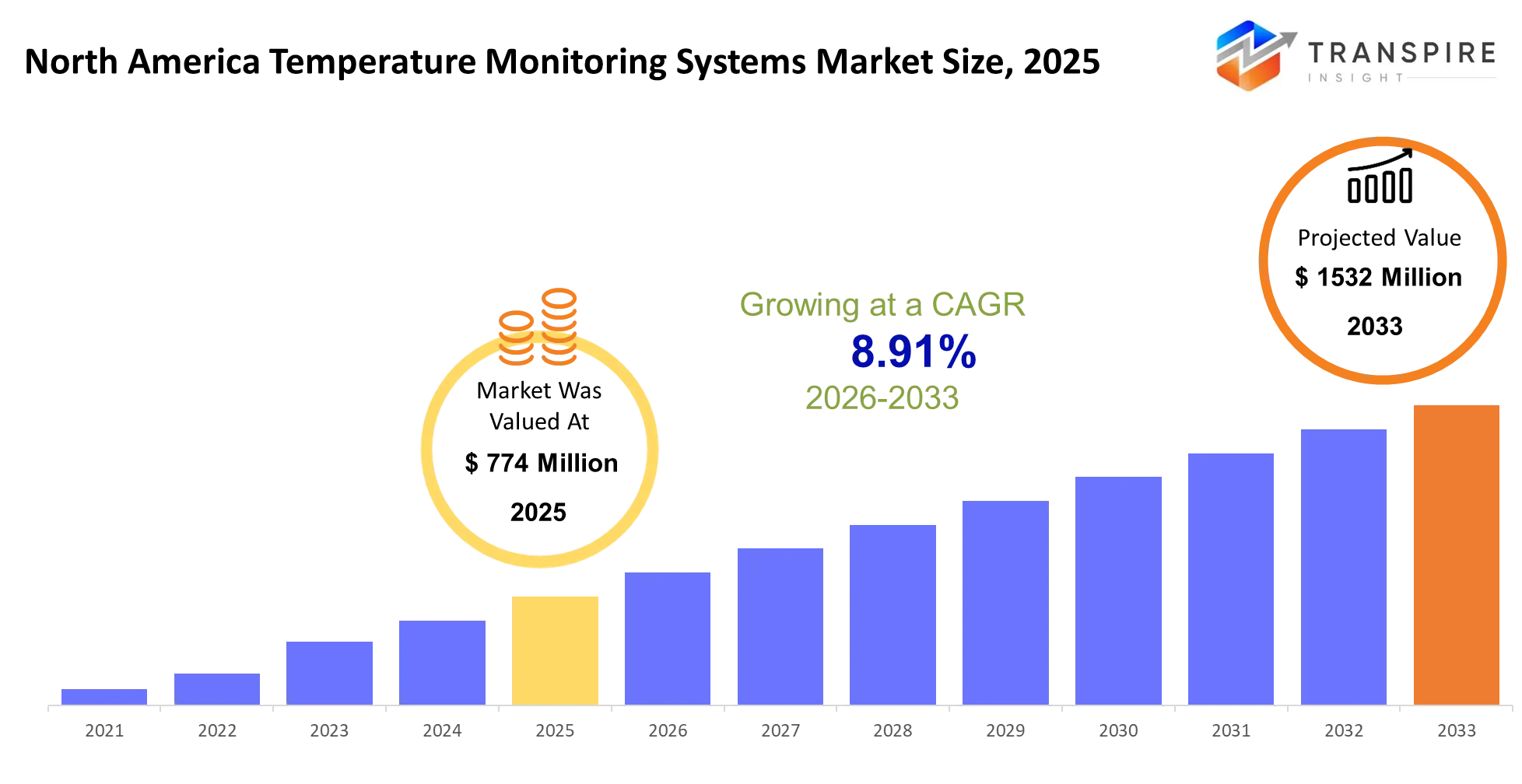
- North America Temperature Monitoring Systems Market Size 2025: USD 774 Million
- North America Temperature Monitoring Systems Market Size 2033: USD 1532 Million
- North America Temperature Monitoring Systems Market CAGR: 8.91%
- North America Temperature Monitoring Systems Market Segments: By Product Type (Wireless Monitoring Systems, Digital Monitoring Systems, Cloud-based Systems, IoT-enabled Systems, Others); By Application (Cold Chain Monitoring, Laboratory Monitoring, Healthcare Monitoring, Food Storage Monitoring, Industrial Monitoring, Others); By End User (Hospitals, Pharmaceutical Companies, Laboratories, Food & Beverage Industry, Others); By Technology (RFID-based Systems, Bluetooth Monitoring, Wi-Fi Monitoring, Others)
To learn more about this report,  Download Free Sample Report
North America Temperature Monitoring Systems Market Summary
The North America Temperature Monitoring Systems Market was valued at USD 774 Million in 2025. It is forecast to reach USD 1532 Million by 2033. That is a CAGR of 8.91% over the period.
North America temperature monitoring systems market kinda supports continuous tracking of temperature conditions across cold chain logistics pharmaceutical storage, food processing, data center environments and industrial equipment set ups, where even little deviations can cause spoilage , compliance issues, or straight up equipment failure. Over the last five years the market drifted away from standalone loggers, into IoT enabled sensors tied to cloud platforms that push near real time alerts and automated compliance paperwork, and they also build an audit trail that is usually more defensible.One big trigger that sped all this up was the COVID-19 vaccine rollout, it basically revealed the necessity for ultra-low temperature monitoring at scale, then later the U.S. FDA FSMA 204 traceability rules got more strict and enforcement picked up. Put together, these pressures nudged organizations to swap periodic manual checks for continuous digital monitoring, and honestly it’s hard to go back once you’ve built that process. So adoption today is being pushed less by “just visibility” and more by the need to reduce liability, prevent losses, and still satisfy audit-ready reporting expectations across distributed supply chains.
Key Market Insights
- North America Temperature Monitoring Systems Market is kinda dominating globally, with something like 38–42% share in 2025, mostly because advanced cold chain infrastructure is already in place and strict regulatory frameworks are pushing adoption.
- The United States still stays the main regional driver, it holds nearly 75% share in the North America Temperature Monitoring Systems Market in 2025, straightforward, no real surprise there.
- Canada, on the other hand looks like the fastest mover, it’s projected to post strong CAGR through 2030. That happens because pharmaceutical cold storage is expanding and logistics modernization is getting a lot more momentum, in other words “transport upgrades” are helping.
- When it comes to offerings, hardware-based monitoring systems take the lead with around 45% share. This is largely due to broad deployment in storage facilities, where teams prefer physical units that are already reliable.
- After that, software platforms are the second-largest segment, they grow steadily because cloud analytics and real-time dashboard adoption are becoming normal across enterprises, not a special case anymore.
- For the fastest growth, IoT-enabled wireless sensors are moving quickest. Between 2025–2030 they’re expanding rapidly due to automation demand, and because monitoring becomes more granular without extra heavy wiring.
- In terms of application, cold chain logistics dominates with nearly 40% share. It supports food safety and vaccine distribution across the North America Temperature Monitoring Systems Market, keeping temperature drift in check.
- Healthcare and pharmaceutical storage is sort of the fastest-growing application area. This gets tied to biologics, vaccines, and regulatory compliance requirements that keep getting stricter over time, kind of, you know.
- On the end-user side, pharmaceutical companies stay as the leading group, with roughly 35% share using continuous monitoring for compliance and risk reduction.
- Lastly, the food and beverage industry shows the quickest growth too, pushed by tighter FDA traceability standards and the need to stop spoilage, early on.
What are the Key Drivers, Restraints, and Opportunities in the North America Temperature Monitoring Systems Market?
Driver: The strongest growth driver seems to be the tightening of regulatory and compliance frameworks across pharmaceuticals and food logistics, especially the FDA FSMA 204 traceability rules and the Good Distribution Practice standards. Under these rules, companies have to do continuous, auditable temperature tracking, not just periodic manual logging. And that change, it has pushed enterprise investment toward IoT-enabled monitoring systems, because firms want to lower compliance exposure and also dodge expensive product recalls. So you end up seeing recurring software subscriptions, plus cloud-based monitoring platforms, that are generating higher lifetime value per deployment across the North America Temperature Monitoring Systems Market.
Restraint: A key structural barrier is the high integration complexity with legacy cold storage and industrial infrastructure. A lot of facilities still run fragmented legacy sensors and analog systems, and they do not easily talk to modern IoT platforms. To upgrade, you need capital expenditure, downtime, and also a workflow redesign, which then slows adoption for mid-sized operators. This turns into a kind of ongoing revenue drag, because replacement cycles can stretch beyond the normal technology refresh timelines.
Opportunity: A major forward-looking opportunity is AI-driven predictive temperature analytics, paired with 5G-enabled edge devices. Early deployments in U.S. vaccine distribution networks show, real-time anomaly prediction can reduce spoilage risk and logistics losses, and it also hints at scalable expansion for the North America Temperature Monitoring Systems Market.
What Has the Impact of Artificial Intelligence Been on the North America Temperature Monitoring Systems Market?
Artificial intelligence is, sort of, reshaping the North America Temperature Monitoring Systems Market by shifting passive sensing networks into automated decision systems that actively manage compliance, equipment health, and logistics performance. In cold chain and industrial settings, AI-enabled platforms are now running monitoring workstreams in the background , continuously checking for temperature deviations across storage compartments, scrubber performance systems, and connected transport fleets. That cuts down the manual audit burden a lot, and it helps compliance tracking feel more precise for regulated sectors like pharmaceuticals, and food logistics.
Machine learning models are also being leaned on for predictive maintenance. They can catch early hints of sensor drift, refrigeration trouble, or insulation deterioration before anything breaks. And in marine emission control systems, plus exhaust gas cleaning technology, AI is used to tune performance too , by linking temperature swings with fuel efficiency and emissions outcomes. Reported results include less refrigeration downtime, lower spoilage levels in cold storage, and better fuel efficiency in fleet operations thanks to improved thermal regulation.
Still, take-up isn’t unlimited. It’s held back by not enough real-world training data from extreme conditions, especially maritime and remote logistics lanes. On top of that , connectivity gaps at sea and in isolated cold storage sites limit real-time model updates, which then lowers predictive accuracy. This also slows down the broader rollout of solutions across the North America Temperature Monitoring Systems Market.
Key Market Trends
- Between 2020 and 2025 , many enterprises swapped out standalone loggers for IoT-enabled platforms, and somehow got better real-time sightlines across those spread-out cold chain networks.
- In a similar way, the FDA FSMA 204 enforcement, started since 2023, really pushed logistics providers to lean on automated traceability systems rather than doing those periodic, mostly manual temperature checks.
- On the other side, pharmaceutical firms have been moving from reactive monitoring toward continuous data streaming, which has helped cut down cold storage compliance problems across North America Temperature Monitoring Systems Market, at least thats what the reports keep implying.
- After 2022, Honeywell International alongside Emerson Electric also expanded their cloud-connected monitoring offerings, aiming at enterprise-level predictive temperature intelligence solutions, kind of a stronger “sense and foretell” angle.
- Meanwhile COVID-19 vaccine distribution from 2020 to 2022, fast-tracked ultra-low temperature monitoring across hospitals, and also through pharmaceutical logistics chains, even if some sites were already on the fence about it.
- Food and beverage companies then reduced their dependence on manual inspections after 2021, and shifted toward sensor-driven spoilage prevention systems while things are in transit , or sitting in storage.
- Siemens AG and Sensitech Inc. also strengthened edge computing capabilities post-2023, which made anomaly detection quicker in temperature-sensitive supply chains.
- And after the energy volatility in 2022, cold storage operators increased spending on wireless sensor networks because the spoilage and operational risk exposure became harder to ignore.
- More recently, fleet operators have been tying temperature monitoring into telematics systems after 2024, creating a more cross-functional view across transport and refrigeration units.
North America Temperature Monitoring Systems Market Segmentation
By Product Type
Wireless monitoring systems currently seem to be sitting at the top, mainly because they are deployed pretty broadly in warehouses, cold storage facilities, and transport fleets. The big point is that they can be installed in a more flexible way, plus they deliver real-time alerts, so operations teams tend to keep using them. After that, IoT-enabled systems come in close behind as more companies push for connected sensor networks, which basically cut down manual supervision and also helps tighten compliance accuracy.
Cloud-based systems are growing faster than traditional digital loggers, not only because they offer centralized dashboards but also because they give multi-site visibility, which a lot of large logistics operators are starting to require. It’s like, the infrastructure becomes less fragmented and more synchronized, if that makes sense.
This portion grows as manual setups and standalone devices are replaced quickly with connected architectures. These new approaches allow automated reporting and regulatory traceability, which most firms consider non negotiable. Hospitals and pharmaceutical distributors in particular lean toward wireless and IoT-enabled systems, since it reduces human error in temperature-sensitive storage. On top of that, when integration happens with AI analytics platforms the adoption pace gets even stronger across day to day enterprise workflows.
During the forecast period, IoT-enabled and cloud-based systems should dominate incremental adoption. The reason is that developers are embedding predictive analytics, plus edge computing capabilities, right into the platforms. Meanwhile hardware-centric vendors will likely move toward subscription-based service models to stay competitive. Also, new capital inflows will increasingly prefer interoperable platforms, rather than just isolated monitoring devices.
By Application
Cold chain monitoring sort of dominates here , mostly because medicines, vaccines, and perishable food all come with strict temperature rules. Healthcare monitoring follows in a close, second way , since hospitals and laboratories need constant environmental checking for storing delicate biological materials. Food storage monitoring is also growing at a pretty steady pace, pushed by compliance needs and this stronger attention on spoilage prevention across distribution pathways.
As for what really fuels the growth, it is mostly regulatory pressure that keeps getting tighter and global supply chains that keep getting more complicated, which basically forces end to end visibility. Vaccine distribution efforts, plus biologics logistics, have doubled down on the need for ongoing monitoring during long distance transport. Industrial monitoring is helped too , by the whole automation wave in production sites where temperature consistency strongly affects product quality , not just performance.
Looking ahead, the expansion should be concentrated in healthcare and cold chain scenarios, because real time monitoring will turn into the normal choice, not some optional upgrade. Food and beverage operators will speed up their digitization efforts to lower waste and also insurance exposure. The next wave of developers will likely aim for multi application platforms, the kind that can unify tracking across warehousing, transit, and processing spaces.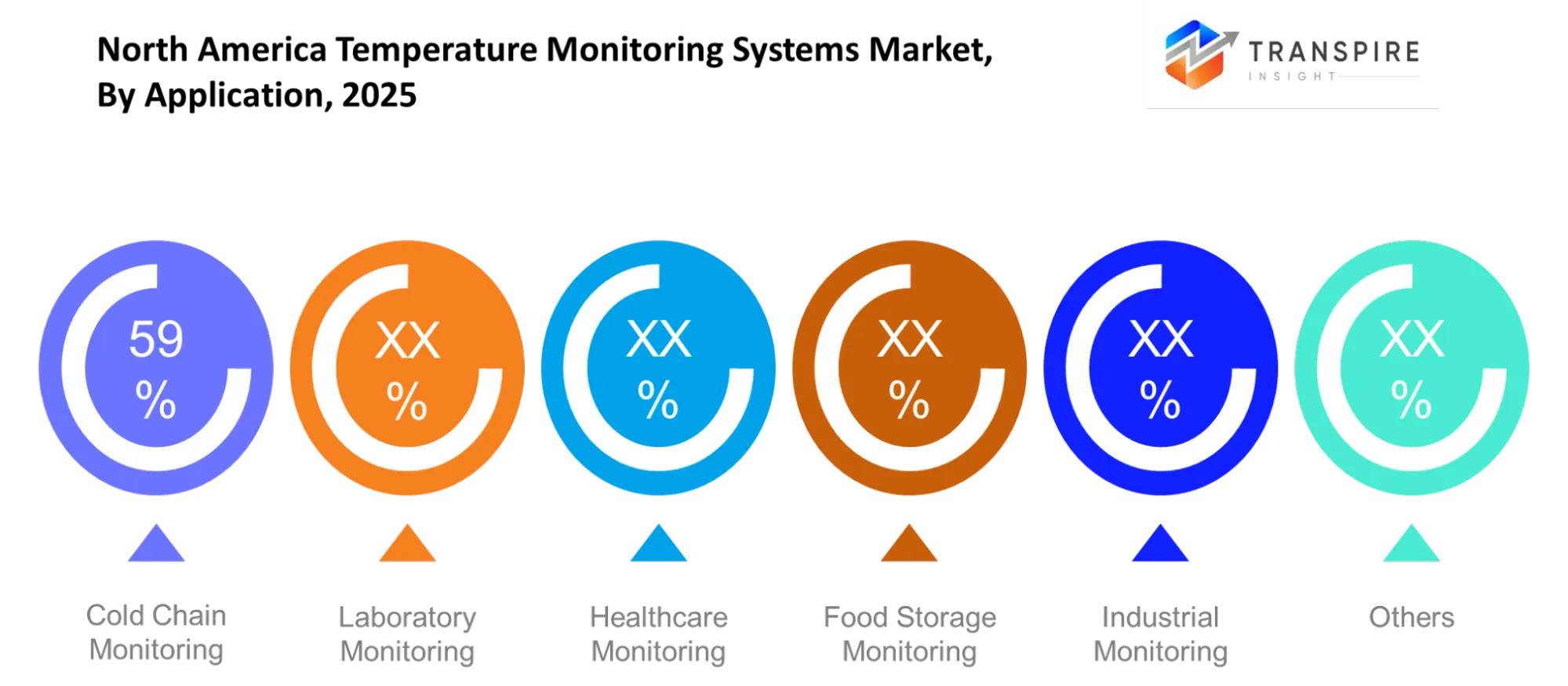
To learn more about this report, Download Free Sample Report
By End User
Pharmaceutical companies currently keep the biggest share, mainly due to tough compliance duties, the high risk attached to valuable stock, and their dependency on temperature sensitive biologics. The food and beverage sector forms a large user group as well , with adoption moving forward as automated monitoring systems become more common to reduce spoilage losses. Hospitals and laboratories stay in steady demand too , since they need controlled storage conditions and they undergo regular regulatory audits.
Growth in this segment is kind of driven by increasing regulatory enforcement and rising financial exposure tied to temperature excursions, sort of yeah. At the same time pharmaceutical supply chains have moved toward continuous digital validation after stricter traceability mandates came in. Food producers too are shifting away from periodic inspection models, and toward sensor based monitoring which helps operational reliability stay more consistent.
During the forecast period, pharmaceutical users will stay dominant, while food and beverage companies will show faster adoption momentum. Investment is expected to lean into integrated platforms that blend compliance reporting, analytics, and predictive alerts. Vendors will end up competing on system interoperability, and also the ease of deployment across more complex end user settings, not just one.
By Technology
Wi-Fi monitoring systems keep a strong position, mainly because they still fit well with existing infrastructure in commercial spaces and healthcare facilities. RFID based systems continue supporting asset tracking in logistics and other inventory heavy environments, where identification and temperature logging happen at the same time. Bluetooth monitoring systems are picking up now, for localized uses like hospital storage rooms and short range transport, where distance matters less.
Growth here happens because companies actually want flexible deployment models that cut installation costs, and at the same time make scaling easier, or you know more realistic. In practice, Wi-Fi systems ride on enterprise familiarity so people are comfortable rolling them out, while RFID solutions pick up momentum in supply chain visibility type use cases. Bluetooth adoption also keeps rising especially for last-mile monitoring where low power consumption is absolutely essential.
Looking ahead, expansion will lean toward hybrid architectures that combine Wi-Fi with RFID, plus Bluetooth and then wrap it with cloud integration layers. Technology providers will likely focus on interoperability—like smooth cooperation between components—and energy efficient sensors to enable continuous monitoring without overheating batteries or anything. On top of that, advanced protocols will keep improving so they can support real-time analytics more often, which in turn strengthens operational reliability across critical environments.
What are the Key Use Cases Driving the North America Temperature Monitoring Systems Market?
Cold chain monitoring is becoming the big reason everyone adopts this because pharma companies and food logistics operators are kinda strict about temperature control for vaccines, biologics, and other perishable goods. With continuous tracking, the risk of spoilage goes down, and it also helps meet compliance things like FDA FSMA 204 traceability across the whole distributed storage and transport web. Honestly this use case pulls the most interest, since even small temperature swings can turn into big financial hits and regulatory trouble.
Healthcare storage monitoring, plus lab environments are also growing fast, especially in hospitals and diagnostic labs that handle sensitive biological samples and lab reagents. Food and beverage manufacturers use real-time monitoring too, not just for checks but to reduce waste during processing, and again during last-mile delivery, and then they connect the temperature information to quality assurance systems. All together these applications are making adoption stronger with institutional end users.
Newer use cases are showing up as well, like fleet integrated telematics for refrigerated transport vehicles, or AI driven predictive maintenance inside industrial refrigeration systems. Even marine and remote logistics operators are starting to bring in connected monitoring for long-haul temperature sensitive shipments. This direction should scale over time as connectivity improves and analytics become more capable, so the value feels more obvious.
|
Report Metrics |
Details |
|
Market size value in 2025 |
USD 774 Million |
|
Market size value in 2026 |
USD 843 Million |
|
Revenue forecast in 2033 |
USD 1532 Million |
|
Growth rate |
CAGR of 8.91% from 2026 to 2033 |
|
Base year |
2025 |
|
Historical data |
2021 - 2024 |
|
Forecast period |
2026 - 2033 |
|
Report coverage |
Revenue forecast, competitive landscape, growth factors, and trends |
|
Regional scope |
North America (Canada, The United States, and Mexico) |
|
Key company profiled |
Emerson Electric, Honeywell, Sensitech, Monnit, Testo, Dickson, Thermo Fisher Scientific, Vaisala, ELPRO, Berlinger & Co., Omega Engineering, Rotronic, Signatrol, Tive, Controlant |
|
Customization scope |
Free report customization (country, regional & segment scope). Avail customized purchase options to meet your exact research needs. |
|
Report Segmentation |
By Product Type (Wireless Monitoring Systems, Digital Monitoring Systems, Cloud-based Systems, IoT-enabled Systems, Others); By Application (Cold Chain Monitoring, Laboratory Monitoring, Healthcare Monitoring, Food Storage Monitoring, Industrial Monitoring, Others); By End User (Hospitals, Pharmaceutical Companies, Laboratories, Food & Beverage Industry, Others); By Technology (RFID-based Systems, Bluetooth Monitoring, Wi-Fi Monitoring, Others) |
Which Regions are Driving the North America Temperature Monitoring Systems Market Growth?
North America sort of leads the temperature monitoring systems market , mostly because its industrial setup is highly regulated and it has an advanced cold chain backbone. In practice, the United States pulls the most weight since FDA enforcement tied to FSMA 204, plus tight pharmaceutical temperature handling rules, pushes for continuous tracking that is auditable. Big logistics networks, solid port connectivity , and a high level of IoT-enabled monitoring in warehouses and on fleets keep reinforcing that position. On top of that, well known technology providers and fairly mature cloud infrastructure make it easier to roll out solutions quickly and integrate them across healthcare , food, and industrial environments.
Europe comes next as a steady but different sort of contributor, with support from consistent regulatory alignment under GDP expectations and older cold chain habits that show up in cross border trade. But compared with North America , here the momentum is less about fast digitization and more about incremental improvements to standardized compliance systems across national markets that are kind of fragmented. Energy-efficiency mandates, plus sustainability reporting obligations, drive ongoing investment in temperature monitoring. Ship operators and logistics companies also lean toward reliability, interoperability, and compatibility, so demand tends to stay firm without big spikes or sharp dips.
Asia Pacific is the fastest grower, mainly due to the quick expansion of pharmaceutical production in India and China, along with the broad modernization of refrigerated logistics infrastructure. Lately, investments in smarter ports and cold chain corridors have improved the handling of temperature-sensitive cargo. Export volumes for vaccines and other perishable goods are climbing, and since 2022, that has really accelerated the uptake of digital monitoring. For market entrants, this region offers high-volume expansion potential through partnerships with logistics providers and healthcare distributors through 2033.
Who are the Key Players in the North America Temperature Monitoring Systems Market and How Do They Compete?
The competitive landscape of the North America Temperature Monitoring Systems Market is kinda moderately consolidated, with a blend of global industrial tech leaders and more specialized cold chain monitoring providers going after enterprise deals. Lately, the fight has kinda moved off pure hardware pricing, and more toward integrated digital ecosystems, you know combining IoT sensing with cloud analytics plus compliance automation, in one flow. Established players try to hang on by pushing deeper interoperability with logistics platforms and healthcare compliance tools. At the same time, newer companies lean into narrow use cases like real-time vaccine tracing and fleet-based refrigeration oversight. Also, service models that bundle software subscriptions together with hardware deployment have become the real differentiator, not just the device itself.
Emerson Electric tends to emphasize industrial IoT-enabled monitoring systems, focused on cold chain logistics integration, and they use predictive analytics to lower equipment failures and, extend service agreements across big distribution networks. Honeywell International leans hard into high-reliability sensor systems, with strong regulatory certifications, which supports adoption in pharmaceutical and aerospace-linked storage settings where compliance accuracy is basically non negotiable. Sensitech, a Carrier company, focuses on pharmaceutical cold chain visibility solutions and relies on deep partnerships with worldwide logistics providers to win vaccine and biologics monitoring contracts. Siemens AG distinguishes itself with edge computing and digital twin integration, linking temperature data to wider industrial automation frameworks. Danfoss instead prioritizes refrigeration system integration and energy efficiency optimization, aiming at facilities that want to cut operating costs while still holding tight temperature stability benchmarks.
Company List
- Emerson Electric
- Honeywell
- Sensitech
- Monnit, Testo
- Dickson
- Thermo Fisher Scientific
- Vaisala
- ELPRO
- Berlinger & Co.
- Omega Engineering
- Rotronic
- Signatrol
- Tive
- Controlant
Recent Development News
“In April 2026, Honeywell announced the sale of its Warehouse and Workflow Solutions (WWS) business to American Industrial Partners (AIP). This divestiture reshapes Honeywell’s automation and sensing portfolio, streamlining its industrial monitoring focus while maintaining its presence in temperature and environmental sensing technologies used across North American logistics and manufacturing systems.https://www.prnewswire.com
In July 2025, Honeywell announced the acquisition of Nexceris’ Li-ion Tamer business.
The deal adds advanced lithium-ion battery temperature and off-gas monitoring technology to Honeywell’s fire life safety and industrial sensing portfolio, strengthening its position in critical temperature and thermal-risk monitoring for energy storage and data center applications in North America.http://www.honeywell.com
What Strategic Insights Define the Future of the North America Temperature Monitoring Systems Market?
The North America Temperature Monitoring Systems Market is shifting toward pretty much fully autonomous, software-defined monitoring ecosystems, where the hardware sensors, they mostly act like data nodes inside bigger AI-driven compliance networks. In the next 5 to 7 years, the growth path is likely to be steered by regulatory digitization and supply chain transparency rules that push companies to move away from reactive tracking and toward continuous predictive assurance across pharmaceuticals, food logistics and industrial storage.
There’s also a risk that is less visible, it’s this growing platform concentration , where a small group of cloud and industrial IoT providers end up controlling the data infrastructure. That situation builds dependency risk for end users and also opens the door to pricing pressure, or interoperability limits that can slow down how fast organizations adopt new innovations.
At the same time, an emerging opportunity is pairing temperature monitoring with carbon accounting platforms, especially in cold chain logistics, where energy usage and spoilage reduction are being jointly tuned. Early pilots in refrigerated transport fleets are showing solid promise for dual reporting , meaning sustainability metrics alongside safety requirements. Market players should really favor open architecture platforms that slot in cleanly with ESG reporting and enterprise resource planning systems , so they can capture longer term contract value without friction.
North America Temperature Monitoring Systems Market Report Segmentation
By Product Type
- Wireless Monitoring Systems
- Digital Monitoring Systems
- Cloud-based Systems
- IoT-enabled Systems
- Others
By Application
- Cold Chain Monitoring
- Laboratory Monitoring
- Healthcare Monitoring
- Food Storage Monitoring
- Industrial Monitoring
- Others
By End User
- Hospitals
- Pharmaceutical Companies
- Laboratories
- Food & Beverage Industry
- Others
By Technology
- RFID-based Systems
- Bluetooth Monitoring
- Wi-Fi Monitoring
- Others
Frequently Asked Questions
Find quick answers to common questions.
The Expected North America Temperature Monitoring Systems Market size is USD 1532 Million in 2033.
Key Segments for the North America Temperature Monitoring Systems Market are By Product Type (Wireless Monitoring Systems, Digital Monitoring Systems, Cloud-based Systems, IoT-enabled Systems, Others); By Application (Cold Chain Monitoring, Laboratory Monitoring, Healthcare Monitoring, Food Storage Monitoring, Industrial Monitoring, Others); By End User (Hospitals, Pharmaceutical Companies, Laboratories, Food & Beverage Industry, Others); By Technology (RFID-based Systems, Bluetooth Monitoring, Wi-Fi Monitoring, Others).
Major North America Temperature Monitoring Systems Market Players are Emerson Electric, Honeywell, Sensitech, Monnit, Testo, Dickson, Thermo Fisher Scientific, Vaisala, ELPRO, Berlinger & Co., Omega Engineering, Rotronic, Signatrol, Tive, Controlant.
The Current North America Temperature Monitoring Systems Market size is USD 774 Million in 2025.
The North America Temperature Monitoring Systems Market CAGR is 8.91% from 2026 to 2033.
- Emerson Electric
- Honeywell
- Sensitech
- Monnit, Testo
- Dickson
- Thermo Fisher Scientific
- Vaisala
- ELPRO
- Berlinger & Co.
- Omega Engineering
- Rotronic
- Signatrol
- Tive
- Controlant
About the Authors

Mayur Shinde
I am Mayur Shinde, a Senior Research Analyst at Transpire Insight, specializing in the Automotive & Transportation and Information & Communication Technology (ICT) Industry. My work focuses on analyzing emerging market trends, technological advancements, competitive landscapes, and industry developments to deliver accurate, data-driven insights. I am passionate about transforming complex market information into clear, actionable content that helps businesses, professionals, and decision-makers stay informed and make confident strategic decisions.

Chakradhar Khansole
Chakradhar serves as the Research Director at Transpire Insight, bringing over 8 years of experience in technology, innovation, and strategic market intelligence. He specializes in transforming complex market data into actionable business insights that enable organizations to make informed, growth-oriented decisions. Recognized for his strategic vision and analytical expertise, Chakradhar leads high-impact research initiatives, delivering comprehensive market assessments, competitive intelligence, and forward-looking industry analysis.
Recently Published Reports
-
Apr 2026
3D Optical Profiler Market
3D Optical Profiler Market Size, Share & Analysis Report By Type (Desktop 3D Optical Profiler, and Portable 3D Optical Profiler), By Technology (Confocal Technology, and White Light Interference), By End-Use Industry (Manufacturing, Research Institutions, Automotive, Aerospace and Defense, Medical Devices, and Other), and Geography (North America, Europe, Asia-Pacific, Middle East and Africa, South and Central America), 2021 - 2031
-
Apr 2026
Depth Sensor Market
Depth Sensor Market Size, Share & Analysis Report By Type (Infrared Depth Sensors, Time-of-Flight (ToF) Sensors, Stereo Vision Sensors, Structured Light Sensors, Ultrasonic Depth Sensors), By Application (Automotive, Robotics, Gaming, Consumer Electronics, Industrial Automation, Healthcare, Security & Surveillance, Others), By End Users (Automotive Manufacturers, Consumer Electronics Companies, Healthcare Providers, Industrial Companies, Security Agencies, Gaming Companies, Robotics Companies, Others), and Geography (North America, Europe, Asia-Pacific, Middle East and Africa, South and Central America), 2021 – 2031
-
Apr 2026
Digital Manufacturing Market
Digital Manufacturing Market Size, Share & Analysis Report By Component (Hardware, Software, and Services), By Technology (Robotics, 3D Printing, Internet of Things (IoT), and Others), By Application (Automotive and Transportation, Aerospace and Defense, Consumer Electronics, Industrial Machinery, and Others), By Process Type (Computer-Based Designing, Computer-Based Simulation, Computer 3D Visualization, Analytics, and Others), and Geography (North America, Europe, Asia-Pacific, Middle East and Africa, South and Central America), 2021 – 2031
-
Apr 2026
Digital Visa Services Market
Digital Visa Services Market Size, Share & Analysis Report By Type (Individual Travelers, Group Travelers), By Application (Tourism, Business Travel, Others), and Geography (North America, Europe, Asia-Pacific, Middle East and Africa, South and Central America), 2021 – 2031