
Global Temperature Data Logger Market Size & Forecast:
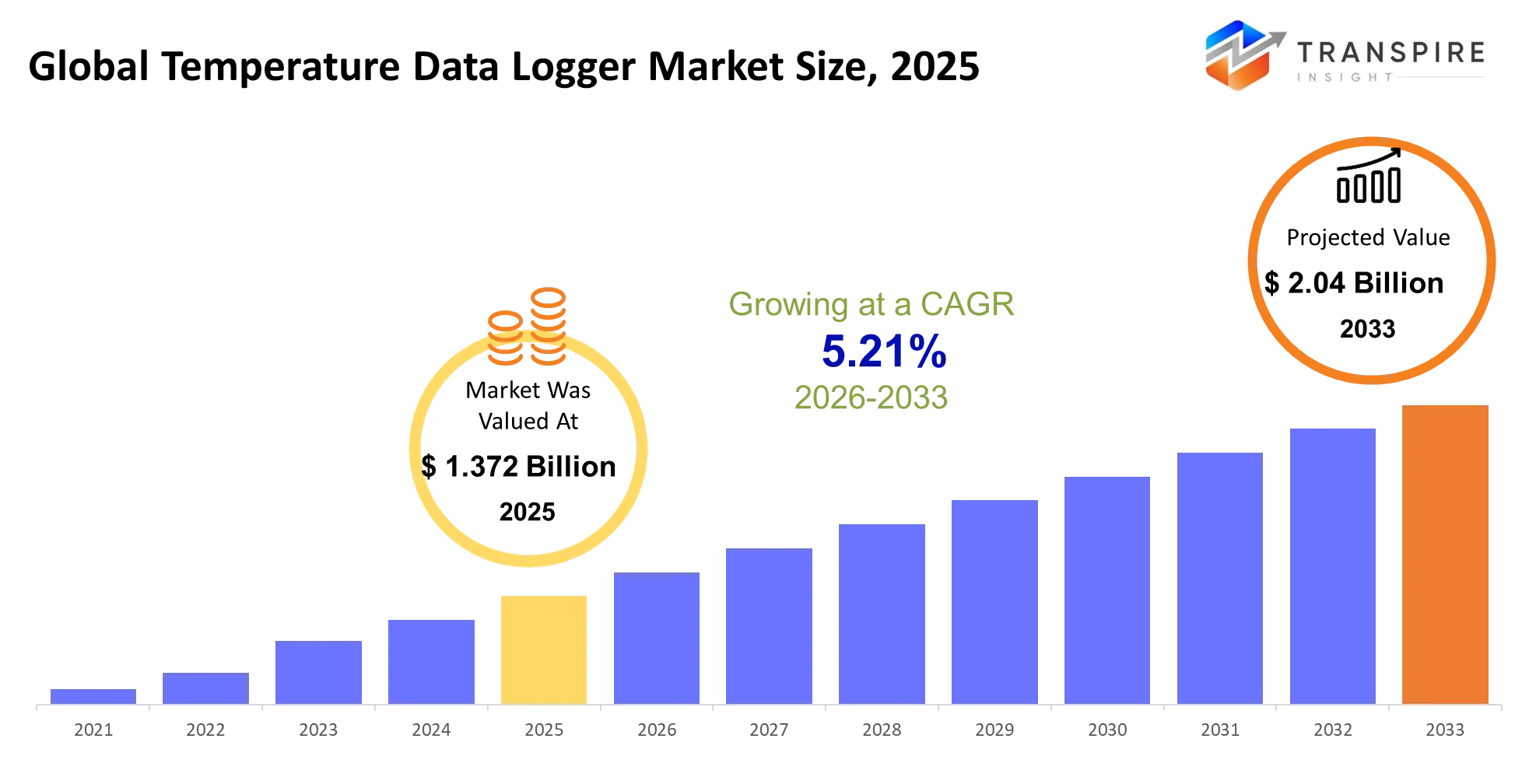
- Global Temperature Data Logger Market Size 2025: USD 1.372 Billion
- Global Temperature Data Logger Market Size 2033: USD 2.04 Billion
- Global Temperature Data Logger Market CAGR: 5.21%
- Global Temperature Data Logger Market Segments: By Type (USB Loggers, Wireless Loggers, Multi-use, Single-use), By Application (Pharma, Food, Logistics, Healthcare), By End-User (Pharma Companies, Food Industry, Logistics Firms, Hospitals)
To learn more about this report,  Download Free Sample Report
Global Temperature Data Logger Market Summary:
The Global Temperature Data Logger Market size is estimated at USD 1.372 billion in 2025 and is anticipated to reach USD 2.04 billion by 2033, growing at a CAGR of 5.21% from 2026 to 2033. The increasing demand for real-time and accurate temperature monitoring across industries like pharmaceuticals, food & beverages, chemicals, and logistics is driving remarkable growth in the temperature data logger market. This equipment assists companies in maintaining the quality of their items and cutting down losses in the course of storage and transportation. The increasing significance of cold chain management and safety compliance is contributing to the rise in advanced monitoring solutions being adopted across various industries.
The storage and transportation of sensitive medical products like vaccines and biological medicines have been regulated by several organizations in the United States and Europe, including the FDA, WHO, and the EU Good Distribution Practices (GDP). Due to these regulations, companies are increasingly employing temperature data loggers to continuously monitor the temperature conditions and ensure that their products are safe and effective all the way through the supply chain.
Europe currently leads the market, with the temperature data logging market accounting for 37% share of the global market, as it has a strict regulatory environment, advanced cold chain infrastructure, and a strong pharmaceutical industry. The region of North America is projected to witness the highest growth rate as investments are made towards biologic, smart healthcare logistics, AI system-based monitoring, and connected cold chain technologies. The growing adoption of wireless and cloud-based temperature monitoring solutions is also driving the market growth in developed and emerging economies.
Key Market Insights:
- Nearly 37% of the global market share has been captured by Europe owing to the stringent regulatory requirements of the European GDP and the strong infrastructure of the pharmaceutical cold chain.
- North America is expected to grow at a CAGR of around 13.9% because of increasing biologics production and smart healthcare logistics.
- Pharmaceutical use makes up a significant portion of the market due to the need for vaccine and biologic transport and storage under stringent conditions.
- Cloud-based, real-time tracking has become the preferred system over traditional USB logging and is growing at a much faster pace than wireless. Testo and Vaisala are targeting IoT-connected monitoring devices for the connected cold chain.
- Temperature loggers used for single use are gaining a lot of popularity in the pharmaceutical sector, as they offer a reduction in contamination risk, and there is no need to recalibrate.
- The food and beverage sector now has a growing appetite for temperature data loggers to enhance food safety and minimise food waste during cold chain transportation.
- Investments in cold chain infrastructure and expansion of the pharmaceutical manufacturing industry by the governments are driving the region to become a strong growth region in the Asia-Pacific.
- AI and machine learning are becoming commonplace in companies' temperature monitoring solutions, helping to anticipate temperatures before they occur.
What are the Key Drivers, Restraints, and Opportunities in the Global Temperature Data Logger Market?
The market is shifting because governments have drastically tightened safety laws for shipping sensitive items like insulin and mRNA vaccines. What triggered this change was a major warning from the World Health Organization showing that nearly 25% of vaccines were arriving damaged due to poor cooling during transit. To fix this, tech companies like Sensitech and Qualcomm collaborated to build loggers with 5G live tracking. This directly impacts revenue because companies are moving away from cheap, one-time use indicators and investing heavily in premium, internet-connected software bundles that can text a driver the exact second a shipping box starts getting warm.
The market is evolving due to the significant and extreme tightening of safety requirements for the shipment of sensitive products, such as insulin and mRNA vaccines, by governments. The reason for this shift was a significant report from the World Health Organization (WHO) that almost a quarter of vaccines were damaged as a result of inadequate cooling during transportation. To solve this, tech brands such as Sensitech and Qualcomm have come together to develop loggers with 5G live tracking. That directly affects revenue as companies attack the cheap, single-use indicators, and are spending big bucks on premium internet-connected software packages that can text a driver the exact moment a shipping box begins to get hot.
Growth is stalling as the raw materials needed to build these devices are in short supply globally. In fact, lithium carbonate has risen to become a very expensive commodity, with a price of around $28,000 per metric ton, due to the demand of electric vehicle manufacturers for all of the lithium carbonate available. This is an ongoing structural issue because single-use logger brands require specialized lithium batteries 100% of the time to operate in cold conditions. As a result, production costs have risen by more than 50% for companies such as Berlinger, and they have had to reduce their profit margins because smaller logistics companies can't cover the increased costs.
The next wave of growth will be the dramatic emergence of an app-based, touch-free scanning system in local food delivery systems. One example of this is the Asia-Pacific region, where countries are introducing local cold-chain regulations for online grocery apps. Companies can now utilize Bluetooth Low Energy (BLE) loggers, instead of opening a delivery truck door and allowing hot air to enter. The technology makes it possible for a driver to take a look at the temperature of an entire food delivery shipment via the driver's own smartphone screen, while the box remains sealed. This technology makes it possible for a driver to check out the temperature of an entire delivery, without ever opening the box, opening up a massive new market for technology upgrades in everyday food logistics.
What Has the Impact of Artificial Intelligence Been on the Global Temperature Data Logger Market?
Artificial intelligence is changing the temperature data logger market by making monitoring systems smarter and more automated. Temperature loggers used to merely collect data earlier, but today AI-powered systems are able to analyze temperature trends in real time and promptly identify anomalous changes. In the food, pharmaceutical, and cold chain industries, where even slight temperature changes might injure goods, this is extremely helpful. AI-based monitoring systems are assisting businesses in maintaining regulatory compliance and enhancing product safety.
By decreasing manual labor and improving monitoring precision, AI is also enhancing day-to-day operations. Without the need for human interaction, contemporary IoT-enabled temperature data loggers may automatically gather data, send alarms, and produce cloud-based reports. AI is being used by businesses to improve cold storage, shipping tracking, and warehouse management, which saves time and minimizes product losses. Businesses can react more quickly when temperature conditions deviate from safe bounds because of real-time monitoring technologies.
One of the biggest advantages of AI is predictive monitoring. AI systems are able to analyze historical temperature data and forecast potential temperature irregularities before they occur. This enables businesses to take proactive measures and keep food products, biologics, vaccines, and other temperature-sensitive items from spoiling. As a result, companies can boost operational effectiveness, lower financial losses, and enhance supply chain dependability.
Key Market Trends:
- Physical cables for downloading shipment history have been discontinued for fleet drivers. They are moving to touchless mobile applications with Bluetooth Low Energy (BLE) to scan cold boxes safely from behind truck walls.
- Manufacturers are phasing out older battery designs as they must sell the batteries at a loss due to rising lithium prices.
- The Global pharmaceutical companies are implementing hardware recycling initiatives under their companies' carbon reduction mandates, under the guidance of their manufacturers.
- Supply chain companies are hesitant to spend a large amount of money initially on new hardware and monitoring equipment. They are moving to a subscription model.
- Freight monitoring has moved beyond the “backward-looking” approach of reviewing trip history.
- Nowadays, companies deploy live cloud automation with localized text alerts that deliver real-time alerts within 90-seconds when the temperature of a transit line exceeds safety limits.
- Closed proprietary data software has been phased out of the warehouse business.
- Food and medical processors have outgrown cumbersome and external equipment.
Global Temperature Data Logger Market Segmentation
By Type
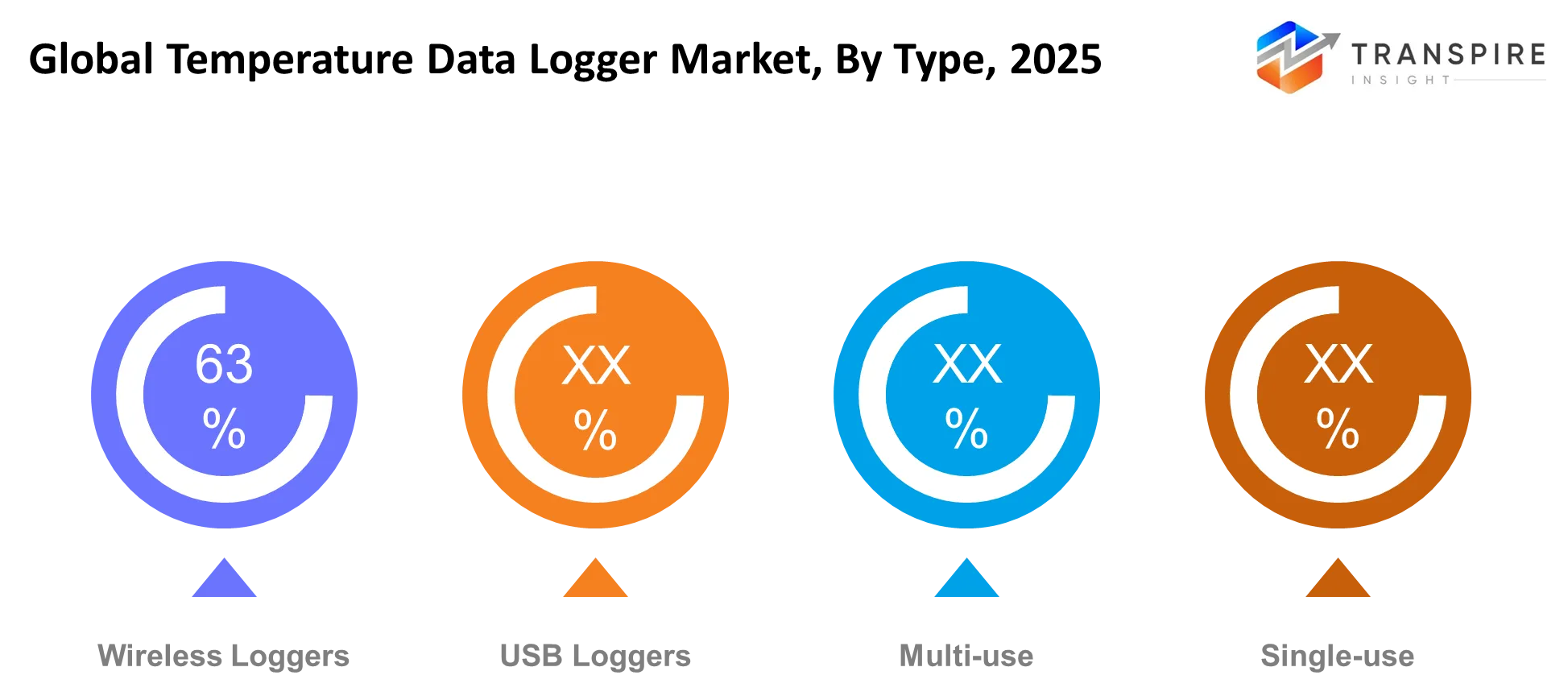
USB loggers continue to hold a strong position in the temperature data logger market, with 48% share. They can be used widely across regulated industries such as food storage and pharmaceuticals, and are affordable and easy to operate. The devices can be used to record temperature data and transfer it to another device without an internet connection, which makes them suitable for the traditional cold chain monitoring demand.
As industries continue to seek real-time monitoring, automated alerts, and cloud-based tracking, wireless loggers are the fastest-growing segment with a CAGR of 12.4%. They are driving the adoption of remote supervision in warehouse, transport, and healthcare management. Multi-use loggers have remained in the market because they are cost-effective, can be used repeatedly for monitoring, particularly in industrial and laboratory settings, and last long.
A single-use logger is gaining momentum with a share of 11% in the pharmaceutical shipment industry due to its elimination of the need for small adjustments and the lower risk of contamination when transporting vaccines and biologics. The market will move increasingly towards wireless and smart IoT solutions for single-use in highly regulated cold chain operations in the future.
To learn more about this report, Download Free Sample Report
By Application
The pharmaceutical industry is one of the most prominent industries because it deals with medicines, vaccines, and biological products that can be damaged if they are kept at the wrong temperature. To keep these products safe and effective, companies must carefully monitor the temperature while storing and transporting them around the world. By constantly monitoring the products throughout the entire supply chain, companies can ensure regulatory compliance and product quality.
Another large application space is the food industry, where food manufacturers and distributors are increasingly concerned with food safety, shelf-life management, and cold storage efficiencies. With the development of global cold chain transportation and e-commerce delivery networks, logistics applications are expanding rapidly and require various parts to be monitored in real-time during delivery.
The healthcare industry is also gaining significant importance in the application of temperature-controlled environments, as hospitals, blood banks, and diagnostic laboratories depend on temperature-controlled environments for the protection of medicines, samples, and medical equipment. The reasons for each application segment growth are different: pharmaceuticals-compliance, food- safety regulations, logistics expansion of supply chain, healthcare- patient safety requirements. The demand from the pharmaceutical cold chains and smart logistics networks is likely to drive the next wave of growth in the market going forward.
By End-User
The pharma companies continue to be the biggest end-users in the temperature data logger market as they manage highly sensitive products that demand precise monitoring during production, storage, and transportation. International guidelines for biologics and vaccines remain even more stringent in promoting investment in advanced monitoring systems.
The food industry is another big end-user, as food spoilage, contamination prevention, and adherence to food safety standards are emerging as key concerns. In the pharmaceutical, food, and specialty chemical sectors, as international trade and cold chain logistics grow, logistics companies are becoming crucial customers.
Hospitals are also important consumers of the markets since temperature management is essential for the storage of vaccines, blood banks, laboratory testing, and medicine. The growth logic varies from one end-user to another: compliance and product integrity are key for pharma companies, quality assurance for food industries, operational visibility for logistics companies, and patient safety for hospitals. Digital healthcare infrastructure and connected supply chains are anticipated to boost the use of temperature monitoring solutions based on cloud and AI technology in the future across all end-user segments.
What are the Key Use Cases Driving the Global Temperature Data Logger Market?
The biggest use of temperature data loggers is in the pharmaceutical industry. Medicines, vaccines, and biologic products must be stored and transported within a specific range of temperatures. Companies can use temperature data loggers to monitor temperature continuously and avoid damaging products. The increasing need for cold chain monitoring in the pharma industry is closely related to this use case.
The market is also growing in the food and logistics sectors. Temperature loggers are used in the food industry to ensure the safety of dairy products, frozen foods, meat, and beverages while in transit and during storage. Logistics firms use these gadgets to track packages inside trucks, containers, and warehouses. Blood samples, medicines, and medical supplies are also stored safely by hospitals and laboratories using temperature loggers.
With smart warehouses and a connected supply chain, new use cases have appeared. Numerous businesses are using wireless and cloud-based temperature monitoring systems that alert them in real time and allow them to access the system remotely. Advanced temperature monitoring solutions are being adopted by various industries for their convenience, to ensure product safety and quality, and to minimize losses, including biotechnology, e-commerce, grocery delivery, and healthcare research.
Report Metrics
|
Report Metrics |
Details |
|
Market size value in 2025 |
USD 1.372 Billion |
|
Market size value in 2026 |
USD 1.43 Billion |
|
Revenue forecast in 2033 |
USD 2.04 Billion |
|
Growth rate |
CAGR of 5.21% from 2026 to 2033 |
|
Base year |
2025 |
|
Historical data |
2021 - 2024 |
|
Forecast period |
2026 - 2033 |
|
Report coverage |
Revenue forecast, competitive landscape, growth factors, and trends |
|
Regional scope |
United States; Canada; Mexico; United Kingdom; Germany; France; Italy; Spain; Denmark; Sweden; Norway; China; Japan; India; Australia; South Korea; Thailand; Brazil; Argentina; South Africa; Saudi Arabia; United Arab Emirates |
|
Key company profiled |
Testo, Thermo Fisher, Omega Engineering, Sensitech, Rotronic, Dickson, ELPRO, DeltaTrak, Onset, Lascar, MadgeTech, Vaisala, Fluke, Hioki, Honeywell |
|
Customization scope |
Free report customization (country, regional & segment scope). Avail customized purchase options to meet your exact research needs. |
|
Report Segmentation |
By Type (USB Loggers, Wireless Loggers, Multi-use, Single-use), By Application (Pharma, Food, Logistics, Healthcare), By End-User (Pharma Companies, Food Industry, Logistics Firms, Hospitals) |
Which Regions are Driving the Global Temperature Data Logger Market Growth?
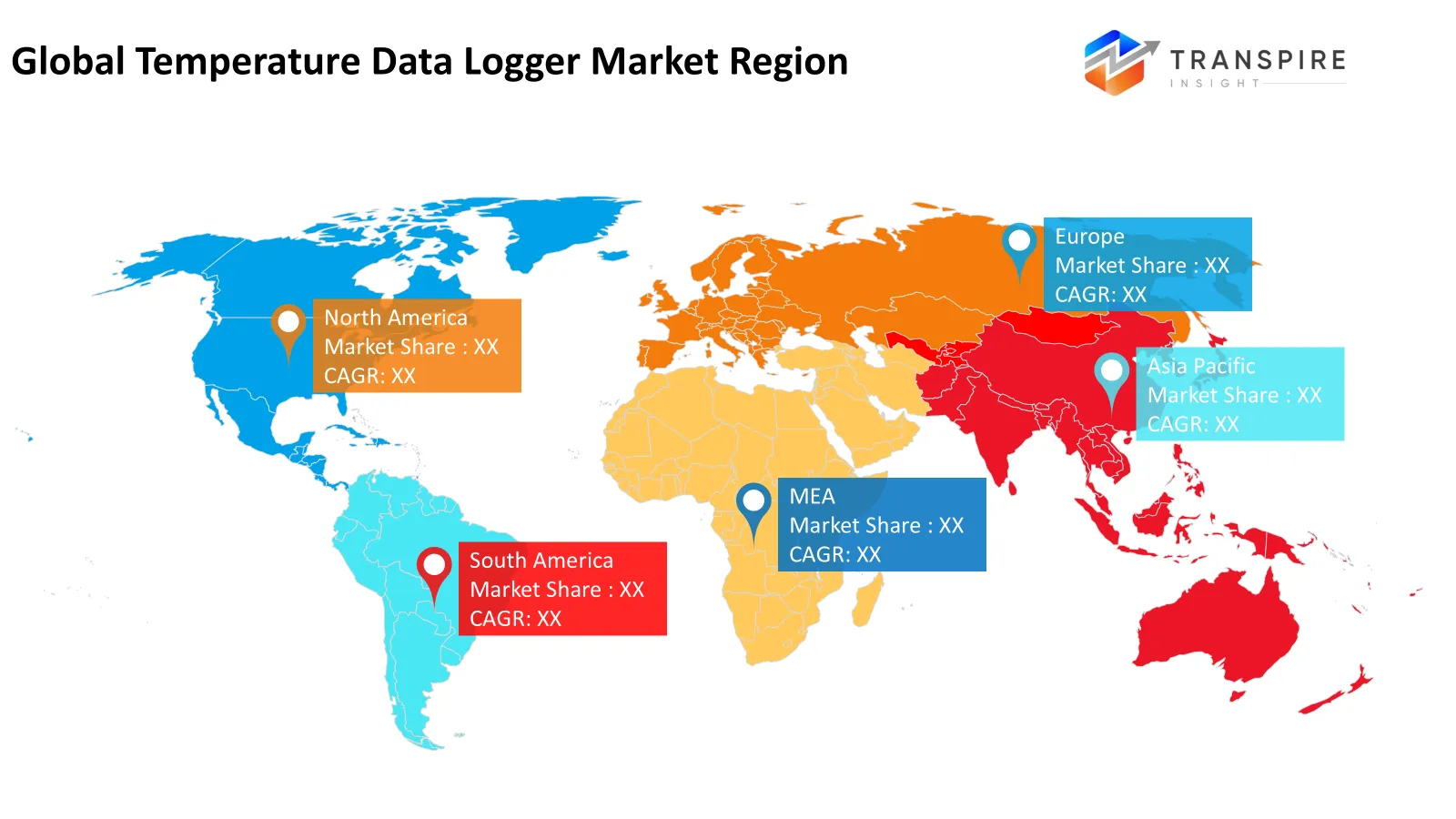
Europe is the dominating region with the largest share of 37%, because the region has very strict rules for pharmaceutical transportation and storage. Companies must track the temperature of medicines throughout the distribution process, as the European Union Good Distribution Practice (EU GDP) guidelines emphasize. This has led to greater adoption of sophisticated temperature data loggers for pharmaceutical warehouses, transport vehicles, and cold storage facilities. For example, the EU GDP guidelines clearly mention that temperature monitoring equipment used during transport must be regularly maintained and calibrated.
Asia-Pacific is the second-largest region, with a share of 21%. It is due to the fast growth of countries in the region's pharmaceutical manufacturing, food export, and distribution of vaccines. Although strict regulation is an important driver, growth in Asia-Pacific is also facilitated by the expansion of industries and government support for cold chain development. Indonesia, among other countries, is investing heavily in refrigerated products storage and transportation systems to aid in the health sector and minimise product waste. In Indonesia, among other countries, investments are made in the refrigerated storage of products and their transportation to enhance the delivery of healthcare services and to reduce product wastage. For example, the Government of India has enhanced cold chain facilities and buildings for vaccine storage in various states in India for transporting vaccines in large quantities as part of its COVID-19 vaccine distribution program.
North America is expected to be the fastest-growing region with a CAGR of 13.9% as the healthcare companies are increasingly adopting biologics, specialty drugs, and advanced therapy, which necessitate precise temperature monitoring. Since the pandemic, there has been a growing emphasis on regulatory activity, particularly from the U.S. Food and Drug Administration (FDA), which is still releasing guidance regarding biologics manufacturing, storage, and compliance systems. This has pushed the pharmaceutical companies and logistics service providers towards implementing a smart and real-time monitoring system for cold chain management. AI tools for monitoring, cloud-based logistics tracking, and the continued expansion of biologics and cell therapies in the United States will be the key drivers of growth in the future.
To learn more about this report, Download Free Sample Report
Who are the Key Players in the Global Temperature Data Logger Market and how do they Compete?
The temperature data logger market is competitive, as many businesses are investing in improving data logger precision, enabling real-time monitoring, and providing robust cold chain solutions. To expand its customer base across pharmaceuticals, food, and logistics, companies are also attempting to boost battery life, wireless connectivity, and cloud-based tracking systems. Certain brands rely on selling their products at an affordable price, and there are others that focus on high-tech solutions and industry-specific products. Competition is rapidly rising among various major players as industries are relying more and more on temperature-sensitive transportation and storage.
Testo focuses on innovation and market-proven monitoring solutions in the cold chain sector as its primary means of competition. Pharmaceutical, food, and warehouse temperature monitoring systems are key focuses for this company. It is used in a variety of products that are popular, due to their long battery life, high accuracy, and adherence to international safety standards (HACCP/EN 12830). Testo, Thermo Fisher Scientific, is primarily a provider of high-technology healthcare and laboratory monitoring solutions. With a strong life sciences and healthcare presence, the company offers temperature monitoring solutions for biologics, vaccines, and laboratory storage applications. The primary competition between Omega Engineering and Lascar Electronics is based on cost-effective and user-friendly monitoring devices for industrial/commercial users.
Sensitech, ELPRO, and Delta Trak are very committed to solutions for cold chain and pharmaceutical logistics. The companies compete based on providing real-time shipment monitoring, cloud-based monitoring, and compliance-driven systems for vaccines and temperature-sensitive products. Dickson, Rotonic, and Onset focus primarily on niche industrial and environmental monitoring applications. Meanwhile, Vaisala, Fluke, Honeywell, Hioki, and MadgeTech play across the board using precision measurement technology, industrial automation, and smart wireless monitoring systems to ensure high-performance industrial operations.
Global Global Temperature Data Logger Market Companies
- Testo
- Thermo Fisher
- Omega Engineering
- Sensitech
- Rotronic
- Dickson
- ELPRO
- DeltaTrak
- Onset
- Lascar
- MadgeTech
- Vaisala
- Fluke
- Hioki
- Honeywell
Recent Development News
In March 2026, ELPRO launched smarter cold chain monitoring solutions through its liberoMANAGER 3.0 platform. The company added real-time monitoring and advanced data analytics features to improve shipment tracking for temperature-sensitive pharmaceutical products. This development is helping logistics and healthcare companies reduce the risk of product damage and improve regulatory compliance. https://www.elpro.com
In April 2026, Copeland launched GO Real-Time GL and GL XL cargo trackers for temperature- and humidity-sensitive pharmaceutical and food shipments. The new solution improved real-time cold chain visibility and supported the growing adoption of smart monitoring technologies.
What Strategic Insights Define the Future of the Global Temperature Data Logger Market Growth?
Smart, connected, and AI-based temperature data loggers are expected to be the future of the temperature data logger market. There are some new loggers in the market that integrate wireless, cloud-based, and IoT technologies, which are helping the logistics sector to improve real-time tracking in fields such as the pharmaceutical, food, and cold chain. The market is also moving from temperature monitoring to predictive monitoring, enabling AI to predict potential failures before they cause damage. This shift should drive up the demand for advanced analytics and cold chain management automation solutions.
Increases in cybersecurity and data privacy concerns are one hidden risk in the market. With more monitoring devices going onto the cloud, companies can encounter risks associated with data breaches, system failures, and even issues with connectivity along the way. Another area of opportunity is the rising market for biologic drugs, vaccines, and personalized medicines that require high precision temperature control, in the meantime.
To stay competitive, companies should focus on AI integration, predictive analytics, and secure cloud-based monitoring platforms. The compliance with the regulatory requirement, real-time monitoring, and automated decision making are all part of a business that can be integrated into a single solution. Real-time monitoring, automated decision-making, and compliance support would be a significant market benefit to businesses.
Temperature Data Logger Market Segmentation
By Type
- USB Loggers
- Wireless Loggers
- Multi-use
- Single-use
By Application
- Pharma
- Food
- Logistics
- Healthcare
By End-User
- Pharma Companies
- Food Industry
- Logistics Firms
- Hospital
Frequently Asked Questions
Find quick answers to common questions.
The expected Global Temperature Data Logger Market size for the market will be USD 2.04 Billion in 2033.
Key segments for the Global Temperature Data Logger Market are By Type (USB Loggers, Wireless Loggers, Multi-use, Single-use), By Application (Pharma, Food, Logistics, Healthcare), and by End-user (Pharma Companies, Food Industry, Logistics Firms, Hospitals).
Major Global Temperature Data Logger Market players are Testo, Thermo Fisher, Omega Engineering, Sensitech, Rotronic, Dickson, ELPRO, DeltaTrak, Onset, Lascar, MadgeTech, Vaisala, Fluke, Hioki, and Honeywell.
The Global Temperature Data Logger Market size is USD 1.43 billion in 2026.
The Global Temperature Data Logger Market is expected to grow 5.21% during the forecast period.
- Testo
- Thermo Fisher
- Omega Engineering
- Sensitech
- Rotronic
- Dickson
- ELPRO
- DeltaTrak
- Onset
- Lascar
- MadgeTech
- Vaisala
- Fluke
- Hioki
- Honeywell
Recently Published Reports
-
Apr 2026
Fiber Optic Faceplates Market
Fiber Optic Faceplates Market Size, Share & Analysis Report By Type (< 300 mm2, 300-350 mm2, and > 350 mm2, By Application (Night Vision, Holographic Imaging, Medical, and Others), and Geography (North America, Europe, Asia-Pacific, Middle East and Africa, South and Central America), 2021 - 2031
-
Apr 2026
High Temperature Superconductors Market
High Temperature Superconductors Market Size, Share & Analysis Report By Type (1G HTS, and 2G HTS), By Application (Power Cable, Fault Current Limiter, and Transformer), and Geography (North America, Europe, Asia-Pacific, Middle East and Africa, South and Central America), 2021 - 2031
-
Apr 2026
Industrial Plugs and Socket Market
Industrial Plugs and Socket Market Size, Share & Analysis Report By Type (Industrial Plugs, Industrial Sockets), By Current (Up to 32 A, 32 to 125 A, Above 125 A), By Protection (Dustproof and Splash Proof, Waterproof, Explosion Proof), By End User (Heavy Industries, Oil and Gas, Chemicals and Pharmaceuticals, Power Generation, Others), and Geography (North America, Europe, Asia-Pacific, Middle East and Africa, South and Central America), 2021 - 2031
-
Apr 2026
InGaAs Avalanche Photodiodes Market
InGaAs Avalanche Photodiodes Market Size, Share & Analysis Report By Type (1100 - 1700 nm, and 1000 - 1600 nm), By Application (Missile Warning System, Muzzle Flash Detection, Wafer Defect Inspection, Laser Rangefinders, and Others), and Geography (North America, Europe, Asia-Pacific, Middle East and Africa, South and Central America), 2021 - 2031