
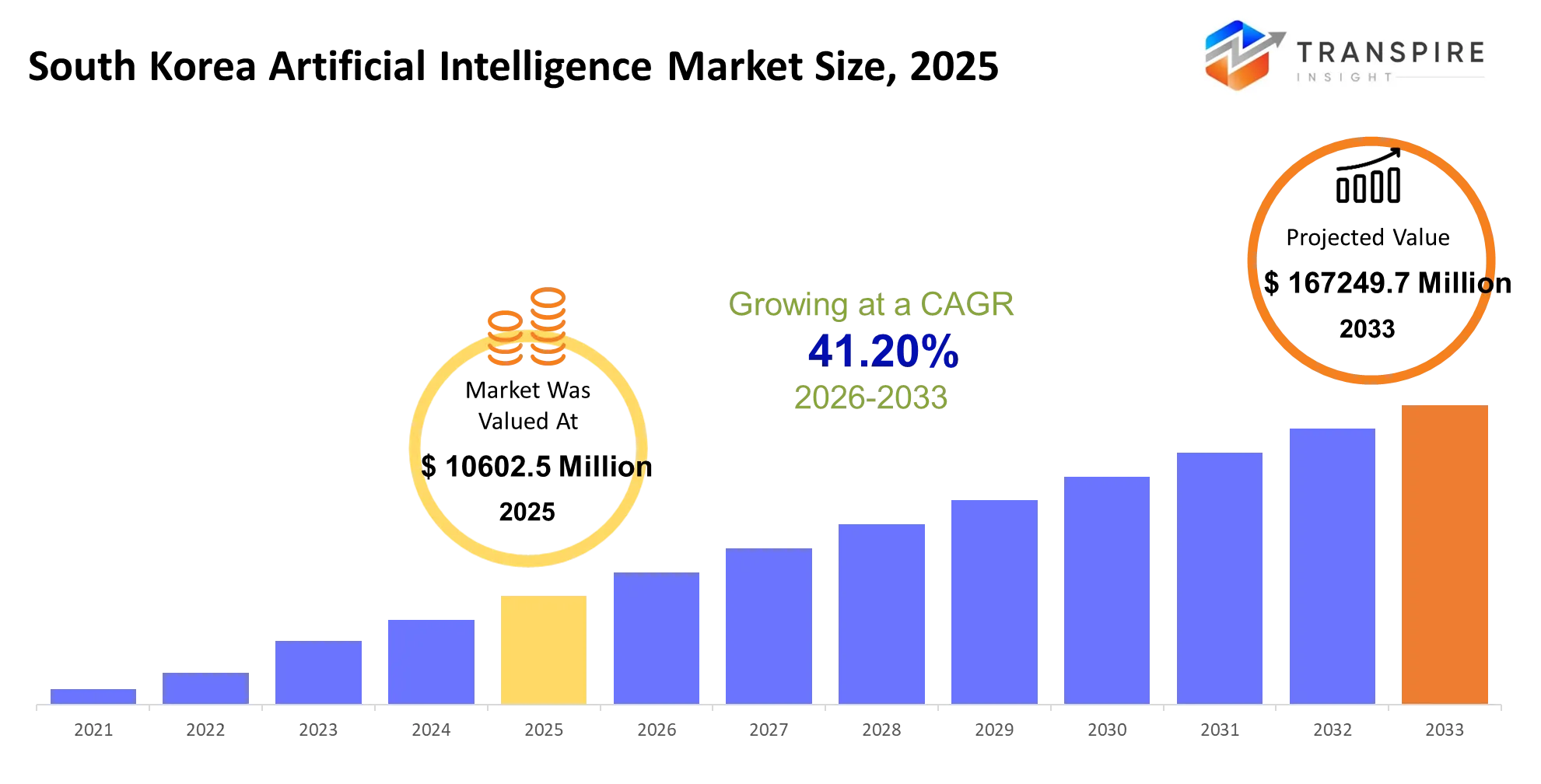
South Korea Artificial Intelligence Market Size & Forecast:
- South Korea Artificial Intelligence Market Size 2025: USD 10602.5 Million
- South Korea Artificial Intelligence Market Size 2033: USD 167249.7 Million
- South Korea Artificial Intelligence Market CAGR: 41.20%
- South Korea Artificial Intelligence Market Segments: By Technology (Machine Learning, Natural Language Processing, Computer Vision, Generative AI, Others); By Deployment (Cloud-based AI, On-premise AI, Hybrid AI, Others); By Application (Predictive Analytics, Virtual Assistants, Autonomous Systems, Fraud Detection, Others); By End User (Healthcare, BFSI, Retail, Manufacturing, Government, Others); By Enterprise Size (Large Enterprises, SMEs, Startups, Others)
To learn more about this report,  Download Free Sample Report
South Korea Artificial Intelligence Market Summary
The South Korea Artificial Intelligence Market was valued at USD 10602.5 Million in 2025. It is forecast to reach USD 167249.7 Million by 2033. That is a CAGR of 41.20% over the period.
The South Korea Artificial Intelligence Market, feels like it has moved past those early experiments and now it’s basically operating as a real core layer, running in manufacturing semiconductors, finance, telecom, healthcare and mobility environments too. In day to day work Korean enterprises are using AI for factory visual checks, it helps with chip architecture work, it improves network traffic flow, it personalizes digital commerce, and it speeds up enterprise choices— sometimes decisions that used to take days. Over the last five years the market has changed in a structural way, from cloud analytics first to more sovereign AI infrastructure, plus foundation model activity and AI-first data centers. That whole shift, really picked up after the global semiconductor supply chain hiccups and then after 2023 when generative AI became more mainstream and faster commercialized, so Korean firms started to lock in local computing capacity and also to cut down on relying too much on foreign platforms. On top of that, government supported AI funding tracks along with rapid expansion efforts by Samsung, SK Telecom, and Naver, are lifting the enterprise adoption pace. And as businesses start embedding AI right inside production operations and telecom frameworks, the spending pattern is going away from one-off trials, toward recurring income in infrastructure, software, and inference services.
Key Market Insights
- In 2025, the South Korea Artificial Intelligence Market kinda exceeded USD 10.6 billion, and it is forecast to get near USD 167.2 billion by 2033, mostly because enterprises are rolling out AI at scale.
- The Seoul metropolitan region actually brought in more than 55% of overall market revenue in 2025, not surprisingly, due to concentrated AI infrastructure plus venture financing, and also those hyperscale cloud investments
- Busan and Incheon became the quickest, new kind of regional centers, with smart port automation and logistics AI spending increasing more than 30% during 2024–2026, which sounds quite aggressive, but yep
- Generative AI platforms made up almost 35% of enterprise AI software spend in 2025, since many Korean firms sped up putting AI copilots to work, along with their own proprietary language models
- Meanwhile AI infrastructure and GPU computing kept growing at above 45% per year since 2024, pushed by sovereign AI programs, and domestic data center building efforts, so yeah, it’s been steady
- Manufacturing still held above a 30% application footprint in 2025, powered by predictive maintenance, semiconductor defect review, and AI-enabled robotics optimization systems
- Healthcare AI adoption grew more than 40% each year after 2024, especially through imaging diagnostics, AI-assisted drug discovery, and workflow automation programs in hospitals
- Telecom operators such as SK Telecom, KT Corporation, and LG Uplus increased AI infrastructure investment by over 25% across the 2025–2026 transformation programs, in a pretty noticeable way
- Samsung Electronics, Microsoft, Google, NVIDIA, and Amazon Web Services are getting more competitive, mainly via AI chips, deeper enterprise AI integration, and cloud partnership deals
- Korean-language large language models, along with sovereign AI platforms, started gaining serious traction after 2024, because enterprise demand for localized, compliance focused AI solutions rose by more than 50%
What are the Key Drivers, Restraints, and Opportunities in the South Korea Artificial Intelligence Market?
The main thing pushing the South Korea Artificial Intelligence Market forward is the meeting of semiconductor strength and that national AI industrial policy. South Korea already figured out that generative AI performance is more about the compute backbone, modern memory chips, and so called sovereign models, not just standalone software apps. So after 2023 there was this pretty aggressive wave of investment toward AI data centers, GPU infrastructure, and enterprise AI offerings. Samsung Electronics and SK Telecom in particular leaned into AI related infrastructure spending to catch the demand coming from cloud providers, telecom operators, and also manufacturing enterprises. The net result is that enterprises have larger AI deployment budgets and AI-enabled services are getting commercialized quicker across finance, telecom, and industrial automation.
The big restraint is still the structural shortage of advanced AI computing capacity, and the skilled AI engineering talent too. Actually training and running large-scale models needs high-end GPUs, advanced cooling setups, and experienced machine learning specialists, and all that is limited and also pricey. The smaller companies in Korea have a harder time competing with the conglomerates for computer access ,and for talent hiring. This mismatch causes adoption delays for mid-sized firms, and it also makes AI monetization more constrained beyond the biggest enterprise groups.
Meanwhile, an opportunity is building around sovereign AI, plus industry specific language models that are tailored for Korean manufacturing, healthcare, and government processes. South Korea’s push into local AI infrastructure, and the Korean-language foundation models, basically opens a door for domestic providers to cut reliance on foreign AI ecosystems.
What Has the Impact of Artificial Intelligence Been on the South Korea Artificial Intelligence Market?
Artificial intelligence is reshaping South Korea’s industrial and digital economy, sort of by stitching automation right into telecom infrastructure, semiconductor manufacturing, logistics, and enterprise software platforms. In fact Korean manufacturers increasingly rely on machine learning systems for automated visual inspection, predictive maintenance , and production scheduling, all happening inside semiconductor fabs and smart factories. Meanwhile telecom operators roll out AI-native network management systems that tune traffic loads, automate billing operations, and smooth out customer interaction workflows. SK Telecom’s AI transformation plan leans heavily on AI-powered autonomous network operations and AI-optimized telecom infrastructure management, which is kind of the headline approach.
On top of that, predictive AI capabilities are steadily lifting operational efficiency across energy-heavy infrastructure. AI models observe network usage, equipment temperatures, chip yields, and maintenance cycles in order to cut downtime and stretch energy efficiency in data centers and telecom networks. Semiconductor firms get the advantage of swifter defect detection and better yield management, while logistics operators use AI forecasting tools to steer delivery routing and warehouse operations more intelligently.
These rollouts are already showing measurable outcomes, like lower maintenance costs , fewer system outages, quicker customer response times, and higher infrastructure utilization rates. Still, adoption hits a key wall tied to compute infrastructure costs and the complexity of integrating AI into existing workflows. Many Korean companies don’t yet have easy access to scalable GPU clusters and high-quality training datasets, especially for industry-specific Korean-language AI applications.
Key Market Trends
- Since 2024, Korean telecom operators have drifted away from pure connectivity services, and more toward AI-native platform type business models and enterprise AI orchestration.
- Samsung, and SK Hynix both expanded AI memory chip production, after generative AI workloads ramped up and basically pushed global high-bandwidth memory demand sharply higher during 2025.
- Korean enterprises also sped up sovereign AI adoption, partly because of geopolitical worry , about being dependent on outside cloud and AI providers.
- Then 2025–2026 saw AI data center investment jump a lot, since hyperscale operators enlarged domestic compute capacity and rolled out more GPU infrastructure.
- Manufacturing firms started swapping rule-based automation for machine learning inspection systems that can do real-time quality optimization , and adjust on the fly.
- Financial institutions expanded generative AI copilots for customer support, fraud detection and compliance analysis, once regulatory sandbox approvals came through.
- Adoption of AI-powered robotics rose across logistics and electronics assembly operations as labor shortages got more intense in industrial areas.
- Korean healthcare providers likewise expanded diagnostic AI integration into radiology and clinical workflow management, after pilot programs showed efficiency gains in practice.
- Partnerships between telecom operators and cloud providers grew strongly, to speed up sovereign AI infrastructure and monetize AI cloud services.
- Overall the competition moved away from standalone AI software, toward vertically integrated ecosystems that stitch together chips, cloud infrastructure, models and enterprise services.
South Korea Artificial Intelligence Market Segmentation
By Technology
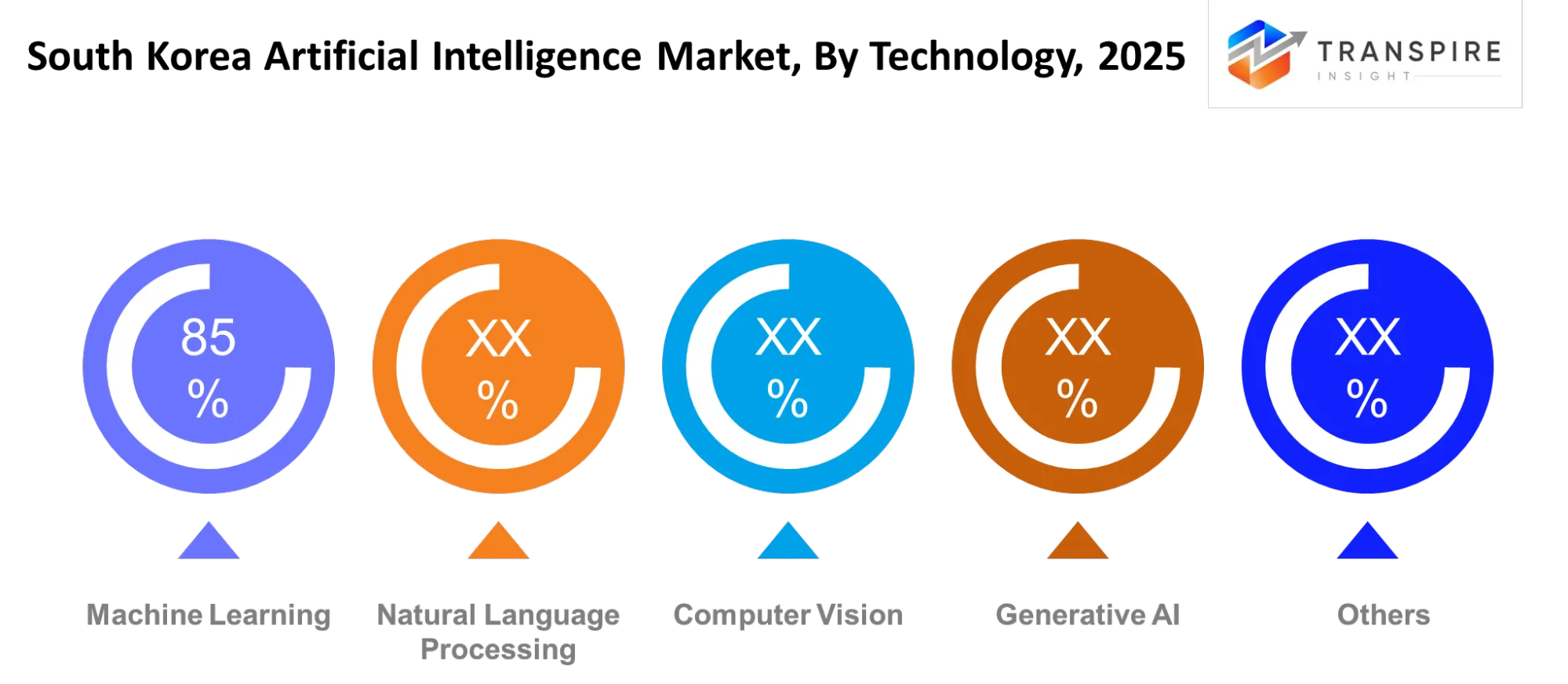
Machine Learning has the dominant position , mostly because it is deployed everywhere in manufacturing automation, financial analytics, telecom tuning and predictive maintenance systems. It also gets a real boost from how well it fits with semiconductor production and industrial robotics which makes Korean enterprises more willing to adopt it. Plus there is always operational data flowing in from factories , telecom networks and digital platforms so model training stays efficient and enterprises can scale without too much friction.
Natural Language Processing grew a lot after Korean-language large language models started getting commercialized , and once enterprise AI assistants became more common. Banks, customer service operators, and public agencies are now using language-based AI systems for automated conversation handling and document preparation. Computer Vision still shows strong take-up in semiconductor inspection smart surveillance and autonomous mobility , where image analysis helps raise day to day accuracy. Generative AI is the fastest growing part because companies put money into enterprise AI copilots, automated content creation, and sovereign AI infrastructure. Other areas include edge AI and suggestion engines. During the forecast window, Generative AI will likely pull in the biggest investment inflows, while Machine Learning stays as the practical backbone for industrial and enterprise automation systems.
To learn more about this report, Download Free Sample Report
By Deployment
Cloud-based AI kind of dominates the deployment model scene, mainly because hyperscale infrastructure keeps expanding, and enterprises seem to prefer scalable computing resources. Big organizations are leaning more and more on cloud environments to run AI workloads, without needing that heavy upfront hardware purchase. Also there are these strong partnerships between telecom operators and global cloud provider s, which helps keep cloud deployment systems in a sort of leadership position.
On-premise AI still feels important in areas that deal with sensitive operational or financial data, especially government agencies, defense contractors, and semiconductor manufacturers. Hybrid AI adoption is also picking up speed, because companies want this middle ground between data protection and scalable processing power. Hybrid deployment is useful too, since it can support AI integration across older industrial systems and at the same time across cloud-native applications. And then there are edge deployment environments as well, basically for localized processing inside autonomous devices and smart factories.
Over the forecast period, hybrid deployment models will grow the fastest, since Korean enterprises are prioritizing operational flexibility more than usual, while cloud-based systems will keep leading. This is mostly tied to infrastructure scalability and that ongoing, recurring demand for enterprise software.
By Application
Predictive Analytics is kind of in the lead because it gets deployed a lot in manufacturing, finance, logistics and telecom. In Korea, companies are using predictive setups to tighten up production schedules, flag operational risks, and make infrastructure run more efficiently. A lot of industrial digitization is going on, plus plenty of operational data is available, and that helps the whole thing keep growing in different enterprise environments.
Virtual Assistants really picked up steam after generative AI became widely commercialized and that pushed automation strategies faster. Telecom operators, financial firms, and online commerce platforms are more and more embedding conversational AI into customer support, and into day to day workflow management systems. Autonomous Systems are also seeing higher uptake in robotics, mobility platforms, and smart logistics operations, especially where operational precision and labor efficiency stay as key priorities. Fraud Detection keeps steady demand in banking and digital payment ecosystems, mostly because transactions keep getting more complex and cybersecurity threats keep rising. There are also recommendation systems, plus AI powered monitoring tools, and a few other use cases. Over the forecast window, autonomous systems and virtual assistants should expand the quickest, because AI is shifting from mostly analytical support toward real time operational decision making, not just insights but action.
By End User
Manufacturing takes the lead for a good reason, largely because South Korea has this real global edge in semiconductors, electronics, automotive production, and even industrial robotics. When AI gets deployed across factories it tends to improve defect detection, do predictive maintenance better, and push production optimization forward , but also it helps cut down operational inefficiencies. And then there is strong capital spending from semiconductor and electronics firms which just keeps strengthening that long term market position.
BFSI still shows major adoption, since more and more financial institutions are automating fraud monitoring, credit assessment, and customer interaction systems. Healthcare is also moving fast, especially across imaging diagnostics, drug discovery, and hospital workflow optimization platforms. Retail companies increasingly rely on AI for demand forecasting, customer personalization , and supply chain visibility management. Government agencies keep expanding AI integration for smart city efforts, digital administration, and public safety systems. The remaining sectors cover education and logistics. During the forecast period, healthcare and government use cases are expected to grow quickly, driven by national AI digitization programs, and manufacturing will likely stay the biggest end user segment by revenue generation.
By Enterprise Size
Large Enterprises seem to hold the dominant share, mostly because conglomerates and telecom operators have the financial wherewithal to put money into hyperscale infrastructure, GPU clusters, and their own proprietary AI models. You can see a lot of momentum too, from strong digital transformation efforts across electronics, manufacturing, and telecommunications , which makes enterprise-scale uptake feel more natural. Plus, the availability of large operational datasets keeps boosting how efficiently AI can be implemented inside big organizations.
SMEs are moving toward cloud based AI platforms more and more, mainly to gain operational efficiency without having to spend heavily on major infrastructure. Then there are government-backed AI funding push programs and subscription style deployment models, that makes the whole transition gradual for medium sized businesses. Startups show a noticeable surge of inventive activity in generative AI, healthcare analytics, robotics, and enterprise automation solutions. Venture capital backing, along with partnerships with larger technology firms, helps speed up commercialization for newer AI builders. Other contributors also matter—research institutions and public sector innovation programs are part of the picture. Over the forecast period, startups and SMEs will likely show the quickest adoption growth, largely due to lower cloud deployment costs and broader access to AI development platforms. Large enterprises, though, will still stay in the lead when it comes to total market spending.
What are the Key Use Cases Driving the South Korea Artificial Intelligence Market?
In the South Korea Artificial Intelligence Market the dominant use case is still smart manufacturing, and semiconductor production optimization, kind of straight forward. Korean manufacturers roll out AI systems for predictive maintenance, automated defect inspection, robotics coordination, and process optimization because these solutions basically lift production yield, and they cut operational downtime in semiconductor plus electronics plants.
Going further, the expansion looks like telecom network automation, and AI driven financial services too. Telecom operators use AI to fine tune network traffic, handle customer service tasks, and supervise AI-native infrastructure. At the same time, financial institutions are adopting generative AI for fraud monitoring, credit assessment, and multilingual customer support across digital banking channels.
Newer trends are showing up in sovereign Korean-language large language models, and AI powered mobility ecosystems. Autonomous logistics systems are getting traction alongside AI-assisted healthcare diagnostics, and also edge AI for smart factories. Enterprises seem to want localized AI capabilities, tuned for Korean industrial workflows and for regulatory requirements, so everything moves smoother.
|
Report Metrics |
Details |
|
Market size value in 2025 |
USD 10602.5 Million |
|
Market size value in 2026 |
USD 14949.1 Million |
|
Revenue forecast in 2033 |
USD 167249.7 Million |
|
Growth rate |
CAGR of 41.20%from 2026 to 2033 |
|
Base year |
2025 |
|
Historical data |
2021 - 2024 |
|
Forecast period |
2026 - 2033 |
|
Report coverage |
Revenue forecast, competitive landscape, growth factors, and trends |
|
Regional scope |
South Korea |
|
Key company profiled |
Samsung Electronics, Naver Corporation, LG AI Research, Kakao Corp, Microsoft, Google, IBM, Amazon Web Services, OpenAI, NVIDIA, Intel Corporation, SAP, Oracle, Baidu, SK Telecom |
|
Customization scope |
Free report customization (country, regional & segment scope). Avail customized purchase options to meet your exact research needs. |
|
Report Segmentation |
By Technology (Machine Learning, Natural Language Processing, Computer Vision, Generative AI, Others); By Deployment (Cloud-based AI, On-premise AI, Hybrid AI, Others); By Application (Predictive Analytics, Virtual Assistants, Autonomous Systems, Fraud Detection, Others); By End User (Healthcare, BFSI, Retail, Manufacturing, Government, Others); By Enterprise Size (Large Enterprises, SMEs, Startups, Others) |
Which Regions are Driving the South Korea Artificial Intelligence Market Growth?
Seoul Capital Area basically leads the South Korea Artificial Intelligence Market , and it does it by mixing policy reach, hyperscale data center muscle, venture capital clustering, and the headquarters of the bigger AI developers. In Seoul you get the biggest kind of AI startup ecosystem, plus semiconductor design firms, cloud operators, and enterprise software providers. Also the government ministries and the research institutes that are stationed around the capital help push commercialization faster via AI funding initiatives, and regulatory backstopping . This kind of concentration then turns into that self reinforcing innovation loop where infrastructure, talent, and enterprise demand stay connected pretty tightly , almost like they do not really separate anymore.
Gyeonggi Province comes next as the second-largest regional contributor , but the “why” behind its momentum feels different compared to Seoul’s more service-minded AI setting . The area leans on big manufacturing routines, semiconductor fabs, electronics production sites, and industrial robotics rollout. Instead of going all-in on consumer-facing generative AI services, companies in Gyeonggi tend to focus on industrial AI use cases that lift production efficiency, and strengthen supply chain resilience. Plus the steady investment coming from semiconductor and electronics manufacturers keeps the region as a fairly consistent revenue driver even when broader tech spending goes through ups and downs.
After that, Busan and the southeastern industrial corridors look like the quickest regional opportunity across 2026–2033 . Smart port modernization, logistics automation, and AI enabled maritime infrastructure spending have been picking up, especially after newer programs aimed at digital trade , and shipping efficiency. Local authorities are also backing AI adoption more and more in transportation, logistics, and industrial energy management systems. For investors , and for new entrants, this expansion creates opportunities
Who are the Key Players in the South Korea Artificial Intelligence Market and How Do They Compete?
Competition in the South Korea Artificial Intelligence Market is still, sort of, moderately consolidated around the big tech conglomerates, telecom operators , cloud providers, and semiconductor firms. Over time the attention has moved away from just standalone AI applications toward those more vertically integrated set ups that blend computer infrastructure, AI models , cloud services and the enterprise deployment side too. Korean incumbents are basically holding their ground on domestic share via sovereign AI programs and Korean language model specialization. Meanwhile the global players push hard using hyperscale cloud infrastructure plus advanced GPU ecosystems.
Samsung Electronics plays a strong game with semiconductor leadership, AI-enabled consumer electronics, and enterprise AI infrastructure integration. The key benefit is that it can control memory chip production and the broader device ecosystem at the same time, so they can tune things across both the hardware side and AI workloads, all in one go. Naver Corporation tends to stand out with Korean-language large language models and localized enterprise AI offerings that are built for domestic users, and yes also for regulators.
SK Telecom is expanding in a more aggressive, AI-native way, using telecom infrastructure upgrades, sovereign AI platforms, and hyperscale AI data center investments. Microsoft and Amazon Web Services go head to head via cloud partnerships, enterprise AI integration tooling, and scalable GPU infrastructure. NVIDIA keeps a strategic leverage position through AI accelerator dominance , plus collaborations with Korean chipmakers and cloud operators, so it ends up well positioned across the national AI infrastructure buildout.
Company List
- Samsung Electronics
- Naver Corporation
- LG AI Research
- Kakao Corp
- Microsoft
- IBM
- Amazon Web Services
- OpenAI
- NVIDIA
- Intel Corporation
- SAP
- Oracle
- Baidu
- SK Telecom
Recent Development News
In March 2026, SK Telecom entered a partnership with Super Micro and Schneider Electric to accelerate modular AI data center deployment. The collaboration aims to reduce construction timelines and improve GPU infrastructure scalability for sovereign AI expansion in South Korea. [https://telecomlead.com/
In May 2026, Samsung Electronics reached a historic valuation milestone driven by AI semiconductor demand and expanded AI infrastructure investment. The company’s surge reflected accelerating global demand for AI memory chips and reinforced South Korea’s strategic position in the global AI supply chain. [https://www.reuters.com
What Strategic Insights Define the Future of the South Korea Artificial Intelligence Market?
The South Korea Artificial Intelligence Market is kinda moving, structurally, toward vertically integrated sovereign AI ecosystems. Mostly those are built around local semiconductors, hyperscale compute infrastructure, and more localized foundation models. And the reason this is happening is sort of obvious when you think about it—long-term AI competitiveness really hinges on owning chips , data centers, and language specific AI systems, not just on the software applications part. Over the next five to seven years telecom operators, semiconductor companies, and cloud providers will keep converging into more integrated AI infrastructure platforms.
One hidden risk is that market power is concentrating more and more among a small group of conglomerates. These players end up controlling compute capacity, GPU procurement, and AI infrastructure financing. If that keeps going, innovation from smaller firms could get squeezed , and it might also create long-term dependency risk across the wider domestic ecosystem.
At the same time there’s an emerging opening in industrial sovereign AI, tailored for Korean manufacturing, robotics, and logistics setups. Firms should lean into partnerships that merge AI software capabilities with infrastructure ownership and domain specific industrial datasets. Those combinations, in practice, will likely end up defining the next competitive advantage cycle, sooner than people expect.
South Korea Artificial Intelligence Market Report Segmentation
By Technology
- Machine Learning
- Natural Language Processing
- Computer Vision
- Generative AI
- Others
By Deployment
- Cloud-based AI
- On-premise AI
- Hybrid AI
- Others
By Application
- Predictive Analytics
- Virtual Assistants
- Autonomous Systems
- Fraud Detection
- Others
By End User
- Healthcare
- BFSI
- Retail
- Manufacturing
- Government
- Others
By Enterprise Size
- Large Enterprises
- SMEs
- Startups
- Others
Frequently Asked Questions
Find quick answers to common questions.
The estimated South Korea Artificial Intelligence Market size for the market will be USD 167249.7 Million in 2033.
Key segments for the South Korea Artificial Intelligence Market are By Technology (Machine Learning, Natural Language Processing, Computer Vision, Generative AI, Others); By Deployment (Cloud-based AI, On-premise AI, Hybrid AI, Others); By Application (Predictive Analytics, Virtual Assistants, Autonomous Systems, Fraud Detection, Others); By End User (Healthcare, BFSI, Retail, Manufacturing, Government, Others); By Enterprise Size (Large Enterprises, SMEs, Startups, Others).
Major South Korea Artificial Intelligence Market players are Samsung Electronics, Naver Corporation, LG AI Research, Kakao Corp, Microsoft, Google, IBM, Amazon Web Services, OpenAI, NVIDIA, Intel Corporation, SAP, Oracle, Baidu, SK Telecom.
The South Korea Artificial Intelligence Market size is USD 10602.5 Million in 2025.
The South Korea Artificial Intelligence Market CAGR is 41.20% from 2026 to 2033.
- Samsung Electronics
- Naver Corporation
- LG AI Research
- Kakao Corp
- Microsoft
- IBM
- Amazon Web Services
- OpenAI
- NVIDIA
- Intel Corporation
- SAP
- Oracle
- Baidu
- SK Telecom
Recently Published Reports
-
Apr 2026
3D Optical Profiler Market
3D Optical Profiler Market Size, Share & Analysis Report By Type (Desktop 3D Optical Profiler, and Portable 3D Optical Profiler), By Technology (Confocal Technology, and White Light Interference), By End-Use Industry (Manufacturing, Research Institutions, Automotive, Aerospace and Defense, Medical Devices, and Other), and Geography (North America, Europe, Asia-Pacific, Middle East and Africa, South and Central America), 2021 - 2031
-
Apr 2026
Depth Sensor Market
Depth Sensor Market Size, Share & Analysis Report By Type (Infrared Depth Sensors, Time-of-Flight (ToF) Sensors, Stereo Vision Sensors, Structured Light Sensors, Ultrasonic Depth Sensors), By Application (Automotive, Robotics, Gaming, Consumer Electronics, Industrial Automation, Healthcare, Security & Surveillance, Others), By End Users (Automotive Manufacturers, Consumer Electronics Companies, Healthcare Providers, Industrial Companies, Security Agencies, Gaming Companies, Robotics Companies, Others), and Geography (North America, Europe, Asia-Pacific, Middle East and Africa, South and Central America), 2021 – 2031
-
Apr 2026
Digital Manufacturing Market
Digital Manufacturing Market Size, Share & Analysis Report By Component (Hardware, Software, and Services), By Technology (Robotics, 3D Printing, Internet of Things (IoT), and Others), By Application (Automotive and Transportation, Aerospace and Defense, Consumer Electronics, Industrial Machinery, and Others), By Process Type (Computer-Based Designing, Computer-Based Simulation, Computer 3D Visualization, Analytics, and Others), and Geography (North America, Europe, Asia-Pacific, Middle East and Africa, South and Central America), 2021 – 2031
-
Apr 2026
Digital Visa Services Market
Digital Visa Services Market Size, Share & Analysis Report By Type (Individual Travelers, Group Travelers), By Application (Tourism, Business Travel, Others), and Geography (North America, Europe, Asia-Pacific, Middle East and Africa, South and Central America), 2021 – 2031