
South Korea Artificial Intelligence Camera Market Size & Forecast:
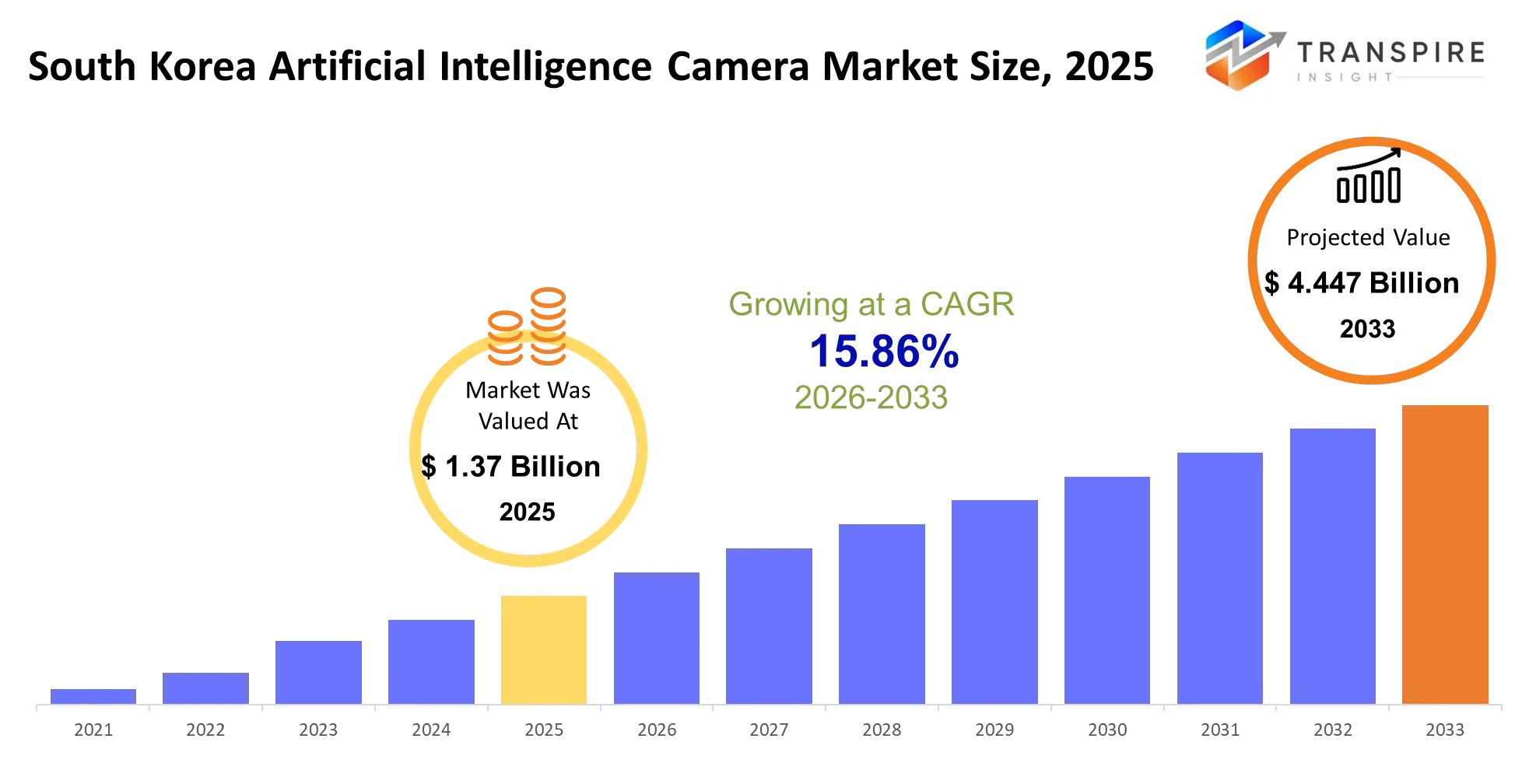
- South Korea Artificial Intelligence Camera Market Size 2025: USD 1.37 Billion
- South Korea Artificial Intelligence Camera Market Size 2033: USD 4.447 Billion
- South Korea Artificial Intelligence Camera Market CAGR: 15.86%
- South Korea Artificial Intelligence Camera Market Segments: By Camera Type (Smart Surveillance Cameras, Smartphone AI Cameras, Automotive AI Cameras, Industrial AI Cameras, Others); By Technology (Facial Recognition, Object Detection, Motion Tracking, AI Image Enhancement, Others); By Application (Security & Surveillance, Consumer Electronics, Automotive Systems, Smart Retail, Others); By End User (Residential Sector, Commercial Sector, Government Sector, Industrial Sector, Others); By Connectivity (Wired Cameras, Wireless Cameras, Cloud-connected Cameras, Others)
To learn more about this report,  Download Free Sample Report
South Korea Artificial Intelligence Camera Market Summary
The South Korea Artificial Intelligence Camera Market was valued at USD 1.37 Billion in 2025. It is forecast to reach USD 4.447 Billion by 2033. That is a CAGR of 15.86% over the period.
In South Korea, AI powered cameras get put in place to make sense of real time visual information for all kinds of security surveillance, industrial monitoring, traffic control, and smart infrastructure automation. They sorta cut down on the need for nonstop manual watching, because they can spot anomalies, find recurring patterns, and then kick off automated actions across public safety services and enterprise settings. Over the last five years , things changed a lot, moving away from rule based video surveillance, and heading toward edge AI systems that analyze everything right inside the devices. This tends to make responses faster, and also reduces how much bandwidth you have to ship around. One big structural change has been the way deep learning chipsets are now integrated inside the cameras themselves, letting them handle real time object detection right at the edge. Growth got another push after the post pandemic period where cities rolled out extra urban security upgrades, and also because cybersecurity expectations got stricter, especially as infrastructure digitization started to bring more risk. Together, this edge computing momentum and the stronger security requirements have leaned enterprises and governments toward bigger AI camera rollouts, which helps operational efficiency and makes procurement cycles speed up across smart city networks and industrial ecosystems.
Key Market Insights
- The South Korea Artificial Intelligence Camera market is quietly moving toward edge AI processing, which cuts back on cloud reliance and makes real time call speed faster across surveillance networks.
- In 2025, Seoul along with Gyeonggi Province actually took up close to 45% of infrastructure deployment share, mostly from those dense smart city investments.
- AI enabled security cameras ended up dominating around 52% of product deployments in 2025, pushed by facial recognition plus object tracking needs.
- Meanwhile, software integrated camera systems sit as the second biggest slice, because enterprises keep picking analytics platforms for more centralized, sort of “watching over everything” style monitoring.
- Cloud based video analytics is growing the quickest too, with strong expansion from 2024–2033, largely due to scalable enterprise adoption models.
- For applications, public safety uses grabbed roughly 48% of overall demand share in 2025, and that was tied to transport hubs and the continued growth of urban surveillance.
- Retail analytics is now showing up as the fastest rising application, backed by AI driven consumer behavior tracking and loss prevention systems.
- On the end user side, government agencies remain the main player, taking more than 50% share, linked to national surveillance modernization programs.
- Private enterprises are actually the fastest-growing end user group, especially when logistics and manufacturing firms start deploying predictive monitoring solutions.
What are the Key Drivers, Restraints, and Opportunities in the South Korea Artificial Intelligence Camera Market?
The main reason the South Korea Artificial Intelligence Camera Market is moving so fast is basically the swift roll-in of AI surveillance inside smart city systems. With government-backed urban safety initiatives and a lot of digital infrastructure upgrades, many municipalities end up swapping older CCTV setups for more intelligent cameras, the kind that can do real-time object spotting and behavioral analytics. That change has bumped procurement levels for edge-AI hardware too, and it also keeps the recurring money flowing, coming from analytics software subscriptions, notably around transit hubs and industrial areas.
The biggest drag, though, is the pretty heavy upfront integration expense for AI camera platforms, especially when someone tries to upgrade an existing surveillance network. A lot of organizations have to redo storage arrangements, widen network bandwidth, and rebuild cybersecurity rules so they can handle AI workloads, and that tends to slow adoption for smaller and mid-sized players. So the structural cost hurdle shows up as uneven rollout rates between public bodies and private operators, which then dampens short-term revenue growth in segments that are very price-sensitive.
The most promising opening is AI-led predictive security plus industrial automation, especially when those efforts connect through 5G networks. As Korea continues to expand private 5G coverage across manufacturing clusters and logistics routes, AI cameras can shift into real-time operational insight tools, not only passive watching devices. Firms that blend video analytics with predictive upkeep and automated alerting will probably open fresh revenue channels across industrial safety programs and smart factory ecosystems.
What Has the Impact of Artificial Intelligence Been on the South Korea Artificial Intelligence Camera Market?
Artificial intelligence has changed camera systems in South Korea from passive recording tools into more active decision making devices, used for surveillance and also for overseeing manufacturing, plus infrastructure watching. In industrial spaces the AI cameras kinda do the work of quality inspection and safety compliance tracking by spotting defects, spotting unauthorized entry and catching equipment oddities without any human presence. This really lowers the whole manual monitoring burden, and it helps operations stay steady even in these high density production locations.
Machine learning models that are baked into edge devices now help with predictive maintenance, because they can study visual degradation trends in machinery. That means problems like mechanical wear can be identified earlier, even in places like logistics hubs and manufacturing plants. Then in transportation setups and smart city frameworks, AI video analytics assists traffic flow tuning and helps emergency response coordination, which ends up reducing congestion delays and operational inefficiencies in ways that can actually be measured.
Still, getting widespread adoption hits a snag, mainly because performance can wobble in everyday environments, like low light situations, weather interference, and network latency across distributed systems. Those issues bring down detection precision and also make integration kinda complicated for deployments that are mission critical. Yet even with those constraints AI keeps moving automation forward, improving compliance monitoring and overall operational efficiency across surveillance driven ecosystems.
Key Market Trends
- South Korea’s Artificial Intelligence Camera Market kind of shifted from analog CCTV toward AI-enabled edge computing systems somewhere across 2022–2025, which improved the real time analytics speed a lot, but it also changed how teams actually deploy stuff day to day.
- In Seoul, smart city spending bumped up surveillance AI rollouts by almost 40% in 2025 and this helped speed up the infrastructure modernization work, not just in theory but in actual deployments.
- Also the Government security programs grew the facial recognition camera installations across transport hubs, and that raised adoption of public safety analytics quite a bit, even where budgets were tight.
- On the enterprise side, security systems are now rolling in AI analytics in more than 55% of the new installations, and it’s basically replacing the older monitoring frameworks that were used before.
- Retail analytics adoption jumped after 2024, with close to 30% growth in AI based customer behavior tracking systems, which made merchants rethink how they interpret foot traffic.
- Edge AI chip integration was another big driver, it cut cloud processing expenses by as much as 35% , so companies felt more comfortable expanding use across industrial fields.
- Hanwha Vision and Samsung Electronics expanded their AI camera offerings in 2025, especially with low light and thermal detection systems that are built to handle harsher conditions.
- The 5G rollout supported better real time surveillance streaming, and that improved responsiveness in those crowded urban areas where latency really matters.
- In manufacturing, AI camera adoption grew strongly because defect detection automation is easier now, plus predictive maintenance has become more practical with these systems.
- In 2025 cybersecurity rules got stricter, so many enterprises started adopting encrypted AI video processing solutions, to reduce exposure risk and keep compliance intact.
South Korea Artificial Intelligence Camera Market Segmentation
By Camera Type
Smart Surveillance Cameras kinda take the leading position because they’re already all over urban monitoring setups, transport hubs, and enterprise security networks. The whole thing leans heavily on solid integration of AI-based threat detection and real-time analytics, and that’s what keeps their advantage growing across both public and private infrastructure. Add in big smart city rollouts and enterprise security upgrades, and you get their market share staying pretty well locked in.
Then you’ve got Smartphone AI Cameras and Automotive AI Cameras; they grow in pretty much the same direction, mostly pushed by people upgrading their consumer devices, plus more advanced driver assistance systems. Industrial AI Cameras are also moving forward at a steady pace due to automation, such as manufacturing quality inspection and safety monitoring. There are also others, like niche imaging systems used in defense and specialized surveillance. Over the forecast period, smart surveillance systems will remain the main revenue driver, while automotive and industrial areas will speed up the innovation push for embedded AI processing and edge computing capabilities.
By Technology
Facial Recognition still holds a foremost position, partly because it’s been dropped into security-sensitive places, like airports, government buildings, and financial institutions. It also benefits from high performance expectations and regulatory support, meant for public safety systems, so it plugs in pretty smoothly with surveillance networks. Ongoing updates to the algorithms keep the day to day operation more dependable, even as conditions change.
Object Detection is seeing rapid growth, mostly from industrial automation, traffic monitoring, and retail analytics use cases. Motion Tracking helps with real time behavioral analysis in packed areas, particularly in city surveillance setups. AI Image Enhancement addresses poor lighting and high-noise video problems, making it a must for night watch and outdoor monitoring. Other items also show up in practice, like anomaly detection and scene reconstruction. Over time, it looks like object detection together with enhancement will keep climbing at a quicker pace, as edge processing gets better and real time analytics turns into the norm across surveillance infrastructures.
By Application
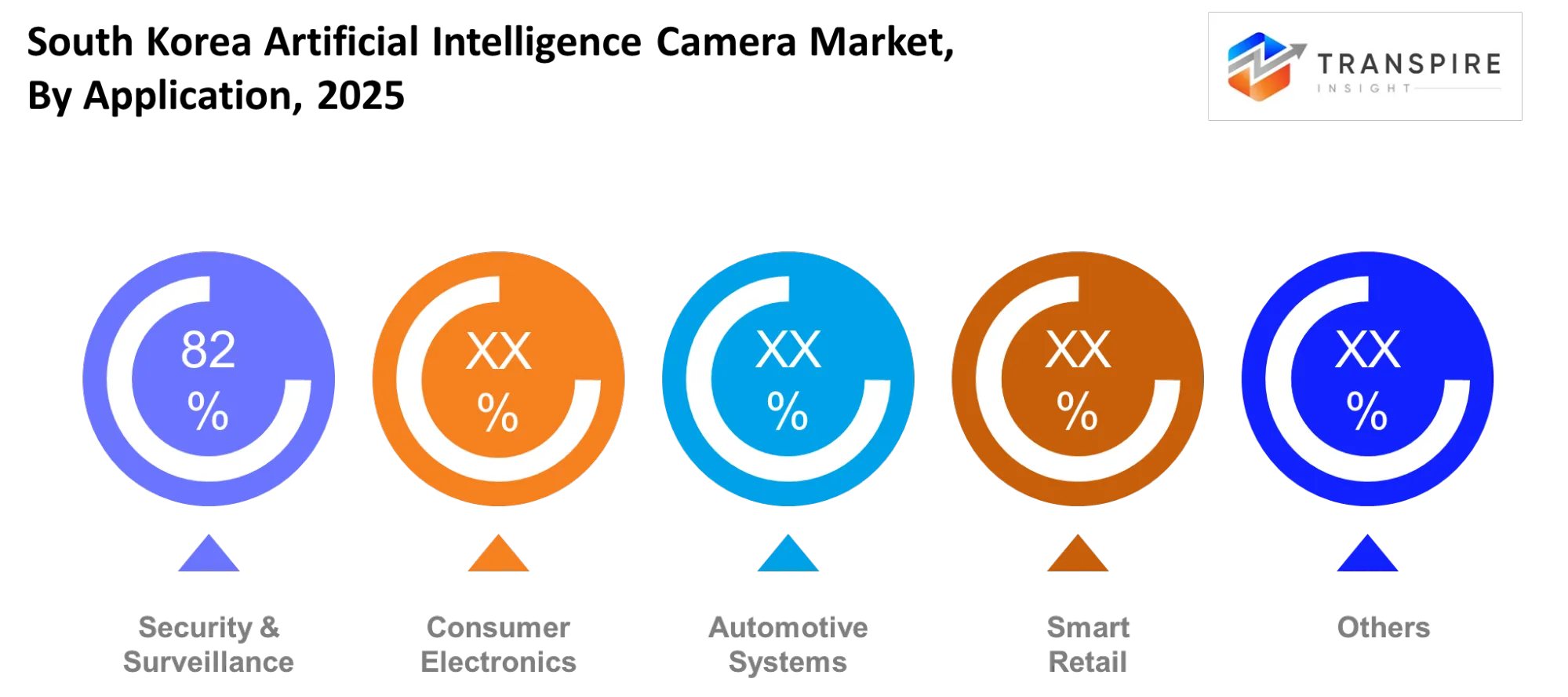
Security & Surveillance still seems to have the largest application share, mostly because it gets deployed everywhere, including across government infrastructure, transportation systems, and commercial security setups. There’s a pretty solid pull for real-time threat detection, plus centralized monitoring systems, so it keeps its lead in a very straightforward way. And honestly, the continuous growth of smart cities kinda locks in the long-term adoption pattern, too.
Consumer Electronics and Automotive Systems are also getting broader, largely tied to AI camera integration in smartphones and advanced driver assistance features in cars. Meanwhile Smart Retail is showing up as a high-growth area, pushed by customer behavior analytics and loss prevention systems, especially across retail chains. Other use cases aren’t exactly small either—healthcare monitoring and industrial safety systems are in there as well. Over the forecast period, security applications will remain dominant, but smart retail and automotive systems are likely to drive the fastest innovation cycles, mainly through real-time analytics and embedded AI capabilities, which, keeps improving the experience.
To learn more about this report, Download Free Sample Report
By End User
The Government Sector ends up holding a dominant position due to significant investments in public surveillance, smart city infrastructure, and national security systems. There are strong regulatory frameworks and a centralized procurement cycle, so the adoption of AI-enabled surveillance tech stays pretty consistent. On top of that, when it ties into transportation networks and broader urban monitoring systems it kinda reinforces its leadership, even more than before.
Commercial Sector and Industrial Sector are also moving ahead fast, mainly from enterprise security upgrades and manufacturing automation. For the Residential Sector, adoption is increasing as well, driven by smart home security systems integrated into IoT ecosystems. Then there are the others, like education and healthcare institutions, where AI monitoring solutions are being used more and more. Looking at the forecast period, it appears that commercial and industrial users will see the fastest growth, while government agencies will continue to serve as the backbone of large-scale rollouts and infrastructure-led demand.
By Connectivity
Wired Cameras have a strong foundation because of their steady performance, low latency, and reliability in government and industrial setups. They stay the go-to choice when the environment is fixed, and when people need uninterrupted data delivery. There’s also that legacy integration, that kinda keeps everything running, and supports continued use, even when teams don't want to change much.
Wireless Cameras are growing fast, mainly because setup is flexible and scalability is easier for commercial and home use. Cloud-connected Cameras are, uh, the portion that seems to expand the quickest, pushed by the need for remote watching and those centralized analytics dashboards. Other types cover hybrid models and edge-only systems too. During the forecast horizon, cloud-connected solutions will speed up adoption because AI analytics is moving toward more distributed computing styles, while wired solutions will still be needed for high-security and mission critical environments where the utmost stability really matters most.
What are the Key Use Cases Driving the South Korea Artificial Intelligence Camera Market?
The main driver of the South Korea Artificial Intelligence Camera Market is urban surveillance, but there's also public safety monitoring and a kind of watchfulness over what is happening. Government agencies end up deploying these AI cameras to catch suspicious behavior, steer crowd movement, and help with real time emergency actions in transport hubs, plus city centers. Because of national security priorities, and because smart city expansion programs are still pushing forward, this becomes the strongest demand pull, almost every time.
Other, more secondary ways are beginning to appear in retail analytics and industrial safety monitoring. Retailers may use AI cameras to map customer behavior trends , adjust store layouts, and curb theft events. At the same time, manufacturers tend to rely on them for defect detection, and for workplace compliance oversight across production lines and logistics facilities. It’s not only one lane, more like a mix of monitoring tasks.
There are also newer applications, like predictive infrastructure maintenance, and autonomous traffic management systems. In practice these solutions blend AI vision with IoT plus 5G connections, so the cities can do more proactive decision-making for urban mobility. The same pattern can be applied in industrial operations, where it helps teams react earlier instead of later, or at least that is the goal.
|
Report Metrics |
Details |
|
Market size value in 2025 |
USD 1.37 Billion |
|
Market size value in 2026 |
USD 1.587 Billion |
|
Revenue forecast in 2033 |
USD 4.447 Billion |
|
Growth rate |
CAGR of 15.86% from 2026 to 2033 |
|
Base year |
2025 |
|
Historical data |
2021 - 2024 |
|
Forecast period |
2026 - 2033 |
|
Report coverage |
Revenue forecast, competitive landscape, growth factors, and trends |
|
Regional scope |
South Korea |
|
Key company profiled |
Samsung Electronics, LG Electronics, Sony, Hikvision, Dahua Technology, Canon, Nikon, Panasonic, Bosch Security Systems, Hanwha Vision, Axis Communications, Qualcomm, Intel Corporation, Omnivision Technologies, Xiaomi |
|
Customization scope |
Free report customization (country, regional & segment scope). Avail customized purchase options to meet your exact research needs. |
|
Report Segmentation |
By Camera Type (Smart Surveillance Cameras, Smartphone AI Cameras, Automotive AI Cameras, Industrial AI Cameras, Others); By Technology (Facial Recognition, Object Detection, Motion Tracking, AI Image Enhancement, Others); By Application (Security & Surveillance, Consumer Electronics, Automotive Systems, Smart Retail, Others); By End User (Residential Sector, Commercial Sector, Government Sector, Industrial Sector, Others); By Connectivity (Wired Cameras, Wireless Cameras, Cloud-connected Cameras, Others) |
Which Regions are Driving the South Korea Artificial Intelligence Camera Market Growth?
Seoul Metropolitan Area kinda leads the South Korea Artificial Intelligence Camera Market, mostly because the area is so packed and has this mature urban framework, plus an advanced smart city ecosystem that already runs in the background. It also gets steady government spending, not just in “one place” but across AI surveillance systems tied to transit, public safety networks, and even commercial neighborhoods. On top of that, strong 5G connectivity combined with edge computing setups lets teams roll out real time video analytics faster, and with less delay. So overall, the mix keeps demand alive for both public sector rollouts and private installations, and it stays pretty consistent.
Gyeonggi Province sits as a fairly steady second-tier area, with industrial and logistics infrastructure that supports ongoing AI camera usage. It feels different from Seoul, because instead of leaning mainly into broad public surveillance, here the focus leans toward manufacturing automation and warehouse security arrangements. Large industrial parks help establish recurring procurement schedules, and those cycles tend to remain regular thanks to enterprise investment roadmaps planned over the long term. In that way, it proves a dependable contributor to nationwide revenue stability, even when market moods shift slightly.
Busan is showing the quickest momentum, mainly from port modernization and smart logistics expansion plans. New spending around maritime logistics digitization, along with container terminal automation, has pushed AI camera adoption for cargo monitoring and safety compliance, faster than before. As the region moves toward a smart port hub, the surveillance needs across shipping operations are basically being reshaped, like the requirements themselves are evolving. This suggests solid opening for technology vendors, especially those aiming at logistics driven AI surveillance deployments.
Who are the Key Players in the South Korea Artificial Intelligence Camera Market and How Do They Compete?
In the South Korea Artificial Intelligence Camera Market competition is kind of moderately consolidated, but you can see a clear tilt toward the bigger established electronics and security technology providers. The incumbents end up focusing mainly on AI algorithm refinement, edge hardware capabilities, and how well the products integrate into broader smart infrastructure ecosystems. New players still stumble a lot, because the certification rules are heavy, and they also need deeper integration with government and enterprise security systems, which is not easy at all.
Samsung Electronics leans into advanced semiconductor-integrated AI cameras, blending on-device processing with smart city compatibility. This gives it pretty strong leadership for deployments that need to scale, and that matters. Hanwha Vision stands out with tightly secured surveillance systems, tuned for government and defense-level use, and it keeps growing via partnerships tied to public infrastructure initiatives. LG Electronics, meanwhile, leans hard on its IoT ecosystem, using it to connect AI cameras into smart home and commercial building automation platforms, so the interoperability feels more seamless across devices. Sony has a notable tech edge in imaging sensors, and it focuses on low-light and high-precision video analytics, typically for industrial and urban settings where fine detail is required.
Axis Communications grows by focusing more on software-centric AI video analytics, along with cloud based surveillance platforms. It targets enterprise clients and leans on scalable subscription style models, which helps it stay flexible. Overall, the competitive advantage now seems to be shaped more and more by edge AI ability, cybersecurity compliance, and how cleanly the solutions integrate with 5G enabled infrastructure networks.
Company List
- Samsung Electronics
- LG Electronics
- Sony
- Hikvision
- Dahua Technology
- Canon
- Nikon
- Panasonic
- Bosch Security Systems
- Hanwha Vision
- Axis Communications
- Qualcomm
- Intel Corporation
- Omnivision Technologies
- Xiaomi
Recent Development News
In October 2025, Samsung Electronics entered a strategic partnership with Nvidia to build an AI factory integrating over 50,000 GPUs. The collaboration strengthens AI-driven manufacturing intelligence, accelerating adoption of vision-based automation and smart imaging systems across semiconductor and device production ecosystems.http://timesofindia.indiatimes.com
In October 2025, NVIDIA announced a large-scale AI infrastructure collaboration with South Korean industrial groups including Samsung, deploying over 250,000 GPUs across AI factory initiatives. The project expands edge AI computing capacity, indirectly boosting demand for AI-enabled imaging and surveillance systems in smart factories and infrastructure monitoring.https://www.wsj.com
In November 2025, Samsung Electronics confirmed expanded domestic investment plans including semiconductor and AI infrastructure upgrades linked to its P5 production line. The investment supports AI-driven hardware ecosystems, strengthening supply chains for edge AI cameras and intelligent vision processing systems used in security and industrial monitoring applications.https://www.reuters.com
What Strategic Insights Define the Future of the South Korea Artificial Intelligence Camera Market?
The South Korea Artificial Intelligence Camera Market is kind of sliding, structurally, toward fully integrated edge intelligence systems that sit inside the national smart infrastructure plus industrial automation networks. I mean growth is being pulled by the meeting point of 5G connectivity, IoT ecosystems, and AI - based visual analytics, so the cameras can work as real time decision nodes, not just passive recording stuff. There is also a quieter risk, less noticeable maybe, because reliance on proprietary AI ecosystems is increasing. That can end up causing vendor lock-in and it may slow down interoperability across public infrastructure platforms. At the same time, there’s a pretty clear emerging opportunity too, like pairing AI cameras with autonomous logistics operations in smart ports and industrial corridors, especially around Busan and Incheon. Market players should focus on modular AI architectures, plus open platform compatibility strategies, so they can secure long-term deals across both government and enterprise environments while keeping integration friction down during big-scale rollouts.
South Korea Artificial Intelligence Camera Market Report Segmentation
By Camera Type
- Smart Surveillance Cameras
- Smartphone AI Cameras
- Automotive AI Cameras
- Industrial AI Cameras
- Others
By Technology
- Facial Recognition
- Object Detection
- Motion Tracking
- AI Image Enhancement
- Others
By Application
- Security & Surveillance
- Consumer Electronics
- Automotive Systems
- Smart Retail
- Others
By End User
- Residential Sector
- Commercial Sector
- Government Sector
- Industrial Sector
- Others
By Connectivity
- Wired Cameras
- Wireless Cameras
- Cloud-connected Cameras
- Others
Frequently Asked Questions
Find quick answers to common questions.
The expected South Korea Artificial Intelligence Camera Market size for the market will be USD 4.447 Billion in 2033.
Key segments for the South Korea Artificial Intelligence Camera Market are By Camera Type (Smart Surveillance Cameras, Smartphone AI Cameras, Automotive AI Cameras, Industrial AI Cameras, Others); By Technology (Facial Recognition, Object Detection, Motion Tracking, AI Image Enhancement, Others); By Application (Security & Surveillance, Consumer Electronics, Automotive Systems, Smart Retail, Others); By End User (Residential Sector, Commercial Sector, Government Sector, Industrial Sector, Others); By Connectivity (Wired Cameras, Wireless Cameras, Cloud-connected Cameras, Others).
Major South Korea Artificial Intelligence Camera Market players are Samsung Electronics, LG Electronics, Sony, Hikvision, Dahua Technology, Canon, Nikon, Panasonic, Bosch Security Systems, Hanwha Vision, Axis Communications, Qualcomm, Intel Corporation, Omnivision Technologies, Xiaomi.
The South Korea Artificial Intelligence Camera Market size is USD 1.37 Billion in 2025.
The South Korea Artificial Intelligence Camera Market CAGR is 15.86% from 2026 to 2033.
- Samsung Electronics
- LG Electronics
- Sony
- Hikvision
- Dahua Technology
- Canon
- Nikon
- Panasonic
- Bosch Security Systems
- Hanwha Vision
- Axis Communications
- Qualcomm
- Intel Corporation
- Omnivision Technologies
- Xiaomi
Recently Published Reports
-
Apr 2026
Bottled Water Market
Bottled Water Market Size, Share & Analysis Report By Product Type (Still Bottled Water, Carbonated Bottled Water, Functional Bottled Water, and Others), By Packaging (PET, Cans, and Others), By Sales Channel (Supermarkets/Hypermarkets, Convenience Stores/Drug Stores, Grocery Stores/Club Stores, Foodservice, and Others) and Geography (North America, Europe, Asia-Pacific, Middle East and Africa, South and Central America), 2021 - 2032
-
Apr 2026
Color Cosmetic Packaging Market
Color Cosmetic Packaging Market Size, Share & Analysis Report By Application (Mascara Packaging, Liquid Packaging, and Liquid Face), By Type (Tubes & Bottles, Pens & Markers, Compacts & Containers, and Droppers & Pumps), and Geography (North America, Europe, Asia-Pacific, Middle East and Africa, South and Central America), 2021 - 2031
-
Apr 2026
External Microphone For Camera Market
External Microphone For Camera Market Size, Share & Analysis Report By Type (Shotgun Microphone, Lavalier Microphone, and Others), By Application (Digital Camera, Professional Video Camera, and Others), and Geography (North America, Europe, Asia-Pacific, Middle East and Africa, South and Central America), 2021 - 2031
-
Apr 2026
Foot Orthotic Insoles Market
Foot Orthotic Insoles Market Size, Share & Analysis Report By Type (Pre-fabricated, and Custom-made), By Material (Thermoplastic, Composite Carbon Fiber, and Others), By Distribution Channel (Drug Stores, Hospitals & Clinics, and Others), and Geography (North America, Europe, Asia-Pacific, Middle East and Africa, South and Central America), 2021 - 2031