
Global Agentic AI in Law Enforcement and Surveillance Market Size & Forecast:
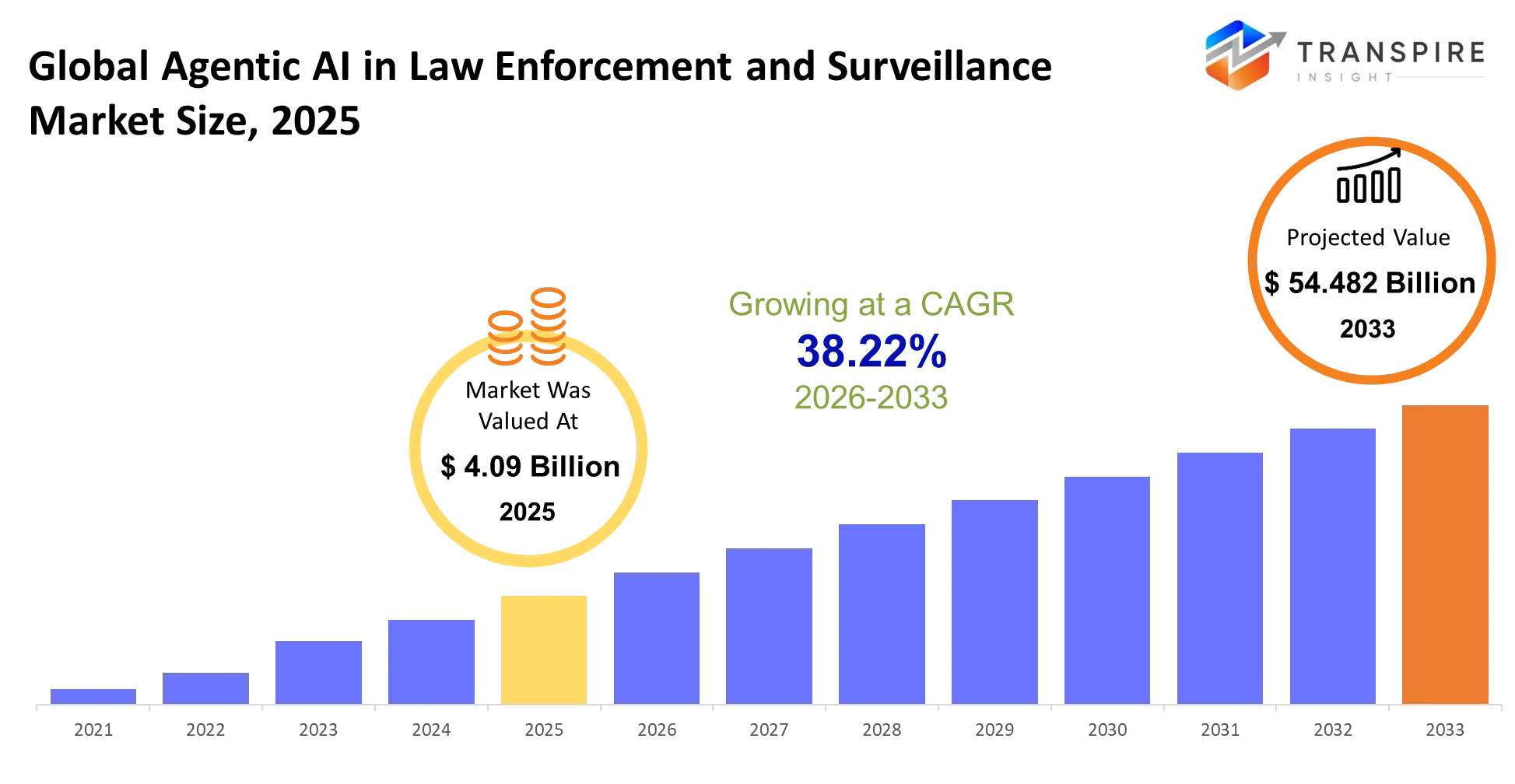
- Global Agentic AI in Law Enforcement and Surveillance Market Size 2025: USD 4.09 Billion
Global Agentic AI in Law Enforcement and Surveillance Market Size 2033: USD 54.482 Billion
Global Agentic AI in Law Enforcement and Surveillance Market CAGR: 38.22%
Global Agentic AI in Law Enforcement and Surveillance Market Segments: By Component (Software, Services, Platforms, Tools), By Application (Surveillance, Predictive Policing, Facial Recognition, Threat Detection), By End-User (Government, Law Enforcement Agencies, Defence, Security Firms)
To learn more about this report,  Download Free Sample Report
Global Agentic AI in Law Enforcement and Surveillance Market Summary:
The Agentic AI in Law Enforcement & Surveillance Market is expected to be valued at USD 4.09 billion in 2025 and to grow to USD 54.482 billion by 2033, at a CAGR of 38.22% during 2026 to 2033.
The industry provides autonomous software that detects public safety risks, identifies people using live-feed video technology, and triggers emergency notifications without requiring any human intervention to verify the system. In the past few years, there has been a complete shift from passive monitoring of safety through human eyes to digital surveillance technology.
There were significant structural changes where these systems were integrated into the smart city networks. Such integration resulted from increasing urban security problems and decreasing police department budgets, which pushed the departments to use automation for surveillance within public spaces. Therefore, due to the fact that modern cities have to handle vast amounts of data with fewer people, they are using drone fleets and biometrics to speed up their emergency responses and reduce crimes within specific regions.
Key Market Insights:
- Given the strong user acceptance of hotspot tracking using drones within the 68% surveillance segment, the public safety organisations are integrating hotspot tracking with drones to replace reactive policing with proactive measures.
- With the help of a 38% software segment presence, engineering companies are developing goal-driven applications that transform the inactive process of corporations into actual physical actions.
- Operating in the 24% tools segment, the software applications, with fast task completion rates, have started analysing the raw data for any possible connections, transforming standard tools into investigative software.
- With an important 20% market presence, the services segment is showing the highest Compound Annual Growth Rate (CAGR) of 13.1%, assisting businesses in moving from pattern matching to overall system protection.
- With a significant 18% platform segment presence, the security companies that are facing issues with model trust are putting up strong firewalls to shift the focus from digital security to logical guardrails.
- As a way of securing the 18% platform and infrastructure space, development companies have introduced dual servers that prevent override functions while monitoring all operations involving the hardware.
- In order to fix the deep memory vulnerabilities within the overall 38% software and data space, IT infrastructure companies have begun protecting their data storage components by shifting their security from matching to defending.
- In addressing the requirements for accuracy within the 68% dominating surveillance space, facial tracking companies have included the relevant legal requirements within their tracking systems.
What are the Key Drivers, Restraints, and Opportunities in the Agentic AI in the Law Enforcement and Surveillance Market?
Growth in this industry arises due to the utilisation of sophisticated automated software and visual analysis systems. The use of such tools allows operation centres to analyse large amounts of data, assess patterns, and detect any abnormalities in the videos without involving human intervention at all. Such an approach eliminates the challenges that arise in conventional security monitoring, where the attention span of humans gets exhausted, and there are delays in responding to emergencies. It is vital to develop an efficient system for managing huge data loads in order to prevent emergencies.
In addition, the usage of such systems helps to optimise budgets and personnel. With the help of historical data analysis, one can identify hotspots and allocate budgets more efficiently.
There are several major factors that prevent the implementation and further improvement of such software. The most pressing problem for the public is related to the possibility of mass surveillance and profiling, as well as vulnerabilities related to automated facial recognition. As these software programs rely greatly on acquiring a large amount of personal data, there is always the constant danger of data leaks. The problem is exacerbated by the absence of strict legal guidelines in place regulating the process.
The main strategy that can be used to expand the market is the move from archaic and fragmented policing systems to full integration of the entire digital ecosystem. By making such technology affordable and accessible, it becomes possible for the departments to shift from the reactive model to the preventive one without overburdening the available resources.
Another area where the technology can be used is in the use of predictive analytics to break down the intricate criminal organisations that operate beyond the borders of the region. Through the adoption of these technologies, it becomes easy to analyse data quickly and get the needed information.
What Has the Impact of Artificial Intelligence Been on the Agentic AI in the Law Enforcement and Surveillance Market?
Proactive policing using digital assistants that learn by themselves is emerging in contemporary policing. Unlike the previous model that responds to incidents, the software provides predictive capacity and enhances optimal resource allocation.
The major benefit of this process is process optimisation. This is achieved through the handling of processes such as the transcription of body-camera videos or the examination of digital evidence by the software, which learns from the archives of the department.
However, accuracy and compatibility become major drawbacks. Matching new technologies with an old database requires significant resources and effort, and ethical concerns arise due to inherent bias in the training data set.
The New Orleans Police Department employed automatic transcription technology to transcribe thousands of hours of body-worn camera footage backlog, transforming audio into searchable text within seconds to alleviate case documentation duties.
Key Market Trends:
- Changes in Infrastructure The police force has made a transition from costly and proprietary servers to networked storage solutions. This change allows processing in a variety of devices irrespective of the department’s size.
- The operational centre is moving from constant manual monitoring of alerts to automatic assignment of tasks. This technological development enables systems to assign tasks automatically once they receive alerts.
- There is a shift from using CCTV as an imaging tool to its use for pattern recognition. This behavioural change means that the police can immediately recognise individuals in the video.
- Isolated network connections have changed to a unified municipal networking infrastructure. This change will link traffic signals, cameras, and sensors for effective real-time and cross-departmental coordination.
- Emergency Management Security officials are moving away from cumbersome manual methods for reviewing footage towards rapid identification systems. This technological revolution makes emergency management less time-consuming.
- This sector is undergoing a transition from the use of technology without proper regulation to highly regulated innovation. In doing so, innovators are forced to create clear, impartial, and privacy-minded gadgets.
Global Agentic AI in Law Enforcement and Surveillance Market Segmentation
By Component
In terms of market structure, four key elements are driving it, with Software representing the main one that takes up 38% of the market share. This software facilitates mass purchases, ensuring the transformation from reactive to proactive policing through behaviour pattern analysis to automatically determine any threat. In order to help this software operate, some Tools occupy 24% of the market and offer affordable modularity upgrades like facial recognition and edge computing that can upgrade the police technologies.
As for the market’s technical aspects, Platforms make up 18% of the market and offer the required architecture that eliminates any data silos as they connect all the information gathered through cameras, drones, and databases for smart city security. Lastly, there are Services occupying 20% of the market and being the fastest-growing part with a CAGR of 13.1%. This is facilitated by the fact that these services are offered through people who integrate and train for compliance with the strict privacy laws; thus, developing third-party audits to ensure civil rights protection.
By Application
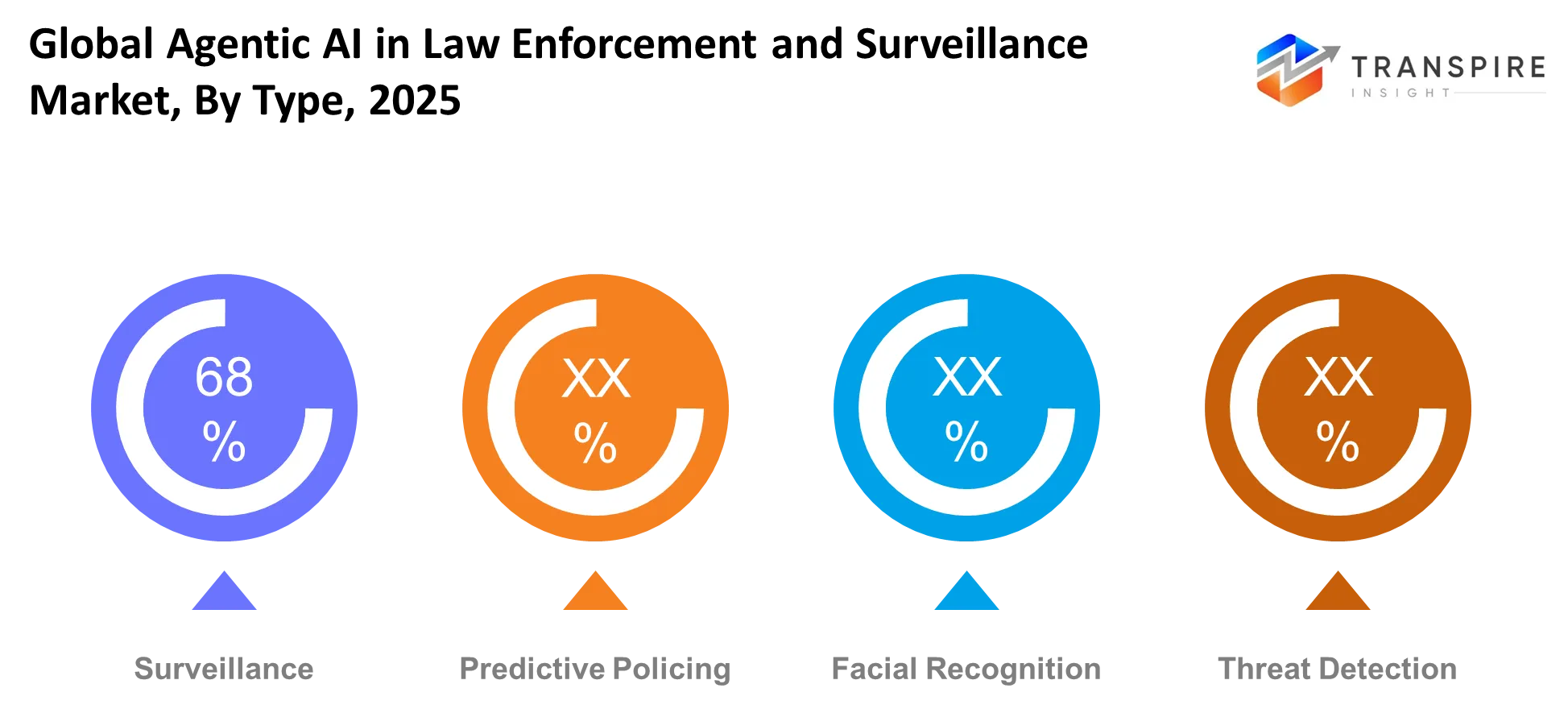
The surveillance segment accounts for 68% of the overall market share in this domain. It uses technology to automate existing cameras and provide live video analysis using machines to create municipal grids and reduce response time. In addition to this, Predictive Policing relies on crime records and mathematical models to move operations from reaction to prediction without discrimination via open algorithms. Facial recognition is an improvement in biometrics that scans complete crowds against a watchlist, and threat detection protects public places by neutralising threats autonomously.
To learn more about this report, Download Free Sample Report
By End-User
Application and usage of these parts and software will be done by the government, law enforcement, and defence agencies. The government, it will be used for the purpose of having an entity that regulates and also provides funding, with more focus being placed on the financial aspect of integrating technology and database security, and this will lead to greater centralisation of monitoring all operations through the use of privacy auditing services offered by the federal agency.
In terms of Law Enforcement, it will be used by end-users to address issues of managing finances and operations, such as patrols and other operations, using the data management techniques that may make operations preventive and not just reactive, in addition to having full transparency in their operations. Finally, by the Defence Sector, it will be used for the purpose of ensuring strategic border protection and anti-terrorism, and thus there will be high demand for technologies like automated threat detection to avoid physical threats from humans.
What are the Key Use Cases Driving the Global Agentic AI in Law Enforcement and Surveillance Market?
Automation of video analysis acts as the core impetus for operational activities, significantly boosting expansion in the predominant software and surveillance categories. City authorities employ such technology to rapidly monitor large transit systems, automatically identify any behavioural abnormalities, and notify emergency dispatchers about events as they occur, without human intervention.
Field operations are increasingly incorporating predictive policing and crowd biometric scanning technologies. The police leverage past crime statistics to plan efficient patrol routes, whereas border guards employ live biometric identification mechanisms to protect major international transit nodes.
Tactical implementations that are emerging involve perimeter security and local edge computing. The military and private security companies employ autonomous sensor networks for the surveillance of isolated posts, detection of weapons, and local isolation of environmental threats without depending on cloud-based computing facilities.
|
Report Metrics |
Details |
|
Market size value in 2025 |
USD 4.09 billion |
|
Market size value in 2026 |
USD 5.653 Billion |
|
Revenue forecast in 2033 |
USD 54.482 Billion |
|
Growth rate |
CAGR of 38.22% from 2026 to 2033 |
|
Base year |
2025 |
|
Historical data |
2021 - 2024 |
|
Forecast period |
2026 - 2033 |
|
Report coverage |
Revenue forecast, competitive landscape, growth factors, and trends |
|
Regional scope |
United States; Canada; Mexico; United Kingdom; Germany; France; Italy; Spain; Denmark; Sweden; Norway; China; Japan; India; Australia; South Korea; Thailand; Brazil; Argentina; South Africa; Saudi Arabia; United Arab Emirates |
|
Key company profiled |
IBM, Microsoft, Google, Amazon AWS, Palantir, NEC, Hikvision, Dahua, Thales, Raytheon, Lockheed Martin, Motorola Solutions, Cisco, Oracle, SAP |
|
Customization scope |
Free report customisation (country, regional & segment scope). Avail customised purchase options to meet your exact research needs. |
|
Report Segmentation |
By Component (Software, Services, Platforms, Tools), By Application (Surveillance, Predictive Policing, Facial Recognition, Threat Detection), By End-User (Government, Law Enforcement Agencies, Defence, Security Firms) |
Which Regions are Driving the Global Agentic AI in Law Enforcement and Surveillance Market Growth?
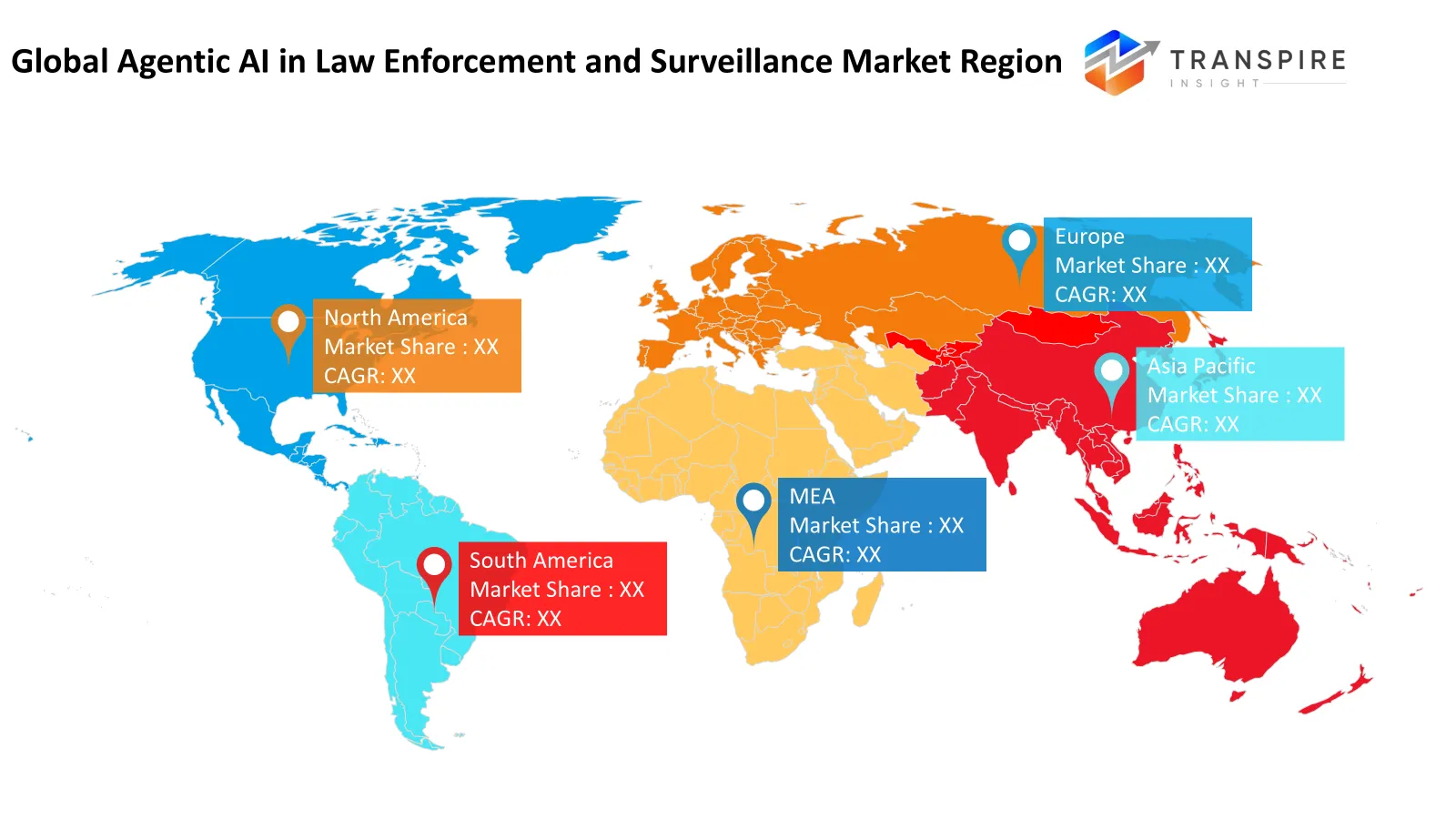
North America has cemented itself as the leader of the security technology industry, holding a market value of USD 1.76 billion in 2025 and predicted to escalate sharply to USD 45.99 billion within a decade. Such dominance arises as a result of being first to embrace the use of state-of-the-art automated systems coupled with significant government and defence funding for the protection of citizens' lives. It also benefits from having an already highly developed digital infrastructure, which will ensure that any new software can easily interface with existing surveillance systems. In May 2026, the international “Five Eyes” intelligence agency (US-led with CISA and NSA as leaders) released the first collaborative guidance on cybersecurity operations, which included guidelines for the safe use of Agentic AI services for defence purposes.
Secondly, the European market has been seen as the second largest one, as it accounts for the dominating 25% to 41% of the region's figures. The European market develops significantly faster due to its interest in protective systems guaranteeing confidentiality, rather than methods of rapid deployment that are used in North America. The stability of this market may be explained by the existence of well-structured state funding programs, among which there is the Digital Europe Programme funding smart city development and border control activities. The major countries in this market are the UK, Germany, and France, which are steadily developing thanks to the utilisation of algorithmic technologies used in crime analysis and management of digital evidence. Their market development has mostly been driven by consumer demand for appropriate software utilisation. In May 2026, the European Commission made its final political decision on the guidelines concerning how to implement high-risk AI applications, according to the EU AI Act, with clear compliance deadlines for biometric surveillance and judicial evidence auditing software.
In just a matter of time, the Asia Pacific has evolved into the world’s fastest-growing and dynamic market, holding an impressive 24% market share of the geographical numbers with the highest CAGR of 14.5%. This has been possible due to the massive efforts undertaken to revolutionise its public security systems, along with improved border protection capabilities through the implementation of digitised solutions. It has already been observed that this change can be attributed to the increased use of advanced automated solutions for its municipal surveillance and judiciary systems, owing to the rapid adoption of facial recognition and object identification software by technology giants.
As far as the future growth potential is concerned, it is expected to emerge from the rapidly increasing need for infrastructure solutions in the upcoming urban centres and smart cities in China, India, and Japan, while ROW accounts for the rest 10%. In January 2026, authorities of Indian cities released details of operations for a huge deployment conducted in late 2025 at the Maha Kumbh and Ganesh Chaturthi celebrations, when CCTV systems driven by artificial intelligence used context-aware monitoring and real-time face recognition technology to issue more than 800,000 security warnings.
To learn more about this report, Download Free Sample Report
Who are the Key Players in the Global Agentic AI in Law Enforcement and Surveillance Market, and how do they Compete?
This law enforcement vendor marketplace competition consists of cloud vendors, silicon providers, and security specialists competing through database creation, uptime, and identification of patterns. Google, AWS, and Microsoft compete by providing cost efficiency and economies of scale through safe and certified hosting of outside policing initiatives in their cloud systems. NVIDIA and IBM innovate through very fast visual processing chips, which can be used in conjunction with city surveillance cameras. OpenAI and C3.ai offer innovative logic-based platforms that are suitable for database contracts of businesses and governments. Palantir and NEC have chosen to compete through the rich data niche, making cross-referencing among many sources unique for their federal intelligence agency clients. Veritone and Clearview AI compete through a focused niche approach, using advanced facial recognition and automatic video censorship in their municipal department services.
- IBM
- Microsoft
- Amazon AWS
- Palantir
- NEC
- Hikvision
- Dahua
- Thales
- Raytheon
- Lockheed Martin
- Motorola Solutions
- Cisco
- Oracle
- SAP
Recent Development News
In May 2026, the Hyderabad Police launched SOCEYE. This product launch implements an AI platform that autonomously monitors social media networks, tracks cyberbullying, and prioritises threats to women's safety and public order. https://www.newindianexpress.com
In September 2025, Axon acquired Prepared, a developer of AI-powered 911 communication technology. This acquisition enables public safety answering points to utilise conversational and multimedia AI agents that autonomously summarise incoming emergency texts, synthesise live-streamed mobile feeds, and rapidly route actionable surveillance intelligence directly to active dispatchers. https://www.police1.com
What Strategic Insights Define the Future of the Global Agentic AI in Law Enforcement and Surveillance Market?
It is transitioning into the use of off-grid and stand-alone infrastructure surveillance technology. Rather than relying on conventional and power-consuming configurations, companies are opting for stand-alone solutions that analyse unstructured information on-the-spot within the physical infrastructure.
One latent threat in this respect is reliance on centralised data storage systems. In the event that the police department needs to work with a large amount of raw data, one bottleneck in the infrastructure could result in delays in processing evidence. An opportunity that companies should consider is the deployment of solar-powered deterrent systems.
Decision makers should shift from being mere keepers of records to proactive security systems through automation. An investment in distributed storage frameworks is the best solution for clearing out data logjams to ensure fast analyses and protection of vital infrastructures from new digital attacks.
By Component
- Software
- Services
- Platforms
- Tools
By Application
- Surveillance
- Predictive Policing
- Facial Recognition
- Threat Detection
By End-User
- Government
- Law Enforcement Agencies
- Defence
- Security Firms
Frequently Asked Questions
Find quick answers to common questions.
The expected Global Agentic AI in Law Enforcement and Surveillance Market size will be USD 54.482 Billion in 2033.
Key segments for the Global Agentic AI in Law Enforcement and Surveillance Market are by Component (Software, Services, Platforms, Tools), By Application (Surveillance, Predictive Policing, Facial Recognition, Threat Detection), By End-User (Government, Law Enforcement Agencies, Defence, Security Firms.
Major Global Agentic AI in Law Enforcement and Surveillance Market players are Google LLC, Amazon Web Services Inc. (AWS), Microsoft Corporation, Nvidia Corporation, International Business Machines Corporation (IBM), OpenAI, C3.ai Inc., Palantir Technologies Inc., NEC Corporation, Veritone Inc., Clearview AI, Inc., Motorola Solutions, Inc., Genetec Inc., Intelli Vision, Cognitive.
The Global Agentic AI in Law Enforcement and Surveillance Market size is USD 4.09 billion in 2025.
The Agentic AI in the Law Enforcement and Surveillance Market CAGR is 38.22%.
- IBM
- Microsoft
- Amazon AWS
- Palantir
- NEC
- Hikvision
- Dahua
- Thales
- Raytheon
- Lockheed Martin
- Motorola Solutions
- Cisco
- Oracle
- SAP
Recently Published Reports
-
Apr 2026
3D Optical Profiler Market
3D Optical Profiler Market Size, Share & Analysis Report By Type (Desktop 3D Optical Profiler, and Portable 3D Optical Profiler), By Technology (Confocal Technology, and White Light Interference), By End-Use Industry (Manufacturing, Research Institutions, Automotive, Aerospace and Defense, Medical Devices, and Other), and Geography (North America, Europe, Asia-Pacific, Middle East and Africa, South and Central America), 2021 - 2031
-
Apr 2026
Depth Sensor Market
Depth Sensor Market Size, Share & Analysis Report By Type (Infrared Depth Sensors, Time-of-Flight (ToF) Sensors, Stereo Vision Sensors, Structured Light Sensors, Ultrasonic Depth Sensors), By Application (Automotive, Robotics, Gaming, Consumer Electronics, Industrial Automation, Healthcare, Security & Surveillance, Others), By End Users (Automotive Manufacturers, Consumer Electronics Companies, Healthcare Providers, Industrial Companies, Security Agencies, Gaming Companies, Robotics Companies, Others), and Geography (North America, Europe, Asia-Pacific, Middle East and Africa, South and Central America), 2021 – 2031
-
Apr 2026
Digital Manufacturing Market
Digital Manufacturing Market Size, Share & Analysis Report By Component (Hardware, Software, and Services), By Technology (Robotics, 3D Printing, Internet of Things (IoT), and Others), By Application (Automotive and Transportation, Aerospace and Defense, Consumer Electronics, Industrial Machinery, and Others), By Process Type (Computer-Based Designing, Computer-Based Simulation, Computer 3D Visualization, Analytics, and Others), and Geography (North America, Europe, Asia-Pacific, Middle East and Africa, South and Central America), 2021 – 2031
-
Apr 2026
Digital Visa Services Market
Digital Visa Services Market Size, Share & Analysis Report By Type (Individual Travelers, Group Travelers), By Application (Tourism, Business Travel, Others), and Geography (North America, Europe, Asia-Pacific, Middle East and Africa, South and Central America), 2021 – 2031