
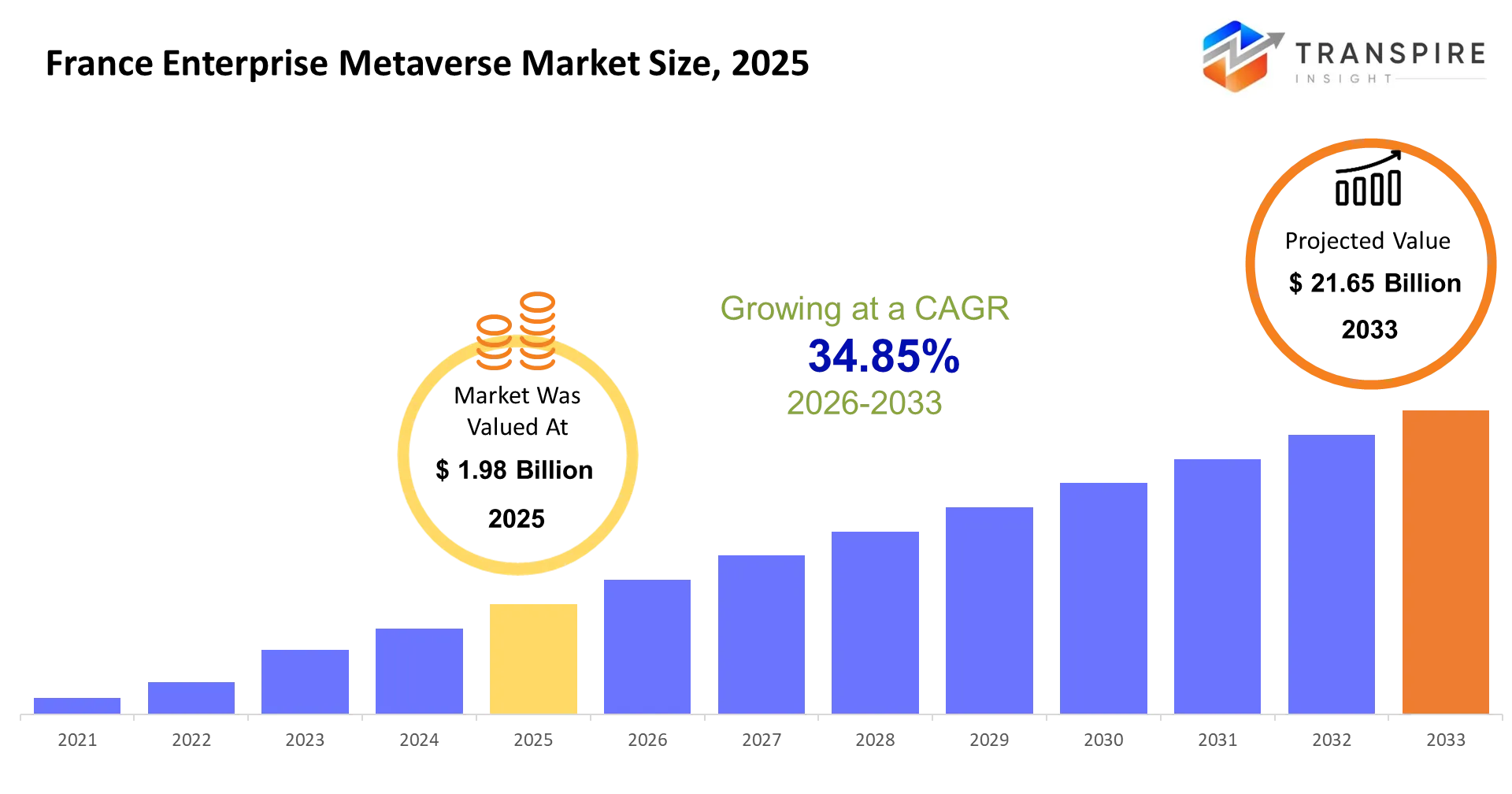
France Enterprise Metaverse Market Size & Forecast:
- France Enterprise Metaverse Market Size 2025: USD 1.98 Billion
- France Enterprise Metaverse Market Size 2033: USD 21.65 Billion
- France Enterprise Metaverse Market CAGR: 34.85%
- France Enterprise Metaverse Market Segments: By Type (Hardware, Software, Services, Platforms, Others); By Application (Collaboration, Training, Digital Twins, Marketing, Remote Work, Others); By End-User (Enterprises, Manufacturing, Healthcare, BFSI, IT, Retail, Others); By Technology (AR, VR, MR, AI, Blockchain, Others)
To learn more about this report,  Download Free Sample Report
France Enterprise Metaverse Market Summary
The France Enterprise Metaverse Market was valued at USD 1.98 Billion in 2025. It is forecast to reach USD 21.65 Billion by 2033. That is a CAGR of 34.85%over the period.
In practice, the France Enterprise Metaverse Market lets companies make immersive digital replicas of factories, logistics networks, and training spaces, so engineers and managers can kind of simulate day to day operations , try different scenarios, and coordinate from distance, all without being stuck by physical limits. In the last three to five years, things moved away from one-off experimental VR rollouts, toward more integrated digital twin ecosystems that blend cloud platforms, AI analytics, and live industrial data feeds across different companies. This shift got a strong push from COVID-19 related supply chain problems and from Europe’s focus on energy-lean and dependable industrial activity, which basically forced many organizations into remote-first design and simulation habits.
So, as a consequence enterprises often see less downtime , faster product cycles development, and lower spending on training and upkeep , and that kind of makes adoption spread more easily across manufacturing, aerospace , and even retail throughout France. Meanwhile this rising reliance on virtual operational environments is quietly changing how organizations design, teach , and fine tune complex industrial systems, it also backs larger, long-term investments in enterprise digital transformation.
Key Market Insights
- Île-de-France basically dominates the France Enterprise Metaverse Market with something like 40–45% share, because there’s a big concentration of enterprises and tech—so it feels very clustered there.
- Auvergne-Rhône-Alpes, on the other hand, shows up as the fastest-growing region, mainly due to industrial digitization and those manufacturing modernization programs that are expected through 2033.
- Software platforms are leading the market, since enterprises really want scalable digital twin ecosystems plus simulation tools, and it’s not just a nice-to-have.
- AR and VR hardware stays in the second spot, supported by enterprise training use cases and also immersive visualization needs that keep expanding.
- Cloud-based digital twin platforms are the fastest-growing segment, as organizations move toward scalable, real-time operational modeling, which makes total sense when you think about uptime and responsiveness.
- For applications, training and simulation dominate, with around 38% share, driven by workforce optimization and the ability to learn in a risk-free, controlled way.
- Product design and remote collaboration are emerging as fast-growing application areas too, helping engineering teams speed things up and also cut development cycles, bit by bit.
- In terms of end-use adoption, manufacturing is leading, mostly because automation needs are strong and industrial process optimization keeps pushing investment.
- Aerospace and defense are the fastest-growing end-user category, mainly because of high-fidelity simulation requirements and mission planning, where accuracy matters a lot.
- Key players include Dassault Systèmes, Microsoft, NVIDIA, Siemens, Meta, and SAP, and they’re pushing industrial metaverse platforms forward.
- Companies are trying to strengthen competitiveness by integrating AI, forming strategic partnerships, and expanding cloud-based immersive enterprise ecosystems.
- Finally, ongoing progress in real-time rendering and digital twins keeps improving enterprise operational efficiency while also boosting the market’s overall scalability, step by step.
What are the Key Drivers, Restraints, and Opportunities in the France Enterprise Metaverse Market?
The main driver for the France Enterprise Metaverse Market seems to be the fast adoption of industrial digital twins that are , sort of , paired with AI and cloud computing. Companies are putting more money into immersive simulation environments to cut down on physical prototyping costs and also to boost operational accuracy . This movement gets even more push from industrial automation programs in France and the EU sustainability targets, where firms are pressured to optimize energy usage and reduce waste , basically through virtual modeling. So in the end, enterprises are seeing better ROI thanks to faster product development cycles , and less downtime during tricky, high-stakes operations.
Now a noticeable brake is the high initial integration cost plus the technical complexity of rolling out enterprise metaverse infrastructure across older legacy industrial systems. A lot of mid-sized firms get stuck because their data is scattered across different tools and they often don’t have the internal know-how to connect IoT, simulation platforms and AI models into one coherent environment. This sort of structural problem slows things down and can delay revenue, especially in traditional manufacturing, where digital transformation maturity is uneven.
There is also a meaningful opportunity in growing cloud-native metaverse platforms designed for industrial SMEs across France. As big hyperscalers and software providers move toward more modular, subscription-based digital twin offerings, smaller enterprises can get access to advanced simulation capabilities without the heavy upfront spend. That direction should help open up new demand in regional manufacturing clusters and logistics hubs , where efficiency is a constant priority.
What Has the Impact of Artificial Intelligence Been on the France Enterprise Metaverse Market?
Artificial intelligence is fundamentally reshaping the France Enterprise Metaverse Market by letting intelligent automation happen, supporting predictive simulation, and enabling real-time operational optimization across enterprise environments. In industrial digital twin systems , AI algorithms can automatically handle equipment monitoring and continuously analyze sensor streams coming from connected production lines. That helps organizations spot inefficiencies sooner and tweak workflows without needing someone to intervene all the time, which matters in complex manufacturing setups.
Machine learning models are now used more often for predictive maintenance, where virtual replicas of machinery foresee component failures before they show up for real. This improves equipment uptime and reduces sudden, unplanned shutdowns, especially in higher-value sectors like aerospace and advanced manufacturing. Plus, AI driven simulation tools also support energy consumption optimization and production scheduling, which generally brings measurable efficiency gains and lower operational costs over time.
Still, there is a big limitation that keeps coming up: the integration complexity, especially when AI systems must connect with legacy industrial infrastructure. Lots of enterprises struggle to train models using reliable, high-quality real-world industrial data, because conditions differ from site to site, sometimes a lot. On top of that, inconsistent data connectivity between edge devices and cloud platforms can weaken real time accuracy in certain deployments. Even with all that , AI keeps acting as a core enabler for scalable enterprise metaverse adoption in France, even if the path is not always smooth.
Key Market Trends
- From pilot VR rollouts, over into enterprise-wide digital twin ecosystems , the shift really sped up quite a bit between 2022 and 2025.
- French manufacturers are increasingly folding AI-powered simulation tooling into their workflow, to cut down on prototyping expenses and to raise design fidelity , even when project timelines get tight.
- At the same time, cloud-based metaverse platforms took off fast , since many enterprises started moving away from on-premise simulation infrastructure , or at least not relying on it as the default option.
- Dassault Systèmes together with Siemens also stepped up spending, leaning harder into real-time industrial modeling and into cooperative engineering spaces that feel more shared than before.
- NVIDIA-led progress in graphics computing improved the real-time rendering capability, so enterprise simulation workloads run smoother, and with less wait between iterations.
- Microsoft and SAP helped push broader enterprise adoption through connected cloud collaboration features and industrial data platforms , in a way that sounds simple but scales in practice.
- Aerospace businesses in France started adopting immersive training setups , which cut down on the operational training time and reduced safety exposure risks, in a noticeable way.
- Meanwhile , retail and logistics organizations increased their use of virtual planning environments, to make supply chains more efficient overall , especially when demand fluctuates.
- The appetite for hybrid physical-digital workflows grew steadily, because enterprises kept prioritizing operational resilience after the pandemic , and they wanted systems that adapt quickly.
- And competitively, strategies increasingly orbit around AI integration, interoperability standards , and cross-industry metaverse ecosystems, which now seem like the common direction everyone is aligning to.
France Enterprise Metaverse Market Segmentation
By Type
Hardware keeps a very noticeable role in the France Enterprise Metaverse Market, mainly because enterprises are still investing a lot into VR headsets, smart glasses, sensors and immersive cooperation equipment. Big industrial companies keep putting in place hardware backbones to enable simulation training, digital prototyping , and day to day operational visualization. In particular manufacturing , and aerospace are driving serious needs since immersive devices help raise design precision and also improve workforce involvement in difficult technical situations. Hardware uptake also rides along with continuous upgrades in screen clarity , computing performance and general device ergonomics.
Software is leading the space. This is largely due to enterprise reliance on digital twin platforms, AI supported simulation systems, and shared virtual spaces. The appetite stays strong because these software packages link operational information with cloud computing and analytics, then push it into scalable enterprise ecosystems. Services keep growing too, since companies keep asking for consulting, rollout help , cybersecurity, and deeper system integration for complicated metaverse setups. Platforms are picking up pace especially when they’re offered through subscription based deployment models which lowers the infrastructure entry for mid sized organizations. Then there are the others, like edge computing and the enabling middleware technologies, which see more targeted adoption in specific industrial contexts. During the forecast interval, software alongside cloud native platforms is expected to pull in the most investment activity, as enterprises focus on scalable and interoperable ecosystems.
By Application
Collaboration is one of the strongest use cases, mostly because enterprises really are adopting immersive virtual workspaces and real time engineering coordination tools. Nowadays, global groups lean harder on virtual environments to run design reviews, operational scheduling, and cross border project management, all without having to travel around. The space seems to be helped by hybrid work rules that last longer, plus that enterprise pressure to boost workforce output while also trimming operational costs. And because real time interaction is there, it also makes decisions faster across distributed organizations, in general.
Training still stays a major area because immersive learning setups improve readiness across manufacturing, healthcare, and aerospace operations. Digital Twins are showing the quickest structural growth, since industrial companies increasingly model factories, supply networks, and operational procedures before anything physical gets built. Marketing keeps expanding too, through virtual product previews and hands-on customer engagement platforms used by luxury retail and automotive brands. Remote Work keeps a steady demand, as organizations lock in hybrid operating models across professional services and technology related teams. Then there are other avenues, like virtual events and enterprise planning environments, which keep evolving inside specific corporate departments. Over time, Digital Twins together with AI assisted collaboration spaces are expected to reshape how enterprises plan operations, and where they put investment priorities.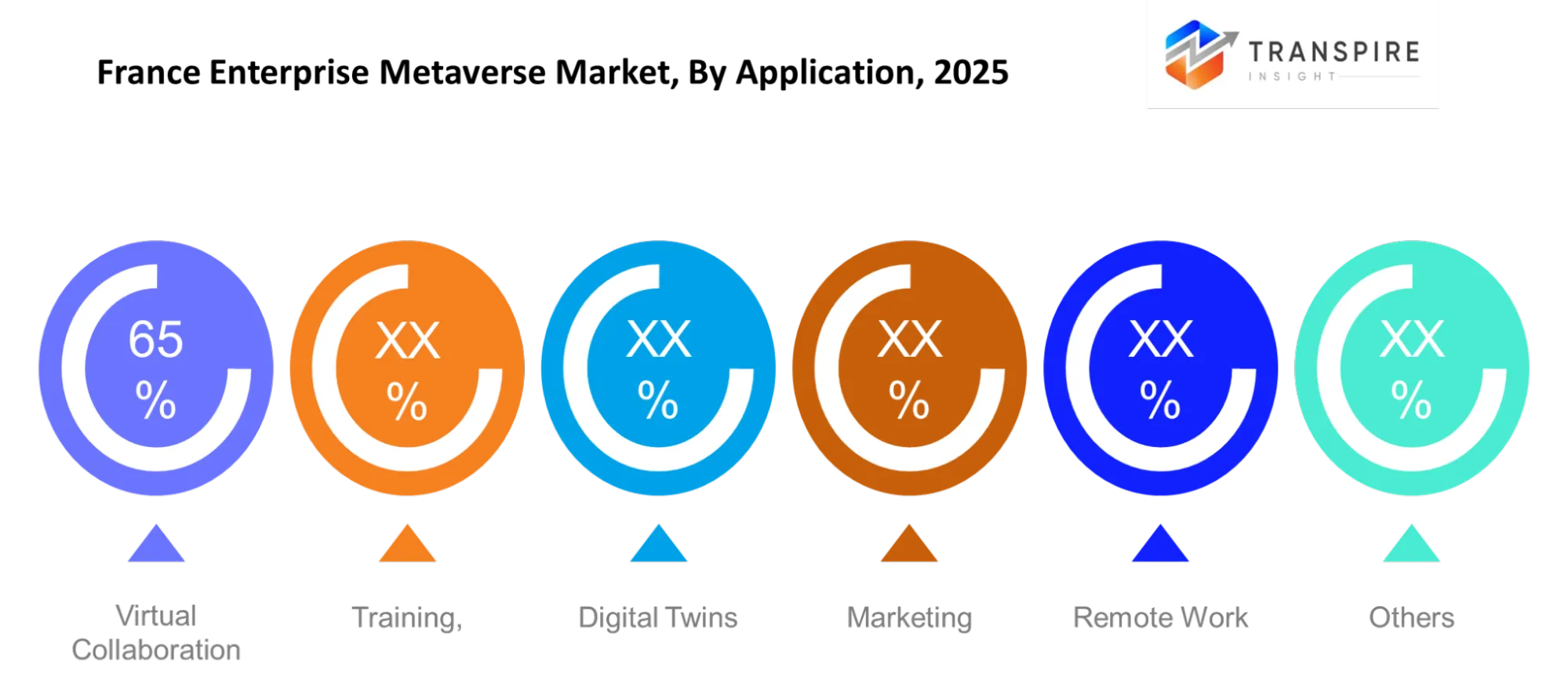
To learn more about this report, Download Free Sample Report
By End-User
Enterprises keep the dominant market position,mostly because big organizations keep putting serious money into operational simulation, virtual teamwork, and immersive productivity systems. The uptake is quite strong from multinational corporations, who are chasing more operational resilience, workforce adaptability, and those data-led decision making tools. Enterprise rollout also gains from solid cloud alignment and AI enabled analytics functions,helping scalability across various global business units. Even with the large corporate budgets ,they keep funding longer term infrastructure modernization plans.
Manufacturing stays a key end-user slice, mainly because it leans hard on digital twins, predictive maintenance, and virtual production planning environments. Healthcare adoption is moving up steadily too,as hospitals and medical institutions blend immersive surgical practice with simulation grounded learning platforms. BFSI firms are also using virtual client interaction spaces and remote advisory surroundings to refine client touchpoints. IT companies continue to release collaborative metaverse platforms for software development coordination and distributed staff control. Retail players are folding in immersive commerce atmospheres and virtual product visualization tech,so customers feel more engaged. Other areas,like education and logistics, are gradually boosting spend on immersive operational systems. Over the forecast period, manufacturing and healthcare are expected to deliver the strongest long term deployment chances due to needs around operational efficiency and ongoing workforce training requirements.
By Technology
AR keeps a solid position, mostly because it works in real-world enterprise use cases, like industrial maintenance, field service activities, and real-time support for workers . Smart glasses along with overlay based guidance systems raise productivity by showing the right contextual info right inside the physical workspace. You can see this advantage in manufacturing, logistics, and healthcare, where hands-free assistance and process streamlining really matter. There’s also a strong enterprise preference for practical deployment modes, and that keeps AR growing across different operational settings, even when things get busy.
VR counts as a major technology segment since immersive simulation and virtual training still sit at the center of enterprise metaverse adoption. MR is picking up momentum too, because more organizations mix physical and digital interaction in order to enable collaborative engineering, industrial maintenance, and remote assistance. AI keeps accelerating across the board through predictive analytics, intelligent automation, and real-time operational tuning inside immersive enterprise environments. Blockchain adoption is still comparatively limited, but it does help with secure digital asset management, identity verification, and decentralized transaction structures inside enterprise ecosystems. Also, other elements like edge computing and improved networking technologies support infrastructure scalability, plus low latency operational delivery. During the forecast period, AI integrated AR and MR ecosystems are expected to push the next step of enterprise metaverse commercialization and platform differentiation , overall.
What are the Key Use Cases Driving the France Enterprise Metaverse Market?
The main use case in the France Enterprise Metaverse Market seems to be industrial digital twin simulation, kinda across manufacturing and aerospace operations. Big firms lean on immersive virtual spaces, to try out production line models, evaluate engineering changes, and tune up maintenance workflows before anything is physically rolled out. That particular application is driving the strongest demand, because it trims prototyping expenses , speeds up production cycles and boosts operational precision in those tricky industrial systems where everything is interconnected.
Right next to that, adjacent applications are growing quickly in workforce training and remote teamwork. Aerospace companies as well as automotive producers are more and more deploying VR training environments, not just for better worker safety but also to cut onboarding time. On the other hand retail and logistics operators are pulling in collaborative virtual planning platforms, to line up warehouse layouts, coordinate inventory movement, and support supply chain work across teams that are spread geographically.
Then there are emerging uses, including AI-driven virtual commerce settings and metaverse-based healthcare simulation platforms. In France, healthcare institutions are testing immersive surgical training systems, while luxury retail brands are experimenting with persistent virtual showrooms and digital customer engagement ecosystems. Those efforts could, potentially reshape premium commerce experiences over the forecast period, and it feels like the momentum is building.
|
Report Metrics |
Details |
|
Market size value in 2025 |
USD 1.98 Billion |
|
Market size value in 2026 |
USD 2.67 Billion |
|
Revenue forecast in 2033 |
USD 21.65 Billion |
|
Growth rate |
CAGR of 34.85% from 2026 to 2033 |
|
Base year |
2025 |
|
Historical data |
2021 - 2024 |
|
Forecast period |
2026 - 2033 |
|
Report coverage |
Revenue forecast, competitive landscape, growth factors, and trends |
|
Regional scope |
France |
|
Key company profiled |
Meta, Microsoft, Google, NVIDIA, Unity, Epic Games, IBM, Accenture, SAP, Oracle, HTC, Sony, Qualcomm, Autodesk, Dassault |
|
Customization scope |
Free report customization (country, regional & segment scope). Avail customized purchase options to meet your exact research needs. |
|
Report Segmentation |
By Type (Hardware, Software, Services, Platforms, Others); By Application (Collaboration, Training, Digital Twins, Marketing, Remote Work, Others); By End-User (Enterprises, Manufacturing, Healthcare, BFSI, IT, Retail, Others); By Technology (AR, VR, MR, AI, Blockchain, Others) |
Which Regions are Driving the France Enterprise Metaverse Market Growth?
Île-de-France remains the most important regional market, more or less because it brings together France’s largest cluster of technology companies, cloud infrastructure providers and enterprise headquarters, all in one place. Here the region also keeps getting solid public and private funding for AI, digital twins, and immersive industrial technologies, so it sort of compounds over time. The Paris-based innovation ecosystem helps different groups work together, like software developers, big industrial actors ,and research institutions. With this kind of connected setup, it becomes easier to move from pilots to actual commercialization of enterprise metaverse platforms, especially in manufacturing , aerospace, and professional services.
Auvergne-Rhône-Alpes is the second-largest contributor but its rise feels more tied to industrial renewal than to pure corporate tech concentration. The region has a strong manufacturing and engineering foundation that keeps putting money into simulation software and immersive operational tools. But unlike Île-de-France, the adoption pattern is less about experimental digital experiences, and more about operational efficiency, predictive maintenance, and industrial training. Also the investment is steady, coming from automotive, robotics, and advanced manufacturing firms, which makes it a consistent source of recurring enterprise metaverse revenue, year after year.
Provence-Alpes-Côte d’Azur is now showing the quickest growth, mainly because of new expansion in smart infrastructure and a bunch of digital innovation initiatives. In other words, regional investment in connected logistics, aerospace technologies, and immersive tourism platforms has sped up enterprise metaverse deployment after 2024. Marseille and nearby technology hubs are drawing more and more startups, especially those building XR collaboration, AI visualization, and digital commerce applications. This momentum is creating real opportunities for software vendors, cloud providers, and immersive tech partners , across multiple verticals
Who are the Key Players in the France Enterprise Metaverse Market and How Do They Compete?
Competition in the France Enterprise Metaverse market still stays moderately concentrated around big technology platforms, cloud providers , and industrial software companies that already have solid enterprise ecosystems in place. Over time the market seems to tilt toward firms that bring together AI infrastructure, digital twin abilities, and cloud integration. Not so many standalone VR hardware providers, even if that sounds obvious. Incumbents keep trying to defend their market share via platform expansion and enterprise partnerships, while specialized developers often edge in with industry-focused simulation offerings and interoperability tools that don’t feel too brittle.Dassault Systèmes really stands out with advanced 3DEXPERIENCE digital twin platforms.
They’re deeply integrated into aerospace and manufacturing workflows , and that matters in practice. A big part of the advantage comes from long-standing relationships with European industrial firms and from strong engineering simulation capability. Microsoft competes by building cloud-native industrial metaverse ecosystems around Azure, AI analytics, and enterprise collaboration tooling. It pushes adoption further by combining immersive simulation with whatever productivity infrastructure enterprises already use today. NVIDIA’s competitive position is tied to high-performance graphics processing plus Omniverse simulation technology. That stack is tuned for real-time industrial rendering and AI-driven virtual settings, so the performance angle isn’t just a claim.
Meta concentrates more on immersive hardware ecosystems and AI-enabled virtual interaction technologies. Still, their approach is increasingly shifting toward mobile and mixed-reality enterprise experiences, which is a little different than before. SAP expands primarily through enterprise data integration and operational workflow management, connecting metaverse environments with real-time business systems. Accenture differentiates by focusing on implementation know-how and sector-specific enterprise tran
Company List
- Meta
- Microsoft
- NVIDIA
- Unity
- Epic Games
- IBM
- Accenture
- SAP
- Oracle
- HTC
- Sony
- Qualcomm
- Autodesk
- Dassault
Recent Development News
“In April 2026, Meta entered a partnership with Amazon Web Services to expand AI infrastructure deployment. The agreement strengthens large-scale compute capabilities supporting immersive AI and enterprise metaverse workloads.
Source:http://about.fb.com
“In February 2026, Meta announced a long-term infrastructure partnership with NVIDIA. The collaboration accelerates deployment of AI-optimized data centers supporting scalable enterprise simulation and metaverse environments.
Source:http://about.fb.com
What Strategic Insights Define the Future of the France Enterprise Metaverse Market?
The France Enterprise Metaverse Market is kind of shifting, structurally, toward AI integrated industrial ecosystems where immersive environments basically work as operational infrastructure, not like those stand alone “collaboration” tools people expect. Over the next five to seven years the most noticeable growth will come from enterprises embedding digital twins, predictive analytics, and real time simulation right into manufacturing, logistics, and engineering workflows. This is driven less by virtual reality adoption, and more by the need for operational resilience, automation efficiency, industrial data integration, and a whole bunch of practical continuity.
One less visible risk is the growing reliance on a small number of hyperscale cloud and AI infrastructure providers. When market concentration clusters around dominant computing platforms, enterprise deployment costs could rise, and interoperability across industrial ecosystems can get constrained. At the same time there is a real emerging opportunity, meaning lightweight cloud native simulation platforms that mid sized industrial firms can actually afford, without going for massive custom deployments.
Market participants should focus on interoperable AI driven platforms that connect cleanly with existing enterprise systems, instead of spending heavily on isolated immersive hardware ecosystems that don’t travel well between environments.
France Enterprise Metaverse Market Report Segmentation
By Type
- Hardware
- Software
- Services
- Platforms
- Others
By Application
- Collaboration
- Training
- Digital Twins
- Marketing
- Remote Work
- Others
By End-User
- Enterprises
- Manufacturing
- Healthcare
- BFSI
- IT
- Retail
- Others
By Technology
- AR
- VR
- MR
- AI
- Blockchain
- Others
Frequently Asked Questions
Find quick answers to common questions.
The Approximate France Enterprise Metaverse Market size for the market will be USD 21.65 Billion in 2033.
Key segments for the France Enterprise Metaverse Market are By Type (Hardware, Software, Services, Platforms, Others); By Application (Collaboration, Training, Digital Twins, Marketing, Remote Work, Others); By End-User (Enterprises, Manufacturing, Healthcare, BFSI, IT, Retail, Others); By Technology (AR, VR, MR, AI, Blockchain, Others)
Major France Enterprise Metaverse Market Players are Meta, Microsoft, Google, NVIDIA, Unity, Epic Games, IBM, Accenture, SAP, Oracle, HTC, Sony, Qualcomm, Autodesk, Dassault.
The Current France Enterprise Metaverse Market size is USD 1.98 Billion in 2025.
The France Enterprise Metaverse Market CAGR is 34.85% from 2026 to 2033.
- Meta
- Microsoft
- NVIDIA
- Unity
- Epic Games
- IBM
- Accenture
- SAP
- Oracle
- HTC
- Sony
- Qualcomm
- Autodesk
- Dassault
Recently Published Reports
-
Apr 2026
3D Optical Profiler Market
3D Optical Profiler Market Size, Share & Analysis Report By Type (Desktop 3D Optical Profiler, and Portable 3D Optical Profiler), By Technology (Confocal Technology, and White Light Interference), By End-Use Industry (Manufacturing, Research Institutions, Automotive, Aerospace and Defense, Medical Devices, and Other), and Geography (North America, Europe, Asia-Pacific, Middle East and Africa, South and Central America), 2021 - 2031
-
Apr 2026
Depth Sensor Market
Depth Sensor Market Size, Share & Analysis Report By Type (Infrared Depth Sensors, Time-of-Flight (ToF) Sensors, Stereo Vision Sensors, Structured Light Sensors, Ultrasonic Depth Sensors), By Application (Automotive, Robotics, Gaming, Consumer Electronics, Industrial Automation, Healthcare, Security & Surveillance, Others), By End Users (Automotive Manufacturers, Consumer Electronics Companies, Healthcare Providers, Industrial Companies, Security Agencies, Gaming Companies, Robotics Companies, Others), and Geography (North America, Europe, Asia-Pacific, Middle East and Africa, South and Central America), 2021 – 2031
-
Apr 2026
Digital Manufacturing Market
Digital Manufacturing Market Size, Share & Analysis Report By Component (Hardware, Software, and Services), By Technology (Robotics, 3D Printing, Internet of Things (IoT), and Others), By Application (Automotive and Transportation, Aerospace and Defense, Consumer Electronics, Industrial Machinery, and Others), By Process Type (Computer-Based Designing, Computer-Based Simulation, Computer 3D Visualization, Analytics, and Others), and Geography (North America, Europe, Asia-Pacific, Middle East and Africa, South and Central America), 2021 – 2031
-
Apr 2026
Digital Visa Services Market
Digital Visa Services Market Size, Share & Analysis Report By Type (Individual Travelers, Group Travelers), By Application (Tourism, Business Travel, Others), and Geography (North America, Europe, Asia-Pacific, Middle East and Africa, South and Central America), 2021 – 2031