
United Kingdom Hydrogen Fueling Station Market Size & Forecast:
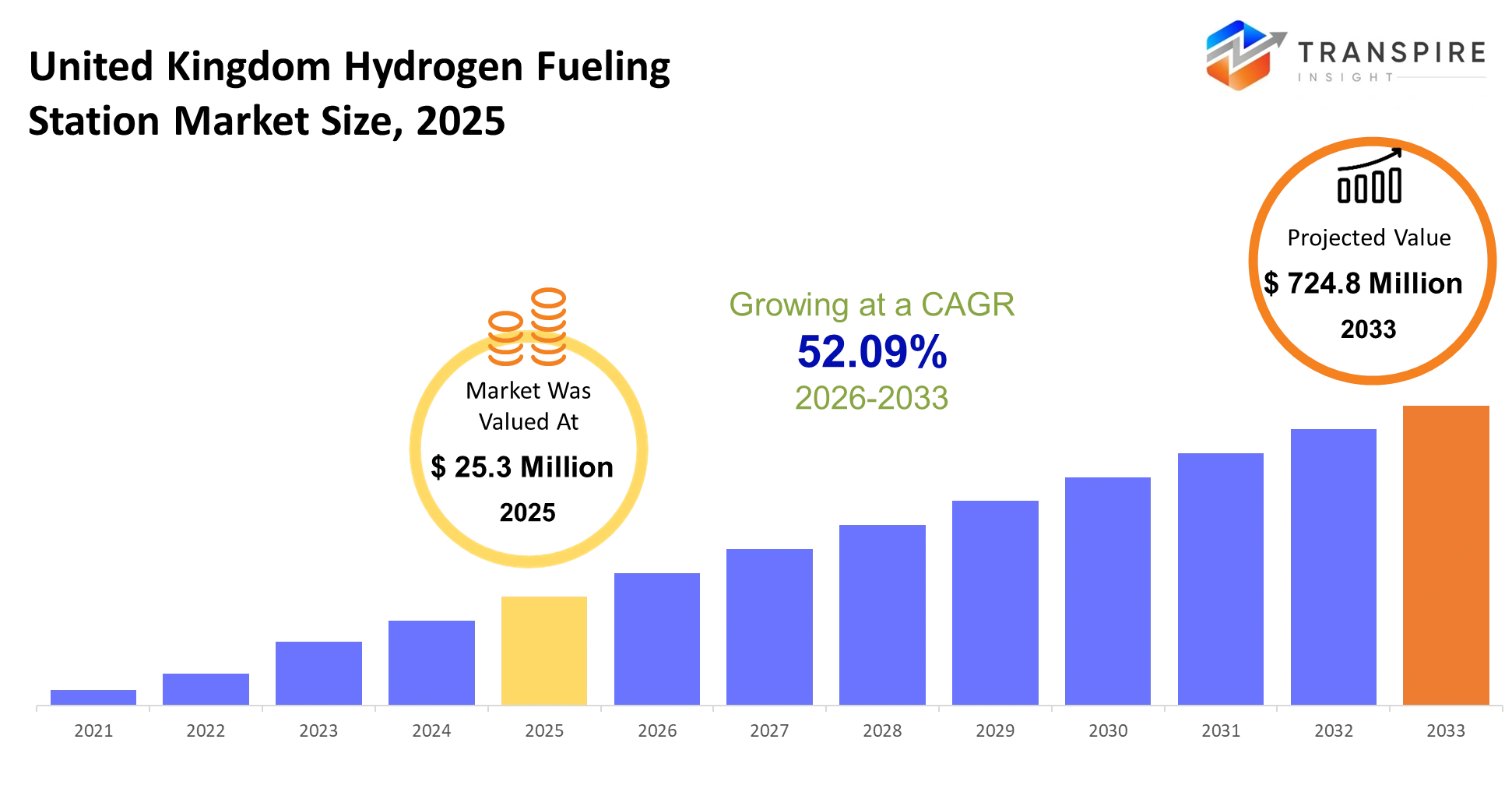
- United Kingdom Hydrogen Fueling Station Market Size 2025: USD 25.3 Million
- United Kingdom Hydrogen Fueling Station Market Size 2033: USD 724.8 Million
- United Kingdom Hydrogen Fueling Station Market CAGR: 52.09%
- United Kingdom Hydrogen Fueling Station Market Segments: By Station Type (On-site Hydrogen Stations, Off-site Hydrogen Stations, Mobile Hydrogen Stations, Retail Hydrogen Stations, Smart Hydrogen Stations, Others); By Technology (Compressed Hydrogen Technology, Liquid Hydrogen Technology, Electrolysis-based Stations, AI-enabled Monitoring Systems, Others); By Application (Passenger Vehicles, Commercial Vehicles, Buses, Industrial Vehicles, Fleet Operations, Others); By End User (Hydrogen Fuel Providers, Government Agencies, Fleet Operators, Public Transport Operators, Others); By Pressure Rating (350 bar Stations, 700 bar Stations, Multi-pressure Stations, Others)
To learn more about this report,  Download Free Sample Report
United Kingdom Hydrogen Fueling Station Market Summary
The United Kingdom Hydrogen Fueling Station Market was valued at USD 25.3 Million in 2025. It is forecast to reach USD 724.8 Million by 2033. That is a CAGR of 52.09% over the period.
Hydrogen fueling stations have a pretty big role in the United Kingdom’s move toward low-emission transport, mostly because they supply compressed hydrogen to fuel cell buses, heavy trucks, municipal fleets, and industrial vehicles—things that often can’t just depend on battery charging infrastructure, without some hassle. In real life, these stations handle a major operational headache for logistics operators and transit agencies, since they allow rapid refueling, longer driving ranges, and less fleet downtime than battery-only setups in places where vehicles are used a lot , like high-utilization transport routes.
Over the last five years the market kind of shifted, from small demonstration projects toward hydrogen mobility corridors that are actually scalable, commercial-leaning, and supported by government decarbonization policy plus industrial investment. The UK’s Net Zero Strategy and the funding support tied to the Hydrogen Strategy helped speed up infrastructure planning and encouraged private-sector involvement. Meanwhile, volatile diesel prices, along with tighter clean transport rules, nudged fleet operators to treat hydrogen as a long-term energy security choice. This whole change has, in turn, motivated energy companies, industrial gas suppliers, and mobility providers to expand station networks near freight hubs and through urban transport corridors. As station density keeps improving, fleet confidence increases too, and that creates a fairly direct pathway for more vehicle adoption and recurring infrastructure revenue.
Key Market Insights
- The United Kingdom Hydrogen Fueling Station Market crossed USD 25.3 million in 2025, being powered by the expanding fuel-cell bus , and freight vehicle rollout, i guess more or less on purpose.
- England leads the United Kingdom Hydrogen Fueling Station Market with more than 68% of the infrastructure concentration, this is pushed by freight corridors plus city transit investments, somewhat tightly tied together.
- Scotland shows the quickest momentum through 2033, mainly because green hydrogen production projects are ramping up, with renewable energy integration approaches following behind, not always neatly aligned.
- On-site hydrogen generation stations held close to 55% market share in 2025 , because operators prefer reduced dependency on transport and storage, it saves effort.
- Off-site delivered hydrogen stations still rank as the second-largest category, especially near logistics hubs and municipal fleet activities.
- Heavy-duty commercial vehicles became the fastest-growing application segment after 2022 , since logistics players sped up zero-emission fleet replacement programs.
- Public transportation made up over 40% of hydrogen dispensing demand in 2025, driven mostly by hydrogen bus adoption across metropolitan transit systems.
- Industrial fleet operators , including ports and warehousing operations, reported the strongest uptake growth from 2023 to 2025, steady and noticeable.
- Major firms like Shell plc, Air Products and Chemicals, ITM Power, BP plc, and Linde plc are broadening collaborations to reinforce hydrogen corridor infrastructure, step by step, not in one go.
- Strategic expansion is increasingly tilting toward integrated electrolyzer technology and digital station, models, and similar systems that coordinate supply and dispensing, more than before
What are the Key Drivers, Restraints, and Opportunities in the United Kingdom Hydrogen Fueling Station Market?
The main growth driver inside the United Kingdom hydrogen fueling station arena is the government-backed decarbonization push for heavy transport, and also public transit fleets. Regulatory pressure went up after the UK tightened its net-zero commitments, plus it rolled out funding programs that basically back hydrogen mobility infrastructure. Fleet operators involved in freight transport, municipal transit, and industrial logistics started putting money into fuel-cell vehicles, because hydrogen provides quicker refueling and a longer operating range than battery-electric options for high-mileage work. That shift then directly boosted infrastructure spending too, since station developers locked in long-term fueling agreements with fleet operators… which improved station utilization levels and revenue predictability
The biggest structural snag still seems to be the high upfront capital cost tied to station construction, hydrogen compression equipment, storage units, and the electrolyzer integration. Unlike typical fuel setups, hydrogen stations need specialized safety systems, and they also depend on a consistent hydrogen supply chain that is still thin across the UK. And no, this isn’t something you can fix overnight, because it relies on nationwide production capacity, grid upgrades, and transportation logistics all happening together. Because of that, lots of regional builds end up with delayed deployment schedules, which limits wider vehicle uptake, and slows down near-term revenue growth
A strong future opportunity is in pairing green hydrogen production with renewable energy clusters near ports, industrial zones, and along freight corridors. Some UK efforts are already connecting offshore wind generation with electrolyzer-led hydrogen production. This approach can lower fuel transportation expenses while also making the hydrogen supply more steady for heavy transport operators
What Has the Impact of Artificial Intelligence Been on the United Kingdom Hydrogen Fueling Station Market?
Artificial intelligence, and advanced digital tech, are slowly but surely boosting operational efficiency across the United Kingdom hydrogen fueling infrastructure sector. More and more station operators are turning to AI- enabled monitoring systems to automate pressure regulation, hydrogen flow balancing, temperature control and safety diagnostics. With these kinds of setups they can cut down manual involvement a lot, yet still keep fueling consistency steadier for commercial fleet operators and also public transit networks, which matters more than people realize.
Meanwhile machine learning models are getting used for predictive maintenance across compressors, dispensers, storage tanks and electrolyzer systems. They examine pressure fluctuations, equipment vibration and even fueling cycle records so operators can flag likely component failures before the breakdown ever shows up. This can help keep station availability higher and it tends to lower unplanned maintenance costs, especially in busy freight hubs and bus depots where uptime is basically everything. Some integrated digital platforms also start to forecast hydrogen demand patterns, based on fleet movement and refueling schedules. That way operators can refine inventory handling and manage electricity use during hydrogen production a bit more carefully.
On top of that, advanced analytics are improving regulatory reporting and day to day compliance, by automating leak detection and safety monitoring workflows. Still, AI adoption runs into limits, mainly because integration costs can be pretty high, and because there is limited historical operating data from large scale hydrogen fueling networks. A lot of these sites are relatively new, so it becomes harder to build deep machine learning training datasets needed for highly reliable long term performance projections.
Key Market Trends
- Hydrogen station rollouts picked up steam after 2021, in the UK clean transport rules seemed to push hard toward zero-emission freight and a broader municipal fleet swap, kind of right away.
- Fleet operators more and more leaned toward hydrogen powered trucks for the long haul, mainly since in commercial trials refueling times stayed under 20 minutes , more or less.
- Electrolyzer setups grew fast, up by about 30% from 2022 to 2025. Operators went after localized green hydrogen generation so the supply chain felt less fragile , at least on paper.
- Big energy players—Shell plc and BP plc, among others —boosted spending on multi fuel mobility hubs that mixed EV charging with hydrogen dispensing, and that blend became common.
- Local public transit teams also expanded hydrogen bus services across urban areas, and several UK municipalities began scaling zero emission fleet procurement sometime after 2023, with noticeable urgency.
- When it came to siting stations, developers increasingly focused the hydrogen corridor near logistics parks, industrial clusters, and motorway freight routes, so utilization rates could look better without stretching too far.
- Digital monitoring for stations also spread more widely after operators said downtime dropped in real numbers , and maintenance response times were faster. Less “ wait around ” type of situation.
- Green hydrogen supply contracts became more usual too, because transport operators needed to meet stricter carbon accounting requirements after 2024 , so contracts mattered.
- Deal making between industrial gas providers and transport operators got stronger, partly to lock in long term supply reliability and keep operating costs steadier over time.
- Modular fueling station designs showed up as a go to choice, because they shortened installation timelines and let operators expand in phases, instead of building everything at once .
United Kingdom Hydrogen Fueling Station Market Segmentation
By Station Type
On- site Hydrogen Stations hold a leading position, mostly because more actors seem to prefer making hydrogen near the point of use. That also cuts down the fuel transportation dependency and, frankly, it feels more controllable day to day. You can see strong adoption in industrial clusters, logistics operators, and big transit depots, so the market leans toward these systems. On- site setups help with supply reliability and they can also lower long term operating costs, which is probably why they keep winning. Off- site Hydrogen Stations stay in a solid secondary spot where centralized hydrogen production plus existing delivery infrastructure gives real economic advantages. Mobile Hydrogen Stations are still limited in volume but they matter more in pilot projects, temporary fleet operations, and remote industrial environments where building permanent infrastructure is not commercially reasonable. Retail Hydrogen Stations keep expanding steadily along public transport corridors and through commercial fueling networks. Meanwhile Smart Hydrogen Stations are gaining traction due to automated monitoring and digital optimization. Other station formats are mostly locked into demonstration programs and niche mobility use cases.
The on- site infrastructure continues expanding, especially as electrolyzer efficiency improves and renewable hydrogen integration becomes more commercially practical. Off- site stations still make sense in urban areas, since centralized supply chains can support higher dispensing capacity and often need less upfront investment. Mobile and smart station models are expected to show faster growth, mainly because flexible deployment options and AI based operational systems look more attractive to fleet operators. Retail operators increasingly push toward integrated multi energy hubs, combining electric charging with hydrogen dispensing infrastructure, and that mix is becoming a common direction.
By Technology
Compressed Hydrogen Technology pretty much keeps the dominant spot, because compressed storage systems are still commercially settled, and also operationally compatible with most heavy transport uses. You can see strong adoption across buses, freight vehicles, and industrial fleets, and that kind of demand pushes more infrastructure investment, partly because deployment feels simpler than with other hydrogen handling options. Liquid Hydrogen Technology has a smaller slice, but it still matters strategically, especially for long-range heavy transport and those high-volume fueling routines where you need higher energy density. Electrolysis-based Stations look like the fastest-growing chunk, since government funding programs keep backing localized green hydrogen production and it’s tied to renewable sources, in a way that sort of scales up better. AI-enabled Monitoring Systems keep taking more share too, because operators want better fueling efficiency, predictive upkeep, and automated safety management. Everything else stays mostly stuck in experimental storage approaches, plus limited pilot-scale rollouts, so yeah it doesn’t move as fast.
Compressed hydrogen setups are likely to keep leading, mainly because existing commercial vehicle platforms already support high-pressure fueling standards. Liquid hydrogen infrastructure will probably grow in a selective manner along industrial freight corridors, and also around large-scale logistics operations, where the fuel density turns into a real operating advantage. Electrolysis-based solutions are set up for quicker growth as renewable electricity keeps getting integrated more smoothly, and that improves cost competitiveness while reducing dependence on outside hydrogen supply chains. AI-enabled digital platforms may become even more important, as operators focus on cutting downtime, tuning energy consumption, and boosting infrastructure reliability.
By Application
Commercial Vehicles keep the leading application spot, mainly because long-haul freight operators want quick refueling and, a longer stint between stops, even when compared to battery-electric options. Really high fleet utilization rates and tight emissions rules also help hydrogen stay in the picture across logistics and distribution systems. Buses make up a major chunk as well, since municipal transit authorities are rolling out hydrogen-powered fleets more and more, trying to cut urban emissions while still running on continuous schedules. Passenger vehicles end up with a smaller market position, mostly because consumer hydrogen vehicle availability is still limited , and retail fueling coverage isn’t that broad. Industrial vehicles and fleet operations are also moving ahead, especially inside warehousing, port logistics, and manufacturing settings where “don’t-stop” operational cycles are basically the priority. Everything else stays narrow, mostly tied to pilot mobility programs or specialized transport tasks.
Commercial vehicle demand will keep steering infrastructure investment as freight decarbonization policies get stricter across the United Kingdom. Bus applications are expected to keep growing at a steady pace, with public funding still backing zero-emission transit modernization efforts. Passenger vehicle adoption may stay more restricted unless retail hydrogen station density rises enough across city and suburban transport corridors. Industrial fleet applications look set for strong longer-term growth, as hydrogen-powered material handling and logistics equipment gradually earns real operational trust. Across the forecast horizon, application demand will increasingly tilt toward high-utilization fleet ecosystems that can reliably support predictable hydrogen consumption volumes , without too many surprises.
To learn more about this report, Download Free Sample Report
By End User
Hydrogen Fuel Providers hold a dominant market position because infrastructure ownership , hydrogen supply management, and long term fueling contracts are still kind of clustered among industrial gas companies and integrated energy providers. They also have solid financial capacity, plus existing transport fuel distribution networks that keep them leading in big station deployment programs. Government Agencies form a notable segment , since they back projects with direct funding, invest in public transit, and keep pushing clean mobility infrastructure planning initiatives. Fleet Operators are gaining ground fast, as logistics companies swap toward hydrogen powered transport systems to meet emissions reduction targets and tighter operational efficiency needs. Public Transport Operators keep expanding hydrogen adoption through municipal bus fleet modernization and urban air quality programs. Other end users mostly stay wrapped up in research projects and smaller scale industrial applications.
Hydrogen suppliers are expected to keep structural influence, since dependable fuel sourcing and infrastructure financing are still the key competitive edge. Government involvement will continue nudging market expansion via infrastructure grants, transport decarbonization mandates, and regional hydrogen development strategies. Fleet operators are likely to become one of the quickest growing end user categories, as hydrogen fueled freight transportation matures commercially during the forecast period. Public transport agencies should keep steady infrastructure demand through long term transit electrification and clean mobility planning programs.
By Pressure Rating
700 bar Stations keep the dominant market position because a lot of passenger fuel-cell vehicles, plus newer commercial transport platforms, end up needing higher-pressure fueling for more extended range type performance. The compatibility factor with current fuel-cell vehicle standards stays solid, so investors keep leaning in across city routes, and also intercity transport corridors. Meanwhile 350 bar Stations still matter a fair amount, especially for buses, industrial fleets and heavy-duty logistics use, where lower-pressure fueling is basically operationally efficient and also cost-effective. Multi-pressure Stations are also picking up steam, partly because operators want infrastructure that can handle mixed vehicle fleets, spanning both public mobility and commercial networks. The other pressure setups stay mostly narrow , being limited to niche industrial uses and a handful of experimental deployments.
Looking ahead, 700 bar infrastructure is set to expand further since automakers keep prioritizing longer driving range plus better vehicle efficiency. 350 bar systems should keep their demand fairly steady in the heavy transport segments, where fueling economics, and day-to-day operational durability, tend to outweigh maximum vehicle range. Multi-pressure stations will likely see the quickest growth, because flexible fueling lets each station run closer to higher utilization rates and makes it easier for more customers to access. Infrastructure builders are increasingly focusing on modular pressure designs, the kind that can adapt as fleet composition shifts over time. Over the forecast window, pressure-rating strategies will move more toward interoperability, and toward scalable dispensing setups meant for diverse commercial mobility ecosystems.
What are the Key Use Cases Driving the United Kingdom Hydrogen Fueling Station Market?
In the United Kingdom the dominant use case for hydrogen fueling stations seems to revolve around heavy duty transportation, mainly fuel cell buses, long-haul trucks, and municipal fleet vehicles. Really, these are the scenarios where infrastructure demand gets highest, since operators want quick refueling, a long operating range and less downtime across those continuous transport timetables.
Also, hydrogen infrastructure is picking up momentum in industrial logistics and port operations. For example, warehousing fleets, material handling vehicles, and airport ground support equipment are leaning more often on hydrogen systems, where battery charging interruptions can mess with the day to day throughput. At the same time public transit agencies keep enlarging hydrogen bus programs as part of urban clean transportation initiatives.
On the emerging side, hydrogen powered rail transport and maritime support operations near industrial ports are starting to show up in pilots. A handful of pilot programs are testing hydrogen fueling approaches for regional rail networks and commercial shipping support services, especially where direct electrification is either technically hard, or just economically not practical.
|
Report Metrics |
Details |
|
Market size value in 2025 |
USD 25.3 Million |
|
Market size value in 2026 |
USD 38.5 Million |
|
Revenue forecast in 2033 |
USD 724.8 Million |
|
Growth rate |
CAGR of 52.09% from 2026 to 2033 |
|
Base year |
2025 |
|
Historical data |
2021 - 2024 |
|
Forecast period |
2026 - 2033 |
|
Report coverage |
Revenue forecast, competitive landscape, growth factors, and trends |
|
Regional scope |
United Kingdom |
|
Key company profiled |
Air Liquide, Linde plc, Nel ASA, ITM Power, Plug Power, Shell, TotalEnergies, Cummins, Ballard Power Systems, Hyundai Motor Company, Toyota Motor Corporation, Siemens Energy, Chart Industries, FirstElement Fuel, ENGIE |
|
Customization scope |
Free report customization (country, regional & segment scope). Avail customized purchase options to meet your exact research needs. |
|
Report Segmentation |
By Station Type (On-site Hydrogen Stations, Off-site Hydrogen Stations, Mobile Hydrogen Stations, Retail Hydrogen Stations, Smart Hydrogen Stations, Others); By Technology (Compressed Hydrogen Technology, Liquid Hydrogen Technology, Electrolysis-based Stations, AI-enabled Monitoring Systems, Others); By Application (Passenger Vehicles, Commercial Vehicles, Buses, Industrial Vehicles, Fleet Operations, Others); By End User (Hydrogen Fuel Providers, Government Agencies, Fleet Operators, Public Transport Operators, Others); By Pressure Rating (350 bar Stations, 700 bar Stations, Multi-pressure Stations, Others) |
Which Regions are Driving the United Kingdom Hydrogen Fueling Station Market Growth?
England is still the most dominant region inside the United Kingdom hydrogen fueling station market because it sort of brings together the country’s biggest freight network, the strongest industrial base, and the most mature transport infrastructure. You can see it on the major motorway corridors like the M1, M25 and M40, they help early deployment of hydrogen refueling hubs, aimed especially at heavy commercial vehicles and municipal transit fleets. Also the region gets a decent amount of policy backing tied to city air quality targets, plus low-emission transport mandates across London, Birmingham, and Manchester. That leadership is then reinforced by a wider ecosystem too, involving electrolyzer makers, industrial gas suppliers, logistics operators, and public transport authorities who work through longer-term infrastructure agreements.
Scotland is different, it grows more through renewable energy integration and hydrogen production, rather than relying only on dense transport demand. Momentum has been built via offshore wind capacity, green hydrogen pilot projects, and government-backed decarbonization schemes focused around Aberdeen and the Highlands. In comparison with England, Scotland’s market shape depends more on energy resilience and localized hydrogen production ecosystems. Because of that, infrastructure investment conditions stay more stable, which keeps pulling in industrial users, transit agencies, and various regional clean mobility programs.
Wales is moving quickly as the fastest-growing regional market, mainly due to newer industrial decarbonization steps and port-led hydrogen infrastructure plans. The investments linked to Milford Haven and the South Wales industrial clusters really picked up after hydrogen production support, and clean energy funding programs, got stronger backing in 2024 and 2025.
Who are the Key Players in the United Kingdom Hydrogen Fueling Station Market and How Do They Compete?
Competition in the United Kingdom hydrogen fueling station market is still kinda moderately concentrated, mainly because rolling out at scale really needs big capital and real engineering know-how, plus some kind of access to longer-term hydrogen supply networks. Right now, the bigger industrial gas players and energy firms seem to carry structural benefits, mostly via infrastructure ownership, distribution strengths, and those often-quiet government relationships. Meanwhile, more specialist hydrogen technology companies are changing the playing field, they do it by bringing integrated electrolyzer systems, modular station designs, and digital fueling platforms into the mix. Basically, competitive positioning is getting shaped by things like technology efficiency, infrastructure reliability, and whether they can line up fleet partnerships across commercial transport corridors.
In that landscape, ITM Power stands out with its proton exchange membrane electrolyzer technology and the way it keeps pushing on-site green hydrogen generation. The firm also improved its standing via hydrogen station collaborations with Shell plc, plus expansion arrangements that link station growth to UK mobility corridors. Shell is competitive through multi-energy forecourt integration, so they blend hydrogen dispensing with existing retail and transport infrastructure. This tends to lower deployment friction and it can make access easier for customers. Linde plc leans on its industrial gas logistics experience and compression technologies, which helps it support high-reliability fueling setups for transit, plus industrial fleet use cases.
Nel ASA, for its part, is centered on scalable fueling infrastructure and automated station technology that’s meant to bring down hydrogen dispensing costs over time. Plug Power is pushing forward by building vertically integrated hydrogen ecosystems, where fuel production, storage, and dispensing infrastructure are treated like one connected system for logistics and heavy transport customers.
Company List
- Air Liquide
- Linde plc
- Nel ASA
- ITM Power
- Plug Power
- Shell
- TotalEnergies
- Cummins
- Ballard Power Systems
- Hyundai Motor Company
- Toyota Motor Corporation
- Siemens Energy
- Chart Industries
- FirstElement Fuel
- ENGIE
Recent Development News
In April 2026, ITM Power secured UK government support totaling approximately £86.5 million to expand green hydrogen manufacturing capacity in Sheffield. The investment supports scaling of next-generation electrolyzer technology and strengthens domestic hydrogen infrastructure development across the UK transport sector. Source:http://hydrogeneurope.eu
In March 2022, ITM Power entered a strategic joint venture partnership with Vitol to expand hydrogen refueling infrastructure through the Motive platform. The agreement included up to £30 million in matched investment to accelerate deployment of public hydrogen refueling stations across the United Kingdom. Source:https://itm-power.com
In May 2019, Shell extended its hydrogen refueling collaboration agreement with ITM Power through 2024 to support expansion of hydrogen vehicle infrastructure in the United Kingdom. The agreement covered fueling solutions for buses, trucks, trains, and commercial transport fleets, strengthening long-term hydrogen mobility deployment. Source:https://www.thestar.co.uk
What Strategic Insights Define the Future of the United Kingdom Hydrogen Fueling Station Market?
The United Kingdom hydrogen fueling station market is sort of moving, structurally, toward integrated heavy-transport energy ecosystems, mainly centered on freight corridors and industrial clusters, plus renewable hydrogen production hubs. This direction is being pushed by the need to decarbonize transport stretches where battery-electric systems hit operational limits, especially during long-haul logistics and in high-utilization fleet use cases. Still, there is a hidden risk that people gloss over: market concentration around a few key infrastructure operators and electrolyzer suppliers, which could lead to pricing pressure, deployment choke points, and slower network scaling if investment cycles start to wobble.
At the same time there’s an emerging chance in port-linked hydrogen mobility hubs that blend maritime logistics, industrial hydrogen demand and also commercial vehicle fueling into one infrastructure web. Market players should lean into long-term fleet supply agreements and localized hydrogen production partnerships, not just bank on standalone retail station expansion, because utilization stability is what will really decide long-term profitability over the 2026–2033 period.
United Kingdom Hydrogen Fueling Station Market Report Segmentation
By Station Type
- On-site Hydrogen Stations
- Off-site Hydrogen Stations
- Mobile Hydrogen Stations
- Retail Hydrogen Stations
- Smart Hydrogen Stations
- Others
By Technology
- Compressed Hydrogen Technology
- Liquid Hydrogen Technology
- Electrolysis-based Stations
- AI-enabled Monitoring Systems
- Others
By Application
- Passenger Vehicles
- Commercial Vehicles
- Buses
- Industrial Vehicles
- Fleet Operations
- Others
By End User
- Hydrogen Fuel Providers
- Government Agencies
- Fleet Operators
- Public Transport Operators
- Others
By Pressure Rating
- 350 bar Stations
- 700 bar Stations
- Multi-pressure Stations
- Others
Frequently Asked Questions
Find quick answers to common questions.
The estimated United Kingdom Hydrogen Fueling Station Market size for the market will be USD 724.8 Million in 2033.
Key segments for the United Kingdom Hydrogen Fueling Station Market are By Station Type (On-site Hydrogen Stations, Off-site Hydrogen Stations, Mobile Hydrogen Stations, Retail Hydrogen Stations, Smart Hydrogen Stations, Others); By Technology (Compressed Hydrogen Technology, Liquid Hydrogen Technology, Electrolysis-based Stations, AI-enabled Monitoring Systems, Others); By Application (Passenger Vehicles, Commercial Vehicles, Buses, Industrial Vehicles, Fleet Operations, Others); By End User (Hydrogen Fuel Providers, Government Agencies, Fleet Operators, Public Transport Operators, Others); By Pressure Rating (350 bar Stations, 700 bar Stations, Multi-pressure Stations, Others).
Major United Kingdom Hydrogen Fueling Station Market players are Air Liquide, Linde plc, Nel ASA, ITM Power, Plug Power, Shell, TotalEnergies, Cummins, Ballard Power Systems, Hyundai Motor Company, Toyota Motor Corporation, Siemens Energy, Chart Industries, FirstElement Fuel, ENGIE.
The United Kingdom Hydrogen Fueling Station Market size is USD 25.3 Million in 2025.
The United Kingdom Hydrogen Fueling Station Market CAGR is 52.09% from 2026 to 2033.
- Air Liquide
- Linde plc
- Nel ASA
- ITM Power
- Plug Power
- Shell
- TotalEnergies
- Cummins
- Ballard Power Systems
- Hyundai Motor Company
- Toyota Motor Corporation
- Siemens Energy
- Chart Industries
- FirstElement Fuel
- ENGIE
About the Authors

Avinash Kumar
I’m Avinash Kumar, a Senior Research Analyst at Transpire Insight, with expertise in the Electronics and Semiconductor and Energy & Power industry. My work focuses on analyzing emerging technologies, market trends, industry developments, and innovation across these sectors. I specialize in transforming complex technical and market insights into clear, research-backed content that helps professionals, businesses, and decision-makers stay informed. Through continuous industry research and data-driven analysis, I strive to deliver accurate, reliable, and practical perspectives on the latest advancements shaping the semiconductor and energy landscape.

Chakradhar Khansole
Chakradhar serves as the Research Director at Transpire Insight, bringing over 8 years of experience in technology, innovation, and strategic market intelligence. He specializes in transforming complex market data into actionable business insights that enable organizations to make informed, growth-oriented decisions. Recognized for his strategic vision and analytical expertise, Chakradhar leads high-impact research initiatives, delivering comprehensive market assessments, competitive intelligence, and forward-looking industry analysis.
Recently Published Reports
-
Apr 2026
Active Power Filter Market
Active Power Filter Market Size, Share & Analysis Report By Type (Shunt Active Power Filters, Series Active Power Filter, Hybrid Active Power Filter), By Application (Harmonics Mitigation, Reactive Power Compensation, Voltage Regulation, Power Factor Correction), By Phase (Single Phase, Three Phase), By End-User Industry (Manufacturing, Healthcare, Commercial, Automotive, Oil and Gas, Others), and Geography (North America, Europe, Asia-Pacific, Middle East and Africa, South and Central America), 2021 - 2031
-
Apr 2026
Electrical Transformer Market
Electrical Transformer Market Size, Share & Analysis Report By Core (Closed, Shell, and Berry), By Insulation (Gas, Oil, Solid, Air, and Other), By Phase (Single, and Three), By Rating (100 MVA to 500 MVA, 501 MVA to 800 MVA, and 801 MVA to 1200 MVA), and Geography (North America, Europe, Asia-Pacific, Middle East and Africa, South and Central America), 2021 – 2031
-
Apr 2026
Hydraulic Piston Pumps Market
Hydraulic Piston Pumps Market Size, Share & Analysis Report By Type (Axial Piston Pumps, Radial Piston Pumps), By Operating Pressure (Low Pressure, Medium Pressure, High Pressure), By Application (Construction, Mining, Agriculture, Automotive, Oil & Gas, Industrial Machinery, Others), By End-User (OEMs, Aftermarket), and Geography (North America, Europe, Asia-Pacific, Middle East and Africa, South and Central America), 2021 – 2031
-
Apr 2026
Laboratory Gas Generators Market
Laboratory Gas Generators Market Size, Share & Analysis Report By Product (Nitrogen Gas Generator, Hydrogen Gas Generator, Zero Air Gas Generator, Purge Gas Generator, TOC Gas Generators, Others), By Application (Gas Chromatography, Liquid Chromatography-mass Spectrometry (LC-MS), Gas Analyzers, Others), By End-user (Life Science, Chemical & Petrochemical, Food & Beverage, Others), and Geography (North America, Europe, Asia-Pacific, Middle East and Africa, South and Central America), 2021 – 2031