
South Korea Lithium Battery Electrolyte Market Size & Forecast:
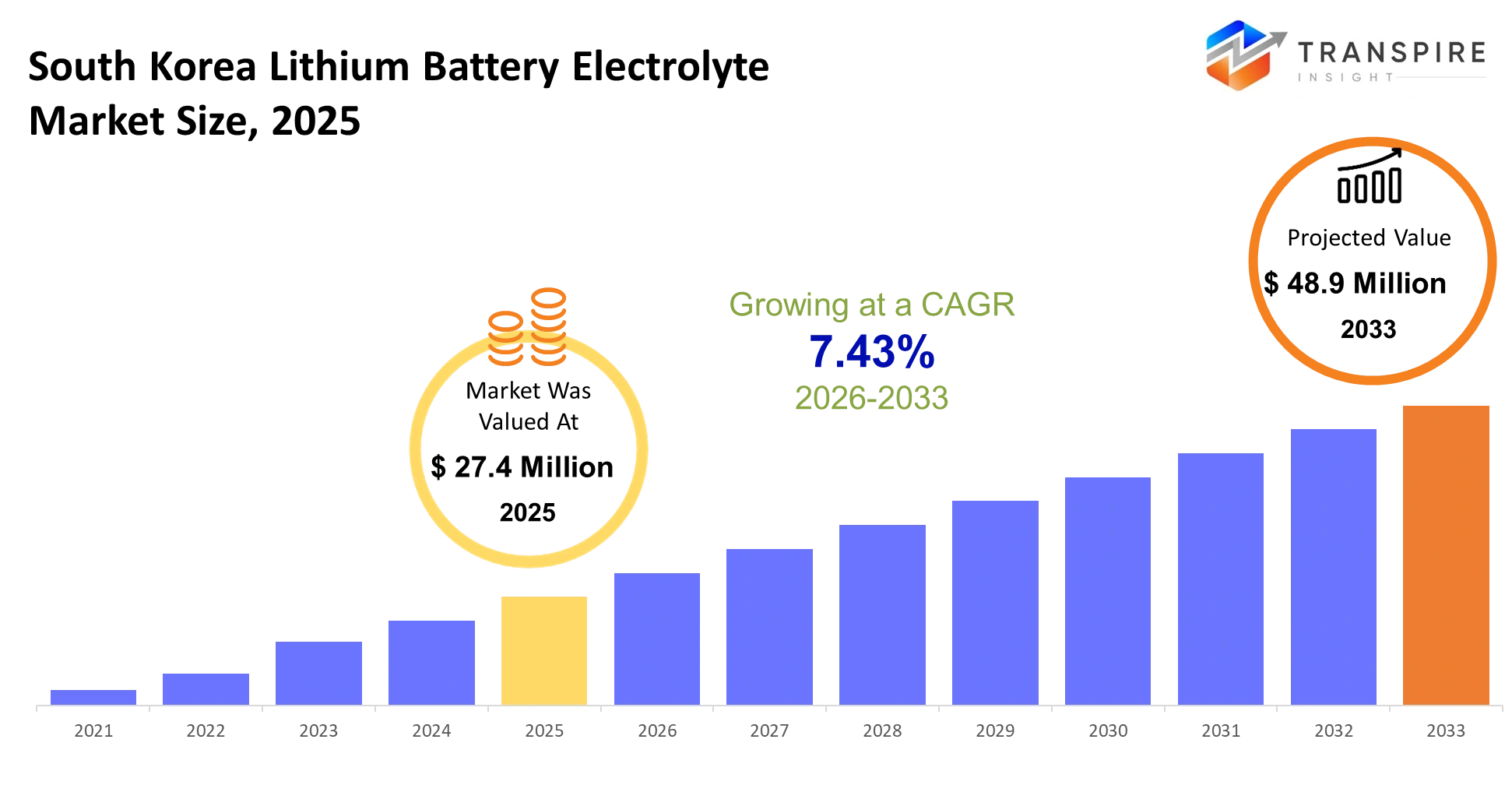
- South Korea Lithium Battery Electrolyte Market Size 2025: USD 27.4 Million
- South Korea Lithium Battery Electrolyte Market Size 2033: USD 48.9 Million
- South Korea Lithium Battery Electrolyte Market CAGR: 7.43%
- South Korea Lithium Battery Electrolyte Market Segments: By Electrolyte Type (Liquid Electrolytes, Solid-state Electrolytes, Gel Polymer Electrolytes, Others); By Battery Type (Lithium-ion Batteries, Lithium Polymer Batteries, Solid-state Batteries, Others); By Application (Electric Vehicles, Consumer Electronics, Energy Storage Systems, Industrial Equipment, Others); By Component (Lithium Salts, Solvents, Additives, Conductive Agents, Others); By End User (Battery Manufacturers, Automotive OEMs, Electronics Companies, Others)
To learn more about this report,  Download Free Sample Report
South Korea Lithium Battery Electrolyte Market Summary
The South Korea Lithium Battery Electrolyte Market was valued at USD 27.4 Million in 2025. It is forecast to reach USD 48.9 Million by 2033. That is a CAGR of 7.43% over the period.
South Korea’s lithium battery electrolyte market kind of plays a key role in keeping the country’s electric mobility and advanced manufacturing ecosystem running. Electrolytes help lithium-ion batteries move ions between electrodes, which then affects charging speed, thermal stability, battery life, and safety behavior in electric vehicles, energy storage systems, and even in everyday consumer devices. Basically, this market supports South Korea’s position as a big battery production hub, and it is tightly connected to global auto as well as electronics supply chains, so it’s not just “one segment” sitting by itself.
Over the last five years, the market moved away from the more traditional liquid electrolyte formulations, and it leaned into high-nickel plus fast-charging friendly chemistries. The whole idea was to chase a longer driving range, and yeah, better battery durability too. This change felt kind of stronger after COVID-19, when global supply chain disruptions and raw material price swings made it painfully clear how risky overseas material dependence can be. So, South Korean battery makers started expanding domestic sourcing partnerships, plus they put money into next generation electrolyte additives, like building resilience from within, sort of. At the same time, automakers kept pushing for longer-range EV platforms, and electrolyte suppliers gained more pricing leverage, then they locked in larger multi-year agreements. That technical momentum then turned into higher production volumes, and steadier revenue, even when everything wasn’t always smooth.
Key Market Insights
- Gyeonggi Province kind of dominated the South Korea lithium battery electrolyte market , with close to 38% share in 2025 mainly because the battery manufacturing facilities are pretty concentrated there.
- Meanwhile Chungcheong region showed up as the quickest expanding production hub from 2025 to 2030, mostly via deliberate scaling up of cathode and electrolyte plants, kind of in parallel.
- Ulsan also recorded noticeable growth in industry size, pushed by electric vehicle battery investments, and on top of that expanding petrochemical integration capacity.
- South Korea keeps working to fortify domestic electrolyte supply chains too, trying to lessen exposure to raw material import disruptions after the 2021 logistics instability , which was pretty unsettling.
- And solid-state compatible electrolytes are expected to post the fastest growth rate through 2030 as battery developers start commercializing the next generation platform, even though timing can shift a bit.
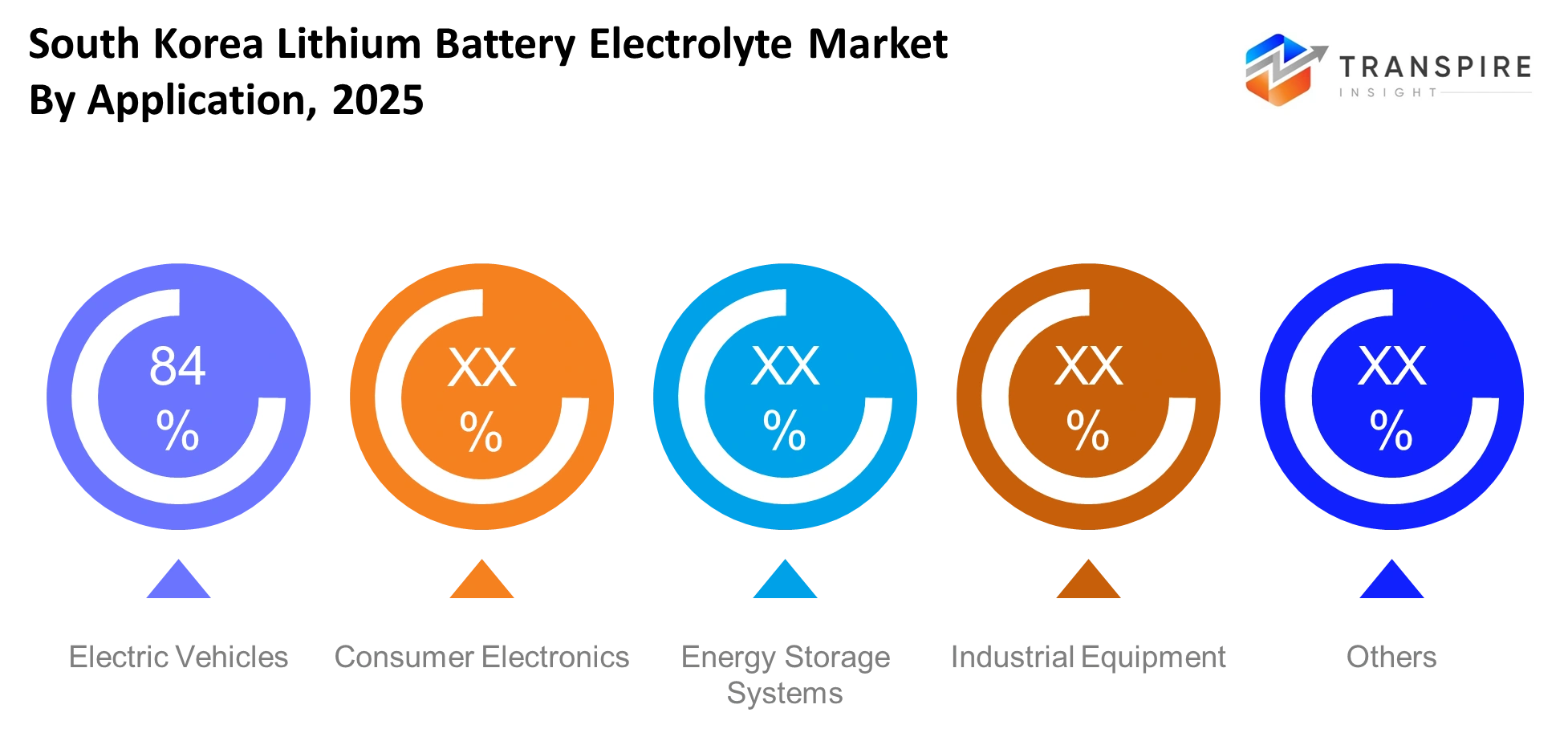
- In 2025, Electric vehicles seemed to make up roughly 61% of the South Korea Lithium Battery Electrolyte Market demand, basically because massive EV battery production contracts were signed at scale, and yes it really drove the number up.
- Meanwhile, energy storage systems came up as the fastest-growing segment of the market, kind of tied in with renewable energy integration and also with those investments aimed at national grid stabilization , so it wasn’t just one single driver or anything.
- Consumer electronics kept a solid chunk of the market, mostly because South Korea remains a major manufacturing hub for smartphones and other higher-end electronic devices, and the backing there never really fully faded.
- On top of that, fast-charging battery applications really pushed electrolyte demand upward, more than people expected. Automakers leaned into extended driving range and quicker charging cycles at the same time, even if the rollout timelines were admittedly tight.
- Battery manufacturers were the largest end users, holding close to 68% market share in 2025, and a big part of that was long-term supply arrangements with automotive OEMs, which in practice sort of fixed consumption patterns in place.
What are the Key Drivers, Restraints, and Opportunities in the South Korea Lithium Battery Electrolyte Market?
The main thing driving the South Korea lithium battery electrolyte market is basically the fast growth of local electric vehicle battery manufacturing. Thi s momentum really picked up after South Korean battery producers landed big supply agreements with global automakers somewhere between 2021 and 2024. The automakers kept asking for cells that go further, charge more quickly, and also handle heat in a more stable way, so electrolyte suppliers started pushing out more advanced mixes, and these are supposed to work well with high-nickel cathodes and silicon based anodes. Once battery cell production capacity kept climbing at plants in Gyeonggi, Ulsan, and Chungcheong, electrolyte demand rose along with it. That then boosts contract driven revenues for domestic chemical and materials firms, almost directly.
The toughest restraint still sits on South Korea’s dependence on imported lithium salts, solvents, and fluorinated compounds. This isn’t just a short-term snag, it’s kinda structural. The upstream raw material network is mostly centered in China, plus only a few mining areas overall. If someone wants to build alternative refining and processing infrastructure, it needs multi billion dollar investment, and also several years of work. On top of that, raw material price swings keep squeezing margins for electrolyte producers, and it can also mess up procurement plans for battery manufacturers.
Meanwhile a clear opportunity is starting to show up with solid state battery commercialization. South Korean companies are ramping up spending on solid state compatible electrolyte technologies in order to back next generation EV platforms expected after 2027. Firms working on sulfide based and gel polymer electrolytes may end up getting premium pricing, and more stable long term partnerships as automakers aim for safer high density batteries.
What Has the Impact of Artificial Intelligence Been on the South Korea Lithium Battery Electrolyte Market?
Artificial intelligence and advanced digital technologies are kind of reshaping South Korea’s lithium battery electrolyte industry, by boosting production precision, keeping quality more steady, and raising operational efficiency all the way through battery material manufacturing sites. Electrolyte producers are rolling out AI driven process control setups that keep watching moisture levels, chemical purity, temperature stability, and solvent mixing ratios in near real time. The automated manufacturing platforms can spot formulation deviations pretty quick, those small shifts that would usually mess with battery cycle life or even charging behavior. In practice, this has allowed big battery material suppliers to cut down production defects and push throughput harder, especially in high volume manufacturing environments.
At the same time, machine learning models are being used to forecast electrolyte degradation patterns and tune battery performance across different charging scenarios. Battery manufacturers comb through huge operational datasets from electric vehicles and energy storage systems, trying to understand how electrolyte additives behave when thermal stress kicks in, and also during fast charging cycles. These predictive tools help speed up product development, and yes, they also lower testing costs while improving safety and long term durability. Some manufacturers even mention measurable drops in unplanned equipment downtime, plus more stable yield after they integrate AI based monitoring into electrolyte production lines.
Still, AI adoption has some snags, mainly because integrating digital monitoring infrastructure into older chemical processing facilities can be expensive. Also, a number of electrolyte formulations don’t generate much long term operational data, so that reduces how accurate predictive models can be during early stage material development, and it tends to slow down broader commercial rollout.
Key Market Trends
- Between 2021 and 2025, South Korean battery manufacturers bumped up their high-nickel cathode use, sort of “pushing” electrolyte suppliers to tune thermal stability , and also cycle durability, formulation a bit more carefully than before.
- After the COVID-19 supply disruptions, many electrolyte producers began leaning into localized sourcing partnerships, so they could cut back on dependence upon imported lithium salts and solvents, in general.
- Since 2023, LG Energy Solution and Samsung SDI kept expanding joint R and D efforts, specifically aimed at fast-charging electrolyte additives, mainly for premium EV platforms and that kind of thing.
- Electrolyte manufacturers started adopting AI-based monitoring systems more often after 2022, partly to reduce moisture contamination and keep production yield consistent even across large scale facilities .
- In 2024 , South Korean suppliers accelerated fluorinated electrolyte development, because automakers demanded stronger battery safety behavior under ultra-fast charging conditions, no delays.
- Between 2022 and 2025, domestic electrolyte contracts increasingly moved away from short term procurement and toward multi-year agreements, tied to EV battery expansion plans and related demand.
- Solid-state battery pilot projects gained some real momentum after 2023, which encouraged further investment into sulfide-based and gel-polymer electrolyte technologies for the next-generation mobility applications.
- Energy storage system deployments also grew electrolyte consumption beyond automotive needs, as utilities invested in grid balancing , and renewable energy stabilization infrastructure—basically making it a bigger market.
- After 2021, raw material price volatility made electrolyte producers want more control, so they vertically integrated supply chains and secured long-term agreements for lithium compound procurement, like they were planning ahead.
South Korea Lithium Battery Electrolyte Market Segmentation
By Electrolyte Type:
Liquid Electrolytes kinda hold a major position in the market, because lithium-ion battery production across South Korea depends on stable ionic conductivity, plus that fast charging support. In practice battery manufacturers often like liquid formats for electric vehicles and consumer electronics, mostly because the processing methods are already established and the commercial scalability is pretty good. At the same time ongoing work on safety additives, and thermal resistance too will help with long-term use, especially across high capacity battery systems where heat can get tricky.
Meanwhile Solid-state Electrolytes are getting more attention, since battery developers are pushing for safer energy storage systems, with higher energy density. There’s also steady research activity from domestic battery companies and material suppliers, and that tends to encourage more investment into advanced solid-state platforms, not just experiments. Gel Polymer Electrolytes and other specialty variants will likely show up in flexible electronics and more compact battery designs as well, where leakage prevention and mechanical stability stay important, kind of no matter what.
By Battery Type:
Lithium-ion Batteries take up the biggest share really, mostly because electric vehicles, smartphones, and industrial storage systems keep using this same battery format for dependable performance and a long operational life. There is also strong manufacturing capacity from domestic battery producers so it naturally supports large scale electrolyte consumption. And as charging efficiency improves, plus battery durability gets better, production demand should stay stronger over the next few years.
Lithium Polymer Batteries keep showing steady adoption in lighter electronics where compact battery structures are the preference, rather than the exception. Meanwhile Solid-state Batteries are starting to look like a key future segment, since automotive companies along with battery developers are investing in next generation mobility platforms. The other battery categories will still be around for niche industrial and backup power uses, where customized energy storage performance is the real point, not just a nice bonus.
By Application:
Electric Vehicles seem to be the leading application segment, mostly because automotive companies ramp up production of long-range electric models, and this is backed by domestic battery manufacturing expansion. Electrolyte demand keeps climbing too ,since high-capacity EV batteries need steady chemical performance during fast charging, plus those extended operating conditions. Government-backed mobility programs along with export-focused vehicle production will keep giving this segment real momentum.
Consumer Electronics stays pretty steady in market participation, largely because South Korea is still a major manufacturing hub for smartphones, tablets, and wearable devices. Energy Storage Systems are growing in parallel, driven by renewable energy integration ,and also the need for industrial power backup. Industrial Equipment and a few other applications should add extra openings too, where resilient battery systems end up supporting automation, logistics, and day to day factory operations.
To learn more about this report, Download Free Sample Report
By Component:
Lithium salts stay essential because battery conductivity and the charging efficiency kind of depend on how electrolyte ions move around. The need for high-purity lithium compounds keeps rising, since battery makers are chasing better thermal steadiness and longer cycle life, you know. Solvents are doing their own job too, they help keep electrolyte consistency and the chemical balance during battery operation, not only in electric mobility but also across everyday electronic devices.
Additives are getting more important lately because manufacturers are working on improved battery safety, faster charging, and a longer operational lifespan. Conductive agents and other supporting materials will remain useful as advanced battery formulations get built for higher energy density applications. And while this is happening, ongoing material development across local chemical companies should help strengthen component innovation and production efficiency across the whole battery supply chain.
By End User:
Battery Manufacturers still take the lead a lot of the time, mostly because large scale battery cell manufacturing needs steady electrolyte procurement for automotive, electronics, and energy storage uses. In South Korea, domestic battery firms keep expanding their plants and also tightening long term marital relationships. When companies invest more in high performance battery technologies, it tends to keep electrolyte demand steady across several kinds of industry.
At the same time, Automotive OEMs are getting more hands-on involvement, since vehicle makers chase direct battery sourcing, plus the next generation development pathways. Electronics Companies remain involved fairly consistently too, because portable consumer gadgets need compact yet durable battery setups. Meanwhile other end users like producers of industrial equipment and energy storage operators will keep playing a part, and that will help widen commercial uptake across South Korea.
What are the Key Use Cases Driving the South Korea Lithium Battery Electrolyte Market?
Electric vehicle battery production stays as the main use case driving electrolyte consumption in South Korea, more or less. South Korea’s domestic battery manufacturers provide high capacity lithium-ion cells to big global automotive companies. Because of that, there is steady demand for electrolytes that help with rapid charging, thermal stability , and longer driving range, even when vehicles are run under actual commercial conditions.
At the same time, consumer electronics and energy storage systems are slowly spreading electrolyte use beyond just cars. Smartphone and wearable producers want compact batteries with dependable charging cycles. Meanwhile utility operators and industrial plants are rolling out large scale battery storage systems, which then helps with renewable energy integration plus backup power management.
There are also newer routes showing up, for example solid-state battery platforms. And there’s this broader set of advanced mobility technologies, like electric aviation support systems and autonomous industrial equipment. In parallel, research partnerships between battery developers and automotive OEMs are pushing efforts toward next generation electrolyte chemistries. These are aimed at higher energy density, better safety performance, and longer day to day operational lifespan.
|
Report Metrics |
Details |
|
Market size value in 2025 |
USD 27.4 Million |
|
Market size value in 2026 |
USD 29.6 Million |
|
Revenue forecast in 2033 |
USD 48.9 Million |
|
Growth rate |
CAGR of 7.43% from 2026 to 2033 |
|
Base year |
2025 |
|
Historical data |
2021 - 2024 |
|
Forecast period |
2026 - 2033 |
|
Report coverage |
Revenue forecast, competitive landscape, growth factors, and trends |
|
Country scope |
South Korea |
|
Key company profiled |
LG Chem, Samsung SDI, SK On, Soulbrain, Panax Etec, Mitsubishi Chemical, UBE Corporation, Capchem, Guangzhou Tinci, BASF, Dongwha Electrolyte, Central Glass, Morita Chemical Industries, Nippon Shokubai, CATL |
|
Customization scope |
Free report customization (country, regional & segment scope). Avail customized purchase options to meet your exact research needs. |
|
Report Segmentation |
By Electrolyte Type (Liquid Electrolytes, Solid-state Electrolytes, Gel Polymer Electrolytes, Others); By Battery Type (Lithium-ion Batteries, Lithium Polymer Batteries, Solid-state Batteries, Others); By Application (Electric Vehicles, Consumer Electronics, Energy Storage Systems, Industrial Equipment, Others); By Component (Lithium Salts, Solvents, Additives, Conductive Agents, Others); By End User (Battery Manufacturers, Automotive OEMs, Electronics Companies, Others) |
Which Regions are Driving the South Korea Lithium Battery Electrolyte Market Growth?
Gyeonggi Province seems to lead the South Korea lithium battery electrolyte market, sorta because the area has this tight mix of battery makers, chemical suppliers, and advanced study spaces . A lot of big production activity from firms like LG Energy Solution and Samsung SDI keeps pushing local electrolyte demand forward , mostly through long-term procurement agreements, not just short deals. On top of that, the region has strong transport links and it’s close to semiconductor and electronics clusters so moving raw material stays smoother and production plans get easier to coordinate. Then there are government-supported industrial programs, plus ongoing funding for battery technology research, which together keep Gyeonggi holding its lead across electric vehicle and energy storage supply chains.
Chungcheong Province ends up as the second-largest contributor, but the growth story feels different. Here it’s more about scaling manufacturing expansion and maintaining production stability, rather than clustering around corporate offices or heavy research centers. Big industrial complexes and comparatively lower operating costs keep drawing battery material suppliers that want scalable output. Local authorities also keep stretching industrial support initiatives that connect to battery exports and advanced manufacturing upgrades. So, the overall industrial setup stays fairly balanced, which helps electrolyte producers with more steady revenue and also lowers the kind of operational stress related to land and labor expenses found in the more crowded manufacturing zones.
Ulsan seems to be showing up as the fastest-growing regional market, kind of because the aggressive electric vehicle spending is happening at the same time as more teamwork between automakers and battery suppliers. There are new production rollouts that are tied to electric mobility and energy storage, and that is speeding up electrolyte consumption through the whole regional supply chain a lot. Even the port infrastructure upgrades, plus export-facing industrial policies, are helping the flow of battery materials and finished products, moving them toward overseas markets. All this momentum is quietly building real chances for electrolyte producers, material processing companies , and tech investors who want longer term involvement in South Korea’s battery manufacturing expansion from 2026 to 2033.
Who are the Key Players in the South Korea Lithium Battery Electrolyte Market and How Do They Compete?
The South Korea lithium battery electrolyte market still feels moderately consolidated, mostly because a small group of battery material suppliers plus integrated battery manufacturers kinda control a big slice of the commercial production capacity. In practice, competition isn’t really pushed by pricing as much as by technological performance, supply steadiness, and how well things line up with next-generation battery chemistries. The well-known players defend market share with long-term supply agreements , and also with joint research efforts alongside automotive OEMs. At the same time, mid-sized chemical firms are sliding into more niche lanes like fast-charging additives and electrolyte solutions that are solid-state compatible. In other words, whoever can provide stable thermal behavior, high-purity feedstocks, and localized supply support keeps improving their commercial stance.
LG Energy Solution leans hard into technology integration and frequent, close collaboration with automotive manufacturers who are working on high-capacity electric vehicle batteries. They sort of stand out thanks to large-scale battery production capability, plus direct involvement in electrolyte optimization for high-nickel battery systems. Samsung SDI competes with a premium approach to battery performance and very targeted materials research for long-cycle, as well as fast-charging applications. Ongoing investment in research partnerships, along with advanced battery testing facilities, also keeps their connections strong with global automotive clients.
SK On is moving pretty aggressively into overseas battery manufacturing projects, and also setting up strategic supply chain partnerships to lock in electrolyte access and raw material supply. They really put weight on high energy density battery platforms, which means the electrolyte has to be more advanced, with better thermal resistance, not just basic performance. Meanwhile, Soulbrain kind of stands out because it’s focused on high-purity electrolyte materials, and also customized additive technologies, made for domestic battery makers. Then there’s Dongwha Electrolyte, they are pushing their production capacity further and leaning more on localized material sourcing to improve delivery reliability. That also helps reduce the risk of getting hit by international raw material disruptions, all in all, it makes their plan feel more stable and practical.
Company List
- LG Chem
- Samsung SDI
- SK On
- Soulbrain
- Panax Etec
- Mitsubishi Chemical
- UBE Corporation
- Capchem
- Guangzhou Tinci
- BASF
- Dongwha Electrolyte
- Central Glass
- Morita Chemical Industries
- Nippon Shokubai
- CATL
Recent Development News
In March 2026, SK On faced workforce reductions. The company laid off 958 employees at its Georgia battery plant as part of restructuring efforts tied to slowing EV battery demand in North America. Source https://www.reuters.com/
In April 2026, LG Energy Solution continued expansion of its battery recycling ecosystem. The company advanced plans for its European battery recycling joint venture designed to recover lithium, nickel, and cobalt from used battery materials.
Source https://news.lgensol.com/
What Strategic Insights Define the Future of the South Korea Lithium Battery Electrolyte Market?
The South Korea lithium battery electrolyte market is kind of slowly and structurally moving, toward high-performance and more application-specific chemistries , that help with fast charging , better energy density, and also better solid-state battery integration. This shift is being pushed by global electric vehicle competition, where battery efficiency and safety performance start mattering more than just production volume or simple scale . Over the next five to seven years, electrolyte suppliers that can co-develop materials in tandem with automotive OEMs and battery manufacturers, will probably lock in stronger pricing leverage and more dependable contract horizons.
There is also this less obvious risk, which is the increasing concentration of advanced raw material processing across a relatively small group of overseas suppliers. Even if domestic production capacity rises, dependence on imported lithium salts and fluorinated compounds could still leave South Korean manufacturers exposed to sudden pricing shocks, and even export restrictions , if something changes abroad. At the same time, solid-state compatible electrolytes look like a big emerging chance, since pilot-scale battery commercialization is expected to expand after 2027. Firms should focus on long-term backing for localized raw material partnerships, and next-generation electrolyte research, rather than leaning only on short-term production expansion tactics.
South Korea Lithium Battery Electrolyte Market Report Segmentation
By Electrolyte Type
- Liquid Electrolytes
- Solid-state Electrolytes
- Gel Polymer Electrolytes
By Battery Type
- Lithium-ion Batteries
- Lithium Polymer Batteries
- Solid-state Batteries
By Application
- Electric Vehicles
- Consumer Electronics
- Energy Storage Systems
- Industrial Equipment
By Component
- Lithium Salts
- Solvents
- Additives
- Conductive Agents
By End User
- Battery Manufacturers
- Automotive OEMs
- Electronics Companies
Frequently Asked Questions
Find quick answers to common questions.
The South Korea Lithium Battery Electrolyte Market size is USD 48.9 Million in 2033.
Key segments for the South Korea Lithium Battery Electrolyte Market are By Electrolyte Type (Liquid Electrolytes, Solid-state Electrolytes, Gel Polymer Electrolytes, Others); By Battery Type (Lithium-ion Batteries, Lithium Polymer Batteries, Solid-state Batteries, Others); By Application (Electric Vehicles, Consumer Electronics, Energy Storage Systems, Industrial Equipment, Others); By Component (Lithium Salts, Solvents, Additives, Conductive Agents, Others); By End User (Battery Manufacturers, Automotive OEMs, Electronics Companies, Others).
Major South Korea Lithium Battery Electrolyte Market players are LG Chem, Samsung SDI, SK On, Soulbrain, Panax Etec, Mitsubishi Chemical, UBE Corporation, Capchem, Guangzhou Tinci, BASF, Dongwha Electrolyte, Central Glass, Morita Chemical Industries, Nippon Shokubai, CATL.
The South Korea Lithium Battery Electrolyte Market size is USD 27.4 Million in 2025.
The South Korea Lithium Battery Electrolyte Market CAGR is 7.43% from 2026 to 2033.
- LG Chem
- Samsung SDI
- SK On
- Soulbrain
- Panax Etec
- Mitsubishi Chemical
- UBE Corporation
- Capchem
- Guangzhou Tinci
- BASF
- Dongwha Electrolyte
- Central Glass
- Morita Chemical Industries
- Nippon Shokubai
- CATL
Recently Published Reports
-
Apr 2026
Active Power Filter Market
Active Power Filter Market Size, Share & Analysis Report By Type (Shunt Active Power Filters, Series Active Power Filter, Hybrid Active Power Filter), By Application (Harmonics Mitigation, Reactive Power Compensation, Voltage Regulation, Power Factor Correction), By Phase (Single Phase, Three Phase), By End-User Industry (Manufacturing, Healthcare, Commercial, Automotive, Oil and Gas, Others), and Geography (North America, Europe, Asia-Pacific, Middle East and Africa, South and Central America), 2021 - 2031
-
Apr 2026
Electrical Transformer Market
Electrical Transformer Market Size, Share & Analysis Report By Core (Closed, Shell, and Berry), By Insulation (Gas, Oil, Solid, Air, and Other), By Phase (Single, and Three), By Rating (100 MVA to 500 MVA, 501 MVA to 800 MVA, and 801 MVA to 1200 MVA), and Geography (North America, Europe, Asia-Pacific, Middle East and Africa, South and Central America), 2021 – 2031
-
Apr 2026
Hydraulic Piston Pumps Market
Hydraulic Piston Pumps Market Size, Share & Analysis Report By Type (Axial Piston Pumps, Radial Piston Pumps), By Operating Pressure (Low Pressure, Medium Pressure, High Pressure), By Application (Construction, Mining, Agriculture, Automotive, Oil & Gas, Industrial Machinery, Others), By End-User (OEMs, Aftermarket), and Geography (North America, Europe, Asia-Pacific, Middle East and Africa, South and Central America), 2021 – 2031
-
Apr 2026
Laboratory Gas Generators Market
Laboratory Gas Generators Market Size, Share & Analysis Report By Product (Nitrogen Gas Generator, Hydrogen Gas Generator, Zero Air Gas Generator, Purge Gas Generator, TOC Gas Generators, Others), By Application (Gas Chromatography, Liquid Chromatography-mass Spectrometry (LC-MS), Gas Analyzers, Others), By End-user (Life Science, Chemical & Petrochemical, Food & Beverage, Others), and Geography (North America, Europe, Asia-Pacific, Middle East and Africa, South and Central America), 2021 – 2031