

South Korea Biomass Fuel Market Size & Forecast:
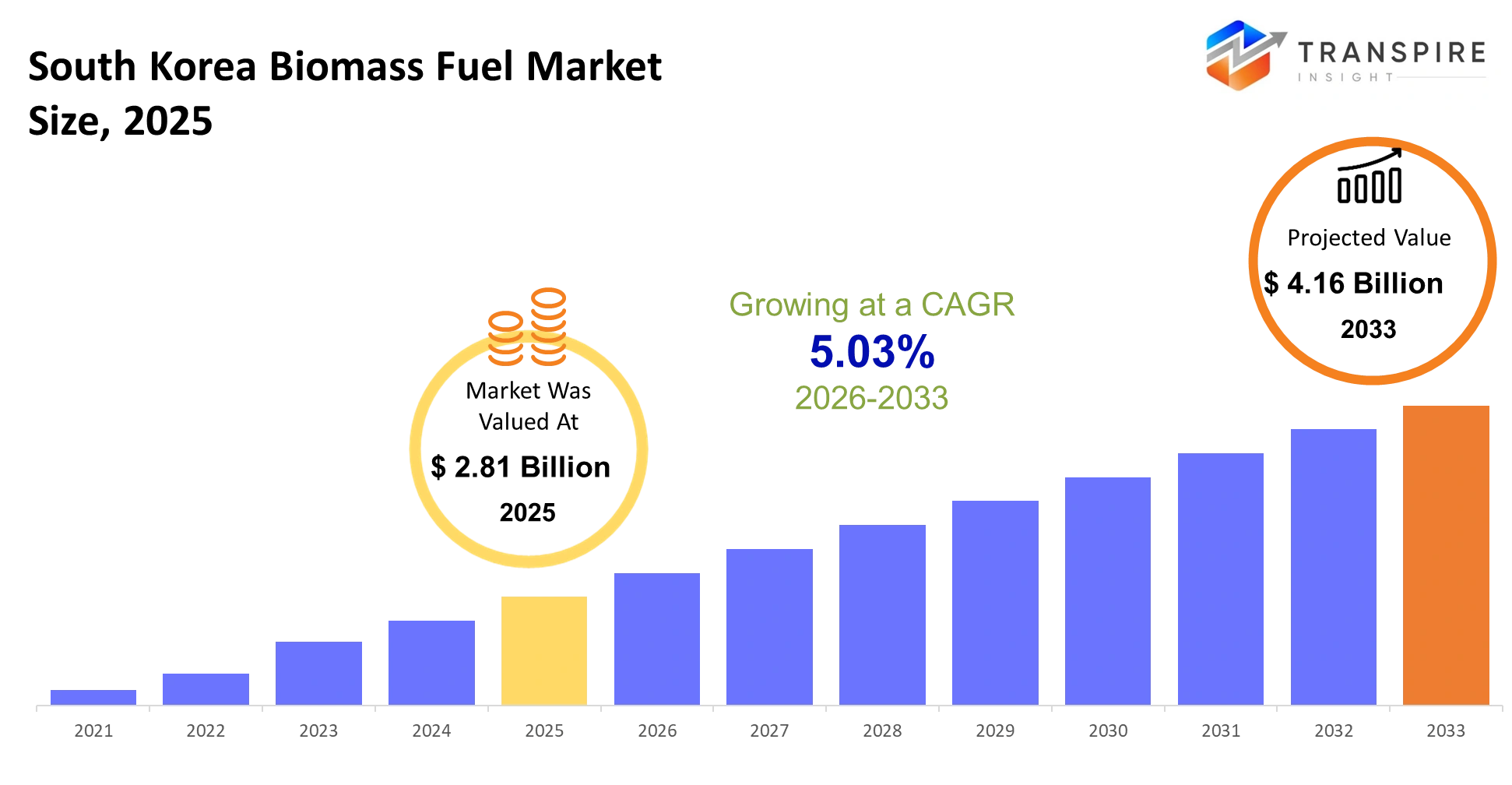
- South Korea Biomass Fuel Market Size 2025: USD 2.81 Billion
- South Korea Biomass Fuel Market Size 2033: USD 4.16 Billion
- South Korea Biomass Fuel Market CAGR: 5.03%
- South Korea Biomass Fuel Market Segments: By Fuel Type (Wood Pellets, Biogas, Biodiesel, Bioethanol, Others); By Application (Power Generation, Heating, Transportation Fuel, Industrial Energy, Others); By Feedstock (Agricultural Waste, Forestry Residues, Municipal Waste, Others); By End User (Utilities, Industrial Sector, Residential Sector, Others)
To learn more about this report,  Download Free Sample Report
South Korea Biomass Fuel Market Summary
The South Korea Biomass Fuel Market was valued at USD 2.81 Billion in 2025. It is forecast to reach USD 4.16 Billion by 2033. That is a CAGR of 5.03% over the period.
In South Korea, biomass fuel is mostly used to substitute coal in industrial boilers and electricity production systems, so factories and utilities can keep their energy levels steady while dealing with more strict carbon reduction goals. In real life it also keeps heat and power flowing, especially in cement plants, district heating grids, and bigger manufacturing zones, where switching to electrification only, is kind of not enough for the day to day baseload demand.
Over the last 3–5 years, you can see a market change, where it went from little co firing tests to bigger biomass integration inside utility power plants. This shift sort of sped up after national carbon neutrality plans got tighter, plus emissions reporting rules became more demanding for coal based facilities. One major reason was global coal price swings after 2022, which made energy operators want to diversify their fuel supply and secure more consistent renewable linked options. Then procurement deals for biomass pellets, and wood chips grew, I guess. And longer term supply contracts got more frequent, not just once in a while. So suppliers tend to get steadier revenue, while investors have clearer visibility across the entire biomass value chain, more or less.
Key Market Insights
- South Korea Biomass Fuel Market is kind of moving away from those small pilot co-firing efforts and going toward big utility scale adoption, and yeah it covers nearly 35% of coal displacement capacity by 2025 or so.
- In places like Ulsan and Incheon, they pull in over 40% of biomass fuel demand, mainly because those dense petrochemical and steel manufacturing clusters are there, and everything is kind of packed together.
- Still, imported wood pellet dependency is above 80% which makes trade-linked pricing volatility across the South Korea Biomass Fuel Market supply chains feel pretty strong, not just mild bumps.
- For use cases, power generation stays the main thing, taking around 55% share, as utilities transition their coal plants into hybrid biomass systems.
- Industrial heat is the fastest-growing slice too, it keeps expanding through 2033 thanks to cement and steel decarbonization mandates that basically won’t wait.
- When it comes to sourcing, Southeast Asia and North America supply more than 70% of biomass imports, so Korean utilities strengthen global procurement partnerships pretty quickly.
- Also, biomass co-firing adoption jumped after 2023, and it has reduced coal usage intensity by nearly 15% in selected thermal plants.
- KEPCO and other private utilities are expanding biomass integration using long-term fuel contracts, plus retrofit-based plant upgrades that make the changes less disruptive.
- Mitsubishi Heavy Industries also backs biomass boiler deployment, which helps improve efficiency in large-scale thermal systems, in a practical way.
- Overall, competitiveness in the South Korea Biomass Fuel Market is rising as companies invest in torrefaction technology and supply chain digitization for fuel quality control.
What are the Key Drivers, Restraints, and Opportunities in the South Korea Biomass Fuel Market?
The main engine behind the South Korea Biomass Fuel Market is this decarbonization pressure, from industrial and power-sector emission rules. Basically, utilities and big heavy industries are being asked to cut back coal reliance, tied to national carbon neutrality targets, so biomass co-firing and dedicated biomass plants have sort of moved into regular procurement playbooks. And because of that regulatory nudge, long-term fuel contracts have gone up, plus you get more stable demand cycles, mainly in electricity production and district heating systems.
On the other hand, the biggest slowdown is feedstock dependency, plus the whole import reliance problem. South Korea doesn’t have enough domestic biomass supply, especially certified wood pellets, so the country leans heavily on shipments from Southeast Asia and North America. That means structural exposure to shipping costs, exchange rate swings and occasional supply chain disruptions. In practice, project teams often end up postponing expansion decisions, and they take on more fuel procurement risk, which then makes it harder to scale biomass-based capacity quickly.
Still, a noticeable opening is appearing from industrial decarbonization retrofit work in coastal manufacturing clusters like Ulsan and Incheon. Large operators in steel cement and petrochemicals are increasingly folding biomass boilers into the thermal setups they already have, instead of trying to build brand new plants. Meanwhile, investment in pellet torrefaction and waste-to-energy preprocessing methods is improving fuel efficiency and helping combustion stay more stable. Altogether, this supports higher-value biomass supply chains and it can also lock in long-term contracted demand from industrial customers that are transitioning away from coal.
What Has the Impact of Artificial Intelligence Been on the South Korea Biomass Fuel Market?
Artificial intelligence is getting more and more rolled into biomass power operations in South Korea, to better tune combustion efficiency, keep emissions under check, and handle fuel logistics management. In the power plants, AI enabled control systems adjust fuel blend ratios and combustion temperature, in real time to keep output steadier while also cutting down particulate emissions. They also help with automated monitoring for scrubber performance, and the exhaust gas cleaning systems, so operators can stay within the tighter environmental rules that keep tightening.
Machine learning models are now used for predictive maintenance of boilers, conveyors, and fuel handling equipment. By looking at vibration patterns , fuel moisture content, and the operating temperature trajectories, teams can anticipate how equipment will degrade and set up maintenance in advance, before failures happen. As a result plant uptime has gone up, and unplanned shutdowns are less frequent, especially in big co-firing facilities where continuity matters.
On the ground, AI based optimization improves fuel efficiency by allowing finer biomass to coal mixing ratios, and by reducing excess fuel burn during high load moments. Still, there is a major hitch , adoption is held back by inconsistent biomass quality data. Changes in moisture levels and feedstock composition mess with model accuracy, particularly when the biomass is coming from several international suppliers. Plus, limited real time sensor integration across older thermal plants makes it harder to fully deploy advanced AI systems at scale.
Key Market Trends
- South Korea Biomass Fuel Market kind of moved from those early, pilot biomass trials pre 2022 into bigger large scale utility co firing programs, by now they’re covering something like nearly 35% of coal capacity by 2025.
- Then KEPCO started leaning harder into biomass blending after 2023, so average emissions intensity across a set of thermal units fell by close to 15%, even with the usual operational variability.
- Also the imported wood pellet dependency climbed past 80% by 2025, which really tweaked procurement strategies, and yeah it boosted exposure to global freight volatility.
- Meanwhile, Southeast Asian pellet suppliers expanded export capacity after 2024 , and ended up grabbing over 50% of South Korea biomass import demand share.
- Industrial clusters in Ulsan and Incheon picked up biomass adoption after 2023 , replacing coal boilers inside steel and petrochemical operations, more or less where it made sense.
- Biomass co firing systems went from experimental trials into more standardized deployment after 2022, largely pushed by stricter national carbon reporting rules.
- Utility operators also expanded long term biomass fuel contracts in 2025, stabilizing those pricing mechanisms and cutting down spot market exposure risks too.
- On the tech side, torrefied biomass uptake increased after 2024, which improved combustion efficiency and reduced moisture related problems, the kind that mess with fuel performance.
- Mitsubishi Heavy Industries together with Korean EPC firms ramped up biomass boiler installations, helping retrofit driven modernization of older thermal plants that had been aging for a while.
- And overall, South Korea Biomass Fuel Market competitiveness intensified, as suppliers rolled out digital tracking systems, to keep fuel quality consistency tight and logistics efficiency improving.
South Korea Biomass Fuel Market Segmentation
By Fuel Type
Wood pellets seem to keep the dominant spot in the South Korea Biomass Fuel Market ,because utility scale power plants lean on standardized, high energy density imported feedstock for steadier combustion work. Big procurement deals and long term supply agreements keep pellet use pretty consistent ,especially in co firing setups where coal plants are slowly moving toward reduced emissions. Biogas is smaller but it keeps edging forward, backed by waste treatment locations and more local energy recovery schemes ,where organic leftovers are turned into usable fuel. Biodiesel and bioethanol stay kind of niche ,mostly linked to transportation blending mandates and some limited industrial substitution programs ,while the rest of the fuels are more scattered across tests and local trials.
The growth for wood pellets comes from a rising need for utility fuel that behaves predictably and matches older coal infrastructure. Biogas grows thanks to municipal waste to energy initiatives ,which lower landfill stress and improve the way cities recycle energy. Biodiesel and bioethanol growth, though, is more policy sensitive ,and it depends on transport decarbonization rules instead of typical industrial demand rhythms. During the forecast stretch, wood pellets should keep leading, while biogas is likely to matter more in distributed energy systems ,so project developers start pushing diversified feedstock sourcing and better fuel standardization technology.
By Application
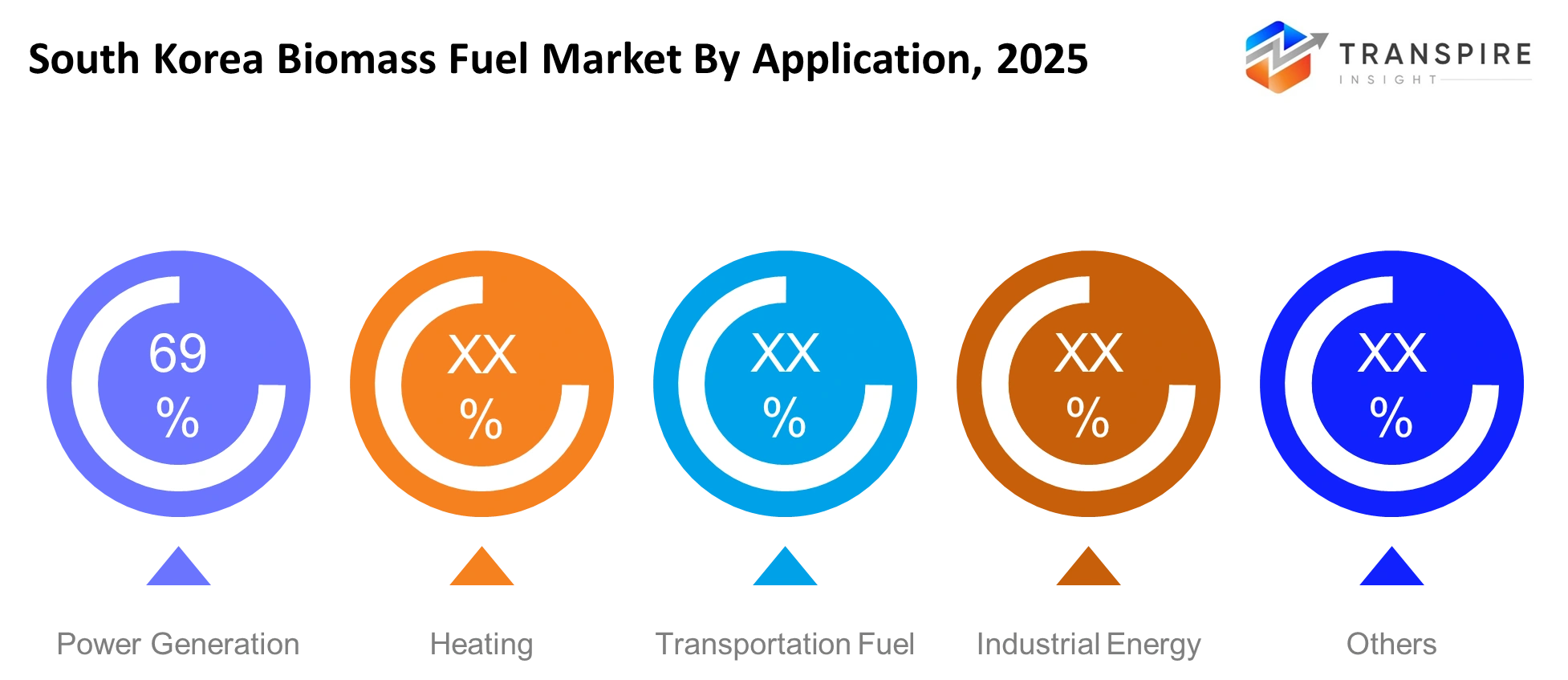
Power generation still has the dominant hold in the South Korea Biomass Fuel Market , because utilities keep integrating biomass co-firing into coal fired plants , mostly to hit emissions reduction targets without having to swap out all the existing infrastructure. Big thermal facilities rely on biomass blending, to keep baseload electricity steadier and at the same time lower carbon intensity. For heating uses, it looks like a secondary lane, pushed mainly by district heating networks and industrial boiler systems , which need a continuous stream of heat. As for transportation fuel, it stays relatively limited, largely due to infrastructure constraints and operational readiness. Meanwhile industrial energy consumption keeps growing, especially across cement, steel, and petrochemical sites.
The momentum in power generation comes from the regulatory pressure on coal fired emissions, plus the push for transitional fuel options that help with grid stability. Heating applications seem to expand in a steady way, fueled by urban energy modernization programs that favor low-carbon district heating systems. Industrial energy demand is climbing as heavy industries retrofit their boilers to reduce carbon exposure, and also to meet environmental reporting expectations. Over the forecast period, industrial energy applications are expected to gather more share, which should nudge investment into high-efficiency combustion systems and flexible fuel switching technologies.
To learn more about this report, Download Free Sample Report
By Feedstock
Agricultural waste has a pretty strong place in the South Korea Biomass Fuel Market, mainly because it’s already there in domestic supply chains, and people are using it more in smaller energy recovery systems that feel local. Forestry residues still remain a main input, especially for imported pellet production, and that helps the big utility buyers who need predictable combustion behavior, consistently. Municipal waste is starting to look like a bigger deal too, since more cities are turning toward waste-to-energy setups, so they can cut landfill reliance and keep energy use in a more circular way. Other feedstocks, well, they’re mostly stuck at pilot-scale or test runs in experimental programs.
The growth path, for agricultural waste, is tied to government backed circular economy initiatives , that basically push the conversion of farm leftovers into usable energy. Forestry residues keep moving forward thanks to cross border supply agreements, which help maintain dependable pellet output for utility consumption. Municipal waste utilization rises as urban areas face tighter disposal rules and also pour money into energy recovery infrastructure. Through the forecast period, municipal waste is anticipated to grow the fastest, which is why technology providers will likely rush into more advanced preprocessing steps, plus conversion systems with controlled emissions, and in practice that means more focus on meeting stricter environmental needs.
By End User
Utilities basically take the dominant share in the South Korea Biomass Fuel Market, not fully sure but it looks like power generation companies keep weaving biomass into coal fired plants, mainly to align with decarbonization targets. Big scale procurement mechanisms plus long term fuel arrangements keep things locked in, so demand cycles stay relatively steady across the energy sector. After that, the industrial space sits as the second largest segment, with cement, steel, and petrochemical operators pushing biomass for process heat, and also for emissions compliance, yes like that.
Residential consumption is still rather limited, mostly tied to district heating setups. Other end users tend to include municipal and institutional energy operators, who obviously follow their own schedules and constraints.
Utility expansion is commonly pinned to national energy transition policies, they want coal reduction, and biomass co-firing becomes the practical lever. The industrial sector, meanwhile, is seeing faster traction because of retrofit investments that let existing facilities redirect toward lower carbon thermal energy sources without too much disruption. Residential demand stays capped, due to infrastructure boundaries and the centralized heating pattern in many cities. Through the forecast horizon, industrial users are expected to build momentum more quickly, so suppliers may start designing higher efficiency fuel systems, and also tightening supply chain reliability for more distributed consumption, which is kind of the point.
What are the Key Use Cases Driving the South Korea Biomass Fuel Market?
In South Korea, the main kind of biomass fuel usage is basically coal replacement in utility electricity production, where co-firing setups do the job of cutting emissions while still keeping a fairly steady baseload supply. Big thermal facilities often lean on biomass blending, so they can stay within regulatory emission limits without actually swapping out all the old infrastructure, right away, or completely.
More room is showing up for broader uses too, like industrial heat generation in cement, steel, and petrochemical settings. In practice, these industries use biomass boilers to take over a slice of coal based process heat, especially in coastal industrial areas with easy import access. On top of that, district heating networks in urban clusters are also starting to incorporate biomass, mainly to handle seasonal swings in demand
Newer and more emerging use cases show up from waste biomass conversion, especially agricultural residues, and then there are AI optimized fuel blending systems inside next generation smart power plants. This whole direction is getting momentum because operators want better efficiency and more consistent fuel standardization across scattered, decentralized supply chains, which can be hard to manage otherwise.
|
Report Metrics |
Details |
|
Market size value in 2025 |
USD 2.81 Billion |
|
Market size value in 2026 |
USD 2.95 Billion |
|
Revenue forecast in 2033 |
USD 4.16 Billion |
|
Growth rate |
CAGR of 5.03% from 2026 to 2033 |
|
Base year |
2025 |
|
Historical data |
2021 - 2024 |
|
Forecast period |
2026 - 2033 |
|
Report coverage |
Revenue forecast, competitive landscape, growth factors, and trends |
|
Regional scope |
South Korea |
|
Key company profiled |
Hanwha Energy, GS EPS, POSCO Energy, SK Innovation, Enviva, Drax Group, Neste, Bunge, Archer Daniels Midland, Valmet, Veolia, Mitsubishi Heavy Industries, Andritz, Chevron Renewable Energy Group, Cargill |
|
Customization scope |
Free report customization (country, regional & segment scope). Avail customized purchase options to meet your exact research needs. |
|
Report Segmentation |
By Fuel Type (Wood Pellets, Biogas, Biodiesel, Bioethanol, Others); By Application (Power Generation, Heating, Transportation Fuel, Industrial Energy, Others); By Feedstock (Agricultural Waste, Forestry Residues, Municipal Waste, Others); By End User (Utilities, Industrial Sector, Residential Sector, Others) |
Which Regions are Driving the South Korea Biomass Fuel Market Growth?
The coastal industrial corridor around Ulsan and Incheon sort of leads the South Korea Biomass Fuel Market because it has a dense cluster of petrochemical complexes, steel manufacturing hubs, and big power generation facilities. These areas tend to get a clear advantage from direct port access, so they can import more than 80% of their biomass feedstock fairly efficiently, especially wood pellets that come in from Southeast Asia and North America. There is also strong synergy between industrial boilers and the port logistics side, which helps keep fuel moving without too much interruption and keeps co-firing operations steady
The Seoul Capital Region works like a secondary but still very dependable demand center. It is pushed by district heating networks , waste-to-energy plants , and municipal energy transition programs. Instead of leaning on heavy manufacturing demand like the coastal zones do, this part depends more on systematic policy rollout and ongoing public-sector investment. Operators here usually focus on long-horizon supply certainty and emissions compliance for urban infrastructure, more than they chase huge combustion volumes in factories. That leads to biomass consumption patterns that feel pretty predictable , supported by government-backed procurement models and regulated utility operations
Then the Honam region and the southern coastal provinces show up as the fastest-growing area. This is linked to newer expansion of renewable energy integration and biomass co-firing retrofits in older thermal plants. Since 2024, grid modernization spending plus upgraded port terminals has improved the way biomass is handled when it lands. On top of that, incentives tied to coal phase-down in regional power stations have sped up adoption further. For investors, this region reads as a high-growth signal between 2026 and 2033, particularly for supply chain developers and retrofit engineering providers who are targeting mid-sized utility operators.
Who are the Key Players in the South Korea Biomass Fuel Market and How Do They Compete?
In the South Korea Biomass Fuel Market, the competition is still kind of moderately fragmented, you know, with domestic power utilities, industrial energy producers , and big global biomass suppliers all chasing leverage across fuel sourcing logistics integration, and the co-firing tech rollout. The usual incumbent power players try to hold their ground with long term supply agreements and procurement that is sort of tightly integrated. Meanwhile, international suppliers tend to push harder on cost efficiency, certification compliance, and delivery reliability, rather than on basic fuel availability. So basically, the main competition shift is not just “do we have fuel”, it’s more about supply chain security and combustion efficiency optimization, even when the conversation sounds simpler.
Hanwha Energy leans into technology integrated biomass co-firing systems, and it differentiates via a hybrid renewable portfolio approach. That mix combines LNG, solar, and biomass in one coordinated integration framework. POSCO Energy, on the other hand , uses its industrial power plant footprint to lock in steady long-term biomass demand, especially for steel-linked energy operations. GS EPS emphasizes operational efficiency, and also leans on steady procurement contracts , so they can reduce exposure to fuel price volatility.
Globally, Enviva and Drax Group compete by scaling pellet production while maintaining certified sustainable sourcing networks. They supply Korean utilities with consistent fuel quality , and they try to keep that reliability front and center. At the equipment and systems level, Valmet and Mitsubishi Heavy Industries push their advantage through biomass boiler technology, plus retrofit engineering services. This lets them drive higher combustion efficiency and help with regulatory compliance across older thermal infrastructure, where updates are usually not optional.
Company List
- Hanwha Energy
- GS EPS
- POSCO Energy
- SK Innovation
- Enviva
- Drax Group
- Neste
- Bunge
- Archer Daniels Midland
- Valmet
- Veolia
- Mitsubishi Heavy Industries
- Andritz
- Chevron Renewable Energy Group
- Cargill
Recent Development News
In May 2026, CJ Biomaterials and Yuhan-Kimberly launched the world’s first biodegradable reusable nonwoven paper towel using cellulose and amorphous PHA technology. The partnership expanded commercial adoption of advanced cellulose-based materials across South Korea’s healthcare and consumer goods industries. http://www.globenewswire.com
In August 2025, Sigachi Industries announced commencement of civil works for its new 12,000 MTPA microcrystalline cellulose manufacturing project at Dahej SEZ. The investment strengthened pharmaceutical excipient supply capacity across Asia-Pacific markets, including South Korean drug manufacturing networks. http://www.business-standard.com
In December 2024, IMCD announced acquisition of the personal care and pharmaceutical business of South Korea-based YCAM Corporation. The acquisition expanded IMCD’s specialty pharmaceutical ingredient distribution capabilities and improved access to advanced excipient and formulation markets in South Korea. http://www.chemanalyst.com
What Strategic Insights Define the Future of the South Korea Biomass Fuel Market?
The South Korea Biomass Fuel Market is shifting toward an integrated decarbonization setup, where biomass works like a stepping stone between coal dependence and the renewable energy stack. In the next 5–7 years, you’ll likely see demand gather more around mixed use power units, plus industrial retrofit projects, instead of standalone biomass plants. This is mostly pulled by stricter carbon neutrality enforcement and the usual energy security worries.
There’s also a quieter risk, feedstock concentration, meaning if operators lean too hard on imported pellets they can get hit by geopolitical shipping disruptions, and also plain price swings. Meanwhile, an opportunity is quietly forming too, torrefied biomass and waste derived feedstock systems, they can raise energy density and cut down import reliance.
Market players should really focus on long range supply diversification plans and put money into local preprocessing infrastructure, to keep costs steady and match regulations as the emissions landscape keeps tightening.
South Korea Biomass Fuel Market Report Segmentation
By Fuel Type
- Wood Pellets
- Biogas
- Biodiesel
- Bioethanol
- Others
By Application
- Power Generation
- Heating
- Transportation Fuel
- Industrial Energy
- Others
By Feedstock
- Agricultural Waste
- Forestry Residues
- Municipal Waste
- Others
By End User
- Utilities
- Industrial Sector
- Residential Sector
- Others
Frequently Asked Questions
Find quick answers to common questions.
The estimated South Korea Biomass Fuel Market size for the market will be USD 4.16 Billion in 2033.
Key segments for the South Korea Biomass Fuel Market are By Fuel Type (Wood Pellets, Biogas, Biodiesel, Bioethanol, Others); By Application (Power Generation, Heating, Transportation Fuel, Industrial Energy, Others); By Feedstock (Agricultural Waste, Forestry Residues, Municipal Waste, Others); By End User (Utilities, Industrial Sector, Residential Sector, Others).
Major South Korea Biomass Fuel Market players are Hanwha Energy, GS EPS, POSCO Energy, SK Innovation, Enviva, Drax Group, Neste, Bunge, Archer Daniels Midland, Valmet, Veolia, Mitsubishi Heavy Industries, Andritz, Chevron Renewable Energy Group, Cargill.
The South Korea Biomass Fuel Market size is USD 2.81 Billion in 2025.
The South Korea Biomass Fuel Market CAGR is 5.03% from 2026 to 2033.
- Hanwha Energy
- GS EPS
- POSCO Energy
- SK Innovation
- Enviva
- Drax Group
- Neste
- Bunge
- Archer Daniels Midland
- Valmet
- Veolia
- Mitsubishi Heavy Industries
- Andritz
- Chevron Renewable Energy Group
- Cargill
Recently Published Reports
-
Apr 2026
Active Power Filter Market
Active Power Filter Market Size, Share & Analysis Report By Type (Shunt Active Power Filters, Series Active Power Filter, Hybrid Active Power Filter), By Application (Harmonics Mitigation, Reactive Power Compensation, Voltage Regulation, Power Factor Correction), By Phase (Single Phase, Three Phase), By End-User Industry (Manufacturing, Healthcare, Commercial, Automotive, Oil and Gas, Others), and Geography (North America, Europe, Asia-Pacific, Middle East and Africa, South and Central America), 2021 - 2031
-
Apr 2026
Electrical Transformer Market
Electrical Transformer Market Size, Share & Analysis Report By Core (Closed, Shell, and Berry), By Insulation (Gas, Oil, Solid, Air, and Other), By Phase (Single, and Three), By Rating (100 MVA to 500 MVA, 501 MVA to 800 MVA, and 801 MVA to 1200 MVA), and Geography (North America, Europe, Asia-Pacific, Middle East and Africa, South and Central America), 2021 – 2031
-
Apr 2026
Hydraulic Piston Pumps Market
Hydraulic Piston Pumps Market Size, Share & Analysis Report By Type (Axial Piston Pumps, Radial Piston Pumps), By Operating Pressure (Low Pressure, Medium Pressure, High Pressure), By Application (Construction, Mining, Agriculture, Automotive, Oil & Gas, Industrial Machinery, Others), By End-User (OEMs, Aftermarket), and Geography (North America, Europe, Asia-Pacific, Middle East and Africa, South and Central America), 2021 – 2031
-
Apr 2026
Laboratory Gas Generators Market
Laboratory Gas Generators Market Size, Share & Analysis Report By Product (Nitrogen Gas Generator, Hydrogen Gas Generator, Zero Air Gas Generator, Purge Gas Generator, TOC Gas Generators, Others), By Application (Gas Chromatography, Liquid Chromatography-mass Spectrometry (LC-MS), Gas Analyzers, Others), By End-user (Life Science, Chemical & Petrochemical, Food & Beverage, Others), and Geography (North America, Europe, Asia-Pacific, Middle East and Africa, South and Central America), 2021 – 2031