
Middle East and Africa Power Transformer Market Size & Forecast:
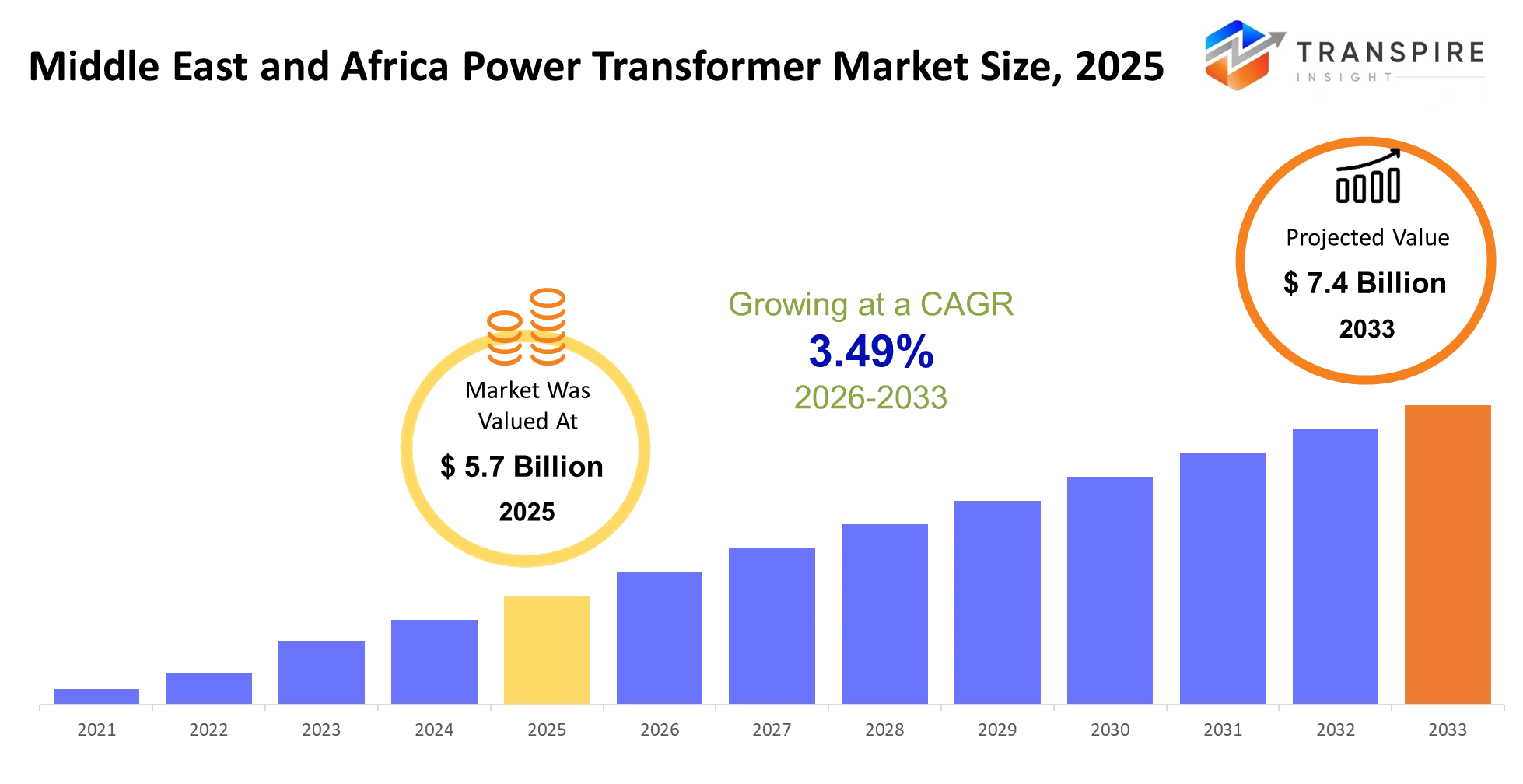
- Middle East and Africa Power Transformer Market Size 2025: USD 5.7 Billion
- Middle East and Africa Power Transformer Market Size 2033: USD 7.4 Billion
- Middle East and Africa Power Transformer Market CAGR: 3.49%
- Middle East and Africa Power Transformer Market Segments: By Type (Distribution Transformer, Power Transformer, Instrument Transformer, Others); By Application (Transmission, Distribution, Renewable Energy, Industrial Use, Utilities, Others); By End-User (Utilities, Industrial Sector, Energy Companies, Government, Infrastructure Firms, Others); By Rating (Small, Medium, Large, Extra High Voltage, Others).
To learn more about this report,  Download Free Sample Report
Middle East and Africa Power Transformer Market Summary
The Middle East and Africa Power Transformer Market was valued at USD 5.7 Billion in 2025. It is forecast to reach USD 7.4 Billion by 2033. That is a CAGR of 3.49% over the period.
The Middle East and Africa power transformer market really underpins the physical movement of electricity from generation hubs toward cities, industrial corridors, and even cross-border interconnections, while making sure voltage is properly raised or lowered so power can span long stretches without becoming unstable. In the real world, it lets utilities and industrial operators keep pushing capacity outward, and it also helps them synchronize solar, wind, and thermal production inside one shared grid, more or less.
Over the past 3 to 5 years, the whole market has started to tilt in a noticeable way toward high-voltage, grid-scale transformer units because countries are leaning harder into interconnection, rather than isolated generation. That momentum got stronger right after the global supply chain disruptions in 2021 , to 2022 which basically showed how risky it can be to depend on imported electrical steel and on very long lead times for key transformer components . Meanwhile, big renewable expansions in Saudi Arabia, UAE, and select regions of North Africa meant utilities had to strengthen transmission infrastructure, not just patch distribution in small increments.
So , demand today is pooling into fewer but more massive projects, which lifts revenue per installation while also increasing the bar for efficiency, performance monitoring, and lifecycle dependability. As a result, suppliers that can provide high capacity units with digital enablement are getting steadier procurement traction across utility driven infrastructure schemes.
Key Market Insights
- GCC region kinda dominated the Middle East and Africa Power Transformer Market, with a nearly 45% share in 2025, mostly pushed by Saudi Arabia and UAE grid expansion projects, where utilities are moving pretty fast.
- Sub-Saharan Africa then popped up as the fastest-growing area, and the momentum is forecast to ramp up through 2026–2033, largely because electrification keeps expanding plus power pool interconnections are getting more attention.
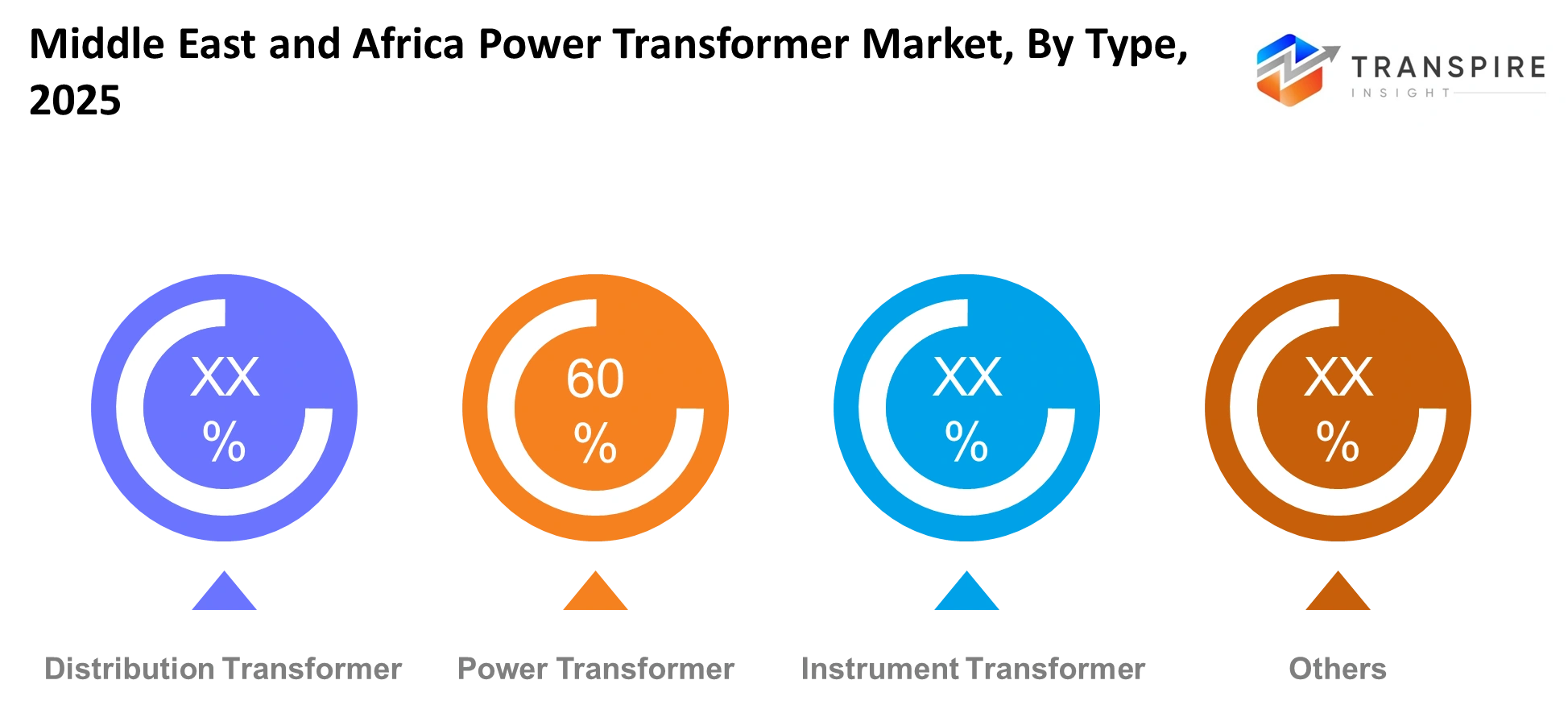
- Looking at type, power transformers still take the largest chunk, over 55% in 2025, and that makes sense since transmission rollouts plus HVDC projects are getting heavy deployment.
- Distribution transformers come in second, they are being supported by urban growth and rural electrification programs across different developing economies, not just one or two.
- For segments, renewable energy applications became the quickest mover after 2025, driven by solar and wind integration into national grids, basically connecting more generation sources.
- In terms of application, transmission stays in front with more than 50% share, supported by long-distance grid interconnection efforts where the lines span big distances.
- End users wise, utilities lead with over 40% share, because state-led infrastructure spending is still a major theme across the Middle East and Africa Power Transformer Market.
- Meanwhile industrial users are showing increasing demand too, especially with oil and gas, and mining electrification needs in high-load operational zones.
- Schneider Electric moved deeper into smart grid, and digital substation offerings, sorta targeting city electrification and energy management systems more broadly.
- Toshiba Energy Systems, on the other hand, reinforced the regional supply reliability via high capacity transformer engineering and ongoing utility partnerships, for the long run.
What are the Key Drivers, Restraints, and Opportunities in the Middle East and Africa Power Transformer Market?
The main thing driving the Middle East and Africa power transformer market is this big, ongoing grid expansion, sort of tied with renewable integration and also more cross border transmission development. In the Gulf Cooperation Council and across Sub Saharan power pools, Governments have been pushing faster investments in high voltage infrastructure so solar, wind, and thermal generation can actually reach urban demand areas. That whole movement seems to have been kicked off by national decarbonization goals, plus the fact that peak load stress keeps climbing, and it made utilities treat transmission upgrades as the priority, instead of doing only small incremental distribution fixes. Because of that, getting large power transformers has gone up, especially for substations along renewable evacuation routes and for HVDC interconnectors.
The biggest brake on the market is the supply chain dependence on key raw materials like grain-oriented electrical steel and higher grade copper. This is kind of a structural issue, not just a short-term problem, since regional manufacturing capacity is still relatively limited which means imports are the main route, mostly from Asia and Europe. Long lead times, shipping instability, and currency swings keep delaying project execution, and they also raise lifecycle costs for utilities and EPC contractors. Those setbacks can choke revenue realization even if the project pipelines look healthy, so you end up with a mismatch between planned infrastructure investment and what equipment deployment can actually deliver.
A key opportunity, starts showing up when localized transformer production meets digital substation rollout, especially within Saudi Arabia’s industrial localization efforts and North Africa’s infrastructure corridors. In these places, joint ventures between global OEMs and local EPC players are now setting up assembly centers, which can lower import reliance and speed up delivery times. At the same time, digital substations—now often fitted with IoT monitoring, and more granular sensors—are picking up momentum, and that makes predictive maintenance feel more practical, while also pushing better grid efficiency. Put simply, these shifts together are helping the region build a more durable, and technically connected transformer ecosystem.
What Has the Impact of Artificial Intelligence Been on the Middle East and Africa Power Transformer Market?
AI, and advanced digital systems, are kind of reshaping scrubber performance systems, plus wider marine emission control tech… by moving operations away from manual inspection and into sensor-driven automation. Ship operators now tend to use AI-enabled monitoring platforms that keep an eye on exhaust gas cleaning efficiency, sulfur compliance, and system pressure stability across fleets. This cuts down on how much they depend on periodic human checks, and it makes compliance reporting more accurate for IMO-aligned regulations. At the same time, digital twins simulate how scrubbers behave when fuel sulfur conditions shift, so operators can tune switching between compliant fuels and scrubber use in real time, more or less.
Machine learning models increasingly back predictive maintenance, by looking at vibration, temperature, and corrosion signals in order to anticipate component failure inside scrubber units and auxiliary systems. Operators say they see a noticeable boost in uptime directionally, and in maintenance scheduling efficiency, with fewer sudden outages, and more sensible dry-docking cycles. There are also fuel efficiency benefits, but in an indirect way—vessels avoid awkward operating modes thanks to continuous performance optimization. Regulatory compliance gets better too, because automated logging produces audit-ready emissions records, which in turn reduces the administrative load, pretty well.
Still, AI rollouts run into limits, mainly because there’s limited high-quality training data from the harsh marine environment, where sensor noise, and variable operating conditions, can erode model accuracy. Integration costs are also high for mid-sized operators, especially when they retrofit older vessels with connected scrubber infrastructure and all the usual extra requirements.
Key Market Trends
- Since 2024, Utilities moved procurement away from standalone transformers toward integrated substation packages with digital monitoring, which somehow improves grid reliability and helps predictive maintenance, more or less.
- After 2025, GCC countries bumped up HVDC-linked transformer deployments, speeding up long distance renewable transfers between Saudi Arabia and the UAE grids.
- In 2025, African power pools broadened cross border transmission tenders, so the demand started leaning toward high capacity transformers for interconnection corridors.
- In 2025, Siemens Energy and Hitachi Energy expanded their transformer manufacturing capacity, pretty much responding to global supply chain pressure for copper and electrical steel.
- Since 2024, South African utilities also reduced their emergency procurement dependence, and they leaned more into planned replacement cycles for aging grid infrastructure assets.
- After 2025, renewable developers across the Gulf increased the share of transformer demand, because solar and wind facilities needed dedicated step up voltage infrastructure, really.
- In 2026, local assembly partnerships in North Africa expanded, cutting import lead times and boosting regional manufacturing involvement.
- After 2025, Middle East oil and gas electrification projects shifted toward higher efficiency transformer systems, aiming to lower operational energy losses.
- And since 2024, digital substation adoption has grown across GCC utilities, so manufacturers were pushed to include IoT enabled transformer monitoring systems, you know.
Middle East and Africa Power Transformer Market Segmentation
By Type
The power transformer segment kind of takes the lead because it s central part in high-voltage transmission networks across the Gulf and through various African interconnect projects. Utilities and EPC contractors tend to push these units first, for bulk power transfer and grid stabilization, particularly in corridors that are packed with renewables. Distribution transformers also keep steady demand, driven by urban growth plus rural electrification, though their procurement scale stays more fragmented than the big power class. Instrument transformers and the rest occupy a smaller slice, mainly because their jobs are specialized—measurement and protection—rather than new capacity expansion, or at least not in the same way.
The growth logic for power transformers feels pretty straightforward: large infrastructure buildouts, cross border transmission lines, and adding solar and wind plants that need voltage stepping at the generation hubs. Distribution transformers grow as housing development moves forward and grids get denser in secondary cities. Instrument transformers benefit from digital substation upgrades, and that’s where the momentum sits. In other words, power transformer demand is project-led, while distribution demand is more cyclical, tied to utility maintenance budgets plus periodic network refresh schedules.
Over the forecast period, power transformers will keep strengthening their dominance as grid interconnection projects expand across Africa and the Gulf. Manufacturers will likely focus on high-capacity, low-loss design approaches, so they can match efficiency standards and support long distance transmission requirements. Distribution transformers should see incremental improvements, more like steady upgrades rather than disruptive leaps. Investors will favor suppliers with solid EPC integration capability and certification compliance for high-voltage deployments, because that reduces risk during rollout.
To learn more about this report, Download Free Sample Report
By Application
Transmission stays like the leading segment, because regional power systems lean heavily on long-distance electricity transfer between generation hubs and consumption centers, and well it’s kind of obvious. Big plants, solar farms plus thermal stations, need step-up and step-down transformation, to keep the grid flow more stable. Distribution comes right after that, mostly due to expanding urban infrastructure and the continued rise in household electrification. Industrial use, utilities , and other categories add steady demand but those shares stay smaller, just quieter.
Transmission growth is pushed by interconnection projects, renewable integration, plus national grid reinforcement programs across Gulf states and within African power pools. Distribution keeps expanding through urban migration and the building of commercial infrastructure. At the same time, renewable energy applications are climbing fast, as solar and wind installations scale across desert landscapes and coastal regions. Industrial demand is broadly steady, anchored in oil, gas, and heavy manufacturing clusters, which keeps everything predictable.
Looking ahead, future trends suggest transmission will keep acting as the backbone application, especially since cross-border energy trading is increasing. Transformer demand tied to renewables should rise faster too, as clean energy mandates tighten, and regulations get more strict. Distribution applications will grow gradually in secondary cities and peri-urban areas, where upgrades happen in phases. Suppliers offering modular, high-efficiency transformer portfolios should gain better positioning across several application layers, because customers want flexibility and consistent performance.
By End-User
Utilities have the largest slice, mostly because they sit right at the center of grid ownership, transmission planning, and the procurement of high-voltage equipment. Energy companies, industrial sectors come next, driven by captive power arrangements and refinery electrification needs, with government and infrastructure firms showing up as well via public grid expansion and electrified transport corridors. The rest of the smaller users stay more fragmented, project specific, and don’t really move as a group.
Utilities dominate because their long cycle investment schedules sync with national electrification efforts and renewable integration targets. Energy companies also put money into transformers for upstream and downstream operational resilience, particularly around oil and gas hubs. Industrial customers lean toward uptime critical use cases in factories and processing sites, while government led infrastructure work helps extend the grid in emerging economies.
In the longer run, utilities will likely hold leadership, though their influence will be pushed and reshaped by independent energy developers and PPP based infrastructure firms. Industrial demand should climb faster in electrified mining and refining clusters. Energy companies will increasingly use efficiency driven procurement strategies to trim operational losses. Meanwhile suppliers that align with utility modernization plans and private sector energy endeavors should see a firmer pipeline of contracts.
By Rating
Large and extra high voltage transformers make up the largest value share, mostly because of their use along transmission corridors and in interconnection projects, it is kinda the main reason. Medium rating transformers help regional substations and secondary grid nodes, while the small units do the usual local distribution things. The big chunk from high-capacity units also points to how fast infrastructure is being extended across long-distance networks, you can see that clearly.
For the growth part in extra high voltage categories, it is tied to HVDC projects renewable evacuation lines , and the cross-border power trading backbone. Medium ratings keep climbing at a steady pace thanks to substation expansion across developing urban corridors, even when timelines vary a bit. Small transformers roll out in parallel with rural electrification and residential load growth. Overall the demand profile leans heavily toward grid-scale capacity upgrades, rather than smaller incremental replacements.
Looking ahead, the future direction suggests a stronger shift toward high-efficiency digitally monitored extra high voltage systems, which sounds like the standard trend now. Medium ratings will likely get incremental technological upgrades focused on lowering losses and improving performance. Small transformers will stay mostly volume-driven but yes, they remain price sensitive too. Manufacturers who bring advanced insulation technology plus predictive maintenance features should gain the competitive edge in the higher rating segments, especially when downtime matters.
What are the Key Use Cases Driving the Middle East and Africa Power Transformer Market?
The most common use is kinda high-voltage transmission and grid expansion, where utilities roll out large power transformers to help with rising electricity demand, and to link up national grids across the Gulf and North Africa. These projects are pushed by targets for renewable integration and also that need to keep long-distance bulk power transfer stable , even when conditions change.
On the side, secondary adoption is also picking up in oil and gas electrification plus urban distribution networks. Industrial operators in refining hubs and petrochemical zones count on transformers so their operations stay uninterrupted for high-load work, while city utilities are upgrading older distribution systems, to cope with fast urbanization and commercial growth.
What’s new-ish lately includes utility-scale renewable energy integration and cross-border HVDC interconnector efforts. Solar and wind farms are more and more asking for dedicated step-up transformers, and in Africa the regional power pools are starting to lean on interconnected transmission corridors to smooth out seasonal supply swings .
|
Report Metrics |
Details |
|
Market size value in 2025 |
USD 5.7 Billion |
|
Market size value in 2026 |
USD 5.82 Billion |
|
Revenue forecast in 2033 |
USD 7.4 Billion |
|
Growth rate |
CAGR of 3.49% from 2026 to 2033 |
|
Base year |
2025 |
|
Historical data |
2021 - 2024 |
|
Forecast period |
2026 - 2033 |
|
Report coverage |
Revenue forecast, competitive landscape, growth factors, and trends |
|
Regional scope |
Middle East and Africa (Saudi Arabia, United Arab Emirates, South Africa, Rest of Middle East and Africa) |
|
Key company profiled |
ABB, Siemens, Schneider Electric, GE, Hitachi Energy, Toshiba, Mitsubishi Electric, Hyundai Electric, Crompton Greaves, Bharat Heavy Electricals, Fuji Electric, Eaton, SPX Transformer, Ormazabal, Wilson Transformer. |
|
Customization scope |
Free report customization (country, regional & segment scope). Avail customized purchase options to meet your exact research needs. |
|
Report Segmentation |
By Type (Distribution Transformer, Power Transformer, Instrument Transformer, Others); By Application (Transmission, Distribution, Renewable Energy, Industrial Use, Utilities, Others); By End-User (Utilities, Industrial Sector, Energy Companies, Government, Infrastructure Firms, Others); By Rating (Small, Medium, Large, Extra High Voltage, Others). |
Which Regions are Driving the Middle East and Africa Power Transformer Market Growth?
The Gulf Cooperation Council kind of dominates the Middle East and Africa power transformer market, mostly pushed by those large-scale grid modernization programs in Saudi Arabia and the UAE. There’s strong state-led investment in transmission corridors, and alongside this those aggressive renewable integration targets , it keeps feeding steady procurement of high-voltage and extra-high-voltage transformers. Also the port infrastructure looks well-developed and the centralized utility procurement systems help projects run quicker, plus bulk equipment imports arrive with less friction. On top of that, a mature set of EPC contractors and global OEM partnerships sort of locks in the region’s position as the primary demand center.
South Africa looks a bit more stability-driven than the Gulf, shaped more by utility-led procurement cycles rather than mega project surges. Its demand is anchored by Eskom’s ongoing grid rehabilitation efforts and only incremental capacity additions, not some rapid, sudden expansion wave. The regulatory framework doesn’t move quickly, but it evolves slowly and predictably, which means utilities and industrial users can plan investment in a more consistent way. As a result , there’s a fairly steady pipeline for replacement transformers and grid reliability upgrades, so global suppliers see it as a dependable revenue contributor.
Sub-Saharan Africa excluding South Africa is the fastest-growing segment, mainly because electrification is accelerating and cross-border transmission initiatives keep picking up pace. In recent years, investments in regional power pools plus donor-backed grid expansion projects have improved transmission connectivity across West and East Africa. Rural electrification directives also matter, and with renewable deployment rising, medium-voltage and distribution transformer networks have to be upgraded fast.For market entrants and investors, this region signals high-volume, price-sensitive growth with strong long-term upside tied to infrastructure maturation through 2033.
Who are the Key Players in the Middle East and Africa Power Transformer Market and How Do They Compete?
The Middle East and Africa power transformer market is sorta moderately consolidated at the high-voltage level , but it still feels fragmented when you look at distribution suppliers. On the big grid side global OEMs take the lead in critical infrastructure, while regional players go at it with pricing pressure plus localization efforts. Now the real fight is less about price only, and more about efficiency, quicker delivery speed, grid-code compliance, and lifecycle service integration …like making sure the whole system keeps working over time.
ABB stands out via high-efficiency transformer engineering, digital monitoring add-ons, and long term service agreements aimed at utilities that want to lower outage risk. Siemens Energy pushes a more integrated transmission approach, especially around HVDC-linked transformer applications, and it further builds momentum through partnerships tied to big grid expansion initiatives across interconnected MEA corridors.
Hitachi Energy leans hard into HVDC transformer systems and cross-border interconnection projects, so it can get the upper hand on complicated grid integration across GCC and African power pools. Schneider Electric meanwhile targets distribution transformers plus smart grid modernization , differentiating through digital substations and energy management platforms used in urban electrification programs and utility efficiency upgrades.
Company List
- ABB
- Siemens
- Schneider Electric
- GE
- Hitachi Energy
- Toshiba
- Mitsubishi Electric
- Hyundai Electric
- Crompton Greaves
- Bharat Heavy Electricals
- Fuji Electric
- Eaton
- SPX Transformer
- Ormazabal
- Wilson Transformer
Recent Development News
“In May 2025, Siemens Energy announced expansion plans for its transformer manufacturing facility in Nuremberg. The company aims to increase production capacity by approximately 50 percent, strengthening global supply availability for large power transformers used in grid modernization projects, including demand-driven imports into the Middle East and Africa region.
Source: https://www.reuters.com
What Strategic Insights Define the Future of the Middle East and Africa Power Transformer Market?
The Middle East and Africa power transformer market is sliding into a faster growth phase, mostly because of grid expansion, renewables being pulled into the mix, and cross border HVDC transmission initiatives that connect Gulf and African electrical systems , plus broader grid resilience investments. At the same time there is a sort of hidden risk exposure tied to supply chains that are too concentrated, especially for grain-oriented electrical steel and copper, and add in shipping volatility, along with currency based procurement delays that can quietly pinch margins, even when demand growth still looks strong , and especially across markets that rely on imports.
Still, there’s an emerging opening: digital twin enabled transformers and hydrogen related transmission build outs tied to GCC mega projects , and also African interconnectors, which seems to act like a new value layer that goes past just equipment supply, and even beyond long-term concession models. Recommendation wise, it is best to prioritize localized assembly partnerships and stitch in predictive maintenance sensors, so the business can move from pure transformer selling toward service-led revenue streams, while also lifting lifecycle reliability and uptime performance.
Middle East and Africa Power Transformer Market Report Segmentation
By Type
- Distribution Transformer
- Power Transformer
- Instrument Transformer
- Others
By Application
- Transmission
- Distribution
- Renewable Energy
- Industrial Use
- Utilities
- Others
By End-User
- Utilities
- Industrial Sector
- Energy Companies
- Government
- Infrastructure Firms
- Others
By Rating
- Small
- Medium
- Large
- Extra High Voltage
- Others
Frequently Asked Questions
Find quick answers to common questions.
The estimated Middle East and Africa Power Transformer Market size is USD 7.4 Billion in 2033.
Key segments for the Middle East and Africa Power Transformer Market are By Type (Distribution Transformer, Power Transformer, Instrument Transformer, Others); By Application (Transmission, Distribution, Renewable Energy, Industrial Use, Utilities, Others); By End-User (Utilities, Industrial Sector, Energy Companies, Government, Infrastructure Firms, Others); By Rating (Small, Medium, Large, Extra High Voltage, Others).
Major Middle East and Africa Power Transformer Market players are ABB, Siemens, Schneider Electric, GE, Hitachi Energy, Toshiba, Mitsubishi Electric, Hyundai Electric, Crompton Greaves, Bharat Heavy Electricals, Fuji Electric, Eaton, SPX Transformer, Ormazabal, Wilson Transformer.
The Middle East and Africa Power Transformer Market size is USD 5.7 Billion in 2025.
The Middle East and Africa Power Transformer Market CAGR is 3.49% from 2026 to 2033.
- ABB
- Siemens
- Schneider Electric
- GE
- Hitachi Energy
- Toshiba
- Mitsubishi Electric
- Hyundai Electric
- Crompton Greaves
- Bharat Heavy Electricals
- Fuji Electric
- Eaton
- SPX Transformer
- Ormazabal
- Wilson Transformer
Recently Published Reports
-
Apr 2026
Active Power Filter Market
Active Power Filter Market Size, Share & Analysis Report By Type (Shunt Active Power Filters, Series Active Power Filter, Hybrid Active Power Filter), By Application (Harmonics Mitigation, Reactive Power Compensation, Voltage Regulation, Power Factor Correction), By Phase (Single Phase, Three Phase), By End-User Industry (Manufacturing, Healthcare, Commercial, Automotive, Oil and Gas, Others), and Geography (North America, Europe, Asia-Pacific, Middle East and Africa, South and Central America), 2021 - 2031
-
Apr 2026
Electrical Transformer Market
Electrical Transformer Market Size, Share & Analysis Report By Core (Closed, Shell, and Berry), By Insulation (Gas, Oil, Solid, Air, and Other), By Phase (Single, and Three), By Rating (100 MVA to 500 MVA, 501 MVA to 800 MVA, and 801 MVA to 1200 MVA), and Geography (North America, Europe, Asia-Pacific, Middle East and Africa, South and Central America), 2021 – 2031
-
Apr 2026
Hydraulic Piston Pumps Market
Hydraulic Piston Pumps Market Size, Share & Analysis Report By Type (Axial Piston Pumps, Radial Piston Pumps), By Operating Pressure (Low Pressure, Medium Pressure, High Pressure), By Application (Construction, Mining, Agriculture, Automotive, Oil & Gas, Industrial Machinery, Others), By End-User (OEMs, Aftermarket), and Geography (North America, Europe, Asia-Pacific, Middle East and Africa, South and Central America), 2021 – 2031
-
Apr 2026
Laboratory Gas Generators Market
Laboratory Gas Generators Market Size, Share & Analysis Report By Product (Nitrogen Gas Generator, Hydrogen Gas Generator, Zero Air Gas Generator, Purge Gas Generator, TOC Gas Generators, Others), By Application (Gas Chromatography, Liquid Chromatography-mass Spectrometry (LC-MS), Gas Analyzers, Others), By End-user (Life Science, Chemical & Petrochemical, Food & Beverage, Others), and Geography (North America, Europe, Asia-Pacific, Middle East and Africa, South and Central America), 2021 – 2031