

France Distribution Transformer Market Size & Forecast:
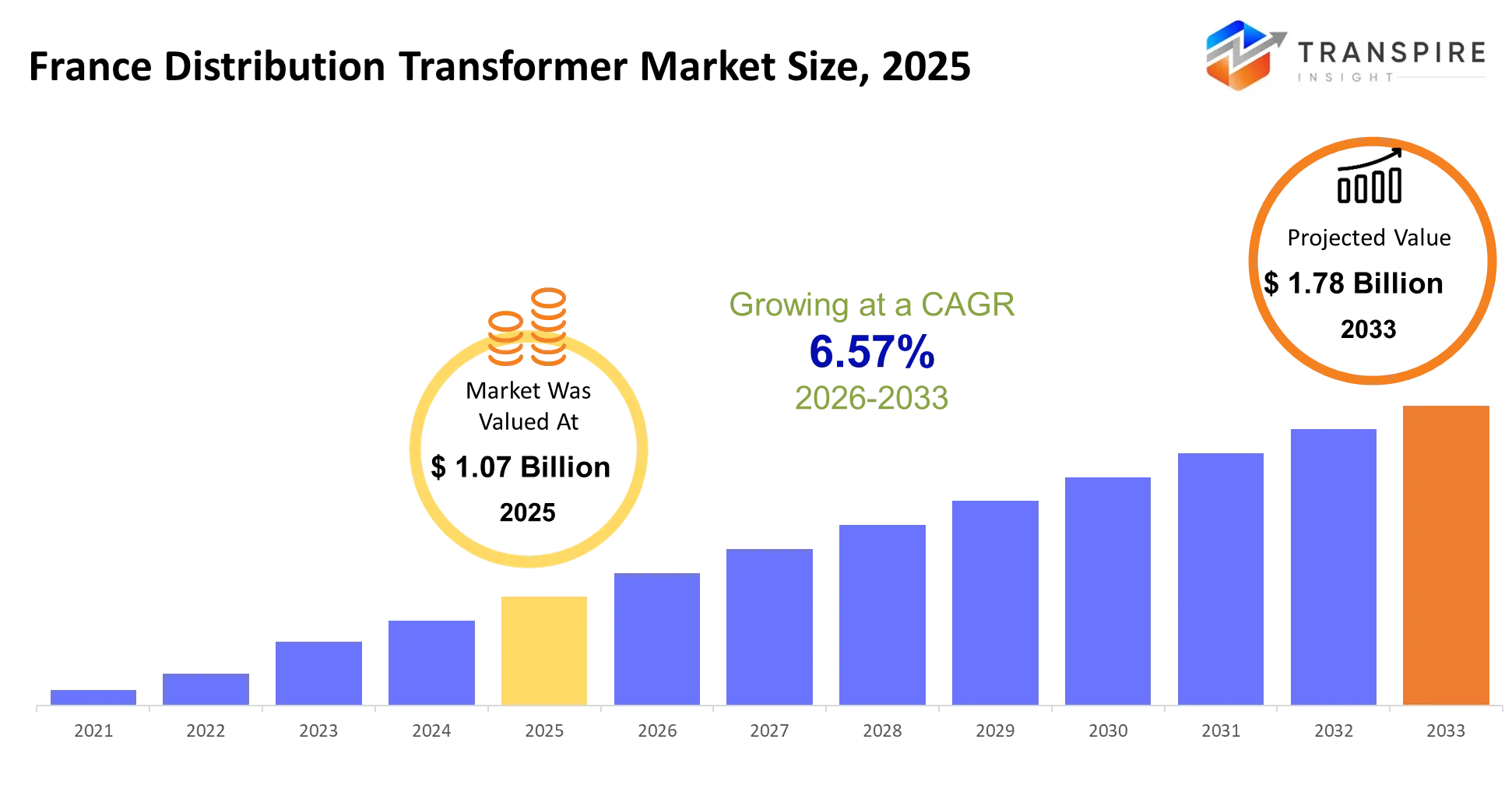
- France Distribution Transformer Market Size 2025: USD 1.07 Billion
- France Distribution Transformer Market Size 2033: USD 1.78 Billion
- France Distribution Transformer Market CAGR: 6.57%
- France Distribution Transformer Market Segments: By Type (Oil-filled Transformers, Dry-type Transformers, Pad-mounted Transformers, Others); By Application (Residential, Commercial, Industrial, Utilities, Renewable Energy, Infrastructure, Others); By End-User (Utilities, Industries, Infrastructure Projects, Energy Sector, Commercial Buildings, Others); By Phase (Single Phase, Three Phase, Others)
To learn more about this report,  Download Free Sample Report
France Distribution Transformer Market Summary
The France Distribution Transformer Market was valued at USD 1.07 Billionin 2025. It is forecast to reach USD 1.78 Billion by 2033. That is a CAGR of 6.57% over the period.
In France, distribution transformers kinda act as that last practical link in the electricity delivery chain, they step down medium-voltage power coming from substations down to a level that’s actually usable for residential neighborhoods, commercial sites, and industrial facilities. In real terms, they help keep voltage steady across urban grids that are getting older, while also helping the electrification of transport systems, data center loads and those renewable integration areas too.
Over roughly the last 3–5 years, the market has been moving in a more permanent direction, toward grid modernization and low-loss, energy-efficient transformer units. This shift is strongly tied to France’s decarbonization agenda for power infrastructure. One thing that really sped it up has been the fast growth of renewable generation, mainly wind and solar, which brought intermittent load behaviors and sort of forced utilities to update distribution networks for stability and also for bidirectional power handling. At the same time , during the post-pandemic years there were global supply chain disruptions, and that revealed how much dependency there was on imported electrical components, so companies leaned more on local purchasing plus rebuilding inventories. So, utilities and industrial operators are now pushing faster replacement cycles, and they’re putting money into digitally monitored transformers, to boost reliability and lower the odds of outages.
Key Market Insights
- France Distribution Transformer Market is moving faster than before, partly because renewable grid integration is ramping up and because transport electrification keeps expanding in a pretty steady way, yes even on the infrastructure side.
- Utilities are now leaning more often toward low-loss transformer designs, mostly to cut transmission losses and to stay aligned with EU energy efficiency directives after 2023, because the pressure is kind of everywhere.
- At the same time smart grid deployment is doing a lot to reshape demand patterns , it’s not just about kW anymore.
- It supports real-time load balancing and gives better distribution reliability across urban districts, especially where outages used to be more frequent.
- Aging grid infrastructure replacement stays a dominant investment priority, and it’s especially heavy in densely populated regions where they’re trying to improve voltage stability, without causing delays that last too long.
- Meanwhile the quickest innovation growth shows up in digitally monitored transformers, the ones with IoT-enabled diagnostics and remote fault detection, that kind of “see it first” monitoring.
- In terms of geography, France Distribution Transformer Market sees Île-de-France as the dominant demand hub , driven by high urban load density plus ongoing modernization programs for the grid.
- Renewable-heavy areas in southern France are also growing faster, mainly due to the grid connection requirements from solar and wind projects, and there the timelines can be pretty demanding.
- Major manufacturers like Siemens, Schneider Electric, ABB, Hitachi Energy, and GE Vernova are expanding their smart transformer portfolios, not only for hardware but also for connected monitoring services.
- Strategic partnerships between utilities and OEMs are increasing too, with more digital substation rollouts and predictive maintenance systems that reduce downtime and improve planning.
- Competition keeps tightening as companies focus on high-efficiency cores, compact designs, and lifecycle cost optimization strategies.
What are the Key Drivers, Restraints, and Opportunities in the France Distribution Transformer Market?
The main push behind the France Distribution Transformer Market is kinda the big, ongoing modernization of the national power grid, backed by France’s decarbonization roadmap and those renewable integration goals. Wind and solar setups have brought in more variable power streams, so distribution networks have to shift toward advanced transformers that can deal with bidirectional electricity movement, along with that fluctuating load situation. As a result you see more buying of high-efficiency, digitally enabled transformers, which helps utilities channel spending into infrastructure renewal. It also tends to speed up replacement cycles in older substations, even if it is not always immediate.
One key breaker , though, is the high capital intensity plus a rather long replacement cycle for distribution transformers, so market turnover can’t be too quick. A lot of utilities still run legacy infrastructure meant for decades long lifespans, which means broad upgrades get slow, and they also rely heavily on regulatory funding approvals. That kind of structural inertia makes adoption of advanced systems drag out longer. It then suppresses near term revenue acceleration for manufacturers, even when the longer term demand looks solid.
The best opportunity seems to be smart grid expansion teamed with predictive maintenance integration. In France utilities are progressively funding digitally connected transformer networks that rely on sensor-based monitoring and analytics, to reduce the risk of outages. Pilot initiatives across urban distribution networks are showing better asset usage and fewer failure events. That creates a pretty clear route for AI-enabled transformer ecosystems, and also supports service-based revenue models instead of just one time equipment sales.
What Has the Impact of Artificial Intelligence Been on the France Distribution Transformer Market?
Artificial intelligence is kind of reshaping the France Distribution Transformer Market, mainly by changing how utilities watch, service, and fine-tune distribution assets across grids that are getting more and more complex. With AI-enabled systems now being dropped into transformer monitoring platforms, operators can look at voltage swings, thermal stress, and insulation conditions almost in real time. Then they tend to automate fault discovery, so there is less need for those manual inspection routines , which helps them respond faster in crowded city networks.
Machine learning models are also popping up for predictive maintenance, where past performance records plus live sensor inputs are used to anticipate failure risk before a breakdown really happens. In several pilot smart grid projects across France, this has boosted asset uptime and also cut down unplanned outages , especially in industrial areas and in those high-demand commercial zones. Utilities using these tools say they get more sensible load balancing and a better way to manage the distribution infrastructure lifecycle costs over time.
That said, adoption still feels a bit constrained by pricey integration work and by data fragmentation across older grid platforms. A lot of older substations don’t have uniform digital sensor coverage, so the AI models don’t always stay accurate once they’re in everyday operating conditions. And connectivity issues in remote spots or underground setups further mess with reliable real time data transmission, so full-scale rollout of AI-driven transformer management systems tends to move slower.
Key Market Trends
- Utilities kind of moved away from the older standard transformers and over to more energy-efficient types once the EU Ecodesign rules tightened after 2023.
- After 2022, the take up of smart monitoring jumped up fast, so that issues could be caught in real time across those urban distribution substations, more or less.
- Then renewable integration really picked up and it basically forced transformer upgrades to handle bidirectional power traffic coming from solar and wind sites.
- In France, the distribution transformer market demand shifted toward smaller but higher capacity units for dense metro infrastructure.
- From 2024 through 2026, digital substation rollout expanded quite a lot, which improved grid automation and also made outage durations shorter, in practice.
- Meanwhile, Schneider Electric and ABB grew their IoT enabled transformer offerings to support predictive maintenance, not just basic monitoring.
- Also, supply chain localization increased after the disruptions around 2020, lowering reliance on imported electrical core components that used to be common.
- Grid resilience spending then grew too, especially after extreme weather events showed weak points in aging distribution networks.
- Finally, industrial electrification efforts for EV charging infrastructure sped up transformer deployment along high-load corridors.
France Distribution Transformer Market Segmentation
By Type
Oil-filled Transformers sort of have the leading position in the France Distribution Transformer Market because they’re really good at managing big load capacities across utility lines and industrial substations. In other words, utilities tend to go for oil-filled setups, they work well for cooling, they typically last longer, and they handle overload situations better when peak demand shows up. Also, their strong fit with national grid upgrade projects and the renewable energy evacuation infrastructure makes the whole thing even more solid. On top of that, the ongoing swap out of aging network equipment keeps procurement fairly consistent, especially around urban areas and semi-urban feeders.
Meanwhile Dry-type Transformers are moving ahead at a steady pace as safety rules and space-related urban limits keep pushing buyers toward fire-resistant, and low-maintenance solutions. Pad-mounted Transformers are getting more attention too, mainly in smaller residential and commercial distribution zones where underground cabling matters, and where space is basically a constraint. Then there are other options—hybrid units and smart digitally monitored transformers among them—that are beginning to show up as utilities roll out grid modernization efforts and adopt condition-based monitoring systems. During the forecast period, the market seems to steer toward energy-efficient, and digitally enabled transformer systems, so manufacturers are nudged to invest in eco design insulation materials plus smart diagnostics, sort of like real-time checking built in.
By Application
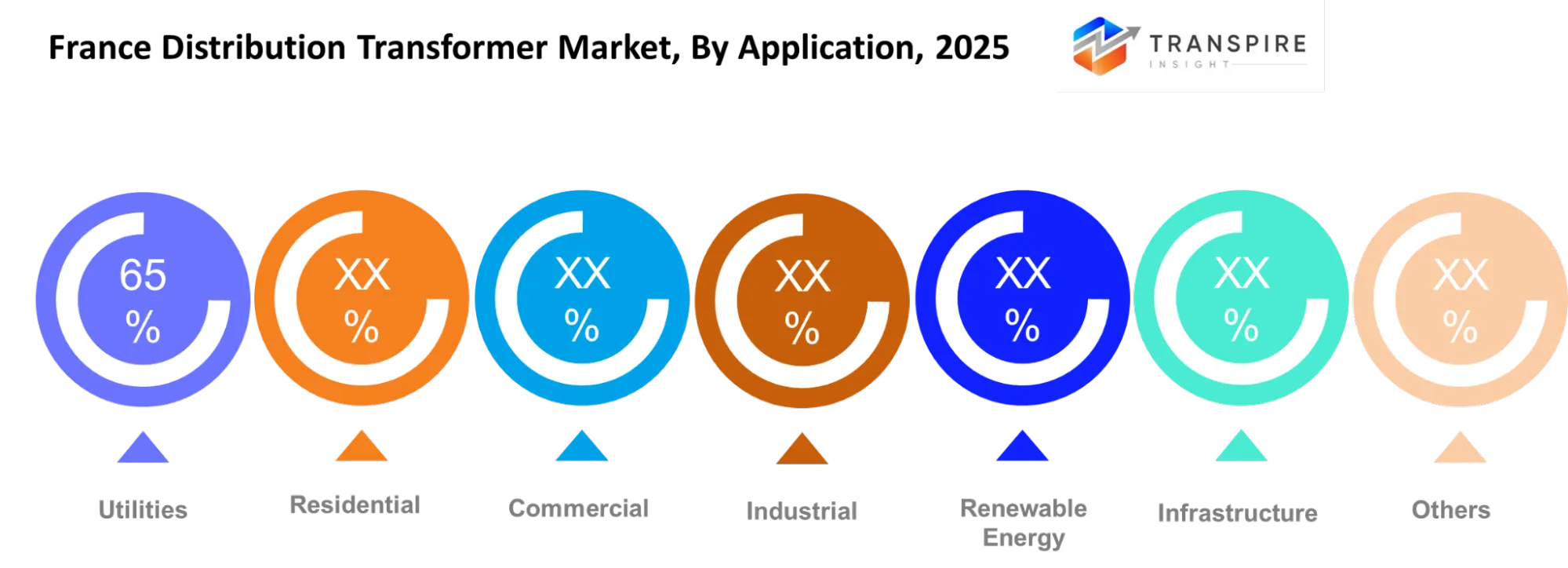
Utilities are basically the main application segment, mostly because of ongoing modernization of the grid, plus the big scale needs for electricity distribution across France. Distribution transformers stay key as they step down voltage from transmission networks into more local usage areas, and this matters a lot in big city zones where residential and commercial density is high. Renewable energy is also a strong driver here, because solar and wind are kind of erratic, so the system wants stable distribution infrastructure to keep things smooth. And you can see more and more infrastructure upgrades across both national and regional grids, which keeps the long term procurement cycles running.
Commercial is also getting more traction, driven by electricity consumption climbing in office buildings, retail hubs, and data oriented companies that expect constant, uninterrupted power. On the industrial side, demand is rising too, and it’s supported by manufacturing automation plus energy heavy production setups across automotive and chemical industries. Renewable energy applications are accelerating in parallel, since solar farms and wind projects need transformers that match the grid, so energy evacuation is efficient and practical. Meanwhile infrastructure plans like transport electrification, and smart city initiatives are likely to bring new demand streams for transformer systems aimed at higher reliability and better tolerance to changing loads, even when the usage pattern is not steady.
To learn more about this report, Download Free Sample Report
By End-User
Utilities kind of dominate the end-user space, mostly because they play a central role in running and maintaining national or regional electricity distribution networks. They keep on investing in transformer upgrades, to boost grid steadiness, cut transmission losses, and also help with renewable integration. You can see big procurement programs going on, plus long-range infrastructure planning, and all that just reinforces their top position. On top of that, strong regulatory pressure related to energy efficiency kind of pushes utilities toward higher-performance transformer adoption.
Industries still make up a sizable end-user base, because there is an ongoing need for dependable power across manufacturing, processing, and other sites. Infrastructure projects are turning into a real growth driver, especially with urban redevelopment and transport electrification efforts. The energy sector is also raising investments in transformer systems, to back renewable integration and decentralized power generation. Commercial buildings, like hospitals, malls, and data centers, are adopting more advanced transformer solutions so operations stay uninterrupted, while other smaller or niche end-users are slowly expanding uptake as electrification is intensifying across smaller facilities.
By Phase
Single phase transformers still see strong use in residential and light commercial distribution systems mostly because they’re cost effective, and they match low load situations pretty well. In practice these setups get put in local grids where the electricity demand stays fairly steady, and you can kinda predict it. You also see real pull from rural electrification programs, since they keep demand consistent over time. Plus utility led distribution upgrades in suburban neighborhoods keep reinforcing this general segment presence, even if the changes look small each year
Three phase transformers, on the other hand, usually take more of the share because they can manage higher loads needed for industrial , commercial and also utility scale uses. They help keep power distribution balanced, and they tend to improve efficiency when you’re dealing with heavier electrical networks. Industrial expansion and renewable energy integration into the grid are major reasons people buy more three phase systems. Through the forecast window, electrification of transport infrastructure plus broader smart grid rollouts should push adoption further, especially of newer three phase transformer technologies that include digital monitoring capabilities.
What are the Key Use Cases Driving the France Distribution Transformer Market?
The main use case in the France Distribution Transformer Market is kind of centered on city electricity distribution for homes and also for commercial grids. Busy places like Paris depend on distribution transformers to keep voltage steady, especially when consumption jumps during heating, cooling and all that digital infrastructure stuff. And it gets even stronger because cities keep getting rebuilt, plus electrification of mobility systems is expanding, so you need dependable power delivery right at the last step.
Other notable use cases show up in industrial power supply for manufacturing areas and in EV charging corridor infrastructure. Automotive plants and transport logistics hubs now lean heavily on high-efficiency transformers, mainly because they have to manage shifting loads from automated production lines , and also from fast-charging stations that don’t really wait.
Then there are emerging applications, like renewable microgrid integration and data center power conditioning. Offshore wind links together with hyperscale cloud facilities are pushing demand for smarter transformers, basically ones that can handle variable input, and still keep uptime uninterrupted.
|
Report Metrics |
Details |
|
Market size value in 2025 |
USD 1.07 Billion |
|
Market size value in 2026 |
USD 1.14 Billion |
|
Revenue forecast in 2033 |
USD 1.78 Billion |
|
Growth rate |
CAGR of6.57% from 2026 to 2033 |
|
Base year |
2025 |
|
Historical data |
2021 - 2024 |
|
Forecast period |
2026 - 2033 |
|
Report coverage |
Revenue forecast, competitive landscape, growth factors, and trends |
|
Regional scope |
France |
|
Key company profiled |
ABB, Siemens, Schneider Electric, Eaton, GE, Hitachi Energy, Mitsubishi Electric, Toshiba, Hyundai Electric, Crompton Greaves, Bharat Heavy Electricals, SPX Transformer, Ormazabal, Wilson Transformer, Kirloskar Electric |
|
Customization scope |
Free report customization (country, regional & segment scope). Avail customized purchase options to meet your exact research needs. |
|
Report Segmentation |
By Type (Oil-filled Transformers, Dry-type Transformers, Pad-mounted Transformers, Others); By Application (Residential, Commercial, Industrial, Utilities, Renewable Energy, Infrastructure, Others); By End-User (Utilities, Industries, Infrastructure Projects, Energy Sector, Commercial Buildings, Others); By Phase (Single Phase, Three Phase, Others) |
Which Regions are Driving the France Distribution Transformer Market Growth?
Île-de-France is basically leading the France Distribution Transformer Market, mainly because there’s such a high population density, lots of commercial infrastructure, and ongoing grid reinforcement programs that never really stop. The area also rides on tight regulatory enforcement under national urban energy efficiency mandates, and that helps speed up the replacement of older distribution assets, you know. Plus there’s this dense network ecosystem—utilities, real estate developers, and transport electrification projects—that keeps long-term demand fairly steady. On top of that, substation modernization projects around Paris, just keep reinforcing why the region stays dominant.
Auvergne-Rhône-Alpes keeps contributing at a steady pace, and it’s supported by a more diversified industrial base and strong manufacturing activity. Here growth feels more like a predictable pattern, not quite the same as the capital region, where urban expansion drives more of the change. In Auvergne-Rhône-Alpes, the engine is stable industrial power consumption. Energy intensive sectors, like chemicals, metallurgy and automotive supply chains, ensure a consistent deployment of transformers. Utility investment cycles are also pretty predictable, so for infrastructure suppliers the region works as a reliable revenue contributor, month after month if we’re being honest.
Southern France, especially Provence-Alpes-Côte d’Azur, is actually the fastest-growing area, largely due to rapid renewable energy expansion. Big solar farms and wind integration projects have recently raised grid interconnection requirements, and that spills into distribution needs. Government-backed energy transition programs have accelerated substation upgrades in coastal and rural zones too, not just the obvious urban areas. So this momentum suggests strong long term opportunities, particularly for investors aiming at renewable-linked distribution infrastructure, basically.
Who are the Key Players in the France Distribution Transformer Market and How Do They Compete?
Competition in the France Distribution Transformer Market looks kind of moderately consolidated, but still, everyone is pushing hard. Big global electrical equipment leaders have solid positions , yet they mostly compete on technology differentiation not just price, you know. What really shapes the market is that utilities want high-efficiency, low-loss, and digitally enabled transformer systems that meet strict EU energy requirements. At the same time, service know-how—predictive maintenance, lifecycle management, and that whole long-term support angle—has turned into one of those major competitive levers, alongside manufacturing scale.
Schneider Electric tends to focus on digital grid integration and smart transformer ecosystems. It differentiates by leaning on software, especially through energy management platforms that feel software-driven. The real edge is kind of the combined hardware + IoT monitoring approach, so utilities can optimize grid performance in real time, even when conditions shift. Growth is supported through partnerships with French utilities, plus involvement in smart city infrastructure programs.
Siemens leans into high-voltage engineering expertise and grid automation solutions, and it places itself well in urban infrastructure modernization efforts. ABB competes using advanced transformer efficiency designs, and it also has strong European utility contracts, notably in grid reinforcement projects. Hitachi Energy brings deep specialization in high-reliability transformers for renewable integration, while GE Vernova leans toward scalable grid modernization solutions, backed by wide global service networks. Overall, these players expand through digital substation collaborations, cross-border utility cooperation, and investments in low-loss transformer technologies that improve operational efficiency over time.
Company List
- ABB
- Siemens
- Schneider Electric
- Eaton
- GE
- Hitachi Energy
- Mitsubishi Electric
- Toshiba
- Hyundai Electric
- Crompton Greaves
- Bharat Heavy Electricals
- SPX Transformer
- Ormazabal
- Wilson Transformer
- Kirloskar Electric
Recent Development News
In July 2025, Schneider Electric confirmed expanded investment in data center power distribution infrastructure following strong growth in its energy management business. The development increased demand for advanced distribution transformer and grid equipment solutions supporting France’s electrification and digital infrastructure expansion.https://www.reuters.com
What Strategic Insights Define the Future of the France Distribution Transformer Market?
The France Distribution Transformer Market is kind of moving, not just slowly but more like structurally, toward a digitally enabled efficiency-first grid setup driven by renewable take up and the electrification of end-use areas. Over the next 5–7 years, growth will be shaped less by pure volume expansion and more by replacement cycles, centered on smart low-loss transformers and even sensor integrated types that help with real time grid balancing.
A less visible problem, or risk, is dependency on critical raw materials like copper and grain oriented electrical steel, it basically puts manufacturers in a spot where supply volatility and pricing pressure can show up. That might end up delaying some deployment steps even if the demand signals look strong.
There’s also an opportunity that is starting to emerge, more like a quieter edge, in AI assisted grid orchestration together with decentralized renewable microgrids. This is especially relevant in southern France, where solar integration is accelerating. Players that start early with digital transformer ecosystems and shift toward service based models should be able to secure long term recurring revenue, not only one time equipment sales.
France Distribution Transformer Market Report Segmentation
By Type
- Oil-filled Transformers
- Dry-type Transformers
- Pad-mounted Transformers
- Others
By Application
- Residential
- Commercial
- Industrial
- Utilities
- Renewable Energy
- Infrastructure
- Others
By End-User
- Utilities
- Industries
- Infrastructure Projects
- Energy Sector
- Commercial Buildings
- Others
By Phase
- Single Phase
- Three Phase
- Others
Frequently Asked Questions
Find quick answers to common questions.
The approximate France Distribution Transformer Market size for the market will be USD 1.78 Billion in 2033.
Key segments for the France Distribution Transformer Market are By Type (Oil-filled Transformers, Dry-type Transformers, Pad-mounted Transformers, Others); By Application (Residential, Commercial, Industrial, Utilities, Renewable Energy, Infrastructure, Others); By End-User (Utilities, Industries, Infrastructure Projects, Energy Sector, Commercial Buildings, Others); By Phase (Single Phase, Three Phase, Others).
Major France Distribution Transformer Market players are ABB, Siemens, Schneider Electric, Eaton, GE, Hitachi Energy, Mitsubishi Electric, Toshiba, Hyundai Electric, Crompton Greaves, Bharat Heavy Electricals, SPX Transformer, Ormazabal, Wilson Transformer, Kirloskar Electric.
The France Distribution Transformer Market size is USD 1.07 Billion in 2025.
The France Distribution Transformer Market CAGR is 6.57% from 2026 to 2033.
- ABB
- Siemens
- Schneider Electric
- Eaton
- GE
- Hitachi Energy
- Mitsubishi Electric
- Toshiba
- Hyundai Electric
- Crompton Greaves
- Bharat Heavy Electricals
- SPX Transformer
- Ormazabal
- Wilson Transformer
- Kirloskar Electric
Recently Published Reports
-
Apr 2026
Active Power Filter Market
Active Power Filter Market Size, Share & Analysis Report By Type (Shunt Active Power Filters, Series Active Power Filter, Hybrid Active Power Filter), By Application (Harmonics Mitigation, Reactive Power Compensation, Voltage Regulation, Power Factor Correction), By Phase (Single Phase, Three Phase), By End-User Industry (Manufacturing, Healthcare, Commercial, Automotive, Oil and Gas, Others), and Geography (North America, Europe, Asia-Pacific, Middle East and Africa, South and Central America), 2021 - 2031
-
Apr 2026
Electrical Transformer Market
Electrical Transformer Market Size, Share & Analysis Report By Core (Closed, Shell, and Berry), By Insulation (Gas, Oil, Solid, Air, and Other), By Phase (Single, and Three), By Rating (100 MVA to 500 MVA, 501 MVA to 800 MVA, and 801 MVA to 1200 MVA), and Geography (North America, Europe, Asia-Pacific, Middle East and Africa, South and Central America), 2021 – 2031
-
Apr 2026
Hydraulic Piston Pumps Market
Hydraulic Piston Pumps Market Size, Share & Analysis Report By Type (Axial Piston Pumps, Radial Piston Pumps), By Operating Pressure (Low Pressure, Medium Pressure, High Pressure), By Application (Construction, Mining, Agriculture, Automotive, Oil & Gas, Industrial Machinery, Others), By End-User (OEMs, Aftermarket), and Geography (North America, Europe, Asia-Pacific, Middle East and Africa, South and Central America), 2021 – 2031
-
Apr 2026
Laboratory Gas Generators Market
Laboratory Gas Generators Market Size, Share & Analysis Report By Product (Nitrogen Gas Generator, Hydrogen Gas Generator, Zero Air Gas Generator, Purge Gas Generator, TOC Gas Generators, Others), By Application (Gas Chromatography, Liquid Chromatography-mass Spectrometry (LC-MS), Gas Analyzers, Others), By End-user (Life Science, Chemical & Petrochemical, Food & Beverage, Others), and Geography (North America, Europe, Asia-Pacific, Middle East and Africa, South and Central America), 2021 – 2031